



Parker Hageman
-
Posts
4,152 -
Joined
-
Last visited
-
Days Won
6
Content Type
Profiles
Minnesota Twins News, Rumors & Analysis
Minnesota Twins Videos
2026 Minnesota Twins Top Prospect Rankings
2022 Minnesota Twins Draft Picks & Signing Bonuses
Minnesota Twins Trade & Free Agent Rumors
Minnesota Twins Fan Guides & Resources
2023 Minnesota Twins Draft Picks & Signing Bonuses
The Minnesota Twins Players Project
2024 Minnesota Twins Draft Picks & Signing Bonuses
2025 Minnesota Twins Draft Picks & Signing Bonuses
2026 Minnesota Twins Draft Picks & Signing Bonuses
Forums
Blogs
Events
Store
Downloads
Gallery
Everything posted by Parker Hageman
-
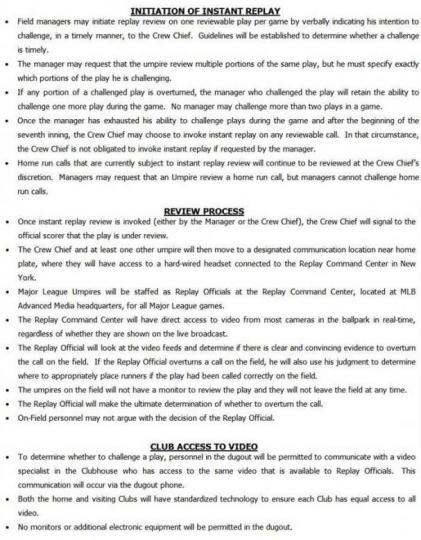
MLB released the rules and regulations for the new instant replay system that is scheduled to be in play in 2014:
-
 This is an interesting little bit from a White Sox blogger in 2012 on how the Twins were one of a few teams that were not shifting on Adam Dunn. http://www.chicagonow.com/white-sox-observer/2012/09/if-the-twins-are-just-going-to-defend-adam-dunn-wrong/ Now a couple of those situations had a runner on first so there may have been the need to keep the shortstop to cover second. It should also be noted that Dunn hit .274 and 17 singles (the highest of any team with 40+ plate appearance) against the Twins that year.
-
BIS has this data (not publicly available) but in James' article, he mentioned that David Ortiz, who is one of the most shifted players, had an average of .245 on grounders/liners when shifted vs .232 when not shifted.
-
First: Stop it. Second: Point taken. Last: Seriously, though, stop it.
-
Wolfson: Twins attend Chone Figgins' workout
Parker Hageman replied to Parker Hageman's topic in Minnesota Twins Talk
I'll take Waring's power over Figgins' (insert whatever redeeming quality he has left) thankyouverymuch. -
Hopefully it just happened because the Twins representative's car broke down in front of the park. Figgins' fall from grace -- hitting every branch on the way down -- is well documented. Once an on-base machine with above-average defensive attributes, he quickly became an expensive proposition for the Mariners that they just cut him and ate the $8 million remaining on his $36 million contract. [Wolfson's tweet]
-
You can view the page at http://twinsdaily.com/content.php/2606-The-Twins-Considering-a-Shift-in-Strategy
-
After three straight 90-loss seasons, the Minnesota Twins need a reinvention. While other teams have harnessed analytics to advance their in-game strategies, the Twins remained analog in a digital world. No longer. Not long ago, the notion of “infield shifting” in the Twins dugout may have been a reference to adjusting one’s protective cup. Now, according to MLB.com’s Rhett Bollinger, the Twins and new bench coach Paul Molitor are to join the rest of baseball when it comes to defensive positioning. [PRBREAK][/PRBREAK] “The game has changed so much; we’re seeing more overshifts and people not afraid to give up space based on tendencies, so it’s something I’m excited about learning about and applying to the way we play defense,” Molitor told Bollinger this week. The Twins, who finished in the middle of the pack when it came to using shifts in 2013, may increase the usage this season. With the help of Jack Goin, the manager of Major League Administration and Baseball Research, and Sean Harlin, the team’s video director, Molitor is looking for an edge. And that edge may include the use of infield shifts. New use of an old trick To be sure, this is certainly not groundbreaking stuff by any means. The idea is to play to a hitter’s tendency by overloading defenders into a zone that a hitter frequents. This methodology, initially known as the Williams Shift, was implemented shortly after World War II by Indians manager Lou Boudreau, who stacked his infielders on the right side when facing Boston’s left-handed hitting Ted Williams. With the advent and dissemination of batted ball data broken down to minutia, forward-thinking teams have been implementing this strategy lately. Last July, Baseball Info Solution’s John Dewan reported that, much like Facebook, everybody and their mothers are doing it. In 2010 the shift was used just 2,465 times. In 2012 it was up to 4,577. Midway through last season, the baseball world was on pace to shift over 7,000 times. At the top of the list for teams who used the shift were teams like Tampa Bay Rays, Boston Red Sox and New York Yankees, generally considered as being the most likely to use statistical analysis. Joining them was the Pittsburgh Pirates, whose defensive efforts were lauded in 2013 and their generous use of the infield shift was at the forefront of items receiving praise. In 2011, Dan Fox -- the team’s Director of Baseball Systems Development and a former Baseball Prospectus contributor -- convinced the organization to sway from baseball convention and embrace playing the odds. The result was a significant swing in defensive efficiency – transforming from Swiss cheese infield to, I don’t know, let’s say a cheese with the ability to make plays up the middle. Issues with the shift? Not all teams see shifting as a net positive. The St. Louis Cardinals, a very well-respected organization, had been a proponent of the shift in 2012. That year manager Mike Matheny said he and front office members reviewed data that showed the advantage of having fielders set up against certain players who have a tendency to hit ground balls or shallow liners in distinct zones 80% of the time or more. However, Matheny’s pitching staff found it was difficult to pitch to that type of alignment in order to make it work. “Last year there were times when we were shifting and I knew [the pitchers] weren’t real comfortable with it,” Matheny told the media last August. “No matter what I believe, we can talk to guys about the importance and show them the statistics, but if they don’t feel comfortable with how the defense is aligned behind them, we’re wasting our time.” Meanwhile, the Oakland A’s newest closer and ground ball aficionado, Jim Johnson, who was a member of the shift-happy Orioles last year, found that the overuse made little sense. “It’s fine on certain guys, but I think sometimes it gets a little carried away,” Johnson remarked last season. “Trying to do things just to do things, you know. If you’re shifting on a number 8 hitter, just because [the numbers] say he grounds out to the right side, and you’ve got a guy throwing 99mph that he’s probably not going to turn around, then why are you shifting?” Pitchers are not the only ones who believe that the shift has shortcomings that may outweigh the positives. In 2012 Bill James penned a piece that suggested there are too many unstudied, undocumented occurrences that happen because of the shift that make it problematic and possibly detrimental. Those include: Lost opportunities during foul pops on the right side of the infield because a third baseman is moved, Missed double play opportunities because fielders are out of position, And missed relays because fielders are out of position, among others. Teams like Tampa and Pittsburgh, who have taken measures to implement the shift strategy system-wide so that fielders are used to playing in a shift, may be equipped to handle those scenarios but a team like the Twins (who may or may not begin to incorporate more shifts in 2014) could find those moments causing more headaches than relieving them. This year, James also prophesized that the days of the shift are numbered and that once ego-driven sluggers begin to recognize that they could bat .700 by simply laying down a bunt (or a bunt double like Robinson Cano did), teams will no longer find giving up hits carte blache to be a worthwhile strategy. Is there a tangible advantage? Then there is the question of exactly how much does the shift improve a team’s ability to convert grounders in outs. As it stands, Baseball Info Solutions believes that teams like the 2013 Pirates were given a 2-win advantage because of their use of the shift. Of course, what James argues is that BIS’s system does not account for those mishaps and missed opportunities. At the end of the day, the top shift addicts were marginally better than teams like the Twins and Cardinals who it used more recreationally when it came to turning ground balls into outs. The 2013 data from ESPN/trumedia shows that the average major league team recorded outs on 77.3% of ground balls. While teams like the Pirates and Orioles scored very high by the Out-of-Zone metric (plays made by fielders out of the typical zone of that position which - surprise - is what happens when you shift a lot) and made their Ultimate Zone Ratings look good, the benefits were negligible compared to the Twins and Cardinals who did not use the shift. The Twins were very strong on the second base/first base side (represented by the Right/Far Right from the batter’s perspective) and based on Mauer’s athletic abilities, there stands a chance that first base should be improved defensively in 2014. Where the Twins lagged greatly last year was the defense up-the-middle: For example, while the shifty Pirates recorded outs on an MLB-best 64.9% of grounders hit in the middle of the diamond, the Twins struggled to defend that turf (which has been a long-standing problem). Could infield shifting improve the out conversion rate for the Twins? Playing the tendency and shifting does not always translate into a complete overload of the right or left side of the diamond either. The Twins recently hired Sam Perlozzo to handle the minor league infielders, the role vacated by Paul Molitor when he was promoted, and Perlozzo’s former job in Philadelphia was positioning the infielders. Although the Phillies did not use the overload shift, Perlozzo told reporters in 2012 that he will use the data to position his fielders, but it may not mean the shortstop is swinging all the way around the horn. While Molitor begins to play the odds at the major league level, Perlozzo will likely try to establish similar techniques at the lower levels. Will it work? If Baseball Info Solutions’ assessment of the effects of the infield shifts proves accurate, the Twins may be able to claim wins at the margins. With three 90-loss seasons, trying anything different is a good thing.
-
-
Perhaps in the efforts of simply doing due diligence, FOX Sports' Ken Rosenthal reports that the Twins were one of three teams to recently request free agent Ervin Santana's medical records. Along with the Orioles and Yankees, the Twins reportedly were interested in the 31-year-old's records. Rosenthal quickly pointed out that Minnesota seemed like an unlikely landing spot considering there were three starters out of options (Vance Worley, Scott Diamond and Samuel Deduno) and one vacancy remaining in the rotation. In general, Santana's injury history has been clean. In 2009 he battled some elbow/UCL issues that delayed his season into the month of May, but since then he has not missed any significant time. UPDATE: As Darren Wolfson reported this evening, the Twins had requested Santana's medical records early in free agency and not recently, as Rosenthal tweeted earlier.
-
Article: The Advantageous Oswaldo Arcia
Parker Hageman replied to Parker Hageman's topic in Twins Daily Front Page News
The difference is that Dozier made contact (17.8% swinging strike rate when in pitcher's counts) and Arcia did not (34.8%). -
Article: The Advantageous Oswaldo Arcia
Parker Hageman replied to Parker Hageman's topic in Twins Daily Front Page News
ESPN/trumedia. The difference is that B-R counts 3-2 counts as "batter ahead" -- which is 63 additional plate appearances in which he hit .186 thereby lowing his B-R splits total to .365. At ESPN/trumedia the 3-2 count is considered "even" which, for all intents and purposes, is an even count. Dozier had a very similar problem of not being able to hit secondary stuff well. -
Article: The Advantageous Oswaldo Arcia
Parker Hageman posted a topic in Twins Daily Front Page News
You can view the page at http://twinsdaily.com/content.php/2599-The-Advantageous-Oswaldo-Arcia -
Oswaldo Arcia’s rookie season was filled with the expected peaks and valleys that most normal human rookies encounter during their first year of facing the world’s best competition. Offensively, he displayed flashes of unbridled power by depositing home runs to all fields but alternated those moments with stretches of being lost. Over three games in early July, Arcia woofed 11 times in 18 at-bats. In that small sampling, he swung the bat 26 times but managed to put the ball in play just three times (two infield flies and a medium fly to left) while missing 16 times and fouling off seven more. [PRBREAK][/PRBREAK] Sent back to Rochester shortly thereafter – perhaps just for his own sanity’s sake as he seemed ready to snap – Arcia returned to Minnesota in August for the duration of the season and continued to hit the ball hard (when he made contact). Like many overzealous noobies, Arcia struggled to maintain the respectable plate discipline he had worked hard to cultivate while in the minors in 2012. In the bigs, he reverted back to his previous ways and swung harder and more frequently than your parents at the neighbor’s key party in the late 1980’s. There are pros and cons to this approach. First, Arcia thrived in hitter’s counts when he could anticipate the heater. Perhaps because he was an unproven player, the Twins outfielder saw a higher than average number of fastballs when he had the drop on pitchers (70% vs. 62% league average) and he was able to capitalize. Of his 14 home runs, seven came on fastballs when he was ahead in the count. Beyond that, just based on batting average, he was baseball’s best when ahead in the count – his .509 batting average led the game (minimum 50 plate appearances). Skeptics can (rightly) point out that this is a small universe to make any sweeping proclamations; however the takeaway is that in situations Arcia needed to take advantage, he did. The reason that Arcia’s plate discipline numbers were so skewed towards the pitcher’s favor is because, far too often, the pitcher was in the catbird seat. Under those circumstances, he struggled mightily and hit just .160 as pitchers put away the fastball (just 44% of the time) and opened up their repertoire to twirl different offerings past his bat. Visually, we can see how much better Arcia’s swing zone is when he is ahead in the count compared to the vast swath of real estate he tries to cover once he falls behind. It turns into an “Oh my god, here’s strike three coming: Kill it! Kill it!” mentality. (via ESPN Stats & Info) There is no question that Arcia’s swing is fundamentally strong. With strong engagement with his lower half (controlled stride, solid hip involvement), his ability to keep his hands in to his body allows him to drive the ball well to all fields, as seen in the example below: Your browser does not support iframes. As Arcia develops his pitch recognition and comprehension skills, the presumption is he will be behind in the count less often as pitchers become more reluctant to throw him anything cherry. If he is able to ignore those out-of-zone pitches, this should allow for him to jump on more of the suitable pitches and deploy his powerful swing.
-
-
Article: More Dingers for Dozier?
Parker Hageman replied to Parker Hageman's topic in Twins Daily Front Page News
Oh, and the 53% for the ESPN trumedia does not include cutters/sinkers whereas the BIS/Fangraphs fastball count does. -
Article: More Dingers for Dozier?
Parker Hageman replied to Parker Hageman's topic in Twins Daily Front Page News
Subtle difference but Fangraphs uses BIS video scouts for their data source while ESPN tru media, I believe, uses a combination of Inside Edge and Pitch F/X. -
Article: More Dingers for Dozier?
Parker Hageman replied to Parker Hageman's topic in Twins Daily Front Page News
Plouffe and Dozier are very different types of hitters. Consider this, when being pitched down-and-in, Plouffe thrived, batting .333 on those pitches (13th best in MLB). Meanwhile, Dozier was the absolute worst at .045 on pitches down-and-in. -
You can view the page at http://www.twinsdaily.com/content.php/2593-More-Dingers-for-Dozier
-
Let’s just start by saying that in his second tour of duty in the major league, Brian Dozier fared better than in his first stint. After a dismal 2012 season, he managed to improve his walk rate and power numbers to finish the year as one of the team’s top contributions. Faint praise, however, considering the lineup’s surprising lack of offense overall. That said, Dozier’s in-season development was impressive.[PRBREAK][/PRBREAK] After a working with hitting coach Tom Brunansky, the infielder was able to make a timing adjustment that paid dividends in the season’s second-half. The adjustment allowed Dozier to combine the changes he made with his hips in spring training with proper timing to drive the ball on the inner-half of the plate. The results were 18 home runs -- the highest total by a Twins’ second baseman in team history. Will this equate to potential big home run numbers in 2014, too? Eh, not so fast. One thing that needs to be taken into consideration is where his home run pitches were located. According to ESPNtrumedia’s database, 11 of his 18 home runs were located in the upper-third of the hitting zone: Brian Dozier's 2013 home runs, by location This represents a very high percentage of his home runs and something that hitters do not typically match, year-in and year-out. In 2013, only Arizona’s Paul Goldschmidt (17) hit more home runs on pitches in the upper-third of the strike zone than Dozier. For the past several years this leader board has had plenty of turnover. In 2012 another Diamondback, Aaron Hill, led baseball with 13 home runs on pitches in the upper-third. The year before that it was Josh Willingham (16) in Oakland and, before that, Albert Pujols (20). Why this appears to be an unrepeatable skill may be influenced by the opposition’s change in approach. If you know that Albert Pujols is going to launch one on a pitch up in the zone, you would avoid that space like the plague. On the other hand, it may simply be luck. Despite major league pitchers’ best efforts, they still miss their spots from time to time and the ability to capitalize on those mistakes by depositing them into the seats may take a stroke of good fortune for the hitter. Beyond that, Dozier faced a very high percentage of fastballs. This may be because he was a non-threatening factor in 2012 but has since made it clear he can handle the heat. Last year, he saw fastballs 57% of the time whereas the league average was 53%. On fastballs Dozier hit a healthy .273/.353/.517 but hit just .196/.239/.249 on non-fastballs. If you were concocting a game plan to combat the Twins’ lineup, the directive would likely be to throw Dozier fewer fastballs in 2014 – at the very least, fewer fastballs up in the zone. This is not to cause despair for Dozier’s 2014 season. After all, his plate discipline was a significant step forward as he reduced his chase rate considerably, from 32% in ’12 to 26%; he also stopped swinging at everything as his swing rate dropped from 49% in ‘12 to 40% in 2013. Those indicators bode well for his comprehension of the zone and his development as a hitter.
-
-
Oswaldo Arcia having roster issues in Venezuela
Parker Hageman replied to Parker Hageman's topic in Minnesota Twins Talk
No, I don't believe there are any lies involved here. I think Steil was clear when he said the Twins do not have any involvement with a player's decision in winter ball. There could have been some influence from another member of the staff (Ryan, Radcliff, Antony, et al) or someone in the marketing department (if it was Twins Fest related) asking him to return to the club. -
Oswaldo Arcia having roster issues in Venezuela
Parker Hageman replied to Parker Hageman's topic in Minnesota Twins Talk
Good points -- as of right now Arcia not scheduled to be on either the Winter Caravan or TwinsFest but that may have changed. Again, the players at this point are in control of whether they want to play. -
According to a tweet from Wilmer Reina, a sports journalist out of Venezuela, says that the Twins and the Venezuelan league Aguilas del Zulia are at odds over the former's addition of Oswaldo Arcia to their roster. Arcia had spent the year with the Aragua Tigers, hitting .262 with 8 home runs. However, once they were eliminated from the Venezuelan Professional Baseball League playoffs, teams are able to draft reinforcements during their round-robin playoffs. The Aguilas selected Arcia with the second pick. For whatever the reason, the Twins organization has an issue with Arcia continuing his winter league play or playing particularly for Aguilas. With the Venezuelan playoffs starting tonight, Arcia will not be on the field with the Aguilas until this is resolved. UPDATE: Brad Steil, the Twins Director of Minor League Operations, said in an email that the Twins have no involvement in Arcia's decision at this point. So any decision to play or not to play the remainder of the winter is coming from Arcia's camp. UPDATE #2: Arcia informs journalist Victor Gomez that he will report to the Augilas next week -- he wanted to spend time with his family. In the report, Arcia maintains that it was the Twins who did not want him to play in the round robin. Interesting and odd.
-
The Mauer behind-the-back play was a very good one and was definitely under consideration (along with his full out diving catch of a pop foul at Target Field) but, ultimately, I felt like the leaping catch and tag was a better representation of his athletic abilities. I did not want this list to become Look How Amazing Joe Mauer Is. In the end, you could certainly swap that play (and the diving catch) with the #6 play.
