



Seth Stohs
-
Posts
25,912 -
Joined
-
Last visited
-
Days Won
109
Content Type
Profiles
News
Minnesota Twins Videos
2026 Minnesota Twins Top Prospects Ranking
2022 Minnesota Twins Draft Picks
Minnesota Twins Free Agent & Trade Rumors, Notes, & Tidbits
Guides & Resources
2023 Minnesota Twins Draft Picks
The Minnesota Twins Players Project
2024 Minnesota Twins Draft Picks
2025 Minnesota Twins Draft Pick Tracker
2026 Minnesota Twins Draft Tracker: Picks & Bonuses
Forums
Blogs
Events
Store
Downloads
Gallery
Everything posted by Seth Stohs
-
When was he healthy?
-
So they can use up service time while on the DL for a year or more?
-

Part 2: Seth's Midseason Top 40 Prospects (21-30)
Seth Stohs replied to Seth Stohs's topic in Twins Daily Front Page News
Benninghoff has a chance, for sure. Quezada was hurt this spring with a shoulder impingement. I haven't heard anything for awhile, but very hard thrower. Very long and lanky. Needs control. -
Part 2: Seth's Midseason Top 40 Prospects (21-30)
Seth Stohs replied to Seth Stohs's topic in Twins Daily Front Page News
I would say that a 24 year old "has some time left to make it." It seems like he's been around longer because he got to AA so far... Injuries are always part of it though. I'll never understand the thinking that a player needs to be in the big leagues before 25 or they won't be good or something. They may not be a Hall of Famer, but if you get a player's ages 25-31, that's pretty good...- 22 replies
-
- 1
-

-
- luis arraez
- jake reed
- (and 3 more)
-
Part 2: Seth's Midseason Top 40 Prospects (21-30)
Seth Stohs replied to Seth Stohs's topic in Twins Daily Front Page News
And Kirilloff too, who would be in Cedar Rapids if not for the injury.- 22 replies
-
- 3
-
-
- luis arraez
- jake reed
- (and 3 more)
-
Mike Berardino spent several days in Cedar Rapids this week. He was able to watch a few Kernels games and talk to some of the players. One story was on the nutrition throughout the Twins system, but specifically as it is seen in Cedar Rapids. http://www.twincities.com/2017/05/26/nutrition-being-emphasized-throughout-minnesota-twins-system/ Manager Tommy Watkins said it was a little different than during the days he played... Note... in the press dining areas in both Ft. Myers and Target Field, there is no more pop either... the options are quite healthy... which is good.
-
Part 2: Seth's Midseason Top 40 Prospects (21-30)
Seth Stohs replied to Seth Stohs's topic in Twins Daily Front Page News
Stats in those lowest levels, and in the small sample of the GCL season are pretty meaningless. It's about the potential and upside and both have big upsides. They could both move up or down quite a bit this year. I wouldn't worry much about Rortvedt yet either.- 22 replies
-
- 2
-
-
- luis arraez
- jake reed
- (and 3 more)
-
Part 2: Seth's Midseason Top 40 Prospects (21-30)
Seth Stohs replied to Seth Stohs's topic in Twins Daily Front Page News
I don't know that Vielma being in AAA means that Escobar would be gone. At least that's not directly true. Vielma isn't guaranteed a big league job next year at all. He's in AAA. Hopefully things go well, but there's no reason he can't be in AAA again next season. Obviously how he performs between now and Labor Day will play a role in that decision.- 22 replies
-
- 3
-
-
- luis arraez
- jake reed
- (and 3 more)
-
Prospect rankings are meant to be fun, but they're also meant to recognize players that work hard throughout the season. I choose to update my personal Top 40 Twins prospect rankings before the draft, before an influx of 25 or so new prospects. Obviously the draft, particularly the #1 overall pick but also several others in the top rounds, will affect any organization’s rankings. When the season is complete I do a quick preliminary Top 50 rankings before diving deep into the Minnesota Twins Prospect Handbook. It is in that publication where you can find my “official” preseason rankings, and a lot more on all Twins minor leaguers. Image courtesy of Seth Stohs, Twins Daily (L to R: John Curtiss, Aaron Whitefield, Engelb Vielma, Akil Baddoo, Lewis Thorpe) Prospect rankings are meant to be fun, but they're also meant to recognize players that work hard throughout the season. I choose to update my personal Top 40 Twins prospect rankings before the draft, before an influx of 25 or so new prospects. Obviously the draft, particularly the #1 overall pick but also several others in the top rounds, will affect any organization’s rankings. When the season is complete I do a quick preliminary Top 50 rankings before diving deep into the Minnesota Twins Prospect Handbook. It is in that publication where you can find my “official” preseason rankings, and a lot more on all Twins minor leaguers. After looking at my Twins Prospects 31-40 yesterday, let’s take a quick look at my choices for Twins Prospect 21-40 today. I welcome your questions and any discussion on the players. (I have included my preseason rankings. Note that I do a Top 30 list in the Prospect Handbook, but I keep and update occasionally a ranking of all of the Twins prospects. However, for this, I will put NR if they were outside my Top 50.) 30. Engelb Vielma, SS, 22 The slick-fielder Vielma signed with the Twins in September of 2011. Last fall, he was added to the Twins 40-man roster and went to his second MLB spring training. When he was sent to minor league camp, Paul Molitor noted that he could do some things with his glove that few can. His defense, his arm, his range and his leadership are all impressive. He began the season splitting time between second base and shortstop, alternating with Nick Gordon. In the last two weeks, he was promoted to AAA where he has played shortstop exclusively (and so has Gordon). Vielma puts together quality at bats, and he will hit for a decent average, but they will mostly be singles. Nothing wrong with that, but he won’t be a guy who puts up big OBP or SLG numbers because pitchers will throw him strikes. But he has value. That kind of defense, any team will be happy with. He’s probably more of a utility guy who you don’t mind starting when needed. Preseason Ranking: 27 Pre-2016 Ranking: 15 29. John Curtiss, RH RP, 24 Curtiss was the Twins sixth-round pick in 2014 out of the University of Texas. While in college, he had Tommy John surgery and came back as a closer. The Twins let him start for a year, but he struggled to stay healthy, so he was moved to the bullpen to start the 2016 season, and he took off. His prospect status really took off last year in the Arizona Fall League when he was pitching well and hitting 97. Last year, he was clocked at 98 mph. And, he has a starter’s mix of pitches available to him. He hasn’t been one of the big-named reliever prospects in the organization, but he has a chance to help the big league club, and maybe in 2017. He now has nine saves this year for Chattanooga. He has thrown 17.2 innings and has not yet given up a run. He has given up ten hits and ten walks, but he’s also struck out 25 batters. Preseason Ranking: 35 28. Jose Miranda, 3B, 18 Miranda was the Twins third draft pick in 2016. He was the first of two compensatory picks between the second and third round. The 73rd overall pick was drafted as a shortstop out of the Leadership Christian Academy in Puerto Rico. He played some at shortstop last year, but this spring, he was already moved to third base. A lot of that may have to do with the presence of Wander Javier. Miranda is 6-2 and approaching 200 pounds. He’s a good athlete and should adapt to the hot corner well. He also should hit well. In 55 games in the GCL last year, he hit .227/.308/.292 (.600) with seven doubles, a triple and a home run. Obviously he’s got a long way to go before getting to the big leagues, but he’s got the tools and the frame to find him very interesting. Preseason Ranking: 18 . 27. Akil Baddoo, 18 Baddoo was the fourth Twins draft pick in 2016, selected one pick after they took Miranda. The Georgia prep was drafted as a tremendous athlete who had become a very good baseball player. While he hit just .178/.299/.271 (.570) with two doubles and two triples in 38 games, he will advance to Elizabethton to play this season (most likely). He came to spring training this year having gained 15 pounds and it was likely all muscle. Baddoo has all the tools. He should hit. He has major power potential. He’s got great speed and can play really good defense, including center field. And, he’s got the arm to play right field. Preseason Ranking: 20 26. Lewis Thorpe, LHP, 21 In July of 2012, the Twins signed Thorpe out of Australia for $500,000. He burst onto the scene the following year when he went 4-1 with a 2.05 ERA in 12 games. In 44 innings, he walked six and struck out 64. The following season, he moved up to Cedar Rapids in mid-May, and as an 18-year-old, he struck out 80 in 71.2 innings. Unfortunately, in his final start of the season, he hurt his elbow. The result was Tommy John surgery which cost him two seasons. He returned to the mound last week and made his second Miracle start on Thursday night. His fastball is still in the 91-93 range, and his secondary pitches are starting to work already. Thorpe will very likely move up this list quickly again. Preseason Ranking: 26 Pre-2016 Ranking: 13 Pre-2015 Ranking: 12 25. Lachlan Wells, LHP, 20 When Thorpe returned to the Miracle, he joined fellow Australian Lachlan Wells in the team’s starting rotation. Wells signed with the Twins in August of 2014 for $300,000. He’s actually followed the path of Thorpe fairly closely. He had a strong debut in the GCL in 2015 when he went 5-2 with a 2.09 ERA. In 47.1 innings, he walked 11 and struck out 49. Last year, he jumped up to Cedar Rapids midseason and made 12 starts for the Kernels. He went 6-4 with a 1.77 ERA. In 71.1 innings, he walked just 16 and struck out 63. He pitched for Australia in this spring’s WBC. He began this season with the Miracle and right now he is 2-6 with a 3.72 ERA. In 46 innings, he has walked ten and struck out 36 batters. Not great numbers, but consider he is three years younger than the average player in the Florida State League. Wells, like Thorpe, has a high baseball and high pitching IQ. He knows how to pitch. He’ll make adjustments. Preseason Rankings: 23 24. Ben Rortvedt, C, 19 Rortvedt was the Twins second round pick in 2016 out of Verona Area High School in Wisconsin. He went to the GCL and hit .203 (.531) in 20 games before moving up to Elizabethton where he hit .250 (.598) in 13 games. I admit that I was a little surprised that he started in Cedar Rapids right away this season, and he has struggled with the bat. However, he is one of the youngest players in the Midwest League and he is tremendous defensively. While he’s hitting just under .150 and his OPS is just shy of .400, he is providing value to his pitchers and to the coaching staff. Obviously at some point he will need to hit, but I have little doubt that will happen at some point. Preseason Ranking: 16 23. Aaron Whitefield, OF, 20 Aaron Whitefield signed with the Twins in May of 2015 after playing fast-pitch softball nearly his entire life. He was the lone GCL Twins player last year to make the league’s post-season All-Star team. He was a top player for the two-time defending Claxton Shield champion Brisbane Bandits in the ABL, and he represented Australia in the WBC this spring. He jumped up to Cedar Rapids to start the season and has played pretty well. In 42 games, he has hit .285/.327/.472 (.799) with six doubles, three triples and five home runs. He’s also stolen seven bases and become a reliable center fielder with great range. Then remember that he has only played baseball for about four years. He’s also 6-4 and 200 pounds. He’s got all of the tools. He just needs to play, and play a lot. He may be a diamond in the rough, but he’s certainly intriguing. Preseason Ranking: 48 22. Jake Reed, RH RP, 24 Reed was the Twins fifth-round pick in 2014 out of the University of Oregon. Upon being drafted, he gave up just one earned run in 31 innings between Elizabethton and Cedar Rapids before giving up one run in 12.2 innings in the Arizona Fall League. In 2015, he struggled early in Chattanooga. He went down to Ft. Myers and was good before returning to the Lookouts late. He ended strong and again pitched well in the AFL. Last year, he pitched well in Chattanooga and ended strong in Rochester .This spring, he went to his second big league spring training and clearly impressed the coaching staff. Unfortunately, in the final exhibition game (Rochester vs Twins), he pulled a muscle in his side. He has been out since. He has pitched in recent days in extended spring training and even hit 98. He should return to the Red Wings soon. Preseason Ranking: 19 Pre-2016 Ranking: 18 Pre-2015 Ranking: 18 21. Luis Arraez, 2B, 20 The Twins signed Arraez in November of 2013 out of Venezuela. He broke out last year in Cedar Rapids. As a 19-year-old, he led the Midwest League in batting average in 2016. He went back home and played in the Venezuelan Winter League where he hit .335 against competition much older than him on average. He was starting to be talked about more and more as a bigger prospect. He began this season by going 5-13 (.385) in his first three games. However, in his final at-bat of that third game, he lunged toward first base and landed awkwardly, falling over the bag. He was carted off the field. Two days later, we learned that he had a torn ACL and would miss the entire remainder of the 2017 season. Preseason Ranking: 17 So there you have it, my choices for Twins prospects 21-30. If you missed my choices for Twins prospects 31-40, click here. The top 20 prospects will come over four more installments of five prospects a piece until we reach #1. Please feel free to leave comments and discuss the prospects mentioned and the order they are in. View full article
-
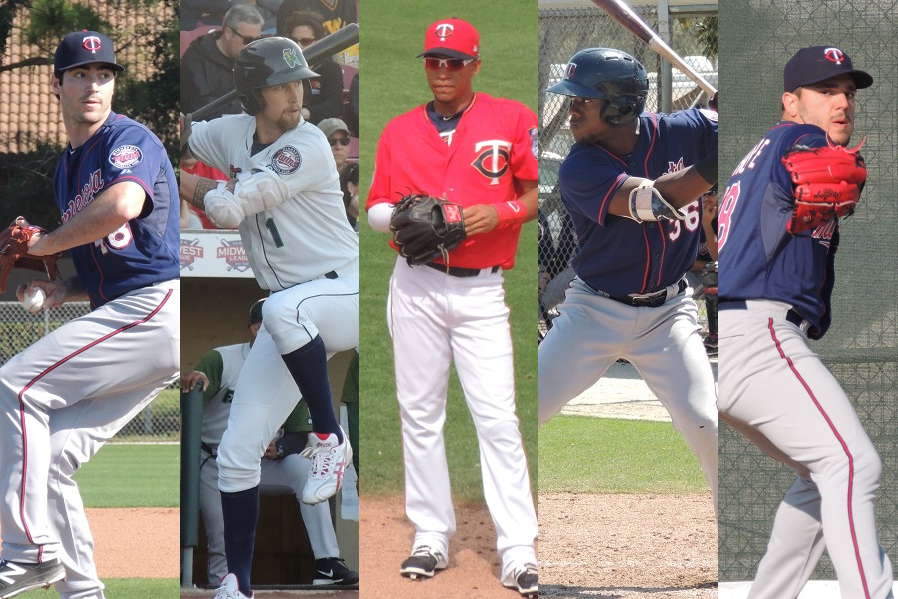 After looking at my Twins Prospects 31-40 yesterday, let’s take a quick look at my choices for Twins Prospect 21-40 today. I welcome your questions and any discussion on the players. (I have included my preseason rankings. Note that I do a Top 30 list in the Prospect Handbook, but I keep and update occasionally a ranking of all of the Twins prospects. However, for this, I will put NR if they were outside my Top 50.) 30. Engelb Vielma, SS, 22 The slick-fielder Vielma signed with the Twins in September of 2011. Last fall, he was added to the Twins 40-man roster and went to his second MLB spring training. When he was sent to minor league camp, Paul Molitor noted that he could do some things with his glove that few can. His defense, his arm, his range and his leadership are all impressive. He began the season splitting time between second base and shortstop, alternating with Nick Gordon. In the last two weeks, he was promoted to AAA where he has played shortstop exclusively (and so has Gordon). Vielma puts together quality at bats, and he will hit for a decent average, but they will mostly be singles. Nothing wrong with that, but he won’t be a guy who puts up big OBP or SLG numbers because pitchers will throw him strikes. But he has value. That kind of defense, any team will be happy with. He’s probably more of a utility guy who you don’t mind starting when needed. Preseason Ranking: 27 Pre-2016 Ranking: 15 29. John Curtiss, RH RP, 24 Curtiss was the Twins sixth-round pick in 2014 out of the University of Texas. While in college, he had Tommy John surgery and came back as a closer. The Twins let him start for a year, but he struggled to stay healthy, so he was moved to the bullpen to start the 2016 season, and he took off. His prospect status really took off last year in the Arizona Fall League when he was pitching well and hitting 97. Last year, he was clocked at 98 mph. And, he has a starter’s mix of pitches available to him. He hasn’t been one of the big-named reliever prospects in the organization, but he has a chance to help the big league club, and maybe in 2017. He now has nine saves this year for Chattanooga. He has thrown 17.2 innings and has not yet given up a run. He has given up ten hits and ten walks, but he’s also struck out 25 batters. Preseason Ranking: 35 28. Jose Miranda, 3B, 18 Miranda was the Twins third draft pick in 2016. He was the first of two compensatory picks between the second and third round. The 73rd overall pick was drafted as a shortstop out of the Leadership Christian Academy in Puerto Rico. He played some at shortstop last year, but this spring, he was already moved to third base. A lot of that may have to do with the presence of Wander Javier. Miranda is 6-2 and approaching 200 pounds. He’s a good athlete and should adapt to the hot corner well. He also should hit well. In 55 games in the GCL last year, he hit .227/.308/.292 (.600) with seven doubles, a triple and a home run. Obviously he’s got a long way to go before getting to the big leagues, but he’s got the tools and the frame to find him very interesting. Preseason Ranking: 18 . 27. Akil Baddoo, 18 Baddoo was the fourth Twins draft pick in 2016, selected one pick after they took Miranda. The Georgia prep was drafted as a tremendous athlete who had become a very good baseball player. While he hit just .178/.299/.271 (.570) with two doubles and two triples in 38 games, he will advance to Elizabethton to play this season (most likely). He came to spring training this year having gained 15 pounds and it was likely all muscle. Baddoo has all the tools. He should hit. He has major power potential. He’s got great speed and can play really good defense, including center field. And, he’s got the arm to play right field. Preseason Ranking: 20 26. Lewis Thorpe, LHP, 21 In July of 2012, the Twins signed Thorpe out of Australia for $500,000. He burst onto the scene the following year when he went 4-1 with a 2.05 ERA in 12 games. In 44 innings, he walked six and struck out 64. The following season, he moved up to Cedar Rapids in mid-May, and as an 18-year-old, he struck out 80 in 71.2 innings. Unfortunately, in his final start of the season, he hurt his elbow. The result was Tommy John surgery which cost him two seasons. He returned to the mound last week and made his second Miracle start on Thursday night. His fastball is still in the 91-93 range, and his secondary pitches are starting to work already. Thorpe will very likely move up this list quickly again. Preseason Ranking: 26 Pre-2016 Ranking: 13 Pre-2015 Ranking: 12 25. Lachlan Wells, LHP, 20 When Thorpe returned to the Miracle, he joined fellow Australian Lachlan Wells in the team’s starting rotation. Wells signed with the Twins in August of 2014 for $300,000. He’s actually followed the path of Thorpe fairly closely. He had a strong debut in the GCL in 2015 when he went 5-2 with a 2.09 ERA. In 47.1 innings, he walked 11 and struck out 49. Last year, he jumped up to Cedar Rapids midseason and made 12 starts for the Kernels. He went 6-4 with a 1.77 ERA. In 71.1 innings, he walked just 16 and struck out 63. He pitched for Australia in this spring’s WBC. He began this season with the Miracle and right now he is 2-6 with a 3.72 ERA. In 46 innings, he has walked ten and struck out 36 batters. Not great numbers, but consider he is three years younger than the average player in the Florida State League. Wells, like Thorpe, has a high baseball and high pitching IQ. He knows how to pitch. He’ll make adjustments. Preseason Rankings: 23 24. Ben Rortvedt, C, 19 Rortvedt was the Twins second round pick in 2016 out of Verona Area High School in Wisconsin. He went to the GCL and hit .203 (.531) in 20 games before moving up to Elizabethton where he hit .250 (.598) in 13 games. I admit that I was a little surprised that he started in Cedar Rapids right away this season, and he has struggled with the bat. However, he is one of the youngest players in the Midwest League and he is tremendous defensively. While he’s hitting just under .150 and his OPS is just shy of .400, he is providing value to his pitchers and to the coaching staff. Obviously at some point he will need to hit, but I have little doubt that will happen at some point. Preseason Ranking: 16 23. Aaron Whitefield, OF, 20 Aaron Whitefield signed with the Twins in May of 2015 after playing fast-pitch softball nearly his entire life. He was the lone GCL Twins player last year to make the league’s post-season All-Star team. He was a top player for the two-time defending Claxton Shield champion Brisbane Bandits in the ABL, and he represented Australia in the WBC this spring. He jumped up to Cedar Rapids to start the season and has played pretty well. In 42 games, he has hit .285/.327/.472 (.799) with six doubles, three triples and five home runs. He’s also stolen seven bases and become a reliable center fielder with great range. Then remember that he has only played baseball for about four years. He’s also 6-4 and 200 pounds. He’s got all of the tools. He just needs to play, and play a lot. He may be a diamond in the rough, but he’s certainly intriguing. Preseason Ranking: 48 22. Jake Reed, RH RP, 24 Reed was the Twins fifth-round pick in 2014 out of the University of Oregon. Upon being drafted, he gave up just one earned run in 31 innings between Elizabethton and Cedar Rapids before giving up one run in 12.2 innings in the Arizona Fall League. In 2015, he struggled early in Chattanooga. He went down to Ft. Myers and was good before returning to the Lookouts late. He ended strong and again pitched well in the AFL. Last year, he pitched well in Chattanooga and ended strong in Rochester .This spring, he went to his second big league spring training and clearly impressed the coaching staff. Unfortunately, in the final exhibition game (Rochester vs Twins), he pulled a muscle in his side. He has been out since. He has pitched in recent days in extended spring training and even hit 98. He should return to the Red Wings soon. Preseason Ranking: 19 Pre-2016 Ranking: 18 Pre-2015 Ranking: 18 21. Luis Arraez, 2B, 20 The Twins signed Arraez in November of 2013 out of Venezuela. He broke out last year in Cedar Rapids. As a 19-year-old, he led the Midwest League in batting average in 2016. He went back home and played in the Venezuelan Winter League where he hit .335 against competition much older than him on average. He was starting to be talked about more and more as a bigger prospect. He began this season by going 5-13 (.385) in his first three games. However, in his final at-bat of that third game, he lunged toward first base and landed awkwardly, falling over the bag. He was carted off the field. Two days later, we learned that he had a torn ACL and would miss the entire remainder of the 2017 season. Preseason Ranking: 17 So there you have it, my choices for Twins prospects 21-30. If you missed my choices for Twins prospects 31-40, click here. The top 20 prospects will come over four more installments of five prospects a piece until we reach #1. Please feel free to leave comments and discuss the prospects mentioned and the order they are in.
 -
I like it, and it sounds like it's something he'll be doing every couple of weeks. That's great!!
-
That's not really how prospect lists go though... they have little to do with MLB ready and about projecting potential ceiling. Hildenberger is pretty much ready too.
-
Here are a few: Cody Stashak is a guy I like as a Radke type. Slow start in FM, now on DL. Trey Cabbage should be higher on my list... and I would guess after the season, he'll jump into the Top 25, especially if he stays healthy and plays in E-Town. Niko Goodrum is at least in the category of "could be an MLB utility guy." Dereck Rodriguez... I think he could be a solid MLB reliever. Tyler Benninghoff ... huge upside arm. Tanner English... has the great defense, but really struggled in AA with the bat. Alan Busenitz has been a great find and has to be on the verge. Tom Hackimer --- a Hildenberger-esque delivery in Cedar Rapids. I don't want to give away the whole list, but those are some in that 'next' category.
- 40 replies
-
- 1
-
-
- randy rosario
- jaylin davis
- (and 3 more)
-
I don't know. I mean, Deduno pitched in the big leagues. Robinson throws harder, is left-handed, profiles more as a late-inning reliever rather than starter or long relief guy. But the command and control will be something I'm sure he'll fight.
-
That said, if he was on the 40-man roster right now, we might look at it differently. But that can be a factor too... I just feel he is where he needs to be right now, and they could re-evaluate that again in a month.
-
Chatted with him the other day... sounds like things are going well. He's pitching a couple of bullpens each week. He said that he's currently scheduled to pitch in a game in July... I don't know if that would be a GCL game or if there might be some simulated games or what... but I'd think he'll get into some innings for the GCL Twins this year.
-
I would stick more with Gibson right now and let Slegers keep working in Rochester. He's been really good at times, and he's been lit up at times. I'd like to see him spend a little more time down there because I do think he could have a future in the rotation at some point, and I'd rather let him develop at his own pace rather than push him too quickly. That's not to say he couldn't come up and be OK right now... but he's got a few things to iron out and clean up.
- 40 replies
-
- 1
-
-
- randy rosario
- jaylin davis
- (and 3 more)
-
I would say that Robinson and Kranson both flew up this ranking pretty significantly. I don't think prospect rankings should change a ton, unless there is really good performance, or something that I've seen or heard that effects the thinking of what a player can be. Since my last rankings (right around June 1), I have spent 9 days at spring training, a lot of that on the minor league side. I've also spent four days in Cedar Rapids watching that team. We also have about 7 weeks of the season complete, so there is some performance equation to it too. And then, it's far from scientific.
-
I think that's a very fair question. There are certainly comparisons to Pat Neshek, and I think that Hildenberger could potentially have that same type of career. Hildenberger is absolutely legit. He throws hard enough, has a good slider and a really good changeup. Obviously there is some deception. I just typically rank relief pitchers lower than starters, unless they could be really dominant. I see Hildenberger as being a guy who pitches a lot of 7th and even 8th innings in the big leagues, and hopefully for a long time. I think there are several starters who can be #3/4 types of starters (ceiling) in the big leagues that are ahead of him. I definitely don't claim that this is right. Even as I rank these, I feel guilty about putting him that low, but I'm willing to take the heat.
- 40 replies
-
- 1
-
-
- randy rosario
- jaylin davis
- (and 3 more)
-
Thank you, and that's why I enjoy doing rankings that extend past a Top 10 or even 20. There, honestly, are guys outside my current Top 40 that will play in the big leagues. At this point, there is just some development to do before I'm ready to bump them up. But rankings are based on ceilings and a measure of proximity and age and so many factors. But there are definitely some guys in this range who will play in the big leagues, and the relievers could be reliable guys too.
- 40 replies
-
- 2
-
-
- randy rosario
- jaylin davis
- (and 3 more)
-
I added the Preseason Ranking... As I noted in a paragraph... I actually maintain (occasionally, not real often) a ranking of all Twins minor league prospects. I'll put NR if they were outside my Top 50...) I'll also add if they were in previous preseason rankings, but only if they actually were in the Top 30.
- 40 replies
-
- 1
-
-
- randy rosario
- jaylin davis
- (and 3 more)
-
Twins Minor League Report (5/24): Garver Powers Wings
Seth Stohs replied to Seth Stohs's topic in Twins Daily Front Page News
Yeah, he's been up and down throughout the first 6-7 weeks of the season. He's had a few good ones and a few clunkers. Consistency would be good. -
Prospect rankings are always fun. I choose to update my personal Top 40 Twins prospect rankings before the draft, before an influx of 25 or so new prospects. Obviously the draft, particularly the #1 overall pick but also several others in the top rounds, will affect any organization’s rankings. When the season is complete I do a quick preliminary Top 50 rankings before diving deep into the Minnesota Twins Prospect Handbook. It is in that publication where you can find my “official” preseason rankings. Image courtesy of Seth Stohs, Twins Daily (L to R: Tyler Wells, Jaylin Davis, Randy Rosario, Jordan Balazovic, Mason Melotakis) Prospect rankings are always fun. I choose to update my personal Top 40 Twins prospect rankings before the draft, before an influx of 25 or so new prospects. Obviously the draft, particularly the #1 overall pick but also several others in the top rounds, will affect any organization’s rankings. When the season is complete I do a quick preliminary Top 50 rankings before diving deep into the Minnesota Twins Prospect Handbook. It is in that publication where you can find my “official” preseason rankings. Let’s take a quick look at my choices for Twins Prospect 31-40, and I certainly encourage your questions and any discussion on the players. (I have included my preseason rankings. Note that I do a Top 30 list in the Prospect Handbook, but I keep and update occasionally a ranking of all of the Twins prospects. However, for this, I will put NR if they were outside my Top 50.) 40. Alex Robinson, LH RP, 22 Robinson was the Twins fifth-round draft pick in 2015 out of Maryland.He spent the last two years at Elizabethton where he struck out 67 batters combined in 45 innings. So why was he there for two years? It might have something to do with the 50 walks. He’s worked hard to harness some incredible stuff, including a fastball that sits 96-97 and touches 98-99. He also has a slider that is nearly unhittable. He’s currently in the Cedar Rapids bullpen where he has seven walks and 28 strikeouts in 20 innings. Continued improvement of those two pitches as well as some semblance of command, and Robinson could be another dominant relief option. Preseason Ranking: NR 39. Mitchell Kranson, C/3B/1B/DH, 23 Kranson was the Twins ninth-round pick in 2016 out of Cal-Berkeley. Kranson is a hitter. That is what his position is. However, he has made himself valuable by being able to play all over the field. While he has DHd a lot, he’s also spent multiple games behind the plate, at first base and at third base this season. In college, he also played some in the outfield. In 38 games for the Kernels, he is hitting .262/.314/.421 (.735) with 12 doubles, a triple and three home runs. Kranson has a high baseball IQ as well, and his offseason demonstrates his drive to be better. He lost 25 pounds without losing any muscle. Preseason Ranking: NR 38. Mason Melotakis, LHP, 25 “Melo” was the Twins second-round draft pick in 2012 out of Northwestern State in Louisiana. He had a year as a starter before moving to the bullpen. And, soon after, his elbow required Tommy John surgery. He returned to the mound for the 2016 season. He spent the year in Chattanooga. This season, he returned to Chattanooga where he didn’t give up a run for the first five weeks of the season. He has struggled more in the past two weeks, but his stuff is still good. He’s another lefty reliever who throws in the mid-90s with a strong slider. If needed, he can still work more pitches into the mix as well. (Here is a One To Watch story on Melotakis from Twins Fest 2015, shortly before his return from surgery) Preseason Ranking: 31 37. Jaylin Davis, OF, 22 Davis was the Twins 24th-round pick in 2015 out of Appalachian State. He likely would have been drafted about 15 rounds sooner if not for an injury that cost him the rest of that year. He returned to action last year and hit seven home runs in 12 games for Elizabethton. He then hit nine more homers in 52 games in Cedar Rapids. That’s where he started the 2017 season. In 46 games, he’s hitting .256/.309/.506 (.815) with six doubles and ten home runs (most in the Twins minor leagues so far this year). While he strikes out a lot, Davis has tremendous power. He’s actually become a real solid right fielder as well. He should get a midseason promotion to the Miracle. (Here is his Get to know ‘em Q&A) Preseason Ranking: 39 36. Eduardo Del Rosario, RHP, 22 Eduardo Del Rosario signed with the Twins way back in December of 2012 out of the Dominican Republic. He spent 2013 in the DSL, 2014 in the GCL. He split 2015 between the GCL and Elizabethton. Last year, before the short-season started, he was promoted to Cedar Rapids. He returned to the Kernels to start this season. He is currently 3-2 with a 4.69 ERA in eight starts and 40.1 innings. He’s got 43 strikeouts but also 18 walks. He’s listed at 6-0 and 145 pounds. He is more than 145 pounds, but he is very thin. He’s got a good, whip-like action in his delivery. He throws in the low 90s with a good slider/breaking ball and a decent changeup. He’ll have to keep improving those pitches, but the potential is there. Preseason Ranking: 44 35. Trevor Hildenberger, RHP, 25 Hildenberger was the Twins 22nd-round draft pick in 2014 after five years at Cal-Berkeley. He has been the Twins Daily Minor League Relief Pitcher of the Year the last two seasons, 2015 and 2016. He is now with the Rochester Red Wings. In 16.2 innings, he has walked six and struck out 16 batters. The side-winding right-hander We’ve written a lot of words on this site about Hildenberger over the years, but now he is at the point where he’s nearly ready, and he’s just waiting for an opportunity. He could be a good seventh inning guy who could also pitch in the eighth frame. Preseason Ranking: 42 34. Tyler Wells, RHP, 22 Wells was the Twins 15th-round pick in 2016 out of Cal State San Bernadino. He made ten starts last year in Elizabethton and went 5-2 with a 3.23 ERA. In 47.1 innings, he struck out 59 and walked 17. He began this season in Cedar Rapids where he went 2-0 with a 2.65 ERA in six starts. In 34 innings, he has walked ten and struck out 45 batters. At 6-8 and 265 pounds, Wells is a big man, and can be somewhat intimidating on the mound. He’s got a fastball that sits 91-93 and touches 94 and even 95 at times. He’s also got a couple of breaking pitches that can be very good. A sharp slider and more of a 12-6 curveball. (Here is his Get To Know ‘Em Q&A from this past offseason.) Preseason Ranking: NR 33. Aaron Slegers, RHP, 24 Twice already this season, Aaron Slegers has taken a no-hitter through six innings. In his first AAA start, he threw six no-hit innings before being removed from the game due to pitch count. And he went into the eighth inning once before losing the no-hitter. Last night, he had yet another quality start. Slegers was the Twins’ fifth- round pick back in 2013 out of Indiana where he was the reigning Big Ten Pitcher of the Year. He has moved up one level per year. In eight starts so far this year with Rochester, he is 4-3 with a 3.72 ERA. In 48.1 innings, he has nine walks and 34 strikeouts. Slegers sits 90-93 but he has hit 94 and 95 on occasions. At 6-10, Slegers has smooth mechanics and good control. (Here is the story on Slegers discussing his big league spring training.) Preseason Ranking: 36 Pre-2016 Ranking: 28 32. Jordan Balazovic, RHP, 18 The Twins used their fifth-round pick in 2016 on the St. Martin Secondary School in Mississauga high school in Ontario, Canada. After signing, he went to the GCL and made eight appearances including six starts. He went 2-1 with a 1.97 ERA. In 32 innings, he walked just five (though he also hit seven) and struck out just 16. But reports on him were glowing. Observers saw a fastball that could reach up to 94-95 mph with good secondary pitches. He also was described as having a bulldog like attitude on the mound. Still so young, at 6-4 and 175 pounds, Balazovic has plenty of projection remaining. (Here is his Get to Know ‘Em Q&A) Preseason Ranking: 30 31. Randy Rosario, LH RP, 23 Rosario signed with the Twins in August of 2010. He had Tommy John surgery after just three starts in Cedar Rapids in 2014. He missed the remainder of that season. He did return to the Kernels midway through the 2015 season and flashed a fastball that touched 96-97 mph. It was enough to get added to the 40-man roster. He pitched to mixed results last year in Ft. Myers. He throws hard and has a good slider, but he didn’t rack up many strikeouts. He came to spring training this year and was moved to the bullpen full time, something he was happy about. With the big fastball and sharp slider, it’s a great role for him. He’s pitched well this season in AA Chattanooga. (Here is his Get To Know ‘Em Q&A from late 2015.) Preseason Ranking: 33 Pre-2016 Ranking: 19 So there you have it, the start to my personal midseason Top 40 Twins prospect rankings. Today’s installment covered my choices for Twins prospects 31-40. Over the next week or two, there’ll be several more installments until we reach #1. Hopefully you will enjoy the series and will leave comments and discuss the prospects mentioned and the order they are in. View full article
- 40 replies
-
- 4
-
-
- randy rosario
- jaylin davis
- (and 3 more)
-
Part 1: Seth's Midseason Top 40 Twins Prospects (31-40)
Seth Stohs posted an article in Minor Leagues
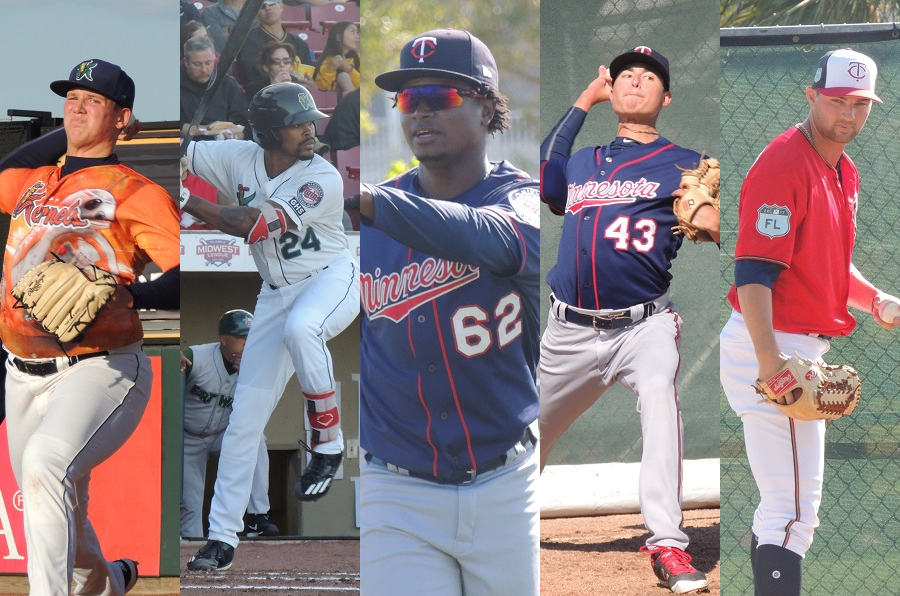 Let’s take a quick look at my choices for Twins Prospect 31-40, and I certainly encourage your questions and any discussion on the players. (I have included my preseason rankings. Note that I do a Top 30 list in the Prospect Handbook, but I keep and update occasionally a ranking of all of the Twins prospects. However, for this, I will put NR if they were outside my Top 50.) 40. Alex Robinson, LH RP, 22 Robinson was the Twins fifth-round draft pick in 2015 out of Maryland.He spent the last two years at Elizabethton where he struck out 67 batters combined in 45 innings. So why was he there for two years? It might have something to do with the 50 walks. He’s worked hard to harness some incredible stuff, including a fastball that sits 96-97 and touches 98-99. He also has a slider that is nearly unhittable. He’s currently in the Cedar Rapids bullpen where he has seven walks and 28 strikeouts in 20 innings. Continued improvement of those two pitches as well as some semblance of command, and Robinson could be another dominant relief option. Preseason Ranking: NR 39. Mitchell Kranson, C/3B/1B/DH, 23 Kranson was the Twins ninth-round pick in 2016 out of Cal-Berkeley. Kranson is a hitter. That is what his position is. However, he has made himself valuable by being able to play all over the field. While he has DHd a lot, he’s also spent multiple games behind the plate, at first base and at third base this season. In college, he also played some in the outfield. In 38 games for the Kernels, he is hitting .262/.314/.421 (.735) with 12 doubles, a triple and three home runs. Kranson has a high baseball IQ as well, and his offseason demonstrates his drive to be better. He lost 25 pounds without losing any muscle. Preseason Ranking: NR 38. Mason Melotakis, LHP, 25 “Melo” was the Twins second-round draft pick in 2012 out of Northwestern State in Louisiana. He had a year as a starter before moving to the bullpen. And, soon after, his elbow required Tommy John surgery. He returned to the mound for the 2016 season. He spent the year in Chattanooga. This season, he returned to Chattanooga where he didn’t give up a run for the first five weeks of the season. He has struggled more in the past two weeks, but his stuff is still good. He’s another lefty reliever who throws in the mid-90s with a strong slider. If needed, he can still work more pitches into the mix as well. (Here is a One To Watch story on Melotakis from Twins Fest 2015, shortly before his return from surgery) Preseason Ranking: 31 37. Jaylin Davis, OF, 22 Davis was the Twins 24th-round pick in 2015 out of Appalachian State. He likely would have been drafted about 15 rounds sooner if not for an injury that cost him the rest of that year. He returned to action last year and hit seven home runs in 12 games for Elizabethton. He then hit nine more homers in 52 games in Cedar Rapids. That’s where he started the 2017 season. In 46 games, he’s hitting .256/.309/.506 (.815) with six doubles and ten home runs (most in the Twins minor leagues so far this year). While he strikes out a lot, Davis has tremendous power. He’s actually become a real solid right fielder as well. He should get a midseason promotion to the Miracle. (Here is his Get to know ‘em Q&A) Preseason Ranking: 39 36. Eduardo Del Rosario, RHP, 22 Eduardo Del Rosario signed with the Twins way back in December of 2012 out of the Dominican Republic. He spent 2013 in the DSL, 2014 in the GCL. He split 2015 between the GCL and Elizabethton. Last year, before the short-season started, he was promoted to Cedar Rapids. He returned to the Kernels to start this season. He is currently 3-2 with a 4.69 ERA in eight starts and 40.1 innings. He’s got 43 strikeouts but also 18 walks. He’s listed at 6-0 and 145 pounds. He is more than 145 pounds, but he is very thin. He’s got a good, whip-like action in his delivery. He throws in the low 90s with a good slider/breaking ball and a decent changeup. He’ll have to keep improving those pitches, but the potential is there. Preseason Ranking: 44 35. Trevor Hildenberger, RHP, 25 Hildenberger was the Twins 22nd-round draft pick in 2014 after five years at Cal-Berkeley. He has been the Twins Daily Minor League Relief Pitcher of the Year the last two seasons, 2015 and 2016. He is now with the Rochester Red Wings. In 16.2 innings, he has walked six and struck out 16 batters. The side-winding right-hander We’ve written a lot of words on this site about Hildenberger over the years, but now he is at the point where he’s nearly ready, and he’s just waiting for an opportunity. He could be a good seventh inning guy who could also pitch in the eighth frame. Preseason Ranking: 42 34. Tyler Wells, RHP, 22 Wells was the Twins 15th-round pick in 2016 out of Cal State San Bernadino. He made ten starts last year in Elizabethton and went 5-2 with a 3.23 ERA. In 47.1 innings, he struck out 59 and walked 17. He began this season in Cedar Rapids where he went 2-0 with a 2.65 ERA in six starts. In 34 innings, he has walked ten and struck out 45 batters. At 6-8 and 265 pounds, Wells is a big man, and can be somewhat intimidating on the mound. He’s got a fastball that sits 91-93 and touches 94 and even 95 at times. He’s also got a couple of breaking pitches that can be very good. A sharp slider and more of a 12-6 curveball. (Here is his Get To Know ‘Em Q&A from this past offseason.) Preseason Ranking: NR 33. Aaron Slegers, RHP, 24 Twice already this season, Aaron Slegers has taken a no-hitter through six innings. In his first AAA start, he threw six no-hit innings before being removed from the game due to pitch count. And he went into the eighth inning once before losing the no-hitter. Last night, he had yet another quality start. Slegers was the Twins’ fifth- round pick back in 2013 out of Indiana where he was the reigning Big Ten Pitcher of the Year. He has moved up one level per year. In eight starts so far this year with Rochester, he is 4-3 with a 3.72 ERA. In 48.1 innings, he has nine walks and 34 strikeouts. Slegers sits 90-93 but he has hit 94 and 95 on occasions. At 6-10, Slegers has smooth mechanics and good control. (Here is the story on Slegers discussing his big league spring training.) Preseason Ranking: 36 Pre-2016 Ranking: 28 32. Jordan Balazovic, RHP, 18 The Twins used their fifth-round pick in 2016 on the St. Martin Secondary School in Mississauga high school in Ontario, Canada. After signing, he went to the GCL and made eight appearances including six starts. He went 2-1 with a 1.97 ERA. In 32 innings, he walked just five (though he also hit seven) and struck out just 16. But reports on him were glowing. Observers saw a fastball that could reach up to 94-95 mph with good secondary pitches. He also was described as having a bulldog like attitude on the mound. Still so young, at 6-4 and 175 pounds, Balazovic has plenty of projection remaining. (Here is his Get to Know ‘Em Q&A) Preseason Ranking: 30 31. Randy Rosario, LH RP, 23 Rosario signed with the Twins in August of 2010. He had Tommy John surgery after just three starts in Cedar Rapids in 2014. He missed the remainder of that season. He did return to the Kernels midway through the 2015 season and flashed a fastball that touched 96-97 mph. It was enough to get added to the 40-man roster. He pitched to mixed results last year in Ft. Myers. He throws hard and has a good slider, but he didn’t rack up many strikeouts. He came to spring training this year and was moved to the bullpen full time, something he was happy about. With the big fastball and sharp slider, it’s a great role for him. He’s pitched well this season in AA Chattanooga. (Here is his Get To Know ‘Em Q&A from late 2015.) Preseason Ranking: 33 Pre-2016 Ranking: 19 So there you have it, the start to my personal midseason Top 40 Twins prospect rankings. Today’s installment covered my choices for Twins prospects 31-40. Over the next week or two, there’ll be several more installments until we reach #1. Hopefully you will enjoy the series and will leave comments and discuss the prospects mentioned and the order they are in.
 -
Ft. Myers had their game postponed. The three Minnesota Twins affiliates did all play each received a quality start from their starting pitcher. That’s always good, at least enough to keep a team in a game until late. John Curtiss kept a streak going. And, Tommy Watkins experienced a first as a manager. To find out what it was, well, you’ll just have to keep reading. Image courtesy of Seth Stohs, Twins Daily (photos of Mitch Garver, Fernando Romero) Ft. Myers had their game postponed. The three Minnesota Twins affiliates did all play each received a quality start from their starting pitcher. That’s always good, at least enough to keep a team in a game until late. John Curtiss kept a streak going. And, Tommy Watkins experienced a first as a manager. To find out what it was, well, you’ll just have to keep reading. Find out everything and more that happened happened in the Twins system on Wednesday, starting with the transactions of the day. TRANSACTIONS Check out the transactions through the minor league system on Wednesday: Following their afternoon game on Wednesday, the Kernels announced that Tyler Beardsley was placed on the disabled list with right elbow bursitis. Also, OF Shane Carrier was sent down to extended spring training with OF Hank Morrison coming up to Cedar Rapids from EST. RED WINGS REPORT Rochester 5, Durham 6 Box Score Mitch Garver got things going early for the Red Wings with his third home run of the season. The solo homer gave them a 1-0 lead. Aaron Slegers gave up two in the top of the third inning. In the bottom of the sixth inning, the Red Wings put together a rally. RBI doubles from Matt Hague, Niko Goodrum and Mitch Garver gave the Red Wings the lead. In the seventh, Niko Goodrum hit a sacrifice fly to score Engelb Vielma and give them a 5-2 lead. Aaron Slegers was strong again on this night. The right-hander went six innings and gave up just two runs on six hits. He struck out five without allowing a walk. Alan Busenitz came on and pitched a scoreless seventh inning. He started the eighth frame and got two outs. He left the game with a runner on first base. Buddy Boshers came on and gave up an RBI double. Boshers exited, replaced by Drew Rucinski. He gave up a run-scoring single followed by a two-run homer, and the Red Wings were down 6-5, then game’s final score. Alex Wimmers pitched a perfect ninth inning. Mitch Garver led the offense. He went 3-4 with his seventh double and third home run. Matt Hague was 2-5 with his sixth double. Byungho Park went 2-3 with a walk and his sixth double. CHATTANOOGA CHATTER Chattanooga 2, Montgomery 0 Box Score The Lookouts got tremendous pitching through this shutout. Fernando Romero started and threw six scoreless innings. He gave up three hits, walked three and struck out five. Luke Bard came on and struck out four over the next two innings. He gave up two hits and walked one. John Curtiss recorded his eighth save, had two strikeouts in the ninth and kept his ERA for the year at 0.00. There wasn’t a lot of offense for the Lookouts either in this game. In fact, they scored both of their runs in the bottom of the sixth inning. With one out, Ryan Walker singled and Nick Gordon doubled him to third. Edgar Corcino came up and singled in both runs. The double was Gordon’s 12th of the season. TJ White went 1-2 with a walk and his third double. MIRACLE MATTERS Ft. Myers, Dunedin (Postponed) Box Score Rain forced the postponement of Wednesday night’s game in Dunedin. The two teams will play a doubleheader on Thursday. KERNELS NUGGETS Cedar Rapids 2, Clinton 3 Box Score The Kernels played a matinee game at home against Clinton on Wednesday. Clark Beeker put together another quality start. The right-hander gave up two runs (one earned) on six hits. He struck out two without a walk. However, when he left, the Kernels were down 2-0. With two outs in the bottom of the seventh, Brandon Lopez doubled. Ben Rortvedt struck out, but the ball eluded the catcher and he reached first base. They took advantage of that wild pitch when Aaron Whitefield tripled to score both runs and tie the game. Alex Robinson came on and put two zeroes on the board. He struck out three. But after getting the first out of out the ninth, he gave up a walk and a single. Hector Lujan came on and gave up a single to load the bases. He then got a ground ball. Jermaine Palacios fielded the ball, threw to second base for the force out, allowing the lead runner to score. The throw was made to first base where the runner was safe, but when a second runner tried to score, he was thrown out at the plate to end the inning. Lopez led the offense. He went 3-4 with his third double. Ariel Montesino was 2-5. Lewin Diaz hit his 17th double. Whitefield’s two-run triple was his third of the season. It was an early game, and it came to an end early for manager Tommy Watkins who was ejected in the first inning for the first time as a manager. He was arguing an out call on an attempted steal of second by Ariel Montesino. TWINS DAILY PLAYERS OF THE DAY Twins Daily Minor League Pitcher of the Day – Fernando Romero, Chattanooga Lookouts Twins Daily Minor League Hitter of the Day – Mitch Garver, Rochester Red Wings THURSDAY’S PROBABLE STARTERS Durham @ Rochester (10:05 a.m. CST) - RHP Nick Tepesch (GAME POSTPONED BY RAIN) Montgomery @ Chattanooga (6:15 CST) - RHP Ryan Eades Ft. Myers @ Dunedin (DH at 4:05 CST) - RHP Brady Anderson Clinton @ Cedar Rapids (6:35 CST) - RHP Eduardo Del Rosario Please feel free to ask any questions and discuss Wednesday’s games. View full article
