


Twins Video
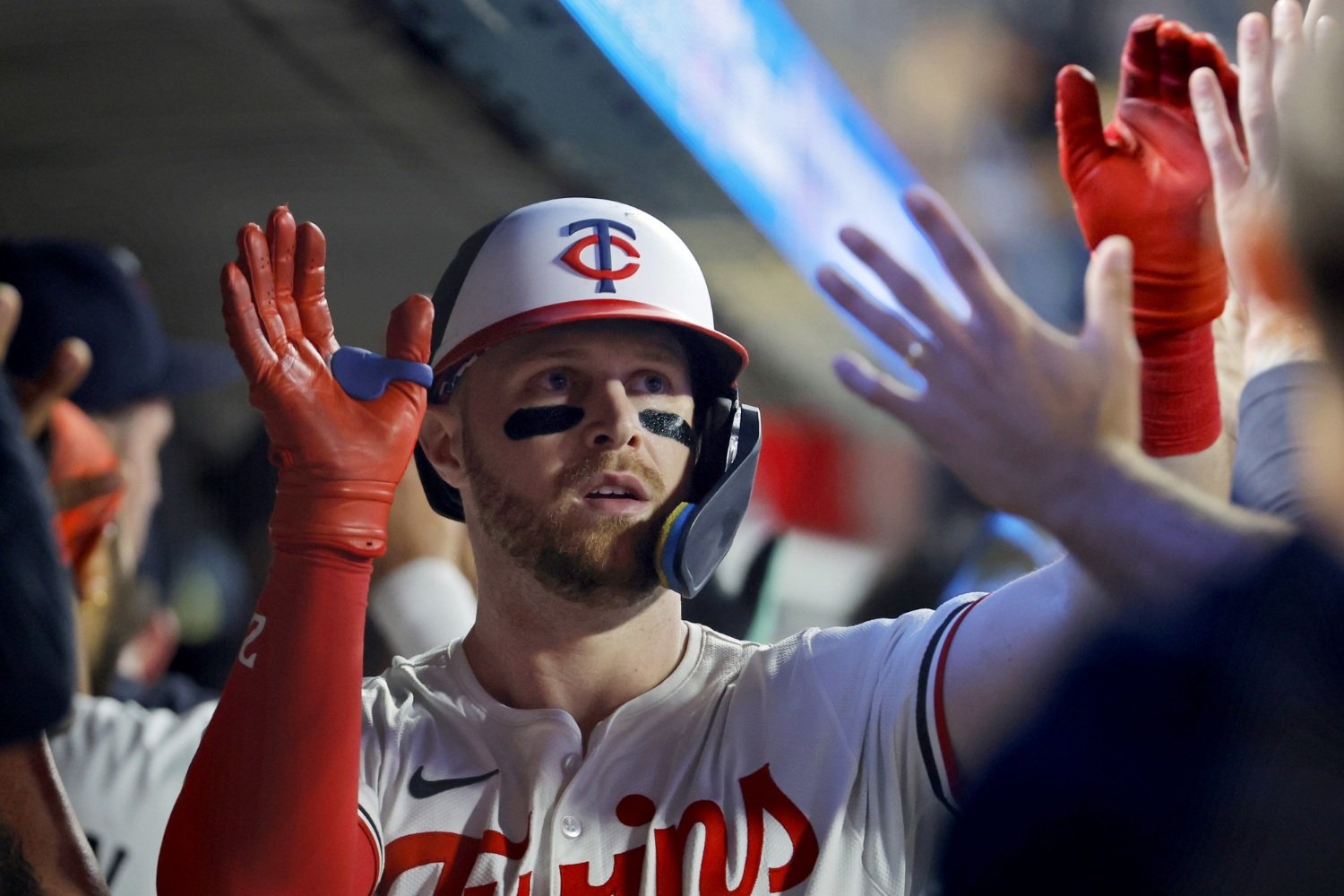
In your head, Ryan Jeffers might be a young building block for the Minnesota Twins, but time is running low on his tenure. Since his debut in 2020, he’s more or less been the Twins' starting catcher. At minimum, he's held a substantial portion of a timeshare behind the plate—whether that be alongside Mitch Garver (2020-2021), Gary Sánchez (2022), or Christian Vázquez (2023-2025).
He’s hit fairly well, sporting a career 104 OPS+, which is about average for the league overall but much better than the average catcher. The offensive standard for backstops hovers around 90, or 10% below league average. In that context, a 104 OPS+ is substantial. In 2024, Jeffers came in at 103. In 2023, that figure was 133, nearly 50% better than the average catcher that year.
His defense has graded out inconsistently. Early in his career, his receiving was his strong suit, and the major questions were about his arm. Over time, his reputation for framing diminished, but he improved in controlling the running game. He seems to be reliable in challenging pitches in the automated ball-strike system, as he was fairly successful during spring training. In all likelihood, starting next year, that will become an actual (and fairly valuable) skill.
I have laid out this information to set up a comparison to the Mariners’ Cal Raleigh, the latest of a few catchers to be extended recently. Raleigh signed a six-year, $105-million extension, with a vesting option for a seventh year.
Raleigh shares some similarities with Jeffers. They’re around the same age—Raleigh is about half a year older. Raleigh had two years of team control after 2025 before his extension—one more than Jeffers. They both hit well for catchers. Raleigh has the better career mark, with a 112 OPS+, though Jeffers has been almost exactly as good if we only consider the last two seasons: 117 for Raleigh and 116 for Jeffers (which admittedly may be buoyed by the latter's outstanding 2023).
Ryan Jeffers v. Cal Raleigh, 2023-24

In addition to being the better hitter for his career, Raleigh controls the running game and receives substantially better than Jeffers. Raleigh won the Gold Glove for American League catchers last season and the Rawlings Platinum Glove, given to the best fielder in the league across all positions. He’s very good.
Jeffers isn’t Raleigh, so his figure probably wouldn’t come in so high. For reference, Raleigh’s $105 million is divided up like so:
- 2025: $11 million
- 2026: $11 million
- 2027: $12 million
- 2028: $23 million
- 2029: $23 million
- 2030: $23 million
- 2031: $20 million (vesting option, $2 million buyout)
Other relevant recent extensions include the Dodgers buying out Will Smith’s last two years of team control and eight additional years (until his age-38 season) at $14 million per year in 2024 and Atlanta buying out all three years of Sean Murphy’s arbitration, plus three more years and a team option ($15 million for his age-34 season) for $12.2 million per year, on average.
Smith and Murphy are also viewed as better hitters and defenders (though that’s debatable, with Smith) than Jeffers. All three of these comparable cases were extended earlier in their arbitration processes than Jeffers, which does diminish their average annual value, given that they have less leverage for those years, and Smith’s long contract is structured to spread money out and manipulate the luxury tax system for the Dodgers. (I’d be surprised if he finished the contract.) However, each was extended ahead of his age-28 or 29 season, right in line with Jeffers.
So, what might an extension for Jeffers look like? Perhaps it would be five years, with an average annual value around $12-15 million. He only has one arbitration year remaining, which removes some of the artificial suppression on the yearly value. A five-year, $70-million contract would align him with Murphy’s (arbitration-deflated) deal and retain Jeffers through his age-33 season. I’m sure I could be talked into something longer or shorter, more expensive or less expensive, maybe with a vesting option for his age-34 season, but $70 million over five seasons is a decent spot to start thinking through this.
Is this something that the Twins would want to do? There are a few factors at play. Right now, $14 million (the average annual value for this hypothetical deal) would represent about 10% of the Twins’ total payroll, just a hair less than the money Byron Buxton is getting—though also less than Jeffers and Vázquez are making combined this year as the catching tandem. That’s not an insignificant amount, and we’ve already seen the repercussions of an aging catcher getting an eight-figure salary with Vázquez’s performance over the last three years (which, by the way, does still indicate that the team is open to multi-year, eight-digit AAV contracts for starting catchers).
Given this concern in particular, it’s worth speculating on how Jeffers will hold up as he ages. Catchers do not age gracefully. It’s a demanding position that ages a young man quickly. Jeffers is a big guy, at 6-foot-3. However, he’s been lightly ridden over his career. He’s never caught in more than 86 games in a season, and he’s stayed relatively healthy, only missing significant time in 2022 (presumably due, in part, to the Twins’ commitment to splitting time to keep both primary catchers fresh). The lack of miles on his tires may protect him a bit from a catcher’s typical aging curve (or cliff).
However, that brings up another point: Jeffers has never been a full-time catcher. The last three catchers to get multi-year extensions consistently caught at least 100 games per year. If the Twins are committing that money to Jeffers, would they need him to catch more often than not, and would his body hold up to that workload? We’ve never seen it before for him, so that’s a question.
Finally, the last factor that needs to be considered here is the alternative options. The Twins do not have a clear replacement for Jeffers come 2027. Right now, they have two minor-league catchers on the 40-man roster, in Jair Camargo and Diego Cartaya. Camargo seems destined for a career as a backup catcher, and assuming he plays his way into that role, he could be an inexpensive catching partner with Jeffers for the life of his extension. However, that plan would likely require Jeffers to get above the 100 games caught threshold.
Cartaya, once a top prospect, still has a ceiling where he could feasibly become a starting-caliber catcher, but that’s assuming a lot for a kid who’s struggled over the last couple of years. However, he is still young, and he could get to a level where the Twins feel comfortable splitting time between him and Jeffers more evenly. He could also top out as a more traditional backup, and fill a similar role to the one we discussed with Camargo. Then again, perhaps neither of them could ever be viable options. Who knows?
Outside of those two, the Twins don’t have a name that jumps off the page. Ricardo Olivar, Khadim Diaw, or Ricardo Pena could be options, but there are huge questions for those names (and any others in the system). If the Twins don’t extend Jeffers, they could still need to invest salary or prospect trade capital in covering the positions in the years after Jeffers exits. It may just be a question of whether they want to pay Jeffers a good chunk of change, or someone else (probably worse) a bit less.






Recommended Comments
Create an account or sign in to comment
You need to be a member in order to leave a comment
Create an account
Sign up for a new account in our community. It's easy!
Register a new accountSign in
Already have an account? Sign in here.
Sign In Now