
Jump to content
Twins Daily
  • Create Account
  • Twins News & Analysis

    Charting The Competition: Cleveland Indians


    Nick Nelson

    For the past five years, this team has been there, lurking. The Indians have won 80 or more games in four of those seasons, almost constantly remaining within reach of first place, but all that this stretch has yielded is one single postseason game – a loss to Tampa Bay in the 2013 wild card.

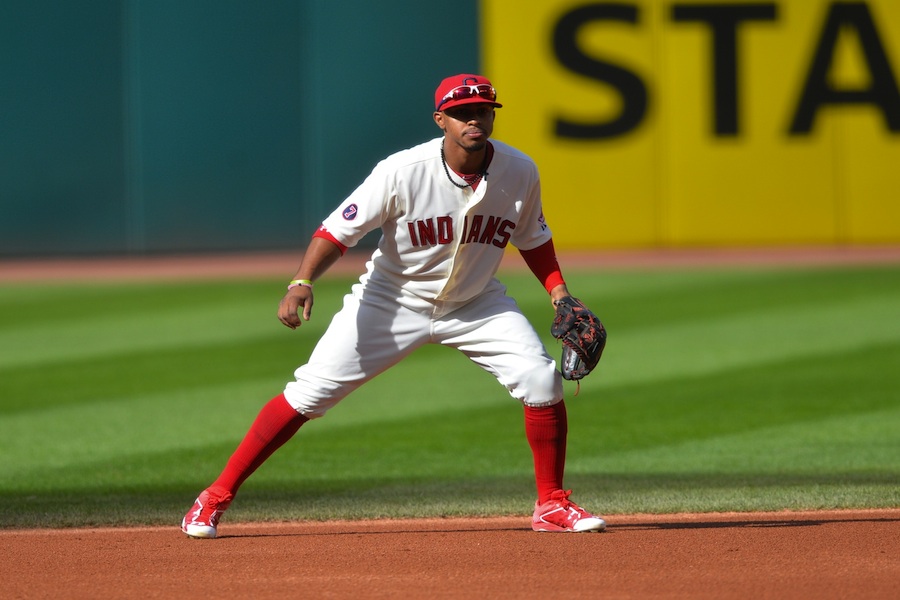
    Image courtesy of David Richard, USA Today. Image of Francisco Lindor

    Twins Video

    Cleveland has a good young core entrenched, with a potentially (likely?) elite rotation, but their fans are feeling quite similar to those in Minnesota, waiting for an offseason splash that still hasn't come.

    The Indians are on the brink – they won just two fewer games than the Twins last year – but their only substantial moves this winter have been the signings of Rajai Davis and Mike Napoli, both to one-year deals. It's a lukewarm approach to addressing an offense that scored only 669 runs last year and ranked third-to-last in the American League in OPS+.

    Much like Terry Ryan, it appears that GM Chris Antonetti is committed to relying mostly on what he already has in place. In some ways, that's more than understandable. Cleveland's starting pitching situation is the envy of the entire AL, with Corey Kluber leading the way for a young and inexpensive slate of talented hurlers who all possess strikeout stuff.

    The front of the rotation is filthy with the combination of Kluber, Carlos Carrasco and Danny Salazar leading the way. Each of those three made 30-plus starts last year and held opponents to an OPS below .680, which is pretty ridiculous. If those guys keep rolling and Trevor Bauer takes the next step at age 25, this is a contender for the best unit in the majors.

    The bullpen is solid, anchored by underrated closer Cody Allen with support from Zach McAllister, Bryan Shaw, Tommy Hunter and old friend Jeff Manship, among others. Like the Twins, the Indians probably could have benefited from a more potent infusion to the relief corps, but instead have opted mostly for gambles on guys like Craig Stammen and Joba Chamberlain through minor-league deals.

    All in all, though, the Cleveland pitching staff looks promising. This team's fate will most likely rest on what the offense can do, and that's hard to predict. Davis and Napoli aren't high-impact additions, and the unit will be hurt by missing Michael Brantley for at least the first month following shoulder surgery.

    In the same way that the Twins are hoping that Miguel Sano and Byron Buxton will be transformative figures in their lineup, the Indians are leaning on 22-year-old shortstop Francisco Lindor, who will be in the MVP race if he repeats his rookie production over a full season.

    And like the Twins, they Indians are hoping that their formerly premier offensive catcher turned ordinary first baseman can once again emerge as a true asset at the plate. Carlos Santana remains one of the best in the game at controlling the strike zone and drawing walks, but last year he batted just .231 with a .395 slugging percentage.

    Cleveland has a wide range of possible outcomes for the 2016 season. With their rotation setup, they can't be discounted as legitimate World Series contenders, but with an offense that wasn't good last year and displays no obvious avenues for significant improvement, they may not score enough to finally get over that hump.

    It's surprising that they haven't landed an upgrade over the light-hitting Giovanny Urshela at third base, but it sounds like the Indians are still in talks with free agent David Freese, who would give them a bit of a nudge in the right direction.

    ~~~

    This wraps up our series looking at Minnesota's divisional opponents and where they stand heading into the 2016 season. To get caught up, make sure you check out:

    Follow Twins Daily For Minnesota Twins News & Analysis

    Recent Twins Articles

    Recent Twins Videos


    User Feedback

    Recommended Comments


    Featured Comments


    Looks like we're in agreement that there is no comparison to the Pujols contract, but you cherry picked career stats.  


    You seem impressed by the last 3 years of an injured Pujols putting up 116, 126, 118 OPS+.  But you write off Davis by using his career numbers, which were bad in Texas. His last 4 years his OPS+ is 121, 168, 96, 146.  He has been a significantly better hitter than Angels Albert Pujols.  


    You’re the only one bringing up contract differences, I’m asking you to throw that away. We’re talking about performance, purely performance at the age.  You seem confused about this (likely my fault) so let me take it back:
    -------
    Entering his age 32 season, Albert Pujols had a career OPS of 1.037, five top-2 MVP finishes and an OPS+ of 170. His lowest OPS season was a .906, the only time he hit below .300 (that was his age-31 season, still a fine season where he hit .299). He’s a first ballot Hall of Famer if he retired right then. 


    Chris Davis is currently entering his age-30 season. He has a career OPS of .835 and one top-3 MVP finish. He has a career OPS+ of 122.  Since his age 27 season, he’s had one great season (which I call a Pujols Season since Albert did that for a decade - amazing) and one very good season, sandwiched around a dismal season where his OPS+ was 96.  His best batting average was .286 – in 2014 he didn’t hit his weight. He’s been a very good power hitter who is a bit inconsistent and pretty one-dimensional.


    When Pujols moved to the Angels for his age-32 season his performance continued his drop off from his age-31 season. He hasn’t hit above .285 in the four seasons since and his OPS is .804 for an OPS+ of 126. Those are fine seasons but they are not Pujols Seasons. Interestingly those four seasons actually represent a close approximation to Chris Davis’s peak, whose last four seasons yield an OPS+ of 136. Davis hasn’t been a significantly better hitter that Pujols, peak Chris Davis has been slightly better than Old Man Pujols.  And before you ask, I’m not cherry picking those stats, the four-year sample shines Chris Davis in the best light.
    -------
    Okay those are the numbers. What I’m saying is that Albert Pujols shows that even a once-in-a-generation hitter and power slugger experiences issues when he gets towards his age-32 season (and I won’t do the numbers but Teixeira has a similar drop off as do a number of other power hitting first basemen).  Chris Davis signed a 7-year deal at age 30 and here are the warning signs to me:


    (1) Chris Davis has never proven himself like Pujols or Teixeira did. We don’t really know if his big seasons are a flash in the pan or if the 2014 season is more representative of what we can expect the next season or two of his prime. I imagine it will be somewhere closer to 2015 than 2013 or 2014 for the record.  But we can’t ignore his inconsistent past, which adds some risk. 


    (2) If Chris Davis follows the pattern of much better players than himself (again, not a given – if better players drop off, we could reasonably see Davis’s decline being more sharp) he looks to be taking a drop-off in year 3 of this contract, his age 32 season (Pujols dropped at age 31 so I’m giving Davis an extra year since he likely has less wear and tear from starting his career later).  If Davis is declining from his current state (Old Man Pujols), you’re talking about a replacement level player.  For five years at $17 million a year while playing a premier offensive position.  Even if he extends his peak a year beyond Pujols and Teixeira did, you’ve still got 4 years of a replacement player. That’s really tough, especially since The Tribe would be hitting Lindor’s prime and be looking to start locking him up along with their strong starting pitching. They could really use that $17 million at that point, especially since they aren’t a huge market team.


    So my point isn’t to say Chris Davis = Albert Pujols, it’s just to use Pujols to point out that even the greatest and most well-rounded slugging first basemen are prone to a drop off in their early 30s. With the caveat that we obviously can’t guarantee Davis will fall off in the same manner as Pujols and Teixeira (again just because A., doesn’t mean B.) there are some really alarming trends which don’t point in Davis’s favor. He’s coming up on an age where slugging first basemen experience a drop and in his case, that drop indicates he’s likely to be a replacement level player.


    That’s why I think the contract is a disaster (and absurd since the Orioles were competing against no one).  Chris Davis would have been the wrong signing for the Tribe and the Orioles are likely going to really regret the last 4-5 years of his 7 year deal.

    Edited by ThejacKmp


    $42 million spread over 20 years is an insignificant amount to MLB owners, so ignoring it is more than fair.  In no way will those deferred payments effect the Orioles future payrolls. 


    It's spread over 15 years and yes it will matter. You can correctly say it won't matter as much as if it was part of today but the money doesn't disappear. The O's will have less to spend. That's how businesses work, they can’t make costs disappear. Bobby Bonilla’s salary currently plays into the Mets financial picture, even in a small way.

    Wow, lots of words there to tell me Pujols has had a better career than Chris Davis.  You weren't ever going to get any argument from me on that. 


    "Pujols had a way better (HOF) track record and that contract looks terrible now."


    Maybe I was nitpicking, but my initial issue was how this was phrased... I simply pointed out the contracts aren't comparable at all.  If Albert Pujols had signed a 7 year contract at age 30, for $17 million/year w/ deferrals tacked on at the end, it would have looked great. 


    Albert Pujols contract looks terrible now, because it always looked terrible. They gave a 32 year old who had started to enter his decline 10 years and well over $200 million.  The Angels will pay a 40-41 year old Pujols $59 million in 2021-2022.  Kind of puts $42 million over 15 years into perspective. 


    Chris Davis' contract ends when he is 36 years old.  There will almost certainly be a decline at the end, my simple point was they may get enough value during his age 30-33 seasons that it doesn't really matter. The contract was structured nicely. 

    2 pages on a guy CLE didn't sign.......maybe you should start a Chris Davis thread.


    All I know is that if I was a Tribe fan, I'd be disappointed they didn't buy a bat or two, Even minor upgrades. Next year's class is awful.


    It is easy to understand why the trade market for Plouffe is low, when you have a guy that has 10 WAR the last three years out there for 1-5.


    I would not be shocked if something happens with Trevor when these guys come off the board.

    Edited by tobi0040


    Create an account or sign in to comment

    You need to be a member in order to leave a comment

    Create an account

    Sign up for a new account in our community. It's easy!

    Register a new account

    Sign in

    Already have an account? Sign in here.

    Sign In Now

×
×
  • Create New...