



Hugh Morris
-
Posts
51 -
Joined
-
Last visited
Content Type
Profiles
News
Minnesota Twins Videos
2026 Minnesota Twins Top Prospects Ranking
2022 Minnesota Twins Draft Picks
Minnesota Twins Free Agent & Trade Rumors, Notes, & Tidbits
Guides & Resources
2023 Minnesota Twins Draft Picks
The Minnesota Twins Players Project
2024 Minnesota Twins Draft Picks
2025 Minnesota Twins Draft Pick Tracker
2026 Minnesota Twins Draft Tracker: Picks & Bonuses
Forums
Blogs
Events
Store
Downloads
Gallery
Everything posted by Hugh Morris
-
I've seen the numbers and I trust Badler, I've got no problem believing he's somewhere between Shooter Hunt and during-surgery Nick Blackburn on the awful scale... but given what the Yankees gave up for him and what his scouting report coming out was-he sounds like a player who could make a push for the Twins Top 10 prospect list as early as next season (aided by the graduations of Meyer, Sano, etc). Assuming that the bullpen is kept the same as last year, he'd be blocking a MR without a ton of upside (Thielbar, etc) as I assume Tonkin will get the promotion. Is a benefit of being an awful team for 3 years in a row that you can get away with a 24-man roster while playing towards the future? I guess the only reason I ask is that Omar seems like a somewhat unique case. He's still only 21, was well-regarded enough to get a nice sized signing bonus from a team quite active in the Latin sphere and reversing his apparent (potentially fixable?) propensity for future injury may negate the damage done to his development by missing a year. Ignoring the specifics of the pitcher (broad strokes: Is awful, fitness likely to lead to future injury but is correctable) and assuming only extremely low leverage usage -or even zero usage-how high would the prospect ceiling have to be to be worth the roster spot for a year?
-
To play devil's advocate* here: Isn't a major league training room, surrounded by older teammates who focus on their bodies, and with the team able to closely monitor his diet exactly where you'd want a raw, out of shape guy like this? Wouldn't the best way to touch up the mechanics that have evidently given him trouble since he's come stateside be to have him pitch consistent bullpen sessions under the watchful eyes of (I would hope) the two best pitching coaches and best medical staff in the organization? Based on Badler's description and some of the other things I've seen, he seems like a prime candidate to lose a season to injury sometime in the near future. Maybe he'd be better off "losing a season" to improved fitness and mechanics. If the only cost is $50,000 and Ryan Pressley's roster spot, along with a few of Swarzak's swing starts, is that worth it? *I'm aware that "Devil's Advocate" is synonymous with "argumentative jerk"-but it's not a position I hold so much as a question I'm pondering, so I'd rather not be stuck to it. Just think it's worth the thought exercise and would love to hear the input of others.
-
Not sure if I disagree with you in principle on trading for Bailey, but I have to ask-given the glut SPs currently scheduled to hit FA in 2015, is the prospect haul required to outbid other teams for the right to Bailey worth the opportunity to negotiate with him early and get a discount over a price driven up by a hypothetical bidding war that's far from guaranteed to materialize? I'm leaning towards no, but various extensions by other clubs could sway me (reminder that consensus expectation was that Cano would never see the market at this time last year). I'd put Kershaw, Shields, Scherzer and Lester ahead of him at this stage-which would make him the top option of teams who don't want to pay Kershaw and lose out on the other three and that rarely makes for a lucrative bidding war for a player.
-
Sorry, but I find this unrealistic and very shortsighted. There are few good options available for one year contracts at this time-especially in positions of need (which I'll go ahead and define in this post as SP and SS-whereas C and 2B are unsettled and could use upgrades, and COF has questions beyond 2014). I'll go ahead and say that if you're looking for "superior to Nolasco", there are no players available on 1 year deals for 2014. Which means that any signing will limit flexibility in signings for future years. Looking at the 2014 offseason (When the Twins have ~17m coming off the books between Correia, Doumit and Willingham, a young and minimum salaried core already in/shortly joining the bigs and the need to sell tickets without the ASG as an incentive), the following players are available (as of now. Any players with options have been redacted): SP: Claytons Kershaw and Richard, Lester, Shields, Peavy, Scherzer, Bailey, Beckett, Josh Johnson SS: Hardy, Asdrubal, Lowrie, HanRam 3B (if Sano can't cut it?): Sandoval OF: Cuddyer, Torii, Aoki, Hammer, Rasmus C: Russ Martin I'm not stating the Twins would, or should, pursue any specific name on that list. I'm not saying that money not spent this year will increase the budget for 2015 and on. I am saying money not committed to 2015+ this year will be available for that purpose next year. I'd much rather pursue Kershaw at the ridiculous sum he expects, or Bailey/Scherzer/Shields/Lester tier at 115/5 than Garza at the minimum 80/4 I expect him to get. I'd rather see the Twins be aggressive at getting one of the SS candidates and pick up a Peavy/Beckett type in addition than pay Garza that minimum 80/4. And if you'll tell me that with the Payroll Ceiling and TV Money and absolutely accurate Forbes/Bloomberg numbers, the Twins can afford to sign Garza and one of these guys, I'll preemptively reply that while that's true, not signing Garza would allow for a premium arm and bat next season-when the contention window has clarified and team needs have become more evident. The Twins made a nice splash with Nolasco (and finally quieted the "it can't happen because it hasn't happened yet" crowd when it comes to TR's spending), but with the number of teams looking for top of the rotation help this offseason and only Garza left fitting that category-I'd prefer not to hamstring the future free agency efforts by paying Garza whatever exorbitant sum he'll require. Even if it means 5 extra losses this season.
-
Official 'Twins Aren't Doing Stuff' Thread
Hugh Morris replied to twinscowboysbulls's topic in Minnesota Twins Talk
And again, this is why I feel as though we're talking past each other. There is plenty of reason to believe many or all of them would perform somewhat poorly. The issue I have is not with the idea that people predicted these acquisitions wouldn't be good. I've agreed that Diamond was due for regression, that Pelfrey was trying to make it back from Tommy John on a tight schedule and that Worley had an inflated Krate due to swinging strikes My issue is not in the direction of performance, but in the magnitude The Twins had to replace 162 starts. I agree that replacing the 28 combined starts of Liriano and Pavano and the 27 of Diamond are where regression was likely (Napkin Math has that at around 4.5-4.75 for a ERA). But that's not even a third of the starts made on the season. Where else did the starts come from? 42 of those came from the quartet of Blackburn-Duensing-Swarzak-Marquis. The combined 7.55 ERA of those starts help to illustrate what happens when 3 people who have no business in a major league starting rotation and one person who just underwent immense personal tragedy wind up with the ball. Deduno and Hendricks combined for another 31 starts with a 4.44 and 5.59 ERA respectively. I'm not sure why either of them was a likely regression candidate (Deduno I could see up until the WBC). The remainder of the starts came from absolute nonprospects like De Vries or Walters and total scratch tickets like Vazquez. What I'm trying to say is this: I can see reasonable arguments for why Correia would put up something much closer to a 5 than what he did (making him an almost exact replacement for Liriano despite drastic style differences). I can understand why someone might suggest that Pelfrey's season will look like Pavano's 6.00 ERA-though expecting worse than that is suspect. I can see why someone might say Scott Diamond would wind up settling in at a higher ERA just from returning to the mean. And once those starts have been replaced-we come to the remainder. The ones thrown by has beens (Blackie), never wases (most of the rest) and guys who are clearly better suited for the bullpen in Duensing and Swarzak. And here's where my point of contention lies: Even when assuming that Correia and Pelfrey might be as bad as Liriano and Pavano were in 2012 (no easy feat), even when assuming that Scott Diamond will not anchor the rotation while keeping his ERA under 4.5 again (despite a solid xFIP and a strikeout rate that had dropped substantially from where it was in the minors), and even while assuming that Deduno's WBC experience was a flash in the pan while Liam wouldn't develop at all and have as bad a season as he did the year prior... the rotation would be in line for a marked improvement because Blackburn-Marquis-Duensing and Swarzak were simply that awful. There was nothing in Worley's track record to suggest he would implode TO THE EXTENT THAT HE DID. There's nothing in Gibson's track record to suggest that he would scuffle as hard as he did when he was called up (I recall many on this board complaining that he was wasting innings in the minors because he was clearly ready. FWIW, I agree). All of this started because I disagreed with the idea that anyone predicted Worley, Correia and Pelfrey would combine to rival the performances put on by Duensing, Swarzak, Marquis and Blackburn the year before. And I stand by my point. I do not believe anyone predicted that the new acquisitions would combine for a 7+ ERA-and anyone who did predict that did so out of a general pessimism rather than an analysis of the situation. For as warty and bad as Pelfrey, Correia and Worley may have been, all three had demonstrated at least some aptitude for starting pitching at a major league level, and had no signs entering the season that they'd lost that. The same simply cannot be said after the performances of Duensing, Blackburn and Swarzak in the rotation during 2012. I'll leave Marquis out of that last statement because I can't imagine trying to prepare for a season and keeping your mind right while going through the despair and helplessness he must have felt-I don't put the performance on his abilities, but it was an awful performance. Tremendously so. For what it's worth, "sober" was synonymous with clear/levelheaded rather than antonymous with "drunk"-I had hoped that the discussion of the rainy day made that clear. Apologies if any were offended. also-TheLeviathan; clear out some PM space or send me one! Got something I'd like to cover in private real quick! -
New to here... opinionated, but respectful.
Hugh Morris replied to Vikesfan47's topic in Minnesota Twins Talk
Marta-Sorry that I wasn't clear. I was referring to TR's spending habits in the Metrodome and under Carl Pohlad, not Target Field and Carl's heirs. TheLeviathan- Not trying to spin anything. We have one solid, uncontested datapoint that's been put out there for TR's willingness to sign an elite pitcher. While I think the absolute number is too low-especially in 2013-I also recognize that the team's financial circumstances have changed and I think the idea of using that as a cap for portion-of-payroll he's willing to spend on a pitcher is at minimum an interesting thought experiment. I suppose the concept is invalidated if you assume the offer was a bit of kabuki theatre and Terry never had any intention of resigning him-but to each his (or her) own. -
Official 'Twins Aren't Doing Stuff' Thread
Hugh Morris replied to twinscowboysbulls's topic in Minnesota Twins Talk
You could describe them as AAA suspects. Or you could describe them as a recent top 10 organizational prospect who showed glimpses of promise (the duel with King Felix in Seattle) but was generally inconsistent in his age 23 season and a journeyman AAA oddity who appeared in his first MLB season to have finally gained some control of his unique pitch and had used it to dominate the WBC in the winter/spring. I suppose it's a matter of how you'd like to frame it, but I think your method was somewhat oversimplified. I'm also curious if you'd use the description of floatsam/jetsam in your post to describe Gibson, who had a fairly similar debut season to Hendriks-despite being older. Again on framing: "coming off" and "some form" are both used here to cover all manner of sins- Pelfrey had Tommy John in April. Worley had bone chips removed in September and Diamond had bone chips removed in December. One of these is an existential threat to a pitching career and the reason Pelfrey was available on a 1 year deal. The other is a fairy common procedure (with a fairly minimal rehab timeline) that many movement-dependent pitchers (a category that Worley/Diamond fall into) report easing/removing the pain that makes it difficult to throw their arsenal properly-often leading to both short and long term improvement. But I absolutely grant you that the projected weakest member of the 4 was either Correia or Pelfrey, depending on your feelings on Tommy John. With regards to Diamond and Worley-I'd have found Diamond's strand rate as a better indicator of the flukiness of his season (Which should serve as a warning for Correia after this year), but we agree regression was likely. a 2pt rise in ERA and 1.5 in FIP seems harder to justify, though. Worley followed up his rookie season (where he finished 3rd in RoY voting) with a sophomore campaign in which he was a touch below league average while dealing with injuries that tend not to be chronic. I don't know that relatively minor elbow surgery warrants the levels of pessimism necessary to project his 2013 as being below average-even with K numbers inflated due to called 3rd strikes. My recollection of 2012 involved Liriano (young and had a legitimate Ace-like season in 2010, contract year), the mediocre to terrible Marquis, Pavano (coming off a 2 WAR season, contract year), the rookie year of Hendriks who'd done nothing so far besides dominating the minors despite being at age-appropriate levels, and the awful Nick Blackburn... which is to say we agree-though I'd only have called Marquis and Blackburn marginal from that list. {Comment related to discussion with Different User redacted- Super embarrassed about crossing the two} The career ERA+s of Deduno after 15 starts and Pelfrey after nearly 150 are hardly comparable. Regarding recently successful, the distinction is almost meaningless if you widely broaden the definition of both terms Worley: ERA+ of 127 in his rookie year (2011), RoY Consideration, 96 ERA+ in sophmore campaign (2012) Diamond: ERA+ of 116 in 2012. Decent minor league track record prior but poor cup of coffee in 2011. Humber: 4 years of abysmal MLB and MiLB stats. Showed hints of maybe getting it in KC in 2010. 3 amazing months in 2011 followed by 3 awful months to end 2011(total ERA+: 116) and a 66 ERA+ in 2012. Slowey: 61 ERA+ in 2011. Injury and a horrible stint in the minors in 2012. One >100 ERA+ season in his career. I do apologize, I mistook Correia's SDP seasons for each other in my head. He has been solidly below average for a considerable time before the Twins picked him up. -
Official 'Twins Aren't Doing Stuff' Thread
Hugh Morris replied to twinscowboysbulls's topic in Minnesota Twins Talk
I didn't think I was that unclear, I apologize if it came across as overly confusing. To begin by clarifying my stance: It was reasonable to assume the 2013 rotation would show substantial improvement over 2012-and that the collected pitchers had the ability to pitch the team to somewhere in the realm of league-average. With that being said, "average" would take a couple of lucky breaks-as the pitchers who were assembled were not great and frequently were not good (hence "warts", "not exciting", etc). I do, however, make a distinction between "not good" and "absolutely horrible" The thought of substantial improvement in the rotation was far from unreasonable and had support within analytics. The most readily available projection set (Steamer) had the Twins improving their rotation ERA by roughly 15% (even with some laughable HR/FB numbers and a few other quirks I found questionable). That improvement would have made them the 6th most improved rotation in the majors. I'm fully aware that there were people who expected this rotation to be poor. What I consider revisionism is the idea that people, through reasoned and sober analysis, expected the rotation to be as bad as it was. After 2 90+ loss seasons, the lack of any glamorous/sexy FA signings and the departure of favorites like Liriano, it'd be like me bragging about my meteorological skills for predicting that my recent planned outdoor afternoon date was forced inside by the rain. I'm a pessimist-of course I predicted it would rain. There was little reason to expect "Good" out of the Twins last year. Again, if you (or anyone else) can show your work on having the 3 acquisitions and Diamond performing as poorly as they did, I'd be interested in seeing it. As it stands though, I have a tough time believing that anybody got to this level of ineptitude by the rotation without a variety of baseless assumptions that wound up being accurate. And my general point stems from that distinction.... There is no reason to suspect that Duensing, Swarzak and to a lesser extent Johnson are anything besides BAD MLB starters. One is 29 without having received meaningful MLB time and the others are bad enough as starters that they couldn't grasp consistent playing time even while sharing a roster with the rollercoaster of revulsion the rotation has been over the last 2 years. If your grading scale doesn't allow for two different grades (perhaps "Below Average" and "Awful") and a distinction between a group consisting of [PJ Walters, Brian Duensing, Anthony Swarzak, Nick Blackburn, Kris Johnson and the performances of Jason Marquis and Carl Pavano] and a group consisting of the projected 2013 performances of [Correia, Worley, Pelfrey and Diamond], then I understand why we seem to be on opposite ends and talking past each other. If that's the case, then we're having a semantics discussion rather than a baseball one and I apologize for dragging it out -
New to here... opinionated, but respectful.
Hugh Morris replied to Vikesfan47's topic in Minnesota Twins Talk
Don't really want to go into necromancy on this thread, but wanted to reply to this since you took the time to answer my questions (always much appreciated!): Starting from the bottom-I also know that you've been a fan long enough to remember the seasons surrounding 87 and 91... specifically 89 to 90, where MacPhail traded away his best pitcher and did nothing of note in FA to help out the horrid infield offense or to replace the recent World Series hero and Cy Young Award winner he dealt away. I say this not because I think MacPhail was a bad GM (clearly, he was not, and the game will be lucky if he winds up replacing Bud), or because I disagree with his style-but because up until he signed Jack Morris, I can't think of (and some quick research backs this up) a major free agent signing by MacPhail that would qualify as "going out and getting what the team needed." He made trades and various other moves, but it's tough to look at TR's time atop the organization (somewhere around the 2 year anniversary now) and say he's been sitting on his hands when it comes to acquiring the power starting pitching that I think we can universally agree is the major issue facing the roster (Meyer, Stewart, Berrios, to a lesser extent both the college reliever experiment and May). I'm simply not sure that outside of Jack Morris, MacPhail is a particularly good model to use when the complaint is lack of free agent impact. As far as willingness to pay goes, I think there's another way of looking at it (and I'm sure we'll disagree here, but bear with me. I promise that I understand where your complaint on TR's FA spending is coming from): Terry has, by my napkin math, offered a single pitcher 22% of the payroll on a 5 year deal (Santana was offered 80/5, adding his salary to the 2008 opening day roster would have made it a touch under $73m). Obviously, how applicable extensions are to new FA signings (assuming the 'cap' is still in the $105m range, that would make for a 115/5 deal) is a subjective matter and up for debate. Personally? I think it's a better insight into TR's philosophy than his parsimonious spending under a notably cheap owner in one of modern baseball's worst revenue situations. I'm not looking to change any minds or get into an extended debate over why MacPhail was/is more successful than TR (because I think we're on the same side of that), but I hope you'll consider the point. -
Official 'Twins Aren't Doing Stuff' Thread
Hugh Morris replied to twinscowboysbulls's topic in Minnesota Twins Talk
If you had Correia being a touch below average with the league change(and not substantially worse), Pelfrey spending the first half of the year between 6-7 ERA, Worley with a 7 era and the obvious regression candidate of Diamond landing a sub-80 ERA+, congratulations. Many MLB offices likely have a place for you in baseball operations. I'm not saying that anyone felt the rotation was exciting. Many people predicted that something would go wrong-but very few had any (reasoned out, detailed) predictions that came close to the magnitude of regression and failure involved. The rotation was extremely warty. But 80% of the opening day rotation was players who had recent(Pelfrey is debatable due to injury and whether 2010 was "recent" for 28yo who missed the prior season with injury) success as Major League starters. Does a rotation made out of the pieces in the post you quoted come close to fitting that description? -
Official 'Twins Aren't Doing Stuff' Thread
Hugh Morris replied to twinscowboysbulls's topic in Minnesota Twins Talk
I never phonepost, but had to chime in. This is staggeringly inaccurate. TR acquired 3 pitchers last season with the intent all would be starting the season (or reasonably close from rehab) in the rotation. Worley, Correia and Pelfrey were all acquired in December. They were to join the rotation alongside Scott Diamond and the winner of a Hendriks-Deduno battle. The team was linked to Saunders and other names later in the year, and had a couple injury lottery tickets to boot. Additionally, Gibson and possibly May were expected to be potential midseason support. That staff, going into into 2013, wasn't particularly exciting and had some risk and reversion concerns attached. But one could reasonably expect something approaching competence from it. Pretending that situation is in any way analogous to the Duensing-Swarzak-Gibson-Correia-Albers/Johnson/Diamond rotation/nightmare being theorized about in this thread is revisionist at best. -
New to here... opinionated, but respectful.
Hugh Morris replied to Vikesfan47's topic in Minnesota Twins Talk
Welcome, OP! I appreciate the effort you put into your first post and the tone you aimed for (and frequently struck ). Attempting to keep with that tone, I do have a few questions for you based on your statements above. Before I begin: I understand and share your frustration with team performance and the results obtained on the field over the last three seasons. I think there are substantial holes in the way Gardy manages (platoons, for example) and some measure (though exactly how much is debatable) of the pitching failure rests on the shoulders of Anderson. With that being said, I reject a number of the statements you presented as factual. Most of those have been covered ad nauseum in thread and on the forum generally, so I'll direct this differently. Question 1: Do you believe that fans who continue to attend games at Target Field are complicit in the on field failures of the team? I apologize if this comes off accusatory, I just find disapproval of the inverse of your action to be the implied subtext (or occasional explicit text) I see when I come across posts like yours on various websites, forums and comment sections-and I'm wondering if you intend it as such. Also a note-The Twins haven't drawn more than 3 million fans in either of the last two seasons, according to BB-Ref, which I believe works off of box scores, which is paid attendance rather than in-stadium and thus inflating the numbers. Question 2: Are you familiar with the language programs throughout the minor league system and in the GCL? Is providing players with a second language (a system that Arcia, Sano and Rosario would have all gone through-Florimon likely less so) an insufficient means of easing assimilation? What about the presence of bilingual teammates (Wilkin apparently served as unofficial translator for most clubhouse interviews for those who didn't feel their English was up to par last season)? What of Bobby Cuellar's presence in the clubhouse and during all periods except for the game itself? And I hope you to take this in the inoffensive, genuinely curious manner in which it's asked: Does he not count because he's not Latino? Question 3 (group topic!): Why is this discussion point so exclusively discussed in terms of Latin America? Do African American players need African American coaches? Are white players expected to not mesh as well with Latin coaches, or is it only an issue in the other direction? It's something that always strikes me about these conversations and I'd be curious on how others feel. I usually enjoy your posts, Oldgoat, but I have to ask-why can't you imagine TR attempting to build a future for this club? From the way you've worded it, I can't tell if you feel like it's a matter of competence or a matter of apathy. I disagree with both, but for vastly different reasons, so I'm curious. -
New to here... opinionated, but respectful.
Hugh Morris replied to Vikesfan47's topic in Minnesota Twins Talk
I wasn't sure what route I was going to take with this. I could point out that Humber passed through waivers before the Twins let him loose in the offseason-literally nobody wanted him. I could point out that Kansas City signed him to a minor league deal and quickly booted him from big league camp-they saw him, and didn't really want him. I could point out that Humber opened 2011 in the bullpen. Or... I could point out that Humber's ERA from July through the end of the season in 2011 is 5.02. So yes, I grant you that Humber had an unbelievable 3 months in 2011. I suspect most people will agree with me that a pitcher having a great 3 months is hardly a condemnation of Rick Anderson as a pitching coach. You'll find stretches like that for many pitchers. Often, they're bookended by complete mediocrity. Mediocrity, of course, representing a substantial upgrade over what Humber put up before April 2011 and after July 2011 (less one magical night in 2012). Please do keep going-I hadn't considered Humber as a possible Anderson failure that went on to be successful elsewhere and examining it was a good exercise. And let's be clear, Liriano absolutely has the ability to repeat that season-it's a question of whether his arm can continue throwing sliders every third pitch. I'm also curious if Cooper gets blame for 3 months of bad Liriano given that he got credit for 3 months of good Humber. To cover Lohse quickly- I'd say that his post-Twins success reflects maturity and personal growth (and a league change) more than an inability on behalf of Rick Anderson (unless we're going to argue that Gardy and Anderson are somehow responsible for Lohse taking a bat to Gardy's door after being pulled from an embarrassingly awful start for a competitive team. Which you can feel free to do). I'm happy to take discussion of the 8 ex-Twin allstars elsewhere if people feel like it's threadjacking. -
A contrarian perspective on Correia, Twins Sabermetrics use and the Front Office
Hugh Morris commented on Hugh Morris's blog entry in Blog Hugh Morris
Parker- That's terribly embarrassing. I apologize, you defintiely deserve credit for the interview and that's anything but a small quibble. First off, thanks for the compliments, to those of you whom it applies. Always nice to know that adding a night to the constantly ticking carpal tunnel clock was appreciated. Starting to address other comments Paul-I get the visceral reaction against Anderson. To an extent I've got it too, which is what inspired me to dig into things more. Spycake-Yes, more context would definitely be helpful. I'll update this (or perhaps post a thread) based on the results of what I've found. Given that grabbing 30 games worth of data for a pitcher based on these criteria isn't necessarily quick, are there any specific pitchers you'd like to see him compared to? Doing any sort of normalized comparison on the topic isn't feasible under my current constraints, so I'd welcome any pitchers you think would make helpful comps. BBref suggests Westbook as a similar pitcher, so he'll be included. Let me know if there's anyone else. beckmt-Fangraphs has his slider rate as being the highest it's been since he blew out his arm (not very far below it either). That's... troubling. I hope he figured out whatever has given him arm issues and he's going to be durable. I just wouldn't bet any cash on that. twinsfan34: NOW THAT is what I call meeting effort with effort. I loved the breakdowns you gave and appreciate your insight from your own past. Assigning cause to injuries is... difficult. Seems like every year a new team has found the way to resolve injury issues on pitching staffs-Texas started ignoring pitch counts and had a pretty healthy year. The following year was a disaster. Other organizations have emphasized non-throwing conditioning to seemingly random results. Dusty Baker's teams seem to favor lifting heavy boxes with a wrenching, jerking motion. Jokes aside-I think people could go for ages on assigning blame- debating between blaming player evaluation, MiLB coaching, MLB Pitching Coaches, Player Misreporting and random luck. The only exception is Dusty Baker. I think everyone can agree he's a coach with a body(arm?) count on his permanent record. It's perhaps an intellectual copout, but I have to say I simply don't think most human beings are built to throw a small, hard object over 90 MPH while adding deception or movement tens of thousands of times in our adult lives. Some people (Verlander) are the exceptions. I don't believe there's an effective way to identify those players before the first injury happens-but maybe the Rays will sustain their success and I'll buy that there's something to it. Regarding the various pitchers: Silva was sought after enough that Seattle decided to make a (at the time) pretty large commitment to bring him in, both dollars and years. Pavano hadn't had a productive season in the four before coming here, and even his time in Cleveland the season we traded for him was just barely on the rosy side of passable. I agree that he was a veteran by the time he arrived, but his last success came back in the NL (before Mauer's first full season, even)... I suppose that's more where things continue into subjective rankings, but something seemed to start "going right" for Pavano when he arrived in Minnesota and continued (though not as strongly) through his time here even as his age and injury history would hint at a decline. Boof is definitely granted-got lost as I was researching everyone else and forgot he'd lost his starters job even before he was sent away. Loshe I definitely struggle with. He is a person who very clearly struggled with maturity/impulse control issues and was worse than his time here for the first few years off the roster. Even after meeting up with Duncan and the Cards, Loshe had a good season, followed by an average one, a terrible one and an excellent one. Of course, he was also four years older by the end of that process and it may just be that time mellowed him. I've got him as a push but could be swayed either way. Garza I initially had as a push, I may have overcorrected when attempting to avoid my own bias. Perhaps Bonser ought to be grouped in with Albers, Diamond, and others that have seen a season of competent results coaxed out of them with skillsets that are charitably described as mediocre. Does Albers have the same "success" in Houston or Chicago or elsewhere as he did here? I don't know. But that is a category I wound up paying little attention to. With regards to in game adjustments, I can't pretend that my lipreading skills are good enough to have any idea of what he says. I also don't know what he prepares as far as a "book" for the battery on batter tendencies or any variety of other duties that are generally assigned to the pitching coach. Admitting that I have little actual knowledge to base this on, it strains credulity for me to believe that Anderson somehow kept his job while not being helpful to his pitchers on the mound and while not competently accomplishing the basic tasks one would usually assign a pitching coach. Even with Gardy's backing, this sort of consistent awfulness from the rotation combined with subpar performance on the tasks he can directly control would lead to a dismissal from any organization, even this one. -
[I](I'm going to start this off with some generalized statements about where I'm coming from and why I'm writing this. Feel free to scroll down until you see the big red “TL;DR”. I like to think I've got some insight or can provide a bit of entertainment, but that belief hardly makes me unique amongst people who post on the Internet. The footnotes also get a little loose.)[/I] [FONT=Verdana]As sports fans, we've become used to hearing a viewpoint, statement or assertion repeated ad nauseum. Twitter, Facebook, Skip Bayless, forums such as TD, talk radio and click-trolling columnists all contribute to the cacophony. The noise to signal ratio is frequently atrocious, and yet little by little, “conventional wisdom” forms from the opinions and becomes the bedrock of acceptable conversation. This post is not written to complain about the process, mind you. Frankly, the public's insatiable appetite to discuss, pontificate and absorb information about Sport is what gives it such an appeal to me. I have a feeling many of those posting on this site agree. Sports, and the common opinions about them, become a cultural touchstone, allowing immediate connection across generation gaps, racial boundaries, gender, classes and any other obstacle society may put between people.[/FONT] [FONT=Verdana]I find the study ofhow this wisdom forms to be fascinating, personally, and I'm even more interested by how local stimuli and self-selection fuel formation... and occasionally transform it into a fermentation process. Sometimes conventional wisdom can be accurate and widespread (Adrian Peterson is an elite NFL running back, the Twins generally have more pitch to contact guys in their rotation than they do strikeout machines), other times it can be accurate and localized(Brian Dozier plays very good defense at second). [/FONT] [FONT=Verdana]Most intriguing though, is when “conventional wisdom” or “common sense” is either completely wrong or vastly over-generalized. Usually, this is most visible when new information is processed by someone who has already determined his opinion on a topic and is examining the information through that lens. Sometimes,this misinformation is held by a widespread group of people (Adrian Peterson needs a quarterback who can make defenses pull the 8[/FONT][SUP]th [/SUP][FONT=Verdana]man out of the box if he wants to have a successful game/season) and other times it can be held very locally (Michael Baumann of Crashburn and Jonah Keri of ESPN have had very funny reactions to seeing Twins fans respond to tweets/posts containing Mauer praise. I've removed them to condense the post. Happy to post pictures upon request though, for anyone who missed it in August).[/FONT][SUP]1[/SUP] [FONT=Verdana]In (mostly) lurking around TwinsDaily since inception, I've seen all sorts of things work their way into becoming accepted opinion. Some things are absolutely accurate (Gardy's unwillingness to platoon players, Delmon's utter inability to play defense) while others are definitely not (The Twins do not immediately jettison players with“personality” even when it negatively impacts the clubhouse. The Pioneer-Press has hinted at it and I believe that one of the Star-Tribune guys has actually said/tweeted it, but Danny Valencia did not get along with some of the players in the clubhouse we might consider more milquetoast. When circumstances necessitated a choice between the players, Danny was kept). [/FONT] [B] TL;DR[/B] [FONT=Verdana]Most entertaining to me are debatable premises held up by using certain readings (possibly misreadings) of information to support them. Those are what I'd like to cover here.My hope is that this thread generates some discussion. No specific forum poster is being called out by this post, but I'm trying to avoid straw men, so these will be views I've seen expressed on the board. I will warn the reader that since I've put considerable time and effort into writing this, any reductivist/tribalist comments or arguments below (ranging from “stat nerd” to “front office apologist”to “wrong kind of fan” and everywhere in between) [/FONT][U][I]will greatly strain my civility[/I][/U][FONT=Verdana]. Successful forums meet effort with effort. Dying forums are drowned by attempts to shut down discussion.[/FONT] [FONT=Verdana] Without further ado, and avoiding the lowest of hanging fruit(“Mauer's soft!”), I present to you:[/FONT] [U][SIZE=4][B]Contrarian Thinking [/B][/SIZE][/U] [B]Theme 1: The Twins Front Office is averse to/dismissive of/ignorant about Sabermetrics.[/B] [FONT=Verdana]This one is rampant. It usually coincides with posts about the team being stuck in the past. Please don't get me wrong- there is plenty of evidence that the Twins aren't industry leaders on the SABR front, but they also may not be as far behind as many believe. Dissecting two of the more common citations I've seen for this belief, we begin with:[/FONT] [U]Item 1: Terry Ryan on Kevin Correia[/U] [FONT=Verdana]“[/FONT][COLOR=#000000][FONT=Verdana][FONT=Verdana]Well,I always go back to the scouting evaluation, people that have seen him, and we saw him a lot with the Pirates, and certainly before that when he was with the Padres and the Giants. We like his makeup, he has stuff, we had evaluators tell us and me in particular that this guy is better than the numbers.[/FONT][/FONT][/COLOR][FONT=Verdana] “[/FONT] [FONT=Verdana]In a certain light, especially with already established opinions about the front office, this quote is excellent evidence to prove that when it comes down to it, TR and the front office will routinely overlook statistical analysis in favor of scouting. Looking back at the box scores of Correia's worst starts of the season, however, I think I see where Terry was coming from. Even as an unabashed fan of advanced stats I think he has a point. A quote from Correia, late in September, started me down this path.[/FONT] [COLOR=#333333][FONT=Verdana][FONT=Georgia]"There are just a few innings I'd like to take back, besides that, I think I had a good year."[/FONT][/FONT][/COLOR] [FONT=Verdana]Looking back at his ten worst starts (judged by WPA, ~ one third of his year) I found something interesting. In those ten starts, [B]h[/B][/FONT][B]e held opponents scoreless in 35 of his 53 innings[/B][B] pitched. There were only four innings among the eighteen scored-upon innings in which he gave up only 1 run to his opponents [/B][I](in three of them, he was pulled. The other was a solo home run by Jose Bautista)[/I][FONT=Verdana]. In only one of those games did opponents score on him in three separate innings.[/FONT] [U]This is to say- Kevin Correia has a crooked numbers problem[/U][FONT=Verdana]. In the 14 innings that opponents hung crooked numbers on Correia ('4' is sort of crooked, right?), 2 of them had Correia giving up 3 runs, 1 giving up 4, 1 giving up 5 and 2 giving up 6. [/FONT][B]If, in those 6 innings, Correia gave up only 2 runs instead of letting the inning spiral out of control, his ERA on the year would have dropped to [U][COLOR=#ff0000]3.45[/COLOR][/U][/B][FONT=Verdana]. There'd be debates about if he was the FA acquisition of the year.[/FONT][SUP]2[/SUP] [FONT=Verdana]Obviously, there is some note to be taken about sample size. The converse is also true-if he had given up an additional 15 runs throughout the year, his ERA would have risen by a point. In baseball, you don't get mulligans for bad innings. I simply found it notable that [/FONT][U]6 innings (3% of his total IP) spread across 10 games[/U][FONT=Verdana] had such an impact on his end of year stats. And that brings me back to the original Terry quote.[/FONT] [FONT=Verdana]A scout watching one of those games would report that Correia had a very effective start, were it not for one big inning. When looking at an acquisition (where makeup, personality, etc come into play)- the organization would ask itself if Correia had the ability to stop an inning from spiraling out of control and if he could avoid the mostly mental pitching errors[/FONT][SUP]3[/SUP][FONT=Verdana] that will drown an inning as fast as struggling in quicksand[/FONT][SUP]4[/SUP][FONT=Verdana].[/FONT] [FONT=Verdana]Those numbers suggest that if Correia can find a way to get himself out of those innings[/FONT][SUP]5[/SUP][FONT=Verdana] (or if the defense in the corner outfield starts turning in-the-gap doubles into long outs and singles... a distinct possibility if we never see a Willingham-Doumit/Parmalee outfield combo again), his value would increase dramatically[/FONT] [B]Posited Theory[/B][FONT=Verdana]: Given that I'm unaware of a stat that measures scoreless innings vs big innings[/FONT][SUP]6[/SUP][FONT=Verdana], [/FONT][COLOR=#006400][FONT=Verdana][U]I think it's reasonable for one to argue that Correia has pitched better than his numbers- without being anti-SABR or opposed to statistical analysis.[/U][/FONT][/COLOR] [U]Item 2: Rob Antony doesn't know FIP![/U] [FONT=Verdana]This one has been kicking around for a while. SI did an article, Gleeman lit up a blog post about it, so Neyer called up Assistant GM Rob Antony. In basic summary: During a 2010 interview, Rob Antony guessed that FIP meant “First strike in Inning Pitched”. While a hilarious guess, he was quite wrong. It means Fielding Independent Pitching[/FONT][SUP]7[/SUP][FONT=Verdana]. This has been red meat for those who dislike the front office's POV on analysis/SABR ever since. I find it curious. If Jack Goin is still kicking around the board, he may be able to provide more insight on the topic, but I'm interested in how forums members actually think front offices in Major League Baseball work. [/FONT][U]Is it the assumption/working belief here that all members of a Baseball Operations/Player Personnel department have their jobs focused around player personnel?[/U][FONT=Verdana] I lack firsthand experience, but that seems off to me.[/FONT] [FONT=Verdana]Essentially every story I see involving Rob Antony doing something has him involved in contract negotiations, the mechanics of trade deals and arbitration. Additionally, nearly every story I see on negotiations involving the Twins that names a member of the Front Office names Rob. I've yet to see his name on any stories regarding skill evaluations for any FA, draft pick or international prospect.If I were to liken it to an auto company- [/FONT][U]would we expect the VP of Marketing at Ford to know the specs and sourcing for the bolts holding the engine in place on the F150? If Rob's job is primarily(or solely) negotiations and contracts, would it be reasonable to consider advanced metrics outside of the scope of his job?[/U][FONT=Verdana] In essence, it was four years ago, the organization has since elevated Jack to a greater role and, based on his answers in his thread, it sounds like the analytics department is growing. [/FONT] [B]Posited Theory:[/B][FONT=Verdana] Don't get me wrong, the flub was certainly embarrassing and quite telling of Rob's knowledge (4 years ago), or lack thereof, of advanced metrics. But[/FONT][COLOR=#006400][FONT=Verdana][U] if Rob's job only tangentially involves player evaluation and we have additional evidence in the form of greater resources going to enhance statistical analysis in the Front Office- does the Neyer interview tell us that much about the front office of the Twins as a whole? If it did at the time, do those findings still hold true now?[/U][/FONT][/COLOR] [B]Theme 2: The Twins are an Old Boys Network and need fresh ideas and staff members[/B] [U]Item 1: Rick Anderson, Joe Vavra, Etc.[/U] [FONT=Verdana]There certainly has been limited turnover in the coaching staff under Gardenhire. While I think that we, as fans, generally have very limited knowledge of what coaches do and the impact they have- the last 3 years has provided plenty of ammunition for those seeking changes. I'll leave Vavra alone for now.[/FONT][SUP]8[/SUP][FONT=Verdana] But, Rick Anderson. Rick Anderson is where Twins Arguments go to find agreement. He got lucky with Johan, many say, but has otherwise been terrible as a pitching coach. Or he has passed his prime.[/FONT] [FONT=Verdana]But how does one measure a successful pitching coach? Are they the ones whose teams consistently have the lowest ERA? The most wins? The highest K Rate? The lowest walk rate? Personally, I find it useless to try to divine a pitching coach's impact from stats. I'm more than willing to listen if anyone has a method they like...[/FONT][U] but trying to analyze the impact of any variable without a baseline or a control makes for pretty fuzzy analysis that tends to read like a Rorschach Blot, confirming the belief of the analyst.[/U] [FONT=Verdana]To the extent that it's possible to evaluate a coaching staff from the outside, I'd lean towards looking for pitchers who have had increased success after leaving the team- or who came in successful and promptly cratered. Certainly, David Ortiz, the platooned Danny Valencia, Carlos Gomez, JJ Hardy and a mess of others can be pointed to as evidence of potential hitting coach failures. But what about Rick Anderson, pitching coach since 2002.[/FONT] [FONT=Verdana]Since he began, the Twins have had the following meaningful starters leave or join the team (I'm sparing the explanations because they're way too long. Happy to post any of them if people would like to see or disagree with my scoring)[/FONT][SUP]9[/SUP][FONT=Verdana] :[/FONT] [U]Point for Anderson (Outperformed reasonable expectations with the Twins or tanked upon departure):[/U] [FONT=Verdana]Carlos Silva. Boof Bonser, Johan Santana, Carl Pavano[/FONT] [U]Push:[/U] [FONT=Verdana]Kyle Loshe, Joe Mays, Kevin Slowey, Scott Baker, Vance Worley(SSS), RA Dickey (knuckleball)[/FONT] [U]Point against Anderson (Improved noticeably after release/trade):[/U] [FONT=Verdana]Matt Garza, Francisco Liriano[/FONT] [FONT=Verdana]The Twins rotation has been absolutely miserable over the last three years.[/FONT][U] I'll happily grant that it appears that Rick Anderson has been ineffective at helping players come back from arm surgeries and injuries- at least in the first year back[/U][FONT=Verdana]. That's hardly a complaint unique to him, and I'm not aware of any organizations known for their surgery rehabbing prowess (though Tampa seems to have hit an extended run without injury at all. The bottom line, however, is that the power arms drafted or traded for over the last six years either haven't made it to the team yet (Berrios, Reliever/Starter Conversion Crew, Meyer, Stewart, May), are too fresh to truly grade out (Gibson) or flamed out in the minors (Shooter Hunt, Guiterrez, Guerra, etc). I have a tough time pinning any of that on Anderson. [/FONT] [U][B]Posited Theory: [/B][/U][COLOR=#006400][FONT=Verdana][U]For the pitchers who have been in the big leagues over his tenure, I find it skewing in his favor. Feel free to disagree,but I'd love to see the compelling argument that Anderson has meaningfully contributed to the dumpster fire of the rotation over the last three years and that he should be shouldering the blame for no player personnel, medical issues and luck.[/U][/FONT][/COLOR] [U] Item 2: Bill Smith[/U] [FONT=Verdana]Walked into a situation rife with potential (and a few pitfalls), was struck by three monumental injuries (Nathan, Morneau, Mauer)[/FONT][SUP]10[/SUP][FONT=Verdana] and in some cases compounded problems with his reactions (Ramos-for-Capps, 2011 and the Drew Butera Show). If a few other posters here weren't doing such a good job of it, I'd have fought against the “Bill Smith had an awful tenure” logic in this post, but I will address his continued presence (I believe this was in the Corrigan thread). Again, I would imagine that Jack would have insight here, but the only places I see Bill's name appear in news stories lately is regarding the new facility in Lee County. [/FONT] [B]Posited Theory: [/B][FONT=Verdana]Bill Smith was pretty well regarded for business and group management acumen. He did not work out as a general manager. [/FONT][COLOR=#006400][FONT=Verdana][U]An employee who committed no misconduct and who was willing to be demoted back to his still-open previous job, at which he had been successful, would only be fired for symbolic reasons (unless there was the belief that he actually would rock the boat). Symbolic terminations when demotion is an option make me queasy.[/U][/FONT][/COLOR] [FONT=Verdana]I hope the read was enjoyable, and more importantly, enlightening. Turns out I had to turn this into a blog post instead of a forums post due to length. I could also probably use a hobby. I know at least a couple of the posited theories may be controversial enough to spark some discussion-and I hope they do! If there's any interest, I may do a followup. Possible ideas floating around include hidden benefits from Pelfrey's time here, the value of strikeouts (thanks Mackey), and analyzing the uptick in SpiritofVodkaDave's posting since the DeRosa retirement announcement. Regardless, enjoy.[/FONT] [I]Note: I apologize for any spacing issues above. The "restore autosaved content" button completely saved me-but had the nasty side effect of merging a few words together in every sentence. I think I got them all.[/I] [HR][/HR][SUP]1 [/SUP][FONT=Verdana]Sometimes it happens with small self-selected groups of people across the country. I pray none of you have the misfortune of getting into a discussion about Football with a casual friend or complete stranger and hearing a sentence begin with "Everybody knows Black Quarterbacks...". Yet I'd wager many of you have. Or I just have a face that appeals to casual racists. Regardless, for them-that's "common knowledge".[/FONT] [SUP]2[/SUP][FONT=Verdana]Fans in Kansas City would have been irate that Dayton Moore was too cheap to put up the money to sign him and get the Royals into the playoffs.[/FONT] [SUP]3[/SUP][FONT=Verdana] He's a veteran pitcher, but most 40 year olds you ask would have a list of things that they wish they knew when they were 30. There's still time to mature and grow as a player. Of course, if you ask a 10 year old, he'll try to figure out how a 30 year old could make it to the mound without his walker. There's also a very easy USAFChief joke in here somewhere.[/FONT] [SUP]4[/SUP][FONT=Verdana][media]http://www.youtube.com/watch?v=3K0oy2Na_pg[/media][/FONT] [SUP]5[/SUP][FONT=Verdana]Yes, I'm aware that strikeouts are a perfect way to do that. [/FONT] [SUP]6[/SUP][FONT=Verdana]Though if someone would like to provide me a usable data set, or do the work himself, I'd love to see whether a pitcher throwing six 1 run innings and three shutout innings is a more or less valuable way to get to a 6 ERA than two 3 run innings and 6 shutout innings. And it should have a cool name. Like TOOTBLAN or OOPS.[/FONT] [SUP]7[/SUP][FONT=Verdana]As opposed to xFIP, which is Fielding and Pitching Independent Pitching. But maybe I just need someone to explain the rationale behind normalizing home runs. Please though, PMs only. Don't ruin the thread![/FONT] [SUP]8[/SUP][FONT=Verdana] Though I'll admit that I'm troubled by the across-the-board strikeout rate increase for the 2013 lineup under Brunansky... including a lot of swinging-for-the-fences Ks late in games where the Twins could have tied the game or taken the lead with a single or even sacrifice fly.[/FONT] [SUP]9[/SUP][FONT=Verdana] It's probably for the best. I had a wildly inappropriate joke about Dusty Baker's feelings towards Francisco Liriano's 2013 pitch mix and slider frequency. It would definitely have been redacted for non-adult situations.[/FONT] [SUP]10[/SUP][FONT=Verdana]Is there precedent for losing such a contingent in two years? 2 MVPs in the primes of their careers and an elite closer- all without red flags for concussion, catastrophic leg weakness or arm destruction.[/FONT] View full article
-
(I'm going to start this off with some generalized statements about where I'm coming from and why I'm writing this. Feel free to scroll down until you see the big red “TL;DR”. I like to think I've got some insight or can provide a bit of entertainment, but that belief hardly makes me unique amongst people who post on the Internet. The footnotes also get a little loose.) As sports fans, we've become used to hearing a viewpoint, statement or assertion repeated ad nauseum. Twitter, Facebook, Skip Bayless, forums such as TD, talk radio and click-trolling columnists all contribute to the cacophony. The noise to signal ratio is frequently atrocious, and yet little by little, “conventional wisdom” forms from the opinions and becomes the bedrock of acceptable conversation. This post is not written to complain about the process, mind you. Frankly, the public's insatiable appetite to discuss, pontificate and absorb information about Sport is what gives it such an appeal to me. I have a feeling many of those posting on this site agree. Sports, and the common opinions about them, become a cultural touchstone, allowing immediate connection across generation gaps, racial boundaries, gender, classes and any other obstacle society may put between people. I find the study ofhow this wisdom forms to be fascinating, personally, and I'm even more interested by how local stimuli and self-selection fuel formation... and occasionally transform it into a fermentation process. Sometimes conventional wisdom can be accurate and widespread (Adrian Peterson is an elite NFL running back, the Twins generally have more pitch to contact guys in their rotation than they do strikeout machines), other times it can be accurate and localized(Brian Dozier plays very good defense at second). Most intriguing though, is when “conventional wisdom” or “common sense” is either completely wrong or vastly over-generalized. Usually, this is most visible when new information is processed by someone who has already determined his opinion on a topic and is examining the information through that lens. Sometimes,this misinformation is held by a widespread group of people (Adrian Peterson needs a quarterback who can make defenses pull the 8th man out of the box if he wants to have a successful game/season) and other times it can be held very locally (Michael Baumann of Crashburn and Jonah Keri of ESPN have had very funny reactions to seeing Twins fans respond to tweets/posts containing Mauer praise. I've removed them to condense the post. Happy to post pictures upon request though, for anyone who missed it in August).1 In (mostly) lurking around TwinsDaily since inception, I've seen all sorts of things work their way into becoming accepted opinion. Some things are absolutely accurate (Gardy's unwillingness to platoon players, Delmon's utter inability to play defense) while others are definitely not (The Twins do not immediately jettison players with“personality” even when it negatively impacts the clubhouse. The Pioneer-Press has hinted at it and I believe that one of the Star-Tribune guys has actually said/tweeted it, but Danny Valencia did not get along with some of the players in the clubhouse we might consider more milquetoast. When circumstances necessitated a choice between the players, Danny was kept). TL;DR Most entertaining to me are debatable premises held up by using certain readings (possibly misreadings) of information to support them. Those are what I'd like to cover here.My hope is that this thread generates some discussion. No specific forum poster is being called out by this post, but I'm trying to avoid straw men, so these will be views I've seen expressed on the board. I will warn the reader that since I've put considerable time and effort into writing this, any reductivist/tribalist comments or arguments below (ranging from “stat nerd” to “front office apologist”to “wrong kind of fan” and everywhere in between) will greatly strain my civility. Successful forums meet effort with effort. Dying forums are drowned by attempts to shut down discussion. Without further ado, and avoiding the lowest of hanging fruit(“Mauer's soft!”), I present to you: Contrarian Thinking Theme 1: The Twins Front Office is averse to/dismissive of/ignorant about Sabermetrics. This one is rampant. It usually coincides with posts about the team being stuck in the past. Please don't get me wrong- there is plenty of evidence that the Twins aren't industry leaders on the SABR front, but they also may not be as far behind as many believe. Dissecting two of the more common citations I've seen for this belief, we begin with: Item 1: Terry Ryan on Kevin Correia “Well,I always go back to the scouting evaluation, people that have seen him, and we saw him a lot with the Pirates, and certainly before that when he was with the Padres and the Giants. We like his makeup, he has stuff, we had evaluators tell us and me in particular that this guy is better than the numbers. “ In a certain light, especially with already established opinions about the front office, this quote is excellent evidence to prove that when it comes down to it, TR and the front office will routinely overlook statistical analysis in favor of scouting. Looking back at the box scores of Correia's worst starts of the season, however, I think I see where Terry was coming from. Even as an unabashed fan of advanced stats I think he has a point. A quote from Correia, late in September, started me down this path. "There are just a few innings I'd like to take back, besides that, I think I had a good year." Looking back at his ten worst starts (judged by WPA, ~ one third of his year) I found something interesting. In those ten starts, he held opponents scoreless in 35 of his 53 innings pitched. There were only four innings among the eighteen scored-upon innings in which he gave up only 1 run to his opponents (in three of them, he was pulled. The other was a solo home run by Jose Bautista). In only one of those games did opponents score on him in three separate innings. This is to say- Kevin Correia has a crooked numbers problem. In the 14 innings that opponents hung crooked numbers on Correia ('4' is sort of crooked, right?), 2 of them had Correia giving up 3 runs, 1 giving up 4, 1 giving up 5 and 2 giving up 6. If, in those 6 innings, Correia gave up only 2 runs instead of letting the inning spiral out of control, his ERA on the year would have dropped to 3.45. There'd be debates about if he was the FA acquisition of the year.2 Obviously, there is some note to be taken about sample size. The converse is also true-if he had given up an additional 15 runs throughout the year, his ERA would have risen by a point. In baseball, you don't get mulligans for bad innings. I simply found it notable that 6 innings (3% of his total IP) spread across 10 games had such an impact on his end of year stats. And that brings me back to the original Terry quote. A scout watching one of those games would report that Correia had a very effective start, were it not for one big inning. When looking at an acquisition (where makeup, personality, etc come into play)- the organization would ask itself if Correia had the ability to stop an inning from spiraling out of control and if he could avoid the mostly mental pitching errors3 that will drown an inning as fast as struggling in quicksand4. Those numbers suggest that if Correia can find a way to get himself out of those innings5 (or if the defense in the corner outfield starts turning in-the-gap doubles into long outs and singles... a distinct possibility if we never see a Willingham-Doumit/Parmalee outfield combo again), his value would increase dramatically Posited Theory: Given that I'm unaware of a stat that measures scoreless innings vs big innings6, I think it's reasonable for one to argue that Correia has pitched better than his numbers- without being anti-SABR or opposed to statistical analysis. Item 2: Rob Antony doesn't know FIP! This one has been kicking around for a while. SI did an article, Gleeman lit up a blog post about it, so Neyer called up Assistant GM Rob Antony. In basic summary: During a 2010 interview, Rob Antony guessed that FIP meant “First strike in Inning Pitched”. While a hilarious guess, he was quite wrong. It means Fielding Independent Pitching7. This has been red meat for those who dislike the front office's POV on analysis/SABR ever since. I find it curious. If Jack Goin is still kicking around the board, he may be able to provide more insight on the topic, but I'm interested in how forums members actually think front offices in Major League Baseball work. Is it the assumption/working belief here that all members of a Baseball Operations/Player Personnel department have their jobs focused around player personnel? I lack firsthand experience, but that seems off to me. Essentially every story I see involving Rob Antony doing something has him involved in contract negotiations, the mechanics of trade deals and arbitration. Additionally, nearly every story I see on negotiations involving the Twins that names a member of the Front Office names Rob. I've yet to see his name on any stories regarding skill evaluations for any FA, draft pick or international prospect.If I were to liken it to an auto company- would we expect the VP of Marketing at Ford to know the specs and sourcing for the bolts holding the engine in place on the F150? If Rob's job is primarily(or solely) negotiations and contracts, would it be reasonable to consider advanced metrics outside of the scope of his job? In essence, it was four years ago, the organization has since elevated Jack to a greater role and, based on his answers in his thread, it sounds like the analytics department is growing. Posited Theory: Don't get me wrong, the flub was certainly embarrassing and quite telling of Rob's knowledge (4 years ago), or lack thereof, of advanced metrics. But if Rob's job only tangentially involves player evaluation and we have additional evidence in the form of greater resources going to enhance statistical analysis in the Front Office- does the Neyer interview tell us that much about the front office of the Twins as a whole? If it did at the time, do those findings still hold true now? Theme 2: The Twins are an Old Boys Network and need fresh ideas and staff members Item 1: Rick Anderson, Joe Vavra, Etc. There certainly has been limited turnover in the coaching staff under Gardenhire. While I think that we, as fans, generally have very limited knowledge of what coaches do and the impact they have- the last 3 years has provided plenty of ammunition for those seeking changes. I'll leave Vavra alone for now.8 But, Rick Anderson. Rick Anderson is where Twins Arguments go to find agreement. He got lucky with Johan, many say, but has otherwise been terrible as a pitching coach. Or he has passed his prime. But how does one measure a successful pitching coach? Are they the ones whose teams consistently have the lowest ERA? The most wins? The highest K Rate? The lowest walk rate? Personally, I find it useless to try to divine a pitching coach's impact from stats. I'm more than willing to listen if anyone has a method they like... but trying to analyze the impact of any variable without a baseline or a control makes for pretty fuzzy analysis that tends to read like a Rorschach Blot, confirming the belief of the analyst. To the extent that it's possible to evaluate a coaching staff from the outside, I'd lean towards looking for pitchers who have had increased success after leaving the team- or who came in successful and promptly cratered. Certainly, David Ortiz, the platooned Danny Valencia, Carlos Gomez, JJ Hardy and a mess of others can be pointed to as evidence of potential hitting coach failures. But what about Rick Anderson, pitching coach since 2002. Since he began, the Twins have had the following meaningful starters leave or join the team (I'm sparing the explanations because they're way too long. Happy to post any of them if people would like to see or disagree with my scoring)9 : Point for Anderson (Outperformed reasonable expectations with the Twins or tanked upon departure): Carlos Silva. Boof Bonser, Johan Santana, Carl Pavano Push: Kyle Loshe, Joe Mays, Kevin Slowey, Scott Baker, Vance Worley(SSS), RA Dickey (knuckleball) Point against Anderson (Improved noticeably after release/trade): Matt Garza, Francisco Liriano The Twins rotation has been absolutely miserable over the last three years. I'll happily grant that it appears that Rick Anderson has been ineffective at helping players come back from arm surgeries and injuries- at least in the first year back. That's hardly a complaint unique to him, and I'm not aware of any organizations known for their surgery rehabbing prowess (though Tampa seems to have hit an extended run without injury at all. The bottom line, however, is that the power arms drafted or traded for over the last six years either haven't made it to the team yet (Berrios, Reliever/Starter Conversion Crew, Meyer, Stewart, May), are too fresh to truly grade out (Gibson) or flamed out in the minors (Shooter Hunt, Guiterrez, Guerra, etc). I have a tough time pinning any of that on Anderson. Posited Theory: For the pitchers who have been in the big leagues over his tenure, I find it skewing in his favor. Feel free to disagree,but I'd love to see the compelling argument that Anderson has meaningfully contributed to the dumpster fire of the rotation over the last three years and that he should be shouldering the blame for no player personnel, medical issues and luck. Item 2: Bill Smith Walked into a situation rife with potential (and a few pitfalls), was struck by three monumental injuries (Nathan, Morneau, Mauer)10 and in some cases compounded problems with his reactions (Ramos-for-Capps, 2011 and the Drew Butera Show). If a few other posters here weren't doing such a good job of it, I'd have fought against the “Bill Smith had an awful tenure” logic in this post, but I will address his continued presence (I believe this was in the Corrigan thread). Again, I would imagine that Jack would have insight here, but the only places I see Bill's name appear in news stories lately is regarding the new facility in Lee County. Posited Theory: Bill Smith was pretty well regarded for business and group management acumen. He did not work out as a general manager. An employee who committed no misconduct and who was willing to be demoted back to his still-open previous job, at which he had been successful, would only be fired for symbolic reasons (unless there was the belief that he actually would rock the boat). Symbolic terminations when demotion is an option make me queasy. I hope the read was enjoyable, and more importantly, enlightening. Turns out I had to turn this into a blog post instead of a forums post due to length. I could also probably use a hobby. I know at least a couple of the posited theories may be controversial enough to spark some discussion-and I hope they do! If there's any interest, I may do a followup. Possible ideas floating around include hidden benefits from Pelfrey's time here, the value of strikeouts (thanks Mackey), and analyzing the uptick in SpiritofVodkaDave's posting since the DeRosa retirement announcement. Regardless, enjoy. Note: I apologize for any spacing issues above. The "restore autosaved content" button completely saved me-but had the nasty side effect of merging a few words together in every sentence. I think I got them all. 1 Sometimes it happens with small self-selected groups of people across the country. I pray none of you have the misfortune of getting into a discussion about Football with a casual friend or complete stranger and hearing a sentence begin with "Everybody knows Black Quarterbacks...". Yet I'd wager many of you have. Or I just have a face that appeals to casual racists. Regardless, for them-that's "common knowledge".2Fans in Kansas City would have been irate that Dayton Moore was too cheap to put up the money to sign him and get the Royals into the playoffs. 3 He's a veteran pitcher, but most 40 year olds you ask would have a list of things that they wish they knew when they were 30. There's still time to mature and grow as a player. Of course, if you ask a 10 year old, he'll try to figure out how a 30 year old could make it to the mound without his walker. There's also a very easy USAFChief joke in here somewhere. 4http://www.youtube.com/watch?v=3K0oy2Na_pg 5Yes, I'm aware that strikeouts are a perfect way to do that. 6Though if someone would like to provide me a usable data set, or do the work himself, I'd love to see whether a pitcher throwing six 1 run innings and three shutout innings is a more or less valuable way to get to a 6 ERA than two 3 run innings and 6 shutout innings. And it should have a cool name. Like TOOTBLAN or OOPS. 7As opposed to xFIP, which is Fielding and Pitching Independent Pitching. But maybe I just need someone to explain the rationale behind normalizing home runs. Please though, PMs only. Don't ruin the thread! 8 Though I'll admit that I'm troubled by the across-the-board strikeout rate increase for the 2013 lineup under Brunansky... including a lot of swinging-for-the-fences Ks late in games where the Twins could have tied the game or taken the lead with a single or even sacrifice fly. 9 It's probably for the best. I had a wildly inappropriate joke about Dusty Baker's feelings towards Francisco Liriano's 2013 pitch mix and slider frequency. It would definitely have been redacted for non-adult situations. 10Is there precedent for losing such a contingent in two years? 2 MVPs in the primes of their careers and an elite closer- all without red flags for concussion, catastrophic leg weakness or arm destruction.
-
(I'm going to start this off with some generalized statements about where I'm coming from and why I'm writing this. Feel free to scroll down until you see the big red “TL;DR”. I like to think I've got some insight or can provide a bit of entertainment, but that belief hardly makes me unique amongst people who post on the internet. The footnotes also get a little loose.) As sports fans, we've become used to hearing a viewpoint,statement or assertion repeated ad nauseum. Twitter, Facebook, Skip Bayless, forums such as TD, talk radio and click trolling columnists all contribute to the cacophony. The noise to signal ratio is frequently atrocious, and yet little by little, “conventional wisdom” forms from the opinions and becomes the bedrock of acceptable conversation. This post is not written to complain about the process, mind you. Frankly, the public's insatiable appetite to discuss, pontificate and absorb information about Sport that gives it such an appeal to me. I have a feeling many of those posting on this site agree. Sports, and the common opinions about them, become a cultural touchstone-allowing immediate connection across generation gaps, racial boundaries, gender, classes and any other obstacle society may put between people. I find how this wisdom forms to be fascinating, personally, and I'm even more interested by how local stimuli and self-selection fuel formation... and occasionally transform it into a fermentation process. Sometimes conventional wisdom can be accurate and widespread (Adrian Peterson is an elite NFL running back, the Twins generally have more pitch to contact guys in their rotation than they do strikeout machines), other times it can be accurate and localized(Brian Dozier plays very good defense at second). Most intriguing though, is when “conventional wisdom” or “common sense” is either completely wrong or vastly over-generalized. Usually, this is most visible when new information is processed by someone who has already determined their opinion on a topic and are examining the information through that lens. Sometimes,this misinformation is held by a widespread group of people (Adrian Peterson needs a quarterback who can make defenses pull the 8th man out of the box if he wants to have a successful game/season) and other times it can be held very locally (Michael Baumann of Crashburn and Jonah Keri of ESPN have had very funny reactions to seeing Twins fans respond to tweets/posts containing Mauer praise. I've removed them to condense the post. Happy to post pictures upon request though, for anyone who missed it in August).1 In (mostly) lurking TwinsDaily since inception, I've seen all sorts of things work their way into becoming accepted opinion. Somethings are absolutely accurate (Gardy's unwillingness to platoon players, Delmon's utter inability to play defense) while others are definitely not (The Twins do not immediately jettison players with“personality” even when it negatively impacts the clubhouse-Pioneer Press has hinted at it and I believe that one of the Star Tribune guys has actually said/tweeted it, but Danny Valencia did not get along with some of the players in the clubhouse we might consider more milquetoast. When circumstances necessitated a choice between the players, Danny was kept). TL;DR The most entertaining to me are debatable premises held up by using certain readings (possibly misreadings) of information to support them. Those are what I'd like to cover here.My hope is that this thread generates some discussion. No specific forums poster is being called out by this post-but I'm trying to avoid strawmen so these will be views that I've seen expressed on the board. I will warn the reader that since I've put considerable time and effort into writing this, any reductivist/tribalist comments or arguments below (ranging from “stat nerd” to “front office apologist”to “wrong kind of fan” and everywhere in between) will greatly strain my civility. Successful forums meet effort with effort. Dying forums are drowned by attempts to shut down discussion. Without further ado, and avoiding the lowest hanging of fruit(“Mauer's soft!”), I present to you: Contrarian Thinking Theme 1: The Twins Front Office is averse to/dismissive of/ignorant about Sabermetrics. This one is rampant. It usually coincides with posts about the team being stuck in the past. Please don't get me wrong-there is plenty of evidence that the Twins aren't industry leaders on the SABR front, but they also may not be as far behind as many believe. Dissecting two of the more common citations I've seen for this belief, we begin with: Item 1: Terry Ryan on Kevin Correia “Well,I always go back to the scouting evaluation, people that have seen him, and we saw him a lot with the Pirates, and certainly before that when he was with the Padres and the Giants. We like his makeup, he has stuff, we had evaluators tell us and me in particular that this guy is better than the numbers. “ In a certain light, especially with already established opinions about the front office, this quote is excellent evidence to prove that when it comes down to it, TR and the front office will routinely overlook statistical analysis in favor of scouting. Looking back at the box scores of Correia's worst starts of the season, however, I think I see where Terry was coming from. Even as an unabashed fan of advanced stats I think he has a point. A quote from Correia, late in September, started me down this path. "There are just a few innings I'd like to take back, besides that, I think I had a good year." Looking back at his 10 worst starts (judged by WPA, ~1/3 of his year) I found something interesting. He held opponents scoreless in35 of his 53 innings (roughly two of every three) pitched. There were only four innings in which he gave up just 1 run to his opponents (in three of them, he was pulled. The other was a solo homerun by Jose Bautista). In only one of those games did opponents score on him in three separate innings. This is to say- Kevin Correia has a crooked numbers problem. In the 14 innings that opponents hung crooked numbers on Correia ('4' is sort of crooked, right?), 2 of them had Correia giving up 3 runs, 1 giving up 4, 1 giving up 5 and 2 giving up 6. If, in those 6 innings, Correia gave up only 2 runs instead of letting the inning spiral out of control, his ERA on the year would have dropped to 3.45. There'd be debates about if he was the FA acquisition of the year.2 Obviously, there is some note to be made about sample size. The converse is also true-if he had given up an additional 15 runs throughout the year, his ERA would have risen by a point. In baseball, you didn't get mulligans for bad innings. I simply found it notable that 6 innings (3% of his total IP) spread across 10 games had such an impact on his end of year stats. And that brings me back to the original Terry quote. A scout watching one of those games would report that Correia had a very effective start, were it not for one big inning. When looking at acquisition (where makeup, personality, etc come into play)-the organization would ask itself if Correia had the ability to stop an inning from spiraling out of control and if he could avoid the mostly mental pitching errors3 that will drown an inning as fast as struggling in quicksand4. Those numbers suggest that if Correia can find a way to get himself out of those innings5 (or if the defense in the corner outfield starts turning in-the-gap doubles into long outs and singles... a distinct possibility if we never see a Willingham-Doumit/Parmalee outfield combo again), his value would increase dramatically Posited Theory: Given that I'm unaware of a stat that measures scoreless innings vs big innings6, I think it's reasonable for one to argue that Correia has pitched better than his numbers-without being anti-SABR or opposed to statistical analysis. Item 2: Rob Antony doesn't know FIP! This one has been kicking around for a while. SI did an article,Gleeman lit up a blog post about it, so Neyer called up Assistant GM Rob Antony. Evidently Parker wants credit when he has amazing interviews: In basic summary: During a 2010 interview, Rob Antony guessed that FIP meant “First strike in Inning Pitched”. While a hilarious guess, he was quite wrong. It means Fielding Independent Pitching7. This has been red meat for those who dislike the front office's POV on analysis/SABR ever since. I find it curious. If Jack Goin is still kicking around the board, he may be able to provide more insight on the topic, but I'm interested in how forums members actually think front offices in Major League Baseball work. Is it the assumption/working belief here that all members of a Baseball Operations/Player Personnel department have their jobs focused around player personnel? I lack firsthand experience, but that seems off to me. Essentially every story I see involving Rob Antony doing something has him involved in contract negotiations, the mechanics of trade deals and arbitration. Additionally, nearly every story I see on negotiations involving the Twins that names a member of the Front Office names Rob. I've yet to see his name on any stories regarding skill evaluations for any FA, draft pick or international prospect.If I were to liken it to an auto company- would we expect the VP of Marketing at Ford to know the specs and sourcing for the bolts holding the engine in place on the F150? If Rob's job is primarily(or solely) negotiations and contracts, would it be reasonable to consider advanced metrics outside of the scope of his job? In essence, it was four years ago, the organization has since elevated Jack to a greater role and, based on his answers in his thread, it sounds like the analytics department is growing. Posited Theory: Don't get me wrong, the flub was certainly embarrassing and quite telling of Rob's knowledge (4 years ago) or lack thereof of advanced metrics. But if Rob's job only tangentially involves player evaluation and we have additional evidence in the form of greater resources going to enhance statistical analysis in the Front Office-does the Neyer interview tell us that much about the front office of the Twins as a whole? If it did at the time, do those findings still hold true now? Theme 2: The Twins are an Old Boys Network and need fresh ideas and staff members Item 1: Rick Anderson, Joe Vavra, Etc. There certainly has been limited turnover in the coaching staff under Gardenhire. While I think that we, as fans, generally have very limited knowledge of what coaches do and the impact they have-the last 3 years has provided plenty of ammunition for those seeking changes. I'll leave Vavra alone for now.8 But Rick Anderson. Rick Anderson is where Twins Arguments go to find agreement. He got lucky with Johan, many say, but has otherwise been terrible as a pitching coach. Or has passed his prime. But how does one measure a successful pitching coach? Are they the ones whose teams consistently have the lowest ERA? The most wins? The highest K Rate? The lowest walk rate? Personally, I find it useless to try and divine a pitching coach's impact from stats. I'm more than willing to listen if anyone has a method they like... but trying to analyze the impact of any variable without a baseline or a control makes for pretty fuzzy analysis that tends to read like a Rorschach Blot, confirming the belief of the analyst. To the extent that it's possible to evaluate a coaching staff from the outside, I'd lean towards looking for pitchers who had increased success after leaving the team- or who came in successful and promptly cratered. Certainly, David Ortiz, the platooned Danny Valencia, Carlos Gomez, JJ Hardy and a mess of others can be pointed to as evidence of potential Hitting Coach failures. But what about for Rick Anderson, since he started in 2002? Since he began, the Twins have had the following meaningful starters leave or join the team (I'm sparing the explanations because they're way too long. Happy to post any of them if people would like to see or disagree with my scoring)9 : Point for Anderson (Outperformed reasonable expectations with theTwins or tanked upon departure): Carlos Silva. Boof Bonser, Johan Santana, Carl Pavano Push: Kyle Loshe, Joe Mays, Kevin Slowey, Scott Baker, Vance Worley(SSS), RA Dickey (Knuckleball) Point against Anderson (Improved noticeably after release/trade): Matt Garza, Francisco Liriano The Twins rotation has been absolutely miserable over the last three years. I'll happily grant that it appears that Rick Anderson has been ineffective at helping players come back from arm surgeries and injuries-at least in the first year back. That's hardly a complaint unique to him, and I'm not aware of any organizations known for their surgery rehabbing prowess (though Tampa seems to have hit an extended run without injury at all. Some say 2%, others try to assign logic to random chance. I'll not argue with either). The bottom line, however, is that the power arms drafted or traded for over the last six years either haven't made it to the team yet (Berrios, Reliever/Starter Conversion Crew, Meyer, Stewart, May), are too fresh to truly grade out (Gibson) or flamed out in the minors (Shooter Hunt, Guiterrez, Guerra, etc). I have a tough time pinning any of that on Anderson. Posited Theory: For the folks who have been in the big leagues over his tenure, I find it skewing in his favor. Feel free to disagree,but I'd love seeing the compelling reason that Anderson has meaningfully contributed to the dumpster fire of the rotation over the last three years and that he should be shouldering the blame, no player personnel, medical and luck. Item 2: Bill Smith Walked into a situation rife with potential (and a few pitfalls), was struck by three monumental injuries (Nathan, Morneau, Mauer)10 and in some cases compounded problems with his reactions (Ramos-for-Capps, 2011 and the Drew Butera Show). If a few other posters here weren't doing such a good job of it, I'd have fought against the “Bill Smith had an awful tenure” logic in this post, but I will address his continued presence (I believe this was in the Corrigan thread). Again, I would imagine that Jack would have insight here, but the only places I see Bill's name appear in news stories lately is regarding the new facility in Lee County. Posited Theory: Bill Smith was pretty well regarded for business and group management acumen. He did not work out as a general manager. An employee who committed no misconduct and who was willing to be demoted back to his still-open previous job, at which he was successful, would only be fired for symbolic reasons (unless there was the belief that he actually would rock the boat). Symbolic terminations when demotion is an option makes me queasy. I hope the read was enjoyable, and more importantly, enlightening. Turns out I had to turn this into a blog post instead of a forums post due to length. I could also probably use a hobby. I know at least a couple of the posited theories may be controversial enough to spark some discussion-and I hope they do! If there's any interest, I may do a followup. Possible ideas floating around include hidden benefits from Pelfrey's time here, the value of strikeouts (thanks Mackey), and analyzing the uptick in SpiritofVodkaDave's posting since the Derosa retirement announcement. Regardless, enjoy. Note: I apologize for any spacing issues above. The "restore autosaved content" button completely saved me-but had the nasty side effect of merging a few words together in every sentence. I think I got them all. 1 Sometimes it happens with small self-selected groups of people across the country. I pray none of you have the misfortune of getting into a discussion about Football with a casual friend or complete stranger and hearing a sentence begin with "Everybody knows Black Quarterbacks...". Yet I'd wager many of you have. Or I just have a face that appeals to casual racists. Regardless, for them-that's "common knowledge". 2Fans in Kansas City would have been irate that Dayton Moore was too cheap to put up the money to sign him and get the Royals into the playoffs. 3 He's a veteran pitcher, but most 40 year olds you ask would have a list of things that they wish they knew when they were 30. There's still time to mature and grow as a player. Of course, if you ask a 10 year old, he'll try to figure out how a 30 year old could make it to the mound without his walker. There's also a very easy USAFChief joke in here somewhere. 4[video=youtube;3K0oy2Na_pg]http://www.youtube.com/watch?v=3K0oy2Na_pg 5Yes, I'm aware that strikeouts are a perfect way to do that. 6Though if someone would like to provide me a usable data set, or do the work themselves, I'd love to see whether a pitcher throwing 6 1 run innings and 3 shutout innings is a more or less valuable way to get to a 6 ERA than 2 3 run innings and 6 shutout innings. And it should have a cool name. Like TOOTBLAN or OOPS. 7As opposed to xFIP, which is Fielding and Pitching Independent Pitching. But maybe I just need someone to explain the rationale behind normalizing Home Runs. Please though, PMs only. Don't ruin the thread! 8 Though I'll admit that I'm troubled by the across-the-board strikeout rate increase for the 2013 lineup under Brunansky... including a lot swinging for the fences Ks late in games where the Twins could have tied the game or taken the lead with a single or even sacrifice fly. 9 It's probably for the best. I had a wildly inappropriate joke about Dusty Baker feelings towards Francisco Liriano's 2013 pitch mix and slider frequency. It would definitely have been redacted for adult situations. 10Is there precedent for losing such a contingent in two years? 2 MVPs in the primes of their careers and an elite closer-all without red flags for concussion, catastrophic leg weakness or arm destruction.
-
Talks with Bronson Arroyo "heating up"
Hugh Morris replied to cmb0252's topic in Minnesota Twins Talk
SoVD already covered this pretty well, but there seems to be some revisionism going on across this thread and this board. Correia was signed pretty early on in FA, and while there are people from Philly I'd have rather had (The at-the-time unutilized Dom Brown, for instance), Vance Worley was pretty solid in his first 2 years before the injury bug struck him. The periphrials suggest that he was remarkably unlucky and also that he's lost some of the deception that made him so effective earlier in his career. It's quite possible that being 25, getting engaged (married?) and completely/unexpectedly uprooting your life to a new city, while trying to rehab an injury, proved too much for him. Given that the Twins felt he showed up to spring training out of shape, I think there's some solid ground for this theory. It also makes him a solid candidate for a bounceback season if he gets his head and body right (see: Dozier). It's rarely advisable to draw conclusions from a trade one season in. And on that note... I'm aware this is all relative and subjective, the contract Pelfrey signed ($4m, reasonable incentives up to 4.5 or 5m, total potential value of $5.5m, I believe he only reached 4.1) isn't necessarily what I think of when discussing cheap pitcher contracts. It's actually pretty inline with being a one year version of what Correia got (just with a little insurance via the incentives). You may also consider the Correia deal cheap, and that's a perfectly fair reading of it. For my part, and I know Mackey hates it, I don't mind the idea of an Arroyo signing-especially if the organization uses the contact to limit the risk of a multi-year deal(incentives, vesting options, etc). I think there is benefit to having a consistent veteran workhorse (even if it's consistently mediocre) around for younger pitchers, especially since the rotations people are projecting for 14/15/16/17 are built around 3 or 4 players with fewer than 100 IP combined at the major league level. Plus penciling in his average workload for the rotation would make it substantially less likely I'm subjected to another "human interest story" about the Twins Pitcher in his late 20s making his first MLB start and all of the adversity/mediocrity he had to overcome to make that start. I'm definitely in favor of that. -
I doubt they'd take it, but I wouldn't make that deal either. Ignoring that Rosario's bat would likely play presently in an MLB corner outfield (where a year or so of innings would bring him to being a +/++ defender, based on the initial reports of him in CF) and that selling low on Hicks would be a questionable-at-best decision-I just can't believe teams are that interested in Miller. The Cards have had him pegged with "coachability" issues for ages (when there are multiple stories from different time periods about a "new attitude", it's a red flag), KLaw, amongst others, has questioned his competitive spirit with regards to his time in the minors and he was suspended in 2011 for one too many booze-fueled fights (read: more than one)*. His name has come up as a possible trade piece fairly often in the last few years. When an organization like the Cardinals goes slow with a pitcher's promotion and only has him pitch 4 ultra-low-leverage innings in relief in the playoffs, it raises my eyebrows. Combined with his off-field history and general attitude issues, I wouldn't be discussing Stewart at all and would be hesitant to include anything major next to Rosario. *That's not to denigrate anyone with alcohol or other addiction issues. I believe it relates to an impulse control and maturity issue with him. I do not mean to imply that alcoholics, addicts or others struggling with dependence of any form are somehow weak, of inferior character or lacking in willpower.
-
Article: The Tanaka Factor
Hugh Morris replied to Nick Nelson's topic in Twins Daily Front Page News
It really is unfortunate you were so concrete in your claims. In addition to what Glunn pointed out, player salaries (originally and especially in Baseball) have enjoyed a somewhat unique relationship with tax law. For decades, organizations were allowed to write off salary expenses as asset depreciation as well (because all players were getting older and less valuable. Yes the internal logic for that position is tenuous at best) . In essence, a $2m salary became a $4m expense, doublecounting the expense to inflate the loss. Without any recent meaningful leaks, it's difficult to know exactly where this currently lies. Previous financial information leaks from the last decade or so have suggested that some form of this accounting policy is still in being used, with the blessing of the IRS and in accordance with GAAP. I apologize for the slight derail as it's not specifically Tanaka related, but wanted to make sure readers weren't misinformed. -
I'm curious at the idea of "Information that doesn't comport with my assumptions must be propaganda", but:Twins need a coach from Latin America, pronto | StarTribune.com When confronted over this by Smith, notorious in the Twins' system as a hard-nosed manager, Sano basically told Smith that he would do what he chose after hitting home runs. Ryan also had another team employee talk to Sano. Apparently, Sano's response was not satisfactory to the Twins. So, the No. 3 overall prospect in the minor leagues sits at Jeff Smith's discretion. Unless Reusse's in on the coverup? I'm curious what cultural barrier you see at play when Sano tells his manager that he'll do what he wants when he homers.
-
Look at the schedule again. The Twins aren't as bad as they looked leading into the break when they ran up against New York, Toronto (easily Minnesota's biggest matchup problem in the league, with the way they're constructed) and they're not as good as they're going to look in this stretch-where outside of one series with Detroit, the closest thing to a "real team" they play is Cleveland. They've looked all season like a team capable of beating up on bad teams and getting slaughtered by the good ones. It's a real friendly month+ stretch for the former, and it's mostly out of the way for the latter.
-
I'm a little lost here-is this the Mauer that shows no emotion ever? This is the same Mauer who took over pitchers meetings as a 21 year old rookie. The same Mauer who showed the veteran leadership that so many people claim he lacks when Buxton was in town for BP immediately after signing (Minnesota Twins Joe Mauer ignores critics and extends his career - ESPN The Magazine - ESPN): [buxton] stood near the dugout, not entirely sure where to be or how to act. Mauer quietly motioned him into the dugout, down the stairs and into the cocoon of the tunnel, away from the glad-handers and grandstanders. Mauer handed him a pair of batting gloves and one of his bats. After dispensing some advice regarding the logistics of BP, Mauer told him to take a breath and take in the moment. Buxton's nervousness was obvious in his eyes. Perhaps seeing his past in Buxton's present, Mauer sent the young man onto the field by saying, "Just remember: Relax and have fun." I occasionally have to remind myself that I'm a fan of a sport in which I have 95% or so of the knowledge about what's happening on the field during a televised game, and am relying on leaks, speculation and quotes from people with agendas for everything else. Much like in politics, those who don't aggressively engage in the media game are ignored (or, when your talent is too extreme for media to stay completely away, are undercovered) at best, and more commonly are used as rosarch tests.
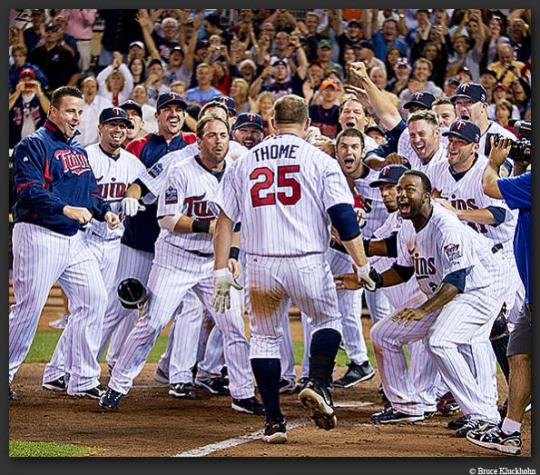
-
I'm not sure what you expect Jeff Smith to do to get control of this. A player behaved in a manner which was viewed as disrespectful and unacceptable from the top of the organization (Ryan) to the bottom (teammates and base coaches in the minors). I've yet to see a single account where Jeff Smith yelled at, screamed at, or publicly berated Sano. Everything I've seen said he talked with him, was displeased at the content of the conversation, had him talk with Ryan, and was given permission to suspend him. Let's not lose sight of this: Unless you're intent on seeing the Twins Organization as relentlessly anti-fun (there is some evidence to that view, I'm just not sure it's here), it doesn't appear Sano was suspended for pimping his home run. From my point of view, it looks like he was suspended for telling his manager (and possibly the GM) to pound sand. That'll earn you discipline in any organization-whether in sports or outside of it.
-
Article: Trading Perkins Makes Too Much Sense
Hugh Morris replied to twinstalker's topic in Twins Daily Front Page News
There are a variety of issues with the trade. First and foremost, the benefit of the trade (Shields) is around for two years. The Royals being in contention for the first of those 2 years was far from a sure thing (especially given a number of the stats others have shown you). Even if the offensive talent matures next year, you've still traded away 7 years of a player whose expected floor is in the .280/20HR range with adequate defense (and a ceiling well above that) for 2 years of a good-but-not-consistently-elite pitcher and you've wasted that first year. All of that said, it's a defensible gamble. If you believe that it was done in the best interests of the club. "This move was in the best interest of the longterm health of the Royals" is a minority view amongst those who covered the trade. "This move was done in the best interests of Dayton Moore not getting fired at the end of the year" would be the more accepted narrative for the chain of events. And it has substantial merit. Even if we're being charitable to Moore and assuming that the Royals saw something that soured them on Wil Meyers, the return could have been substantially more than 2 fairly high priced years of an inconsistent starter and a reclamation project out of the pen.
