



Cody Christie
-
Posts
7,515 -
Joined
-
Last visited
-
Days Won
5
Content Type
Profiles
News
Minnesota Twins Videos
2026 Minnesota Twins Top Prospects Ranking
2022 Minnesota Twins Draft Picks
Minnesota Twins Free Agent & Trade Rumors, Notes, & Tidbits
Guides & Resources
2023 Minnesota Twins Draft Picks
The Minnesota Twins Players Project
2024 Minnesota Twins Draft Picks
2025 Minnesota Twins Draft Pick Tracker
2026 Minnesota Twins Draft Tracker: Picks & Bonuses
Forums
Blogs
Events
Store
Downloads
Gallery
Everything posted by Cody Christie
-
Every year there are surprises and disappointments on any big league roster. Poor play and mounting injuries can impact any number of players. That's one of the reasons teams try to build a deep 40-man roster so they are able to stay in contention even when players don't perform up to expectations. Going into any season it can be tough to predict who is set up to play poorly and maybe it is an exercise in futility. When the end of the season comes around, feel free to shout me out on Twitter and tell me how wrong I was in relation to this year's "Twins Bust Candidates."Tyler Duffey, RHP Duffey pitched well for the while the Twins were still in the postseason hunt. He finished the year boasting a 5-1 record with a very respectable 3.10 ERA and a 1.31 WHIP. Call it the "Scott Diamond Effect" but it seems unlikely for him to keep up this pace into the 2016 campaign. He was never considered one the organization's top pitching prospects, as he averaged 7.4 SO/9 and a 3.73 ERA over four minor league seasons. Can the Twins get by with Duffey as a back of the rotation starter? Sure, he can fit into this role. Baseball Reference projects him to compile a 3.64 ERA and a 1.28 WHIP in just under 90 innings of work. Both of these totals would be better than his minor league track record and he hasn't exactly been lights out this spring as he works on his change-up. With top pitching prospect Jose Berrios in the wings, it seems likely that Duffey could find himself out of a starting spot at some point this season. Glen Perkins, LHP Perkins has made the All-Star Game in each of the last three seasons and he's even been asked to close out the game for the AL each of the last two years. However, the end of last season was a little rough for the Twins closer as he tried to play through an injury and posted some poor numbers along the way. World Series legend Jack Morris even hinted that Perkins might not exactly be in shape in a Twin Cities radio interview last year. While Perkins has been able to accumulate over 30 saves in each of the last three seasons, his other numbers have been on the decline. His first three years in the bullpen he posted a 2.45 ERA with a 1.06 WHIP and 10.2 SO/9. The last two years those numbers have declined to a 3.49 ERA, a 1.19 WHIP, and 9.1 SO/9. Perkins turned 33 at the beginning of March and the organization has a young core of bullpen arms working their way toward Target Field. If the recent trend continues, the team might have to look at other options. Kurt Suzuki, C Suzuki has been on the decline for most of the last year and a half so to say he will be a bust at this point in his career might not be too big of a stretch. After hitting .309/.365/.396 in his first 65 games with the Twins, he went on to hit .259/.323/.339 in the second half of 2014. Last season was even worse as he finished the year hitting .240/.296/.314 while taking a beating behind the plate. He had the lowest caught stealing percentage (15%) of any AL catcher with at least 600 innings behind the dish. The Twins had to add some depth to the catching ranks and they were able to do that this offseason. Minnesota has been clear that Suzuki is their starter and he should be to reward him for his work with the pitching staff over the last couple of years. However, John Ryan Murphy will likely start to play more frequently as the season progresses. This could help Suzuki's performance if he isn't out there for over 130 games but it's hard to know how much he has left in the tank. His days as a starting catcher could be coming to an end Who do you think is set-up to bust this season? Leave a COMMENT and start the discussion. Click here to view the article
-
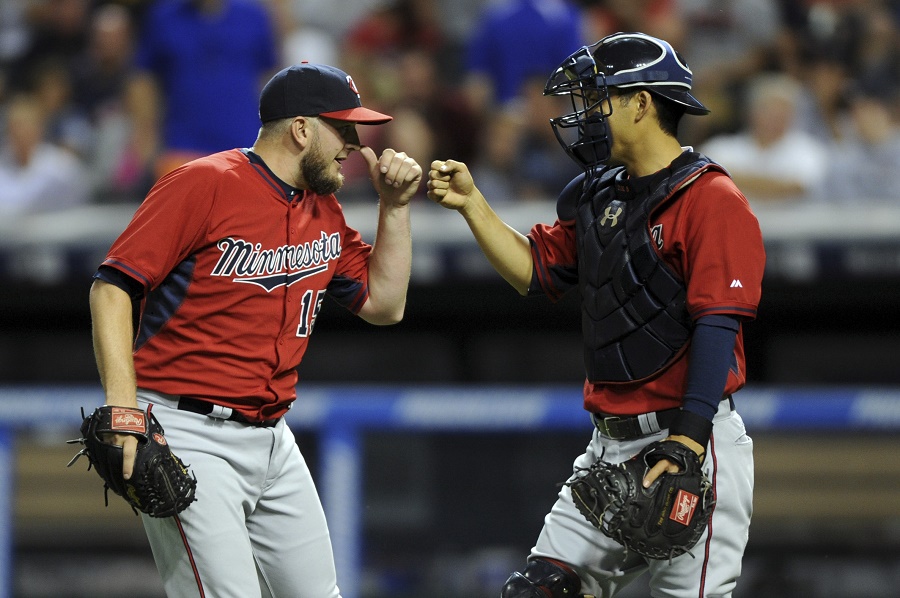 Tyler Duffey, RHP Duffey pitched well for the while the Twins were still in the postseason hunt. He finished the year boasting a 5-1 record with a very respectable 3.10 ERA and a 1.31 WHIP. Call it the "Scott Diamond Effect" but it seems unlikely for him to keep up this pace into the 2016 campaign. He was never considered one the organization's top pitching prospects, as he averaged 7.4 SO/9 and a 3.73 ERA over four minor league seasons. Can the Twins get by with Duffey as a back of the rotation starter? Sure, he can fit into this role. Baseball Reference projects him to compile a 3.64 ERA and a 1.28 WHIP in just under 90 innings of work. Both of these totals would be better than his minor league track record and he hasn't exactly been lights out this spring as he works on his change-up. With top pitching prospect Jose Berrios in the wings, it seems likely that Duffey could find himself out of a starting spot at some point this season. Glen Perkins, LHP Perkins has made the All-Star Game in each of the last three seasons and he's even been asked to close out the game for the AL each of the last two years. However, the end of last season was a little rough for the Twins closer as he tried to play through an injury and posted some poor numbers along the way. World Series legend Jack Morris even hinted that Perkins might not exactly be in shape in a Twin Cities radio interview last year. While Perkins has been able to accumulate over 30 saves in each of the last three seasons, his other numbers have been on the decline. His first three years in the bullpen he posted a 2.45 ERA with a 1.06 WHIP and 10.2 SO/9. The last two years those numbers have declined to a 3.49 ERA, a 1.19 WHIP, and 9.1 SO/9. Perkins turned 33 at the beginning of March and the organization has a young core of bullpen arms working their way toward Target Field. If the recent trend continues, the team might have to look at other options. Kurt Suzuki, C Suzuki has been on the decline for most of the last year and a half so to say he will be a bust at this point in his career might not be too big of a stretch. After hitting .309/.365/.396 in his first 65 games with the Twins, he went on to hit .259/.323/.339 in the second half of 2014. Last season was even worse as he finished the year hitting .240/.296/.314 while taking a beating behind the plate. He had the lowest caught stealing percentage (15%) of any AL catcher with at least 600 innings behind the dish. The Twins had to add some depth to the catching ranks and they were able to do that this offseason. Minnesota has been clear that Suzuki is their starter and he should be to reward him for his work with the pitching staff over the last couple of years. However, John Ryan Murphy will likely start to play more frequently as the season progresses. This could help Suzuki's performance if he isn't out there for over 130 games but it's hard to know how much he has left in the tank. His days as a starting catcher could be coming to an end Who do you think is set-up to bust this season? Leave a COMMENT and start the discussion.
 -
On Monday, the social media platform Twitter celebrated it's tenth birthday (Here's a link to the first tweet ever sent). In the last decade, Twitter has become one of the premier places for "Tweeters" to get instantaneous news and for the world to follow events in real-time. For baseball fans and all sports fans, Twitter has become an avenue for everyone to interact as events are playing out on the field. If a player messes up, you can call out the player as the event unfolds. If Miguel Sano sends one into the upper deck, you can let your followers know that you want to "Let It Sano in July!" Let's take a look down memory lane and find the initial tweets sent out by many of the accounts associated with the Twins organization.Account: Dave St. Peter (@TwinsPrez) Date of First Tweet: 3 Feb 2011 Pitchers/Catchers report in 2 wks. I report to Twitter tonight. Hope to have fun sharing info, answering ??? & talkin' baseball. Win Twins! — Dave St. Peter (@TwinsPrez) February 4, 2011 St. Peter has been very active with fans over the years and he's usually willing to answer questions and to help fans enjoy their experience with the Minnesota Twins. Account: Trevor Plouffe (@TPlouffe24) Date of First Tweet: 8 Dec 2011 First tweet ever. Breakfast with @gabekapler and @TylerSkaggs23. This should be interesting.... — Trevor Plouffe (@TPlouffe24) December 8, 2011 Plouffe's Twitter game has improved over the years much like his game on the field. Account: Glen Perkins (@GlenPerkins) Date of First Tweet: 23 Jun 2011 What is this thing? — Glen Perkins (@glenperkins) June 23, 2011 This might be my favorite first Tweet from any Twins player. Account: Brian Dozier (@Brian Dozier) Date of First Tweet: 22 Apr 2010 I'm now a tweeter thanks to Rae Rae whoop whoop — Brian Dozier (@BrianDozier) April 22, 2010 One of the longest tenured Twins players on Twitter and you can follow his on and off the field work. Account: Joe Mauer (Doesn't Have Twitter) Date of First Tweet: 16 Jul 2013 Joe Mauer: " This is my first tweet ever. Just want to say thank you to the fans for voting me into this years ASG. Never gets old." #ASG — MLB (@MLB) July 17, 2013 It might be good that he doesn't have a Twitter account at this point since there would be a lot of negativity thrown his way. Account: Phil Hughes (@PJHughes45) Date of First Tweet: 8 Mar 2011 What's up Twitter?!!! New to this shizzzz. Gimme some insight. Thanks! — Phil Hughes (@PJHughes45) March 8, 2011 "New to this shizzz" might be the best way to start your Twitter career. Account: Kyle Gibson (@kgib44) Date of First Tweet: 15 Jan 2011 working a youth camp today with justin masterson and my cousin austin. been fun so far and we have one more session to go! — Kyle Gibson (@kgib44) January 15, 2011 Very fitting that Gibson's first tweet was about something he was doing in the community. Account: Miguel Sano (@SanoMiguel) Date of First Tweet: 23 Apr 2013 Hello mi gente — Miguel Angel Sano (@SanoMiguel) April 23, 2013 My response to this would be "Feliz Navidad" because I don't know Spanish. Account: TC Bear Date of First Tweet: 18 Nov 2009 Hello twitter world! The bear is up and operational! More to follow! — TC Bear (@TC_00) November 18, 2009 The bear has been very operational over the years. There are tons of other first Tweets for current and former Twins but this is just a sampling. What's your favorite first Tweet? What was your first Tweet? (Use the link to find out). Leave a COMMENT to start the discussion. Click here to view the article
-
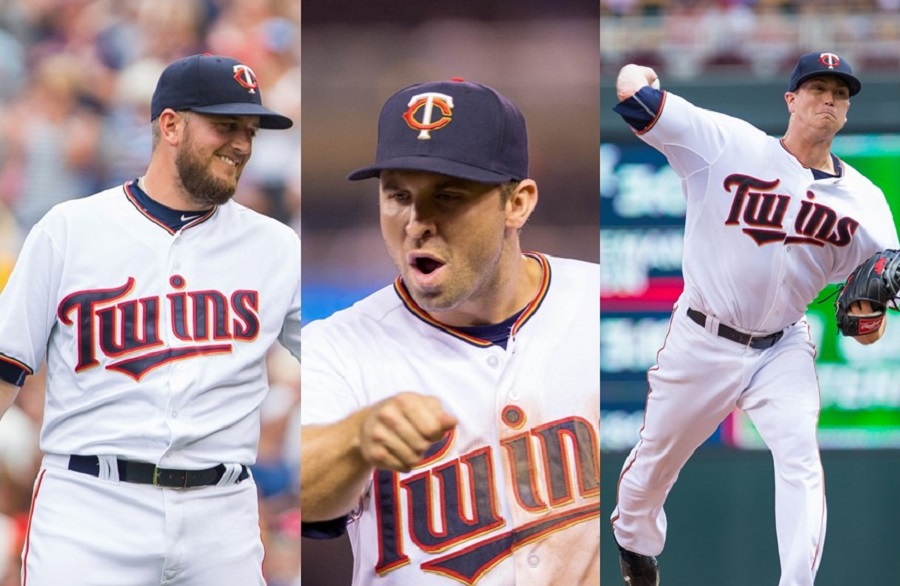 Account: Dave St. Peter (@TwinsPrez) Date of First Tweet: 3 Feb 2011 Pitchers/Catchers report in 2 wks. I report to Twitter tonight. Hope to have fun sharing info, answering ??? & talkin' baseball. Win Twins! — Dave St. Peter (@TwinsPrez) February 4, 2011 St. Peter has been very active with fans over the years and he's usually willing to answer questions and to help fans enjoy their experience with the Minnesota Twins. Account: Trevor Plouffe (@TPlouffe24) Date of First Tweet: 8 Dec 2011 First tweet ever. Breakfast with @gabekapler and @TylerSkaggs23. This should be interesting.... — Trevor Plouffe (@TPlouffe24) December 8, 2011 Plouffe's Twitter game has improved over the years much like his game on the field. Account: Glen Perkins (@GlenPerkins) Date of First Tweet: 23 Jun 2011 What is this thing? — Glen Perkins (@glenperkins) June 23, 2011 This might be my favorite first Tweet from any Twins player. Account: Brian Dozier (@Brian Dozier) Date of First Tweet: 22 Apr 2010 I'm now a tweeter thanks to Rae Rae whoop whoop — Brian Dozier (@BrianDozier) April 22, 2010 One of the longest tenured Twins players on Twitter and you can follow his on and off the field work. Account: Joe Mauer (Doesn't Have Twitter) Date of First Tweet: 16 Jul 2013 Joe Mauer: " This is my first tweet ever. Just want to say thank you to the fans for voting me into this years ASG. Never gets old." #ASG — MLB (@MLB) July 17, 2013 It might be good that he doesn't have a Twitter account at this point since there would be a lot of negativity thrown his way. Account: Phil Hughes (@PJHughes45) Date of First Tweet: 8 Mar 2011 What's up Twitter?!!! New to this shizzzz. Gimme some insight. Thanks! — Phil Hughes (@PJHughes45) March 8, 2011 "New to this shizzz" might be the best way to start your Twitter career. Account: Kyle Gibson (@kgib44) Date of First Tweet: 15 Jan 2011 working a youth camp today with justin masterson and my cousin austin. been fun so far and we have one more session to go! — Kyle Gibson (@kgib44) January 15, 2011 Very fitting that Gibson's first tweet was about something he was doing in the community. Account: Miguel Sano (@SanoMiguel) Date of First Tweet: 23 Apr 2013 Hello mi gente — Miguel Angel Sano (@SanoMiguel) April 23, 2013 My response to this would be "Feliz Navidad" because I don't know Spanish. Account: TC Bear Date of First Tweet: 18 Nov 2009 Hello twitter world! The bear is up and operational! More to follow! — TC Bear (@TC_00) November 18, 2009 The bear has been very operational over the years. There are tons of other first Tweets for current and former Twins but this is just a sampling. What's your favorite first Tweet? What was your first Tweet? (Use the link to find out). Leave a COMMENT to start the discussion.
 -
 In the summer of 2004, the Twins were in the midst of a run for their third straight AL Central crown. The sudden success on the field meant the club was in the routine of drafting later rather than earlier in the first round of baseball's amateur draft. That June the team focused on shortstop and a scrawny high schooler would be their first pick. Trevor Plouffe grew up in Southern California and was committed to the University of Southern California before the Twins came calling. He was listed as 6-foot-1 and 170 pounds but those might have been a little exaggerated if you look at this photo from shortly after he was drafted.Baseball America wrote this scouting report about Plouffe as he entered the draft. "He has a wiry frame, soft hands and fluid middle-infield actions in the mold of Robin Yount." They went on to say, "His range and arm strength are a notch below Matt Bush, the nation's top prep shortstop, but Plouffe may be a better hitter. He has a flatter swing path and the wrist action needed to drive balls." This prediction would turn out to be true as Bush and two other high school shortstops were taken before Plouffe in that draft. The aforementioned Bush was the first overall pick but he never made the big leagues and ended up serving prison time. Chris Nelson is a bench player who has accumulated a negative WAR over five seasons. Stephen Drew is the only one of the group with a higher WAR than Plouffe and he's played almost twice as many big league games. After being drafted by Minnesota, Plouffe moved through the system while being younger than the competition at every level. In his minor league career, he hit .258/.320/.405 (.725 OPS) while never hitting more than 15 home runs at any level. He made it to Triple-A by age 22 and would make his big league debut at the age of 24. There were plenty of struggles for Plouffe in his first taste of the big leagues. From 2010-2011, he hit .226/.286/.382 (.668 OPS) with 30 extra-base hits in over 360 plate appearances. He also struck out in 26% of his at-bats. His defense at shortstop was also rough, to say the least. According to defensive runs saved, he cost the Twins 14 runs in 2011 alone. Something needed to change. In the winter of 2012, the Twins decided to move Plouffe away from shortstop and shift him to the outfield. The club hoped the move would spark Plouffe much like it did for another first-round pick, Michael Cuddyer. However, he would only play 17 games there that season because Danny Valencia struggled at the plate and Minnesota needed someone for third base. Plouffe had found a new home. Flash-forward to the present day and Plouffe is now the second-longest tenured Twins player behind Joe Mauer. He has nestled himself nicely into a solid everyday regular with improved defense at third base while topping 20 home runs in two of the last four seasons. He also went on one of the most impressive home run tears in team history when he hit 10 home runs in a 14 game stretch during the 2012 campaign. In recent years, there has been rumblings about the possibility of Plouffe being traded to make room for star prospect Miguel Sano. Those rumors never came to fruition and Plouffe's strong defense at third means Sano will play in the outfield this coming season. Plouffe is under team control for the 2016 and 2017 seasons but that still doesn't mean the Twins won't consider moving him over the next handful of years. Minnesota surprised a lot of teams by contending in 2015 even while some of their young prospects were still trying to figure out baseball's highest level. Many feel the Twins will come back to the pack this season. If the Twins are out of the race in mid-July, Plouffe will likely hear his name on the trading block once again and it could make sense to deal him if the price is right. Plouffe has been part of some tough seasons in Minnesota with multiple 90-loss seasons marking the last handful of years. He has transformed from a first-round pick to a failed shortstop to an above average MLB regular. Minnesota stayed the course with Plouffe and it has paid off on the field and in the clubhouse. Click here to view the article
 -
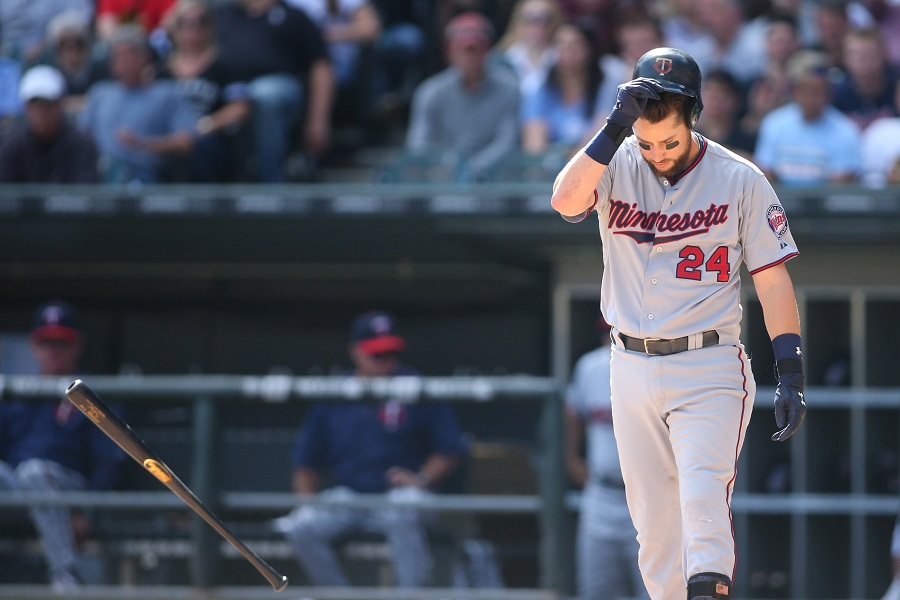 Baseball America wrote this scouting report about Plouffe as he entered the draft. "He has a wiry frame, soft hands and fluid middle-infield actions in the mold of Robin Yount." They went on to say, "His range and arm strength are a notch below Matt Bush, the nation's top prep shortstop, but Plouffe may be a better hitter. He has a flatter swing path and the wrist action needed to drive balls." This prediction would turn out to be true as Bush and two other high school shortstops were taken before Plouffe in that draft. The aforementioned Bush was the first overall pick but he never made the big leagues and ended up serving prison time. Chris Nelson is a bench player who has accumulated a negative WAR over five seasons. Stephen Drew is the only one of the group with a higher WAR than Plouffe and he's played almost twice as many big league games. After being drafted by Minnesota, Plouffe moved through the system while being younger than the competition at every level. In his minor league career, he hit .258/.320/.405 (.725 OPS) while never hitting more than 15 home runs at any level. He made it to Triple-A by age 22 and would make his big league debut at the age of 24. There were plenty of struggles for Plouffe in his first taste of the big leagues. From 2010-2011, he hit .226/.286/.382 (.668 OPS) with 30 extra-base hits in over 360 plate appearances. He also struck out in 26% of his at-bats. His defense at shortstop was also rough, to say the least. According to defensive runs saved, he cost the Twins 14 runs in 2011 alone. Something needed to change. In the winter of 2012, the Twins decided to move Plouffe away from shortstop and shift him to the outfield. The club hoped the move would spark Plouffe much like it did for another first-round pick, Michael Cuddyer. However, he would only play 17 games there that season because Danny Valencia struggled at the plate and Minnesota needed someone for third base. Plouffe had found a new home. Flash-forward to the present day and Plouffe is now the second-longest tenured Twins player behind Joe Mauer. He has nestled himself nicely into a solid everyday regular with improved defense at third base while topping 20 home runs in two of the last four seasons. He also went on one of the most impressive home run tears in team history when he hit 10 home runs in a 14 game stretch during the 2012 campaign. In recent years, there has been rumblings about the possibility of Plouffe being traded to make room for star prospect Miguel Sano. Those rumors never came to fruition and Plouffe's strong defense at third means Sano will play in the outfield this coming season. Plouffe is under team control for the 2016 and 2017 seasons but that still doesn't mean the Twins won't consider moving him over the next handful of years. Minnesota surprised a lot of teams by contending in 2015 even while some of their young prospects were still trying to figure out baseball's highest level. Many feel the Twins will come back to the pack this season. If the Twins are out of the race in mid-July, Plouffe will likely hear his name on the trading block once again and it could make sense to deal him if the price is right. Plouffe has been part of some tough seasons in Minnesota with multiple 90-loss seasons marking the last handful of years. He has transformed from a first-round pick to a failed shortstop to an above average MLB regular. Minnesota stayed the course with Plouffe and it has paid off on the field and in the clubhouse.
 -
Teams are always searching for the a way to get a leg up on the competition. Analyzing spray charts to find the right placement for outfielders, shifting infielders to the right side against a power hitting lefty, or bringing in a LOOGY (left-handed one out guy) in the late innings. Baseball continues to evolve and the teams changing the fastest seem to find more success. Possibly one of the biggest flaws under the Ron Gardenhire regime was his refusal to platoon hitters. For example, take a look at Danny Valencia's tenure in Minnesota. During his rookie year, the right-handed hitter managed to hit .280/.303/.410 against righties which is pretty good. In 2011, his numbers dropped as his OPS dipped to .626 against righties while he posted a .822 mark against lefties. Gardenhire could have taken advantage of Valencia's strength and played him against lefties while utilizing another option against right-handed starters.The Twins have an interesting opportunity facing them this season and it could be setting up to be a very nice platoon advantage for Paul Molitor. Byung Ho Park will almost assuredly make the team's 25-man roster when they head north. Oswaldo Arcia is out of options and it would make sense to have him at the disposal of the big league squad. Park is a right-handed batter and Arcia is a left-handed batter so the Twins might have a perfect solution. Arcia has been a very streaky hitter over the course of his career and that's one of the reasons the Twins let him toil in the minors for almost all of 2015. In nearly 100 minor league games last season, Arcia posted a .678 OPS versus righties which was 243 points higher than what he was able to do against lefties. This still wasn't that great as his OBP was under .280. In his time at the major league level, Arcia's splits are much better against right-handed hurlers. His OPS is almost 200 points higher against righties (.807 OPS vs. RHP) and only six of his 36 home runs have come against southpaws. Since Arcia has been a streaky hitter in the past, the best way to use him could be to get his at-bats exclusively against righties. Byung Ho Park will be facing a tough transition this season as he transitions from the KBO to the MLB level. Things have been going fairly well for him so far this spring but it's hard to take spring training numbers too seriously. Minnesota is going to want to take a long look at Park this season but his best option might be to step in more regularly against lefties. Last season, Park's batting average was 39 points higher against lefties and he posted a very respectable 24 to 21 strikeout to walk ratio. The right-handed slugger struck out 105 times in 343 at-bats versus righties. Park might be better suited to set-up more frequently against southpaws if the Twins want to avoid some of the struggles that come with transitioning from a foreign league. Overall, it seems more likely for the Twins to use Arcia in a role as fourth outfielder. This would allow him to get one or two starts a week and to step in if a player was injured. His bat coming off the bench would be a nice option but his time in Minnesota might be slowly sinking away. Park is going to get playing time this year as the club tries out their new acquisition. Molitor likely won't use a full platoon with Park and Arcia because this would mean playing Arcia more than Park since there are more right-handed pitchers in the baseball world. However, the team could benefit from giving Park the night off against tough lefties like Chris Sale and David Price. So, what do you think? Could the Twins take advantage of some platooning this season? Leave a COMMENT and start the discussion. Click here to view the article
-
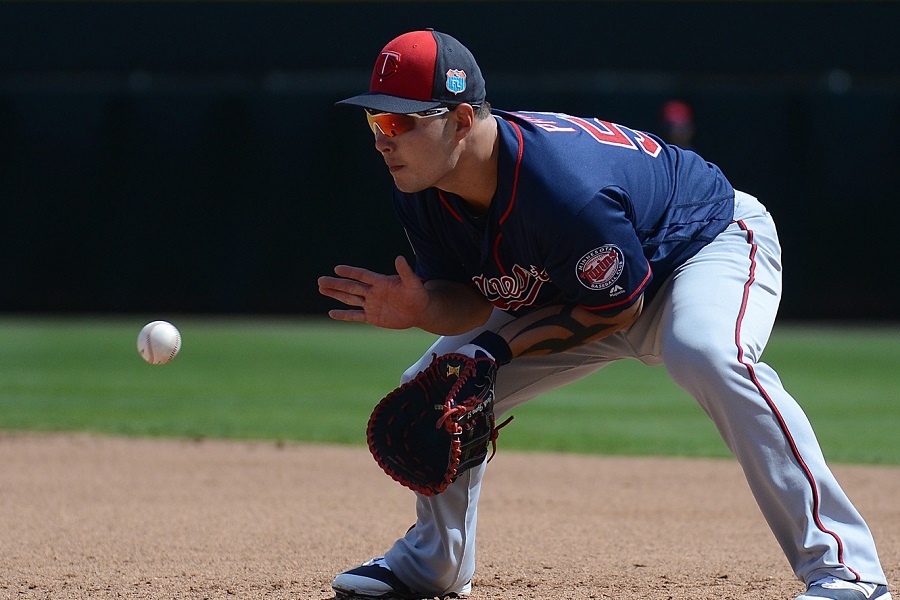 The Twins have an interesting opportunity facing them this season and it could be setting up to be a very nice platoon advantage for Paul Molitor. Byung Ho Park will almost assuredly make the team's 25-man roster when they head north. Oswaldo Arcia is out of options and it would make sense to have him at the disposal of the big league squad. Park is a right-handed batter and Arcia is a left-handed batter so the Twins might have a perfect solution. Arcia has been a very streaky hitter over the course of his career and that's one of the reasons the Twins let him toil in the minors for almost all of 2015. In nearly 100 minor league games last season, Arcia posted a .678 OPS versus righties which was 243 points higher than what he was able to do against lefties. This still wasn't that great as his OBP was under .280. In his time at the major league level, Arcia's splits are much better against right-handed hurlers. His OPS is almost 200 points higher against righties (.807 OPS vs. RHP) and only six of his 36 home runs have come against southpaws. Since Arcia has been a streaky hitter in the past, the best way to use him could be to get his at-bats exclusively against righties. Byung Ho Park will be facing a tough transition this season as he transitions from the KBO to the MLB level. Things have been going fairly well for him so far this spring but it's hard to take spring training numbers too seriously. Minnesota is going to want to take a long look at Park this season but his best option might be to step in more regularly against lefties. Last season, Park's batting average was 39 points higher against lefties and he posted a very respectable 24 to 21 strikeout to walk ratio. The right-handed slugger struck out 105 times in 343 at-bats versus righties. Park might be better suited to set-up more frequently against southpaws if the Twins want to avoid some of the struggles that come with transitioning from a foreign league. Overall, it seems more likely for the Twins to use Arcia in a role as fourth outfielder. This would allow him to get one or two starts a week and to step in if a player was injured. His bat coming off the bench would be a nice option but his time in Minnesota might be slowly sinking away. Park is going to get playing time this year as the club tries out their new acquisition. Molitor likely won't use a full platoon with Park and Arcia because this would mean playing Arcia more than Park since there are more right-handed pitchers in the baseball world. However, the team could benefit from giving Park the night off against tough lefties like Chris Sale and David Price. So, what do you think? Could the Twins take advantage of some platooning this season? Leave a COMMENT and start the discussion.
 -
It's the most wonderful time of the year. Well, baseball fans think it is the most wonderful time of the year because spring training workouts are in full swing, games are being played, and the first regular season action is right around the corner. With the beginning of the season, there comes a lot of prognostication as writers from across the baseball world attempt to select the division winners, award winners, and breakout players. Selecting rookie of the year candidates can be a tough accomplishment at this point in the season. Some teams might keep players in the minor leagues until later in the season to gain more team control. Other rookies might go back and forth between the high levels of the minors and the 25-man roster. By many accounts, Minnesota could have three players in the running for the top rookie player in the American League. Miguel Sano was a finalist for the award last season but finished in a distant third place. Each of the following players will be attempting to be the first Twin to take home the hardware since Marty Cordova in 1995. Jose Berrios Why He Should Win Berrios has been slowly creeping up national prospect lists as he has dominated the upper levels of the minor leagues over the last two seasons. Last year, he led the minors in strikeouts and many Twins fans were clamoring to see him debut while the team was still in postseason contention. Many eyes will be on him as he makes his debut so this could set-up for him to shine while being in the spotlight. Combine his outstanding control with a tenacious work ethic and there's a recipe for a breakout star waiting to happen. Why He Won't Win There's little chance he will start the year in the Twins rotation. Other players like Tyler Duffey, Tommy Milone, Trevor May, or even Ricky Nolasco could get a shot to start before Berrios. He's also not on the 40-man roster at this point so the Twins would need to make room for him before his debut. Minnesota will keep him in the minors until at least June to avoid the Super-2 deadline and pick up an extra year of service. Also, his innings have been limited in the past but the Twins have already said that he won't be limited this season. Byron Buxton Why He Should Win Buxton's name is well known in baseball circles as he has been considered one of baseball's top prospects since being drafted by the Twins. If he's able to show some offensive improvements, there's no doubt that the other parts of his overall game would carry him to this award. He has the potential to be a base-running threat and to be one of the best defensive center fielders in the game. If his name is on the ballot, there's a good chance that the national writers will strongly consider him for the honor on name recognition alone. Why He Won't Win His offensive skills didn't shine through during his first taste of the big leagues and his playing time was inconsistent since the Twins were in the thick of the playoff race. There's also a chance that Minnesota could start Buxton at Rochester to let him build some confidence to start the season. If he struggles again on the offensive side of the ball, it would be a challenge for him to earn this award. The name recognition is there but he would need to be capable with the bat in order to be considered one of the three finalists. Byung Ho Park Why He Should Win The Twins are going to want to give their new international signee as many opportunities as possible to be successful. This could mean the team will continue to play him even if he struggles. The Pirates Jung Ho Kang finished third in last year's National League Rookie of the Year balloting so the voters have recently considered a Korean for the top rookie honor. Park has shown tremendous power in Korea and the Twins hope he can translate that to the big league level. If he is putting up solid power numbers and playing on a consistent basis, he should be in the discussion by season's end. Why He Won't Win Transitioning from Korea to America can be a tough endeavor. There's a cultural and language barrier, plus the level of competition jumps significantly. Since the beginning of 2014, Park averaged over 150 strikeouts per season. He has struck out in over 30% of his at-bats. If that trend continues, or if he raises those marks, it might be hard for voters to take him seriously. Minnesota could use Park in a platoon with Oswaldo Arcia and that would also cut back on the number of at-bats he receives. Who do you think has the best shot at winning the award? Leave a COMMENT and start the discussion. Click here to view the article
- 25 replies
-
- 1
-

-
- byron buxton
- byungho park
- (and 2 more)
-
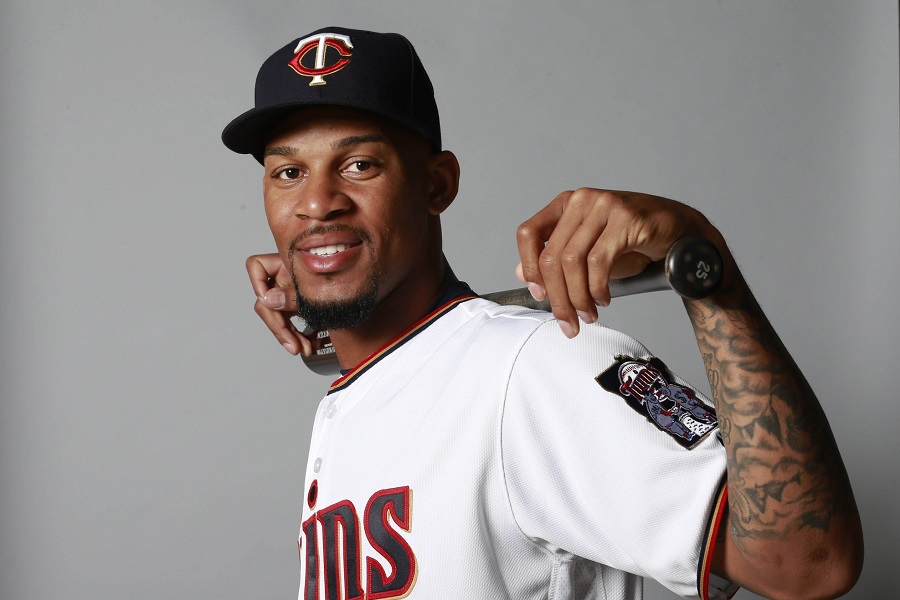 Jose Berrios Why He Should Win Berrios has been slowly creeping up national prospect lists as he has dominated the upper levels of the minor leagues over the last two seasons. Last year, he led the minors in strikeouts and many Twins fans were clamoring to see him debut while the team was still in postseason contention. Many eyes will be on him as he makes his debut so this could set-up for him to shine while being in the spotlight. Combine his outstanding control with a tenacious work ethic and there's a recipe for a breakout star waiting to happen. Why He Won't Win There's little chance he will start the year in the Twins rotation. Other players like Tyler Duffey, Tommy Milone, Trevor May, or even Ricky Nolasco could get a shot to start before Berrios. He's also not on the 40-man roster at this point so the Twins would need to make room for him before his debut. Minnesota will keep him in the minors until at least June to avoid the Super-2 deadline and pick up an extra year of service. Also, his innings have been limited in the past but the Twins have already said that he won't be limited this season. Byron Buxton Why He Should Win Buxton's name is well known in baseball circles as he has been considered one of baseball's top prospects since being drafted by the Twins. If he's able to show some offensive improvements, there's no doubt that the other parts of his overall game would carry him to this award. He has the potential to be a base-running threat and to be one of the best defensive center fielders in the game. If his name is on the ballot, there's a good chance that the national writers will strongly consider him for the honor on name recognition alone. Why He Won't Win His offensive skills didn't shine through during his first taste of the big leagues and his playing time was inconsistent since the Twins were in the thick of the playoff race. There's also a chance that Minnesota could start Buxton at Rochester to let him build some confidence to start the season. If he struggles again on the offensive side of the ball, it would be a challenge for him to earn this award. The name recognition is there but he would need to be capable with the bat in order to be considered one of the three finalists. Byung Ho Park Why He Should Win The Twins are going to want to give their new international signee as many opportunities as possible to be successful. This could mean the team will continue to play him even if he struggles. The Pirates Jung Ho Kang finished third in last year's National League Rookie of the Year balloting so the voters have recently considered a Korean for the top rookie honor. Park has shown tremendous power in Korea and the Twins hope he can translate that to the big league level. If he is putting up solid power numbers and playing on a consistent basis, he should be in the discussion by season's end. Why He Won't Win Transitioning from Korea to America can be a tough endeavor. There's a cultural and language barrier, plus the level of competition jumps significantly. Since the beginning of 2014, Park averaged over 150 strikeouts per season. He has struck out in over 30% of his at-bats. If that trend continues, or if he raises those marks, it might be hard for voters to take him seriously. Minnesota could use Park in a platoon with Oswaldo Arcia and that would also cut back on the number of at-bats he receives. Who do you think has the best shot at winning the award? Leave a COMMENT and start the discussion.
 -
Prospects can be quite the fickle crop of players. Some turn into All-Stars and others fall to the wayside before reaching their full potential. Developing baseball players from teenagers into young men is not an exact science. For every Byron Buxton and Miguel Sano, there will be a Joe Benson and an Alex Wimmers. When it comes to pitchers advancing through a minor league system, there can be plenty of ups and downs. A couple of weeks ago, I looked at the top three pitching prospects in the Twins organization to try and get a pulse on what their ceiling and floors were as they close in on Target Field. Each of these players has the potential to be a very important part of the Twins turnaround.Today, let's look at the top position players in the organization. Many of these top prospects have been or will be featured in the Twins Daily Top Prospect list. Byron Buxton and Max Kepler could see significant playing time at the big league level this season but Nick Gordon is a couple years away from making his debut. How high can this trio go? Or will they follow the path of Joe Benson and Alex Wimmers? Byron Buxton Ceiling: Buxton has been considered one of the top prospects in baseball since he was drafted with the number two overall pick. His defensive skills and base running would already rank him near the top of baseball world. There have been positive offensive signs during his professional career. He has shown more signs of power than what scouts thought during the drafting process and he has a professional approach at the plate. If Buxton can continue trending upward, he has the potential to be an all-star caliber outfielder with MVP potential. Ceiling Result: All-Star Five-Tool Outfielder Floor: Much of Buxton's high-ranking abilities come from his speed. Running down balls in center field and going from first to third on a single is a skill that can't be taught. Luckily, Buxton should be able to rely on his speed for multiple seasons especially as he continues to grow into his body. Buxton's lack of hitting ability in his big league debut was a little disconcerting. He's also been bitten by the injury bug more than once in his professional career. If he can't figure out how to make consistent contact and continues to get injured, it will be impossible for him to reach his potential. Floor Result: Plus Defensive Outfielder Nick Gordon Ceiling: When the Twins drafted Gordon, they knew of his family's baseball heritage. His father Tom, pitched for 20+ MLB seasons and his brother, Dee, has played in the last two All-Star Games. When players like Gordon grow up around baseball, there's a lot they can absorb about the game. Gordon spent all of 2015 in the Midwest League so he will likely spend most of 2016 with Fort Myers. Many believe he will be able to stick at shortstop long-term and there's hope that he will be able to develop more power as he reaches his early 20s. Gordon has things to work on but the potential and tools are all there. Ceiling Result: All-Star Top-of-the-Order Shortstop Floor: Gordon's brother eventually had to move away from shortstop to second base and this could be the eventual landing spot for the younger Gordon. His speed tool is less than his brother's so that is also something that could hold him back. At the plate, Gordon struggled in the first part of the season before hitting for a .763 OPS in the second half of the year. If his power doesn't develop, he is going to need to continue to keep up his on-base percentage and make better contact. There's a good chance he will become a big leaguer but maybe not the star the Twins were hoping to get. Floor Result: Solid Average MLB Regular Max Kepler Ceiling: Patience finally paid off when it came to Kepler. The Twins signed him the same summer as Miguel Sano and have been waiting patiently for him to develop into his athletic frame. Kepler put everything together last season to win the MVP of the Southern League and make his big league debut. He's played center field for most of his professional career so he should slide nicely into a corner outfield spot and be a plus defender at either of those positions. His power potential continues to increase and he has good base-running ability as well. He has the chance to be the first real baseball star from Europe. Ceiling Result: 20/20 All-Star Outfielder Floor: Kepler struggled through some injuries in his early professional career so it was good to see a healthy season from him in 2015. Injury concerns can reappear so it is something to monitor in 2016 and beyond. Some question if his power will continue to develop as he has hit double digits in home runs only once in his professional career (2012). His defense and on-base ability should help him to keep a starting job at the MLB level. However, if the Twins want someone with more power to take over his corner outfield spot, he could see his playing time start to diminish. Floor Result: Fourth Outfielder Which player has the better shot at reaching his ceiling? Are these floor results too optimistic? Leave a COMMENT and start the discussion. Click here to view the article
-
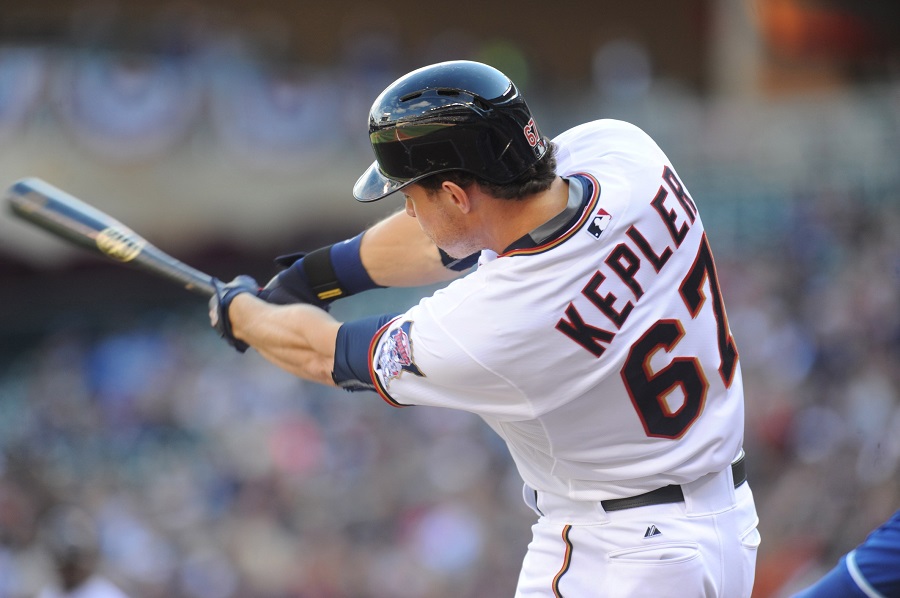 Today, let's look at the top position players in the organization. Many of these top prospects have been or will be featured in the Twins Daily Top Prospect list. Byron Buxton and Max Kepler could see significant playing time at the big league level this season but Nick Gordon is a couple years away from making his debut. How high can this trio go? Or will they follow the path of Joe Benson and Alex Wimmers? Byron Buxton Ceiling: Buxton has been considered one of the top prospects in baseball since he was drafted with the number two overall pick. His defensive skills and base running would already rank him near the top of baseball world. There have been positive offensive signs during his professional career. He has shown more signs of power than what scouts thought during the drafting process and he has a professional approach at the plate. If Buxton can continue trending upward, he has the potential to be an all-star caliber outfielder with MVP potential. Ceiling Result: All-Star Five-Tool Outfielder Floor: Much of Buxton's high-ranking abilities come from his speed. Running down balls in center field and going from first to third on a single is a skill that can't be taught. Luckily, Buxton should be able to rely on his speed for multiple seasons especially as he continues to grow into his body. Buxton's lack of hitting ability in his big league debut was a little disconcerting. He's also been bitten by the injury bug more than once in his professional career. If he can't figure out how to make consistent contact and continues to get injured, it will be impossible for him to reach his potential. Floor Result: Plus Defensive Outfielder Nick Gordon Ceiling: When the Twins drafted Gordon, they knew of his family's baseball heritage. His father Tom, pitched for 20+ MLB seasons and his brother, Dee, has played in the last two All-Star Games. When players like Gordon grow up around baseball, there's a lot they can absorb about the game. Gordon spent all of 2015 in the Midwest League so he will likely spend most of 2016 with Fort Myers. Many believe he will be able to stick at shortstop long-term and there's hope that he will be able to develop more power as he reaches his early 20s. Gordon has things to work on but the potential and tools are all there. Ceiling Result: All-Star Top-of-the-Order Shortstop Floor: Gordon's brother eventually had to move away from shortstop to second base and this could be the eventual landing spot for the younger Gordon. His speed tool is less than his brother's so that is also something that could hold him back. At the plate, Gordon struggled in the first part of the season before hitting for a .763 OPS in the second half of the year. If his power doesn't develop, he is going to need to continue to keep up his on-base percentage and make better contact. There's a good chance he will become a big leaguer but maybe not the star the Twins were hoping to get. Floor Result: Solid Average MLB Regular Max Kepler Ceiling: Patience finally paid off when it came to Kepler. The Twins signed him the same summer as Miguel Sano and have been waiting patiently for him to develop into his athletic frame. Kepler put everything together last season to win the MVP of the Southern League and make his big league debut. He's played center field for most of his professional career so he should slide nicely into a corner outfield spot and be a plus defender at either of those positions. His power potential continues to increase and he has good base-running ability as well. He has the chance to be the first real baseball star from Europe. Ceiling Result: 20/20 All-Star Outfielder Floor: Kepler struggled through some injuries in his early professional career so it was good to see a healthy season from him in 2015. Injury concerns can reappear so it is something to monitor in 2016 and beyond. Some question if his power will continue to develop as he has hit double digits in home runs only once in his professional career (2012). His defense and on-base ability should help him to keep a starting job at the MLB level. However, if the Twins want someone with more power to take over his corner outfield spot, he could see his playing time start to diminish. Floor Result: Fourth Outfielder Which player has the better shot at reaching his ceiling? Are these floor results too optimistic? Leave a COMMENT and start the discussion.
 -
Jorge Polanco has seen limited action with the Twins in each of the last two seasons. Minnesota's use of Polanco in 2015 was unique as he was brought up for one game last June, sent back to Double-A, promoted to Triple-A less than a month later, brought back to the majors for three games, and demoted to Chattanooga where he finished the season. He's in his final option year and the Twins need to figure out where he fits into their long-term puzzle.Age: 22 (DOB: 7/5/1993) 2015 Stats (Chattanooga/Rochester): .288/.339/.386 (.725) with 23-2B, 3-3B, 6-HR ETA: 2016 2014 Ranking: 8; 2015 Ranking: 7 National Top 100 Rankings BA: 99, MLB: 97, BP: NA What's To Like Polanco's bat has been close to major league-ready for a couple of seasons and he's only entering his age-22 season. There were some struggles during his early taste of professional baseball where he hit under .250 in 275 GCL at-bats. He has developed into a .288/.348/.404 hitter through his minor league career. Polanco has even started to be recognized on the national level this year as Baseball America (99), ESPN's Keith Law (66), and MLB.com (97) all have him in their top 100. Even though Minnesota has moved Polanco around a lot over the last two seasons, they wouldn't have done that if they didn't know the player could handle it. Many scouting reports peg him as a very smart player and he shows a lot of maturity even though he has been younger than the competition at every stop in his career. He's added some muscle to his frame over the last two seasons while continuing to be a good base runner. What's Left To Work On The Twins organization continues to play Polanco at shortstop even though he might not have all the skills for the position. Over the last two seasons, he has been charged with 65 errors at shortstop and he has a .932 fielding percentage for his minor league career. He's made some strides at the position but he projects to fit better at second base or even third base. Both of the Twins current players at those positions, Brian Dozier and Trevor Plouffe, started their careers as shortstops. Offensively, the switch-hitter has hit only one right-handed home run during the last two seasons. However, last season he did post identical .341 OBP marks versus righties and lefties. As he has advanced through the system, his OBP has dropped in each season since posting a career high mark of .388 in 2012. As he continues to mature into his body, it would be nice to see a rise in his some of his power numbers, turning into a double-digit home run hitter with some doubles added in. What's Next At this point, there's no spot for Polanco in Minnesota. Brian Dozier is entrenched at second base and the Twins have Trevor Plouffe and Miguel Sano to play at third. Polanco's best shot at the majors would be to slide into the starting shortstop role but Eduardo Escobar will likely start the year at that position. Unless an injury happens this spring, Polanco will start the year at Rochester and continue to play shortstop and second base. It seems like another year where Polanco could be moved back and forth between the minor leagues and the majors but he will be out of options for next season. This means Minnesota will have to trade one of their other starters or find a utility spot to keep Polanco on the roster. TD Top Prospect #10: Nick Burdi TD Top Prospect #9: Kohl Stewart TD Top Prospect #8: Alex Meyer TD Top Prospect #7: Jorge Polanco TD Top Prospect #6-#1: COMING SOON Click here to view the article
-
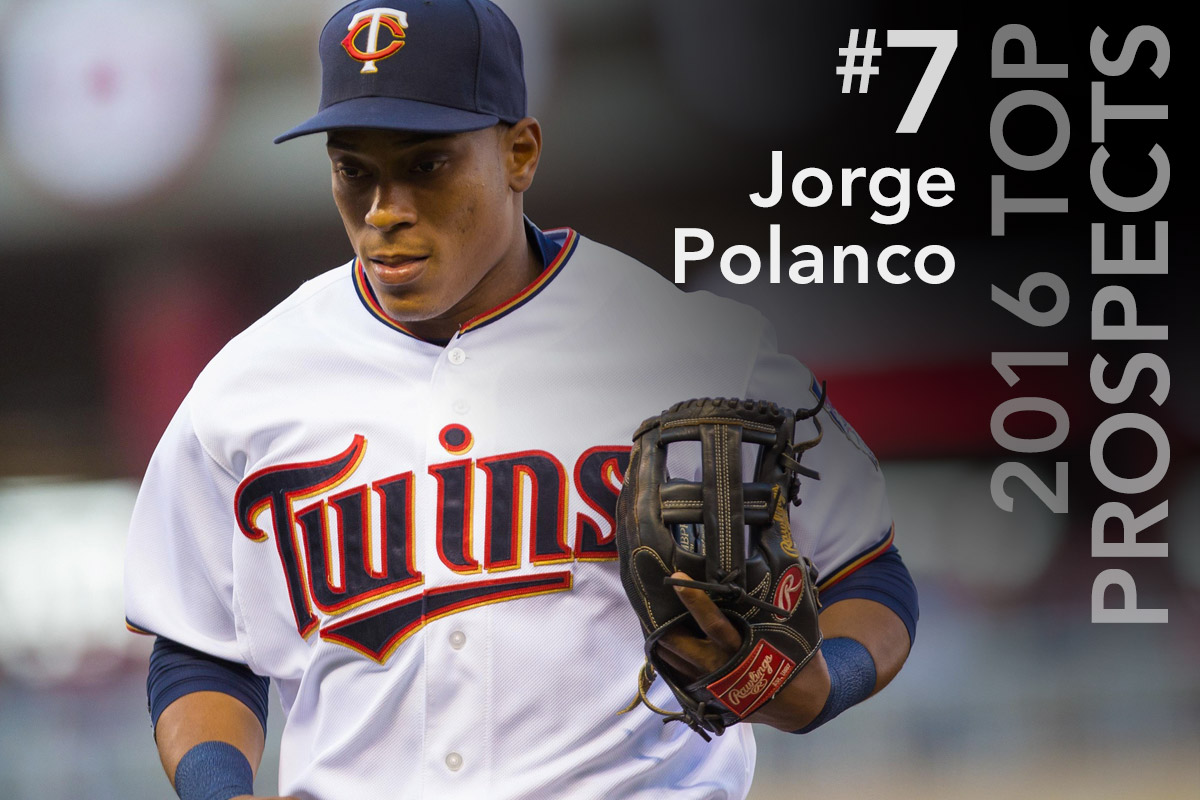 Age: 22 (DOB: 7/5/1993) 2015 Stats (Chattanooga/Rochester): .288/.339/.386 (.725) with 23-2B, 3-3B, 6-HR ETA: 2016 2014 Ranking: 8; 2015 Ranking: 7 National Top 100 Rankings BA: 99, MLB: 97, BP: NA What's To Like Polanco's bat has been close to major league-ready for a couple of seasons and he's only entering his age-22 season. There were some struggles during his early taste of professional baseball where he hit under .250 in 275 GCL at-bats. He has developed into a .288/.348/.404 hitter through his minor league career. Polanco has even started to be recognized on the national level this year as Baseball America (99), ESPN's Keith Law (66), and MLB.com (97) all have him in their top 100. Even though Minnesota has moved Polanco around a lot over the last two seasons, they wouldn't have done that if they didn't know the player could handle it. Many scouting reports peg him as a very smart player and he shows a lot of maturity even though he has been younger than the competition at every stop in his career. He's added some muscle to his frame over the last two seasons while continuing to be a good base runner. What's Left To Work On The Twins organization continues to play Polanco at shortstop even though he might not have all the skills for the position. Over the last two seasons, he has been charged with 65 errors at shortstop and he has a .932 fielding percentage for his minor league career. He's made some strides at the position but he projects to fit better at second base or even third base. Both of the Twins current players at those positions, Brian Dozier and Trevor Plouffe, started their careers as shortstops. Offensively, the switch-hitter has hit only one right-handed home run during the last two seasons. However, last season he did post identical .341 OBP marks versus righties and lefties. As he has advanced through the system, his OBP has dropped in each season since posting a career high mark of .388 in 2012. As he continues to mature into his body, it would be nice to see a rise in his some of his power numbers, turning into a double-digit home run hitter with some doubles added in. What's Next At this point, there's no spot for Polanco in Minnesota. Brian Dozier is entrenched at second base and the Twins have Trevor Plouffe and Miguel Sano to play at third. Polanco's best shot at the majors would be to slide into the starting shortstop role but Eduardo Escobar will likely start the year at that position. Unless an injury happens this spring, Polanco will start the year at Rochester and continue to play shortstop and second base. It seems like another year where Polanco could be moved back and forth between the minor leagues and the majors but he will be out of options for next season. This means Minnesota will have to trade one of their other starters or find a utility spot to keep Polanco on the roster. TD Top Prospect #10: Nick Burdi TD Top Prospect #9: Kohl Stewart TD Top Prospect #8: Alex Meyer TD Top Prospect #7: Jorge Polanco TD Top Prospect #6-#1: COMING SOON
 -
An annual ritual for many baseball fans is the release of the Baseball Prospectus Handbook. It has in-depth coverage for every MLB franchise and commentary on almost 2,000 players. For some fans, this is the "Baseball Bible" for the coming season as they try to gain an advantage in the fantasy baseball realm or just want to know more about the sport they love. I was a first time buyer this season and was surprised to see how big the almost 600-page book was when it arrived at my home. After marveling at it's size, I quickly paged open to the Minnesota Twins section of the book. Twins Territory is flying high after last season so I was ready to read great reviews about the little team that could in 2015. I was wrong. In fact as I flipped through the pages, a thought started to creep into my head. What if the Twins system is broken?It's no secret that the Twins aren't exactly at the forefront of the analytic-driven baseball universe. In fact, Minnesota might be one of the organizations that is furthest behind when it comes to using analytics to drive front office decision- making. Under the Terry Ryan regime, the way teams are built is through player development and acquisitions. Last spring, the folks at Baseball Prospectus attempted to name "Every Team's Moneyball." This series looked to identify the one area team's use to gain an advantage over other clubs. Spoiler alert: The Twins don't have a "Moneyball" strategy. With Ryan at the helm, they are attempting to use scouting and player development because that's the strategy that worked with the Twins teams of the 2000s. Player Development Developing prospects is challenging since there's no magic formula to turn a budding prospect into a contributor at the big league level. Miguel Sano's talent was hard to deny even as the organization signed him as a teenager. Sano's rookie campaign was great but he's got a lot left to prove before he can solidify himself at baseball's highest level. For every one Miguel Sano story, there are going to be other young players that aren't able to make consistent contributions. Oswaldo Arcia was ranked highly on many Twins prospect lists and he even hit 20 home runs in 2014. Last year, he was limited to 19 MLB games and the team didn't even get a September call-up. Like Arcia, fans were excited by Danny Santana and Kennys Vargas in their rookie seasons. Each of these players has shown their flaws with more big league time. Players like Byron Buxton, Jose Berrios, and Max Kepler haven't played enough at the big league level to grade the organization on the players' development. Kepler made major strides last season and Berrios continues to look like the real deal. If Buxton can become the player most think he will be, the Twins system might be back on the right track. Free Agent Acquisitions In the last handful of seasons, the Twins have signed some of their richest free agent deals in team history. Ricky Nolasco and Phil Hughes were brought into the fold during the 2014 offseason. Nolasco's four-year deal is looking like a disaster after two seasons. Hughes had a record breaking first season in Minnesota but the Twins decided to reward him with an extension and he came back down to earth in 2015. Kurt Suzuki fits into the same mold as Hughes. He was selected to the AL All-Star team and the Twins signed him to an extension before seeing a drop in production in 2015. Ervin Santana signed last offseason and the team quickly found out that he would be suspended for the season's first 80 games. Santana's second half was up and down and fans will have to reevaluate his signing after a full campaign. Other teams might have looked at Suzuki and Hughes and known that their age and previous track records were more indicative of their future performance. Trading those players at a the peak of their value could have brought other assets into the organization. This offseason Minnesota has been much quieter on the free agent market and this could be a result of some of their decisions over the last two years. Trades Aaron Hicks was starting to look like a player to be filed in the failed prospect development department. This was before the 2015 season where he finally looked like he might be able to contribute on a regular basis. With the Suzuki situation mentioned above and top catching prospects at least a year away, the Twins needed to add some catching depth. Minnesota dealt Hicks to the Yankees for catcher John Ryan Murphy. Murphy could be a huge piece for the Twins moving forward but only time will tell about what he can do in Minnesota. Minnesota surprised a lot of the baseball world by being in contention around last year's trade deadline. To help bolster their bullpen, Ryan dealt Chih-Wei Hu and Alexi Tapia to the Rays for Kevin Jepsen. With closer Glen Perkins dealing with injuries, Jepsen was asked to take over the closing duties. He led the American League in appearances and he will be a vital part of the Twins 2016 bullpen. With Sano's emergence, there has been plenty of talk about trading current third baseman Trevor Plouffe. Minnesota doesn't seem to be in a hurry as Sano will be relegated to outfield duty this year and Plouffe can't be a free agent until 2018. There still might be a future trade involving Plouffe and maybe Ryan is waiting to get the right kind of value in return. At this point, it seems tough to know if the Twins system is broken. Ryan has been back at the helm for four years and the picture is still being painted. Can a core of Buxton, Sano and Berrios be the team that brings a title back to Minnesota? Only time will tell. Click here to view the article
-
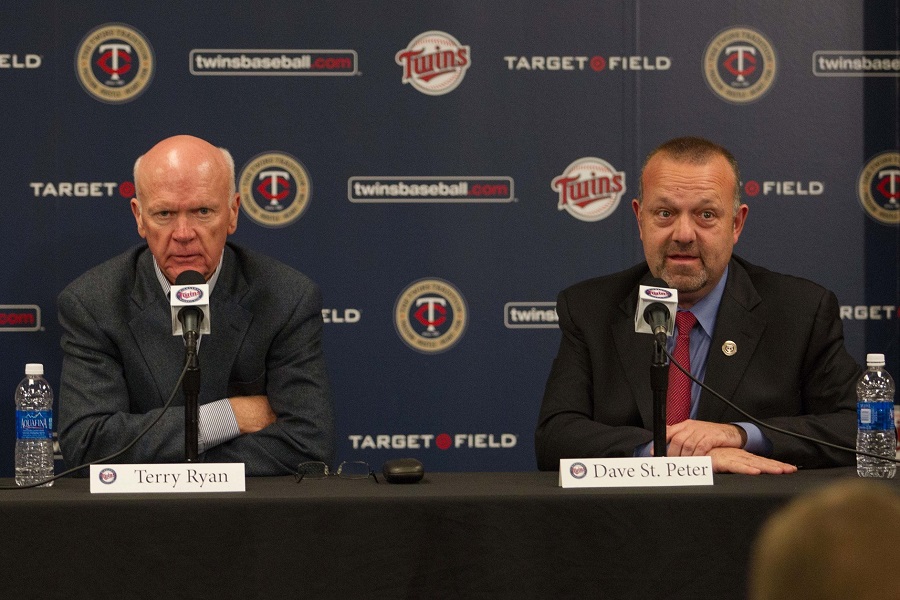 It's no secret that the Twins aren't exactly at the forefront of the analytic-driven baseball universe. In fact, Minnesota might be one of the organizations that is furthest behind when it comes to using analytics to drive front office decision- making. Under the Terry Ryan regime, the way teams are built is through player development and acquisitions. Last spring, the folks at Baseball Prospectus attempted to name "Every Team's Moneyball." This series looked to identify the one area team's use to gain an advantage over other clubs. Spoiler alert: The Twins don't have a "Moneyball" strategy. With Ryan at the helm, they are attempting to use scouting and player development because that's the strategy that worked with the Twins teams of the 2000s. Player Development Developing prospects is challenging since there's no magic formula to turn a budding prospect into a contributor at the big league level. Miguel Sano's talent was hard to deny even as the organization signed him as a teenager. Sano's rookie campaign was great but he's got a lot left to prove before he can solidify himself at baseball's highest level. For every one Miguel Sano story, there are going to be other young players that aren't able to make consistent contributions. Oswaldo Arcia was ranked highly on many Twins prospect lists and he even hit 20 home runs in 2014. Last year, he was limited to 19 MLB games and the team didn't even get a September call-up. Like Arcia, fans were excited by Danny Santana and Kennys Vargas in their rookie seasons. Each of these players has shown their flaws with more big league time. Players like Byron Buxton, Jose Berrios, and Max Kepler haven't played enough at the big league level to grade the organization on the players' development. Kepler made major strides last season and Berrios continues to look like the real deal. If Buxton can become the player most think he will be, the Twins system might be back on the right track. Free Agent Acquisitions In the last handful of seasons, the Twins have signed some of their richest free agent deals in team history. Ricky Nolasco and Phil Hughes were brought into the fold during the 2014 offseason. Nolasco's four-year deal is looking like a disaster after two seasons. Hughes had a record breaking first season in Minnesota but the Twins decided to reward him with an extension and he came back down to earth in 2015. Kurt Suzuki fits into the same mold as Hughes. He was selected to the AL All-Star team and the Twins signed him to an extension before seeing a drop in production in 2015. Ervin Santana signed last offseason and the team quickly found out that he would be suspended for the season's first 80 games. Santana's second half was up and down and fans will have to reevaluate his signing after a full campaign. Other teams might have looked at Suzuki and Hughes and known that their age and previous track records were more indicative of their future performance. Trading those players at a the peak of their value could have brought other assets into the organization. This offseason Minnesota has been much quieter on the free agent market and this could be a result of some of their decisions over the last two years. Trades Aaron Hicks was starting to look like a player to be filed in the failed prospect development department. This was before the 2015 season where he finally looked like he might be able to contribute on a regular basis. With the Suzuki situation mentioned above and top catching prospects at least a year away, the Twins needed to add some catching depth. Minnesota dealt Hicks to the Yankees for catcher John Ryan Murphy. Murphy could be a huge piece for the Twins moving forward but only time will tell about what he can do in Minnesota. Minnesota surprised a lot of the baseball world by being in contention around last year's trade deadline. To help bolster their bullpen, Ryan dealt Chih-Wei Hu and Alexi Tapia to the Rays for Kevin Jepsen. With closer Glen Perkins dealing with injuries, Jepsen was asked to take over the closing duties. He led the American League in appearances and he will be a vital part of the Twins 2016 bullpen. With Sano's emergence, there has been plenty of talk about trading current third baseman Trevor Plouffe. Minnesota doesn't seem to be in a hurry as Sano will be relegated to outfield duty this year and Plouffe can't be a free agent until 2018. There still might be a future trade involving Plouffe and maybe Ryan is waiting to get the right kind of value in return. At this point, it seems tough to know if the Twins system is broken. Ryan has been back at the helm for four years and the picture is still being painted. Can a core of Buxton, Sano and Berrios be the team that brings a title back to Minnesota? Only time will tell.
 -
Many of the national prospect lists have been filtering out in the last handful of weeks. With these lists comes plenty of debate. Seth tried to sort through some of the lists to gain some clarity but there will always be people who don't agree on which prospects should be ranked higher than others. In the end, it doesn't matter how high players are ranked if they don't consistently produce at the big league level. It's great that Byron Buxton is considered one of the best prospects but he needs to put all of his tools together to become the player most pundits believe he can be.Pitching prospects can be tough to project. As Baseball Prospectus famously coined, "there's no such thing as a pitching prospect" because of how unpredictable pitching prospects can be. Twins fans have seen this first hand over the last couple years as top pitching prospect Alex Meyer has gone from possible frontline starter to being relegated to the bullpen. Three of the biggest pitching prospects in the Twins system are Jose Berrios, Kohl Stewart, and Tyler Jay. They have all been first-round picks since 2012 and each one is at a different part of the development process. Berrios is on the verge of his big league debut and Stewart and Jay each have things left to accomplish in the minor leagues. Each of these players has a high ceiling but how high can they go? Or will any of them follow the path followed by Alex Meyer over the last couple of seasons? Jose Berrios Ceiling: Berrios has put together back-to-back strong seasons in the highest levels of the Twins farms system to make him the second highest ranked prospect in the Twins system. His control is one of his strongest assets and MLB.com recently ranked him as having the best control of any pitching prospect. He limited his walks to just 38 last season in 166.1 innings while leading the minors with 175 strikeouts. He's been very young for each level while consistently playing better than the competition. Combine all of this with his impressive curveball and change-up and you have the recipe for a top of the line starter. Ceiling: Front line starter Floor: There have been questions about his height since the Twins drafted him in 2012. He's slowly been able to convince some of his doubters with his on field performance. There's still no guarantee that he will be able to perform on baseball's biggest stage. Getting major league hitters out on a regular basis is much different than minor league hitters even if they are playing at Triple-A. As a worst case scenario, Berrios could only be good enough to be in the back of the rotation. Floor: Back-end of the rotation starter Kohl Stewart Ceiling: Stewart provides the Twins with an interesting case. When the team took him with the fourth pick in the 2013 draft, Stewart was a multi-sport high school athlete. His entire focus hadn't been on pitching until he joined the Twins organization. Now with two full seasons under his belt, Stewart is learning his craft as a pitcher. He's been very good at coaxing groundballs throughout his career and this is a very useful skill at the big league level. His body type and skill set could add up to be a workhorse in the rotation while consistently pitching 200 innings or more. Ceiling: Frontline starter Floor: The strikeouts haven't been there for Stewart as he has moved through the Twins system. He's been at least two and a half years younger than the competition at each level but he has a a skill set that would be nice to see in a starting pitcher. There were some brief injury concerns in 2014 but most of those were behind him in 2015. He also needs to get more use out of his change-up as he continues to get closer to the big league level. If needed, the other two pitchers on this list could end up as very good bullpen options but Stewart might not fit that mold because of his lack of strikeouts. Floor: Long reliever Tyler Jay Ceiling: Jay was a relief pitcher for most of his college career but the Twins liked his stuff enough to use the number six overall pick on him. Minnesota will attempt to transition the left-handed hurler from shutdown bullpen arm to effective starting pitcher. With his fastball and slider combination, the Twins could probably use him in the bullpen this season. That isn't going to happen as the club will monitor his innings closely and begin his starting pitching duties in the Florida State League. If Jay fails in the transition to starting pitcher, he will make a very good bullpen arm. Ceiling: Mid-rotation starter or shutdown left-handed relief pitcher Floor: It's hard to know how Jay will adjust to his new role as starter. The Twins obviously think he can make the switch otherwise they wouldn't have drafted him as high as they did. Unlike Berrios and Stewart, Jay has a proven track record at the collegiate level which means the Twins know more of what kind of asset they have in him. The starting experiment might end up being a total bust but with his top two pitches, he will find success in a bullpen role. Floor: Long reliever Which pitcher has the brighter future? Which pitcher will be able to reach their ceiling? Leave a COMMENT and start the discussion. Click here to view the article
-
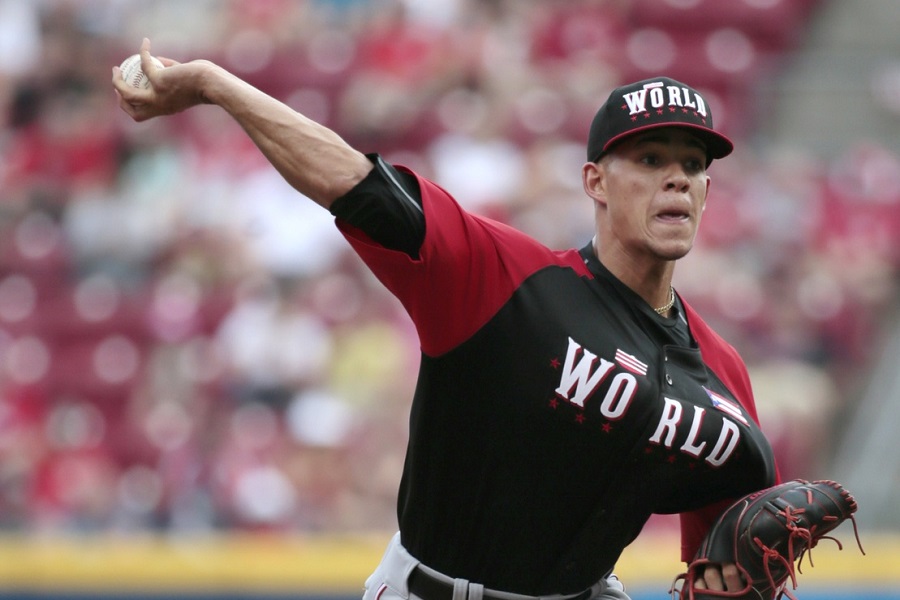 Pitching prospects can be tough to project. As Baseball Prospectus famously coined, "there's no such thing as a pitching prospect" because of how unpredictable pitching prospects can be. Twins fans have seen this first hand over the last couple years as top pitching prospect Alex Meyer has gone from possible frontline starter to being relegated to the bullpen. Three of the biggest pitching prospects in the Twins system are Jose Berrios, Kohl Stewart, and Tyler Jay. They have all been first-round picks since 2012 and each one is at a different part of the development process. Berrios is on the verge of his big league debut and Stewart and Jay each have things left to accomplish in the minor leagues. Each of these players has a high ceiling but how high can they go? Or will any of them follow the path followed by Alex Meyer over the last couple of seasons? Jose Berrios Ceiling: Berrios has put together back-to-back strong seasons in the highest levels of the Twins farms system to make him the second highest ranked prospect in the Twins system. His control is one of his strongest assets and MLB.com recently ranked him as having the best control of any pitching prospect. He limited his walks to just 38 last season in 166.1 innings while leading the minors with 175 strikeouts. He's been very young for each level while consistently playing better than the competition. Combine all of this with his impressive curveball and change-up and you have the recipe for a top of the line starter. Ceiling: Front line starter Floor: There have been questions about his height since the Twins drafted him in 2012. He's slowly been able to convince some of his doubters with his on field performance. There's still no guarantee that he will be able to perform on baseball's biggest stage. Getting major league hitters out on a regular basis is much different than minor league hitters even if they are playing at Triple-A. As a worst case scenario, Berrios could only be good enough to be in the back of the rotation. Floor: Back-end of the rotation starter Kohl Stewart Ceiling: Stewart provides the Twins with an interesting case. When the team took him with the fourth pick in the 2013 draft, Stewart was a multi-sport high school athlete. His entire focus hadn't been on pitching until he joined the Twins organization. Now with two full seasons under his belt, Stewart is learning his craft as a pitcher. He's been very good at coaxing groundballs throughout his career and this is a very useful skill at the big league level. His body type and skill set could add up to be a workhorse in the rotation while consistently pitching 200 innings or more. Ceiling: Frontline starter Floor: The strikeouts haven't been there for Stewart as he has moved through the Twins system. He's been at least two and a half years younger than the competition at each level but he has a a skill set that would be nice to see in a starting pitcher. There were some brief injury concerns in 2014 but most of those were behind him in 2015. He also needs to get more use out of his change-up as he continues to get closer to the big league level. If needed, the other two pitchers on this list could end up as very good bullpen options but Stewart might not fit that mold because of his lack of strikeouts. Floor: Long reliever Tyler Jay Ceiling: Jay was a relief pitcher for most of his college career but the Twins liked his stuff enough to use the number six overall pick on him. Minnesota will attempt to transition the left-handed hurler from shutdown bullpen arm to effective starting pitcher. With his fastball and slider combination, the Twins could probably use him in the bullpen this season. That isn't going to happen as the club will monitor his innings closely and begin his starting pitching duties in the Florida State League. If Jay fails in the transition to starting pitcher, he will make a very good bullpen arm. Ceiling: Mid-rotation starter or shutdown left-handed relief pitcher Floor: It's hard to know how Jay will adjust to his new role as starter. The Twins obviously think he can make the switch otherwise they wouldn't have drafted him as high as they did. Unlike Berrios and Stewart, Jay has a proven track record at the collegiate level which means the Twins know more of what kind of asset they have in him. The starting experiment might end up being a total bust but with his top two pitches, he will find success in a bullpen role. Floor: Long reliever Which pitcher has the brighter future? Which pitcher will be able to reach their ceiling? Leave a COMMENT and start the discussion.
 -
Using a round bat to hit a round ball is one of the hardest skills to master in professional sports. It takes the right combination of hand-eye coordination to be considered one of the best hitters in the game. Joe Mauer had been one of those hitters.Mauer's on-field performance has been on the decline since a concussion in 2013 and the resulting symptoms related to that brain injury. There may finally be some clarity to the situation as Mauer admitted to the Pioneer Press that symptoms from 2013 continued to plague him even last season. In the story, Mauer describes that he suffered from blurred vision that was triggered by bright light. Mauer said the vision issues only happened occasionally and later in the article he implies that he didn't let the coaches or front office know about his vision concerns. Mauer feels like he is starting to get a handle on things as he has been symptom-free for three months. He is still going to try and play with sunglasses during spring training to see if he can do a better job at picking up the ball and solve some of his vision issues. Last season in day games, he hit .248/.316/.354 with 44 strikeouts in 226 plate appearances. His numbers in night games were better even if they weren't at the level of a pre-concussion Mauer. Over 366 night time at-bats, he hit .276/.352/.396 with 68 strikeouts. This meant he was striking out in 19.5% of his day game at-bats and 18.6% of his night game at-bats. During the 2013 campaign (the season of his concussion), Mauer had a higher OBP and SLG during day games. Over 173 at-bats that season, he hit .318/.411/.480 with 40 strikeouts. At night his batting average was nine points higher but his OPS was 18 points lower. His concussion would cause him to miss the season's last six weeks but he was still awarded the Silver Slugger as the best hitting catcher in the American League. There are plenty of fans who have been tough on Mauer as he transitioned to first base and tried to overcome his concussion issues. That same group would probably wonder why Mauer didn't let the coaches or front office know about his symptoms. However, he likely wasn't hurting the team by playing. He had the second highest OBP on the team behind Miguel Sano who only played in half the team's games. So what's next? Mauer is entering his age-33 season and most players see some decline as they start to creep further into their 30s. Mauer did set career highs in games played (158) and at-bats (666) so he was playing through the symptoms even though his performance was suffering. The sunglasses might be at least a partial solution to help with pitch tracking. It's also easy to envision a scenario where Mauer will feel like they are messing with his routine at the plate. In the article, he even refers to his batting box routine as "weird." It doesn't seem like a batting champion version of Mauer will rise from the ashes this season but with some new exercises and a pair of sunglasses, there's hope for Mauer to cut back on strikeouts and hit closer to his career average of .313. Spring training is all about hope and there seems to be more hope now that Mauer will be more successful at using the round bat to hit the round ball. Click here to view the article
-
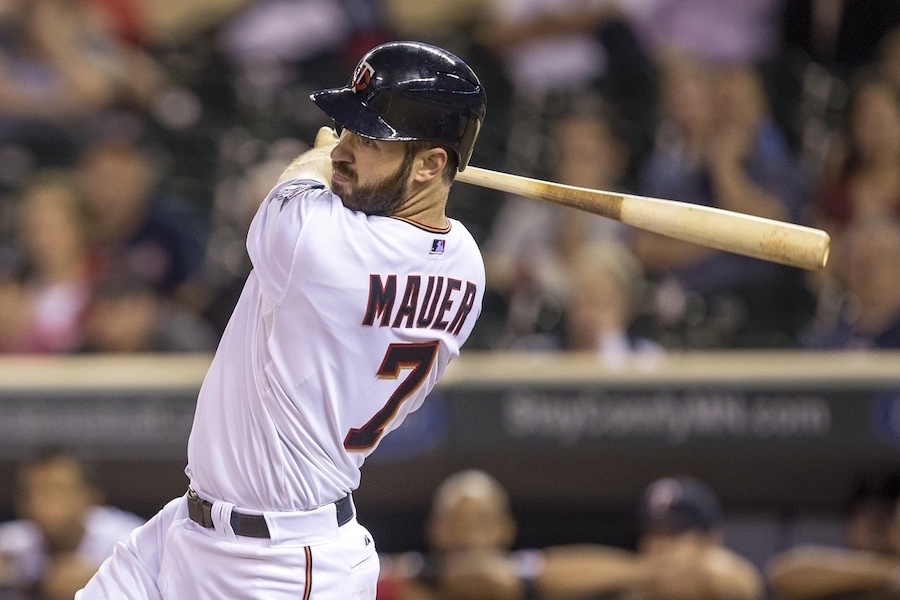 Mauer's on-field performance has been on the decline since a concussion in 2013 and the resulting symptoms related to that brain injury. There may finally be some clarity to the situation as Mauer admitted to the Pioneer Press that symptoms from 2013 continued to plague him even last season. In the story, Mauer describes that he suffered from blurred vision that was triggered by bright light. Mauer said the vision issues only happened occasionally and later in the article he implies that he didn't let the coaches or front office know about his vision concerns. Mauer feels like he is starting to get a handle on things as he has been symptom-free for three months. He is still going to try and play with sunglasses during spring training to see if he can do a better job at picking up the ball and solve some of his vision issues. Last season in day games, he hit .248/.316/.354 with 44 strikeouts in 226 plate appearances. His numbers in night games were better even if they weren't at the level of a pre-concussion Mauer. Over 366 night time at-bats, he hit .276/.352/.396 with 68 strikeouts. This meant he was striking out in 19.5% of his day game at-bats and 18.6% of his night game at-bats. During the 2013 campaign (the season of his concussion), Mauer had a higher OBP and SLG during day games. Over 173 at-bats that season, he hit .318/.411/.480 with 40 strikeouts. At night his batting average was nine points higher but his OPS was 18 points lower. His concussion would cause him to miss the season's last six weeks but he was still awarded the Silver Slugger as the best hitting catcher in the American League. There are plenty of fans who have been tough on Mauer as he transitioned to first base and tried to overcome his concussion issues. That same group would probably wonder why Mauer didn't let the coaches or front office know about his symptoms. However, he likely wasn't hurting the team by playing. He had the second highest OBP on the team behind Miguel Sano who only played in half the team's games. So what's next? Mauer is entering his age-33 season and most players see some decline as they start to creep further into their 30s. Mauer did set career highs in games played (158) and at-bats (666) so he was playing through the symptoms even though his performance was suffering. The sunglasses might be at least a partial solution to help with pitch tracking. It's also easy to envision a scenario where Mauer will feel like they are messing with his routine at the plate. In the article, he even refers to his batting box routine as "weird." It doesn't seem like a batting champion version of Mauer will rise from the ashes this season but with some new exercises and a pair of sunglasses, there's hope for Mauer to cut back on strikeouts and hit closer to his career average of .313. Spring training is all about hope and there seems to be more hope now that Mauer will be more successful at using the round bat to hit the round ball.
 -
Using a round bat to hit a round ball is one of the hardest skills in professional sports. It takes the right combination of hand-eye coordination to be considered one of the best hitters in the game. Joe Mauer had been one of those hitters. Mauer's on-field performance has been on the decline since a concussion in 2013 and the resulting symptoms related to that brain injury. There may finally be some clarity to the situation as Mauer admitted to the Pioneer Press that symptoms from 2013 continued to plague him even last season. In the story, Mauer describes that he suffered from blurred vision that he believes was triggered by bright light. Mauer said the vision issues only happened occasionally and later in the article he implies that he didn't let the coaches or front office know about his vision concerns. Mauer feels like he is starting to get a handle on things as he has been symptom free for three months. He is still going to try and play with sunglasses during spring training to see if he can do a better job at picking up the ball and solve some of his vision issues. Last season in day games, he hit .248/.316/.354 with 44 strikeouts in 226 plate appearances. His numbers in night games were better even if they weren't at the level of a pre-concussion Mauer. Over 366 night time at-bats, he hit .276/.352/.396 with 68 strikeouts. This meant he was striking out in 19.5% of his day game at-bats and 18.6% of his night game at-bats. During the 2013 campaign (the season of his concussion), Mauer had a higher OBP and SLG during day games. Over 173 at-bats that season, he hit .318/.411/.480 with 40 strikeouts. At night his batting average was nine points higher but his OPS was 18 points lower. His concussion would cause him to miss the seasons last six weeks but he was still awarded the Silver Slugger as the best hitting catcher in the American League. There are plenty of fans that have been tough on Mauer as he transitioned to first base and tried to overcome his concussion issues. That same group would probably wonder why Mauer didn't let the coaches or front office know about his symptoms. However, he likely wasn't hurting the team by playing. He had the second highest OBP on the team behind Miguel Sano who only played in half the team's games. So what's next? Mauer is entering his age-33 season and most players see some decline as they start to creep further into their 30s. Mauer did set career highs in games played (158) and at-bats (666) so he was playing through the symptoms even though his performance was suffering. The sunglasses might be a solution to help with pitch tracking. It's also easy to envision a scenario where Mauer will feel like they are messing with his routine at the plate. In the article, he even refers to his batting box routine as "weird." It doesn't seem like a batting champion version of Mauer will rise from the ashes this season but with some new exercises and a pair of sunglasses, there's hope for Mauer to cut back on some strikeouts and hit closer to his career average of .313. Spring training is all about hope and there seems to be more hope now that Mauer will be more successful at using a round bat to hit a round ball.
-
Defense wins championships. In the baseball world, this cliche might not be completely true. Otherwise, there would be teams full of Andrelton Simmons-type players. There are a lot of other factors that go into the overall equation. Teams need offense, they need pitching, and sometimes a little luck goes a long way.Baseball line-ups aren't usually built with a defensive as the first priority. Rosters usually need to have the right combination of defense and offense. You can hide a Josh Willingham-type player in a corner outfield spot if he is mashing a bunch of home runs. What would the Twins line-up look like if it was made up completely with defense as the only factor in making roster decisions? Outfield: Byron Buxton, Eddie Rosario, Max Kepler In this line-up, there are no converted infielders pushed to a corner outfield spot. This team is all about speed, range, and having a cannon for an arm. Luckily for the Twins, their optimal defensive line-up is one that could see some significant playing time this season. All three players have seen time in centerfield during their minor league careers. Buxton was just named the best defensive player in the minors by MLB.com and Rosario finished second in the AL with 16 outfield assists. Add Kepler to the mix and you have one strong trio that would be able to cover foul pole to foul pole with ease. Catcher: Stuart Turner Kurt Suzuki has taken a beating behind the plate over the last couple seasons and he has his flaws as a defensive catcher. The Twins traded Aaron Hicks to the Yankees for catcher John Ryan Murphy this offseason and his defense is fine for now. Two players, Stuart Turner and Mitch Garver, are the future of the position are in the Twins system. Turner is the better defensive option and he could probably hold his own at the big league level behind the plate. He could be up as early as this September as he should spend a good chunk of the year in Rochester. First Base: Joe Mauer Ever since his high school days, Mauer has been considered a good athlete. That's why there was little concern over him making the defensive transition from catcher to first base. Everything hasn't been perfect for Mauer in the move to a corner infield spot but he continues to learn the nuisances of what has become his new home. Mauer's former roommate, Justin Morneau, was a very strong defensive first baseman. While Mauer might not be to that level yet, he is still a strong defensive option. Second Base: Jorge Polanco Brian Dozier's defense has been on a steady decline over the last three years which makes it a little easier to look past him when creating the team's best defensive line-up. Another prospect with a lot of time at shortstop could be a better solution in the middle infield. Jorge Polanco, like Dozier, would need to shift from shortstop to second base. There have been plenty of questions about whether or not he will be able to stick at shortstop. This solves the problem by moving him off the position and possibly offers a little up-side over Dozier and his declining defense. A younger, more athletic player seems like a better option over an aging Dozier. Third Base: Trevor Plouffe It's hard not to be impressed with how far Trevor Plouffe has come at the third base position. As he transitioned to third from shortstop and a brief taste of the outfield, he looked stiff and unable to adjust to the fast pace of being at the "hot corner." By the end of this season, he ranked as one of the best defensive third basemen in the American League according to the SABR Defensive Index. Miguel Sano might take over this position in the near future but Plouffe's defense will be hard to top. Shortstop: Engelb Vielma Unfortunately (or fortunately depending on how you look at it), the Twins best defensive option at shortstop hasn't played a game above the High-A level. Many of the top national prospect rankings peg him as the best defensive infielder in the organization with quite possibly the best infield arm. His offense might be a couple years away from being big league ready but his defense is ready to make the next step. Now it's your turn. Who would be in your defensive line-up? Leave a COMMENT and join the discussion. Click here to view the article
- 29 replies
-
- 1
-
-
- byron buxton
- joe mauer
- (and 3 more)
-
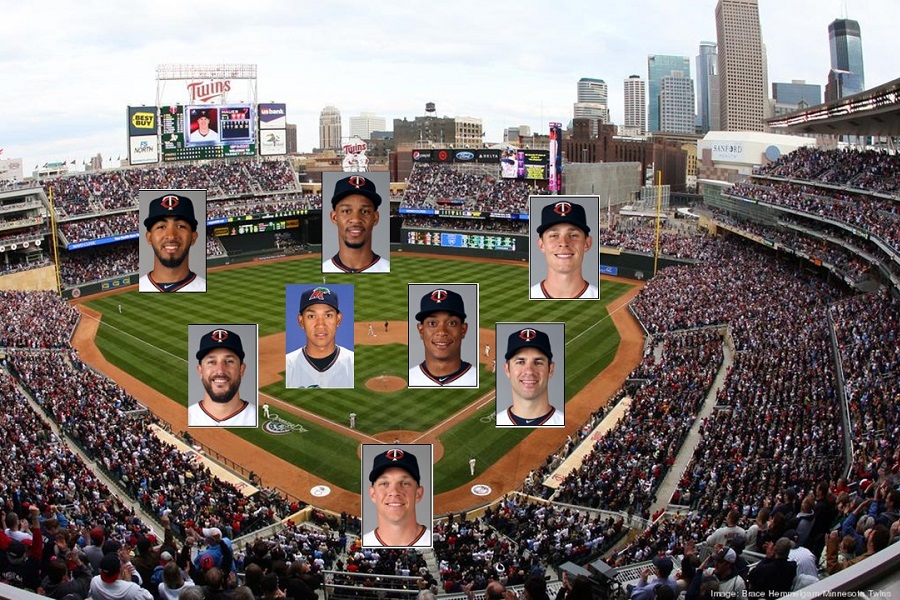 Baseball line-ups aren't usually built with a defensive as the first priority. Rosters usually need to have the right combination of defense and offense. You can hide a Josh Willingham-type player in a corner outfield spot if he is mashing a bunch of home runs. What would the Twins line-up look like if it was made up completely with defense as the only factor in making roster decisions? Outfield: Byron Buxton, Eddie Rosario, Max Kepler In this line-up, there are no converted infielders pushed to a corner outfield spot. This team is all about speed, range, and having a cannon for an arm. Luckily for the Twins, their optimal defensive line-up is one that could see some significant playing time this season. All three players have seen time in centerfield during their minor league careers. Buxton was just named the best defensive player in the minors by MLB.com and Rosario finished second in the AL with 16 outfield assists. Add Kepler to the mix and you have one strong trio that would be able to cover foul pole to foul pole with ease. Catcher: Stuart Turner Kurt Suzuki has taken a beating behind the plate over the last couple seasons and he has his flaws as a defensive catcher. The Twins traded Aaron Hicks to the Yankees for catcher John Ryan Murphy this offseason and his defense is fine for now. Two players, Stuart Turner and Mitch Garver, are the future of the position are in the Twins system. Turner is the better defensive option and he could probably hold his own at the big league level behind the plate. He could be up as early as this September as he should spend a good chunk of the year in Rochester. First Base: Joe Mauer Ever since his high school days, Mauer has been considered a good athlete. That's why there was little concern over him making the defensive transition from catcher to first base. Everything hasn't been perfect for Mauer in the move to a corner infield spot but he continues to learn the nuisances of what has become his new home. Mauer's former roommate, Justin Morneau, was a very strong defensive first baseman. While Mauer might not be to that level yet, he is still a strong defensive option. Second Base: Jorge Polanco Brian Dozier's defense has been on a steady decline over the last three years which makes it a little easier to look past him when creating the team's best defensive line-up. Another prospect with a lot of time at shortstop could be a better solution in the middle infield. Jorge Polanco, like Dozier, would need to shift from shortstop to second base. There have been plenty of questions about whether or not he will be able to stick at shortstop. This solves the problem by moving him off the position and possibly offers a little up-side over Dozier and his declining defense. A younger, more athletic player seems like a better option over an aging Dozier. Third Base: Trevor Plouffe It's hard not to be impressed with how far Trevor Plouffe has come at the third base position. As he transitioned to third from shortstop and a brief taste of the outfield, he looked stiff and unable to adjust to the fast pace of being at the "hot corner." By the end of this season, he ranked as one of the best defensive third basemen in the American League according to the SABR Defensive Index. Miguel Sano might take over this position in the near future but Plouffe's defense will be hard to top. Shortstop: Engelb Vielma Unfortunately (or fortunately depending on how you look at it), the Twins best defensive option at shortstop hasn't played a game above the High-A level. Many of the top national prospect rankings peg him as the best defensive infielder in the organization with quite possibly the best infield arm. His offense might be a couple years away from being big league ready but his defense is ready to make the next step. Now it's your turn. Who would be in your defensive line-up? Leave a COMMENT and join the discussion.
 -
Projecting Minnesota's Optimal Defensive Line-Up
Cody Christie posted a blog entry in North Dakota Twins Fan
Defense wins championships. In the baseball world, this cliche might not be completely true. Otherwise, there would be teams full of Andrelton Simmons-type players. There are a lot of other factors that go into the overall equation. Teams need offense, they need pitching, and sometimes a little luck goes a long way. Baseball line-ups aren't usually built with a defensive as the first priority. Rosters usually need to have the right combination of defense and offense. You can hide a Josh Willingham-type player in a corner outfield spot if he is mashing a bunch of home runs. What would the Twins line-up look like if it was made up completely with defense as the only factor in making roster decisions? Outfield: Byron Buxton, Eddie Rosario, Max Kepler In this line-up, there are no converted infielders pushed to a corner outfield spot. This team is all about speed, range, and having a cannon for an arm. Luckily for the Twins, their optimal defensive line-up is one that could see some significant playing time this season. All three players have seen time in centerfield during their minor league careers. Buxton was just named the best defensive player in the minors by MLB.com and Rosario finished second in the AL with 16 outfield assists. Add Kepler to the mix and you have one strong trio that would be able to cover foul pole to foul pole with ease. Catcher: Stuart Turner Kurt Suzuki has taken a beating behind the plate over the last couple seasons and he has his flaws as a defensive catcher. The Twins traded Aaron Hicks to the Yankees for catcher John Ryan Murphy this offseason and his defense is fine for now. Two players, Stuart Turner and Mitch Garver, are the future of the position are in the Twins system. Turner is the better defensive option and he could probably hold his own at the big league level behind the plate. He could be up as early as this September as he should spend a good chunk of the year in Rochester. First Base: Joe Mauer Ever since his high school days, Mauer has been considered a good athlete. That's why there was little concern over him making the defensive transition from catcher to first base. Everything hasn't been perfect for Mauer in the move to a corner infield spot but he continues to learn the nuisances of what has become his new home. Mauer's former roommate, Justin Morneau, was a very strong defensive first baseman. While Mauer might not be to that level yet, he is still a strong defensive option. Second Base: Jorge Polanco Brian Dozier's defense has been on a steady decline over the last three years which makes it a little easier to look past him when creating the team's best defensive line-up. Another prospect with a lot of time at shortstop could be a better solution in the middle infield. Jorge Polanco, like Dozier, would need to shift from shortstop to second base. There have been plenty of questions about whether or not he will be able to stick at shortstop. This solves the problem by moving him off the position and possibly offers a little up-side over Dozier and his declining defense. A younger, more athletic player seems like a better option over an aging Dozier. Third Base: Trevor Plouffe It's hard not to be impressed with how far Trevor Plouffe has come at the third base position. As he transitioned to third from shortstop and a brief taste of the outfield, he looked stiff and unable to adjust to the fast pace of being at the "hot corner." By the end of this season, he ranked as one of the best defensive third basemen in the American League according to the SABR Defensive Index. Miguel Sano might take over this position in the near future but Plouffe's defense will be hard to top. Shortstop: Engelb Vielma Unfortunately (or fortunately depending on how you look at it), the Twins best defensive option at shortstop hasn't played a game above the High-A level. Many of the top national prospect rankings peg him as the best defensive infielder in the organization with quite possibly the best infield arm. His offense might be a couple years away from being big league ready but his defense is ready to make the next step. Now it's your turn. Who would be in your defensive line-up? Leave a COMMENT and join the discussion. -
Twins Sign Former All-Star Carlos Quentin
Cody Christie posted a blog entry in North Dakota Twins Fan
The Minnesota Twins announced the signing of outfielder Carlos Quentin to a minor league contract with an invitation to major league camp. The 33-year old last appeared in a game for Tacoma, the Triple-A affiliate of the Seattle Mariners. His last big league appearance was in 20014 with the San Diego Padres. The former two-time All-Star was first round pick of the Arizona Diamondbacks in 2003. He played parts of two seasons at the big league level in Arizona before being dealt to the Chicago White Sox for Chris Carter. His debut season in Chicago was his best as he hit .288/.394/.571 with 36 home runs and 100 RBI while finishing fifth in the American League MVP vote. His 36 home runs were one behind Miguel Cabrera for the league lead. Quentin would make another All-Star team in 2011, his last year in Chicago. The White Sox would trade him to the Padres in the offseason. Injuries limited him to averaging under 75 games played per season in San Diego. In 2014, he batted just .177/.284/.315 and he has long been a below-average defender. Plus, there have been just three times in his career where he's played in 100 or more games in a season. Entering the 2015 season, he was sent to Atlanta as part of the deal that brought Craig Kimbrel and Melvin Upton to the Padres. The Braves released him and he signed with Seattle before retiring last May. He cited chronic knee injuries as his reason for stepping away from the game before his 33rd birthday. During his nine-year career, he hit .252/.347/.484 while hitting 13 home runs or more in six consecutive seasons. From 2008-2013, he hit .260 with an .860 OPS while averaging 30 homers per 150 games. At this point, it seems like Quentin is being added as organizational depth and he'll have to prove himself healthy and ready with Rochester. There are already plenty of first base and corner outfield options on the Twins roster including Joe Mauer, Byung Ho Park, Eddie Rosario, Miguel Sano, and Oswaldo Arcia. It seems hard to see him cracking the Opening Day roster unless the injury bug hits the team hard in Florida. What are your thoughts on the signing? Leave a COMMENT and start the discussion.
