



Parker Hageman
-
Posts
4,152 -
Joined
-
Last visited
-
Days Won
6
Content Type
Profiles
News
Minnesota Twins Videos
2026 Minnesota Twins Top Prospects Ranking
2022 Minnesota Twins Draft Picks
Minnesota Twins Free Agent & Trade Rumors, Notes, & Tidbits
Guides & Resources
2023 Minnesota Twins Draft Picks
The Minnesota Twins Players Project
2024 Minnesota Twins Draft Picks
2025 Minnesota Twins Draft Pick Tracker
2026 Minnesota Twins Draft Tracker: Picks & Bonuses
Forums
Blogs
Events
Store
Downloads
Gallery
Everything posted by Parker Hageman
-
Download attachment: MN-TWINS-14.jpg Joe Mauer hit just one infield fly ball all year making his 1.0% infield fly rate the second lowest in all of baseball. That’s a significant increase over his totals last year when he did not hit a single fly ball to anyone in the infield. See, there is still plenty of reason to boo him. Mauer is often credited with having the perfect swing, and the fact that he is not popping pitches up to the second baseman is telling how square he hits the ball. That said Twins fans rarely saw this elusive perfect swing this year as his 35.4% swing rate was the lowest in baseball (compared to the 46% league average). Once again, Mauer's first-pitch swing was the lowest in baseball as he offered at just 8% of total first pitches thrown to him. With that reputation, rumor has it that Hollywood is tapping Mauer to star in the latest action movie sequel,Taken 3: The First Pitch. 32 times this year Denard Span was on second base when a double was hit – the most in baseball. I don’t know what it means but it is provocative. Speaking of Span, because he was caught looking in a baseball-high 48% of his strikeouts, he receives baseball’s 2012 Voyeurism Award for liking to watch so much. (Oh, yeah. You're such a dirty curve on the outer-half of the plate. Oh you filthy backdoor slider...) Josh Willingham had an incredible power year for the Twins – dropping 35 dingers on the crowd. That’s more than anyone in one season in a Twins uniform not named “Killebrew”. But, with great power comes great responsibility…and then some strikeouts. The Hammer came perilously close to breaking another dubious honor: At 141 strikeouts on the year, he was just five shy of overtaking Bobby Darwin as the Twins’ single-season strikeout king. Darwin had set that mark of 145 in 1972. Willingham is probably voting for Mitt Romney this election because, like Romney, he too enjoyed destroying lefties: his 15 home runs were tied with Chicago’s Adam Dunn for the most off of wrong-handed pitchers. Even though Willingham had the highest total, it was Justin Morneau who put on the display. According to HitTrackerOnline.com, Morneau had top three longest home runs hit this season in terms of “true distance” which went 451, 448 and 439 feet respectively. According to Baseball-Reference.com, Ben Revere’s 43 infield hits were tops in the American League. This is not surprising due to (A) his speed and ( his 67% ground ball rate. The real question is, are we sure he’s hitting the ball on those and not just catching it and throwing it as far as he can? Can we re-check the video in slo-mo? Swinging to contact? The offense paced baseball with an 82% contact rate on their swings. Span and Revere were a regular Murderer’s Row for contact, putting the bat on the ball in 92% of their swings. Defensively, the Twins ability to control the run game was atrocious. Whether you want to blame it on the pitching staff for not holding runners or the catchers for being unable to throw them out, the Twins were able to throw out 15 would-be base-stealers on 135 attempts. Only Pittsburgh threw out fewer base-stealers (14). The Twins starters threw more than 100 pitches in just 29 starts this year. Only the hapless Rockies had fewer starts (15) with going over the century mark. (Editor’s note: Depressed yet?) How about that pitching to contact philosophy? The 2012 rotation excelled in that department. Fangraphs.com says their 83.9% contact rate was the highest in baseball. Unfortunately for the Twins, it was not glancing blows, either. The starters had the worst production out of their fastballs so says Fangraphs.com’s Pitch Value warehouse. The Twins starters’ fastballs were collectively -89.2 runs below average. That’s how you don’t make it to 100 pitches in a night… The Twins pitching staff surrendered 23 “No Doubt” home runs. Those are categorized at HitTrackerOnline.com as those which the “ball cleared the fence by at least 20 vertical feet AND landed at least 50 feet past the fence.” Cole DeVries led all pitchers with five No Doubters allowed. The Twins’ 541 strikeouts by their starting pitching staff were, bar none, the least in baseball. Yet, that’s not even the worst performance Minnesota fans have witnessed by their rotation. In club history, it ranks as the 11th lowest strikeout mark (excluding strike-shortened seasons). So, yeah, itcould have been worse. Scott Diamond may have been the Pitcher of the Year for the Twins but he did not get that title by missing bats. According to Pitch F/X, his four-seam fastball induced a swing-and-miss just 6.1% of the time, the lowest the game this year. On the flip side, opponents beat that pitch into the ground 58% of the time, the second-highest rate behind teammate Samuel Deduno. What may have made his fastball that effect was how much he worked in his 11-to-5 curveball. Diamond spun his hook 29.1% of the time, making him the pitcher to use his curveball the most in the American League. The Twins used 25 pitchers this year, a new franchise record. Correction: The Twins used 24 pitchers this year and one Drew Butura. That number topped last year’s previous record of 24. The bullpen was a fairly bright spot this year and overlooked among Glen Perkins and Jared Burton’s solid seasons is the work done by Brian Duensing. Although he can be a human pitching machine when he starts, in the pen he’s nearly unhittable. This season, he allowed just one home run in relief making his 0.16 home runs allowed per nine innings the third lowest in the game and the second lowest for the Twins in the past twenty years. Only Tom Eden’s 0.12 in 1992 bests the Duenslinger’s total. That’s your useless Tom Eden trivia for the year. Nick Blackburn’s 7.39 ERA as a starter in 2012 is tied with Jim Deshaies (1994) as the worst Twins ERA with a minimum of 90 innings pitched. On that note, if you are interested in reading more about the 2012 Twins team and how to improve the 2013 squad, Twins Daily now has the 2013 Offseason Handbook ready for pre-order. If you order now, you can save yourself some cash in the process. Click here to view the article
-
 Download attachment: RN.jpg The Minnesota Twins’ starting pitching shortage of strikeouts has continued into 2014. That’s not anything new but it makes you wonder if the fumes from the garbage burner are causing pitchers to simply lob the ball into the strike zone. As of Tuesday, the Twins were owners of the bottom three strikeout rates in the American League. Download attachment: Krate.png While Kevin Correia and Kyle Gibson are thought of as contact-oriented pitchers, it is Ricky Nolasco’s inclusion on the list which is a bit surprising. After all, Nolasco held a 19% strikeout rate over his career. Though a drop in the strikeout rate is expected during the switch in leagues and pitchers have to face a designated hitter instead of a car antenna-swinging pitcher, the drop from 20% in 2013 to 11% so far in 2014 has been curious. Nolasco has been able to get to a two-strike count regularly, however, he has failed to put hitters away at an expected pace. According to ESPN/TruMedia, Nolasco leads all qualified starters with a .295 batting average in two-strike situations (he also owns a .333 average in 0-2 counts this year!!!)(!!!!!!). Download attachment: BAA.png What is happening? The most notable difference between last year and this year is his reliance on the fastball instead of either of his breaking balls. After throwing 35%/65% fastball/secondary split in two-strike counts in 2013, he’s throwing at a 44%/56% split this year – and his fastball has been hammered. When he throws the fastball in two-strike situations, opponents are hitting .429 (9-for-21 with 3 doubles). Another interesting aspect to this strikeout drop-off is his curveball usage. More than the usage, it is the effectiveness which is more cause for concern. Last year he posted a 25% swing-and-miss rate, that’s down to 7% this year. Who knows where this change is coming from – coaching staff, catcher or Nolasco himself. As he mentioned in spring training, Nolasco knows he has the final say to what is thrown in what situation. As of now, he has not been effective in what should be put-away situations. At the very least, it probably is time to reconsider what he is tossing in two-strike counts. ~~~ Twins beat the Indians on Monday so on Tuesday you can treat your family to a half price Papa John's L or XL pizza by using the promocode 'twinswin' at PapaJohns.com. ~~~ Click here to view the article
 -
Download attachment: Marquis.jpg Once upon a time, in a land far away on the other side of downtown, covered by a beautiful white bubble – where the weather was always a pleasant 72 degrees – there was a starting pitching staff who understood the intrinsic value of working ahead of opponents. In the last decade, from 2000 to 2010, one of the pillars of the Twins Way was to dominate the airspace above the plate. The starters made it their business to pepper the strike zone from the get-go, leading baseball with a 62.8% first-pitch strike rate. Brad Radke paced baseball with a 69% first-pitch strike rate as other members of the team – notably Carlos Silva, Kevin Slowey and Johan Santana - also finishing within the top ten. True, the quality of the arms, particularly Santana and Radke, were vastly superior to the current crop, however, by comparison, the 2012 Twins staff have completely deviated from this philosophy. This season, the staff has posted the worst first-pitch strike rate in baseball meaning just barely over half of the pitcher-batter engagements (53.8%) have resulted in the Twins pitcher registering strike one on the first pitch. While most would think “Liriano” right off the bat, it’s actually Jason Marquis who has been the team’s biggest offender. Heading into yesterday’s contest, Marquis’ 47.5% First-Pitch Strike rate was the second worst in baseball. Beyond just working ahead, Marquis has struggled to find the zone overall. Once again, while we all peg Liriano as the poster wild child, it is actually Marquis who has been missing the plate more frequently (35% versus Liriano’s 36.2% rate). What’s more is that the veteran is not missing any bats. In fact, his 3.5% swinging strike rate heading into yesterday’s outing against the Indians was the lowest in baseball (minimum 20 innings pitched). If we are looking for little victories inside his sixth start of the year, Marquis did improve his attack on the strike zone, jumping ahead for a strike 56% of the time on Tuesday afternoon. Likewise, after not inducing many swinging strikes on any of his secondary pitches, he got four (count ‘em, four) swinging strikes: three on his slider, one on his changeup. After the game, ESPN1500.com’s Phil Mackey relayed Ron Gardenhire’s assessment on the two starters, Cleveland’s Derek Lowe and Marquis: Two of the home runs Marquis allowed to the Indians came on his sinker, which certainly did not appear to be of the highest caliber that day. But, the most recent performance notwithstanding, believe it or not, his sinker is getting the best results in years. Those familiar with Pitch F/X know that the system of cameras inside the ballpark captures (almost) every pitch thrown, which measures the release point, speed, movement, spin, where it crosses the plate, and so on. By using this data, we find that Marquis’ sinker is coming in at a different vertical level than it had in more recent seasons. Before this year, his sinker had averaged vertical movement of 5.2, 6.0, 5.2 and 5.9 inches respectively. This year it’s at 2.9. Sinkers have a tendency to demonstrate, on average, a rise of five inches (not in the gravitational sense but relative to other pitches). For the past several years, Marquis’ sinker was very consistent with this average. However, this year, it is only rising 2.9 inches – meaning it is staying down. What makes this interesting is that Pitch F/X research - like the one found at It’s About The Money Stupid from 2011 - has shown that one of the ways ground balls are achieved the most when a pitch is thrown with 0.0 to 3.0 vertical movement. This has led to a near 60% ground ball rate. Download attachment: GB rate-vertical.jpg (From ItsAboutTheMoney.net) Derek Lowe, who finished the Twins off in short order yesterday by making them burn balls into the ground, had a 63% ground ball rate. His sinker has averaged vertical movement of 1.3, right in that aforementioned sweet spot, helping explain why he incited so many grass-killers off bats. Of course, in Marquis’ case, this only accounts for when opponents put the ball into play that they are knocking it into the ground. Sure, he has a career-high 57% ground ball rate but prior to yesterday’s game, he had only thrown his sinker for a strike just 48% of the time, well below the 62% mark from 2011. Hitters, not finding a diving ball appetizing, and have swung at fewer sinkers than previous seasons. This, in a nutshell, is why his results have been so poor. He cannot throw his best pitch for a strike consistently enough to entice hitters to swing. To make matters worse, he has been falling behind hitters to the point where he has to throw one over the plate. Most importantly, if he wants to that sinker to become even more effective, start with strike one. It is an old recipe that has worked for years. Click here to view the article
-
As a self-proclaimed baseball analyst, I can say that there is nothing more difficult to gauge than a minor league prospect. There is little information available at the fingertips compared to major league players. But beyond that, there is perhaps nothing more difficult to gauge than a prospect at rookie ball where the data, video and observations are as rare as fine dining in their clubhouse.Download attachment: ap-gordon.jpg That said, a recent review of MLBFarm.com’s statistical warehouse -- a website which is enhancing and forwarding the availability of previously unknown data -- revealed that a majority of the balls put in play by Twins prospect and first round draft Nick Gordon were going to left field, a curiosity considering the newly added shortstop was a left-handed hitter. With the data from MLBFarm.com showing an overwhelming tendency for Gordon to go to the other way, a review of his swing was prompted. It could be the lefty had the penchant of simply going the other way with pitches. It could also be that the recent high schooler was struggling with the professional competition that had ability to throw better fastballs to better locations than he had previously seen. Because of this chart: Download attachment: Nick Gordon_HeatMap.png And video from Baseball America that showed contact like this on a fastball that indicating the contact deep into the zone: It is hard not to ask the question whether or not Gordon is having trouble adapting to the pro game. After all, he is not far removed from high school where pitchers rarely humped it up to 90 miles an hour. Suddenly he is playing in a league littered with 90+ arms (albeit without the tools and knowledge to exploit every weakness). Was he struggling to pull the ball at the same 40% clip that left-handed hitters do at the major league level? This is not to say that he is struggling. On the contrary, his statistics are quite good. At 18.67 years old, he is the 13th youngest member of the Appalachian League and is batting .318/.364/.402 -- which is about what Byron Buxton batted in his season at that level. What’s more, while the rest of the league-- in which the average player is 20.2 years old-- his hitting .256, he is besting that batting average by 24%. So even if pro fastballs are giving him fits, he’s done more than expected against them so far. Nevertheless, I had to present my theory to others in the organization in case there was some validity to it. First, I attempted to contact Ray Smith, the manager of the Elizabethton Twins, for a quick conversation regarding Gordon’s hitting tendencies. I wondered if there was something he saw on a nightly basis which explained this attribute. Was he trying to hit the other way, was his swing long or were pitchers simply trying to pitch him away? After a detailed email describing the aforementioned concern and this caveat that this was based on a small sample size with little visual evidence, Smith’s response came back short and sweet: “Absolutely no concerns with Nick’s bat speed.” Following his manager’s approval, I contacted Mike Radcliff, the Twins’ Vice President of Player Personnel, who happened to be following the Elizabethton team on the road for the past week. Radcliff’s testimony echoed the the manager's -- there was no issue with Gordon’s bat speed in terms of catching up to this league’s fastballs. In fact, as Radcliff said, the Twins had seen Gordon face plenty of pitchers who threw harder than the competition in the Appalachian League while he was in high school and performing in national showcases. “He’s hitterish,” Radcliff said. “He’s gonna hit.” Like Smith and the rest of the Twins evaluators, he believed because of Gordon's quick hands, similar to Buxton's, and his young age, he would be progressing offensively as he developed his “man muscles” as he reaches the legal drinking age. His observations were that Gordon has the ability to add extra-base potential based on his quick hands and eventual growth both physically and mentally. When asked if there was anything to explain the current data that suggested Gordon was unable to consistently pull the ball, Radcliff rightfully questioned the data size. “Had it been a 30-year-old veteran, then you might make that conclusion,” he said. Radcliff said that he views Gordon’s defense as more of a focal point for improvement than his offense. For Gordon, the immediate road ahead involved working on his footwork and his pivot at second base on the double play. His raw natural skill -- arm and speed -- would help him cover some of those weaknesses for the time being. What Radcliff emphasized about Gordon’s development is that he comes a strong “gene pool” -- the son of a former major league pitcher and brother to a current major league shortstop. “You value the gene,” Radcliff said in a candid scouting moment regarding Gordon’s lineage. “When you come from a major league gene, that’s what it is all about. There’s a great value at the beginning of their careers and a feeling that they won’t be overmatched.” Gordon is not likely to see any time above rookie ball this year, but he’s got a vote of confidence from the organization that he will be a major league starter and, perhaps, an All-Star like his brother. For more on Nick Gordon and the Minnesota Twins, listen to this week's No Juice Podcast. Click here to view the article
-
On this week’s episode of the No Juice Podcast, Major League Baseball’s trade deadline swiftly approaching, Dan Anderson and Parker Hageman discuss where the Minnesota Twins stand after the All-Star Break. Josh Willingham, Kevin Correia and Kurt Suzuki? Sell ‘em or sell ‘em all?Other topics include Twins prospect Nick Gordon’s introduction to professional baseball, previewing the Twins Daily Touch ‘Em All Pub Crawl, trolling Darren Rovell on Twitter, anger over the late night fireworks and bottomless appetizers. Listen below, on iTunes or Stitcher: THE NO JUICE PODCAST, EPISODE #14 - TRADE DEADLINE Click here to view the article
-
On Wednesday of this past week, Twins pitching prospect Alex Meyer dismantled the Rays’ Triple-A affiliate Durham Bulls, striking out eight over six innings of work while not allowing either a walk or a run. With Phil Hughes apparently sidelined for some time after absorbing an Adam Dunn projectile missile in combination with the inconsistent performance from the starting five that now consists of non-prospect arms, it is hard not to ask “When is it Meyer’s time?”The Twins have been understandably protective of their top pitching prospect based on his injury at the end of last season and the fact that he pitched a limited number of innings. Typically, organizations have a progression for how they would like to build a pitcher’s arm strength and he threw less than 100 innings in 2013 between Double-A and the Arizona Fall League. But based on Boston’s Will Middlebrooks’ early season scouting report after facing Meyer in Pawtucket, Meyer has more than enough weaponry to be hurling in the big leagues. Admittedly, several comments from the front office made in reference to Meyer’s command and pitch counts (the former is the reason the latter gets so high so quick), imply that he would have troubles pitching deep in to games. While a fair assessment given his walk rate, Meyer still could be learning at this level. And here’s another reason why I want to see him dabble here sooner rather than later: his ability to make adjustments. On June 2 in Rochester, Meyer surrendered this majestic blast to Gwinnett’s Mark Hamilton, a 29-year-old first baseman who had fewer than a season’s worth of plate appearances at the major league level with the St. Louis Cardinals. The ball, one can presume, was eventually stopped in its flight when it was shot down by the Canadian border guard. http://i.imgur.com/R8c5hYB.gif Note the location of of the 0-0 pitch: A fastball thigh-high and inside. Even with Meyer’s impressive velocity, this is a location that plenty of left-handed hitters love to do damage on. To be fair, Meyer was falling apart at this juncture of the game. After allowing a double that was considered aided by one of his outfielders, Meyer plunked the batter in front of Hamilton, setting up first-and-third in the fifth inning. Perhaps based on the recently hit batter, the plan was to re-establish the strike zone or maybe it was that with a fastball that averages mid-to-upper 90s, they figured he could fire it past the aging minor leaguer. Regardless of why, the results were disappointing. His next time through the rotation, five days latet, Meyer once again drew the Gwinnett Braves, this time in Georgia. With a three-run lead and two runners on base in the bottom of the sixth, Meyer faced Hamilton. It is this match-up, deep in the ballgame, that shows why Meyer is more of a pitcher and less of a thrower. One who, if it were not for the organization’s inning limitations, might already have been throwing bullets with the Minnesota Twins. Unlike his first pitch to this batter in his previous start, Meyer kept his fastball on the other side of the plate, but a little too far for ball one: http://i.imgur.com/LMhbPYA.gif With his second offering, he is able to command the outer-half of the plate with his fastball. There is little Hamilton can do but watch it blaze by. This, my friends, is a pitcher’s pitch: http://i.imgur.com/5ugjh9R.gif The count now even at 1-1, Meyer unleashes his knee-buckling knucklecurve which stays up in the zone just enough for Hamilton to yank foul as he is unable to stay back after seeing two very good fastballs. To this point in the count, Meyer has not gone back inside with anything of significant velocity: http://i.imgur.com/j7AZP9e.gif Now with two-strikes, Meyer attempts to put the lefty away with a backdoor breaking ball. Like the last one, it too stays up just enough for Hamilton to fight off and stay alive: http://i.imgur.com/mHyQLoG.gif Finally, and here is where it becomes serious business, following two offspeed pitches Meyer rears back and gasses a fastball up-and-away that has Hamilton reduced to rubble, simply trying to stay alive: http://i.imgur.com/0DZOkQL.gif The sequence demonstrates why Meyer could be an extremely good pitcher for the Twins. At this point, most prospect-philes project him as a potential number two starter in a strong rotation (not like a Kevin Correia number two starter, mind you). He has some flaws that the Twins are hoping he will work past, including the consistency in his mechanics and location, as well as refining a changeup that would give him yet another weapon. He clearly has the stuff to make an impact but the Twins do not want to pile too much workload on him -- which is one of the reasons he has not made the jump. Still, seeing his ability to adjust against an opponent is reassuring that he has both the physical and mental makeup for the next big step. Click here to view the article
-
 The Twins have been understandably protective of their top pitching prospect based on his injury at the end of last season and the fact that he pitched a limited number of innings. Typically, organizations have a progression for how they would like to build a pitcher’s arm strength and he threw less than 100 innings in 2013 between Double-A and the Arizona Fall League. But based on Boston’s Will Middlebrooks’ early season scouting report after facing Meyer in Pawtucket, Meyer has more than enough weaponry to be hurling in the big leagues. Admittedly, several comments from the front office made in reference to Meyer’s command and pitch counts (the former is the reason the latter gets so high so quick), imply that he would have troubles pitching deep in to games. While a fair assessment given his walk rate, Meyer still could be learning at this level. And here’s another reason why I want to see him dabble here sooner rather than later: his ability to make adjustments. On June 2 in Rochester, Meyer surrendered this majestic blast to Gwinnett’s Mark Hamilton, a 29-year-old first baseman who had fewer than a season’s worth of plate appearances at the major league level with the St. Louis Cardinals. The ball, one can presume, was eventually stopped in its flight when it was shot down by the Canadian border guard. http://i.imgur.com/R8c5hYB.gif Note the location of of the 0-0 pitch: A fastball thigh-high and inside. Even with Meyer’s impressive velocity, this is a location that plenty of left-handed hitters love to do damage on. To be fair, Meyer was falling apart at this juncture of the game. After allowing a double that was considered aided by one of his outfielders, Meyer plunked the batter in front of Hamilton, setting up first-and-third in the fifth inning. Perhaps based on the recently hit batter, the plan was to re-establish the strike zone or maybe it was that with a fastball that averages mid-to-upper 90s, they figured he could fire it past the aging minor leaguer. Regardless of why, the results were disappointing. His next time through the rotation, five days latet, Meyer once again drew the Gwinnett Braves, this time in Georgia. With a three-run lead and two runners on base in the bottom of the sixth, Meyer faced Hamilton. It is this match-up, deep in the ballgame, that shows why Meyer is more of a pitcher and less of a thrower. One who, if it were not for the organization’s inning limitations, might already have been throwing bullets with the Minnesota Twins. Unlike his first pitch to this batter in his previous start, Meyer kept his fastball on the other side of the plate, but a little too far for ball one: http://i.imgur.com/LMhbPYA.gif With his second offering, he is able to command the outer-half of the plate with his fastball. There is little Hamilton can do but watch it blaze by. This, my friends, is a pitcher’s pitch: http://i.imgur.com/5ugjh9R.gif The count now even at 1-1, Meyer unleashes his knee-buckling knucklecurve which stays up in the zone just enough for Hamilton to yank foul as he is unable to stay back after seeing two very good fastballs. To this point in the count, Meyer has not gone back inside with anything of significant velocity: http://i.imgur.com/j7AZP9e.gif Now with two-strikes, Meyer attempts to put the lefty away with a backdoor breaking ball. Like the last one, it too stays up just enough for Hamilton to fight off and stay alive: http://i.imgur.com/mHyQLoG.gif Finally, and here is where it becomes serious business, following two offspeed pitches Meyer rears back and gasses a fastball up-and-away that has Hamilton reduced to rubble, simply trying to stay alive: http://i.imgur.com/0DZOkQL.gif The sequence demonstrates why Meyer could be an extremely good pitcher for the Twins. At this point, most prospect-philes project him as a potential number two starter in a strong rotation (not like a Kevin Correia number two starter, mind you). He has some flaws that the Twins are hoping he will work past, including the consistency in his mechanics and location, as well as refining a changeup that would give him yet another weapon. He clearly has the stuff to make an impact but the Twins do not want to pile too much workload on him -- which is one of the reasons he has not made the jump. Still, seeing his ability to adjust against an opponent is reassuring that he has both the physical and mental makeup for the next big step.
 -
-
The No Juice Podcast, Episode #14: Trade Deadline
Parker Hageman posted a blog entry in Over the Baggy
-
 Other topics include Twins prospect Nick Gordon’s introduction to professional baseball, previewing the Twins Daily Touch ‘Em All Pub Crawl, trolling Darren Rovell on Twitter, anger over the late night fireworks and bottomless appetizers. Listen below, on iTunes or Stitcher: THE NO JUICE PODCAST, EPISODE #14 - TRADE DEADLINE
 -
-
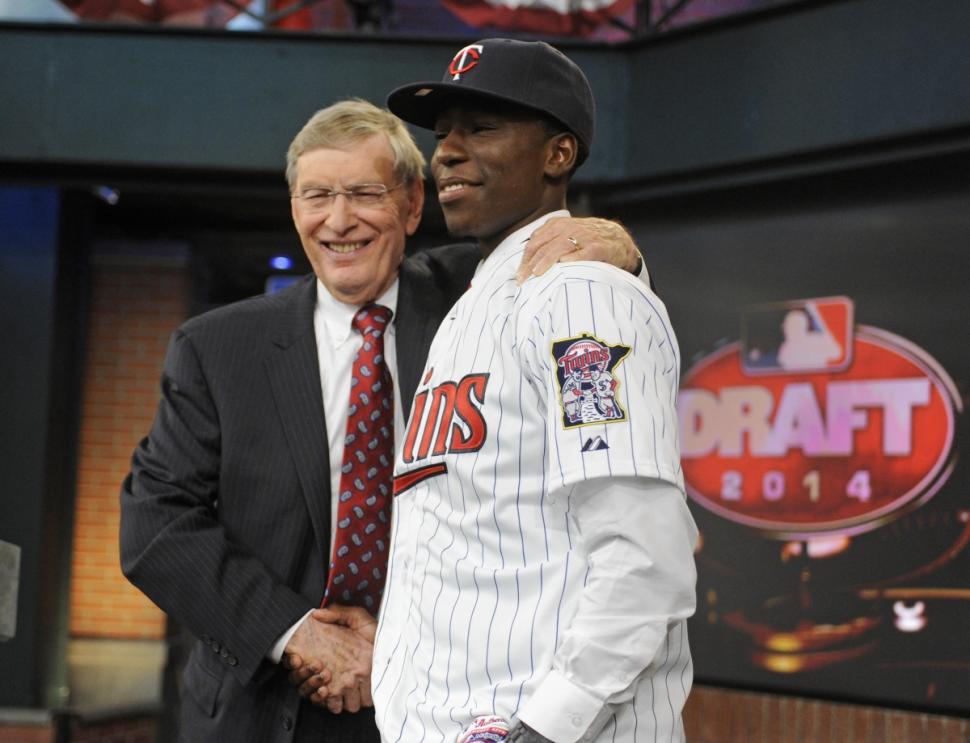 That said, a recent review of MLBFarm.com’s statistical warehouse -- a website which is enhancing and forwarding the availability of previously unknown data -- revealed that a majority of the balls put in play by Twins prospect and first round draft Nick Gordon were going to left field, a curiosity considering the newly added shortstop was a left-handed hitter. With the data from MLBFarm.com showing an overwhelming tendency for Gordon to go to the other way, a review of his swing was prompted. It could be the lefty had the penchant of simply going the other way with pitches. It could also be that the recent high schooler was struggling with the professional competition that had ability to throw better fastballs to better locations than he had previously seen. Because of this chart: And video from Baseball America that showed contact like this on a fastball that indicating the contact deep into the zone: https://www.youtube.com/watch?v=QiE986BM7pg It is hard not to ask the question whether or not Gordon is having trouble adapting to the pro game. After all, he is not far removed from high school where pitchers rarely humped it up to 90 miles an hour. Suddenly he is playing in a league littered with 90+ arms (albeit without the tools and knowledge to exploit every weakness). Was he struggling to pull the ball at the same 40% clip that left-handed hitters do at the major league level? This is not to say that he is struggling. On the contrary, his statistics are quite good. At 18.67 years old, he is the 13th youngest member of the Appalachian League and is batting .318/.364/.402 -- which is about what Byron Buxton batted in his season at that level. What’s more, while the rest of the league-- in which the average player is 20.2 years old-- his hitting .256, he is besting that batting average by 24%. So even if pro fastballs are giving him fits, he’s done more than expected against them so far. Nevertheless, I had to present my theory to others in the organization in case there was some validity to it. First, I attempted to contact Ray Smith, the manager of the Elizabethton Twins, for a quick conversation regarding Gordon’s hitting tendencies. I wondered if there was something he saw on a nightly basis which explained this attribute. Was he trying to hit the other way, was his swing long or were pitchers simply trying to pitch him away? After a detailed email describing the aforementioned concern and this caveat that this was based on a small sample size with little visual evidence, Smith’s response came back short and sweet: “Absolutely no concerns with Nick’s bat speed.” Following his manager’s approval, I contacted Mike Radcliff, the Twins’ Vice President of Player Personnel, who happened to be following the Elizabethton team on the road for the past week. Radcliff’s testimony echoed the the manager's -- there was no issue with Gordon’s bat speed in terms of catching up to this league’s fastballs. In fact, as Radcliff said, the Twins had seen Gordon face plenty of pitchers who threw harder than the competition in the Appalachian League while he was in high school and performing in national showcases. “He’s hitterish,” Radcliff said. “He’s gonna hit.” Like Smith and the rest of the Twins evaluators, he believed because of Gordon's quick hands, similar to Buxton's, and his young age, he would be progressing offensively as he developed his “man muscles” as he reaches the legal drinking age. His observations were that Gordon has the ability to add extra-base potential based on his quick hands and eventual growth both physically and mentally. When asked if there was anything to explain the current data that suggested Gordon was unable to consistently pull the ball, Radcliff rightfully questioned the data size. “Had it been a 30-year-old veteran, then you might make that conclusion,” he said. Radcliff said that he views Gordon’s defense as more of a focal point for improvement than his offense. For Gordon, the immediate road ahead involved working on his footwork and his pivot at second base on the double play. His raw natural skill -- arm and speed -- would help him cover some of those weaknesses for the time being. What Radcliff emphasized about Gordon’s development is that he comes a strong “gene pool” -- the son of a former major league pitcher and brother to a current major league shortstop. “You value the gene,” Radcliff said in a candid scouting moment regarding Gordon’s lineage. “When you come from a major league gene, that’s what it is all about. There’s a great value at the beginning of their careers and a feeling that they won’t be overmatched.” Gordon is not likely to see any time above rookie ball this year, but he’s got a vote of confidence from the organization that he will be a major league starter and, perhaps, an All-Star like his brother. For more on Nick Gordon and the Minnesota Twins, listen to this week's No Juice Podcast.
 -
-
Sponsored by Ticket King If you missed the All-Star festivities at Target Field over the past few days, perhaps the incentive of seeing one of baseball’s hottest teams will bring you back downtown at a more reasonable price. For most of their existence, the Tampa Bay Devil Rays were a league laughingstock, destined to finish last in the AL East for eternity. Then they got new ownership, smartened up and figured out how to beat the financial powerhouses from the big cities up the Atlantic coast. Since 2007, they have won 84 or more games a year and have made the playoffs in four of the last six years. Everything they touched seemed to turn to gold: Carlos Pena, Casey Kotchman, James Loney, Matt Joyce, Kyle Farnsworth and Fernando Rodney -- all unexpected contributors who melded well with Evan Longoria, Ben Zobrist and David Price. These darlings continued to propel themselves towards the top of arguably baseball’s toughest division. As Jonah Keri called it in his seminal book, it was the extra 2% that elevated this organization. It was squeezing the maximum amount of talent out of struggling former top prospects or targeting unwanted free agents with unseen upside. It was developing prospects better and more efficiently to replace departing stars. It was moving soon-to-be departing stars for prospects. In short, it was an impressive top-to-bottom successful approach that turned the losers Devil Rays into the winning Rays. But 2014 has been another story. On June 11, the Rays held the worst record in baseball, harkening back to the Devil Ray era. While it may have seemed as if the Rays were immune to things like pitching injuries, 2014 has proven that their methods are not infallible. First it was starting pitcher Matt Moore, who after finishing 2013 at 17-4 with a 3.29 ERA. This year he lasted 10 innings before he needed Tommy John. Former Rookie of the Year pitcher Jeremy Hellickson has faltered so much that the team made the decision to send him down to Double-A to figure things out. This leaves the pressure on staff leader David Price -- whom the team is considering selling before the deadline per their modus operandi of trading prime value for heaps of prospect talent. On top of that, underperformance from key offensive contributors like last year’s Rookie of the Year Will Myers (injured as well) and Longoria has led to a downturn in runs scored. All this means that the Minnesota will will have several easy home victories coming out of the break, right? Not so fast. If the past thirty games are any indication, that couldn’t be further from the truth. Since bottoming out on June 11, the Rays have gone on to win 19 of the 30 games leading up to the break and no longer have MLB’s worst record. In comparison the Twins, despite a nice road trip surge before the All-Star Game, have finished 13-17 in that span. This is a pivotal series and homestand for the Twins as the team’s front office will likely make the assessment of where they stand at the upcoming trade deadline. Sweep the Rays and win a few more against Cleveland and Chicago and the brass may consider not trading away key players like Kurt Suzuki but rather contend for the final Wild Card spot. Get your seat: Baseball’s second-half is underway. Unable to go to Target Field over the All-Star Weekend? Try getting there this weekend. On Friday, Kyle Gibson gets to redeem himself from his clunker at Tropicana. Saturday night’s game will showcase Tampa Bay’s All-Star pitcher, David Price. On Sunday afternoon Phil Hughes will attempt to continue his dominant first-half performance. All are an even better deal if you use the promo code DAILYDOUBLE, which will get you 10% off and supports Twins Daily. Whatever your needs, your local ticket supplier, Ticket King, can help.
-
On this week's episode of The No Juice Podcast, Parker Hageman and Dan Anderson ventured to KSTP studios to talk to one of the Twin Cities' hardest-working media members, Darren Wolfson. On the night that Labron James announced his intentions of returning to Ohio, Wolfson provided his plugged-in insights on what that means to the Minnesota Timberwolves and Kevin Love. Wolfson also shares information on the impending trade deadline and what that means for the Minnesota Twins. Other topics with Parker and Dan include the All-Star Weekend, Home Run Derby Happy Hours, and TV awards. Listen below, on iTunes or Stitcher: THE NO JUICE PODCAST, EPISODE #13 - DARREN WOLFSON
-
The No Juice Podcast, Episode #13: Darren Wolfson
Parker Hageman posted a blog entry in Over the Baggy
-
On Tuesday night it was announced that Minnesota Twins’ second baseman, Brian Dozier, would be participating in the Home Run Derby. Without question, it will be an honor for him to smack dingers at his home stadium, with his home crowd, and even his own brother pitching to him, no less. The event, where the game's most prolific home run hitters get to sit on the grass, some with their families, and admire the powerful swings while listening to ESPN’s Chris Berman say "back" five hundred and sixty-five million times is a unique experience. (Quick aside: A little word of advice that I'm fairly certain his brother Clay is aware of, the Twins’ second baseman likes to hit his home runs up in the zone: So throw the ball there Clay, and try not to think about the fact that you will be GIF'd into eternity so everyone can laugh if you accidentally throw a pitch like 50 Cent.) No doubt, being added to the Home Run Derby is a wonderful thing to brag about on his Linkedin page but as a fixture on at the top of the order, Dozier is expected to be a table-setter, not a home run hitter. Unfortunately for the sputtering Twins offense, he has been more of the former and less of the latter recently. Dozier’s 65 runs scored still tops the American League but he has been plated 14 times over his last 29 games -- admittedly a product of those hitting behind him and not by his own inability to get on-base (.311 on-base percentage in that time). While he has been a solid on-base catalyst, he has not been able to carry the team like he did in the beginning of the year when he was jacking the jobs that landed him in the Home Run Derby. The power surge that helped him to 11 home runs by the end of May -- the 11th most in the AL at that time -- has slowed. What is going on? The biggest change is his results against fastballs. Dozier, who once feasted on fastballs, is now struggling to make contact and turn them into hits, let alone home runs. From April to June 5 he hit .331/.424/.622 and 9 HRs in 152 plate appearances versus fastballs. Since then he has batted just .115/.227/.250 with two home runs in 65 plate appearances. According to ESPN/trumedia's In-Play Heat Maps, Dozier has not performed as well against fastballs up in the zone (where he once thrived) since June 6: Reviewing the batted ball performance, Dozier, who had once elevated fastballs thrown his direction (58% fly ball rate from April 1 to June 5), is now driving those same pitches into the ground (48% ground ball rate since June 5). There are no real significant changes in approach by the pitchers, either. He still sees a hefty amount of fastballs, plenty still left up in the zone. His mechanics are essentially the same -- there is no loss of the Tom Brunansky-inspired timing mechanism -- but there is an uptick in the number of times he has pulled the ball, a plausible explanation for why he is having issues on putting the ball in play on the inner-half while cheating and pulling pitches on the outer-half where pitchers are targeting him. Dozier understands the importance of success against the fastball at the major league level. "You don't succeed at this level by hitting breaking balls," Dozier told Sports On Earth’s Howard Megdal last month. "You succeed by not missing fastballs. And that's what I had to really come to terms with. Instead of trying to hit the hanger, you stick to your plan. Those guys are good on the mound, but they're not superhuman. They make mistakes." For the sake of the Twins’ offense, Dozier needs to start capitalizing on those mistakes again. Since the Twins beat the Mariners last night, you can get half off your L or XL pizza on Wednesday by ordering online at PapaJohns.com with the promo code 'TWINSWIN'.
-
-
-
On the special holiday episode of The No Juice Podcast, Parker Hageman and Dan Anderson bring in guest Aaron Gleeman to discuss how to make it in America as a blogger. In addition to having Aaron Gleeman discuss his Linkedin profile, you will hear tips on why you should avoid Minneapolis strip clubs if you are a Kansas City Royals pitcher, which baseball analytics websites to use for your ball guy analysis, a comparison between Joe Mauer and Ken Griffey Jr and reactions to the recently released All-Star Game hats. Listen below, on iTunes or Stitcher. THE NO JUICE PODCAST - EPISODE #12
-
-
As the season progresses and the availability of real live center fielders decreases, Minnesota Twins manager Ron Gardenhire has been lowering standards for center field qualifications -- such as "he smells like a center fielder" and "he reminds me of a young John Fogerty". Chris Parmelee has been the latest infielder to play the most defensively significant outfield role. There is no question that Parmelee is swinging a burning hot bat right now -- having gone 16-for-35 over the last 10 games -- which calls for his inclusion somewhere in the lineup. After his performance in Texas, Gardenhire admitted that there may be more lineup cards submitted with Parmelee’s name next to CF. “He reads balls good and gets good jumps on them,” Gardenhire told reporters afterwards. Now with Joe Mauer suffering the dreaded oblique injury during Tuesday night's game, the Twins’ manager could find a new infielder to use in center, however, Chris Colabello was recalled from Rochester -- a likely substitute for Mauer at first -- leaving Parmelee free to roam the outfield. Is Parmelee’s bat really worth the head- and heart-ache of playing center field? Parmelee has proven to be a streaky hitter in his tenure with the Twins. No sooner did I hit "publish" on a post that highlighted the mechanical changes he implemented that were going to increase his power levels three times over, he went into a slump of epic proportions. After going 8-for-25 with two home runs over his first six games back with Minnesota, he went 7-for-48 over the next 19 games (but, hey, two more home runs!). OK then. In many ways, Parmelee is the inverse of Brian Dozier. Dozier has been creaming pitches left up in the zone. Parmelee, just the opposite. The heat map below provided by ESPN/trumedia shows the location of the hitters' extra base hits: Polar opposites, right? Parmelee’s swing is also very susceptible to being pitched up and out over the plate where he swings and misses the most regularly (and where Brian Dozier would deposit the pitch into the left field bleachers): Parmelee showed a tendency to swing (but not necessarily chase anything above the zone) at pitches left up in the zone during his cold spell. Teams attacked those spots to great success. Last night’s first plate appearance demonstrated well Parmelee’s success on pitches down in the zone. Here he takes a James Shields’ off-speed pitch located down in the zone, keeps his weight back and drives the ball into the left-center field gap for a double: Part of the reason why he does so well on low balls is that his swing path follows a golf-swing pattern which allows him to hit that zone better. While certainly not textbook, his back shoulder drops (as seen in the example below) and his bat head tilts in his swing which makes it more difficult for contact at pitches up in the zone. It is because of this swing that Parmelee has the sixth highest fly ball rate (52%) which is well above his career norm (43%). Teams are not stupid; they see the same data and video on Chris Parmelee. Pitchers will continue to attack at Parmelee’s weaknesses and avoid his strengths. Parmelee, to avoid falling into another valley, needs to focus on his strength -- drive the pitch down in the zone when it is there -- and try to lay off those pitches up in the zone.
-
Parker Hageman and Dan Anderson got together to talk about the Twins' latest heart-wrenching road trip, the fiasco in the outfield, and who Jorge Polanco's career has started off like. They discussed soccer and World Cup trolling. Then they had the Idea to End All Ideas when they came up with a Kickstarter campaign. Listen -- below, on iTunes or Stitcher -- and enjoy. NO JUICE PODCAST - EPISODE #11
-
The No Juice Podcast, Episode #11: Kickstarter My Heart
Parker Hageman posted a blog entry in Over the Baggy
-
