



Parker Hageman
-
Posts
4,152 -
Joined
-
Last visited
-
Days Won
6
Content Type
Profiles
Minnesota Twins News, Rumors & Analysis
Minnesota Twins Videos
2026 Minnesota Twins Top Prospect Rankings
2022 Minnesota Twins Draft Picks & Signing Bonuses
Minnesota Twins Trade & Free Agent Rumors
Minnesota Twins Fan Guides & Resources
2023 Minnesota Twins Draft Picks & Signing Bonuses
The Minnesota Twins Players Project
2024 Minnesota Twins Draft Picks & Signing Bonuses
2025 Minnesota Twins Draft Picks & Signing Bonuses
2026 Minnesota Twins Draft Picks & Signing Bonuses
Forums
Blogs
Events
Store
Downloads
Gallery
Everything posted by Parker Hageman
-
 You can view the page at http://twinsdaily.com/content.php?1093-Improving-Twins-offense-is-Greek-to-me
-
For the past four years, we have produced an Offseason Handbook to put fans in the driver’s seat of the Twins franchise. Within it, we highlight all of the winter’s impending free agents, potential trade targets and review the organization’s strengths and weaknesses from top to bottom. This culminates with the presentation of our blueprints to improving the team. In my blueprint, I laid out a fairly elementary explanation as to why the Twins failed so miserably in 2012 and, no, it was not a six-word piece that read “JOE MAUER SHOULD HEET MOR DINGERS.”[PRBREAK][/PRBREAK] While the starting pitching takes precedence and priority, the secondary issue was that scoring runs was also a weak spot for the 2012 squad. Consider this: Only three other American League teams finished with a lower runs per game average than the Minnesota Twins (Seattle, Cleveland and Kansas City). After focusing on repairing the rotation, I outlined several realistic moves that should help elevate the number of runs scored for next season but the move I would like to discuss here is this: Sign Kevin Youkilis. Yes, there is a huge hurdle to clear when it comes to Youkilis and that is his impending option for $12 million which the White Sox hold the rights to. Collectively, because of that hefty payday and his lackluster performance in 2012, we decided that Chicago will opt to pass and allow him to become a free agent. At which point, we estimate that the market will put him in the two-year, $14 million range (or perhaps even a one year, make-good type of contract). Across the board, Youk’s 2012 production was at the lowest levels of his career. His power was down, his average was down and his on-base percentage was down. Even the mighty Greek God of Walks’ walks were down. It could be based on an age-related decline or something mechanical lurking in that funky swing of his, however, if you are basing just purely on his batted ball rates, there is indication that 2013 may see a change for the better. For the most part, Youkilis’s batting ball rates were consistent with his career. His line drive rate was high but he had been hitting a higher percentage of ground balls the past two seasons and those did not find nearly as many holes in the infield as they once did (hence the significant decline in average and OBP). This resulted in a 54 point difference in his batting average on balls in play versus his career norm. Even if he maintains the higher ground ball rate and equals his near 20% line drive rate, he should experience some correction in those numbers. For a guy who sprays the field in all directions regularly, Youkilis also has some pretty significant pull power. From 2008 to 2011, his .899 slugging percentage when yanking the ball was the fourth best in baseball, ahead of even Josh Willingham. Additionally, Youk’s numbers against left-handed pitching in that time was also among the best in the game. His 1.044 OPS in those years facing wrong-handers was the third-highest behind just Albert Pujols and David Wright. Admittedly, a lot of that power is derived from feasting on the close proximity of the Green Monster but even still, Youkilis had success on the road as well. Obviously there are shortcomings when it comes to signing Youkilis. For starters, it denigrates the defense. Heading into his mid-30s, his glove work is not what it used to be. Likewise, as you will find in the blueprint, the subsequent move after signing Youk would be that Trevor Plouffe would be relocated to second base. Once again this downgrades the infield defense (and potentially increases the amount of souvenir balls thrown into the first base stands) but should increase the production in the lineup by putting a power-hitting second baseman in the order. If he indeed bounces back, Youk’s addition would give the Twins the capabilities of moving Mauer up to the two-spot and insert a high quality right-handed bat with impressive on-base skills to, ultimately, score more runs. If you purchase the Offseason Handbook (which you can download a free preview by clicking the link), you will read more about that specific move as well as other recommendations to improve the team. Not only do we provide our blueprints but we supply you with teems of information on the free agent, potential trade targets and the organization from top-to-bottom to allow you to create your own blueprint for success.
-
-
Improving Twins offense is Greek to me
Parker Hageman commented on Parker Hageman's blog entry in Over the Baggy
[ATTACH=CONFIG]2498[/ATTACH]For the past four years, we have produced an Offseason Handbook to put fans in the driver’s seat of the Twins franchise. Within it, we highlight all of the winter’s impending free agents, potential trade targets and review the organization’s strengths and weaknesses from top to bottom. This culminates with the presentation of our blueprints to improving the team. In my blueprint, I laid out a fairly elementary explanation as to why the Twins failed so miserably in 2012 and, no, it was not a six-word piece that read “JOE MAUER SHOULD HEET MOR DINGERS.” While the starting pitching takes precedence and priority, the secondary issue was that scoring runs was also a weak spot for the 2012 squad. Consider this: Only three other American League teams finished with a lower runs per game average than the Minnesota Twins (Seattle, Cleveland and Kansas City). After focusing on repairing the rotation, I outlined several realistic moves that should help elevate the number of runs scored for next season but the move I would like to discuss here is this: Sign Kevin Youkilis. Yes, there is a huge hurdle to clear when it comes to Youkilis and that is his impending option for $12 million which the White Sox hold the rights to. Collectively, because of that hefty payday and his lackluster performance in 2012, we decided that Chicago will opt to pass and allow him to become a free agent. At which point, we estimate that the market will put him in the two-year, $14 million range (or perhaps even a one year, make-good type of contract). Across the board, Youk’s 2012 production was at the lowest levels of his career. His power was down, his average was down and his on-base percentage was down. Even the mighty Greek God of Walks’ walks were down. It could be based on an age-related decline or something mechanical lurking in that funky swing of his, however, if you are basing just purely on his batted ball rates, there is indication that 2013 may see a change for the better. For the most part, Youkilis’s batting ball rates were consistent with his career. His line drive rate was high but he had been hitting a higher percentage of ground balls the past two seasons and those did not find nearly as many holes in the infield as they once did (hence the significant decline in average and OBP). This resulted in a 54 point difference in his batting average on balls in play versus his career norm. Even if he maintains the higher ground ball rate and equals his near 20% line drive rate, he should experience some correction in those numbers. For a guy who sprays the field in all directions regularly, Youkilis also has some pretty significant pull power. From 2008 to 2011, his .899 slugging percentage when yanking the ball was the fourth best in baseball, ahead of even Josh Willingham. Additionally, Youk’s numbers against left-handed pitching in that time was also among the best in the game. His 1.044 OPS in those years facing wrong-handers was the third-highest behind just Albert Pujols and David Wright. Admittedly, a lot of that power is derived from feasting on the close proximity of the Green Monster but even still, Youkilis had success on the road as well. Obviously there are shortcomings when it comes to signing Youkilis. For starters, it denigrates the defense. Heading into his mid-30s, his glove work is not what it used to be. Likewise, as you will find in the blueprint, the subsequent move after signing Youk would be that Trevor Plouffe would be relocated to second base. Once again this downgrades the infield defense (and potentially increases the amount of souvenir balls thrown into the first base stands) but should increase the production in the lineup by putting a power-hitting second baseman in the order. If he indeed bounces back, Youk’s addition would give the Twins the capabilities of moving Mauer up to the two-spot and insert a high quality right-handed bat with impressive on-base skills to, ultimately, score more runs. If you purchase the Offseason Handbook (which you can download a free preview by clicking the link), you will read more about that specific move as well as other recommendations to improve the team. Not only do we provide our blueprints but we supply you with teems of information on the free agent, potential trade targets and the organization from top-to-bottom to allow you to create your own blueprint for success. -
Article: Did you know?
Parker Hageman replied to Parker Hageman's topic in Twins Daily Front Page News
There more that goes in but I would connect it to his low swing rate. He struck out looking in 25% of his strikeouts - his highest rate in his last five years. I'd have to dig deeper in to his two-strike pitch breakdown to see if pitchers are doing anything different in their approach in those circumstances. -
You can view the page at http://twinsdaily.com/content.php?1082-Did-you-know
-
[ATTACH=CONFIG]2468[/ATTACH]Joe Mauer hit just one infield fly ball all year making his 1.0% infield fly rate the second lowest in all of baseball. That’s a significant increase over his totals last year when he did not hit a single fly ball to anyone in the infield. See, there is still plenty of reason to boo him. Mauer is often credited with having the perfect swing, and the fact that he is not popping pitches up to the second baseman is telling how square he hits the ball. That said Twins fans rarely saw this elusive perfect swing this year as his 35.4% swing rate was the lowest in baseball (compared to the 46% league average). Once again, Mauer led baseball by swinging at just 8% of total first pitches thrown to him. With that reputation, rumor has it that Hollywood is tapping Mauer to star in the latest action movie sequel,Taken 3: The First Pitch. 32 times this year Denard Span was on second base when a double was hit – the most in baseball. I don’t know what it means but it is provocative. Speaking of Span, because he was caught looking in a baseball-high 48% of his strikeouts, he receives baseball’s 2012 Voyeurism Award for liking to watch so much. Josh Willingham had an incredible power year for the Twins – dropping 35 dingers on the crowd. That’s more than anyone in one season in a Twins uniform not named “Killebrew”. But, with great power comes great responsibility…and then some strikeouts. The Hammer came perilously close to breaking another dubious honor: At 141 strikeouts on the year, he was just five shy of overtaking Bobby Darwin as the Twins’ single-season strikeout king. Darwin had set that mark of 145 in 1972. Willingham is probably voting for Mitt Romney this election because, like Romney, he too enjoyed destroying lefties: his 15 home runs were tied with Chicago’s Adam Dunn for the most off of wrong-handed pitchers. Even though Willingham had the highest total, it was Justin Morneau who put on the display. According to HitTrackerOnline.com, Morneau had top three longest home runs hit this season in terms of “true distance” which went 451, 448 and 439 feet respectively. According to Baseball-Reference.com, Ben Revere’s 43 infield hits were tops in the American League. This is not surprising due to (A) his speed and ( his 67% ground ball rate. The real question is, are we sure he’s hitting the ball on those and not just catching it and throwing it as far as he can? Can we re-check the video in slo-mo? Swinging to contact? The offense paced baseball with an 82% contact rate on their swings. Span and Revere were a regular Murderer’s Row for contact, putting the bat on the ball in 92% of their swings. Defensively, the Twins ability to control the run game was atrocious. Whether you want to blame it on the pitching staff for not holding runners or the catchers for being unable to throw them out, the Twins were able to throw out 15 would-be base-stealers on 135 attempts. Only Pittsburgh threw out fewer base-stealers (14). The Twins starters threw more than 100 pitches in just 29 starts this year. Only the hapless Rockies had fewer starts (15) with going over the century mark. (Editor’s note: Depressed yet?) How about that pitching to contact philosophy? The 2012 rotation excelled in that department. Fangraphs.com says their 83.9% contact rate was the highest in baseball. Unfortunately for the Twins, it was not glancing blows, either. The starters had the worst production out of their fastballs so says Fangraphs.com’s Pitch Value warehouse. The Twins starters’ fastballs were collectively -89.2 runs below average. That’s how you don’t make it to 100 pitches in a night… The Twins pitching staff surrendered 23 “No Doubt” home runs. Those are categorized at HitTrackerOnline.com as those which the “ball cleared the fence by at least 20 vertical feet AND landed at least 50 feet past the fence.” Cole DeVries led all pitchers with five No Doubters allowed. The Twins’ 541 strikeouts by their starting pitching staff were, bar none, the least in baseball. Yet, that’s not even the worst performance Minnesota fans have witnessed by their rotation. In club history, it ranks as the 11th lowest strikeout mark (excluding strike-shortened seasons). So, yeah, itcould have been worse. Scott Diamond may have been the Pitcher of the Year for the Twins but he did not get that title by missing bats. According to Pitch F/X, his four-seam fastball induced a swing-and-miss just 6.1% of the time, the lowest the game this year. On the flip side, opponents beat that pitch into the ground 58% of the time, the second-highest rate behind teammate Samuel Deduno. What may have made his fastball that effect was how much he worked in his 11-to-5 curveball. Diamond spun his hook 29.1% of the time, making him the pitcher to use his curveball the most in the American League. The Twins used 25 pitchers this year, a new franchise record. Correction: The Twins used 24 pitchers this year and one Drew Butura. That number topped last year’s previous record of 24. The bullpen was a fairly bright spot this year and overlooked among Glen Perkins and Jared Burton’s solid seasons is the work done by Brian Duensing. Although he can be a human pitching machine when he starts, in the pen he’s nearly unhittable. This season, he allowed just one home run in relief making his 0.16 home runs allowed per nine innings the third lowest in the game and the second lowest for the Twins in the past twenty years. Only Tom Eden’s 0.12 in 1992 bests the Duenslinger’s total. That’s your useless Tom Eden trivia for the year. Nick Blackburn’s 7.39 ERA as a starter in 2012 is tied with Jim Deshaies (1994) as the worst Twins ERA with a minimum of 90 innings pitched. On that note, if you are interested in reading more about the 2012 Twins team and how to improve the 2013 squad, Twins Daily now has the 2013 Offseason Handbook ready for pre-order. If you order now, you can save yourself some cash in the process.
-
-
Joe Mauer hit just one infield fly ball all year making his 1.0% infield fly rate the second lowest in all of baseball. That’s a significant increase over his totals last year when he did not hit a single fly ball to anyone in the infield. See, there is still plenty of reason to boo him. Mauer is often credited with having the perfect swing, and the fact that he is not popping pitches up to the second baseman is telling how square he hits the ball. That said Twins fans rarely saw this elusive perfect swing this year as his 35.4% swing rate was the lowest in baseball (compared to the 46% league average). Once again, Mauer's first-pitch swing was the lowest in baseball as he offered at just 8% of total first pitches thrown to him. With that reputation, rumor has it that Hollywood is tapping Mauer to star in the latest action movie sequel,Taken 3: The First Pitch. 32 times this year Denard Span was on second base when a double was hit – the most in baseball. I don’t know what it means but it is provocative. Speaking of Span, because he was caught looking in a baseball-high 48% of his strikeouts, he receives baseball’s 2012 Voyeurism Award for liking to watch so much. (Oh, yeah. You're such a dirty curve on the outer-half of the plate. Oh you filthy backdoor slider...) Josh Willingham had an incredible power year for the Twins – dropping 35 dingers on the crowd. That’s more than anyone in one season in a Twins uniform not named “Killebrew”. But, with great power comes great responsibility…and then some strikeouts. The Hammer came perilously close to breaking another dubious honor: At 141 strikeouts on the year, he was just five shy of overtaking Bobby Darwin as the Twins’ single-season strikeout king. Darwin had set that mark of 145 in 1972. Willingham is probably voting for Mitt Romney this election because, like Romney, he too enjoyed destroying lefties: his 15 home runs were tied with Chicago’s Adam Dunn for the most off of wrong-handed pitchers. Even though Willingham had the highest total, it was Justin Morneau who put on the display. According to HitTrackerOnline.com, Morneau had top three longest home runs hit this season in terms of “true distance” which went 451, 448 and 439 feet respectively. According to Baseball-Reference.com, Ben Revere’s 43 infield hits were tops in the American League. This is not surprising due to (A) his speed and ( his 67% ground ball rate. The real question is, are we sure he’s hitting the ball on those and not just catching it and throwing it as far as he can? Can we re-check the video in slo-mo? Swinging to contact? The offense paced baseball with an 82% contact rate on their swings. Span and Revere were a regular Murderer’s Row for contact, putting the bat on the ball in 92% of their swings. Defensively, the Twins ability to control the run game was atrocious. Whether you want to blame it on the pitching staff for not holding runners or the catchers for being unable to throw them out, the Twins were able to throw out 15 would-be base-stealers on 135 attempts. Only Pittsburgh threw out fewer base-stealers (14). The Twins starters threw more than 100 pitches in just 29 starts this year. Only the hapless Rockies had fewer starts (15) with going over the century mark. (Editor’s note: Depressed yet?) How about that pitching to contact philosophy? The 2012 rotation excelled in that department. Fangraphs.com says their 83.9% contact rate was the highest in baseball. Unfortunately for the Twins, it was not glancing blows, either. The starters had the worst production out of their fastballs so says Fangraphs.com’s Pitch Value warehouse. The Twins starters’ fastballs were collectively -89.2 runs below average. That’s how you don’t make it to 100 pitches in a night… The Twins pitching staff surrendered 23 “No Doubt” home runs. Those are categorized at HitTrackerOnline.com as those which the “ball cleared the fence by at least 20 vertical feet AND landed at least 50 feet past the fence.” Cole DeVries led all pitchers with five No Doubters allowed. The Twins’ 541 strikeouts by their starting pitching staff were, bar none, the least in baseball. Yet, that’s not even the worst performance Minnesota fans have witnessed by their rotation. In club history, it ranks as the 11th lowest strikeout mark (excluding strike-shortened seasons). So, yeah, itcould have been worse. Scott Diamond may have been the Pitcher of the Year for the Twins but he did not get that title by missing bats. According to Pitch F/X, his four-seam fastball induced a swing-and-miss just 6.1% of the time, the lowest the game this year. On the flip side, opponents beat that pitch into the ground 58% of the time, the second-highest rate behind teammate Samuel Deduno. What may have made his fastball that effect was how much he worked in his 11-to-5 curveball. Diamond spun his hook 29.1% of the time, making him the pitcher to use his curveball the most in the American League. The Twins used 25 pitchers this year, a new franchise record. Correction: The Twins used 24 pitchers this year and one Drew Butura. That number topped last year’s previous record of 24. The bullpen was a fairly bright spot this year and overlooked among Glen Perkins and Jared Burton’s solid seasons is the work done by Brian Duensing. Although he can be a human pitching machine when he starts, in the pen he’s nearly unhittable. This season, he allowed just one home run in relief making his 0.16 home runs allowed per nine innings the third lowest in the game and the second lowest for the Twins in the past twenty years. Only Tom Eden’s 0.12 in 1992 bests the Duenslinger’s total. That’s your useless Tom Eden trivia for the year. Nick Blackburn’s 7.39 ERA as a starter in 2012 is tied with Jim Deshaies (1994) as the worst Twins ERA with a minimum of 90 innings pitched. On that note, if you are interested in reading more about the 2012 Twins team and how to improve the 2013 squad, Twins Daily now has the 2013 Offseason Handbook ready for pre-order. If you order now, you can save yourself some cash in the process.
-
You can view the page at http://twinsdaily.com/content.php?1076-Joe-Mauer-finishes-shy-of-batting-title-quest
-
Joe Mauer finishes shy of batting title quest
Parker Hageman commented on Parker Hageman's blog entry in Over the Baggy
[ATTACH=CONFIG]2455[/ATTACH]Joe Mauer’s noble effort to obtain his fourth batting title was thwarted when those cyborgs known as Miguel Cabrera and Mike Trout were unrelenting. That notwithstanding, this has been an outstanding rebound season for the Twins catcher. Considering the slow start by his standards, his .320 average heading into the last day of the season is impressive nonetheless. At the beginning of May, his average was down to .270 before he checked into the Rip City Motel and hit .336 over his last 115 games. A closer inspection of his numbers reveals something very interesting that you might want to sit down for. For the first time in his major league career Joe Mauer pulled the ball more often than he went the other away with the pitch. I’ll let you digest that for a moment because it seems so improbable compared to what we have become accustom to. Between 2004 and 2011, Mauer accumulated 447 hits going to left field. That was the fifth highest total in that time behind preeminent going-the-other-way hitters in Ichiro, Derek Jeter, Michael Young and Juan Pierre. Still, no one had a higher average when going oppo than Mauer’s .436. His ability to inside-out a pitch or drive a fastball on the outer half the other way has had its rewards for the Twins catcher. It was that methodology that helped him obtain three batting titles while having five seasons with an average over .300. Although he still went to left field with a high percentage of his balls in play and had plenty of success on them (a .432 average when going oppo in 2012), it was his improvement when pulling the ball that helped him raise his average from the career-low .287 average he possessed in 2011. Starting in late 2010, according to Twins hitting coach Joe Vavra, Mauer’s knee ailments were keeping him from “getting off his backside” on his swing. This led to him being “unable to turn on the ball.” With his health returning, Mauer seemed much better at turning on pitches. At BaseballProspectus.com, this Pitch F/X chart shows just how much better he was when swinging at pitches down-and-in and middle-down: [ATTACH=CONFIG]2454[/ATTACH] A year ago, he was 6-for-21 (.286) on pitches in the down-and-in quadrant. This year he has been 21-for-43 (.488). In 2011, Mauer pulled the ball 25.3% of the time – down from his career average closer to 30% - and he hit just .242 when going to the right side of the field. This year, he turned on the ball 32% of the time and posted a .310 average. Now, he still beat the ball into the ground over 80% of the time in both season but this year, he was having a higher success rate of sneaking those through the infield – likely a direct result of better struck balls because of a strong base. -
-
Joe Mauer’s noble effort to obtain his fourth batting title was thwarted when those cyborgs known as Miguel Cabrera and Mike Trout were unrelenting at the season's end. That notwithstanding, this has been an outstanding rebound season for the Twins catcher. [PRBREAK][/PRBREAK] Considering the slow start by his standards, his .320 average heading into the last day of the season is impressive nonetheless. At the beginning of May, his average was down to .270 before he checked into the Rip City Motel and hit .336 over his last 115 games. A closer inspection of his numbers reveals something very interesting that you might want to sit down for. For the first time in his major league career Joe Mauer pulled the ball more often than he went the other away with the pitch. I’ll let you digest that for a moment because it seems so improbable compared to what we have become accustom to. Between 2004 and 2011, Mauer accumulated 447 hits going to left field. That was the fifth highest total in that time behind preeminent going-the-other-way hitters in Ichiro, Derek Jeter, Michael Young and Juan Pierre. Still, no one had a higher average when going oppo than Mauer’s .436. His ability to inside-out a pitch or drive a fastball on the outer half the other way has had its rewards for the Twins catcher. It was that methodology that helped him obtain three batting titles while having five seasons with an average over .300. Although he still went to left field with a high percentage of his balls in play and had plenty of success on them (a .432 average when going oppo in 2012), it was his improvement when pulling the ball that helped him raise his average from the career-low .287 average he possessed in 2011. Starting in late 2010, according to Twins hitting coach Joe Vavra, Mauer’s knee ailments were keeping him from “getting off his backside” on his swing. This led to him being “unable to turn on the ball.” With his health returning, Mauer seemed much better at turning on pitches. At BaseballProspectus.com, this Pitch F/X chart shows just how much better he was when swinging at pitches down-and-in and middle-down: A year ago, he was 6-for-21 (.286) on pitches in the down-and-in quadrant. This year he has been 21-for-43 (.488). In 2011, Mauer pulled the ball 25.3% of the time – down from his career average closer to 30% - and he hit just .242 when going to the right side of the field. This year, he turned on the ball 32% of the time and posted a .310 average. Now, he still beat the ball into the ground over 80% of the time in both season but this year, he was having a higher success rate of sneaking those through the infield – likely a direct result of better struck balls because of a strong base.
-
Article: Should Twins Emulate White Sox?
Parker Hageman replied to John Bonnes's topic in Twins Daily Front Page News
*Ozzie Guillen. -
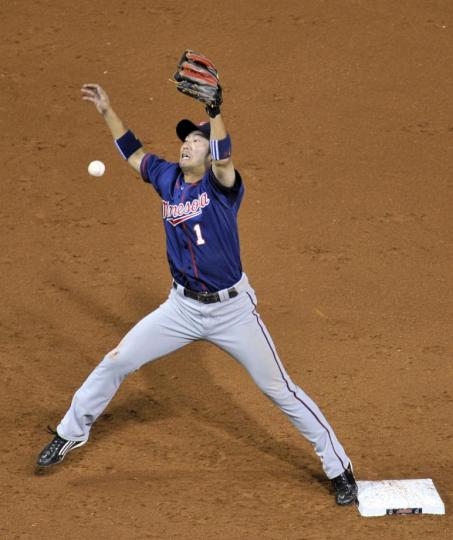
The Twins announced today that they have released Tsuyoshi Nishioka at his request. The middle infielder will relieve the Twins of their 2013 obligations, saving the team $3.25 million ($3M in salary and $250,000 in a buyout). The highly touted Japanese free agent never adapted well to the game at the highest level, hitting .215/.267/.236 in 254 plate appearances while provided terribly disappointing defense in the field. You can leave your comments here.
-
The Twins announced today that they have released Tsuyoshi Nishioka at his request. The middle infielder will relieve the Twins of their 2013 obligations, saving the team $3.25 million ($3M in salary and $250,000 in a buyout). The highly touted Japanese free agent never adapted well to the game at the highest level, hitting .215/.267/.236 in 254 plate appearances while provided terribly disappointing defense in the field.
-
You can view the page at http://twinsdaily.com/content.php?1067-Down-early
-
With the possible exception of the popularity of “Call Me Maybe”, nothing has spun more out of control in 2012 than the Minnesota Twins starting pitching. Categorically the Twins rotation has produced some of the least desirable stats in the American League. For starters, their misshapen 5.50 ERA tops the charts. Performances like Nick Blackburn (7.39 ERA in 19 starts), Brian Duensing (6.92 in 11 starts) and Liam Hendriks (6.13 ERA in 15 starts) shows where that number can be quickly inflated. Adding insult to injury, their expected Fielding Independent Pitching (4.60 xFIP) is the highest in all of baseball and offers no reprieve that would suggest perhaps, just maybe, the local staff was unfairly fastened to that ugly ERA. Not surprising either is the fact that the rotation is currently averaging just 5.4 innings per starts - the lowest average in the American League. If you happened to have attended a Jason Marquis start and stopped for popcorn on your way to the seat, chances are with him getting the hook before the fifth inning (4.9), you would have missed your opportunity to see him pitch. Same scenario could be applied for a Duensing start as well (4.7). It is probably easy to deduce judging from the bloated ERA and the early showers that the rotation’s Quality Start percentage would also be adversely affected. And you would be punctilious in assuming that. In just 38% of their contests (60 of 152 games), the Twins have managed to get through six innings with allowing three runs or less. The biggest culprit, which has resulted in the sideways statistics listed above, is the battle of the first inning – a battle in which the Twins are losing in spectacular fashion. In the first inning, the Twins starters have issued 69 walks and allowed 32 home runs. Like politics and family dinners or crack and Charlie Sheen, putting runners on base and then surrendering moon shots is a volatile combination. Only Baltimore and Kansas City encroach on that home run mark (30 each), as we all know, the O’s are playing this season protected by a bubble of pixie dust and unicorn farts from Pythagoras and his nerdy theories. It is a year in which no matter how many runs they allow, the Orioles still wind up winning more games than they lose. The Twins and Royals, meanwhile, play in the real world where giving up runs in bunches has legitimate consequences. Right now, the Twins lead the American League in runs allowed in the first inning with 124. That’s a remarkable deficit to put one’s team into. Compare that to what may be a less talent Oakland A’s team on paper. With their brood of starters all under the age of 30, the A’s have allowed just 56 runs in the first inning. With a 68-runs allowed differential between the A’s and the Twins, if you subscribe to the notion that 10 runs equals one win, then Oakland is, in theory, 7-wins better than Minnesota in the first inning alone. Obviously, the original plan was not to head into the year with Scott Diamond, Cole De Vries, Sam Deduno or Brian Duensing taking up a large portion of the starts. Then again, the original plan was not all that solid, either. The Twins rolled the dice heading into 2012 and plowed forward with a starting rotation that was held together by a wing and a prayer. Scott Baker had always struggled with injuries. Nick Blackburn had not only been battling injuries but had been highly ineffective overall. Carl Pavano was showing signs of aging, with a strikeout rate and velocity that dropped in 2011. Francisco Liriano had a clunker of a 2011 and was nothing more than a coin-flip with a high upside if everything landed correctly. So much had to break in the team’s favor in order for this group to succeed, instead it all fell apart early on. As Terry Ryan spoke to in his conference call last night with season ticket holders, the highest priority will be to acquire starting pitching – whether it be through trades, free agency or exploring the international market. There is plenty of room for improvement and if the Twins are looking to raise their win total in 2013, giving their lineup a fighting chance in the battle of the first inning is a good place to start.
-
[ATTACH=CONFIG]2431[/ATTACH]With the possible exception of the popularity of “Call Me Maybe”, nothing has spun more out of control in 2012 than the Minnesota Twins starting pitching. Categorically the Twins rotation has produced some of the least desirable stats in the American League. For starters, their misshapen 5.50 ERA tops the charts. Performances like Nick Blackburn (7.39 ERA in 19 starts), Brian Duensing (6.92 in 11 starts) and Liam Hendriks (6.13 ERA in 15 starts) shows where that number can be quickly inflated. Adding insult to injury, their expected Fielding Independent Pitching (4.60 xFIP) is the highest in all of baseball and offers no reprieve that would suggest perhaps, just maybe, the local staff was unfairly fastened to that ugly ERA. Not surprising either is the fact that the rotation is currently averaging just 5.4 innings per starts - the lowest average in the American League. If you happened to have attended a Jason Marquis start and stopped for popcorn on your way to the seat, chances are with him getting the hook before the fifth inning (4.9), you would have missed your opportunity to see him pitch. Same scenario could be applied for a Duensing start as well (4.7). It is probably easy to deduce judging from the bloated ERA and the early showers that the rotation’s Quality Start percentage would also be adversely affected. And you would be punctilious in assuming that. In just 38% of their contests (60 of 152 games), the Twins have managed to get through six innings with allowing three runs or less. The biggest culprit, which has resulted in the sideways statistics listed above, is the battle of the first inning – a batter in which the Twins are losing in spectacular fashion. In the first inning, the Twins starters have issued 69 walks and allowed 32 home runs. Like politics and family dinners or crack and Charlie Sheen, putting runners on base and then surrendering moon shots is a volatile combination. Only Baltimore and Kansas City encroach on that home run mark (30 each), as we all know, the O’s are playing this season protected by a bubble of pixie dust and unicorn farts from Pythagoras and his nerdy theories. It is a year in which no matter how many runs they allow, the Orioles still wind up winning more games than they lose. The Twins and Royals, meanwhile, play in the real world where giving up runs in bunches has legitimate consequences. Right now, the Twins lead the American League in runs allowed in the first inning with 124. That’s a remarkable deficit to put one’s team into. Compare that to what may be a less talent Oakland A’s team on paper. With their brood of starters all under the age of 30, the A’s have allowed just 56 runs in the first inning. With a 68-runs allowed differential between the A’s and the Twins, if you subscribe to the notion that 10 runs equals one win, then Oakland is, in theory, 7-wins better than Minnesota in the first inning alone. Obviously, the original plan was not to head into the year with Scott Diamond, Cole De Vries, Sam Deduno or Brian Duensing taking up a large portion of the starts. Then again, the original plan was not all that solid, either. The Twins rolled the dice heading into 2012 and plowed forward with a starting rotation that was held together by a wing and a prayer. Scott Baker had always struggled with injuries. Nick Blackburn had not only been battling injuries but had been highly ineffective overall. Carl Pavano was showing signs of aging, with a strikeout rate and velocity that dropped in 2011. Francisco Liriano had a clunker of a 2011 and was nothing more than a coin-flip with a high upside if everything landed correctly. So much had to break in the team’s favor in order for this group to succeed, instead it all fell apart early on. As Terry Ryan spoke to in his conference call last night with season ticket holders, the highest priority will be to acquire starting pitching – whether it be through trades, free agency or exploring the international market. There is plenty of room for improvement and if the Twins are looking to raise their win total in 2013, giving their lineup a fighting chance in the battle of the first inning is a good place to start.
-
-
Posnanski: Glen Perkins and the Art of the Save
Parker Hageman replied to Parker Hageman's topic in Minnesota Twins Talk
Yes, he certainly has a thing for Ron Gardenhire: http://joeposnanski.blogspot.com/2010/09/my-annual-gardy-rant.html -
This is an excellent must-read by Joe Posnanski on Glen Perkins and his closer role. Here's a sampling: Good stuff. Read the whole damn thing.
-
Fangraphs.com's Eno Sarris has put up a very interesting read on the inner workings of the San Francisco Giants. In speaking with Bobby Evans, the Giants' Vice President of Baseball Operations, we find that the organization is very savvy and has taken advantage of the local computer nerds: I was told that the Twins have their own proprietary databases and - as recently as this past spring - were exploring measures to implement systems like the Giants or the Indians' DiamondView (which was in operation back in 2003). Still, while no one in the organization was absolutely forthright on their current capabilities, you get the sense the team lags behind many others in this technological arms race.
-
Deduno leaves start with "left eye irritation"
Parker Hageman posted a topic in Minnesota Twins Talk
Deduno threw just 30 pitches in Wednesday's game before a left eye irritation caused manager Ron Gardenhire to pull him. -
You can view the page at http://twinsdaily.com/content.php?1063-Quick-Hits-Perkins-saves-Burton-under-pressure-and-Hendriks-struggles
