



Seth Stohs
-
Posts
25,909 -
Joined
-
Last visited
-
Days Won
109
Content Type
Profiles
News
Minnesota Twins Videos
2026 Minnesota Twins Top Prospects Ranking
2022 Minnesota Twins Draft Picks
Minnesota Twins Free Agent & Trade Rumors, Notes, & Tidbits
Guides & Resources
2023 Minnesota Twins Draft Picks
The Minnesota Twins Players Project
2024 Minnesota Twins Draft Picks
2025 Minnesota Twins Draft Pick Tracker
2026 Minnesota Twins Draft Tracker: Picks & Bonuses
Forums
Blogs
Events
Store
Downloads
Gallery
Everything posted by Seth Stohs
-
Article: Inside the Florida Instructional League
Seth Stohs replied to John Bonnes's topic in Twins Daily Front Page News
I pointed out on last week's Twins Hangouts podcasts that I'm hearing Chargois is hitting 97-98 on the radar gun in Instructs. That's rather encouraging! -
Article: Inside the Florida Instructional League
Seth Stohs replied to John Bonnes's topic in Twins Daily Front Page News
Interesting idea.... Ha! I really enjoy this look into the Instructional League... it's an aspect of the minor leagues that we just have so little visibility to. -
Inside the Florida Instructional League 9/20/2014
Seth Stohs commented on Bob Sacamento's blog entry in Blog Bob Sacamento
This is awesome!! Thank you so much for sharing all of the pictures and the great information. -
Florida Instructional League Roster
Seth Stohs replied to Seth Stohs's topic in Twins Minor League Talk
There is our definitive answer! Thanks! -
On Friday night, the Twins announced that All-Star closer Glen Perkins will not pitch again during the 2014 season due to a left forearm strain and nerve irritation. He will also not pitch during MLB's tour in Japan.According to FSN's Tyler Mason, Twins Doctor John Steubs said that Perkins' ulnar collateral ligament "looks perfect." He also noted that the forearm strain will be managed with exercise and therapy. Earlier this week, Parker Hageman asked What was going on with Glen. Specifically, he wrote about his declining fastball velocity. Perkins has experienced this forearm issue before but not to this degree. The most important thing is that the UCL is intact. That is actually good news. He is expected to be ready for spring training. Click here to view the article
-
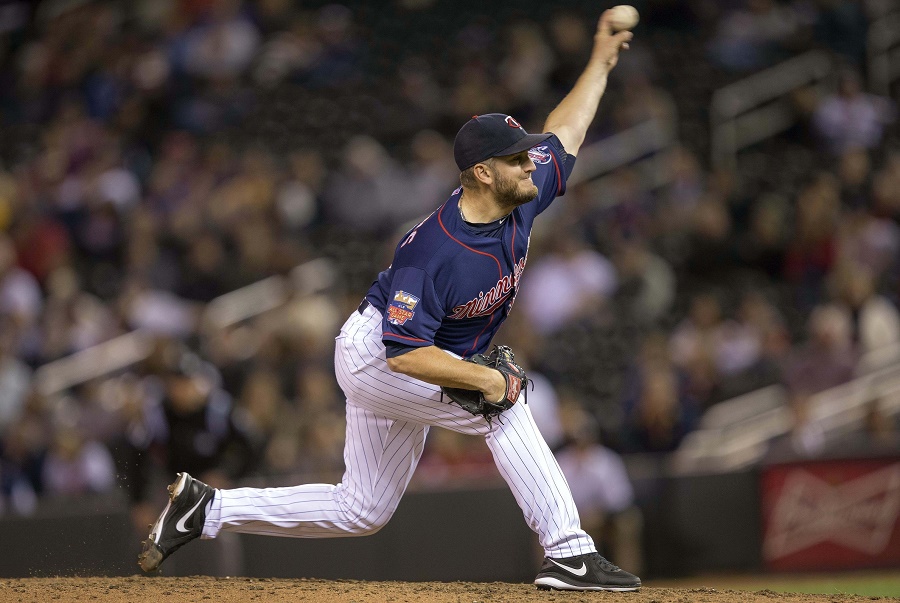 According to FSN's Tyler Mason, Twins Doctor John Steubs said that Perkins' ulnar collateral ligament "looks perfect." He also noted that the forearm strain will be managed with exercise and therapy. Earlier this week, Parker Hageman asked What was going on with Glen. Specifically, he wrote about his declining fastball velocity. Perkins has experienced this forearm issue before but not to this degree. The most important thing is that the UCL is intact. That is actually good news. He is expected to be ready for spring training.
-
Article: What Is Going On With Glen?
Seth Stohs replied to Parker Hageman's topic in Twins Daily Front Page News
It's OK news... nerve issues are concerning, but not as much as ligaments. -
Jake Reed Heading to Arizona Fall League
Seth Stohs replied to Seth Stohs's topic in Twins Minor League Talk
Zack Jones is replacing Mason Melotakis in the Arizona Fall League. -
Great summary! I really like this 3 positives, 3 negatives look at his season. Very good stuff!
-
But Jeremy... we already knew that nobody listens to us...
-
Florida Instructional League Roster
Seth Stohs replied to Seth Stohs's topic in Twins Minor League Talk
that's the one I use, but I know it's wrong... I just can't remember what the correct is. Speaking of JT Chargois, the reports I'm hearing are that he's sitting 97-98 in Instructs. Very encouraging. -
Article: Peterson Saga Brings Back Memories
Seth Stohs replied to Seth Stohs's topic in Twins Daily Front Page News
Fair point... I can't disagree with that. -
Below are a couple of baseball-related books that I would recommend. Please comment on these and then recommend a few others for us for the offseason. Include a link to where it can be purchased as well. Of course, I will also mention the Minnesota Twins Prospect Handbook, which are must-reads for Twins fans. (I asked the author. He said it was pretty good!) I was in the airport in San Francisco last weekend and picked up John Feinstein's Where Nobody Knows Your Name. It's about life in the minor leagues. It's stories about John Lindsay of the Dodgers who has the distinction of playing the most Minor League games before finally getting an opportunity in the Majors. It's about a guy like Scott Podsednik who was a World Series hero in 2005 and found himself back in AAA in 2010. Or a guy like Scott Elarton who was injured and left the game, lost a bunch of weight in his post-career life and then asked for another shot. There are tons of stories and it's really interesting. The Sons of Marella Windsong isn't really a baseball book, per se. However, the author is from Minnesota's Iron Range and incorporated just a ton of Minnesota Twins information. In fact, he even referenced me in the book, which is always really cool. It's kind of a psychological look at identical twins. Well, here is a much better description of the book than I could give. You can buy it on Amazon here.
-
Article: Peterson Saga Brings Back Memories
Seth Stohs posted a topic in Twins Daily Front Page News
Since news broke last Friday, the Adrian Peterson situation has been at the forefront of national and local sports talk. Each day, there are new details that come out and take the discussion in different directions. A local sports “hero” has suddenly been cast into a new and different light (or darkness). Maybe this is a little déjà vu for some of us Twins fans.I was eight years old when Kirby Puckett was called up to the Twins. He pretty quickly became my new favorite baseball player. In all honesty, I’m thinking it was his name, at least at first. He was the speedy new centerfielder who was sure fun to watch. And within a couple seasons, he became one of baseball's best players. When the Twins won their first World Series in 1987, I was 12 years old. I had spent the summer playing baseball, wearing number 34. In 1991, I was a junior in high school and the Twins won the World Series again. There was The Catch against the plexi-glass. There was his “We’ll see you tomorrow night” moment. Puckett was full of charisma and clearly enjoyed playing the game of baseball. He was a hit machine. He was a perennial All-Star and one of the great ambassadors of the game. He was someone who was involved in charities, especially those that helped children. Then came spring of 1995, and his career was suddenly over due to glaucoma. I was 19 years old, in college, and the news was devastating. Kirby Puckett was my hero. He was the guy who I enjoyed watching through my formative years. I’m guessing the same can be said for many of my generation. In 2001, my dad and brother and I went to Cooperstown with some friends to watch Puckett (and Dave Winfield) get inducted into baseball’s Hall of Fame. That is certainly the pinnacle for any ball player’s career. It wasn’t long after his induction that things went tumbling downhill for Puckett. I’m not going to get into the details here. If you want, you can Google it. I was grown up then, but the news was still painful to read. Where did this come from? How could I have been so wrong? The situation now if very similar for Adrian Peterson and these fans. There are many kids in Minnesota and around the country who idolize Adrian Peterson. He is one of the best running backs to play the game. He did things that we haven’t seen before on a football field. Although his reputation had taken a few hits, he was generally considered a very good person who did a lot in the community. As horrible as this Adrian Peterson situation has been (and will continue to be), and as horrible as the Kirby Puckett news was, can we learn anything from them? Maybe the conversations about the Peterson situation can do some good. Maybe the conversations on talk radio and in the Vikings Journal forums can be productive. It can help define what is wrong and what limits should be. If even a handful of parents alter their thinking on using a switch or other extreme “discipline,” it will help those kids. If it can keep some people around the country from abusing a child, a girlfriend, a wife, the conversation is worthwhile. I agree with the old Charles Barkley commercial in which he famously said, “I am not a role model. I am not paid to be a role model. I am paid to wreak havoc on the basketball court.” In theory, that is correct. Teachers, doctors and parents should be the heroes of kids. In reality, kids who enjoy sports are going to look up to their favorite athletes. They will emulate the stars. They will try to replicate batting stances or touchdown celebrations or 360-windmill slam dunks (Well, maybe when they get older). I am now a parent of an eight-year-old. She’s not quite the sports fanatic I was at that age, but she knows a few Twins names and will occasionally watch part of a ballgame with me. What should we tell our kids? At one point, I thought it might be best to tell children not to have athletes as heroes and role models. I don’t really agree with that. I think it’s important to remember that a large majority of athletes are really good people who really do a lot of great work in the community. I've had the opportunity to meet several of the Twins players and minor leaguers and there are so many genuinely good people. I also think that does put some responsibility on the athletes to realize that kids are watching them. I would like to see a few top athletes take a stand and speak out against domestic violence, against other things and about being good people and role models. It’s also important as a parent to talk to your children and help them understand that what we see on the field and on TV is just a part of who these people are. The Twins players are more than just athletes. They have families. Some have wives or girlfriends, and some have kids. Like each and every one of us, they will make mistakes. We aren't perfect. When I am asked who my favorite baseball player of all time is, I still say that it is Kirby Puckett. And I say it easily and with no hesitation. If someone were to ask me who the best running back that I’ve ever seen in the NFL, I will tell them Adrian Peterson (though Bo Jackson might be the answer on the right days). And that’s OK. Click here to view the article -
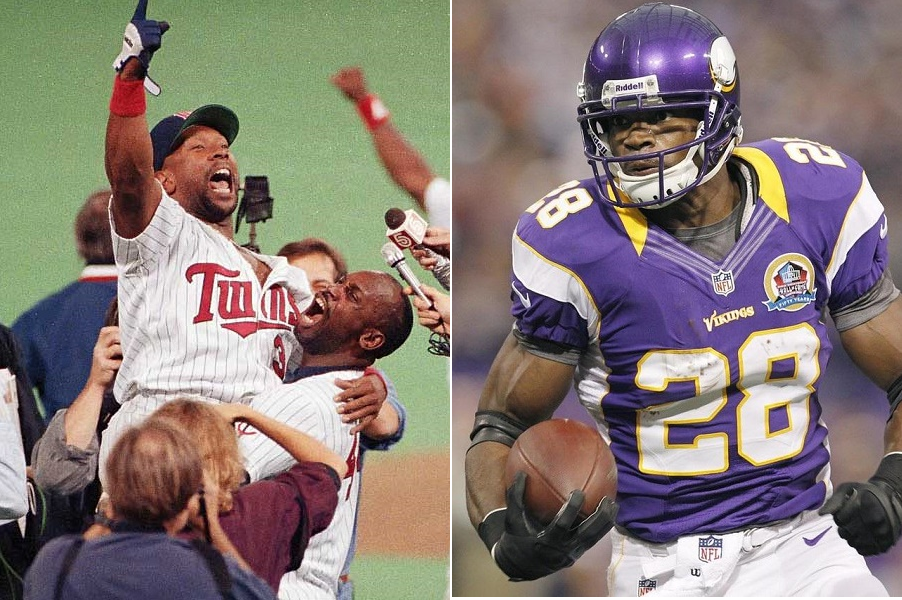 I was eight years old when Kirby Puckett was called up to the Twins. He pretty quickly became my new favorite baseball player. In all honesty, I’m thinking it was his name, at least at first. He was the speedy new centerfielder who was sure fun to watch. And within a couple seasons, he became one of baseball's best players. When the Twins won their first World Series in 1987, I was 12 years old. I had spent the summer playing baseball, wearing number 34. In 1991, I was a junior in high school and the Twins won the World Series again. There was The Catch against the plexi-glass. There was his “We’ll see you tomorrow night” moment. Puckett was full of charisma and clearly enjoyed playing the game of baseball. He was a hit machine. He was a perennial All-Star and one of the great ambassadors of the game. He was someone who was involved in charities, especially those that helped children. Then came spring of 1995, and his career was suddenly over due to glaucoma. I was 19 years old, in college, and the news was devastating. Kirby Puckett was my hero. He was the guy who I enjoyed watching through my formative years. I’m guessing the same can be said for many of my generation. In 2001, my dad and brother and I went to Cooperstown with some friends to watch Puckett (and Dave Winfield) get inducted into baseball’s Hall of Fame. That is certainly the pinnacle for any ball player’s career. It wasn’t long after his induction that things went tumbling downhill for Puckett. I’m not going to get into the details here. If you want, you can Google it. I was grown up then, but the news was still painful to read. Where did this come from? How could I have been so wrong? The situation now if very similar for Adrian Peterson and these fans. There are many kids in Minnesota and around the country who idolize Adrian Peterson. He is one of the best running backs to play the game. He did things that we haven’t seen before on a football field. Although his reputation had taken a few hits, he was generally considered a very good person who did a lot in the community. As horrible as this Adrian Peterson situation has been (and will continue to be), and as horrible as the Kirby Puckett news was, can we learn anything from them? Maybe the conversations about the Peterson situation can do some good. Maybe the conversations on talk radio and in the Vikings Journal forums can be productive. It can help define what is wrong and what limits should be. If even a handful of parents alter their thinking on using a switch or other extreme “discipline,” it will help those kids. If it can keep some people around the country from abusing a child, a girlfriend, a wife, the conversation is worthwhile. I agree with the old Charles Barkley commercial in which he famously said, “I am not a role model. I am not paid to be a role model. I am paid to wreak havoc on the basketball court.” In theory, that is correct. Teachers, doctors and parents should be the heroes of kids. In reality, kids who enjoy sports are going to look up to their favorite athletes. They will emulate the stars. They will try to replicate batting stances or touchdown celebrations or 360-windmill slam dunks (Well, maybe when they get older). I am now a parent of an eight-year-old. She’s not quite the sports fanatic I was at that age, but she knows a few Twins names and will occasionally watch part of a ballgame with me. What should we tell our kids? At one point, I thought it might be best to tell children not to have athletes as heroes and role models. I don’t really agree with that. I think it’s important to remember that a large majority of athletes are really good people who really do a lot of great work in the community. I've had the opportunity to meet several of the Twins players and minor leaguers and there are so many genuinely good people. I also think that does put some responsibility on the athletes to realize that kids are watching them. I would like to see a few top athletes take a stand and speak out against domestic violence, against other things and about being good people and role models. It’s also important as a parent to talk to your children and help them understand that what we see on the field and on TV is just a part of who these people are. The Twins players are more than just athletes. They have families. Some have wives or girlfriends, and some have kids. Like each and every one of us, they will make mistakes. We aren't perfect. When I am asked who my favorite baseball player of all time is, I still say that it is Kirby Puckett. And I say it easily and with no hesitation. If someone were to ask me who the best running back that I’ve ever seen in the NFL, I will tell them Adrian Peterson (though Bo Jackson might be the answer on the right days). And that’s OK.
-
Twins/Chattanooga to announce affiliation?
Seth Stohs replied to Steven Buhr's topic in Twins Minor League Talk
It is interesting to think about the Twins having affiliates in Nashville, Chattanooga and Elizabethon. That said, I really like the Rochester relationship and at this point hope they stick around there for awhile. -
Article: What Is Going On With Glen?
Seth Stohs replied to Parker Hageman's topic in Twins Daily Front Page News
I'm positive in that, if he is healthy, he is a smart guy and will make some adjustments. He was very good until the last few weeks despite the lower velocity. If he's hurt, obviously at that point there is a concern. -
According to LaVelle Neal, the Twins officials are now in Chattanooga.
-
Article: What Is Going On With Glen?
Seth Stohs replied to Parker Hageman's topic in Twins Daily Front Page News
Perkins will be just fine. Good fastball, very good slider. All relievers have their moments that last a couple of weeks to a month. It happens to the best. The concern is possible injury, and that's unpredictable. -
MUST READ TWEET: Span Disses Twins?
Seth Stohs replied to Seth Stohs's topic in Minnesota Twins Talk
Tweet from Darren Wolfson: -
If he's healthy, he should pitch. That's his job. if he's not healthy, they need to know. He's important and they need to take care of it. There is reason for concern, sure...
-
Article: The Real Brian Dozier?
Seth Stohs replied to Nick Nelson's topic in Twins Daily Front Page News
Definitely a guy worth getting through the arbitration years with... I'm encouraged by the increased walk rate, though I'd definitely like to see that strikeout rate decrease. I think that will help with the batting average... and the on-base percentage. Like above, I'm not worried about the home runs. I am encouraged by the doubles... And the defense has been terrific. Increased errors (I believe) but overall, I think better. -
MUST READ TWEET: Span Disses Twins?
Seth Stohs replied to Seth Stohs's topic in Minnesota Twins Talk
That's the question. I don't know how he possibly thinks he was held back. He had his best two seasons in Minnesota, turned it into a big contract, played most every day, was taken care of during his concussion, and much more... My assumption is that it was a heat-of-the-moment comment that he just wasn't thinking when he said it. -
Aaron Gleeman posted the following on Twitter on Tuesday night: What do you think? Is Span right? Did Minnesota hold him back? If so... when??
-
Thank you for that comment. It's good to hear. It's hard to ignore the frustration that another 90+ loss season brings, but it'd just be silly not to acknowledge that there is also a lot of good happening on and off the field as well.

