


Twins Video
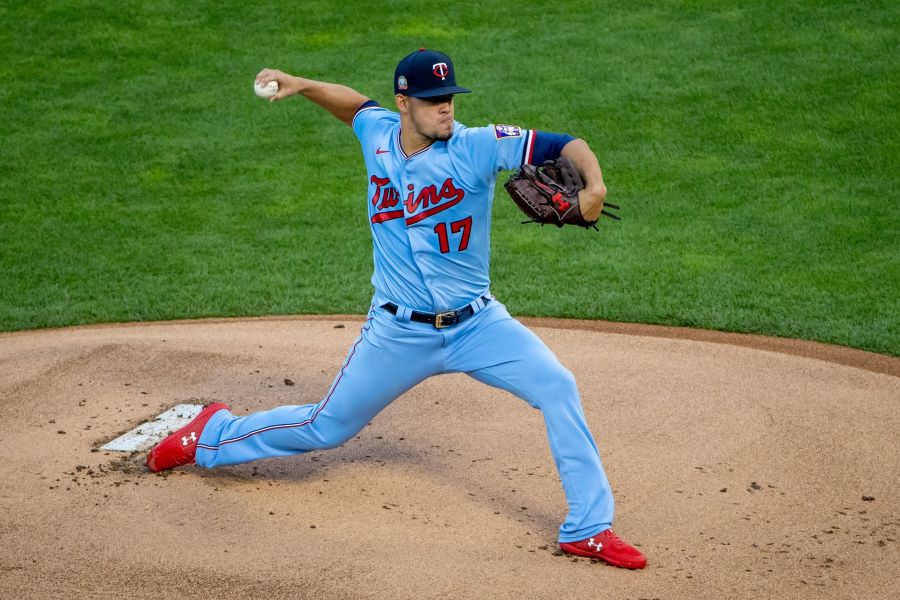
Because of his arm action and the other pitches in his repertoire, Berríos has never had an especially consistent feel for spinning his four-seamer at the top of the strike zone. He’s shorter than the average starting pitcher, but even adjusting for that fact, he’s tended to release the ball at a relatively low height, indicating a three-quarter arm slot and giving his fastball some tailing action, rather than pure ride. That’s been especially true since his last significant mechanical overhaul, in 2018.
In his final three regular-season starts of 2020, however, Berríos changed something. He altered his arm angle slightly, raising it to a more overhand slot, and had his three highest average release points of the season in those starts. That matters, because when a pitcher releases the ball higher, with a higher arm angle, their fastball runs less to the arm side. Given Berríos’s style of delivery, a higher release point will also tend to lead to higher spin rates and more rising action, because the hurler reaches further through release, letting it off their fingertips more naturally.
That’s exactly what happened at the end of 2020. Berríos had averaged under 2,190 RPM on his heater through mid-September, but that number rose to 2,291 in his September 25 start, when he had his highest single-game release point of the season, at 5.63 feet. In that game, he only got six non-contact strikes on 22 four-seam fastballs, but that was a promising game for that pitch.
This spring, Berríos has only increased his emphasis on this skill. He’s had three starts tracked by Statcast, including Monday’s, and they are three of the four starts of his whole career in which he’s had the highest average release point. His spin rates are markedly higher. The results were more in line with the process on Monday, too: he got 11 non-contact strikes on 29 four-seamers.
As I wrote earlier this month, Berríos came into the spring with three key mandates: to hit spots on the glove side of the plate with his four-seamer, to achieve the 12-to-6 shape he’s sought on his curveball, and to use his changeup more often against right-handed batters. He’s now doing all three. Continuing to get on top of his fastball and curve will only augment his efforts to sustain each of those skills, too, because obviously, a more overhand slot should yield a more vertical curve. That’s exactly what it’s done, and with Berríos executing better at the top of the zone because of his higher-spin heat, hitters are going to have to commit too soon to pick up the breaking ball.
He’ll never have a classic overhand delivery, and that’s fine. Berríos’s deception and the tricky angles he creates by working from the third-base edge of the rubber make him a tough at-bat for opposing hitters. If he can keep his release point high, though, he’s going to hit his targets and miss bats more frequently, and he might make a leap to the next level in 2021.
MORE FROM TWINS DAILY
— Latest Twins coverage from our writers
— Recent Twins discussion in our forums
— Follow Twins Daily via Twitter, Facebook or email






Recommended Comments
Create an account or sign in to comment
You need to be a member in order to leave a comment
Create an account
Sign up for a new account in our community. It's easy!
Register a new accountSign in
Already have an account? Sign in here.
Sign In Now