


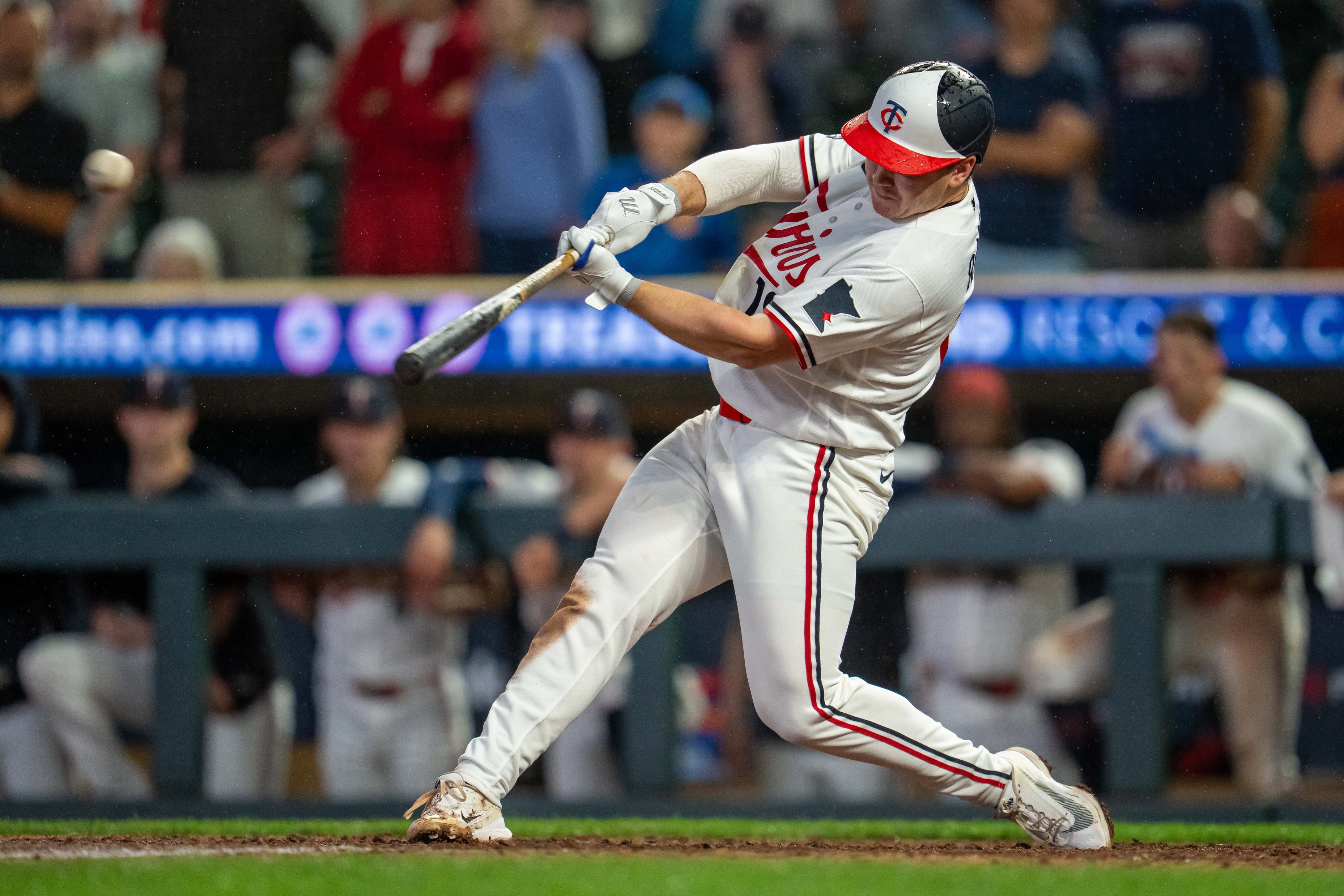
Twins Video
Nobody reads anymore.
A recent Atlantic article found that just 16% of Americans read for pleasure. The other 84%? Apparently they're reading because life, work, or the IRS forced them to.
That means if you clicked on an article breaking down Alan Roden's swing changes, you're either part of a dying breed or you accidentally tapped the wrong link. Either way, welcome.
I'll make you a deal. We'll get to the video almost immediately, and then we'll spend the rest of the article figuring out why the Twins believe Roden's new setup might unlock more offense than the version we watched a year ago.
So what did you just watch?
My guess is your first thought was something along the lines of, "Alan Roden has a pretty unorthodox swing." That slow-pitch softball leg kick catches a lot of people off guard. Your second thought might be that the two swings actually look fairly similar, aside from him setting up a little lower this season.
You'd be right on both counts.
But let's dig a little deeper.
In 2024, Roden hit a career-high 16 home runs. The left-handed hitting outfielder believed he had the tools to produce that kind of power more consistently. His goal became improving his launch angle to the pull side so he could drive more baseballs in the air and over the fence.
Here's what Roden told Fangraphs' David Laurila about his stance during spring training last year:
"The stance is about pre-setting the slot so that once I get to launch position I can just turn — it’s how I’m posturing, and directionally moving through the swing to match the plane of the pitch. There is a little more space behind me now, and the turn starts a little bit earlier. It’s been a process to get to this point, but I really like where I’m at right now."
When Roden talks about "pre-setting the slot," he's referring to the relationship between his hands, arms, and bat throughout the swing. In simple terms, he's trying to maintain a strong triangle between his arms and hands as he delivers the barrel.
Compare that to his setup at Creighton. His pre-pitch posture was noticeably looser than what we saw during his 2025 season.
Alan Roden with his 5th HR of the season gives Creighton a 3-0 lead over San Jose State! pic.twitter.com/QIzcgndDMy
— Nebraska Public Media (@NebPublicMedia) April 17, 2021
While Roden found success against college and minor league pitching, those results didn't immediately carry over against major league arms. In 55 games with the Blue Jays and Twins in 2025, he hit .191/.261/.294. In his 12 games just with Minnesota, he hit .158 with 13 strikeouts, no walks, and just 40 plate appearances.
Rather than continue doing the same thing and hoping for different results, Roden made meaningful adjustments entering 2026.
The first noticeable change is in his lower half.
Just as he previously focused on pre-setting his slot, he's now pre-setting his back hip. You'll notice he's hinging much more into his rear leg compared to last year's upright setup. In 2025, his lower-half move eventually got him into this position. Now he's ready to fire the moment he gets into the box.
He's also starting from a much more open stance. This season he's set up at roughly 45 degrees compared to 34 degrees a year ago, which was already well above the MLB average of 11 degrees.
His hand position is another obvious adjustment.
He's starting with his hands lower and farther away from his body than he did last season. In 2025, the bat would wrap behind him during the load, creating a longer path to the baseball and making it more difficult to get to velocity on the inner half. Now his hands stay much more in line with his torso, creating stretch without pulling everything offline.
There are also several underlying traits that make Roden an intriguing offensive bet and someone worth giving every opportunity to figure things out.
He owns one of the better strike-zone profiles you'll find. Throughout the minors, Roden actually walked more than he struck out, a rare accomplishment in today's game.
Interestingly, his bat speed is merely average. It's an extremely small sample of just 14 competitive swings in the majors during 2026, but his average bat speed is actually down one mile per hour to 69.1 MPH. League average sits at 71.7 MPH.
The tradeoff is that the bat is getting to the ball on a shorter path. That's one reason he's consistently able to control the strike zone.
There's no guarantee these changes turn Alan Roden into an everyday major leaguer. Hitting is rarely that simple.
What matters is that he's attacking the problem instead of hoping it fixes itself. Every adjustment in his setup has a purpose, from the way he loads his back hip to how he positions his hands.
The next few months won't tell us whether Roden can hit. They'll tell us whether this version of Roden is the one the Twins believed they were acquiring.
Do you approve of the job Derek Shelton is doing as Twins manager?

Follow Twins Daily For Minnesota Twins News & Analysis



- nclahammer, Cris E, Patzky and 3 others
-
 6
6


Recommended Comments
Create an account or sign in to comment
You need to be a member in order to leave a comment
Create an account
Sign up for a new account in our community. It's easy!
Register a new accountSign in
Already have an account? Sign in here.
Sign In Now