


Twins Video
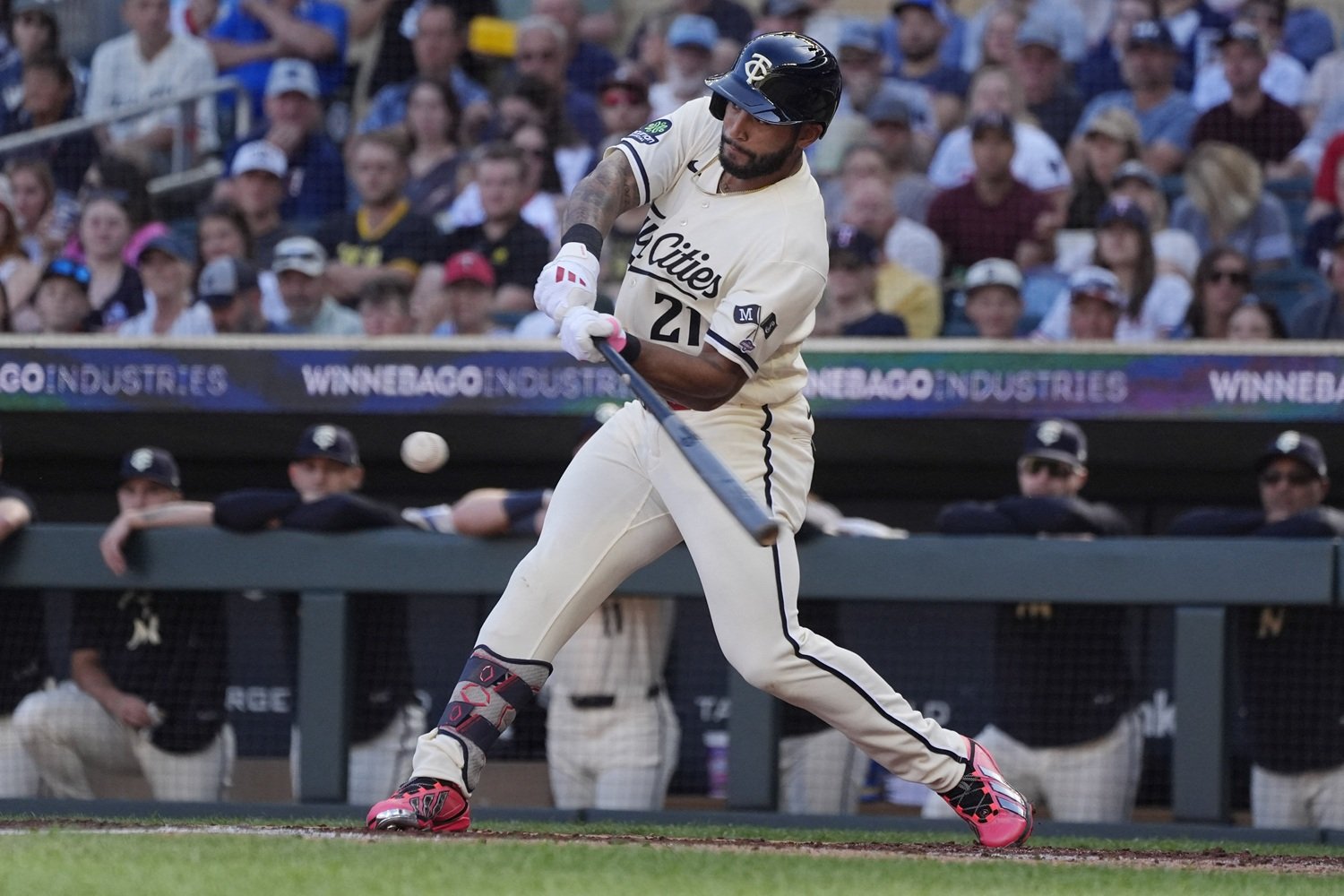
Emmanuel Rodriguez and Miguel Sano don't exactly look like the same type of baseball player. Sano stood 6-foot-4 and weighed more than 260 pounds during his time with the Twins. Rodriguez is listed at 5-foot-11 and 210 pounds. Their physical builds, positions, and paths through the organization are different.
But there is one important similarity between the two. Both developed into what can be described as three true outcomes prospects. That isn't necessarily a bad thing. In fact, both players demonstrated the ability to produce tremendous offensive numbers because of their power and patience. But there is a danger when too many plate appearances end without the ball ever being put into play.
And the Twins have already seen how that story can play out.
What Are the Three True Outcomes?
MLB defines a three true outcome hitter as a player whose plate appearances end almost exclusively in a home run, walk, or strikeout. These are considered "true" outcomes because defensive players aren't involved in determining the result. The pitcher and batter decide the outcome themselves.
That profile has become increasingly common in modern baseball. Hitters are encouraged to hunt pitches they can drive, accept walks when pitchers won't give them something to hit, and live with strikeouts in exchange for power.
The problem is that there can be a fine line between maximizing those strengths and becoming overly dependent on them. Rodriguez and Sano both walked that line as prospects.
Comparing Rodriguez and Sano
Sano and Rodriguez were both consensus Top 100 prospects as they moved through the Twins' farm system. Their minor-league numbers are remarkably similar in some ways, while also highlighting one major difference.
Sano hit .280/.375/.559 for a .934 OPS in the minors. He struck out in 26.3% of his plate appearances while walking 12.3% of the time. Rodriguez hit .257/.424/.489 for a .912 OPS. His strikeout rate was considerably higher at 29.7%, but his walk rate was an incredible 21.2%.
There are obvious differences. Sano hit for a much higher average and generated more power. Rodriguez, meanwhile, showed an extraordinary ability to get on base without putting the ball in play. That patience is one of Rodriguez's greatest strengths. It can also contribute to one of his biggest concerns.
Patience Can Come with a Cost
There is an important relationship between walks and strikeouts that can sometimes get overlooked. A patient hitter doesn't have to swing at a pitch simply because it is close to the strike zone. He can wait for something he believes he can drive. That approach can produce more walks, but it can also lead to deeper counts.
And deeper counts create more opportunities for strikeouts. A hitter who regularly takes pitches can find himself in two-strike counts. Once that happens, the pitcher has more freedom to expand the strike zone, and the hitter has fewer opportunities to make an aggressive swing.
Rodriguez's 21.2% minor-league walk rate is elite. But his 29.7% strikeout rate shows the other side of that approach. The goal isn't necessarily to eliminate strikeouts. Every hitter strikes out.
The question is whether Rodriguez can maintain his exceptional plate discipline while putting enough balls in play to keep his offensive production from becoming overly dependent on walks and home runs. Sano never completely solved that problem.
Sano's Major-League Warning
Sano played parts of nine seasons in the majors, experiencing plenty of highs and lows along the way. His final major-league line was .233/.325/.477 for an .801 OPS. His 36.5% strikeout rate was dramatically higher than the 26.3% mark he posted in the minors, while his 11.6% walk rate remained relatively strong.
The batting average dropped. The strikeouts climbed. The power, however, remained impressive. Sano had three seasons with at least 28 home runs, demonstrating exactly why the three true outcomes can be so appealing. A hitter doesn't necessarily need to hit for a high average if he can consistently get on base and punish mistakes.
But Sano's career also demonstrated the downside. When the walks weren't enough to offset the strikeouts and the home runs weren't coming, there wasn't much else left to carry the offensive production. A player who rarely puts the ball in play has fewer opportunities to collect singles, doubles, productive outs, or hits that come from defensive mistakes. That is the concern with Rodriguez.
What to Watch for With Rodriguez
Rodriguez's profile is not identical to Sano's, and that distinction matters. His elite walk rate gives him an offensive skill that Sano never possessed at the same level. Rodriguez has also demonstrated impressive power and has been one of the more intriguing offensive prospects in the Twins system for years. But his minor-league batting average was lower than Sano's, while his strikeout rate was higher. That's the combination worth watching as Rodriguez establishes himself at the major-league level.
The first thing to monitor is his contact rate. If major-league pitchers can consistently get Rodriguez into two-strike counts, his strikeout rate could climb even higher. The second is whether his walk rate holds up. A 21.2% walk rate is difficult to maintain against big-league pitching. If pitchers discover they can attack him in the strike zone without giving him pitches he can punish, Rodriguez could see fewer free passes.
Finally, there is the power. The three true outcomes work best when the home run portion is significant enough to offset the strikeouts. Rodriguez doesn't need to become a .300 hitter to be productive, but he does need to turn enough of those favorable counts into hard contact and extra-base damage. That's where the comparison to Sano becomes particularly interesting.
Three Outcomes, But More Than Three Possibilities
There is nothing inherently wrong with being a three true outcomes hitter. Baseball has changed, and walks and home runs are valuable. A hitter who combines patience with power can be an incredibly dangerous offensive weapon. But there is a point where the balance becomes problematic.
If Rodriguez walks 20% of the time and hits enough home runs to make the strikeouts manageable, the profile could work extremely well. If the walks fall, the strikeouts rise, and the power doesn't fully translate, the margin for error becomes much smaller. Sano's career provides a useful example of that risk without being a prediction of Rodriguez's future.
The two players look completely different standing next to each other. One was a massive slugger who seemed built to hit baseballs into the upper deck. The other is a smaller, more compact outfielder whose calling card has been an extraordinary combination of patience and power.
Yet their paths through the Twins' farm system produced a similar question. Can a hitter who lives on the edges of the strike zone generate enough damage when he does swing to compensate for all the times he doesn't put the ball in play?
For Rodriguez, that's one of the biggest questions facing his transition to the majors. The three true outcomes can produce a superstar. They can also produce a hitter whose offensive floor is lower than the prospect pedigree suggests. Rodriguez has plenty of time to prove which path he will take.
Should fans be worried about Rodriguez following Sano’s path? Leave a comment and start the discussion.






Recommended Comments
Create an account or sign in to comment
You need to be a member in order to leave a comment
Create an account
Sign up for a new account in our community. It's easy!
Register a new accountSign in
Already have an account? Sign in here.
Sign In Now