


Pedro Muñoz Autograph

Pedro Muñoz Bio
Twins Video
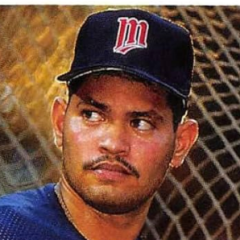
I believe all optimistic baseball fans do what I am about to describe. In the low points of a franchise’s history, the optimists want to hold out hope for something positive, cheer for the newest player, anything to give them reasons to hope or believe in a brighter future. I believe optimistic fans do so to the point that they convince themselves that an average player is better than his numbers suggest; a player might be perceived as good simply because there are too many subpar players surrounding him. That’s how I feel about Pedro Muñoz and his Minnesota Twins tenure. He was a supremely average player in his peak seasons of 1992-95 who seemed better than he really was solely because those Twins teams were on a downward spiral toward ineptitude at that time.
Pedro Javier Muñoz Gonzalez was born September 19, 1968, in Ponce, Puerto Rico. He was signed as an undrafted free agent by the Toronto Blue Jays on May 31, 1985. Toronto was ahead of the curve in signing players from Latin America. They often seemed to have a stable supply of new, young Latin Americans coming through their development pipeline, including All-Stars Dámaso García, Alfredo Griffin, Tony Fernández, and 1987 AL MVP George Bell. Pedro Muñoz was another of those players signed from Latin America.
For the whole Muñoz story, we need to look back at the 1990 offseason. The Twins had obtained lightning in a bottle by signing John Candelaria before the 1990 season for $500,000. For context, the minimum Major League Baseball salary for 1990 was $100,000. The left-handed pitcher was an excellent starting pitcher for Pittsburgh early in his career. He was an All-Star in his second full season with the Pirates and so good he earned Cy Young and Most Valuable Player votes. From 1975 to 1986, his ERA+ was greater than 100 in all but one season. From 1987 to 1989, his performance suffered from injuries, personal matters, and off-the-field issues. The Twins gambled and signed him on the cheap in 1990 and put him in the bullpen. He had a great half-season. His Twins career consisted of 34 games with only one start. His record was 7-3 with 44 strikeouts in 58.1 innings. His ERA+ was 123. With 1990 being a disastrous season for the Twins, they took the opportunity to cash in on their offseason find and traded Candelaria while he was hot. Near the trade deadline, on July 27, 1990, Candelaria was traded to Toronto for second baseman Nelson Liriano and outfielder Pedro Muñoz.
1990 was a bad season for the Minnesota Twins. They had little to no pitching. Their record was 47-52 on the day they acquired Pedro Muñoz. They were 6th in the American League West, 15 games behind Oakland. Things deteriorated even further with a nine-game losing streak in August, lowering them to last place and 24 games behind Oakland. With the season being a failure, September offered a chance to look at the youngsters with the expansion of rosters. Muñoz debuted on September 1, at 21, and mainly played every day in September, hitting .271/.281/.341. He showed little patience (two walks) and little power (five extra-base hits) in 90 plate appearances.
We all know the 1991 Twins team was special, but they were a little slow getting going. The outfielders were Dan Gladden, Kirby Puckett, and Shane Mack, with Randy Bush and Gene Larkin providing depth. Later in the season, Jarvis Brown was often used as a pinch runner and defensive replacement. Because of the team’s slow start (14-15 through May 10) and Muñoz batting .408 at Triple-A Portland, he was called up on May 11, 1991, and the seldom-used Carmen Castillo was released. Very interestingly, the Star Tribune’s summary of the Pedro Muñoz call-up mentioned the likelihood that Gladden and Mack would be those whose playing time would be most affected. That did not prove to be accurate, as Gladden continued to play nearly every day. Mack also continued to play almost every day but was used as a defensive replacement in nine games from May 11 to June 13. However, a funny thing happened. During that month, Mack batted .310/.365/.466, proving his worth. Muñoz then became the part-time player and defensive replacement and then landed on the disabled list with a sprained thumb on July 15. Muñoz came back in September to lesser usage, often as a defensive replacement. For the season, he had 151 plate appearances and improved from the prior season to .283/.327/.500. He had 15 extra-base hits and an OPS+ of 121. Ultimately, that performance was not enough to force his way onto the postseason roster. He would have to watch the 1991 Fall Classic.
After 1991, the continual budget constraints of the Minnesota Twins reared their head. Jack Morris opted out of his contract, making him a free agent who would ultimately sign with Toronto. More importantly for this article, the Twins released Gladden about two months after the World Series. Pedro Muñoz essentially replaced Gladden at the MLB minimum salary. Muñoz played in 127 games in 1992, getting 439 plate appearances. This was the most extensive action of his career. With this big opportunity, he hit .270/.298/.409 with 12 home runs and 71 RBI. He had an OPS+ of 96. Was this a promising start?
Muñoz’s 1993 season was worse. In 354 plate appearances, his slash line was .233/.294/.393. His OPS+ dropped to 83.
Muñoz’s 1994 and 1995 seasons were better, but the Twins were worse. The team hit a low point in 1995. Their winning percentage of .389 was their worst of the decade. During those two seasons, Muñoz hit a combined .298/.342/.497. He played only 179 games but had 29 home runs and 94 RBI. His combined OPS+ for those two seasons was 114.
Muñoz signed as a free agent with Oakland in 1996. I would call this a salary dump as Terry Ryan said he wanted Muñoz back, but not at his 1995 salary. His Twins salary in 1995 was $725,000, and his Oakland salary in 1996 was $595,000. His 1996 season with Oakland was unremarkable. He signed a minor league deal with Detroit in 1997 but never reappeared in MLB or even the minor leagues. That was the last of Muñoz in American baseball.
Muñoz’s career slash was .273/.315/.444. His cumulative WAR was -1.3, and his OPS+ was a completely average 100. His Minnesota years produced an OPS+ of 102, but he was never a significant star. In fact, I can’t find anything to make me recall why I thought he was anything better than an average player, even during the dark times of the mid-1990s.
Thankfully, since Muñoz’s last season in 1995, the Twins have only recorded a worse winning percentage once, that being in 2016. The Twins were awfully bad during Muñoz’s career. I wish his tenure could have been better for Muñoz, the Twins, and their fans.

Pedro Muñoz Statistics
| Season | Age | Team | Lg | WAR | G | PA | AB | R | H | 2B | 3B | HR | RBI | SB | CS | BB | SO | BA | OBP | SLG | OPS | OPS+ | rOBA | Rbat+ | TB | GIDP | HBP | SH | SF | IBB | Pos | Awards |
|---|---|---|---|---|---|---|---|---|---|---|---|---|---|---|---|---|---|---|---|---|---|---|---|---|---|---|---|---|---|---|---|---|
| 1990 | 21 | MIN | AL | -0.8 | 22 | 90 | 85 | 13 | 23 | 4 | 1 | 0 | 5 | 3 | 0 | 2 | 16 | .271 | .281 | .341 | .622 | 70 | .308 | 69 | 29 | 3 | 0 | 1 | 2 | 0 | 9/7D | |
| 1991 | 22 | MIN | AL | 0.3 | 51 | 151 | 138 | 15 | 39 | 7 | 1 | 7 | 26 | 3 | 0 | 9 | 31 | .283 | .327 | .500 | .827 | 121 | .374 | 119 | 69 | 2 | 1 | 1 | 2 | 0 | 97/HD | |
| 1992 | 23 | MIN | AL | 1.4 | 127 | 439 | 418 | 44 | 113 | 16 | 3 | 12 | 71 | 4 | 5 | 17 | 90 | .270 | .298 | .409 | .707 | 96 | .320 | 91 | 171 | 18 | 1 | 0 | 3 | 1 | *9/H7D | |
| 1993 | 24 | MIN | AL | -1.9 | 104 | 354 | 326 | 34 | 76 | 11 | 1 | 13 | 38 | 1 | 2 | 25 | 97 | .233 | .294 | .393 | .686 | 83 | .309 | 78 | 128 | 7 | 3 | 0 | 0 | 2 | 79/H | |
| 1994 | 25 | MIN | AL | 0.6 | 75 | 268 | 244 | 35 | 72 | 15 | 2 | 11 | 36 | 0 | 0 | 19 | 67 | .295 | .348 | .508 | .857 | 118 | .383 | 121 | 124 | 4 | 2 | 0 | 2 | 0 | 79D/H | |
| 1995 | 26 | MIN | AL | -0.1 | 104 | 400 | 376 | 45 | 113 | 17 | 0 | 18 | 58 | 0 | 3 | 19 | 86 | .301 | .338 | .489 | .827 | 112 | .365 | 112 | 184 | 14 | 3 | 0 | 2 | 0 | D9/H37 | |
| 1996 | 27 | OAK | AL | -0.8 | 34 | 130 | 121 | 17 | 31 | 5 | 0 | 6 | 18 | 0 | 0 | 9 | 31 | .256 | .308 | .446 | .754 | 87 | .330 | 81 | 54 | 2 | 0 | 0 | 0 | 1 | D9/H | |
| 7 Yrs | -1.3 | 517 | 1832 | 1708 | 203 | 467 | 75 | 8 | 67 | 252 | 11 | 10 | 100 | 418 | .273 | .315 | .444 | .760 | 100 | .342 | 98 | 759 | 50 | 10 | 2 | 11 | 4 | 97DH/3 | ||||
| 162 Game Avg | -0.4 | 162 | 574 | 535 | 64 | 146 | 24 | 3 | 21 | 79 | 3 | 3 | 31 | 131 | .273 | .315 | .444 | .760 | 100 | .342 | 98 | 238 | 16 | 3 | 1 | 3 | 1 | |||||
| MIN (6 Yrs) | -0.4 | 483 | 1702 | 1587 | 186 | 436 | 70 | 8 | 61 | 234 | 11 | 10 | 91 | 387 | .275 | .316 | .444 | .760 | 102 | .342 | 100 | 705 | 48 | 10 | 2 | 11 | 3 | 97DH/3 | ||||
| OAK (1 Yr) | -0.8 | 34 | 130 | 121 | 17 | 31 | 5 | 0 | 6 | 18 | 0 | 0 | 9 | 31 | .256 | .308 | .446 | .754 | 87 | .330 | 81 | 54 | 2 | 0 | 0 | 0 | 1 | D9/H | ||||
See all » Pedro Muñoz Articles
Was Pedro Muñoz Actually Good Or Were The Mid-1990s Twins Teams Just That Bad?

If a team is terrible, even mediocre players stand out in the eyes of fans. Say hello to Pedro Muñoz and the mid-1990s Twins.
See all » Pedro Muñoz Videos
No videos for this player found
See all blogs » See all topics » Community Topics & Blogs
Page Creator:

Other Contributors:






Recommended Comments