



Ted Schwerzler
-
Posts
5,149 -
Joined
-
Last visited
Content Type
Profiles
News
Minnesota Twins Videos
2026 Minnesota Twins Top Prospects Ranking
2022 Minnesota Twins Draft Picks
Minnesota Twins Free Agent & Trade Rumors, Notes, & Tidbits
Guides & Resources
2023 Minnesota Twins Draft Picks
The Minnesota Twins Players Project
2024 Minnesota Twins Draft Picks
2025 Minnesota Twins Draft Pick Tracker
2026 Minnesota Twins Draft Tracker: Picks & Bonuses
Forums
Blogs
Events
Store
Downloads
Gallery
Everything posted by Ted Schwerzler
-
Understanding The Twins Tradeable Assets
Ted Schwerzler commented on Ted Schwerzler 's blog entry in Off The Baggy
There's definitely plenty of power intrigue there, but prospects are evaluated and understood as a whole. What he is doing isn't going to be replicated at higher levels against better talent unless he can refine his approach. -
A season ago, the Minnesota Twins lost 90 games, finished dead last in the AL Central, and watched as longtime manager Ron Gardenhire got the heave-ho. In the middle of all of the negativity however, there were three players who contributed at a level that could not have been imagined. Fending off regression with every at bat, they helped to pace a bad Twins team. Now, as the expected regression has set in, they are at the root of many of the Twins problems. The most unlikely breakthrough candidate last year was the shortstop turned outfielder that put himself in the midst of the Rookie of the Year race. Danny Santana slashed .308/.343/.492 in 101 games with the Twins. Adding seven home runs and 40 RBI, Santana was incredibly productive at the plate. With Aaron Hicks struggling at the plate, it was Santana that would take over the centerfield role. Things were going great, but many advanced stats suggested it wasn't meant to be. Owning a .405 BABIP (Batting average on balls in play), Santana's success never seemed sustainable. On top of waiting for that hammer to fall, his outfield defense left plenty to be desired. Sure the speed was there, but playing out of position was relatively apparent. Santana owned a -2 DRS (defensive runs saved) and had a -5.4 UZR (ultimate zone rating). As a whole, it was smoke and mirrors at its finest. Fast forward a year, and everything has blown up at once. After winning the Opening Day shortstop spot, Santana has been demoted once and has been deserving of it happening a second time for quite a while. He's been worth a horrible -12 DRS and -4.8 UZR at what is considered his natural position. Santana has also 15 errors (5th in MLB), despite playing significantly less games than the rest of the group. His .221/.241/.306 line at the plate is nothing short of ugly as well. The perfect storm (or maybe imperfect) has hit for Santana, and left a gaping hole at shortstop. Not only can't Santana hit or field, but Minnesota is void of secondary options as well. While Eduardo Escobar is an upgrade, he's more backup material than anything. Jorge Polanco has the bat for big league action, but looks to be nearly as much of a defensive liability. Minnesota invested heavily in both Nick Gordon and Wander Javier, but neither are anywhere close to the big leagues. For now, Santana isn't the Twins shortstop of the future, and there isn't one in sight. From the middle of the diamond to the position behind it, Kurt Suzuki is also becoming a problem for the Twins. After playing out of his mind in 2014 and securing All Star honors, baseball has reversed course for the former Athletics backstop. Much like Santana, Suzuki was benefited by an out of whack BABIP. At .310 a year ago, Suzuki was enjoying the highest mark of his career. It help to push his slash line to an impressive .288/.345/.383 mark. His 61 RBI were his best total since 2010, and the Twins locked in the veteran with a two year extension. Considering the market for capable veteran catchers, the new deal wasn't exactly the problem. Between the extensive regression, and the lack of development, Minnesota now finds themselves in a bad spot however. Suzuki was not going to keep his 2014 pace, but his .225/.283/.300 2015 slash line is ugly. He continues to be a bad defensive catcher and has been worth -3 DRS on the season. Throwing out just 19% of base runners on the year, he's one of the worst receivers in the big leagues. Minnesota has watched as Stuart Turner has failed to develop at Double-A, batting just .206/.292/.291, and Josmil Pinto has been unable to stay healthy at Triple-A. With the farm being void of options, the combination of extending what is now a horrible catcher, and having nothing to pair him with, has become disastrous. Rounding out the problematic group of regression is none other than another young phenom, Kennys Vargas. After bursting onto the scene during the Future's Game at Target Field, Vargas was inserted into the Twins lineup to provide some pop. The first basemen was promoted from Double-A and went on to hit .274/.316/.456 with nine home runs across just 53 big league games. Unlike the first two candidates on this list, Vargas wasn't seen as such a significant cause for concern when it came to taking a step back this year. What he has done however has no doubt hurt the club that counted on him being a power bat as the DH in the middle of the lineup. Batting just .245/.277/.365 in 47 games, the Twins have demoted Vargas twice (with the most recent being all the way to Double-A). The Twins made a pretty big mistake in demoting Vargas the first time in the midst of the young slugger figuring things out. However, he has since not been able to rebound and continues to be the power bat the Twins wished they would have been able to make work. In a lineup struggling to score runs, the power that was believed to be there with Vargas is haunting Minnesota more nights than it isn't. As an organization, the Twins are still in a good place. They are competing a year before they should be, and they have some good pieces going forward. With the regression of three players holding down key roles however, Minnesota must address the problems before they can take what might end up being the vital next step. There doesn't appear to be answers for either of the first two from within, and salvaging the third should be a priority. As the Twins look to complete their turnaround, these storylines will remain worth monitoring. For more from Off The Baggy, click here. Follow @tlschwerz
-
As the July 31st non-waiver trade deadline quickly approaches, the Twins are in position to be buyers for the first time since at least 2010. With 50 wins under their belt, the next handful of games will go help to determine just how aggressive the Twins should be, and where they need help the most. With three glaring holes, the Twins have a couple of options to consider. I'd still make the argument that bullpen help is the Twins biggest need, and it should undoubtedly come with the lowest acquisition cost. However, if Minnesota wants to address the issues behind the plate or at shortstop, a higher profile solution is likely going to be the target. In those cases, the assets sent away will also be of the heightened ceiling variety. Minnesota has one of the deepest farm systems in all of baseball, but how do we quantify what players fall where. Let's take a look. The Untouchables I think it probably goes without saying who's in this grouping. Led by Byron Buxton, the Twins also would consider Miguel Sano a lock for this title. Rounding out, and being right on the edge of this territory is Jose Berrios. Buxton is currently shelved, but looked every bit the best prospect in baseball in his romp through the minor leagues. His bat was always going to take some time at the big league level, but it was pretty apparent to see his influence on the Twins outfield. Sano has started his big league career with a bang. In his first 13 games he's slashed .326/.558/.992 with four doubles, two home runs, and 19 RBI. His power stroke is incredibly impressive, and he;s going to contribute at the plate for a very long time. Berrios is the lone member of this club yet to make his big league debut. Worrying some projectors with his small 6'0" frame, Berrios has continued to impress in 2015. Recently earning a promotion to Triple-A, the Puerto Rican owns a 3.49 ERA and a 9.4 K/9 across two levels this season. Of the three players, only Berrios could be had for the perfect deal. Acquiring a shortstop like Troy Tulowitzki, or a catcher such as Jonathan Lucroy, it would seem to reason Berrios would be the starting point. The Ceiling Types After the big three, the Twins top prospects take on somewhat of a different look. Rather than presenting an already projectable cornerstone type of talent, the Twins have three first round picks that still have the promise of being an organizational influencing talent going forward. Considering first those drafted by the Twins, we come across both Nick Gordon and Kohl Stewart. Gordon has scuffled at times for Low-A Cedar Rapids, but that was expected. He's seen as an All Star caliber shortstop with Gold Glove ability. His bat will take time, but he recently put together a nice 17 game hit streak in which he slashed .333/.360/.417. Stewart has been a little bit more disappointing in 2015. After working through a throwing program to strengthen his arm in the offseason, the results haven't provided what would have been hoped. The Texan owns a respectable 3.26 ERA but has struck out batters at just a 4.6 K/9 clip while walking 3.3 per nine. Long term, there's still plenty to hope for here, as he's just 20. Lastly in this group is a first round guy that the Twins traded for. Alex Meyer was at one time regarded as a top of the rotation starter. He's since been demoted to the bullpen and owns a 7.56 ERA since being sent back to Triple-A after 2.2 IP with the big club. He's 25 and needs to turn things around soon, but the Twins could be motivated to allow him to do so somewhere else. Moving on from ceiling prospects generally is going to involve a significant return. Outside of Meyer being 25, these types have development and projectability often on their side. Knowing they could be an organizational calling card in a few years makes them incredibly valuable. The Poker Chips Creativity aside, this definition does justice for virtually all of these players. Depth of the Twins farm system aside, most of these types are going to be players the Twins hope to cash in on in one way or another. Most organizations around baseball have these types of players down on the farm, but the Twins simply have more of them at their disposal. Flaws here or there provide boom or bust material, but they are definitely not just a throw in to any deal either. I mentioned the Twins have plenty of poker chips at their disposal, and the names span Stephen Gonsalves, Jorge Polanco, Adam Brett Walker, Max Kepler, Jake Reed, and Nick Burdi. With each of those mentioned having different strengths and weaknesses, the Twins can get creative in any deal they would be putting together. Of the grouping, you'd be hard pressed not to suggest Polanco is the cream of the crop. A projectable bat who will hit at the next level, he's a second basemen forced to play out of position, and he's not very good at it. Polanco has already debuted with the Twins, but he was recently promoted to Triple-A. He's hit .300/.341/.397 across two minor league levels this season. The issue is that he's committed 23 errors in just 77 games, and it's only going to get tougher at the next stop. Big name deals will likely take a long look at Polanco as well. Max Kepler and Stephen Gonsalves would probably be argued to have some of the higher values at this level as well. Both are players many organizations have similar types to, but the Twins have watched them succeed to great lengths in 2015. Kepler owns a .336/.415/.528 line at Double-A and has looked ready for a promotion for some time. Gonsalves was promoted to High-A earlier this season and owns a 2.50 ERA in seven starts since his callup. He's a lefty and he stikes people out (10.1 career K/9 in 185 minor league innings). Both Reed and Burdi are types the Twins would likely rather not trade, but would have hoped to see more from. College relievers expected to help the big league club this year, Burdi has been demoted back to High-A while Reed has struggled since starting strong at Double-A. They could be targets in a deal, but no doubt that Minnesota would rather see them put it together for their own pen. One of the most talked of names this year has been Adam Brett Walker. He defines poker chip in the greatest sense. Known for his impressive power stroke, Walker has mashed 25 longballs at Double-A this season. The problem is, he's striking out at an incredible rate down on the farm (138 K and just 26 walks). He's got an incredibly long way to go before he's Mark Reynolds or Chris Carter at the big league level, and at 23, he may never make it. When trading these types of players, it's about adding to your own pocket. Every organization has their own poker chips, but the more you have, the better the odds you are able to cash in. They aren't going to be the lone trade piece, but they're much more than a throw in. The Long Shots This set of three players is somewhat interesting as it offers a little bit of everything. There's no doubt some high upside here, but as they ascend towards the big leagues, they could definitely end of being the exciting piece of a deal that went nowhere for their new team. Starting with the guy having a great year, Chih-Wei Hu has impressed for High-A Fort Myers. Owning a 2.20 ERA across 13 starts, he strikes out a modest 7.9 per nine. In a spot start for Triple-A Rochester, Hu tossed six innings of two hit ball to grab the win. He's 21 and has an exciting ceiling, but there's plenty of development left there. Jumping up to Double-A, and to a position the Twins need to upgrade, Stuart Turner has been anything but the catcher they believed he could be. A defensive stud who they hoped a bat would develop, Turner is slashing just .247/.317/.351 in 192 minor league games. He could be another organizations Drew Butera right now probably, but Minnesota will need more starting behind the dish. Rounding out the group is a relative high ceiling type in Amaurys Minier. He's young, 19, and he's raw. Now playing at Elizabethton, Minier is working through some early struggles. He does however have two home runs and 13 RBI in his first 20 games, and he's a prospect many of the national types see as having real power potential. This grouping could round out a trade either for a big name acquisition, or a lesser, but more immediate need. They have definite value both to the organization and in the form of a trade, but it's hard to say how or when that comes to fruition. The Meaningful Majors The Twins are likely going to be buyers at the trade deadline, but that doesn't mean their 25 man roster is off limits (or those who find themselves just squeezed off of it). You won't find Mike Pelfrey or Tommy Milone here (the former has no trade value anyways), but the team controlled types with more to offer definitely will bring a return. Breaking out as expected this season, Kyle Gibson has been nothing short of spectacular in 2015. Owning a 2.85 ERA across 18 starts, Gibson has also improved his strikeout rate up to 6.2 per nine. His 4.00 FIP could cause teams reason for pause, but he could be equally as coveted as a Berrios type. Sent to the bullpen, despite being one of the Twins best pitchers, Trevor May would have definite appeal to other clubs. In his last six starts before converting to relief, May owned a 3.23 ERA across 30.2 IP. He also led the Twins rotation in strikeouts. A former top prospect on his own and under team control until 2021, May has plenty going for him. The white elephant in this pool is the castoff outfielder Oswaldo Arcia. Lacking drive at points this season, Arcia has lit Triple-A on fire. In his last 16 games, he owns a .322/.403/.780 slash line with eight home runs and 19 RBI. It's mind boggling as to why he isn't punching balls out of the park for the Twins, but there's little reason to believe another team wouldn't make use of his services. Of those mentioned, only Gibson would likely be able to be a feature piece in any big trade. Arcia and may are both great options to pair with some other pieces, but you can bet any suitor will be looking for a bit more. What's important to remember is that while buying, the Twins have some expendable depth even at the highest level. At the end of the day, the trade deadline is something to approach with a heightened sense of understanding. Nearly every team in the big leagues has the pieces to acquire the same players your favorite team does, knowing which pieces are worth what, and more importantly, which ones aren't worth what you think, is the defining line between fantasy and reality. Minnesota is entering a critical stretch in deciding what they will do at the end of the month. Don't miss the next handful of games, because it should determine how the end of the Twins summer takes shape. For more from Off The Baggy, click here. Follow @tlschwerz
-
Article: Brian Dozier's Next Accolade
Ted Schwerzler replied to Ted Schwerzler 's topic in Twins Daily Front Page News
Glad you asked, Ed Feng wrote it up a few days ago in the Detroit Free Press. http://www.detroitnews.com/story/sports/mlb/tigers/2015/07/13/feng-is-the-home-run-derby-slump-real/30093989/ -
Article: Twins Are Poised For The Playoffs
Ted Schwerzler replied to Ted Schwerzler 's topic in Twins Daily Front Page News
Torii stuggling in the outfield isn't understood by your eye test or by a fielding percentage. Errors and fielding percentage simply are a measure of the plays you do or don't make. Hunter is currently worth -5 DRS (defensive runs saved) and owns just a 2.8 UZR (ultimate zone rating). To put that in context for you, Hunter is on pace to be worth right around -10 DRS, or virtually equivalent to 2014 Oswaldo Arcia. As far as Rogers and Duffey, both are currently starters. Rogers probably is a future bullpen arm, but Duffey was the AA Opening Day starter over a guy named Jose Berrios. He has put together a great season, and cheapening him a la Trevor May by patching him into the bullpen doesn't make sense. -
We have officially hit the All-Star break, and while the stretch run is where the pretenders and contenders are sorted out, the Twins are currently one of the best teams in baseball. It feels odd to say, given what expectations were, and what results have been, but it rings absolutely true.At the break, Minnesota owns the second best record in the American League, and their own best mark since 2008. It's no longer too early to suggest the playoffs are in sight. Forty-four, 40, 36, and 41, those are the win totals for Minnesota at the break over the last four seasons. This year, the number is 49. Each of those years, the Twins went on to lose 90 or more games. It's probably not fair to compare a winning team to those teams of futility, so take a look back to 2010 when Minnesota last won the AL Central with 94 wins. At the All-Star break, Ron Gardenhire's Twins checked in at 46-42, or behind their current pace, for those playing along at home. Coming into the season, the Twins had plenty of question marks. They were viewed as a year or two from making their turnaround, Paul Molitor was a first -year manager, and the big free agent signing made to bolster the pitching staff was shelved before meaningful games even started. At the artificial halfway point, the Twins have answered more questions than they haven't, and it's now fair to start to wonder just how far they can climb. Pitching was going to once again be something to monitor for Minnesota, having finished in the doldrums of major league baseball in virtually every pitching category in recent years. Changes needed to be made. As things stand, Minnesota owns the 15th best ERA in the big leagues, and both Kyle Gibson and Tommy Milone rank among the top 15 ERA leaders in the American League. Twins starters have combined for 789.2 IP as well as 45 quality starts, once again putting them right in the middle of the pack. However, these results have been accomplished, generally, using the same techniques as the Twins have become synonymous with. Pitching to contact, Twins starters have allowed a .269 BAA (28th in MLB), and struck out just 537 batters (last in MLB). It's not smoke and mirrors, but rather pounding the strike zone and making opposing hitters beat them, a strategy that has thus far panned out. At points this season, the Twins offense looked like it was in need of a boost. With Kennys Vargas and Oswaldo Arcia struggling, the pop has since come from a second basemen and a 40 year old. Brian Dozier is having an MVP- caliber season, and his 18 home runs put him on pace to be the first Twins player to reach 30 home runs since Josh Willingham in 2012. Torii Hunter has been every bit the defensive liability he was imagined to be, but his bat (14 HR 49 RBI 15 2B) has produced at a vintage level. While winning, the Twins have also been afforded the opportunity to usher in the future. Eddie Rosario has played an excellent outfield for Minnesota, and his .284 average is among the best on the ballclub. Byron Buxton was able to debut prior to the All-Star break (and should be back not too long after it), and Miguel Sano has set the world on fire. In fact, instead of needing to deal for another Kendrys Morales-type bat this season, the Twins traded with themselves by inserting Sano into the lineup. In his first 11 games, he's hit two home runs, driven in eight, doubled four times, and raced out to a .378/.489/.649 slash line. His power was expected to play, but Sano has been every bit the elite prospect he was billed to be. Looking down the line at the rest of the season, the Twins future has become much more clear. With far fewer questions looming, they can focus on two key actions. First, the organization must make a trade for some bullpen help. So far, Molitor has pieced the back-end of his bullpen together, and it's starting to blow up big time. Blaine Boyer has given the Twins more than they could have imagined, but he's on pace to be one of the most taxed relievers in all of baseball. Brian Duensing and Casey Fien have been up and down, and Minnesota has filled in the gaps with different pieces at a revolving door pace. In fact the only sure thing in the Twins pen is All-Star closer Glen Perkins. Having saved 28 of 28 opportunities, he owns a sparkling 1.21 ERA in 37.1 IP. Perkins' 8.68 K/9 is also among the best on the club, but he no doubt needs help. Minnesota has one of the best farm system in the big leagues and dealing some depth for a quality pen arm is a must. Bringing in someone to act as a true setup man would bridge the gap from the starters to Perkins, and no doubt afford Molitor and Minnesota a few more late inning wins. The second focus for the Twins is to view the postseason as their new reality. Every team sets that as a goal at the beginning of the year, or at least says thet do. Now for the first time in recent memory, the Twins are able to act on that. Key injuries to both the Royals and Tigers have opened a door that Minnesota must step through. Having played Kansas City and Detroit both to a 5-8 record, a recalibration of expectations needs to occur. At 49-40, Minnesota is just 4.5 back of the Royals while being 4.5 clear of the Tigers. In the wild card race, Minnesota owns the top spot, and is three games clear of the Tampa Bay Rays. Keeping pace in the division with the Royals should no doubt be the goal, and it's hard to imagine the Central not sending two teams to play October baseball. .500 would have been a great place for this Twins team to be this season,.Thanks to the start however, that mark is now in the rear view mirror. Minnesota is poised for the postseason, Target Field is electric once again, and the Twins hold a lot of the cards in their own hands. Buckle up, it's going to be a fun ride. For more from Off The Baggy, click here. Follow @tlschwerz Click here to view the article
-
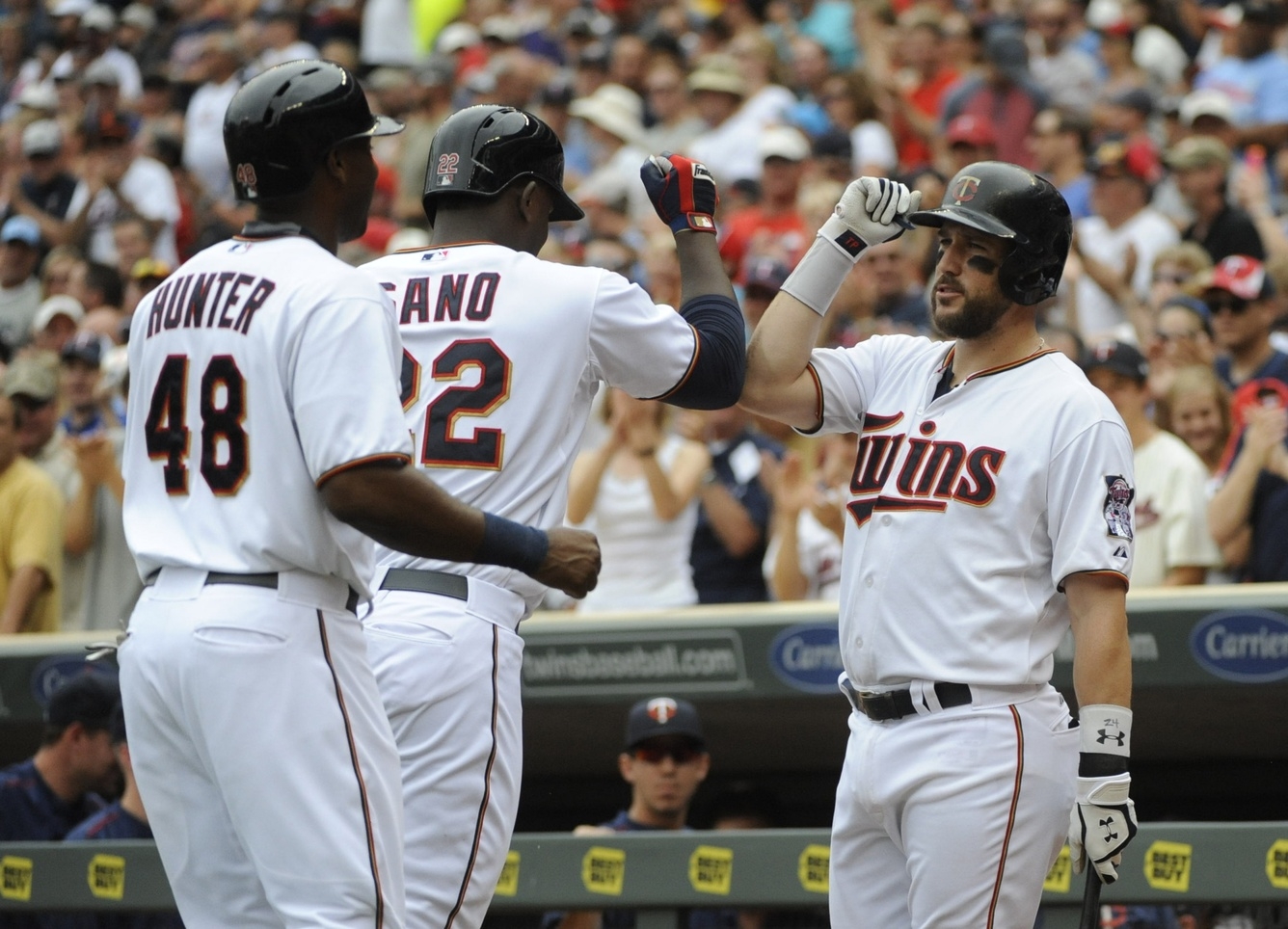 At the break, Minnesota owns the second best record in the American League, and their own best mark since 2008. It's no longer too early to suggest the playoffs are in sight. Forty-four, 40, 36, and 41, those are the win totals for Minnesota at the break over the last four seasons. This year, the number is 49. Each of those years, the Twins went on to lose 90 or more games. It's probably not fair to compare a winning team to those teams of futility, so take a look back to 2010 when Minnesota last won the AL Central with 94 wins. At the All-Star break, Ron Gardenhire's Twins checked in at 46-42, or behind their current pace, for those playing along at home. Coming into the season, the Twins had plenty of question marks. They were viewed as a year or two from making their turnaround, Paul Molitor was a first -year manager, and the big free agent signing made to bolster the pitching staff was shelved before meaningful games even started. At the artificial halfway point, the Twins have answered more questions than they haven't, and it's now fair to start to wonder just how far they can climb. Pitching was going to once again be something to monitor for Minnesota, having finished in the doldrums of major league baseball in virtually every pitching category in recent years. Changes needed to be made. As things stand, Minnesota owns the 15th best ERA in the big leagues, and both Kyle Gibson and Tommy Milone rank among the top 15 ERA leaders in the American League. Twins starters have combined for 789.2 IP as well as 45 quality starts, once again putting them right in the middle of the pack. However, these results have been accomplished, generally, using the same techniques as the Twins have become synonymous with. Pitching to contact, Twins starters have allowed a .269 BAA (28th in MLB), and struck out just 537 batters (last in MLB). It's not smoke and mirrors, but rather pounding the strike zone and making opposing hitters beat them, a strategy that has thus far panned out. At points this season, the Twins offense looked like it was in need of a boost. With Kennys Vargas and Oswaldo Arcia struggling, the pop has since come from a second basemen and a 40 year old. Brian Dozier is having an MVP- caliber season, and his 18 home runs put him on pace to be the first Twins player to reach 30 home runs since Josh Willingham in 2012. Torii Hunter has been every bit the defensive liability he was imagined to be, but his bat (14 HR 49 RBI 15 2B) has produced at a vintage level. While winning, the Twins have also been afforded the opportunity to usher in the future. Eddie Rosario has played an excellent outfield for Minnesota, and his .284 average is among the best on the ballclub. Byron Buxton was able to debut prior to the All-Star break (and should be back not too long after it), and Miguel Sano has set the world on fire. In fact, instead of needing to deal for another Kendrys Morales-type bat this season, the Twins traded with themselves by inserting Sano into the lineup. In his first 11 games, he's hit two home runs, driven in eight, doubled four times, and raced out to a .378/.489/.649 slash line. His power was expected to play, but Sano has been every bit the elite prospect he was billed to be. Looking down the line at the rest of the season, the Twins future has become much more clear. With far fewer questions looming, they can focus on two key actions. First, the organization must make a trade for some bullpen help. So far, Molitor has pieced the back-end of his bullpen together, and it's starting to blow up big time. Blaine Boyer has given the Twins more than they could have imagined, but he's on pace to be one of the most taxed relievers in all of baseball. Brian Duensing and Casey Fien have been up and down, and Minnesota has filled in the gaps with different pieces at a revolving door pace. In fact the only sure thing in the Twins pen is All-Star closer Glen Perkins. Having saved 28 of 28 opportunities, he owns a sparkling 1.21 ERA in 37.1 IP. Perkins' 8.68 K/9 is also among the best on the club, but he no doubt needs help. Minnesota has one of the best farm system in the big leagues and dealing some depth for a quality pen arm is a must. Bringing in someone to act as a true setup man would bridge the gap from the starters to Perkins, and no doubt afford Molitor and Minnesota a few more late inning wins. The second focus for the Twins is to view the postseason as their new reality. Every team sets that as a goal at the beginning of the year, or at least says thet do. Now for the first time in recent memory, the Twins are able to act on that. Key injuries to both the Royals and Tigers have opened a door that Minnesota must step through. Having played Kansas City and Detroit both to a 5-8 record, a recalibration of expectations needs to occur. At 49-40, Minnesota is just 4.5 back of the Royals while being 4.5 clear of the Tigers. In the wild card race, Minnesota owns the top spot, and is three games clear of the Tampa Bay Rays. Keeping pace in the division with the Royals should no doubt be the goal, and it's hard to imagine the Central not sending two teams to play October baseball. .500 would have been a great place for this Twins team to be this season,.Thanks to the start however, that mark is now in the rear view mirror. Minnesota is poised for the postseason, Target Field is electric once again, and the Twins hold a lot of the cards in their own hands. Buckle up, it's going to be a fun ride. For more from Off The Baggy, click here. Follow @tlschwerz
 -
Article: Brian Dozier's Next Accolade
Ted Schwerzler replied to Ted Schwerzler 's topic in Twins Daily Front Page News
Addressing a few comments all at once here. First off, one of the premises laid out in the article is that Dozier must absolutely continue his pace as well as the Twins make the playoffs for this possibility to even exist. If they catch the Royals and win the division, things only get more real. Yes, Dozier dropped off significantly in the power category a year ago. He also participated in the HR Derby. It has generally plagued hitters in the second half. That's not to say it was the reason, but regardless, we're operating with the understanding things continue. As far as Trout is concerned and the quoted comment. Yes he is the best player in baseball (as mentioned), but he probably doesn't mean as much to his team as Dozier does. Trout elevates the Angels by being the most important player in baseball, but the Angels could win without him. Regardless, the fact that an 8th round pick that spent time as a 24 year old in Low-A is being talked about as a potential MVP candidate is the point. Dozier needs 2.5 more months of things going right, but he's put himself in a great spot. -
The Minnesota Twins can arguably be looked at as the most surprising team in baseball through the first half of the season. With most projections suggesting another 90 loss campaign as far more likely than a playoff run, the Twins have taken the majors by storm. Now at 49-40, with the second best record in the American League, does Minnesota sink or swim? Having had a poor month (to put it lightly) under their belt already, the Twins have proven they can handle adversity. If they are going to return to the playoffs for the first time since 2010 however, the club needs a couple of scenarios to play out. Brian Dozier Needs To Be For Real We have seen this narrative before. Dozier started out great in 2014 for the Twins. in 92 games (playing in 91) before the All Star Break, the Twins second basemen slashed .242/.340/.436 with 18 home runs, 45 RBI, 16 doubles, and 69 runs scored. Through the rest of the season though, Dozier hit just .244/.352/.387 with five home runs 26 RBI, 17 doubles, and 43 runs scored. Production was still there, but the power numbers faded almost entirely. The owner of a current .256/.328/.513 slash line along with 19 home runs, 50 RBI, 26 doubles, and 67 runs scored, Dozier has an opportunity to do something special. If he can have a second half worthy of matching his first, there's no doubt he'll be near the top of the MVP discussion, and the Twins will be staring into the playoff race. The Right Joe Mauer Needs To Show Up Currently hovering right around a .270 batting average, Joe Mauer has taken his lumps once again this season. After talking up a recommitted pull and power approach at the plate, the home runs were few and far between (just one in the first two months of the season). Since a slide to start the summer, Mauer appears to have turned somewhat of a corner. In April, Mauer owned a .318/.392/.412 slash line. The power was gone, but he was driving in runners and getting on base. Then in May and June, Mauer slashed .240/.309/.353; abysmal. After scuffling over those two months, July saw Mauer return to form. Using the opposite field again, he has hit .319/.347/.489 with two home runs through the first two weeks. The Twins know Mauer is never going to be at first what he was behind the plate. he's also not going to be a power hitting stereotypical first basemen. However, for the Twins to continue their playoff push, Mauer will need to produce at the top of the lineup, even if that's in his singles-doubles-on base capacity. Bullpen Is Given Some Help Everyone not named Glen Perkins has contributed to the Twins employing one of the most inefficient bullpens in the big leagues. Minnesota doesn't strike anyone out late in games, and innings are pieced together by pitchers rivaling a dart throw on a near nightly basis. Blaine Boyer and J.R. Graham have given the Twins more than they could have expected, but the stretch is going to require more. Minnesota, Terry Ryan, and Paul Molitor need to commit to getting relief help. A trade for at least one arm capable of being more than a LOOGY needs to happen. A reliever shouldn't fleece the Twins farm, but the Twins should probably aim higher than a retread like Joaquin Benoit or LaTroy Hawkins. If the Twins don't find bullpen help prior to the July 31 trade deadline, it's hard to imagine them weathering the storm in the AL Central. Phil Hughes Has To Control The Longball On the season, Phil Hughes has allowed a major league worst 135 hits and 22 home runs. he's currently on pace to serve up 39 dingers and 240 hits (both career worsts). In his 18 starts, Hughes has allowed round-trippers in 15 of them. What's working in Hughes' favor is that of the 22 home runs allowed, 16 of them have been of the solo variety. Looking at Hughes peripherals, there's some things to worry about. With a 4.32 ERA his 4.64 FIP (fielding independent pitching) indicates things could be even worse. While he's still not walking anyone (0.8 BB/9) he's also striking out a career low 5.4 batters per nine. Hitters are also having better at bats against Hughes at the plate. The Twins ace is giving up a near career high 24.6% line drive rate, as well as a 32.5% hard hit rate. In the second half, Minnesota needs the former Yankees pitcher to keep the ball in the yard. He needs to keep hitters off balance to a higher extent, and he needs to handle more at bats himself. The solo shots are aided by his low walk rate, but eventually base hits being buoyed by home runs will put a damper on things. Injuries Can't Mount In Minnesota As witnessed by division rival Kansas City and Detroit, injuries can be crippling. Minnesota has dealt with their fair share over the past four years, but has remained relatively health this season. That absolutely needs to continue, and the Twins need to capitalize on the misfortune of the Royals and Tigers. Byron Buxton is currently shelved but should be back within the next few weeks. Ricky Nolasco underwent ankle surgery and is likely going to miss the rest of the season. If Minnesota can stop the bleeding there, they are in a good place. More than in recent memory, depth is provided in both the outfield and the starting rotation. The Twins find more value in a product of their whole rather than any one player. However, depleting that depth for the stretch run won't bode well for a team void of superstars either. With right around two and a half months left in the regular season, the Twins are in control of their own destiny. Pieces are in place to stay relevant, and adding a key one or two more immediately makes playoff contention a real situation. As the Twins head to Oakland to take on the lowly Athletics, the momentum from the first half needs to carry over. It's been a fun ride to this point, but the story is only half written. Buckle up, here we go. For more from Off The Baggy, click here. Follow @tlschwerz
-
What a week, and what a night. Brian Dozier sent walk-off blasts into the stands for the Twins. He had hopes of winning the Final Vote. He was beaten out by a Royal, and then, he was the only one that mattered. Following his eighth inning blast, the Twins' Dozier was the only second basemen in the All-Star Game to record a hit. As great as those events have all been, Dozier's next accolade will be in a different category altogether.As the second half kicks off, Dozier and the Twins have their eyes on another prize. In the thick of the AL Central race, and in position to return to the playoffs for the first time since 2010, both Minnesota and Dozier have plenty to play for. Team accomplishments aside though, Dozier has the opportunity to push himself into the center of the MVP discussion. For periods of time throughout the season, it's been fair to question whether Dozier could keep it up, or if what we were seeing was real. Now with 88 games under his belt, the question becomes whether he can finish what he's started. As it stands, Brian Dozier has accumulated a 3.3 fWAR mark, good enough for 19th in major league baseball. In the American League, he is behind just Mike Trout, Jason Kipnis, Josh Donaldson, Manny Machado, Lorenzo Cain, J.D. Martinez and Miguel Cabrera. To put it lightly, that's some pretty elite company. Current production has Dozier on pace for career highs in both batting average and slugging percentage. He's also looking at projections of 47 doubles, five triples, 35 home runs, 91 RBI and 122 runs scored. Each of those totals would be a career for the Twins second basemen and it wouldn't be particularly close. Now, being the MVP requires extraordinary numbers. Brian Dozier has done great things for the Twins this season, but how does he stack up to 2014 AL MVP Mike Trout's production? Trout had 39 doubles, nine triples, 36 home runs, 111 RBI, and scored 115 runs. To put it into context, Dozier is right in the ballpark. Of course Dozier isn't the only AL player having a great 2015, and there's still the uphill battle of continuing to produce. As mentioned above, Dozier trails seven players in fWAR at the halfway point. Of those, it's fair to argue that five of them won't be on playoff teams (Indians, Blue Jays, Orioles, and Tigers). That gives the Twins and Dozier an opportunity on which to capitalize. A year ago, Dozier got off to a blistering start as well; his .242/.340/.436 slash line with 18 HR and 45 doubles was respectable in and of itself. The biggest difference in the 2015 first half is Dozier's slugging nearly .100 points higher, and while still hitting home runs, he's driving the ball for doubles as well. The second-half slide Dozier went on last year may be related to the Home Run Derby, but regardless, it turned his season from elite to great. Looking at some of his swing percentages, Dozier may actually be poised to continue his torrid pace. Sure, he's still pulling the ball a ton (a career high 62.4%) but he's also hitting line drives at a career best 24.6%. On top of that, Dozier's fly ball ratio, while up, has contributed to a career best 14.7% HR/FB ratio (meaning just over 14% of his fly balls are deposited into the seats). The number helping Dozier the most though is his hard hit ratio. At a career best 32.5%, the Twins second basemen is making great contact nearly one third of the time. There's no doubt Dozier's MVP prospectus relies upon a perfect storm. First and foremost, he must continue the strong pace he has been on. That would appear doable as he has been steady rather than streaky all season. Second, the Twins absolutely need to make the playoffs (and overtaking the Royals would be a huge bonus). The MVP is an individual award, but should Dozier help bolster the lowly and unassuming Twins to the postseason, it would only boost his credentials. Finally, his feats would need to be recognized and acknowledged among those voting. Should the first two scenarios play out, Dozier would likely be staring a Mike Trout sized showdown in the face. Trout is no doubt the best player in baseball, but is he the most valuable? Take him away from the Angels and they are still a playoff team. This season, Dozier has been the driving force behind the Twins, and may be the exact definition of MVP. At the end of the day, er... season, the scenarios will no doubt play themselves out. For now though, halfway in, Brian Dozier has positioned himself in a great spot to capitalize on an opportunity. While you sit there and wonder why his average isn't higher, make sure to kick back and realize it doesn't matter and you're watching one of the best in the game. For more from Off The Baggy, click here. Follow @tlschwerz Click here to view the article
-
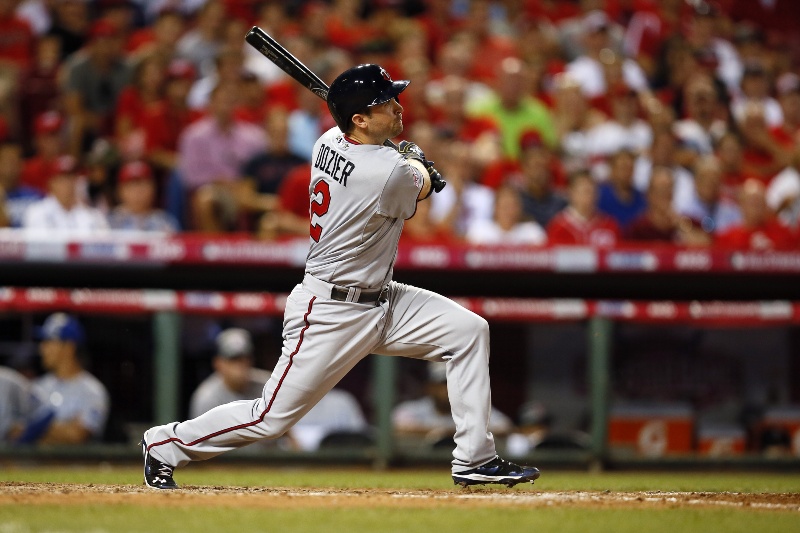 As the second half kicks off, Dozier and the Twins have their eyes on another prize. In the thick of the AL Central race, and in position to return to the playoffs for the first time since 2010, both Minnesota and Dozier have plenty to play for. Team accomplishments aside though, Dozier has the opportunity to push himself into the center of the MVP discussion. For periods of time throughout the season, it's been fair to question whether Dozier could keep it up, or if what we were seeing was real. Now with 88 games under his belt, the question becomes whether he can finish what he's started. As it stands, Brian Dozier has accumulated a 3.3 fWAR mark, good enough for 19th in major league baseball. In the American League, he is behind just Mike Trout, Jason Kipnis, Josh Donaldson, Manny Machado, Lorenzo Cain, J.D. Martinez and Miguel Cabrera. To put it lightly, that's some pretty elite company. Current production has Dozier on pace for career highs in both batting average and slugging percentage. He's also looking at projections of 47 doubles, five triples, 35 home runs, 91 RBI and 122 runs scored. Each of those totals would be a career for the Twins second basemen and it wouldn't be particularly close. Now, being the MVP requires extraordinary numbers. Brian Dozier has done great things for the Twins this season, but how does he stack up to 2014 AL MVP Mike Trout's production? Trout had 39 doubles, nine triples, 36 home runs, 111 RBI, and scored 115 runs. To put it into context, Dozier is right in the ballpark. Of course Dozier isn't the only AL player having a great 2015, and there's still the uphill battle of continuing to produce. As mentioned above, Dozier trails seven players in fWAR at the halfway point. Of those, it's fair to argue that five of them won't be on playoff teams (Indians, Blue Jays, Orioles, and Tigers). That gives the Twins and Dozier an opportunity on which to capitalize. A year ago, Dozier got off to a blistering start as well; his .242/.340/.436 slash line with 18 HR and 45 doubles was respectable in and of itself. The biggest difference in the 2015 first half is Dozier's slugging nearly .100 points higher, and while still hitting home runs, he's driving the ball for doubles as well. The second-half slide Dozier went on last year may be related to the Home Run Derby, but regardless, it turned his season from elite to great. Looking at some of his swing percentages, Dozier may actually be poised to continue his torrid pace. Sure, he's still pulling the ball a ton (a career high 62.4%) but he's also hitting line drives at a career best 24.6%. On top of that, Dozier's fly ball ratio, while up, has contributed to a career best 14.7% HR/FB ratio (meaning just over 14% of his fly balls are deposited into the seats). The number helping Dozier the most though is his hard hit ratio. At a career best 32.5%, the Twins second basemen is making great contact nearly one third of the time. There's no doubt Dozier's MVP prospectus relies upon a perfect storm. First and foremost, he must continue the strong pace he has been on. That would appear doable as he has been steady rather than streaky all season. Second, the Twins absolutely need to make the playoffs (and overtaking the Royals would be a huge bonus). The MVP is an individual award, but should Dozier help bolster the lowly and unassuming Twins to the postseason, it would only boost his credentials. Finally, his feats would need to be recognized and acknowledged among those voting. Should the first two scenarios play out, Dozier would likely be staring a Mike Trout sized showdown in the face. Trout is no doubt the best player in baseball, but is he the most valuable? Take him away from the Angels and they are still a playoff team. This season, Dozier has been the driving force behind the Twins, and may be the exact definition of MVP. At the end of the day, er... season, the scenarios will no doubt play themselves out. For now though, halfway in, Brian Dozier has positioned himself in a great spot to capitalize on an opportunity. While you sit there and wonder why his average isn't higher, make sure to kick back and realize it doesn't matter and you're watching one of the best in the game. For more from Off The Baggy, click here. Follow @tlschwerz
 -
Generally, lights out relievers are hard to come by. While you can put together a makeshift bullpen in hopes of finding things that work, the really good ones often get hung onto. With the emergence of closer importance for teams, seeing the Craig Kimbrel's and Aroldis Chapman's of the big leagues dealt on a yearly basis often doesn't happen. On July 18, 2014, it did happen though. A guy with a 2.78 career ERA, 299 saves, and a 9.0 K/9 was sent packing. Not only are those great numbers for a bullpen guy, but they rank amongst some of the best when it comes to closers. That pitcher was the San Diego Padres Huston Street. In being sent to the Los Angeles Angels, the Padres expected a return, and that's exactly what they got. The Padres welcomed the Angels number one, six, and eighth best prospects, as well as fourth top 20 inclusion (per FanGraphs). In retrospect, the Angels fleeced the bulk of their already mediocre farm system in return for elite level back end of the bullpen help. So, why does this matter? Last season, the Twins dangled the idea of dealing their home grown closer. To be fair, I was even on board with the idea (sadly). Without a doubt, the lack of a move, may go down as one of the best decisions in Twins history. For a losing team, and one in it's fourth year of significant losing, having a great closer seems like somewhat of a luxury. Even when 30 or more saves get racked up, does it really matter in the context of 90 losses. What about making the farm system even stronger for when the winning returns? Sure it would look like a bad move after just extending Perkins a contract extension, but who cares right? The Twins put their foot down, they said no. No to dealing the local product. No to selling of a irreplaceable asset. No to all of it, and now, Perkins is making them feel great about the decision all over again. Sure, Perkins was a very good closer last season. Late in the year injury problems inflated his ERA, but his 34 saves and 9.6 K/9 were some of the best marks of his career. He was coming off a 36 save season in 2013, a 2.30 ERA, an 11.1 K/9 mark, his first All Star Game appearance, and that shiny new four-year, $22.18 million contract. Nothing he did last season though could have prepared the Twins for what was to come. There was a spring training injury scare, but Perkins insisted he was good to go this season. He wasn't going to miss time, and he was ready to compete. Glen Perkins was right. In 2015, Perkins is 28-28 in save opportunities and leads the American League in that category. He's walking batters at a career best 1.2 BB/9 rate and his 0.830 WHIP is the best of his career. Not only is his season impressive, but Perkins recent run has been impressive as well. He's yet to give up a run since May 31 (a stretch of 14 games and 14.1 IP). In that timeframe, Perkins has struck out 15, walked just two, allowed only four hits, and picked up 10 saves. Unlike other back end of the bullpen options, Perkins does it differently. Having thrown just four pitches 96 miles per hour or faster this season, it's his slider that has been devastating. Used a career high (as a closer) 26.7% of the time, Perkins has kept hitters off balance and outworked them at the plate. Now fresh off his third straight trip to the midsummer classic, Glen Perkins looks every bit the part of one of the best in team history. Tying Eddie Guardado for third on the list right before the All Star break, he will set his sights on Rick Aguilera and Joe Nathan as the season draws on. With his current pace set at 51 saves when the season comes to an end, Perkins is targeting what would be a tie for the 9th best single-season mark in Major League Baseball history. While an uphill battle, Perkins has overcome being a failed starter, a timeshared reliever, and an injured closer to boast the best season of his career. It's pretty safe to say dealing Glen Perkins is the best trade the Twins never made. At 32, signed through 2017, and with no intention of playing anywhere else, Perkins should have Twins fans on their feet in the 9th for years to come. For more from Off The Baggy, click here. Follow @tlschwerz
-
What a week, and what a night. Brian Dozier sent walkoff blasts into the stands for the Twins. He had hopes of winning the Final Vote. He was beat out by a Royal, and then, he was the only one that mattered. Following his 8th inning blast, the Twins Dozier was the only second basemen in the All Star Game to record a hit. As great as those events have all been, Dozier's next accolade is in a different category altogether. As the second half kicks off, Dozier and the Twins have their eyes on another prize. In the thick of the AL Central race, and in position to return to the playoffs for the first time since 2010, both Minnesota and Dozier have plenty to play for. Team accomplishments aside though, Dozier has the opportunity to push himself into the center of the MVP discussion. For periods of time throughout the season, it's been fair to question whether Dozier could keep it up, or if what we were seeing was real. Now with 88 games under his belt, the question becomes whether he can finish what he's started. As it stands, Brian Dozier has accumulated a 3.3 fWAR mark, good enough for 19th in Major League Baseball. In the American League, he is behind just Mike Trout, Jason Kipnis, Josh Donaldson, Manny Machado, Lorenzo Cain, J.D. Martinez, and Miguel Cabrera. To put it lightly, that's some pretty elite company. Current production has Dozier on pace for career highs in both batting average and slugging percentage. He's also looking at projections of 47 doubles, five triples, 35 home runs, 91 RBI, and 122 runs scored. Each of those totals would be career numbers for the Twins second basemen and it wouldn't be particularly close. Now being the MVP requires extraordinary numbers. Brian Dozier has done great things for the Twins this season, but how does he stack up to 2014 AL MVP Mike Trout's production? Trout had 39 doubles, nine triples, 36 home runs, 111 RBI, and scored 115 runs. To put it into context, Dozier is right in the ballpark. Of course Dozier isn't the only AL player having a great 2015, and there's still the uphill battle of continuing to produce. As mentioned above, Dozier trails seven players in fWAR at the halfway point. Of those, it's fair to argue that five players won't be on playoff teams (Indians, Blue Jays, Orioles, and Tigers). That gives the Twins and Dozier an opportunity to capitalize on. A year ago, Dozier got off to a blistering start as well. His .242/.340/.436 slash line with 18 HR and 45 doubles was respectable in and of itself. The biggest difference in the 2015 first half is Dozier's slugging nearly .100 points higher, and while still hitting home runs, he's driving the ball for doubles as well. The slide Dozier went on last year may be related to the Home Run Derby, but regardless, it turned his season from elite to great. Looking at some of his swing percentages, Dozier may actually be poised to continue his torrid pace. Sure, he's still pulling the ball a ton (a career high 62.4%) but he's also hitting line drives at a career best 24.6%. On top of that, Dozier's fly ball ratio while up, has contributed to a career best 14.7% HR/FB ratio (meaning just over 14% of his fly balls are deposited into the seats). The number helping Dozier the most though is his hard hit ratio. A career best 32.5%, the Twins second basemen is making great contact nearly one third of the time. There's no doubt Dozier's MVP prospectus relies upon a perfect storm. First and foremost, he must continue the strong pace he has been on. That would appear doable as he has been steady rather than streaky all season. Secondly, the Twins absolutely need to make the playoffs (and overtaking the Royals would be a huge bonus). The MVP is an individual award, but should Dozier help bolster the lowly and unassuming Twins to the postseason, it would only boost his credentials. Finally, his feats would need to be acknowledged amongst those voting. Should the first two scenarios play out, Dozier would likely be staring a Mike Trout sized showdown in the face. Trout is no doubt the best player in baseball, but is he the most valuable? Take him away from the Angels and they are still a playoff team. This season, Dozier has been the driving force behind the Twins, and may be exactly how to define MVP. At the end of the day, er season, the scenarios will no doubt play themselves out. for now though, halfway in, Brian Dozier has positioned himself in a great spot to capitalize on an opportunity. While you sit there and wonder why his average isn't higher, make sure to kick back and realize it doesn't matter and you're watching one of the best in the game. For more from Off The Baggy, click here. Follow @tlschwerz
-
A year ago, on a rainy night in downtown Minneapolis, some of the biggest sluggers took center stage for the 2014 Home Run Derby. While the Minnesota twins and Target Field were no doubt excited to play host to All Star week, there's no doubt that the playing conditions were going to be adverse on this night. When the dust settled, Yoenis Cespedes reigned supreme, and massive shots were hit, but the event still felt stale. Forget the fact that inclement weather pushed the action back, or that hometown selection Brian Dozier was lost amongst his slugging peers. As many other years before it, the Home Run Derby once again seemed to have worn out its welcome. Fast forward on the calendar and Major League Baseball was reinventing the rules once again. After creating the bracket a season ago, the event now resembled something like the NBA's Three Point contest. As a timed event, players were no longer given the luxury of standing around to wait for that meatball pitch. In theory it sounded like a wonderful idea, and what was even better, that's exactly how it played out. With a stacked field, there was already plenty of intrigue. Having youth rounded out by the old guard in the form of Albert Pujols made sure there was a competitor for everyone to get behind. My money (quite literally) wagon punishing phenom Joc Pederson. The combination of a lefty and long home runs seemed too good to pass up. Quickly in the competition however, it was plain to see there were going to be more strategical tactics to consider. While the blasts over 420 feet (original set for 475) would give hitters bonus time, they also would take precious seconds off of a winding clock. Going second was going to provide obvious advantages in knowing your target mark, and even stamina would come into play for the sluggers. Thanks to the way in which baseball had set this new contest up, intrigue was there from the get go. Hometown hero Todd Frazier knocked favorite, Prince Fielder out at the buzzer in the first round. Peterson blew by Manny Machado, and Pujols bested the kid in Kris Bryant. Just one round in, this was shaping up to be a lot of fun. As both Frazier and Pederson continued on, the finals were set with the most interesting matchup of the night. Pederson was punishing baseballs with the heaviest bat (34/34) in the field, while Frazier was launching rockets out of the park. Thanks to his bonus time, it would be the Reds own Frazier that would hoist the trophy when all was said and done. Thanks to the timed round, we all witnessed one of the greatest Home Run Derby performances ever, and likely didn't even notice. In 2008, Josh Hamilton hit 28 first round homers in Yankees Stadium. He went on to total 35 and lose to the Twins Justin Morneau. Being able to take breaks and take pitches, Hamilton still wore down over the course of a contest that was simply too long. Last night, the Reds Frazier went 14-10-14 to a total of 38 home runs. In history, it is Fielder who owns the most derby homers with 81. Frazier nearly halved that amount in a night. With the pressure to keep swinging staying constant, the derby itself became evolving dram right before our eyes. I expected this season's rendition of the event to be more fun, I didn't think I'd be counting down the days to next year's contest immediately following the end however. Major League Baseball got this one absolutely right, and we are all better for it. Now for ESPN to just take away "Back, back, back, back, back" and Chris Berman. One change at a time I suppose. For more from Off The Baggy, click here. Follow @tlschwerz
-
We have officially hit the All Star Break in Major League Baseball, and while the stretch run is where the pretenders and contenders are sorted out, the Twins are currently one of the best teams in baseball. It feels odd to say, given what expectations were, and what results have been, but it rings absolutely true. At the break, Minnesota owns the second best record in the American League, and their own best mark since 2008. It's no longer too early to suggest the playoffs are in sight. 44, 40, 36, and 41, those are the win totals for Minnesota at the break over the last four seasons. Each of those years, the Twins went on to lose 90 or more games. It's probably not fair to compare a winning team to those of futility, so take a look back to 2010 when Minnesota last won the AL Central with 94 wins. At the All Star Break, Ron Gardenhire's Twins checked in at 46-42, or behind their current pace for those playing along at home. Coming into the season, the Twins had plenty of question marks. They were viewed as a year or two before making their turnaround, Paul Molitor was a first year manager, and the big free agent signing made to bolster the pitching staff was shelved before meaningful games even started. At the artificial halfway point, the Twins have answered more questions than they haven't, and it's now fair to start to wonder just how far they can climb. Pitching was going to once again be something to monitor for Minnesota. finishing in the doldrums of Major League Baseball in virtually every pitching category in recent years, changes needed to be made. As things stand, Minnesota owns the 15th best ERA in the big leagues, and both Kyle Gibson and Tommy Milone rank amongst the top 15 ERA leaders in the American League. Twins starters have combined for 789.2 IP as well as 45 quality starts, again putting them right in the middle of the pack. The results have been accomplished along the same lines as the Twins have become synonymous with however. Pitching to contact, Twins starters have allowed a .269 BAA (28th in MLB), and struck out just 537 batters (last in MLB). It's not smoke and mirrors, but rather pounding the strike zone and making opposing hitters beat them, a strategy that has thus far panned out. At points this season, the Twins offense looked like it was in need of a boost. With Kennys Vargas and Oswaldo Arcia struggling, the pop has since come from a second basemen and a 40 year old. Brian Dozier is having an MVP caliber season, and his 18 home runs put him on pace to be the first Twins player to reach 30 home runs since Josh Willingham in 2012. Torii Hunter has been every bit the defensive liability he was imagined, but his bat (14 HR 49 RBI 15 2B) has produced at a vintage level. While winning, the Twins have also been afforded the opportunity to usher in the future. Eddie Rosario has played an excellent outfield for Minnesota, and his .284 average is amongst the best on the ballclub. Byron Buxton was able to debut prior to the All Star Break (and should be back not too long after it), and Miguel Sano has set the world on fire. In fact, instead of needing to deal for another Kendrys Morales type bat this season, the Twins traded with themselves in inserting Sano into the lineup. In his first 11 games, he's hit two home runs, driven in eight, doubled four times, and raced out to a .378/.489/.649 slash line. His power was expected to play, but Sano has been every bit the elite prospect he was billed to be. Looking down the line at the rest of the season, the Twins future has become much more clear. With far fewer questions looming, they can focus on two keys principles. First, the organization must make a trade for some bullpen help. So far, Molitor has pieced the back end of his bullpen together, and it's starting to blow up big time. Blaine Boyer has given the Twins more than they could have imagined, but he's on pace to be one of the most taxed relievers in all of baseball. Brian Duensing and Casey Fien have been up and down, and Minnesota has filled in the gaps with different pieces at a revolving door pace. In fact the only sure thing in the Twins pen is All Star closer Glen Perkins. Having saved 28 of 28 opportunities, he owns a sparkling 1.21 ERA in 37.1 IP. Perkins 8.68 K/9 is also amongst the best on the club for the Twins, but he no doubt needs help. Minnesota has one of the best farm system in all of the big leagues, and dealing some depth for a quality pen arm is a must. Bringing in someone to act as a true setup man would bridge the gap from the starters to Perkins, and no doubt afford Molitor and Minnesota a few more late inning wins. The second focus for the Twins is to view the postseason as their new reality. Every team sets that as a goal at the beginning of the year, or at least says so. Now for the first time in recent memory, the Twins are able to act on that. Key injuries to both the Royals and Tigers have opened a door that Minnesota must step through. Having played Kansas City and Detroit both to a 5-8 record, an evening out needs to occur. At 49-40, Minnesota is just 4.5 back of the Royals while being 4.5 clear of the Tigers. In the wild card race, Minnesota owns the top spot, and is three games clear of the Tampa Bay Rays. Keeping pace in the division with the Royals should no doubt be the goal, and it's hard to imagine the Central not sending two teams to play October baseball. .500 would have been a great place for this Twins team to be this season, thanks to the start however, that mark is now in the rear view mirror. Minnesota is poised for the postseason, Target Field is electric once again, and the Twins hold a lot of the cards in their own hands. Buckle up, it's going to be a fun ride. For more from Off The Baggy, click here. Follow @tlschwerz
-
Article: Twins Should Just Keep Dancing
Ted Schwerzler posted a topic in Twins Daily Front Page News
Going into the 2015 major league baseball season, the Twins knew they had some deficiencies. Among the most glaring were veteran leadership and outfield depth. Terry Ryan and crew addressed those problems in one sweep, signing fan favorite Torii Hunter to a one-year $10.5 million deal. While I was critical of the move from the get go, it's played out better than anyone could have imagined.Torii was being sold as a veteran leader, and there's no doubt he brought that ability. From a baseball sense however, he was a clear downgrade in the outfield, and his bat absolutely needed to play to add weight to the move. So far, everything has worked out wonderfully, and maybe the best thing Torii has brought to the club are his post-win dance parties. "We win. We dance." It's a moniker displayed on the videoboards around Target Field following a Twins win. Now with over 45 of them under their belt heading into the All-Star break, the Twins have had plenty of chances to dance this season. Of late, maybe one of the most important reasons for the Twins to celebrate is the re-emergence of Joe Mauer. Arguably the most polarizing sports figure in Minnesota, Mauer has gone from a near Hall of Fame lock, to being a punching bag for many. In June, his average dipped to the .250 mark, and 2015 looked to be the beginning of a steep decline. Then things clicked. Since June 5, Mauer owns a .301/.385/.469 line with five home runs, 12 RBI, and a 16/22 B/K ratio. More impressive than that, he has been on an absolute tear of late. Since June 26, Mauer has slashed .388/.426/.531 with two home runs and five RBI, and in the month of July he owns a .400/.438/.633 line. Now hitting for relative power again, with six home runs on the year, Mauer has a shot to post his best total since 2009. Just ahead of Mauer in the lineup, the Twins have watched a legitimate MVP candidate emerge. Never mind the fact that Brian Dozier belongs in the All-Star Game, he's the best second basemen in all of baseball. With 18 home runs, 45 RBI, 26 doubles, and a career best .851 OPS, Dozier is an elite-level talent. While last year saw a second half slide in the power department for the Twins second basemen, skipping the Home Run Derby could benefit Dozier this time around. On pace for right around 30 home runs and 50 doubles, Dozier is having one of the best power production seasons in Twins history. On top of that, Dozier continues to flash the leather routinely in the field. If nothing but Brian Dozier went right for the Twins this season, it'd be hard not to be happy. On the mound, the Twins have watched years go by as pitching has been an absolute atrocity. This season however, not only has it been improved, but the team's starters have actually been a strength. Maybe most surprisingly, the Twins have enjoyed the development of Tommy Milone. Already a proven starter when the Twins acquired him, Milone took his lumps for the first season he spent with the Twins, no doubt related to the benign tumor, since excised, that was found on his neck. After getting sent down to Triple-A Rochester early in 2015, he has since come back with a vengeance. Throwing to the tune of a 0.70 ERA and a .182/.200/.248 for Rochester, Milone has gone 3-0 in his seven starts back with the Twins. In those games he owns a 1.84 ERA, 32/11 K/BB ratio and just a .236/.284/.345 line against. To put it bluntly, Milone has been virtually untouchable. It's not just Tommy getting the job done, however. Fellow starting pitcher, and former first-round Twins draft pick, Kyle Gibson has been equally impressive. Expected to take steps forward this season, he has absolutely risen to the occasion. On the year, Gibson owns a 3.04 ERA, 6.1 K/9 ratio, and just a 2.9 BB/9 mark. In his last five starts for the Twins, Gibson owns a 2.56 ERA and is allowing opposing hitters to bat just .239 against him. The former Missouri Tiger was always expected to be a top half of the rotation guy in the big leagues. After mixed results in his first two seasons, the Twins were hoping that the further he distanced himself from Tommy John surgery, the better he would be. It's safe to say no one expected Gibson to be among the American League's best in ERA, but that's where we find ourselves. If these already aren't enough reasons to be dancing with excitement, you can probably add in the fact that the Twins are winning as well. Holding pace with the best in the American League, the playoffs look like something more than a mirage for the first time in a while. On top of making that a reality, the organization has found room for top prospects Byron Buxton and Miguel Sano to make their big league debut prior to the All-Star reak. While Buxton's debut didn't start as smoothly as hoped (and now he's shelved on the DL), the fact that he blitzed Double-A was a great thing. Although his bat will take some time to transition to the big league level, it's no surprise the difference he makes in the Twins outfield. On the flip side, Sano has done everything he's been asked to do at the big league level. Fortunately, he's really only been asked to hit, and hit he has. In his first seven games at the big league level, Sano has slashed .455/.571/.682, hit his first home run, and driven in five RBI. Also, and maybe even more impressive, Sano owns an even 6/6 K/BB ratio. He's a week into his big league career, and pitchers have already been pitching around him. Counting up all of the reasons, and there're plenty more than have been discussed here, Torii Hunter could probably double as a dance instructor. Brought in for some veteran leadership and a hope his bat had some pop left in it, Hunter has helped to reverse a culture of losing, and make the Twins look like an AL Central power once again. The Twins have been doing plenty of winning, but even when they aren't, there have been plenty of reasons to be dancing. For more from Off The Baggy, click here. Follow @tlschwerz Click here to view the article -
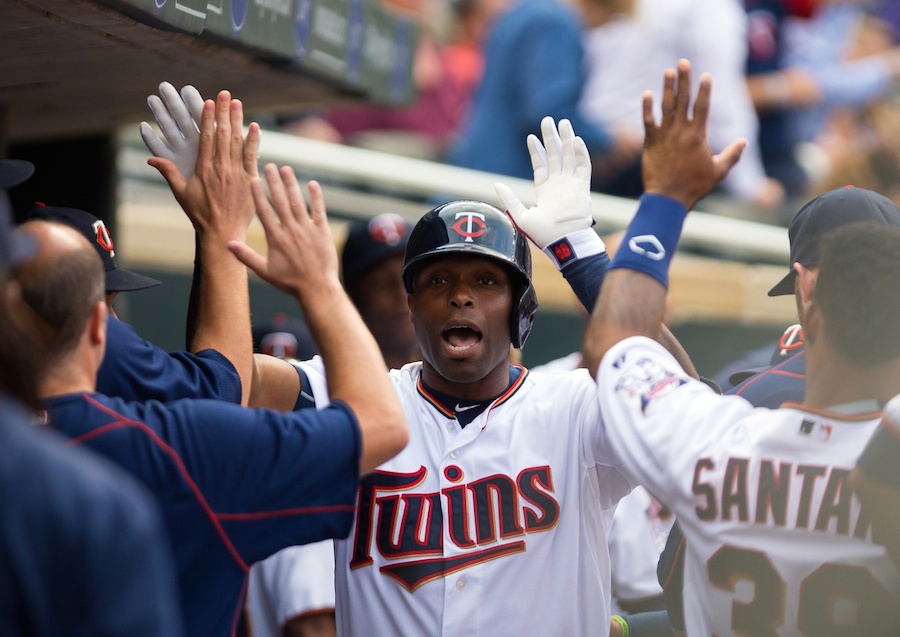 Torii was being sold as a veteran leader, and there's no doubt he brought that ability. From a baseball sense however, he was a clear downgrade in the outfield, and his bat absolutely needed to play to add weight to the move. So far, everything has worked out wonderfully, and maybe the best thing Torii has brought to the club are his post-win dance parties. "We win. We dance." It's a moniker displayed on the videoboards around Target Field following a Twins win. Now with over 45 of them under their belt heading into the All-Star break, the Twins have had plenty of chances to dance this season. Of late, maybe one of the most important reasons for the Twins to celebrate is the re-emergence of Joe Mauer. Arguably the most polarizing sports figure in Minnesota, Mauer has gone from a near Hall of Fame lock, to being a punching bag for many. In June, his average dipped to the .250 mark, and 2015 looked to be the beginning of a steep decline. Then things clicked. Since June 5, Mauer owns a .301/.385/.469 line with five home runs, 12 RBI, and a 16/22 B/K ratio. More impressive than that, he has been on an absolute tear of late. Since June 26, Mauer has slashed .388/.426/.531 with two home runs and five RBI, and in the month of July he owns a .400/.438/.633 line. Now hitting for relative power again, with six home runs on the year, Mauer has a shot to post his best total since 2009. Just ahead of Mauer in the lineup, the Twins have watched a legitimate MVP candidate emerge. Never mind the fact that Brian Dozier belongs in the All-Star Game, he's the best second basemen in all of baseball. With 18 home runs, 45 RBI, 26 doubles, and a career best .851 OPS, Dozier is an elite-level talent. While last year saw a second half slide in the power department for the Twins second basemen, skipping the Home Run Derby could benefit Dozier this time around. On pace for right around 30 home runs and 50 doubles, Dozier is having one of the best power production seasons in Twins history. On top of that, Dozier continues to flash the leather routinely in the field. If nothing but Brian Dozier went right for the Twins this season, it'd be hard not to be happy. On the mound, the Twins have watched years go by as pitching has been an absolute atrocity. This season however, not only has it been improved, but the team's starters have actually been a strength. Maybe most surprisingly, the Twins have enjoyed the development of Tommy Milone. Already a proven starter when the Twins acquired him, Milone took his lumps for the first season he spent with the Twins, no doubt related to the benign tumor, since excised, that was found on his neck. After getting sent down to Triple-A Rochester early in 2015, he has since come back with a vengeance. Throwing to the tune of a 0.70 ERA and a .182/.200/.248 for Rochester, Milone has gone 3-0 in his seven starts back with the Twins. In those games he owns a 1.84 ERA, 32/11 K/BB ratio and just a .236/.284/.345 line against. To put it bluntly, Milone has been virtually untouchable. It's not just Tommy getting the job done, however. Fellow starting pitcher, and former first-round Twins draft pick, Kyle Gibson has been equally impressive. Expected to take steps forward this season, he has absolutely risen to the occasion. On the year, Gibson owns a 3.04 ERA, 6.1 K/9 ratio, and just a 2.9 BB/9 mark. In his last five starts for the Twins, Gibson owns a 2.56 ERA and is allowing opposing hitters to bat just .239 against him. The former Missouri Tiger was always expected to be a top half of the rotation guy in the big leagues. After mixed results in his first two seasons, the Twins were hoping that the further he distanced himself from Tommy John surgery, the better he would be. It's safe to say no one expected Gibson to be among the American League's best in ERA, but that's where we find ourselves. If these already aren't enough reasons to be dancing with excitement, you can probably add in the fact that the Twins are winning as well. Holding pace with the best in the American League, the playoffs look like something more than a mirage for the first time in a while. On top of making that a reality, the organization has found room for top prospects Byron Buxton and Miguel Sano to make their big league debut prior to the All-Star reak. While Buxton's debut didn't start as smoothly as hoped (and now he's shelved on the DL), the fact that he blitzed Double-A was a great thing. Although his bat will take some time to transition to the big league level, it's no surprise the difference he makes in the Twins outfield. On the flip side, Sano has done everything he's been asked to do at the big league level. Fortunately, he's really only been asked to hit, and hit he has. In his first seven games at the big league level, Sano has slashed .455/.571/.682, hit his first home run, and driven in five RBI. Also, and maybe even more impressive, Sano owns an even 6/6 K/BB ratio. He's a week into his big league career, and pitchers have already been pitching around him. Counting up all of the reasons, and there're plenty more than have been discussed here, Torii Hunter could probably double as a dance instructor. Brought in for some veteran leadership and a hope his bat had some pop left in it, Hunter has helped to reverse a culture of losing, and make the Twins look like an AL Central power once again. The Twins have been doing plenty of winning, but even when they aren't, there have been plenty of reasons to be dancing. For more from Off The Baggy, click here. Follow @tlschwerz
 -
The Open Door, And The Twins Stepping Through IT
Ted Schwerzler posted a blog entry in Off The Baggy
Injuries are never good, and cheering for an opposing player to go down is not something anyone would advocate for. However, they are an inevitability in the world of sports,and the Twins have a big opportunity thanks to two recent maladies. Both the Tigers and the Royals were bit by the injury bug in a bad way recently. Detroit watched stay first basemen Miguel Cabrera head to the disabled list for the first time in his career. Early indications suggest he could be out into September. The hurt at the top of the AL Central doesn't stop there however. Twins killer Alex Gordon also has wound up on the DL and will be there for at least the next 8 weeks. It's pretty hard to overstate how integral both of these players are for their respective teams. Cabrera and the Tigers are currently in 3rd in the AL Central race. They trail the Twins by just 1.5 games and are 8-2 against Minnesota on the season. Cabrera owns a .350/.456/.578 slash line and has hit 15 round trippers to go with 54 RBI. Just two years removed from winning the Triple Crown, he is every bit the same scary hitter he has been over the course of his career. For the Royals, Alex Gordon offers value in a different form. Instead of being a beast with the bat, he gets it done with his glove. Gordon is hitting .279/.2394/.457 (one of the best lines of his career) and has added 11 home runs and 39 RBI. As mentioned though, it's in the field where Gordon will be missed. He's been worth 4 DRS (defensive runs saved) and owns a 7.9 UZR paired with a 15.7 UZR/150 rating. Watch enough Twins games against the Royals, and you've likely cursed Gordon taking away a sure base hit. Now nearing the All Star Break, push must come to shove for the Twins. Minnesota has tread water for quite some time. After a blistering May, Minnesota ran into an ugly month of June. Thanks to losing streaks by Detroit and Kansas City though, the Twins held serve. With both of those teams missing key cogs, it's time to start taking advantage. The twins split with the Royals to open the month despite the fact that they were in position to win all four games. In the first matchup of the month against the Tigers, a late inning meltdown led to yet another failed opportunity to capitalize. If the Twins want to climb the standings, and create some distance, it will start by reversing the fortunes of a 2-8 record against the Tigers. With Minnesota not facing either division rival again until September, it will be on them to handle their own business. It's a pretty good bet that both Detroit and Kansas City will experience a downturn with their injuries. While Cabrera and Gordon are out, the Twins must set themselves up for a good September. Minnesota will need to make some adjustments before the trade deadline if they are going to stay in the race, but the biggest positive for the Twins may have come at the expense of their divisional foes. For more from Off The Baggy, click here. Follow @tlschwerz -
A reminder: You can still vote for Brian Dozier in the Final Vote until 3:00 this afternoon. From 9-3 central time, you can also do the #VoteDozier thing on Twitter, and you'll even get to see the little Dozier emoji. Get out the vote! #VoteDozier all day! Just under a month ago, I told you that Brian Dozier was entering elite territory in major league baseball. Since that time, Dozier has done nothing but squash my silly notion. Instead of entering elite territory, he instead has defined what elite is. At this point, you're probably wrong about the Twins second basemen, and so is MLB itself.We are less than a week away from the midsummer classic. Major League Baseball has unfortunately pinned World Series implications on the exhibition, and while many players still overlook that implication, the fact is that this does count. The process in place often leads to fans voting for the biggest names or their favorite jerseys. This process will often not draw wonderful reviews, and it's probably time Major League Baseball is held accountable. As the fan voting took place for the All-Star Game in Cincinnati this year, we watched as the Royals fans came out of the woodwork and make a mockery of the system. Even the Kauffman faithful had to find humor in the fact that their .231/.240/.307 slashing second basemen was pacing a portion of the voting. While it isn't unexpected to have snubs on the fans' part, it's pretty ugly that manager Ned Yost failed to get it right as well. Last season, the Minnesota Twins watched Brian Dozier blossom before their eyes. Going from a relative unknown to one of the most surprising power-hitters in the game, Dozier received some national attention in the home run derby. While it was the consolation prize for nor receiving an All-Star appearance he was more than qualified for, it was a stepping stone. After being among the best in the big leagues in runs scored, and securing a shiny new 4-year, $20 million contract, how would Dozier respond? The answer is by continuing to be the best second basemen in baseball and it's not particularly close. Dozier's 7.6 WAR since the beginning of 2014 ranks above all other qualifiers, and Houston's Jose Altuve is next closest with a 6.7 mark. On the season, Dozier leads the big leagues in runs scored (63) and is on pace for career highs in doubles, triples, hits, home runs, runs batted in, batting average and OPS. In fact, it's actually that last number that might be most impressive when looking at the Twins second basemen. Often times, detractors will point to Dozier's average as a reason why he shouldn't be regarded among the game's best. Despite his .245 career mark (.260 in 2015), Brian Dozier's value at the plate goes far beyond that of other second basemen. With an .849 OPS, the Twins second basemen lays claim to the 15th best mark in all of baseball. Of those 14 players ahead of him, the only ones not to be named All-Stars: Alex Rodriguez (.902) and Brett Gardner (.854, also in the final vote). When adjusting for ballparks with OPS+, Dozier falls just one spot to 16th. Players behind Dozier in OPS include Jose Abreu, Dustin Pedroia, and Adam Jones. Bringing it back full circle to the context of the All-Star Game, Dozier looks poised to be snubbed yet again in the Final Vote. Once again placing the onus on the fans, Dozier goes up against Xander Bogaerts, Yoenis Cespedes, Brett Gardener and Mike Moustakas. If the initial vote was any indication as to how this Final Vote might go, the Royals' Moustakas appears to have the edge. Looking at Moustakas, the biggest Dozier detractors are forced to come full circle. After scuffling through the first four seasons of his career, Moustakas has put it together for Kansas City. He's got seven home runs, 31 RBI and is slashing .301/.357/.436. That last bit of information is the most important however. Despite hitting .41 points higher than Dozier, Moustakas owns an OPS (.793) a stout .56 points lower. It probably can't be made any clearer: Brian Dozier hitting for average absolutely, positively, does not matter. As long as he is getting on base and generating extra base hits, the Twins second basemen will remain the best in baseball. At the end of the day, or maybe better said, at the end of the first half of the MLB season, Brian Dozier was failed. He may not care on the surface whether or not he was included in a meaningless* exhibition, but the fans failing to acknowledge him failed, Ned Yost failed, and Major League Baseball failed. All-Star Game aside, Brian Dozier continues to come to work and get the job done. It's probably the best interests of all of us to take notice sooner rather than later. Until then, he'll keep hitting walk-off shots and flipping his doubters the...bat. For more from Off The Baggy, click here. Follow @tlschwerz Click here to view the article
-
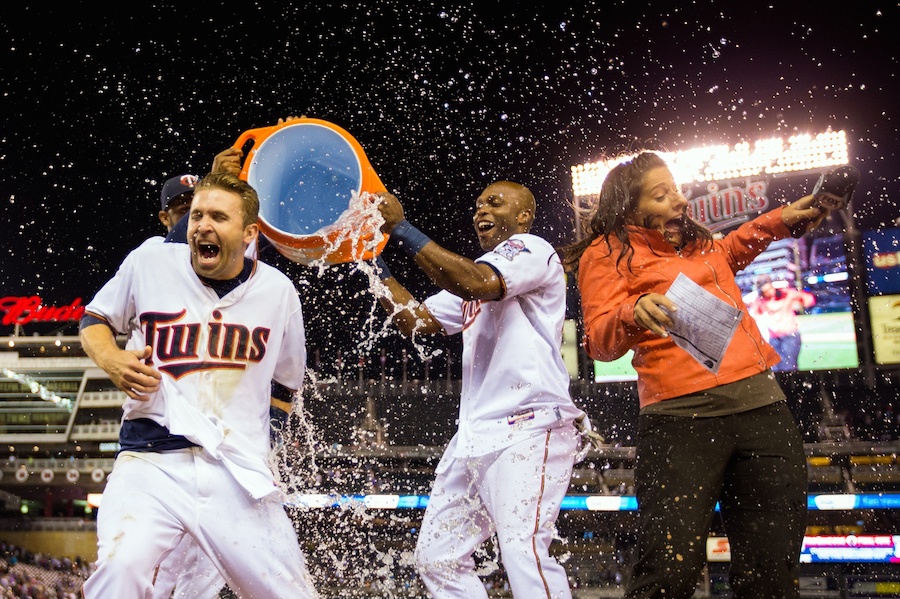 We are less than a week away from the midsummer classic. Major League Baseball has unfortunately pinned World Series implications on the exhibition, and while many players still overlook that implication, the fact is that this does count. The process in place often leads to fans voting for the biggest names or their favorite jerseys. This process will often not draw wonderful reviews, and it's probably time Major League Baseball is held accountable. As the fan voting took place for the All-Star Game in Cincinnati this year, we watched as the Royals fans came out of the woodwork and make a mockery of the system. Even the Kauffman faithful had to find humor in the fact that their .231/.240/.307 slashing second basemen was pacing a portion of the voting. While it isn't unexpected to have snubs on the fans' part, it's pretty ugly that manager Ned Yost failed to get it right as well. Last season, the Minnesota Twins watched Brian Dozier blossom before their eyes. Going from a relative unknown to one of the most surprising power-hitters in the game, Dozier received some national attention in the home run derby. While it was the consolation prize for nor receiving an All-Star appearance he was more than qualified for, it was a stepping stone. After being among the best in the big leagues in runs scored, and securing a shiny new 4-year, $20 million contract, how would Dozier respond? The answer is by continuing to be the best second basemen in baseball and it's not particularly close. Dozier's 7.6 WAR since the beginning of 2014 ranks above all other qualifiers, and Houston's Jose Altuve is next closest with a 6.7 mark. On the season, Dozier leads the big leagues in runs scored (63) and is on pace for career highs in doubles, triples, hits, home runs, runs batted in, batting average and OPS. In fact, it's actually that last number that might be most impressive when looking at the Twins second basemen. Often times, detractors will point to Dozier's average as a reason why he shouldn't be regarded among the game's best. Despite his .245 career mark (.260 in 2015), Brian Dozier's value at the plate goes far beyond that of other second basemen. With an .849 OPS, the Twins second basemen lays claim to the 15th best mark in all of baseball. Of those 14 players ahead of him, the only ones not to be named All-Stars: Alex Rodriguez (.902) and Brett Gardner (.854, also in the final vote). When adjusting for ballparks with OPS+, Dozier falls just one spot to 16th. Players behind Dozier in OPS include Jose Abreu, Dustin Pedroia, and Adam Jones. Bringing it back full circle to the context of the All-Star Game, Dozier looks poised to be snubbed yet again in the Final Vote. Once again placing the onus on the fans, Dozier goes up against Xander Bogaerts, Yoenis Cespedes, Brett Gardener and Mike Moustakas. If the initial vote was any indication as to how this Final Vote might go, the Royals' Moustakas appears to have the edge. Looking at Moustakas, the biggest Dozier detractors are forced to come full circle. After scuffling through the first four seasons of his career, Moustakas has put it together for Kansas City. He's got seven home runs, 31 RBI and is slashing .301/.357/.436. That last bit of information is the most important however. Despite hitting .41 points higher than Dozier, Moustakas owns an OPS (.793) a stout .56 points lower. It probably can't be made any clearer: Brian Dozier hitting for average absolutely, positively, does not matter. As long as he is getting on base and generating extra base hits, the Twins second basemen will remain the best in baseball. At the end of the day, or maybe better said, at the end of the first half of the MLB season, Brian Dozier was failed. He may not care on the surface whether or not he was included in a meaningless* exhibition, but the fans failing to acknowledge him failed, Ned Yost failed, and Major League Baseball failed. All-Star Game aside, Brian Dozier continues to come to work and get the job done. It's probably the best interests of all of us to take notice sooner rather than later. Until then, he'll keep hitting walk-off shots and flipping his doubters the...bat. For more from Off The Baggy, click here. Follow @tlschwerz
 -
Going into the 2015 Major League Baseball season, the Twins knew they had some deficiencies. Of the most glaring were veteran leadership and outfield depth. Terry Ryan and crew addressed that problem in one sweep signing fan favorite Torii Hunter to a one-year $10.5 million deal. While I was critical of the move from the get go, it's played out better than anyone could have imagined. Torii was being sold as a veteran leader, and there's no doubt he brought that ability. From a baseball sense however, he was a clear downgrade in the outfield, and his bat absolutely needed to play to put weight to the move. So far, everything has worked out wonderfully, and maybe the best things Torii has brought to the club is his post-win dance parties. "We win. We dance." It's a moniker displayed on the videoboards around Target Field following a Twins win. Now with over 45 of them under their belt heading into the All Star Break, the Twins have plenty of reasons to dance this season. Of late, maybe one of the most important reasons for the Twins to celebrate is the reemergence of Joe Mauer. Arguably the most polarizing sports figure in Minnesota, Mauer has gone from a near Hall of Fame lock, to being a punching bag for many. In June, his average dipped to the .250 mark, and 2015 looked to be the beginning of what was a steep decline. Then things clicked. Since June 5, Mauer owns a .301/.385/.469 line with five home runs, 12 RBI, and a 16/22 B/K ratio. More impressive than that, he has been on an absolute tear of late. Since June 26, Mauer has slashed .388/.426/.531 with two home runs and five RBI, and in the month of July he owns a .400/.438/.633 line. Now hitting for relative power again, with six home runs on the year, Mauer has a shot to post his best total since 2009. Just ahead of Mauer in the lineup, the Twins have watched a legitimate MVP candidate emerge. Nevermind the fact that Brian Dozier belongs in the All Star Game, he's the best second basemen in all of baseball. 18 home runs, 45 RBI, 26 doubles, and a career best .851 OPS, Dozier is an elite level talent. While last year saw a second half slide in the power department for the Twins second basemen, skipping the Home Run Derby should no doubt benefit Dozier this time around. On pace for right around 30 home runs and 50 doubles, Dozier is having one of the best power production seasons in Twins history. On top of that, Dozier continues to flash the leather routinely in the field. If nothing but Brian Dozier went right for the Twins this season, it'd be hard not to be happy. On the mound, the Twins have watched years go by as pitching has been an absolute atrocity. This season however, not only has it been improved, but the team's starters have actually been a strength. Maybe most surprisingly, the Twins have enjoyed the development of Tommy Milone. Already a proven starter when the Twins acquired him, Milone took his lumps for the first season he spent with the Twins. After getting sent down to Triple-A Rochester early in 2015, he has since come back with a vengeance. Throwing to the tune of a 0.70 ERA and a .182/.200/.248 for Rochester, Milone has gone 3-0 in his seven starts back with the Twins. In those games he owns a 1.84 ERA 32/11 K/BB ratio and just a .236/.284/.345 line against. To put it bluntly, Milone has been virtually untouchable. It's not just Tommy getting the job done however. Fellow starting pitcher, and former first round Twins draft pick, Kyle Gibson has been equally as impressive. Expected to take steps forward this season, he has absolutely risen to the occasion. On the year Gibson owns a 3.04 ERA, 6.1 K/9 ratio, and just a 2.9 BB/9 mark. In his last five starts for the Twins, Gibson owns a 2.56 ERA and is allowing opposing hitters to bat just .239 against him. The former Missouri Tiger was always expected to be a top half of the rotation guy in the big leagues. After mixed results in his first two seasons, the Twins were hoping that the further he distanced himself from Tommy John surgery, the better he would be. It's safe to say no one expected Gibson to be amongst the American League's best in ERA, but that's where we find ourselves. If that already isn't enough reasons to be dancing with excitement, you can probably add in the fact that the Twins are winning as well. Holding pace with the best in the American League, the playoffs look like something more than a mirage for the first time in a while. On top of making that a reality, the organization has found room for top prospects Byron Buxton and Miguel Sano to make their big league debut prior to the All Star Break. While Buxton's debut didn't start as smoothly as hoped (and now he's shelved on the DL), the fact that he blitzed Double-A was a great thing. Although his bat will take some time to transition to the big league level, it's no surprise the difference he makes in the Twins outfield. On the flip side, Sano has done everything he's been asked to at the big league level. Fortunately, he's really only been asked to hit, and hit he has. In his first seven games at the big league level, Sano has slashed .455/.571/.682, hit his first home run, and driven in five RBI. Also, and maybe even more impressively, Sano owns an even 6/6 K/BB ratio. He's a week into his big league career, and pitchers have already been pitching around him. Counting up all of the reasons, and there's plenty more than have been discussed here, Torii Hunter could probably double as a dance instructor. Brought in for some veteran leadership and a hope his bat had some pop left in it, Hunter has helped to reverse a culture of losing, and make the Twins look like an AL Central power once again. The Twins have been doing plenty of winning, but even when they aren't, there's been plenty of reasons to be dancing. For more from Off The Baggy, click here. Follow @tlschwerz
-
To kick off the week, the Minnesota Twins welcomed the Baltimore Orioles into the friendly confines of Target Field. Looking around the diamond, it's hard not to get a little upset knowing J.J. Hardy is standing at shortstop while Jim Hoey is off building computers somewhere. Although the Twins have been on the short end of the stick in their fair share of roster moves, this season it's been about one of the best trades in recent memory. Despite looking to make a run at the playoffs in 2014 by bringing in slugging designated hitter Kendrys Morales, the Twins sealed their fate by mid-summer. Sellers at the trade deadline, Minnesota had few assets that other teams coveted. The one they did have however, was an outfielder claimed off of waivers just a few months earlier. Cast off by the Oakland Athletics, Sam Fuld was snagged by the Twins. With Aaron Hicks struggling, Oswaldo Arcia being what he is defensively, and the options running thin, the Twins needed a capable fielder. Snatching up Billy Beane's castoff, the Twins employed Fuld for 53 games last season. Over the course of those 53 games, Fuld proved extremely valuable for the Twins. The scrappy outfielder hit .274/.370/.354 with 10 doubles and 17 runs batted in. Then it happened, on July 31, the Athletics came knocking. Needing to make up for the oft-injured Coco Crisp, and outfield deficiencies of their own, Beane wanted Fuld back for his playoff run. In return, he would off the Twins Tommy Milone. Milone is far from an elite level major league pitcher, and he's probably not even a front end of the rotation type guy. However, for a team in the doldrums of the Major League Baseball ERA standings, the amount of value was through the roof. Sure, Milone's first impression for the Twins was less than ideal. In six games, he owned a 7.06 ERA, his 4.6 BB/9 ratio wasn't good, and the former Oakland pitcher was rarely healthy. Coming off of that performance, spring training was going to be an uphill battle as well. Competing for the 5th and final rotation spot, Milone just squeaked into what was slated to be a much improved Twins rotation. After a rocky start to the season, Milone was given a chance to let things click. Being sent down to Triple-A Rochester, Tommy really turned things on. On the farm, he pitched five games going 4-0, owning a 0.70 ERA, striking out 47 in 38.2 IP, and walking just three. On top of that, he allowed opposing hitters to bat just .182/.200/.248 off of him. By all accounts, he was absolutely brilliant. What's better is that it hasn't stopped. Since returning to the Twins on June 4th, Milone has pitched six games and owns a 1.95 ERA across that span. He's struck out 29, walked just nine, and pitched 37 innings. Allowing just a .243/.289/.350 slash line against, major league hitters have been overmatched by the soft-tossing lefty as well. The level of production Milone has afforded the Twins in 2015 couldn't have been predicted by even the most in tune baseball minds. Knowing that the Twins gave up nothing to get him (or more accurately, rented a player and then received a pay day for it), makes the situation all that much better. It's probably not fair to suggest that this run of brilliance is going to continue, at least not at this level. His current ERA ranks amongst the American League leaders, and after all, he still remains a less than ideal top end starter. For the Twins though, he absolutely makes sense, and remains a massive asset going forward. Knowing that pitchers like Jose Berrios, Trevor May, Tyler Duffey, and Taylor Rogers are all readily available to provide quality depth, Milone's brilliance only bolsters the Twins going forward. Not eligible for free agency until 2019, Minnesota has a very controllable asset at their disposal, and they will continue to be all the better for it. From the get go, Terry Ryan and the Twins absolutely fleeced Billy Beane, the Athletics, and the AL West by sending Sam Fuld back in exchange for Milone. With his emergence in 2015, the icing on the cake looks even tastier. For more from Off The Baggy, click here. Follow @tlschwerz
-
You're Wrong About Brian Dozier, And So Is MLB
Ted Schwerzler commented on Ted Schwerzler 's blog entry in Off The Baggy
He is, and because there aren't positional implications. Holt can play SS when Escobar comes out. Dozier is far more deserving than Iglesias. To that notion as well, you could make the argument it could/should have been Bogaerts over Holt (Xander owns a 2.2 fWAR compared to Holt's 1.7). -
You're Wrong About Brian Dozier, And So Is MLB
Ted Schwerzler commented on Ted Schwerzler 's blog entry in Off The Baggy
Well aware of the roster implications and each team needing a rep. Holt didn't take Dozier's spot, Iglesias did...as noted above. -
You're Wrong About Brian Dozier, And So Is MLB
Ted Schwerzler commented on Ted Schwerzler 's blog entry in Off The Baggy
This is less about Dozier than it is the fundamental error that is his lower average matter. Also, Altuve and Kipnis both were deserving. Dozier was snubbed in lieu of Jose Iglesias, a 1.7 fWAR player. There's no way to spin that being incorrect.

