



Jeremy Nygaard
-
Posts
4,552 -
Joined
-
Last visited
Content Type
Profiles
News
Minnesota Twins Videos
2026 Minnesota Twins Top Prospects Ranking
2022 Minnesota Twins Draft Picks
Minnesota Twins Free Agent & Trade Rumors, Notes, & Tidbits
Guides & Resources
2023 Minnesota Twins Draft Picks
The Minnesota Twins Players Project
2024 Minnesota Twins Draft Picks
2025 Minnesota Twins Draft Pick Tracker
2026 Minnesota Twins Draft Tracker: Picks & Bonuses
Forums
Blogs
Events
Store
Downloads
Gallery
Everything posted by Jeremy Nygaard
-
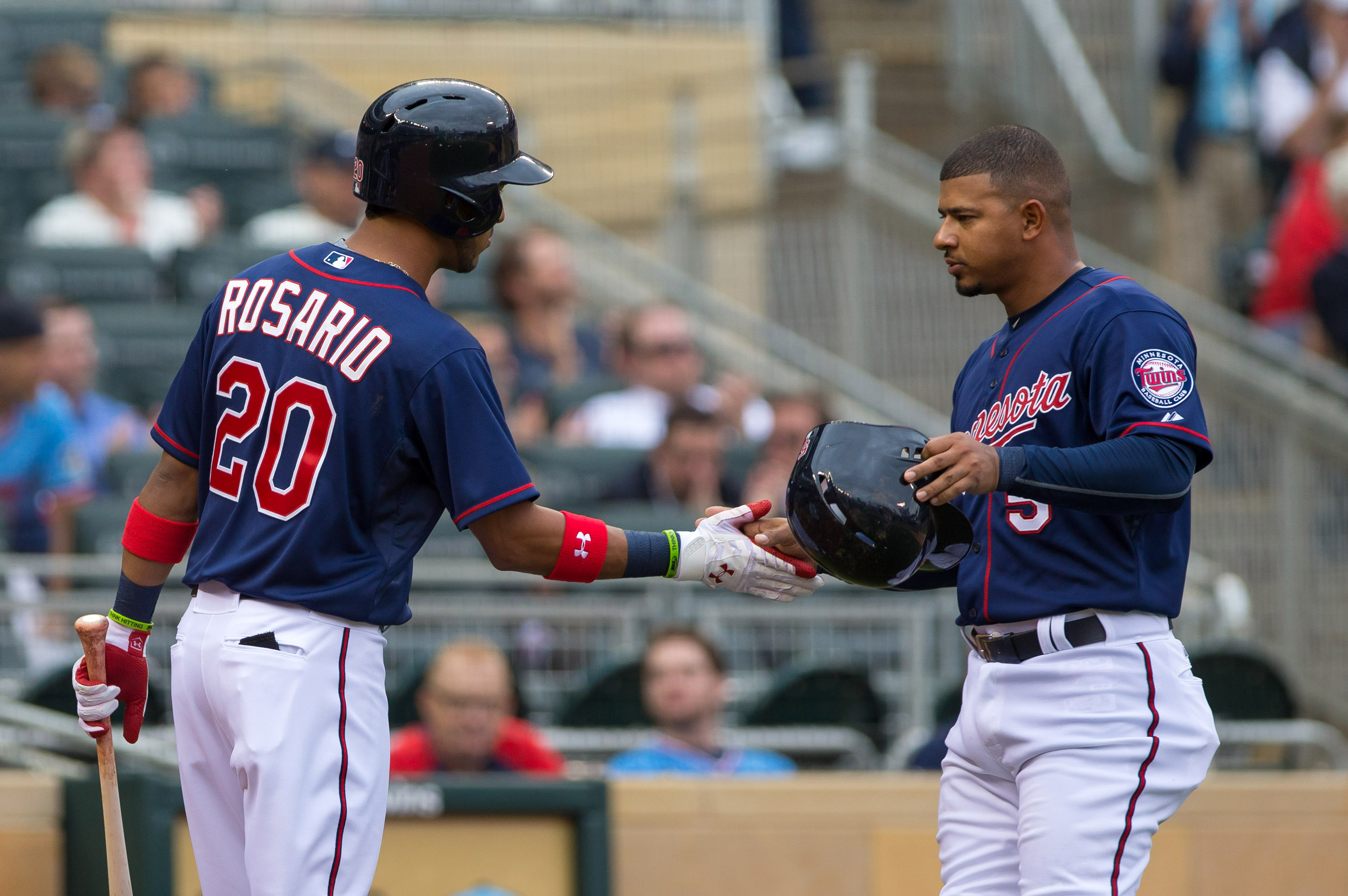 6) Eduardo Escobar, shortstop Personally, I feel like the time to extend Escobar has passed. There are a couple of reasons for that. When he narrowly missed the Super 2 deadline after the 2014 season, the Twins could have given him an extra bump in 2015 in return for a guarantee in 2016. Even as a utility-type player, Escobar brought lots of value to the roster. Amid rumors that the Twins were dangling him for a relief pitcher though, it shouldn’t be surprising he wasn’t extended. Secondly, while negotiating his salary as a first-time arbitration-eligible player, the Twins could have rewarded their new shortstop by guaranteeing his second year. Basically a “You’re our shortstop, we believe in you, now stop looking over your shoulder” contract. Essentially the same type of ill-fated deal the team made with Brendan Harris a few years back. A contract, too, that doesn’t damage your payroll even if Escobar returns to a utility-role. Escobar has earned the starting shortstop position to begin 2016. It’s hard to see Jorge Polanco wrestling it away from him as many believe he’s not equipped to handle that position long-term. So who in the organization is? Defensively Engelb Vielma is, but his bat has a ways to go and he hasn’t even played at AA yet. Nick Gordon is a better all-around player, but he’s only likely to make his Fort Myers debut this year. The reality is that the Twins, for the first time in a long time, have middle infield options. Brian Dozier is one of the best second baseman in the American League. Polanco is a legitimate prospect. Vielma and Gordon are down the line and Jermaine Palacios and bonus-baby Wander Javier are even further down the line. Oh, Danny Santana, despite the “position change” this offseason, and Eduardo Nunez could still remain options as well. There are some big-sticker prices on the arbitration years of bought-out shortstops, but then there’s also the deal the Royals signed Alcides Escobar to. A deal that agreed to pay the shortstop $3 million in EACH of his three arbitration years. If there’s a deal like that out there to be had, that’s one worth considering. 5) Eddie Rosario, outfielder The unlikelihood of signing a player with less than one year of service was discussed during the potential Buxton extension. Rosario falls into that category. But there is a deal that was signed a handful of years ago that could provide a nice framework for a Rosario deal; A deal signed by then-Pirates outfielder Jose Tabata. Yes, Tabata turned out to be a bust, but the investment for six years of Tabata ($15 million) pales in comparison to the nearly $25 million invested in Byung Ho Park, a complete unknown. There is going to be pretty significant difference between Tabata and Rosario, though, and that is because Rosario is in line to be a Super 2 player after the 2017 season. So while the framework remains the same, an extra year of arbitration, inflation over the 2011 Tabata deal and some incentives that will reward Rosario if he continues to remain a regular will increase the value of this deal. At a minimum, Rosario will always provide defensive value and has a floor of a fourth outfielder. The initial contract would pay him, at worst, as a fourth outfielder. The proposal: 2016 (0+): $540,000 2017 (1+): $760,000 2018 (Super 2): $2 million 2019 (3+): $3.5 million 2020 (4+): $4.5 million 2021 (5+): $5.7 million 2022 (6+): $7 million option or $.5 million buyout 2023 (7+): $8 million option or $.5 million buyout 2024 (8+): $9 million option or $.5 million buyout All told, the guarantee is over six years at the price of $17.5 million. Some other caveats: Starting in 2018, Rosario will earn an additional $500,000 in any year he exceeds 550 plate appearances. His salary for each ensuing year will also increase by $500,000 and his buyouts will increase by $100,000. An additional security for Rosario is that starting with that 2019 season, each time he exceeds the aforementioned 550 plate appearances, he can opt out of the remainder of his contract. Rosario’s maximum contract, if he reached 550 plate appearances each year and never opted out, would look as follows: 2016 (0+): $540,000 2017 (1+): $760,000 2018 (Super 2): $2.5 million 2019 (3+): $4.5 million 2020 (4+): $6 million 2021 (5+): $7.7 million 2022 (6+): $9.5 million option or $1 million buyout 2023 (7+): $11 million option or $1.1 million buyout 2024 (8+): $12.5 million option or $1.2 million buyout The contract becomes a six year, $23 million deal with a maximum value of $55 million over eight years, a fair-market contract for an everyday, but not an All-Star, outfielder. What do you think? #ExtendEitherEddie?
 -
 This is Polanco's last option year. I hope he plays around the diamond this year in AAA. I don't know if I said it in this thread or a different one, but Polanco is a player that I think could have a lot of success in a Josh Harrison-type role. And he's one injury away from bring a regular infielder at 2B, SS and (I even feel) 3B.
- 43 replies
-
- 1
-

-
- brian dozier
- kurt suzuki
- (and 1 more)
-
Yesterday we examined what possible extensions might look like in the cases of Kurt Suzuki (more of a modification than anything) and Brian Dozier. Overwhelmingly - and in no way surprisingly - the consensus is that the Twins would be wise to let Suzuki’s contract play out, hoping that the team can avoid him getting enough plate appearances for his option to vest. Brian Dozier is coming off of his first year of a three-year deal that bought out no free agents years. Readers were less than enthused to tack on years to his deal either. Let’s take a look at two new candidates today.8) Glen Perkins, proven closer During my initial time researching this piece, Perkins didn’t jump out as a potential extension candidate. Not even a little bit. But the more I dug, the more he became a player that I had to think about including. Consider this: After his age-28 season (2011), the club and Perkins agreed on a five-year deal that was very team-friendly. Just two years later, during the spring training of 2014, Perkins approached the team about a restructure/extension and terms to another team-friendly deal were agreed upon very quickly. After signing the “discounted” deal, Perkins was quoted as saying, “I’ll take a $22 million discount every day of the week” citing he was going to make more money than he’d “ever need,” playing for the team that he never wants to leave. Perkins is a forward-thinking player, who is very honest about himself and what he needs to do better. He’s also basically put on the record that he’ll make more money than he will ever need. Players don’t do that. I don’t know what kind of trick Perk could have up his sleeve this time, but I’d say there’s a non-zero chance that the three-time All-Star closer is thinking about making the next move typical ballplayers don’t make. 7) Byron Buxton, centerfielder Here’s one you’ve all been waiting for, right? But you also probably thought Buxton might be higher on the list. Right? One reason Buxton is showing up here and not higher is there might be some trepidation after his slow start. Not at all because the Twins think he’s a bust, but just because there were very high expectations that weren’t met and it would be extremely difficult to find a deal that both parties are comfortable with. Another reason is that Buxton falls into the 0-1 year of service category. The Twins have never signed a player to an extension with less than one year of service. In fact, it’s only happened five times in the history of baseball. (Tampa Bay is responsible for three of those deals.) The nearest comparison from the Twins perspective would be the five-year deal that was given to Denard Span in March of 2010. With Span’s service time, the guarantee lasted through his arbitration years and the team held an option for his first year of free agency. At the time, Span’s deal was very similar to the contract that Grady Sizemore had signed. Strictly using the contracts signed recently by A.J. Pollock, Lorenzo Cain and Juan Lagares, you can assume that Buxton could easily command north of $20 million just to buy out his arbitration years. You’ve read this far because you want me to throw some actual numbers out, didn’t you? Here goes: 2016 (0+): $525,000 2017 (1+): $750,000 2018 (2+): $1 million 2019 (3+): $3.5 million (same as A.J. Pollack) 2020 (4+): $7 million (all of Pollack, Cain and Lagares got between $6.5m and $6.75m) 2021 (5+): $10.5 million (Pollack will go to arbitration; Cain is signed for $11m, Lagares $9m) 2022 (6+): $13 million option or $1 million buyout Grand total: Six years, $24.275 million. Something to note: The Twins have only Hughes and Park under contract in 2019 (with a Santana option) and only Park’s option on the books in 2020. Would that make them more or less likely to sign one of their younger players to an extension? Weigh in below. Click here to view the article
-
 8) Glen Perkins, proven closer During my initial time researching this piece, Perkins didn’t jump out as a potential extension candidate. Not even a little bit. But the more I dug, the more he became a player that I had to think about including. Consider this: After his age-28 season (2011), the club and Perkins agreed on a five-year deal that was very team-friendly. Just two years later, during the spring training of 2014, Perkins approached the team about a restructure/extension and terms to another team-friendly deal were agreed upon very quickly. After signing the “discounted” deal, Perkins was quoted as saying, “I’ll take a $22 million discount every day of the week” citing he was going to make more money than he’d “ever need,” playing for the team that he never wants to leave. Perkins is a forward-thinking player, who is very honest about himself and what he needs to do better. He’s also basically put on the record that he’ll make more money than he will ever need. Players don’t do that. I don’t know what kind of trick Perk could have up his sleeve this time, but I’d say there’s a non-zero chance that the three-time All-Star closer is thinking about making the next move typical ballplayers don’t make. 7) Byron Buxton, centerfielder Here’s one you’ve all been waiting for, right? But you also probably thought Buxton might be higher on the list. Right? One reason Buxton is showing up here and not higher is there might be some trepidation after his slow start. Not at all because the Twins think he’s a bust, but just because there were very high expectations that weren’t met and it would be extremely difficult to find a deal that both parties are comfortable with. Another reason is that Buxton falls into the 0-1 year of service category. The Twins have never signed a player to an extension with less than one year of service. In fact, it’s only happened five times in the history of baseball. (Tampa Bay is responsible for three of those deals.) The nearest comparison from the Twins perspective would be the five-year deal that was given to Denard Span in March of 2010. With Span’s service time, the guarantee lasted through his arbitration years and the team held an option for his first year of free agency. At the time, Span’s deal was very similar to the contract that Grady Sizemore had signed. Strictly using the contracts signed recently by A.J. Pollock, Lorenzo Cain and Juan Lagares, you can assume that Buxton could easily command north of $20 million just to buy out his arbitration years. You’ve read this far because you want me to throw some actual numbers out, didn’t you? Here goes: 2016 (0+): $525,000 2017 (1+): $750,000 2018 (2+): $1 million 2019 (3+): $3.5 million (same as A.J. Pollack) 2020 (4+): $7 million (all of Pollack, Cain and Lagares got between $6.5m and $6.75m) 2021 (5+): $10.5 million (Pollack will go to arbitration; Cain is signed for $11m, Lagares $9m) 2022 (6+): $13 million option or $1 million buyout Grand total: Six years, $24.275 million. Something to note: The Twins have only Hughes and Park under contract in 2019 (with a Santana option) and only Park’s option on the books in 2020. Would that make them more or less likely to sign one of their younger players to an extension? Weigh in below.
 -
Right. (Site wasn't working correctly, so I couldn't edit my post.) FOR ME if I'm looking at it from the team's perspective, at the time I didn't think cost certainty was enough of a benefit to make the deal. Any extension should involve give-and-take from both parties... felt like more give from the Twins and more take from Dozier. Which I don't have a problem with as a fan. Good for the player!
-
The Twins pushed hard for a free agent year or two. Dozier didn't bite. (From the team's perspective, if there are no free agent years included - whether it's an option or a straight year - that's a deal-breaker.)
-
I don't even like myself for thinking Suzuki is 10th most-likely to sign a new contract. But I still have the pukey taste in my mouth from the first extension I didn't like. I view it - from the Twins perspective - that if things go bad behind the plate and Suzuki somehow reaches the plate appearances to vest... I'd pay him money now to not have that option. As far as Dozier goes, I think he'll be the second baseman for the forseeable future. I'm starting to wonder if Polanco gets more time at third this year - the Twins talked about doing it last year according to one of Phil Miller's blurbs in BA - and is the third baseman of the future. I also really like the idea of him being the Twins version of Josh Harrison (or Ben Zobrist).
-
I’ve always been a fan of extensions. Well, baseball extensions anyway. My wife came home with hair extensions once because they were a “good deal” and I wasn’t a big fan of that. But that’s besides the point. As far as baseball extensions go, even “good deals” sometimes aren’t good deals. And sometimes bad-looking deals turn into great deals (but usually not). The reality is that’s impossible to tell until later. Sometimes a little later. Sometimes a lot later. The best part - for me anyway - is that once an extension is signed it’s thrown into a group of contracts that can be examined in a number of different ways - from years of free agency bought out to team options to buyouts to looking specifically at the details of those with similar service time and position.According to MLBTR’s Extension Tracker, the Twins have signed 13 players to 15 extensions since the beginning of the 2008 calendar year. Eight of those have been signed during the month of March, including the extension of Brian Dozier in 2015 and Glen Perkins in 2014. Will there be another one in 2016? Over the next couple of weeks, we’re going to examine ten players and how a potential extension would be structured and why. Please note: I’M NOT SUGGESTING SIGNING ALL OF THESE PLAYERS TO EXTENSIONS. In fact, there are a couple that would be downright ridiculous. But ten is a nice, round number to examine over this multi-part series. These are listed in order of a combination of likelihood and personal preference, starting with least-likely/preferred ones. 10) Kurt Suzuki, catcher Wait, this can’t be serious. Can it!? Well, it was serious when the Twins signed Suzuki to a two-year extension 18 months ago when many fans were hoping they would trade him. Suzuki, of course, finished 2014 .288/.345/.383 after signing the extension on trade deadline day (and hitting .306/.369/.391 at the time). He backed that up with a 2015 that saw his production drop even more, to the tune of .240/.296/.314. Yikes! So why extend him? There’s not a great reason to “extend” him as much as there is to “modify”. Currently Suzuki is in line to earn $6 million in 2016 and $6 million in 2017, but only if he makes 485 plate appearance in 2016. He’s almost assured to not reach that number in 2016; he fell short of it in 2015. So the likelihood is that he’ll hit the open market and be looking at, what, the possibility of signing a minor league deal? Even the best case scenario is he’s not coming close to the $6 million he will make this year. The addition of John Ryan Murphy and having both Stuart Turner and Mitch Garver knocking on the door might render Suzuki useless as we look towards 2017, but what if we replace the vesting option with a team option at a much lower price that includes a guaranteed buyout. We’ll toss some plate appearance bonuses in to insure Suzuki makes money if he would have otherwise triggered what would have vested the option. Would I extend Suzuki? No way. I’d make sure his option doesn’t vest and he’s off the books, but would the team and Suzuki consider the following deal: Eliminate the vesting option. Add a mutual option for $2 million for 2017 with a $100,000 buyout (if the term declines). Add $250,000 plate appearances bonuses at 450, 485, 520 and 555 and add a $1 million bonus at 615. The Twins will be on the hook for an extra $100,000 but Suzuki could earn an extra $2 million if he makes 615 plate appearances. He wouldn’t recoup the $6 million that he could have earned, but if he puts up a season that includes 615 plate appearances, he’ll probably do ok for himself in free agency. Like I mentioned earlier, it’s not so much an “extension” as it is a “modification”. I’ve also said it’s something I wouldn’t do. But is it something that both parties would consider beneficial to themselves? It might be, especially considering how much the parties involved seem to like each other. 9) Brian Dozier, second baseman You Can’t Be Serious, Part 2, right? Sort of. As much as I was against the Suzuki extension when it was signed, I was against the Dozier extension for a completely different reason: It didn’t give the Twins any additional years of control. The only benefit - and it’s a benefit that might prove to be even bigger as the years progress - is that it provided cost-certainty. But you can also make the argument that having to pay additional dollars going year-by-year is a better alternative than locking in at a cost for a handful of years. Now’s not the place to argue that (well, you can down below if you’d like). I’m just not going to touch it here. If you don’t remember, the Twins signed Dozier to a four-year/$20 million deal last spring. They tore up the $540,000 deal they had given him for 2015 and bumped his salary to $2 million. The club then bought out his arbitration years at $3, $6 and $9 million. But no more years. And no team options. The contract signed by Dee Gordon is a great comparison for what Dozier should have gotten/could still get. You could view the $1.46 million bump Dozier got as a signing bonus. Gordon got a signing bonus of $1.5 million. Both players will make $3 million in their 3+ year of service. Gordon will make $1.5 million more than Dozier in each of his 4+ and 5+ seasons. The big difference is that Gordon will remain under the Marlins control for $13 million and $13.5 million with an additional vesting option whereas Dozier will become a free agent. Is it time for the Twins to right that wrong? Not many would have batted an eye if the Twins bought out a year or two of Dozier’s free agency last March, so would they now? An additional two years at $30.5 million. It would break down like this: $3 million signing bonus (the difference in arbitration-year salaries), $13 million in 2019, $13.5 million in 2020 and a $1 million buyout on a $14 million team option for 2021. Essentially the exact same deal that Dee Gordon signed. This would lock up Dozier through his age-33 season and he would enter free agency the same time as Gordon, who is one year younger. Personally, I would have been more likely to give Dozier this deal last March. Now that he’s locked in, I’d let it play out (at least until this time next year). But it wouldn’t be the first time the club extended a player one year into a contract. *cough*Phil Hughes*cough* Which might be just enough to make the club a little gun shy this time around. So what do you think about Suzuki (are you kidding me?!) and Dozier (well, now that you put it that way)? We’ll be checking in on eight more players over the next few days or weeks. Feel free to chime in below. Click here to view the article
- 43 replies
-
- 1
-
-
- brian dozier
- kurt suzuki
- (and 1 more)
-
 According to MLBTR’s Extension Tracker, the Twins have signed 13 players to 15 extensions since the beginning of the 2008 calendar year. Eight of those have been signed during the month of March, including the extension of Brian Dozier in 2015 and Glen Perkins in 2014. Will there be another one in 2016? Over the next couple of weeks, we’re going to examine ten players and how a potential extension would be structured and why. Please note: I’M NOT SUGGESTING SIGNING ALL OF THESE PLAYERS TO EXTENSIONS. In fact, there are a couple that would be downright ridiculous. But ten is a nice, round number to examine over this multi-part series. These are listed in order of a combination of likelihood and personal preference, starting with least-likely/preferred ones. 10) Kurt Suzuki, catcher Wait, this can’t be serious. Can it!? Well, it was serious when the Twins signed Suzuki to a two-year extension 18 months ago when many fans were hoping they would trade him. Suzuki, of course, finished 2014 .288/.345/.383 after signing the extension on trade deadline day (and hitting .306/.369/.391 at the time). He backed that up with a 2015 that saw his production drop even more, to the tune of .240/.296/.314. Yikes! So why extend him? There’s not a great reason to “extend” him as much as there is to “modify”. Currently Suzuki is in line to earn $6 million in 2016 and $6 million in 2017, but only if he makes 485 plate appearance in 2016. He’s almost assured to not reach that number in 2016; he fell short of it in 2015. So the likelihood is that he’ll hit the open market and be looking at, what, the possibility of signing a minor league deal? Even the best case scenario is he’s not coming close to the $6 million he will make this year. The addition of John Ryan Murphy and having both Stuart Turner and Mitch Garver knocking on the door might render Suzuki useless as we look towards 2017, but what if we replace the vesting option with a team option at a much lower price that includes a guaranteed buyout. We’ll toss some plate appearance bonuses in to insure Suzuki makes money if he would have otherwise triggered what would have vested the option. Would I extend Suzuki? No way. I’d make sure his option doesn’t vest and he’s off the books, but would the team and Suzuki consider the following deal: Eliminate the vesting option. Add a mutual option for $2 million for 2017 with a $100,000 buyout (if the term declines). Add $250,000 plate appearances bonuses at 450, 485, 520 and 555 and add a $1 million bonus at 615. The Twins will be on the hook for an extra $100,000 but Suzuki could earn an extra $2 million if he makes 615 plate appearances. He wouldn’t recoup the $6 million that he could have earned, but if he puts up a season that includes 615 plate appearances, he’ll probably do ok for himself in free agency. Like I mentioned earlier, it’s not so much an “extension” as it is a “modification”. I’ve also said it’s something I wouldn’t do. But is it something that both parties would consider beneficial to themselves? It might be, especially considering how much the parties involved seem to like each other. 9) Brian Dozier, second baseman You Can’t Be Serious, Part 2, right? Sort of. As much as I was against the Suzuki extension when it was signed, I was against the Dozier extension for a completely different reason: It didn’t give the Twins any additional years of control. The only benefit - and it’s a benefit that might prove to be even bigger as the years progress - is that it provided cost-certainty. But you can also make the argument that having to pay additional dollars going year-by-year is a better alternative than locking in at a cost for a handful of years. Now’s not the place to argue that (well, you can down below if you’d like). I’m just not going to touch it here. If you don’t remember, the Twins signed Dozier to a four-year/$20 million deal last spring. They tore up the $540,000 deal they had given him for 2015 and bumped his salary to $2 million. The club then bought out his arbitration years at $3, $6 and $9 million. But no more years. And no team options. The contract signed by Dee Gordon is a great comparison for what Dozier should have gotten/could still get. You could view the $1.46 million bump Dozier got as a signing bonus. Gordon got a signing bonus of $1.5 million. Both players will make $3 million in their 3+ year of service. Gordon will make $1.5 million more than Dozier in each of his 4+ and 5+ seasons. The big difference is that Gordon will remain under the Marlins control for $13 million and $13.5 million with an additional vesting option whereas Dozier will become a free agent. Is it time for the Twins to right that wrong? Not many would have batted an eye if the Twins bought out a year or two of Dozier’s free agency last March, so would they now? An additional two years at $30.5 million. It would break down like this: $3 million signing bonus (the difference in arbitration-year salaries), $13 million in 2019, $13.5 million in 2020 and a $1 million buyout on a $14 million team option for 2021. Essentially the exact same deal that Dee Gordon signed. This would lock up Dozier through his age-33 season and he would enter free agency the same time as Gordon, who is one year younger. Personally, I would have been more likely to give Dozier this deal last March. Now that he’s locked in, I’d let it play out (at least until this time next year). But it wouldn’t be the first time the club extended a player one year into a contract. *cough*Phil Hughes*cough* Which might be just enough to make the club a little gun shy this time around. So what do you think about Suzuki (are you kidding me?!) and Dozier (well, now that you put it that way)? We’ll be checking in on eight more players over the next few days or weeks. Feel free to chime in below.
 -
He was on scout's radar for a couple of years before being drafted. Everyone thought he would make a big leap from year to year... and he didn't. Then his senior year he was suspended (yes, I did talk about it) and missed time and when he came back he hadn't taken the jump teams hoped to see. The Twins felt with professional coaching he'd take the leap. And he's outperformed their expectations.
-
It happened. It's over. Can we instead talk about how good he's been?
-
We all know the backstory of Stephen Gonsalves. Gonsalves entered this senior year of high school at Cathedral Catholic High School in San Diego, California as the 27th best draft prospect according to MLB.com. A suspension, however, led to him dropping on the boards of the well-known websites. Details surrounding the suspension have always been cloudy, though Gonsalves came out right after signing to set the record straight: He didn’t come clean about a teammate’s marijuana use during a trip to North Carolina. The failure to do so resulted in a month-long suspension. The Twins never wavered. Believing in his makeup and character, they were thrilled to see Gonsalves available in the fourth round of the 2014 draft and promptly drafted and signed him for $700,000.Age: 21 (DOB: 7/8/94) 2015 Stats (l-A/h-A): 13-3, 2.01 ERA, 1.10 WHIP, 134.1 IP, 95 H, 53 BB, 132 K ETA: mid-2018 2015 Ranking: 13 National Top 100 Rankings BA: NR | MLB: NR | BP: NR What’s To Like Gonsalves checks a lot of different boxes in this particular section. Scouts laud his “intense focus” and how he “won’t let outside variables influence his preparation and resolve to be the best he can be.” You know, the makeup the Twins were convinced of when he was only a high schooler. And that’s only between his ears. Physically, Gonsalves has the prototypical pitcher size. Standing 6’ 5”, Gonsalves is pretty skinny, weighing around 200 pounds, but has long levers and comes with the added bonus of being left-handed. Currently, Gonsalves has two pitches at his disposal that profile as major-league pitches. He’s increased his fastball velocity to the 90-93 mph range and can touch 94 mph on the right day. His changeup is his go-to pitch right now and probably “always will be” his best pitch according to one American League scout. Despite not having much of a breaking ball, Gonsalves has been exceeding expectations. Lots of strikeouts, low walks and fastball command point this pitcher towards the direction of “future major leaguer.” What’s Left To Work On After putting up 13 wins across two levels of A-ball in 2015, many scratched their heads when they saw Gonsalves’ name included on the Instructional League roster. The reason for his inclusion was simple: work on the slider he plans to use more this year. As mentioned earlier, Gonsalves lacks a breaking pitch. To this point, Gonsalves’s two breaking pitches - his curveball and slider - have lacked distinctness and the curveball, the breaking ball he’s been primarily as a pro, is presently a below-average offering and doesn’t project to get a lot better. Gonsalves will also need to continue to hone his fastball command. A usable breaking pitch is important, but having pinpoint accuracy with the fastball puts less pressure on either the slider or curveball to become major league pitches. His 6.2 K/9 in his 79.1 innings at Fort Myers in 2015 was his lowest at any stop in his professional career by a wide margin. What’s Next It seems as though Gonsalves is destined for Fort Myers to start his 2016 season. The same Fort Myers in which he went 7-2 to close his 2015 season. There is hope within the organization that Gonsalves could break camp and head to Chattanooga, but the more likely scenario is that he earns a midseason promotion to AA to continue his successful run as a professional. The Twins Prospect Handbook projected an ETA of June 2018, but a dominant 2016 between two levels could have the young lefty knocking on the big league door by the middle of the 2017 season. Click here to view the article
-
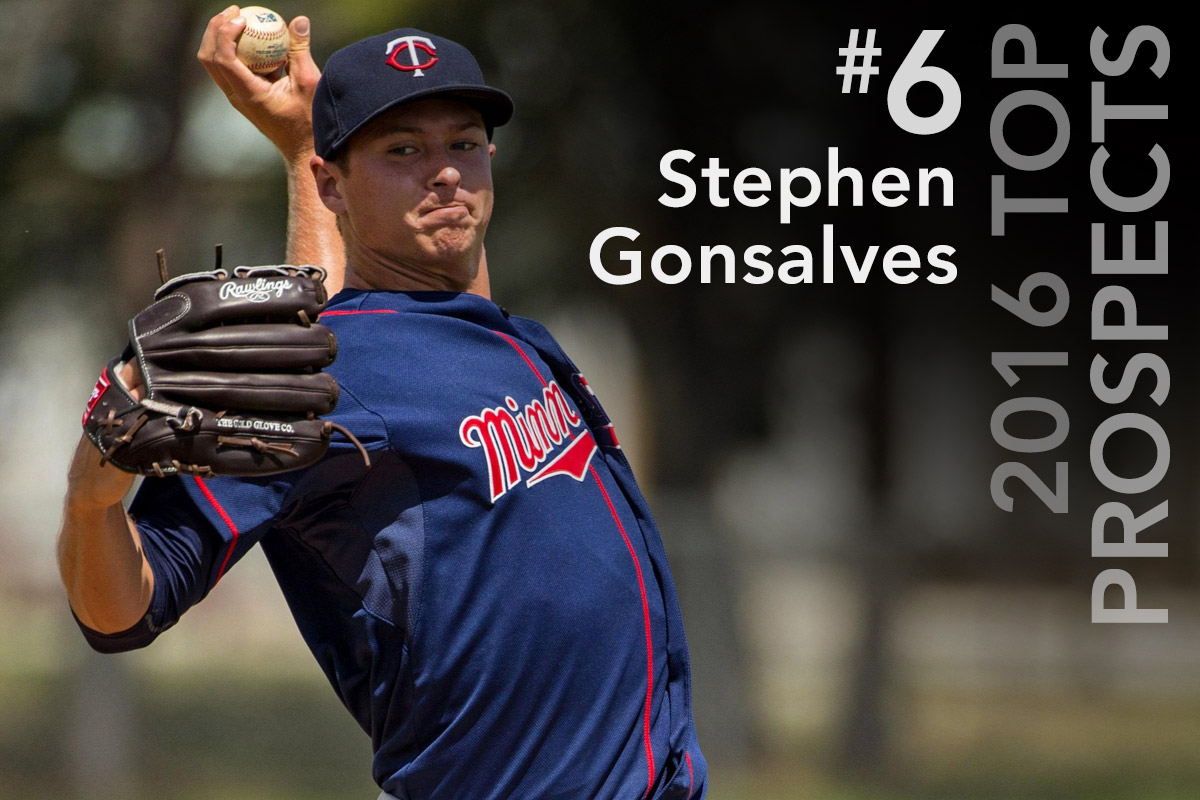 Age: 21 (DOB: 7/8/94) 2015 Stats (l-A/h-A): 13-3, 2.01 ERA, 1.10 WHIP, 134.1 IP, 95 H, 53 BB, 132 K ETA: mid-2018 2015 Ranking: 13 National Top 100 Rankings BA: NR | MLB: NR | BP: NR What’s To Like Gonsalves checks a lot of different boxes in this particular section. Scouts laud his “intense focus” and how he “won’t let outside variables influence his preparation and resolve to be the best he can be.” You know, the makeup the Twins were convinced of when he was only a high schooler. And that’s only between his ears. Physically, Gonsalves has the prototypical pitcher size. Standing 6’ 5”, Gonsalves is pretty skinny, weighing around 200 pounds, but has long levers and comes with the added bonus of being left-handed. Currently, Gonsalves has two pitches at his disposal that profile as major-league pitches. He’s increased his fastball velocity to the 90-93 mph range and can touch 94 mph on the right day. His changeup is his go-to pitch right now and probably “always will be” his best pitch according to one American League scout. Despite not having much of a breaking ball, Gonsalves has been exceeding expectations. Lots of strikeouts, low walks and fastball command point this pitcher towards the direction of “future major leaguer.” What’s Left To Work On After putting up 13 wins across two levels of A-ball in 2015, many scratched their heads when they saw Gonsalves’ name included on the Instructional League roster. The reason for his inclusion was simple: work on the slider he plans to use more this year. As mentioned earlier, Gonsalves lacks a breaking pitch. To this point, Gonsalves’s two breaking pitches - his curveball and slider - have lacked distinctness and the curveball, the breaking ball he’s been primarily as a pro, is presently a below-average offering and doesn’t project to get a lot better. Gonsalves will also need to continue to hone his fastball command. A usable breaking pitch is important, but having pinpoint accuracy with the fastball puts less pressure on either the slider or curveball to become major league pitches. His 6.2 K/9 in his 79.1 innings at Fort Myers in 2015 was his lowest at any stop in his professional career by a wide margin. What’s Next It seems as though Gonsalves is destined for Fort Myers to start his 2016 season. The same Fort Myers in which he went 7-2 to close his 2015 season. There is hope within the organization that Gonsalves could break camp and head to Chattanooga, but the more likely scenario is that he earns a midseason promotion to AA to continue his successful run as a professional. The Twins Prospect Handbook projected an ETA of June 2018, but a dominant 2016 between two levels could have the young lefty knocking on the big league door by the middle of the 2017 season.
 -
Article: Draft Blog, Entry 1 (2/9/16)
Jeremy Nygaard replied to Jeremy Nygaard's topic in Twins Daily Front Page News
Benson's definitely a high-ceiling prospect. I'm sure there will be a write-up at some point. I went with guys with local ties to give readers some people to follow as the season begins. Benson's season was supposed to start today, but the game was cancelled. So his season will begin Friday. He's from Georgia - where the Twins drafted some Buxton guy from - so I'll make sure to keep close tabs on Benson throughout the spring and into draft season. As far as the nutshell goes, Benson shares a lot of physical characteristics with Jason Heyward, but I'd bet Benson's future profile is much more of a typical corner outfielder than Heyward. He'll be fun to watch develop. The Twins love "toolsy" outfielders. -
Article: Draft Blog, Entry 1 (2/9/16)
Jeremy Nygaard replied to Jeremy Nygaard's topic in Twins Daily Front Page News
I don't disagree with any of what you said. But without knowing exactly what was found, exactly what the offers were, or exactly what was said in conversations between the two parties, I don't want to speculate... even though I feel like I can connect the dots. What I do know is there weren't many people involved in the negotiations that thought the final offer was not fair given what both parties knew. -
Article: Draft Blog, Entry 1 (2/9/16)
Jeremy Nygaard replied to Jeremy Nygaard's topic in Twins Daily Front Page News
Typically when teams reach an agreement there are contingencies built in. When one side backs off those contingencies, it doesn't go over well.- 43 replies
-
- 1
-
-
- mlb draft
- logan shore
- (and 1 more)
-
Article: Draft Blog, Entry 1 (2/9/16)
Jeremy Nygaard replied to Jeremy Nygaard's topic in Twins Daily Front Page News
In the 2012 draft, when Correa was off the board, I absolutely thought Buxton was the right pick. Had Buxton been gone, I was leaning Gausman, but hoped the Twins would save on Correa and use money elsewhere. I think the Twins would have taken Correa had Buxton been gone. There was late steam. In 2013, I was all over Stewart for about three months. I hoped the Twins wouldn't pass on Jon Gray if he fell, but didn't love Kris Bryant. (I'm not perfect.) In 2014, the selection of Gordon was no secret. When Rodon dropped past second, I was hoping he'd fall to the Twins. Really liked Alex Jackson if they'd keep him at catcher (went sixth) and came around on Aaron Nola (seventh) if something crazy happened. In 2015, I loved Bregman and hoped Tate would be the guy if Bregman didn't fall. I wasn't super high on Jay, but understood what he offered and the Twins were convinced he'd be good. The guy I loved late was Benintendi. I think he'll make the five teams who didn't pick him regret it. -
Article: Draft Blog, Entry 1 (2/9/16)
Jeremy Nygaard replied to Jeremy Nygaard's topic in Twins Daily Front Page News
Like I've said, it's a long ways away and the team could change their mind. But after Cody went unsigned last year, the Twins were furious. There was a lot to it that I'm not going to re-hash (mostly because it was never picked up by the mainstream media), but you could read an article I wrote in mid-July. The Twins aren't going to go that direction again. -
Article: Draft Blog, Entry 1 (2/9/16)
Jeremy Nygaard replied to Jeremy Nygaard's topic in Twins Daily Front Page News
He would have signed if he was a first-rounder, I have no doubt about that. The process has changed since Trout went through. Trout was #22 on BA's Top 100 coming into the draft. Boldt was late 50s, but that was after not having played all season. He was regarded as a mid-first round pick coming into his senior year. Of course... things change, especially injuries. -
Article: Draft Blog, Entry 1 (2/9/16)
Jeremy Nygaard replied to Jeremy Nygaard's topic in Twins Daily Front Page News
It's easy to come out after he's a star and say that. He wasn't saying that in 2009. Morhardt was also let go by the Angels. I've had many conversations about Trout as a prep. Nobody knew what he was. He wasn't seeing anything quality in high school. For every "we knew he was going to be a star" that's right, there are ninety-nine stories that are untold because they're wrong.- 43 replies
-
- 2
-
-
- mlb draft
- logan shore
- (and 1 more)
-
Article: Draft Blog, Entry 1 (2/9/16)
Jeremy Nygaard replied to Jeremy Nygaard's topic in Twins Daily Front Page News
There are definitely better draft prospects. These were just guys with ties to the Twins or the area. They are all Top 75 guys, but without any of them playing their draft season yet, it's impossible to say. Kyle Cody? I don't think that Twins even pursue him. Sure Trout was a prospect, but he wasn't an uberprospect yet. -
The draft kicks off exactly four months from today, so what better time to start a draft blog series? Don’t even really think of this as a starting point though, few players even have seen their season get underway; consider this more of an appetizer. People love to talk about the draft and speculate about who might be available when the Twins come to the podium. Today, we’ll look at four players with ties to the Twins franchise.Logan Shore, RHP, Florida Drafted by the Twins out of Coon Rapids (MN) in the 29th round in 2013, Shore chose to head to Florida and immediately become their Friday night starter. In his 208 innings as a collegian, the 6-2, 210-lb right-hander has struck out 152 and allowed only 183 hits and 44 walks. Not bad considering he was stepping into the most competitive league in the NCAA. Stats aside, Shore left the state of Minnesota as it’s second-best prep prospect (behind someone we’ll talk about later) and now has a MLB-ready fastball that sits in the low-90s and an above-average chang-up that scouts rave about. He’s still working on his breaking ball, but there is belief that if he can tighten it up, it will be - at a minimum - a MLB-average slider. Seeing Shore’s name included on this list should be no surprise. Doogie Wolfson has been talking about the connection for quite some time and points out it should be no surprise that - if available - Shore is drafted by the Twins at #16. Ryan Boldt, OF, Nebraska Boldt was considered the top prep prospect in the state of Minnesota entering his senior year at Red Wing. After a knee injury eliminated all but one game of his senior year, he saw his first-round stock fall and was eventually drafted in the 22nd round by the Red Sox but also passed on signing and is currently entering his junior season with the Cornhuskers. Solidly built at 6-2, 220, Boldt shares many physical characteristics with Mike Trout. This isn’t to say that Boldt will ever be anywhere near as good as present-day Mike Trout - he won’t - but the player the Angels thought they were drafting when they drafted Trout is similar to the player that the team that drafts Boldt is getting - a very good athlete, a solid hitter, a player with the potential to hit for a little bit of power and steal some bases while playing a capable outfield. Trout far exceeded those expectations (obviously). (Note: Please understand this isn’t a Boldt/Trout comparison. Physically, there is a resemblance. Trout was not an uberprospect entering the draft. In fact, out of high school, Boldt was probably the more highly-regarded prospect. But guys get better and, sometimes, they become the all-time greats.) Another popular comparison you’ll see is to Boldt’s current coach, Darin Erstad, a two-time All-Star and three-time Gold Glover with the Angels. Zack Burdi, RHRP, Louisville The connection here is obviously current farmhand Nick Burdi, twice drafted by the Twins and the older brother of Zack. The youngest Burdi is also blessed with a powerful right arm, though he hasn’t lit the up radar gun quite as much as his older brother; think more mid-90s than high-90s. Filling the closer role that his brother vacated, Burdi saved nine games in 2015 for Louisville, striking out 30 in 29 ⅓ innings. He allowed only 16 hits and eight walks. Interestingly, he made only 20 appearances, so he wasn’t strictly used as a one-inning closer. While Nick employs a more violent delivery, some scouts believe that Zack could be given a chance to start. The youngest Burdi has a lot of work to do in that regard, as both his off-speed and breaking offerings are far from ready. Chad Hockin, RHRP, Cal-St. Fullerton What’s the connection here? None other than Chad’s mother, Erin, daughter of the late, great Harmon Killebrew. The bloodlines have left an impact, though, as Hockin lists the Twins as his favorite team and Target Field as his favorite stadium on his player bio. Hockin is a two-pitch reliever for Fullerton currently, hittable in his 18 appearances (21 hits in 18 ⅓ innings). But he showed signs of life with an uptick in his fastball in his appearance in the Cape Cod League. The Twins have always seemed to value time in the wood-bat league and in 13 innings, Hockin struck out 19 and allowed only eight hits and five walks. If he can build on that success, Hockin could be a Day One pick. --- That’s four players with Twins ties - but no in-state players - the team could be considering when the draft rolls around in June. Who are you interested in? Click here to view the article
- 43 replies
-
- 3
-
-
- mlb draft
- logan shore
- (and 1 more)
-
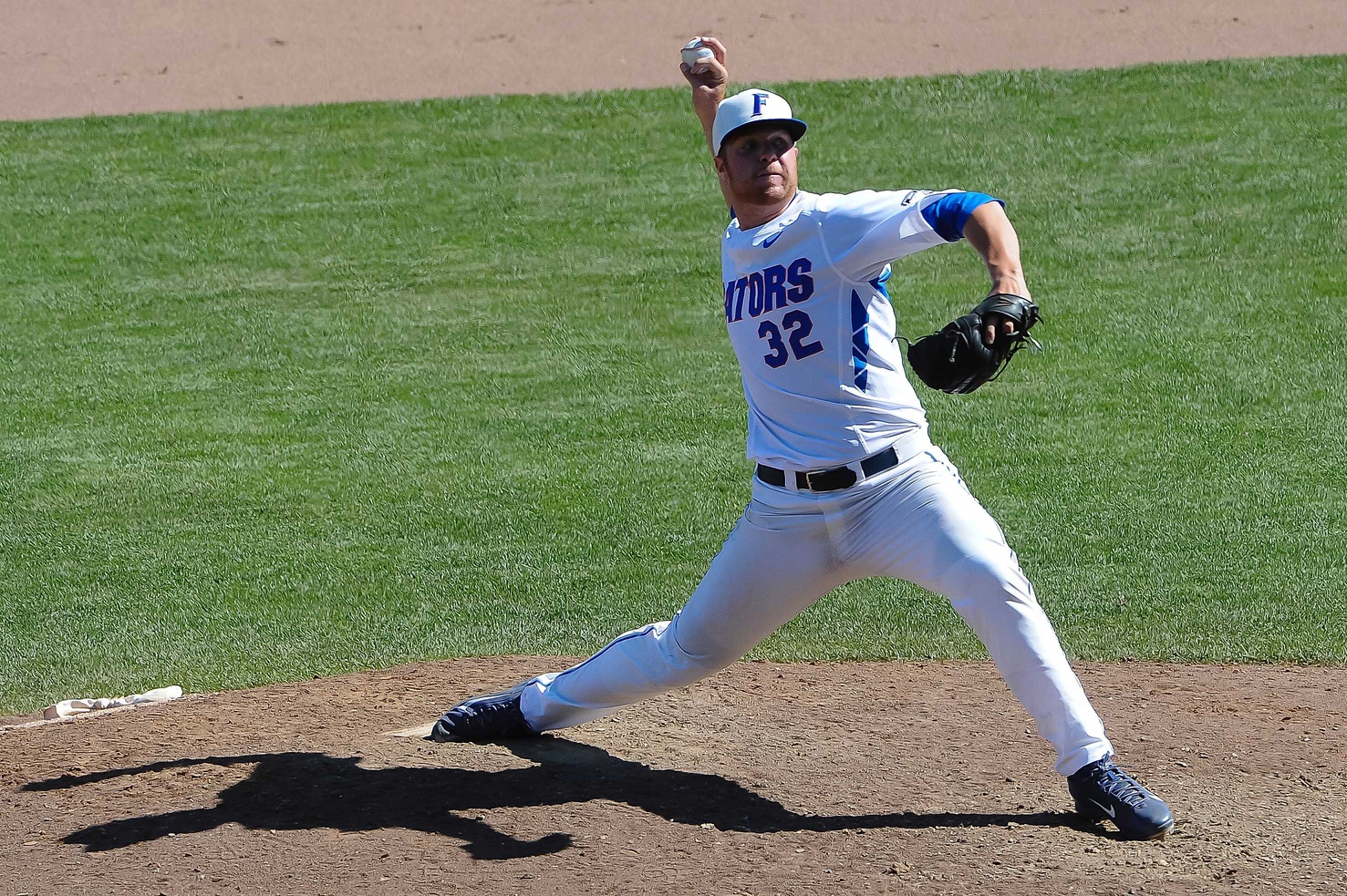 Logan Shore, RHP, Florida Drafted by the Twins out of Coon Rapids (MN) in the 29th round in 2013, Shore chose to head to Florida and immediately become their Friday night starter. In his 208 innings as a collegian, the 6-2, 210-lb right-hander has struck out 152 and allowed only 183 hits and 44 walks. Not bad considering he was stepping into the most competitive league in the NCAA. Stats aside, Shore left the state of Minnesota as it’s second-best prep prospect (behind someone we’ll talk about later) and now has a MLB-ready fastball that sits in the low-90s and an above-average chang-up that scouts rave about. He’s still working on his breaking ball, but there is belief that if he can tighten it up, it will be - at a minimum - a MLB-average slider. Seeing Shore’s name included on this list should be no surprise. Doogie Wolfson has been talking about the connection for quite some time and points out it should be no surprise that - if available - Shore is drafted by the Twins at #16. Ryan Boldt, OF, Nebraska Boldt was considered the top prep prospect in the state of Minnesota entering his senior year at Red Wing. After a knee injury eliminated all but one game of his senior year, he saw his first-round stock fall and was eventually drafted in the 22nd round by the Red Sox but also passed on signing and is currently entering his junior season with the Cornhuskers. Solidly built at 6-2, 220, Boldt shares many physical characteristics with Mike Trout. This isn’t to say that Boldt will ever be anywhere near as good as present-day Mike Trout - he won’t - but the player the Angels thought they were drafting when they drafted Trout is similar to the player that the team that drafts Boldt is getting - a very good athlete, a solid hitter, a player with the potential to hit for a little bit of power and steal some bases while playing a capable outfield. Trout far exceeded those expectations (obviously). (Note: Please understand this isn’t a Boldt/Trout comparison. Physically, there is a resemblance. Trout was not an uberprospect entering the draft. In fact, out of high school, Boldt was probably the more highly-regarded prospect. But guys get better and, sometimes, they become the all-time greats.) Another popular comparison you’ll see is to Boldt’s current coach, Darin Erstad, a two-time All-Star and three-time Gold Glover with the Angels. Zack Burdi, RHRP, Louisville The connection here is obviously current farmhand Nick Burdi, twice drafted by the Twins and the older brother of Zack. The youngest Burdi is also blessed with a powerful right arm, though he hasn’t lit the up radar gun quite as much as his older brother; think more mid-90s than high-90s. Filling the closer role that his brother vacated, Burdi saved nine games in 2015 for Louisville, striking out 30 in 29 ⅓ innings. He allowed only 16 hits and eight walks. Interestingly, he made only 20 appearances, so he wasn’t strictly used as a one-inning closer. While Nick employs a more violent delivery, some scouts believe that Zack could be given a chance to start. The youngest Burdi has a lot of work to do in that regard, as both his off-speed and breaking offerings are far from ready. Chad Hockin, RHRP, Cal-St. Fullerton What’s the connection here? None other than Chad’s mother, Erin, daughter of the late, great Harmon Killebrew. The bloodlines have left an impact, though, as Hockin lists the Twins as his favorite team and Target Field as his favorite stadium on his player bio. Hockin is a two-pitch reliever for Fullerton currently, hittable in his 18 appearances (21 hits in 18 ⅓ innings). But he showed signs of life with an uptick in his fastball in his appearance in the Cape Cod League. The Twins have always seemed to value time in the wood-bat league and in 13 innings, Hockin struck out 19 and allowed only eight hits and five walks. If he can build on that success, Hockin could be a Day One pick. --- That’s four players with Twins ties - but no in-state players - the team could be considering when the draft rolls around in June. Who are you interested in?
 -
Article: My Day as GM
Jeremy Nygaard replied to Jeremy Nygaard's topic in Twins Daily Front Page News
I would move Polanco, though I like him to replace Nunez in 2017. I wouldn't move Kepler. I'm much too big of a believer in Kepler. -
Article: My Day as GM
Jeremy Nygaard replied to Jeremy Nygaard's topic in Twins Daily Front Page News
Phew. After my day yesterday, I probably would have slept all day today.
