



Parker Hageman
-
Posts
4,152 -
Joined
-
Last visited
-
Days Won
6
Content Type
Profiles
Minnesota Twins News, Rumors & Analysis
Minnesota Twins Videos
2026 Minnesota Twins Top Prospect Rankings
2022 Minnesota Twins Draft Picks & Signing Bonuses
Minnesota Twins Trade & Free Agent Rumors
Minnesota Twins Fan Guides & Resources
2023 Minnesota Twins Draft Picks & Signing Bonuses
The Minnesota Twins Players Project
2024 Minnesota Twins Draft Picks & Signing Bonuses
2025 Minnesota Twins Draft Picks & Signing Bonuses
2026 Minnesota Twins Draft Picks & Signing Bonuses
Forums
Blogs
Events
Store
Downloads
Gallery
Everything posted by Parker Hageman
-

Who are you going to believe? Me or your own eyes?
Parker Hageman commented on dwintheiser's blog entry in Blog dwintheiser
Gee, I feel slighted. -
Here's more on Hardy from Krawczynski: http://sports.yahoo.com/mlb/news?slug=ap-orioles-hardyshomers
-
Twins Daily was created with non-clubhouse types in mind
Parker Hageman commented on Parker Hageman's blog entry in Over the Baggy
Its the beauty of being a sports fan, period. -
That's something that was discussed a bit last year. I believe the story of the encounter with his then-new batting coach was Hardy began his batting practice by spraying a bunch of balls to right field and center. He was done, marched out of the cage and the hitting coach, Jim Presley, said "What are you doing?" to which Hardy responded "Hitting a few the other way, going up the middle, you know." Presley then told him that he had watched him mash home runs with the Brewers (while Presley was with the Marlins) and to knock off that opposite field crap. He did and showed much more power. Camden Yards did not hurt either. Brandon Warne's interview with Joe Vavra at Twinkie Town is essential reading for those looking to get into the organization's mindset. In regards to this specific topic, Vavra said this: So there’s a bit of a preconceived notion that the organization is more of a "go the other way/don’t care much about home runs" philosophy-wise. Care to put that to bed ?
-
Twins Daily was created with non-clubhouse types in mind
Parker Hageman posted a blog entry in Over the Baggy
Twins Daily’s Seth Stohs tweeted that this morning on ESPN1500’s Judd & Phunn show, co-host Joe Anderson, aka “Phunn”, “just bashed blogs and big-timed all fans for not being in the clubhouse.” Anderson apparently said that only then could bloggers and fans have opinions. Not having heard the rant live (you can likely go to the show’s webpage and catch it on-demand shortly), I cannot comment on the overall tone of Anderson’s remarks. He’s a radio guy that is likely making a statement just to push the envelope and rile people up. All in all, it’s likely not worth the time reacting to it. But, still, I feel as if I must. As a blogger, I do find his take unenlightened. We at TwinsCentric strive to put out high quality content that goes beyond the brick and mortar of the confines of the clubhouse. John Bonnes has done extensive studies on the team’s payroll. No need to access the clubhouse for that. Seth Stohs has limitless connections within and knowledge of the team’s minor league system that puts many in the Twins organization to shame. No need for clubhouse access for him. Nick Nelson provides unparalleled commentary on the team that does not require him to be in the pressbox nightly. Beyond our group are plenty of other writers who have used the internet to provide outstanding insight without ever having had stepped foot in a locker room of any sport. Certainly there is a genre of bloggers and fans that light up the internets or radio lines to offer their opinions that may have no grounding in reality. They may be out of left field but that does not mean they don’t have the right to have those opinions. Here at Twins Daily, we welcome those opinions – no matter how off-base they may be (just so they are not off-color). We hope you contribute all of your information. Having clubhouse access is not a prerequisite for providing thoughtful commentary or analysis. -
Twins Daily was created with non-clubhouse types in mind
Parker Hageman commented on Parker Hageman's blog entry in Over the Baggy
Twins Daily’s Seth Stohs tweeted that this morning on ESPN1500’s Judd & Phunn show, co-host Joe Anderson, aka “Phunn”, “just bashed blogs and big-timed all fans for not being in the clubhouse.” Anderson apparently said that only then could bloggers and fans have opinions. Not having heard the rant live (you can likely go to the show’s webpage and catch it on-demand shortly), I cannot comment on the overall tone of Anderson’s remarks. He’s a radio guy that is likely making a statement just to push the envelope and rile people up. All in all, it’s likely not worth the time reacting to it. But, still, I feel as if I must. As a blogger, I do find his take unenlightened. We at TwinsCentric strive to put out high quality content that goes beyond the brick and mortar of the confines of the clubhouse. John Bonnes has done extensive studies on the team’s payroll. No need to access the clubhouse for that. Seth Stohs has limitless connections within and knowledge of the team’s minor league system that puts many in the Twins organization to shame. No need for clubhouse access for him. Nick Nelson provides unparalleled commentary on the team that does not require him to be in the pressbox nightly. Beyond our group are plenty of other writers who have used the internet to provide outstanding insight without ever having had stepped foot in a locker room of any sport. Certainly there is a genre of bloggers and fans that light up the internets or radio lines to offer their opinions that may have no grounding in reality. They may be out of left field but that does not mean they don’t have the right to have those opinions. Here at Twins Daily, we welcome those opinions – no matter how off-base they may be (just so they are not off-color). We hope you contribute all of your information. Having clubhouse access is not a prerequisite for providing thoughtful commentary or analysis. -
Article: Behind Joel Zumaya's elbow blowout
Parker Hageman replied to Parker Hageman's topic in Twins Daily Front Page News
@thrylos I think you have some confusion as to what an Inverted W delivery actually is. The description is based on when a pitcher breaks his hands from the glove and picks up the ball in the t-position, not at the end of the delivery. Tom Seaver is not an example of a pitcher who threw with an Inverted W delivery. -
Article: Behind Joel Zumaya's elbow blowout
Parker Hageman replied to Parker Hageman's topic in Twins Daily Front Page News
@JeffB The standard W is the motion that a majority of pitchers use. It depends on what you are looking for in terms of proper images - DrivelineBaseball.com has some excellent stuff and I'd highly recommend checking them out. @thrylos98 (1) No, Tom Seaver did not throw with the Inverted W. Here's a that shows a good angle of him from the center field camera. The Inverted W occurs when the pitching side elbow goes above the shoulder level. You will see that Seaver's pitching side elbow does not go above the shoulder line. He does do a significant amount of scap loading which has drawn criticisms but overall, if done properly, is a fine technique. What it boils down to is whether or not it disrupts timing. (2) Apparently you don't follow baseball much as the Inverted W was mentioned constantly with the Stephen Strasburg injury. -
You can view the page at http://twinsdaily.com/content.php?251-Behind-Joel-Zumaya-s-elbow-blowout
-
On Saturday, Joel Zumaya, the Twins key bullpen addition of the offseason, prepared to throw live batting practice for the first time in the spring. After 13 pitches, he was headed off the mound and into an MRI machine. News broke on Sunday that the injury, a snapped UCL, would require Tommy John surgery and that it would end his 2012 Comeback Player of the Year campaign, his time with the Twins and, very likely, his career. Because of his extensive history with injuries, this news did not come as a surprise to anyone. General Manager Terry Ryan seemed a bit perplex that it had happened to his UCL, the one area of his body that he has never had an issue with: [PRBREAK][/PRBREAK] However, based on his mechanics, the result that Zumaya blew out his ulnar collateral ligament should not have been entirely unexpected. Notice that when he enters his load position, his elbow is pulled up and back away from his shoulder level (the pitcher’s driveline). This arm action has been deemed the “Inverted V” – designated such because of the V-shape a pitcher’s throwing arm makes when in the cocked position (this is different than the more readily known Inverted W in that a pitcher’s glove side arm remains straight). What this does is create improper timing in his delivery thereby putting an increased amount of pressure on his shoulder and elbow. In 2008, Chris O’Leary studied Zumaya’s mechanics and broke down the video clips only to find that this motion indeed throws off his timing. Since then, Zumaya has had shoulder ailments and the exploding elbow cap. On February 20, ESPN1500’s Phil Mackey grabbed some video of the Twins’ new acquisition throwing in the bullpen. The brief clip showed Zumaya with a big reduction in the elevation of his pitching elbow at the cocked position. At the time, I was optimistic that all of the injuries inspired him to make some changes in his delivery. When Francisco Liriano came back from his Tommy John surgery, he too toned down his arm action. Baseball-Intellect.com posted in April 2008 showing that pre-injury Liriano had significant horizontal loading while bringing his elbow above his shoulder level. Upon his return, he reduced the horizontal loading and would keep his elbow at or below his shoulder level. Whether this was a designed attempt to avoid further injury or simply the post-surgery aftermath limiting his range of motion is unknown. Based on that notion, I thought maybe – just maybe – Zumaya had made some improvements that would keep him on the field a bit longer in 2012. Of course, five days later he would take the mound to throw his first live session of the spring only to leave clutching his elbow. Mackey also captured video of Zumaya warming up for that session. Unfortunately, Zumaya, now clearly pushing closer to max effort which may have been the reason for the lowered loading point from the previous video, unleashed a fastball and the Inverted V arm action was prevalent once again: The camera angle does not provide a great view but you can see that at this loading point, Zumaya has his elbow well above his shoulder-line, almost to the peak of his head. Now, I am not suggesting that this specific injury occur just because he was throwing with this particular arm action. There are plenty of other factors that played in such as the fact that he was recovering from a past elbow surgery and the UCL could have been in a weakened state. Yet, the years of improper mechanics and rushing through his delivery likely took a toll on the UCL – stretching it out like rubber band – and waited for the right pitch to snap. To be sure, there are split viewpoints from mechanics experts on the effects of the inverted arm motion. Some, like Carlos Gomez – a former Hardball Times writer turned pro scout – and pitching instructor Paul Nyman, have encouraged this practice as they say it adds velocity or helps throw more effective breaking balls. So there may be plenty of people inside baseball who actually view this as a positive in a pitcher – which may or may not be the Twins perspective as well. In addition to Zumaya, the Twins also recently targeted Nationals closer Drew Storen. Understandably, Storen has been wildly successful in his first two seasons in Washington and will remain inexpensive for some time as he stays under club control. On the other hand, Storen’s delivers with the Inverted W arm motion which leaves his open to various injuries. If the Twins were to trade off Denard Span for the closer – as the rumors went last year anyways – they would be trading a valuable player, inexpensive in his own right, for a commodity that has a higher potential to tear up his elbow or shoulder than other pitchers. This raises the larger question of the influence of mechanics, player acquisition and development. In his book The Extra 2%, Jonah Keri delves into the inner workings of the Tampa Bay Rays organization and how the franchise turned itself from being the league’s laughingstock to a model for other teams. During the massive turnaround, the Rays implemented new practices throughout the business. One area that received a lot of attention was the health of their pitchers from top to bottom in their system. They challenged some of baseball’s well-accepted practices such as limiting rehabbing pitchers to throwing no more than 120 feet while long-tossing and diligently creating individualized pitch counts for developing arms. The results were no short of amazing. From late-2005 through mid-2009, only one pitcher at any level in the system, Jacob McGee, required Tommy John surgery. Part of the credit went to the minor league instructors who created and executed the plan but a significant amount of credit goes to the scouts and front office who found many of these pitchers through the draft or as a free agent signing. In attempting to achieve that extra 2%, Keri writes that the Rays have made some interesting personnel hires for their front office staff, including the likes of Josh Kalk whose expertise in the pitch f/x system has been utilized to potentially spot patterns that may lead to injuries. Given the fact that the Rays hired a guy for what was said to be a “professor’s salary” to track release points, it would be expected that the team probably has a person on staff to monitor mechanics and advises against players like Zumaya who exhibit the traits that could lead to injuries. Admittedly, at $400,000, the Twins had little to lose with their gamble on Zumaya’s recovery. At the same time, because the 2012 budget was extremely tight and the team was limited to just signing just Zumaya as their only right-handed set-up man, the gamble was amplified beyond the fiscal investment. Even without going back to his long list of injuries, the Inverted V provided an additional layer of discomfort when heading into a season relying on a guy for a critical bullpen role. Had the Twins organization been more vigilant of this, they may have opted to sign one of the other bullpen arms instead of Zumaya or, at the very least, one as an insurance policy.
-
-
Behind Joel Zumaya's elbow blowout
Parker Hageman commented on Parker Hageman's blog entry in Over the Baggy
On Saturday, Joel Zumaya, the Twins key bullpen addition of the offseason, prepared to throw live batting practice for the first time in the spring. After 13 pitches, he was headed off the mound and into an MRI machine. News broke on Sunday that the injury, a snapped UCL, would require Tommy John surgery and that it would end his 2012 Comeback Player of the Year campaign, his time with the Twins and, very likely, his career. Because of his extensive history with injuries, this news did not come as a surprise to anyone. General Manager Terry Ryan seemed a bit perplex that it had happened to his UCL, the one area of his body that he has never had an issue with: However, based on his mechanics, the result that Zumaya blew out his ulnar collateral ligament should not have been entirely unexpected. [ATTACH=CONFIG]205[/ATTACH]Notice that when he enters his load position, his elbow is pulled up and back away from his shoulder level (the pitcher’s driveline). This arm action has been deemed the “Inverted V” – designated such because of the V-shape a pitcher’s throwing arm makes when in the cocked position (this is different than the more readily known Inverted W in that a pitcher’s glove side arm remains straight). What this does is create improper timing in his delivery thereby putting an increased amount of pressure on his shoulder and elbow. In 2008, Chris O’Leary studied Zumaya’s mechanics and broke down the video clips only to find that this motion indeed throws off his timing. Since then, Zumaya has had shoulder ailments and the exploding elbow cap. On February 20, ESPN1500’s Phil Mackey grabbed some video of the Twins’ new acquisition throwing in the bullpen. The brief clip showed Zumaya with a big reduction in the elevation of his pitching elbow at the cocked position. [ATTACH=CONFIG]204[/ATTACH] At the time, I was optimistic that all of the injuries inspired him to make some changes in his delivery. When Francisco Liriano came back from his Tommy John surgery, he too toned down his arm action. Baseball-Intellect.com posted in April 2008 showing that pre-injury Liriano had significant horizontal loading while bringing his elbow above his shoulder level. Upon his return, he reduced the horizontal loading and would keep his elbow at or below his shoulder level. Whether this was a designed attempt to avoid further injury or simply the post-surgery aftermath limiting his range of motion is unknown. Based on that notion, I thought maybe – just maybe – Zumaya had made some improvements that would keep him on the field a bit longer in 2012. Of course, five days later he would take the mound to throw his first live session of the spring only to leave clutching his elbow. Mackey also captured video of Zumaya warming up for that session. Unfortunately, Zumaya, now clearly pushing closer to max effort which may have been the reason for the lowered loading point from the previous video, unleashed a fastball and the Inverted V arm action was prevalent once again: [ATTACH=CONFIG]203[/ATTACH]The camera angle does not provide a great view but you can see that at this loading point, Zumaya has his elbow well above his shoulder-line, almost to the peak of his head. Now, I am not suggesting that this specific injury occur just because he was throwing with this particular arm action. There are plenty of other factors that played in such as the fact that he was recovering from a past elbow surgery and the UCL could have been in a weakened state. Yet, the years of improper mechanics and rushing through his delivery likely took a toll on the UCL – stretching it out like rubber band – and waited for the right pitch to snap. To be sure, there are split viewpoints from mechanics experts on the effects of the inverted arm motion. Some, like Carlos Gomez – a former Hardball Times writer turned pro scout – and pitching instructor Paul Nyman, have encouraged this practice as they say it adds velocity or helps throw more effective breaking balls. So there may be plenty of people inside baseball who actually view this as a positive in a pitcher – which may or may not be the Twins perspective as well. In addition to Zumaya, the Twins also recently targeted Nationals closer Drew Storen. Understandably, Storen has been wildly successful in his first two seasons in Washington and will remain inexpensive for some time as he stays under club control. On the other hand, Storen’s delivers with the Inverted W arm motion which leaves his open to various injuries. If the Twins were to trade off Denard Span for the closer – as the rumors went last year anyways – they would be trading a valuable player, inexpensive in his own right, for a commodity that has a higher potential to tear up his elbow or shoulder than other pitchers. [ATTACH=CONFIG]206[/ATTACH] This raises the larger question of the influence of mechanics, player acquisition and development. In his book The Extra 2%, Jonah Keri delves into the inner workings of the Tampa Bay Rays organization and how the franchise turned itself from being the league’s laughingstock to a model for other teams. During the massive turnaround, the Rays implemented new practices throughout the business. One area that received a lot of attention was the health of their pitchers from top to bottom in their system. They challenged some of baseball’s well-accepted practices such as limiting rehabbing pitchers to throwing no more than 120 feet while long-tossing and diligently creating individualized pitch counts for developing arms. The results were no short of amazing. From late-2005 through mid-2009, only one pitcher at any level in the system, Jacob McGee, required Tommy John surgery. Part of the credit went to the minor league instructors who created and executed the plan but a significant amount of credit goes to the scouts and front office who found many of these pitchers through the draft or as a free agent signing. In attempting to achieve that extra 2%, Keri writes that the Rays have made some interesting personnel hires for their front office staff, including the likes of Josh Kalk whose expertise in the pitch f/x system has been utilized to potentially spot patterns that may lead to injuries. Given the fact that the Rays hired a guy for what was said to be a “professor’s salary” to track release points, it would be expected that the team probably has a person on staff to monitor mechanics and advises against players like Zumaya who exhibit the traits that could lead to injuries. Admittedly, at $400,000, the Twins had little to lose with their gamble on Zumaya’s recovery. At the same time, because the 2012 budget was extremely tight and the team was limited to just signing just Zumaya as their only right-handed set-up man, the gamble was amplified beyond the fiscal investment. Even without going back to his long list of injuries, the Inverted V provided an additional layer of discomfort when heading into a season relying on a guy for a critical bullpen role. Had the Twins organization been more vigilant of this, they may have opted to sign one of the other bullpen arms instead of Zumaya or, at the very least, one as an insurance policy. -
In an unrelated Twins alumni update, the Los Angeles Angels have signed reliever Juan Rincon to a minor league deal. The 33-year-old Rincon pitched last season in the independent leagues for Bridgeport. Also happening today, Jose Mijares reported to Royals camp after a visa delay.
-
Well, at least if Zumaya is injured the Twins can still fall back on...um...oh, right...
-
The beat writers on Twitter did not make it sound urgent so hopefully it was just a bit of recovery discomfort and not something more. But it is Zumaya soe...
-
Not to be negative, but you kind of hope that if the concussion symptoms are going to manifest, that you want them to do so in spring training rather than during the season. That way, the Twins will be able to collect more insurance on his salary and likely be able to spend it on a replacement at some point.
-
You can view the page at http://twinsdaily.com/content.php?240-Table-setters-needed
-
One of the questions posed on our new TwinsDaily.com message board was how will the Twins account for 200 runs in their runs scored/runs allowed differential over the 2011 season which would bring the club back towards 81 wins and beyond. On the defensive/pitching side of the ledger, Minnesota allowed 804 runs – the second-highest in the American League behind only Baltimore. At the plate, they managed to score just 619 – the second-fewest ahead of only Seattle. It is simple enough: In order to become a competitive team again, this year’s squad needs to shave off runs allowed and increase the runs scored. Yes, the 2011 Twins scored less frequently than your standard World of Warcraft participant but there are plenty of reasons why fans should anticipate a boost in runs scored in 2012. One such reason more offense by the Twins should be expected is because of the overhaul at the top of the order. From this chart below, you can see that based on a team’s ability to get their first two hitters in the order on base regularly, their scoring tendency increased: [TABLE=width: 192, align: center] [TD=colspan: 3]Lead-off & Two-hitter (2011)[/TD] Team On-Base Percentage Runs BOS 0.369 875 NYY 0.355 867 TEX 0.351 855 TBR 0.340 707 TOR 0.335 743 KCR 0.334 730 CWS 0.327 654 LAA 0.321 667 DET 0.320 787 CLE 0.317 704 BAL 0.317 708 OAK 0.316 645 MIN 0.304 619 SEA 0.295 556 [/TABLE] Of course, there are a lot of variables that go into a team’s ability to generate runs that extend just beyond the first two hitters. For example, while the Rays were able to set their table extremely well, the team’s bottom of the order, spots seven through nine, hit a paltry .216/.219/.330 throughout the season. This top heavy production likely cost Tampa some runs over the year. On the other hand, the Detroit Tigers had the opposite effect. Their top of the order, starting with Austin Jackson, had a difficult time getting on base. Instead of getting runners on from the top of the lineup, the middle of Detroit’s order – hitter’s three through six – mashed to the tune of .305/.369/.482. This led to 787 runs, the fourth-highest in the American League last year. With the exception of those outliers, a team’s offense and their performance at the top of the order is fairly intertwined. Obviously, a team like the Red Sox, Yankees and Rangers have consistent lineup from top to bottom while teams like the Orioles, A’s and Mariners had holes everywhere. A team bursting with hitting is likely going to score more runs. In many ways, the Twins were no different from those bottom-feeding clubs. Injuries diluted the lineup so much it became as potent as a watered-down liquor bottle in the cabinet of a high school kid’s parents’ house. Even with a thin lineup, the 2011 Twins top of the order lacked any means to jumpstart the offense. Denard Span started the season off well but the concussion greatly reduced his production before he was sidelined. His replacement, Ben Revere, was learning on the job and posted a .310 on-base percentage – a very lackluster rate for a leadoff man. In the two-spot, Alexi Casilla posted a .322 on-base percentage but he too was injured and the spot in the order was given most often to Trevor Plouffe, who had a .305 on-base percentage. So even with the dilapidated lineup in the season’s second-half the Twins did not provide the middle-of-the-order much of an opportunity to drive in runs. It is clear that if the team wants to compete in 2011, they need to score runs. With Joe Mauer claiming to be in excellent physical condition this spring and Josh Willingham entering into the picture, the heart of the order should be at the very least incrementally strong than it was a year ago. The trick is having a pair of hitters that can be on base for the big sticks to do their work. While he admits there have been some good days and bad days when it comes to his recovery, for now, there is optimism that Span is ready to go. An owner of a career .361 on-base percentage, when he has been healthy, he’s been one of the game’s best lead-off hitters. Even though he has had a down year in 2010, he appeared to be on the path to a rebound season in 2011: Prior to his collision with Royals catcher Brayan Pena, he was holding an OBP north of his current career rate. Following Span in the order will likely be new addition Jamey Carroll. Carroll is a prototypical number two hitter – able to get on base as well as move runners over by hitting behind them. Provided that he can play serviceable defense in the twilight of his career, he should be a solid contributor out of the two spot. With Span and Carroll as the lineup’s opening acts, the Twins should be climbing the on-base chart and, as such, should be scoring more runs and thereby closing that important 200-run differential chasm.
-
One of the questions posed on our new TwinsDaily.com message board was how the Twins will account for 200 runs in their runs scored/runs allowed differential over the 2011 season which would bring the club back towards 81 wins and beyond. On the defensive/pitching side of the ledger, Minnesota allowed 804 runs – the second-highest in the American League behind only Baltimore. At the plate, they managed to score just 619 – the second-fewest ahead of only Seattle. It is simple enough: In order to become a competitive team again, this year’s squad needs to shave off runs allowed and increase the runs scored. Yes, the 2011 Twins scored less frequently than your standard World of Warcraft participant but there are plenty of reasons why fans should anticipate a boost in runs scored in 2012. One such reason more offense by the Twins should be expected is because of the overhaul at the top of the order. From this chart below, you can see that based on a team’s ability to get their first two hitters in the order on base regularly, their scoring tendency increased: [TABLE=width: 192, align: center] [TD=colspan: 3]Lead-off & Two-hitter (2011) [/TD] Team On-Base Percentage Runs BOS 0.369 875 NYY 0.355 867 TEX 0.351 855 TBR 0.340 707 TOR 0.335 743 KCR 0.334 730 CWS 0.327 654 LAA 0.321 667 DET 0.320 787 CLE 0.317 704 BAL 0.317 708 OAK 0.316 645 MIN 0.304 619 SEA 0.295 556 [/TABLE] Of course, there are a lot of variables that go into a team’s ability to generate runs that extend just beyond the first two hitters. For example, while the Rays were able to set their table extremely well, the team’s bottom of the order, spots seven through nine, hit a paltry .216/.219/.330 throughout the season. This top heavy production likely cost Tampa some runs over the year. On the other hand, the Detroit Tigers had the opposite effect. Their top of the order, starting with Austin Jackson, had a difficult time getting on base. Instead of getting runners on from the top of the lineup, the middle of Detroit’s order – hitter’s three through six – mashed to the tune of .305/.369/.482. This led to 787 runs, the fourth-highest in the American League last year. With the exception of those outliers, a team’s offense and their performance at the top of the order is fairly intertwined. Obviously, a team like the Red Sox, Yankees and Rangers have a consistent lineup from top to bottom while teams like the Orioles, A’s and Mariners had holes everywhere. A team bursting with hitting is likely going to score more runs. In many ways, the Twins were no different from those bottom-feeding clubs. Injuries diluted the lineup so much it became as potent as a watered-down liquor bottle in the cabinet of a high school kid’s parents’ house. Even with a thin lineup, the 2011 Twins top of the order lacked any means to jumpstart the offense. Denard Span started the season off well but the concussion greatly reduced his production before he was sidelined. His replacement, Ben Revere, was learning on the job and posted a .310 on-base percentage – a very lackluster rate for a leadoff man. In the two-spot, Alexi Casilla posted a .322 on-base percentage but he too was injured and the spot in the order was given most often to Trevor Plouffe, who had a .305 on-base percentage. So even with the dilapidated lineup in the season’s second-half the Twins did not provide the middle-of-the-order much of an opportunity to drive in runs. It is clear that if the team wants to compete in 2011, they need to score runs. With Joe Mauer claiming to be in excellent physical condition this spring and Josh Willingham entering into the picture, the heart of the order should be at the very least incrementally strong than it was a year ago. The trick is having a pair of hitters that can be on base for the big sticks to do their work. While he admits there have been some good days and bad days when it comes to his recovery, for now, there is optimism that Span is ready to go. An owner of a career .361 on-base percentage, when he has been healthy, he’s been one of the game’s best lead-off hitters. Even though he has had a down year in 2010, he appeared to be on the path to a rebound season in 2011: Prior to his collision with Royals catcher Brayan Pena, he was holding an OBP north of his current career rate. Following Span in the order will likely be new addition Jamey Carroll. Carroll is a prototypical number two hitter – able to get on base as well as move runners over by hitting behind them. Provided that he can play serviceable defense in the twilight of his career, he should be a solid contributor out of the two spot. With Span and Carroll as the lineup’s opening acts, the Twins should be climbing the on-base chart and, as such, should be scoring more runs and thereby closing that important 200-run differential chasm.
-
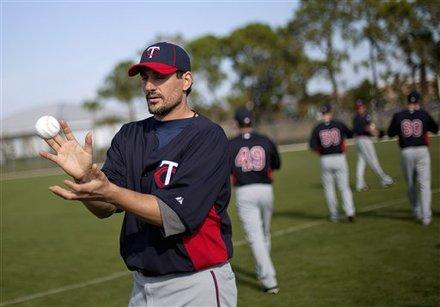
Some of you may be aware that in addition to being a member of TwinsCentric, I also run an apparel company called DiamondCentric where we provide sports-themed t-shirts. This venture has mostly focused around the Twins but has since branched into other local sports teams. If you are a follower of ours on Facebook, you know that we often do Caption Contests, giving the winner who amuses us the most a free tee. I thought we'd bring the practice over to the Twins Daily community and rewards those of you who have visited our new site. So, for a free Duenslinger t-shirt, give us your best caption for this picture:**Winner will be chosen tomorrow (2/24 at 5 PM Twin Cities time)** (administrator note: If you can't see the picture on this site, try logging in. If you don't want to register, click through to the image and you'll be able to see it. Thanks.)
-
Twins to get Tsuyoshi Nishioka reps at third
Parker Hageman commented on Parker Hageman's blog entry in Over the Baggy
According to AP Guy, Jon Krawczynski, Twins GM Terry Ryan said that Tsuyoshi Nishioka could see some time at third base this spring.[ATTACH=CONFIG]181[/ATTACH]This might be the attempts to Punto-ize the middle infielder, giving him experience at all infield positions in efforts to bolster his resume as a potential utility candidate. While his range may play well at the hot corner as Punto’s did, Nishioka clearly lacks the same arm strength to adequately perform at that position. Consider this: In the past three seasons, the Fans Scouting Report has given Punto a 56 on his Arm Strength. In his first year at the major league level, fans deemed Nishioka’s arm to be worth 16 – one of the worst in the game. There probably is not much of a reason to read any more into this than the Twins attempts of adding versatility in the spring, but even so, I have a hard time seeing Nishioka adapting to that position. -
-
Made an informal bet via Twitter on the total number of home runs Joe Mauer will hit in 2012. I say nine. What say you?
-
Former star prospect arrested again.
Parker Hageman replied to Parker Hageman's topic in Other Baseball
C'mon now. It's Elijah Dukes.
