



Parker Hageman
-
Posts
4,152 -
Joined
-
Last visited
-
Days Won
6
Content Type
Profiles
Minnesota Twins News, Rumors & Analysis
Minnesota Twins Videos
2026 Minnesota Twins Top Prospect Rankings
2022 Minnesota Twins Draft Picks & Signing Bonuses
Minnesota Twins Trade & Free Agent Rumors
Minnesota Twins Fan Guides & Resources
2023 Minnesota Twins Draft Picks & Signing Bonuses
The Minnesota Twins Players Project
2024 Minnesota Twins Draft Picks & Signing Bonuses
2025 Minnesota Twins Draft Picks & Signing Bonuses
2026 Minnesota Twins Draft Picks & Signing Bonuses
Forums
Blogs
Events
Store
Downloads
Gallery
Everything posted by Parker Hageman
-

Minnesota Twins' Alexi Casilla not in the swing of things
Parker Hageman posted a blog entry in Over the Baggy
Last season, the switch-hitting Alexi Casilla had produced at a very good rate against right-handed pitching. In 247 plate appearances in the left-handed batter’s box, he hit .274/.350/.400 – not too shabby for a middle infielder. This was a significant improvement for someone who had hit .228/.299/.320 from the left-side over the two previous seasons (2009 and 2010) in 314 plate appearances. Most analysts would likely dismiss his 2011 breakout as a statistical glitch of the effects of a small sample galaxy in comparison to his vast universe of career suck-i-tude. Meanwhile, before this season started I presented the argument that Casilla, at the ripe baseball age of 27, was finally ready to breakout. Based upon his mechanical changes he made in 2011 and his impressive winter ball performance which yielded some very good numbers, I was optimistic that Casilla would more than earn his $1.4 million payday and pick up where he left off in July of 2011. Of course, rather than being motivated to prove my thesis correct, Casilla continued to do his best Luis Rivas impersonation. After posting a career-best 750 OPS against right-handed pitching in 2011, Casilla has struggled to even reach 500 mark (currently at 475 OPS). In fact, his .192 average against right-handers is the fourth-lowest in the American League and the lowest among those with the platoon advantage. Once again, although it may be easy to simplify his performance to regression, Casilla’s offensive downturn has more to do with his mechanics and timing. The first clip is a swing from June 2011 that exemplifies his approach from May through July of 2011. Watch his lower half and witness a fluid and unison leg lift, a front toe tap that comes after the pitcher releases the ball and a noticeably violent lower-half weight transfer: http://apps.startribune.com/blogs/user_images/Casilla_FV_May2011.gif Casilla implemented these mechanics from May onward of last season and experienced terrific results. This gives his swing pop, instead of the slap-hitting Casilla we became accustom to seeing over the majority of his career. Compare that swing to his pre-May 2011 approach: http://apps.startribune.com/blogs/user_images/Casilla_FV_April2011v3.gif Notice that his stride is completed prior to the pitcher’s release of the ball (in the first version, he started his stride mid-pitch), leaving him flat-footed and simply shifting his weight from back to front and using more of his upper body in his swing. Casilla’s current mechanics are almost identical to those he used before his hot streak in 2011. Note the foot plant well before the pitcher’s release and muted weight shift: http://apps.startribune.com/blogs/user_images/Casilla_FV_2012.gif There is no clear reason as to why Casilla abandoned the method which proved the most fruitful for one that is quickly expediting his career out of professional baseball. Perhaps it is that his sporadic time between starts has thrown off his timing. Maybe it is something that the coaching staff has encouraged him to revert back to the old approach. Whatever the rationale behind it, it would seem to make more sense to attempt to revisit video of his swing from last year and attempt to resurrect his mechanics from that stretch of baseball. -
Star Tribune's Sid Hartman writes that Twins GM Terry Ryan is not indicating one way or another if the team is trading Francisco Liriano. He did, however, meet with Liriano's agent.
-
By all means, ask away...
-
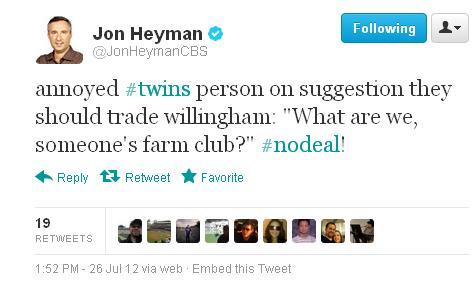
A tweet by CBSSports.com's Jon Heyman shows what the Twins front office's mindset is right now: I know from a public relations standpoint, trading Willingham would cause a firestorm among fans but in terms of gaining the most value, outside of this coming offseason, Willingham's value may never be higher. He's got a friendly contract but he's also 33 years old and has had a history of injuries throughout his career. Additionally, those power numbers are likely to regress too. At 25% HR/FB, that's well above his career norm of 16% and due from some drainage. His style is conducive to Target Field but it is not like we are talking about him playing in Fenway Park. While he may be able to provide good value in the next two years, it is not likely going to be at this current pace. Trade, or don't trade? Why or why not?
-
Since leaving the Metrodome for Target Field, the White Sox have punished the Twins. Is he right? Is the organization still building its team with a Metrodome mindset or has other factors (like injuries and poor pitching) been the more likely cause of this downturn?
-
Article: Should the Twins pick up Jonathan Sanchez?
Parker Hageman replied to DaveW's topic in Twins Daily Front Page News
(A) That's completely inaccurate. Since 2008, even with the bad 2012 season factored in, his contact rate has been one of the lowest in baseball. At a 76% contact rate, only six other starters with 500 innings have had less contact against them in that time. © He's had 37.2 innings against AL teams this year. Hard to make a sweeping judgement like that unless you are basing it on his 37 innings this year against AL teams. Almost all pitchers have a K-rate drop when they switch from NL to AL. Prior to this season, Sanchez had worked 90.2 innings against AL teams while posting an 84/46 K/BB ratio and allowed 37 earned runs (3.69 ERA). Again, it's a first-hand look, that's the point. That's valuable for a team that is may be doing some heavy shopping this off-season. If he is available at no cost and the Twins can have a free 30-day trial period - great. -
Article: Should the Twins pick up Jonathan Sanchez?
Parker Hageman replied to DaveW's topic in Twins Daily Front Page News
Not suggesting he would experience a Liriano-like turnaround in 5-6 starts at the end of the year, but the Twins get to audition and first-hand experience with a pitcher who is likely poised to make less than $5 million. It gives them time to do some thorough due diligence on him. That's huge for a team who will be doing some shopping this winter. Is it possible he and his agent choose another offer this winter? Sure but at least the Twins would know what they were buying versus a team on the open market who did not have the two-three months of being able to work with him. -
Article: Should the Twins pick up Jonathan Sanchez?
Parker Hageman replied to DaveW's topic in Twins Daily Front Page News
You can view the page at http://twinsdaily.com/content.php?808-Should-the-Twins-pick-up-Jonathan-Sanchez -
So the Kansas City Royals made one of the most lopsided trades when the acquired Jonathan Sanchez for Melky Cabrera since the natives swapped Manhattan Island to the Dutch for about 25 bucks. After a rebound season in KC, Cabrera is fully rejuvenated in the Bay Area, hitting .353/.391/.514 with 8 home runs for the Giants. Meanwhile, in 12 starts, Sanchez completely soiled the bed so badly that the Royals were recently forced to designate him for assignment. There was plenty of reason for the Royals to take a chance on the 29-year-old left-hander. According to his expected fielding independent figures, his 4.10 mark from 2008 to 2011 tied him with rotation-mate Matt Cain and put him ahead of such higher priced free agents as Edwin Jackson. So for the nominal sum of $5.6 million, the Royals received a veteran starter for Cabrera who, like Sanchez, was also in his final year of arbitration. On paper it made all the sense in the world. Of course, Sanchez’s glaring weakness, command, reared its ugly head once he moved to the American League. Considering his walk rate of 12.2% was the highest among those with a minimum of 500 innings pitched from 2008 to 2011, this should not come as a complete surprise. While his control waned in 2011 with San Francisco, the wheels fell completely off in 2012. Last year, Sanchez threw fewer pitches in the strike zone (45%) but was able to get opponents to chase after stuff off the plate (27%) and miss on those pitches at a decent rate (59%). This year, however, he threw the same amount of pitches in the zone (45%) but was unable to entice any takers on the out of zone ones (21% - the lowest among qualified starters in 2012) and those who did, hit the ball a high amount (69%). Ergo, Sanchez’s swinging strike rate declined from the above average 10% to the below average 7% in 2012. Frustrated with his tendency to hand out free passes carte blanche, the Royals made the decision to waive him. This gives teams the option to claim him then either work out a deal with Kansas City for a potential trade or assume the remainder of his $5.6 million prorated the rest of the year. Of course, if everyone passes – and because of the results of his last four starts (17 IP, 27 hits, 23 earned runs and a 11/16 K/BB ratio), it is entirely possible – anyone could pick him up for an audition at the league minimum. If that scenario plays out, should the Twins consider grabbing the left-hander? The Twins have done great work turning around their own control-deficient lefty in Francisco Liriano. Like Sanchez, Liriano struggled against his mechanics which led to a high walk rate as well (10% from 2008 to 2011). This current season was one of Liriano’s worst but, in season, the team saw him re-establish his control and post a 67-to-25 strikeouts-to-walks ratio in 57.1 innings. The stage is set for the organization to trade Liriano. Despite his stellar performance as of late, his impending free agency and high cost of retaining him (over $12 million for 2013), the heightened interest in him by other teams only stands to benefit the Twins and the front office is bound to pounce on that. Still, Liriano’s departure would leave Minnesota with yet another hole to fill within the rotation – now and in the future. That’s where Sanchez would come in. If he’s available for the minimum – similar to the way the Padres nabbed Jason Marquis after the Twins kicked him to the curb – the Twins may have the opportunity to tinker with Sanchez for a handful of starts and see if they can redirect him back to his form he showed with the Giants. After all, from 2008 to 2011 Sanchez had one of the best swing-and-miss rates among left-handers (10.4%) leading to the second-best strikeout rate among southpaws (24%). And, at 29, he’s still in what should be the prime of his career. If his decline is not injury-related, he could be resurrected with the proper instruction. Sanchez’s mechanics, as mentioned above, have been a bit chaotic at times. Occasionally he’ll wrap his leg during his wind-up and other times he’ll fail to pick up his target before throwing. These are certainly imperfections that teams would probably like to correct. However, Sanchez does not seem to be receptive to the suggestions. When pressed by the Royals’ media on the possible of adjusting his mechanics, Sanchez balked. “I don’t want to change anything,” he told reporters at the end of June, “If I try to change things, I’ll end up a real mess. I just have to trust that it will work out.” That’s not the talk of someone entirely open to doing everything possible to turn things around. Then again, being released might be just that type of wake up call to make a pitcher amiable to making adjustments. If the Twins grab him, he may wind up being the stubborn type who is not willing to listen or try new methods, even if that means a one-way ticket out of baseball. The Twins have 10 days to contemplate and examine whether or not Sanchez is repairable (perhaps less if they want to grab him on waivers and work out a trade). Based on his past track record, there is certainly a reason to spend the extra time on this decision. If he proves teachable and makes progress, consider bringing him back for one of the vacancies for 2013. If not, send him packing.
-
-
Should the Twins pick up Jonathan Sanchez?
Parker Hageman commented on Parker Hageman's blog entry in Over the Baggy
[ATTACH=CONFIG]1584[/ATTACH]So the Kansas City Royals made one of the most lopsided trades when the acquired Jonathan Sanchez for Melky Cabrera since the natives swapped Manhattan Island to the Dutch for about 25 bucks. After a rebound season in KC, Cabrera is fully rejuvenated in the Bay Area, hitting .353/.391/.514 with 8 home runs for the Giants. Meanwhile, in 12 starts, Sanchez completely soiled the bed so badly that the Royals were recently forced to designate him for assignment. There was plenty of reason for the Royals to take a chance on the 29-year-old left-hander. According to his expected fielding independent figures, his 4.10 mark from 2008 to 2011 tied him with rotation-mate Matt Cain and put him ahead of such higher priced free agents as Edwin Jackson. So for the nominal sum of $5.6 million, the Royals received a veteran starter for Cabrera who, like Sanchez, was also in his final year of arbitration. On paper it made all the sense in the world. Of course, Sanchez’s glaring weakness, command, reared its ugly head once he moved to the American League. Considering his walk rate of 12.2% was the highest among those with a minimum of 500 innings pitched from 2008 to 2011, this should not come as a complete surprise. While his control waned in 2011 with San Francisco, the wheels fell completely off in 2012. Last year, Sanchez threw fewer pitches in the strike zone (45%) but was able to get opponents to chase after stuff off the plate (27%) and miss on those pitches at a decent rate (59%). This year, however, he threw the same amount of pitches in the zone (45%) but was unable to entice any takers on the out of zone ones (21% - the lowest among qualified starters in 2012) and those who did, hit the ball a high amount (69%). Ergo, Sanchez’s swinging strike rate declined from the above average 10% to the below average 7% in 2012. Frustrated with his tendency to hand out free passes carte blanche, the Royals made the decision to waive him. This gives teams the option to claim him then either work out a deal with Kansas City for a potential trade or assume the remainder of his $5.6 million prorated the rest of the year. Of course, if everyone passes – and because of the results of his last four starts (17 IP, 27 hits, 23 earned runs and a 11/16 K/BB ratio), it is entirely possible – anyone could pick him up for an audition at the league minimum. If that scenario plays out, should the Twins consider grabbing the left-hander? The Twins have done great work turning around their own control-deficient lefty in Francisco Liriano. Like Sanchez, Liriano struggled against his mechanics which led to a high walk rate as well (10% from 2008 to 2011). This current season was one of Liriano’s worst but, in season, the team saw him re-establish his control and post a 67-to-25 strikeouts-to-walks ratio in 57.1 innings. The stage is set for the organization to trade Liriano. Despite his stellar performance as of late, his impending free agency and high cost of retaining him (over $12 million for 2013), the heightened interest in him by other teams only stands to benefit the Twins and the front office is bound to pounce on that. Still, Liriano’s departure would leave Minnesota with yet another hole to fill within the rotation – now and in the future. That’s where Sanchez would come in. If he’s available for the minimum – similar to the way the Padres nabbed Jason Marquis after the Twins kicked him to the curb – the Twins may have the opportunity to tinker with Sanchez for a handful of starts and see if they can redirect him back to his form he showed with the Giants. After all, from 2008 to 2011 Sanchez had one of the best swing-and-miss rates among left-handers (10.4%) leading to the second-best strikeout rate among southpaws (24%). And, at 29, he’s still in what should be the prime of his career. If his decline is not injury-related, he could be resurrected with the proper instruction. Sanchez’s mechanics, as mentioned above, have been a bit chaotic at times. Occasionally he’ll wrap his leg during his wind-up and other times he’ll fail to pick up his target before throwing. These are certainly imperfections that teams would probably like to correct. However, Sanchez does not seem to be receptive to the suggestions. When pressed by the Royals’ media on the possible of adjusting his mechanics, Sanchez balked. “I don’t want to change anything,” he told reporters at the end of June, “If I try to change things, I’ll end up a real mess. I just have to trust that it will work out.” That’s not the talk of someone entirely open to doing everything possible to turn things around. Then again, being released might be just that type of wake up call to make a pitcher amiable to making adjustments. If the Twins grab him, he may wind up being the stubborn type who is not willing to listen or try new methods, even if that means a one-way ticket out of baseball. The Twins have 10 days to contemplate and examine whether or not Sanchez is repairable (perhaps less if they want to grab him on waivers and work out a trade). Based on his past track record, there is certainly a reason to spend the extra time on this decision. If he proves teachable and makes progress, consider bringing him back for one of the vacancies for 2013. If not, send him packing. -
He's another guy who signed post-August last year and would not be available in a trade or has to be a PTBNL.
-
Even as a throw in, Bernadina was a throw away - but the Twins were asking for Bernadina at first (as the reports go) and then shifted to Lombardozzi later on.
-
Meyer is one of their better prospect right now but, unfortunately, after being drafted in 2011, he was not signed until August - which means he cannot be outright traded this trade deadline. He would need to be a Player To Be Named Later.
-
You can view the page at http://twinsdaily.com/content.php?789-Trade-Target-Team-Profile-Washington-Nationals
-
The Big Picture At the All Star Break last year, the Washington Nationals were playing .500 baseball (46-46) but were already 11.5 games back behind the National League East leading Phillies. To be sure, it was just their second non-losing first half of the season since they emigrated from Montreal. Prior to last season, DC had entered just one midseason classic with a winning record. When MLB moved the Expos to the nation’s capital, the newly christen Nationals posted a 52-36 record heading into the All Star Break, leading the division by two-and-a-half games. Of course, Washington would go 29-45 in the season’s back half and wind up in last place. [PRBREAK][/PRBREAK] This season, the Nationals, fueled by some incredible young talent (Bryce Harper) and outstanding pitching (3.21 ERA, best in MLB), have produced their second winning first-half – going 49-34 with a four game lead over the Atlanta Braves. Why They Will Trade With The Twins Selling “Hope” has played well in Washington in the political world. Now the Nationals are attempting to convince their fans that it exists for them in the NL East too. It won’t be easy with the big spending teams like the Braves, Mets and Marlins breathing down their necks so the Nationals’ general manager Mike Rizzo will be making calls in July to see what is available to help push his team over that hump. And, let’s face it: the Twins have made for very good trade partners in the past as well. Rizzo did a job picking Wilson Ramos (season-ending knee surgery notwithstanding) and, if you believed last trade deadline’s reports, he nearly got the Twins to hand over Denard Span for…ROGER BERNADINA. (Yes, Span was still struggling through concussion symptoms but good god, ROGER BERNADINA?) Based on those two instances, I’d say Rizzo has found himself an organization in which he can sell oceanfront property in Arizona. Given their need to appease the fan base in a heavily competitive DC/Baltimore market combined with the complete lack of a legitimate lead-off hitter (as a group they are posting a .306 on-base percentage), there is probably a strong chance that Rizzo would pick up the phone and see if the Twins are still interested in Span-for-Bernadina. Why They Won’t Trade With the Twins Aside from Span, there is not much on the menu that would appeal to this team. Their pitching staff is Jim Morrison poetry deep and even their need for a center fielder has quelled since moving uber-stud Harper to the middle of the outfield. While Span’s +21 Plus/Minus in center field is the best in baseball, Harper’s +12 is not far behind (fifth among center fielders). What’s more is the Nationals’ mix of Mike Morse in left, Andy LaRoche at first and Jayson Werth impending return from the DL to return to right field means Harper might need to stay in center. Also, it’s worth noting that Washington’s minor league pitching depth is fairly thin after the Nationals unloaded three of their top arms to Oakland in exchange for Gio Gonzalez. What is left might not be appealing to the Twins either. Conclusion The Nationals will be buyers but it would appear that if they are not interested in Span - or maybe a reunion with Jamey Carroll as a back-up infielder - there may not be a match with the Twins. ---- Possible Trade Targets Steve Lombardozzi Jr – INF/OF The Son of Lombo in the same lineup with the Son of Sal (Butera)? Whoa. The 23-year-old Lombardozzi has been ousted from his second base position by Danny Espinosa and has been shifted to left field where his bat is a complete miscast. He’s shown good on-base acumen in the minors (career .369 OBP) but has not had that manifest in his 238 plate appearances at the major league level (career .313 OBP). He intrigued the Twins last year when they were discussing a Span trade. Drew Storen – Closer Gosh, you’d hate to think that the Twins would target recently damaged goods like Storen but damn do they love them some Proven Closer. With Storen rehabbing his way back to the Nationals as we speak, the Twins have no clear cut plans for the backend of the bullpen in the coming years. The 24-year-old Storen would in theory give them stability at a cheap price in 2013 but comes with risks. Matthew Skole – Third Base At six-foot-four and 230 pounds, Skole is a monster at third base. His left-handed power has certainly manifested in his second professional season. In 319 plate appearances in 2011, he hit five home runs in low-A. This year, in 370 plate appearances, he’s hit 21 home runs and is leading the Sally League. His glove is questionable so he might be destined for another position than his current one. Rob Wort – RHRP If the team is in need of some bullpen depth, the 23-year-old Rob Wort might be an interesting plus-one in any potential trade. Repeating High-A ball for the second consecutive year, he’s struck out 63 in 38.1 innings while walking just 13. It is the latter that is important as Wort’s control had been terrible in 2011 (he walked 27 in 36.2 innings). He throws a low-90s fastball but can clearly miss bats. Roger Bernadina - OF No.
-
Trade Target Team Profile: Washington Nationals
Parker Hageman posted a blog entry in Over the Baggy
-
Trade Target Team Profile: Washington Nationals
Parker Hageman commented on Parker Hageman's blog entry in Over the Baggy
[ATTACH=CONFIG]1536[/ATTACH]The Big Picture At the All Star Break last year, the Washington Nationals were playing .500 baseball (46-46) but were already 11.5 games back behind the National League East leading Phillies. To be sure, it was just their second non-losing first half of the season since they emigrated from Montreal. Prior to last season, DC had entered just one midseason classic with a winning record. When MLB moved the Expos to the nation’s capital, the newly christen Nationals posted a 52-36 record heading into the All Star Break, leading the division by two-and-a-half games. Of course, Washington would go 29-45 in the season’s back half and wind up in last place. This season, the Nationals, fueled by some incredible young talent (Bryce Harper) and outstanding pitching (3.21 ERA, best in MLB), have produced their second winning first-half – going 49-34 with a four game lead over the Atlanta Braves. Why They Will Trade With The Twins Selling “Hope” has played well in Washington in the political world. Now the Nationals are attempting to convince their fans that it exists for them in the NL East too. It won’t be easy with the big spending teams like the Braves, Mets and Marlins breathing down their necks so the Nationals’ general manager Mike Rizzo will be making calls in July to see what is available to help push his team over that hump. And, let’s face it: the Twins have made for very good trade partners in the past as well. Rizzo did a job picking Wilson Ramos (season-ending knee surgery notwithstanding) and, if you believed last trade deadline’s reports, he nearly got the Twins to hand over Denard Span for…ROGER BERNADINA. (Yes, Span was still struggling through concussion symptoms but good god, ROGER BERNADINA?) Based on those two instances, I’d say Rizzo has found himself an organization in which he can sell oceanfront property in Arizona. Given their need to appease the fan base in a heavily competitive DC/Baltimore market combined with the complete lack of a legitimate lead-off hitter (as a group they are posting a .306 on-base percentage), there is probably a strong chance that Rizzo would pick up the phone and see if the Twins are still interested in Span-for-Bernadina. Why They Won’t Trade With the Twins Aside from Span, there is not much on the menu that would appeal to this team. Their pitching staff is Jim Morrison poetry deep and even their need for a center fielder has quelled since moving uber-stud Harper to the middle of the outfield. While Span’s +21 Plus/Minus in center field is the best in baseball, Harper’s +12 is not far behind (fifth among center fielders). What’s more is the Nationals’ mix of Mike Morse in left, Andy LaRoche at first and Jayson Werth impending return from the DL to return to right field means Harper might need to stay in center. Also, it’s worth noting that Washington’s minor league pitching depth is fairly thin after the Nationals unloaded three of their top arms to Oakland in exchange for Gio Gonzalez. What is left might not be appealing to the Twins either. Conclusion The Nationals will be buyers but it would appear that if they are not interested in Span - or maybe a reunion with Jamey Carroll as a back-up infielder - there may not be a match with the Twins. ---- Possible Trade Targets Steve Lombardozzi Jr – INF/OF The Son of Lombo in the same lineup with the Son of Sal (Butera)? Whoa. The 23-year-old Lombardozzi has been ousted from his second base position by Danny Espinosa and has been shifted to left field where his bat is a complete miscast. He’s shown good on-base acumen in the minors (career .369 OBP) but has not had that manifest in his 238 plate appearances at the major league level (career .313 OBP). He intrigued the Twins last year when they were discussing a Span trade. Drew Storen – Closer Gosh, you’d hate to think that the Twins would target recently damaged goods like Storen but damn do they love them some Proven Closer. With Storen rehabbing his way back to the Nationals as we speak, the Twins have no clear cut plans for the backend of the bullpen in the coming years. The 24-year-old Storen would in theory give them stability at a cheap price in 2013 but comes with risks. Matthew Skole – Third Base At six-foot-four and 230 pounds, Skole is a monster at third base. His left-handed power has certainly manifested in his second professional season. In 319 plate appearances in 2011, he hit five home runs in low-A. This year, in 370 plate appearances, he’s hit 21 home runs and is leading the Sally League. His glove is questionable so he might be destined for another position than his current one. Rob Wort – RHRP If the team is in need of some bullpen depth, the 23-year-old Rob Wort might be an interesting plus-one in any potential trade. Repeating High-A ball for the second consecutive year, he’s struck out 63 in 38.1 innings while walking just 13. It is the latter that is important as Wort’s control had been terrible in 2011 (he walked 27 in 36.2 innings). He throws a low-90s fastball but can clearly miss bats. Roger Bernadina - OF No. -
...at Midway Stadium in St. Paul this summer as the Twin Cities' scrappy little east side club is hosting an atheist night. It's clever and all but it is a bit sacrilegious to the one true deity, the Flying Spaghetti Monster.
-
You can view the page at http://twinsdaily.com/content.php?787-Capps-reinstated-from-DL
-
The Twins have reinstated reliever Matt Capps from the 15-day disabled list. Capps was placed on the disabled list on June 25 (retroactive to June 24) with right shoulder inflammation. In his two outings with the Fort Myers Miracle Capps worked two innings while striking out one against Florida State League competition. To clear room, the Twins have optioned reliever Kyle Waldrop to Rochester. In Capps' absence, the Twins have used Glen Perkins and Jared Burton as the team's closers. Perkins worked nine innings, striking out eight and walking just one while converting four of five save opportunities. Burton pitched 8.2 innings while posting a 6/5 strikeout-to-walk ratio while converting on both of his save opportunities. With Capps back in the fold, Burton and Perkins may return to their previous set-up roles.
-
He balked 12 times from 1987 to 1989 and balked just 7 times from 1990 to 1995.
-
But not an expert on the balk rule...you can click on the video linked above to hear the entire commentary on the play. Although to explore your idea, Williams did have a decent enough pick off move to nab 29 base-runners from 1987 to 1989. Either his move got worse or became easier to read over the rest of his career as teams stole 42 bases in 51 tries and he picked off just 7 more base-runners from 1990 to 1995.
-
Again, because there is no such thing as a "45 degree" rule, this does not come into play. What overrides this non-existent rule is the actual rule of "makes any motion naturally associated with his pitch and fails to make such delivery." In terms of the crossing the rubber, it's not necessary a prerequisite of the overarching rule - "makes a motion naturally associated with his pitch" - but it does appear in the video that at the very least, his knee is crossing. I agree that it's hard to pick up entirely from the angle given in your screenshot and the telltale view would have been that of the first base umpire's or from the first base side to ultimate tell.
-
Yes, it's a guideline but not a rule at all in MLB (although some amateur umpiring guidelines do reference that as their rule). It is very much like the often misstated check swing strike commentary - that a bat "broke his wrists" or "crossed the plate" and therefore it is a strike. Neither are true as a check swing strike is basically an umpire's interpretation of intent: In terms of breaking the plane, re-watching the video it is extremely close. From the camera's angle, it definitely appears that his knee has broke that plane and the foot cannot be that far behind (I suspect that if we had a view from third, it would confirm that his leg indeed broke that rubber plane). To me, however, the main rule "makes any motion naturally associated with his pitch and fails to make such delivery" supersedes the foot plane argument of the comments. Holland made a motion naturally associated with his pitch and failed to delivery home. Balk. I do realize that we have the power of instant replay and slow motion to confirm this, so I am not that critical on the umpire for missing this call (if you want to say it was missed). What the point is, is that Williams' explanation shows a large chuck on ignorance on his part of the rules.
