



Parker Hageman
-
Posts
4,152 -
Joined
-
Last visited
-
Days Won
6
Content Type
Profiles
Minnesota Twins News, Rumors & Analysis
Minnesota Twins Videos
2026 Minnesota Twins Top Prospect Rankings
2022 Minnesota Twins Draft Picks & Signing Bonuses
Minnesota Twins Trade & Free Agent Rumors
Minnesota Twins Fan Guides & Resources
2023 Minnesota Twins Draft Picks & Signing Bonuses
The Minnesota Twins Players Project
2024 Minnesota Twins Draft Picks & Signing Bonuses
2025 Minnesota Twins Draft Picks & Signing Bonuses
2026 Minnesota Twins Draft Picks & Signing Bonuses
Forums
Blogs
Events
Store
Downloads
Gallery
Everything posted by Parker Hageman
-

Article: Notes from Day 1 in Beloit
Parker Hageman replied to Seth Stohs's topic in Twins Daily Front Page News
And then a tickle fight broke out... Just kidding Seth. Great report. I have to get down there one of these days. -
Article: Morneau is steadily improving
Parker Hageman replied to robbie111's topic in Twins Daily Front Page News
You can view the page at http://twinsdaily.com/content.php?872-Morneau-is-steadily-improving -
Morneau is steadily improving
Parker Hageman commented on Parker Hageman's blog entry in Over the Baggy
[ATTACH=CONFIG]1749[/ATTACH]In early July Justin Morneau had been plodding through a season in which he was completely lost at the plate against left-handed pitching. Even though his performance against right-handed pitchers was classic Morneausie, against the sinister his swing was basically a clusterbleep. His front side leaking so far open, he was left with little choice but to pull the ball. Left-handed opponents attacked this weakness by throwing more sliders which would run away from his swing zone. He flailed away helplessly as southpaws painted the outer-half of the plate and anything he did manage to put lumber on was typically bounced to the right side of the infield. By the end of June his average against lefties had sunk to below .100 and was the worst in baseball. In a little over a month however Morneau has doubled that average - .174 heading in to last night’s game – and, what’s more, his swing has looked 100 times better. Last night, the Twins’ Director of Baseball Communications, Dustin Morse, highlighted Morneau’s improvement against same-sided pitchers by tweeting this: [ATTACH=CONFIG]1748[/ATTACH] Now, the answer could be as simple as a small sample size fluctuation and that his suppressed batting average on balls in play was due to shoot up once the Baseball Gods felt like blessing the Canadian. However, just a few weeks before this streak started, Morneau made a noticeable adjustment to his approach at the plate. While this tweak lasted just a handful of games, the Twins first baseman emerged a different hitter. Morneau, who had a sizeable stride accompanied by a hearty swing, was hitting just .229/.301/.435 heading into the final June series against the Kansas City Royals when he made the changes. Instead of the leg lift, Morneau would lift only his heel, keeping his toes stationary which would likely increase his connectivity and, more importantly, help him refrain from opening up his front side. As I described back in the beginning of July: This mechanical adjustment did not last long – somewhere around five games – and Morneau returned to his previous swing on July 5. But this practice seems to have righted the ship and helped him stay on the ball better. In addition to the improved numbers against left-handed pitching, he hit .313/.360/.488 overall in 86 plate appearances (not including last night’s game against Boston). He had gone from striking out in 20% of his plate appearances pre-July 5 to striking out in just 10% of his plate appearances since then. In short, Morneau appears to be on the right path both against righties and lefties. Friday night, look for him continue this success against Boston’s rookie lefty Felix Doubront – who has limited left-handed hitters to a .229 average. -
-
In early July Justin Morneau had been plodding through a season in which he was completely lost at the plate against left-handed pitching. Even though his performance against right-handed pitchers was classic Morneausie, against the sinister his swing was basically a clusterbleep. His front side leaking so far open, he was left with little choice but to pull the ball. Left-handed opponents attacked this weakness by throwing more sliders which would run away from his swing zone. He flailed away helplessly as southpaws painted the outer-half of the plate and anything he did manage to put lumber on was typically bounced to the right side of the infield. [PRBREAK][/PRBREAK] By the end of June his average against lefties had sunk to below .100 and was the worst in baseball. In a little over a month however Morneau has doubled that average - .174 heading in to last night’s game – and, what’s more, his swing has looked 100 times better. Last night, the Twins’ Director of Baseball Communications, Dustin Morse, highlighted Morneau’s improvement against same-sided pitchers by tweeting this: Now, the answer could be as simple as a small sample size fluctuation and that his suppressed batting average on balls in play was due to shoot up once the Baseball Gods felt like blessing the Canadian. However, just a few weeks before this streak started, Morneau made a noticeable adjustment to his approach at the plate. While this tweak lasted just a handful of games, the Twins first baseman emerged a different hitter. Morneau, who had a sizeable stride accompanied by a hearty swing, was hitting just .229/.301/.435 heading into the final June series against the Kansas City Royals when he made the changes. Instead of the leg lift, Morneau would lift only his heel, keeping his toes stationary which would likely increase his connectivity and, more importantly, help him refrain from opening up his front side. As I described back in the beginning of July: This mechanical adjustment did not last long – somewhere around five games – and Morneau returned to his previous swing on July 5. But this practice seems to have righted the ship and helped him stay on the ball better. In addition to the improved numbers against left-handed pitching, he hit .313/.360/.488 overall in 86 plate appearances (not including last night’s game against Boston). He had gone from striking out in 20% of his plate appearances pre-July 5 to striking out in just 10% of his plate appearances since then. In short, Morneau appears to be on the right path both against righties and lefties. Friday night, look for him continue this success against Boston’s rookie lefty Felix Doubront – who has limited left-handed hitters to a .229 average.
-
Article: The Francisco Liriano Postmortem
Parker Hageman replied to Parker Hageman's topic in Twins Daily Front Page News
I can definitely see the Twins balking at a $13M+ offer to almost any pitcher, let alone one they seem to have little confidence in. -
You can view the page at http://twinsdaily.com/content.php?867-The-Francisco-Liriano-Postmortem
-
Last night saw a near vintage Francisco Liriano carving up his now former team. In six innings of work, the lefty punched out eight Twins batters, showcasing a well-placed 94 mile per hour fastball and a devastating slide piece. It was this first weapon, the well-placed fastball, which would have been inconceivable in the season’s opening months. Liriano’s first half of the season was marred by lack of command of his fastball. Unable to get ahead of hitters properly, the left-hander was forced to ease up on his usage of his slider. In his first stint as a starter, opponents smacked him around to the tune of .346/.435/.589 while allowing six home runs in six starts and 26.2 innings pitched. The home runs allowed were a direct result of Liriano being unable to induce ground balls are easily as he did in the past. With fastballs up in the zone, Liriano’s ground ball-to-fly ball ratio sat at 0.69 which, heading into this season, sat at a much higher grounder rate of 0.96. As you will see, Liriano’s fastball location had a lot to do with his mechanics. Over his career one of Liriano’s biggest struggles seemed to be battling against his delivery. His short-arm action, the various tempos and, of course, his tendency to spin out after landing have been trademarks of his style. At times, he will be able to corral this mess into some conformity and consistency for an extended period of time that will lead to strong numbers – such as in 2010. At other points, like at the beginning of the season, he will be in an utter tailspin and be completely lost when it comes to his motion. What we saw during his first stretch of starts this year was Liriano pulling his weight away from home plate and towards the third base side. This movement away from the target likely caused numerous problems for his command. In this early season match-up against Evan Longoria of the Rays, Joe Mauer sits down and in with a target at Longoria’s knees: Instead of painting that spot, Liriano’s offering travels up, slightly above the belt, over the plate: With a pitch that high in the zone, Liriano is not likely to induce many ground balls. For his part, Longoria smacked this one for a double. What’s more, with a target miss that significant, you can see why he walked 19 batters in 26.2 innings. Fast forward to Tuesday night. Now in uniform with his new team, Liriano had been working on an impressive stretch of outings in which his strikeout rate was up, his walk rate was down and his ground ball rate had increased. Including yesterday’s performance, over his last 12 starts, Liriano has held opponents to a .189/.285/.301 batting line with a very good 87/33 K/BB ratio in 72 innings pitched while only allowing six home runs (three of which came in his start against Chicago). Because of his ability to command his fastball early and often, Liriano has been able to use his slider more, resulting in more swing and misses as well as weak contact (0.98 GB/FB). In the controversial Joe Mauer at-bat, Liriano rang the Twins catcher up on a fastball that likely crossed between the batter’s box chalk and the plate. Nevertheless, it was because of A.J. Pierzynski’s location and Liriano’s ability to hit that target that Liriano was able to coax a strike call out of the umpire. Pierzynski sits down and in on Mauer, not unlike Mauer’s target on Longoria above perhaps slightly above the knee more: Not only does Liriano hit this spot, but his fastball is also running down and in. Had Mauer decided to swing at that pitch, the results would have a high probability of becoming a ground ball: The biggest difference between the two versions comes at Liriano’s release point. In his offering to Longoria, Liriano’s lower body is opening up at the point of release. This was a trait he displayed constantly through his first month of starts. Meanwhile, in his pitch to Mauer, he is staying over his front leg which is directed to his target: Many fans wonder why the Twins, instead of trading for some marginal prospects, simply did not opt to keep Liriano and hope of getting him to re-up for the $12.5 million qualifying offer. After all, his second half performance has been close to vintage Liriano from 2010 – after which most people would have been very happy extending him a long-term contract. The one-year risk, even at that price, seemed minimal. For their part, the Twins organization had seen too many inconsistencies (not to mention injuries) like the one highlighted above to commit another year at that price. We know that the front office is risk adverse in both their free agent signings and their long-term commitments. Still, credit the White Sox for landing a pitcher who had been trending upwards and exercising better mechanics at a low cost. Will Liriano be able to maintain these mechanics over the course of the rest of the season or, going forward, over an entire contract? By trading him away, the Twins clearly do not believe that he can sustain this pace. In my opinion, barring any injury, Liriano should finish this season out strong and will be a high-risk, high-reward signing for another team this offseason.
-
The Francisco Liriano Postmortem
Parker Hageman commented on Parker Hageman's blog entry in Over the Baggy
Last night saw a near vintage Francisco Liriano carving up his now former team. In six innings of work, the lefty punched out eight Twins batters, showcasing a well-placed 94 mile per hour fastball and a devastating slide piece. It was this first weapon, the well-placed fastball, which would have been inconceivable in the season’s opening months. Liriano’s first half of the season was marred by lack of command of his fastball. Unable to get ahead of hitters properly, the left-hander was forced to ease up on his usage of his slider. In his first stint as a starter, opponents smacked him around to the tune of .346/.435/.589 while allowing six home runs in six starts and 26.2 innings pitched. The home runs allowed were a direct result of Liriano being unable to induce ground balls are easily as he did in the past. With fastballs up in the zone, Liriano’s ground ball-to-fly ball ratio sat at 0.69 which, heading into this season, sat at a much higher grounder rate of 0.96. As you will see, Liriano’s fastball location had a lot to do with his mechanics. Over his career one of Liriano’s biggest struggles seemed to be battling against his delivery. His short-arm action, the various tempos and, of course, his tendency to spin out after landing have been trademarks of his style. At times, he will be able to corral this mess into some conformity and consistency for an extended period of time that will lead to strong numbers – such as in 2010. At other points, like at the beginning of the season, he will be in an utter tailspin and be completely lost when it comes to his motion. What we saw during his first stretch of starts this year was Liriano pulling his weight away from home plate and towards the third base side. This movement away from the target likely caused numerous problems for his command. In this early season match-up against Evan Longoria of the Rays, Joe Mauer sits down and in with a target at Longoria’s knees: [ATTACH=CONFIG]1728[/ATTACH] Instead of painting that spot, Liriano’s offering travels up, slightly above the belt, over the plate: [ATTACH=CONFIG]1727[/ATTACH] With a pitch that high in the zone, Liriano is not likely to induce many ground balls. For his part, Longoria smacked this one for a double. What’s more, with a target miss that significant, you can see why he walked 19 batters in 26.2 innings. Fast forward to Tuesday night. Now in uniform with his new team, Liriano had been working on an impressive stretch of outings in which his strikeout rate was up, his walk rate was down and his ground ball rate had increased. Including yesterday’s performance, over his last 12 starts, Liriano has held opponents to a .189/.285/.301 batting line with a very good 87/33 K/BB ratio in 72 innings pitched while only allowing six home runs (three of which came in his start against Chicago). Because of his ability to command his fastball early and often, Liriano has been able to use his slider more, resulting in more swing and misses as well as weak contact (0.98 GB/FB). In the controversial Joe Mauer at-bat, Liriano rang the Twins catcher up on a fastball that likely crossed between the batter’s box chalk and the plate. Nevertheless, it was because of A.J. Pierzynski’s location and Liriano’s ability to hit that target that Liriano was able to coax a strike call out of the umpire. Pierzynski sits down and in on Mauer, not unlike Mauer’s target on Longoria above perhaps slightly above the knee more: [ATTACH=CONFIG]1726[/ATTACH] Not only does Liriano hit this spot, but his fastball is also running down and in. Had Mauer decided to swing at that pitch, the results would have a high probability of becoming a ground ball: [ATTACH=CONFIG]1725[/ATTACH] The biggest difference between the two versions comes at Liriano’s release point. In his offering to Longoria, Liriano’s lower body is opening up at the point of release. This was a trait he displayed constantly through his first month of starts. Meanwhile, in his pitch to Mauer, he is staying over his front leg which is directed to his target: [ATTACH=CONFIG]1724[/ATTACH] [ATTACH=CONFIG]1723[/ATTACH] Many fans wonder why the Twins, instead of trading for some marginal prospects, simply did not opt to keep Liriano and hope of getting him to re-up for the $12.5 million qualifying offer. After all, his second half performance has been close to vintage Liriano from 2010 – after which most people would have been very happy extending him a long-term contract. The one-year risk, even at that price, seemed minimal. For their part, the Twins organization had seen too many inconsistencies (not to mention injuries) like the one highlighted above to commit another year at that price. We know that the front office is risk adverse in both their free agent signings and their long-term commitments. Still, credit the White Sox for landing a pitcher who had been trending upwards and exercising better mechanics at a low cost. Will Liriano be able to maintain these mechanics over the course of the rest of the season or, going forward, over an entire contract? By trading him away, the Twins clearly do not believe that he can sustain this pace. In my opinion, barring any injury, Liriano should finish this season out strong and will be a high-risk, high-reward signing for another team this offseason. -
-
About a half-hour to go before the deadline and ESPN.com's Jerry Crasnick tweets that he confirms that the Reds feel that the trade for Denard Span is "not likely" happening. This comes on the heels of the Star Tribune's Joe Christensen reporting that a Twins official relayed that the team did not feel any pressure to trade Span at the deadline.
-
According to Yahoo!Sports' Tim Brown, the Rangers are inquiring about Twins reliever Jared Burton. While I like the idea of keeping Burton around, particularly because he is cheap and has been very good, if you are able to turn him into a future starting position player, you have to make that deal.
-
Miller: Reds talking Denard Span with Twins
Parker Hageman replied to gunnarthor's topic in Minnesota Twins Talk
According to CBS Sports' Scott Miller, the Reds, following the trade of Shane Victorino, are now increasing their efforts to land Denard Span from the Minnesota Twins. Once of Miller's sources said there is a "50/50" chance the deal gets done. -
Yeah, I guess I don't see why Burton shouldn't be in play for the right deal. Found money at that point.
-
ESPN.com's Jerry Crasnick reports that the interest in Twins reliever Glen Perkins is very high. The caveat is, of course, that Perkins is signed to a long-term deal ($10.3 million through 2015 with an option for 2016) and that the Twins would need to be "overwhelmed" by an offer to trade him.
-
You can view the page at http://twinsdaily.com/content.php?853-Sam-Deduno-and-his-crazy-fastball
-
-
Sam Deduno and his "crazy" fastball
Parker Hageman commented on Parker Hageman's blog entry in Over the Baggy
Sam Deduno has a curveball that would be easily classified as “filthy” by baseball jargon standards but his fastball is “crazy” – at least by his own admission. According to a story from Rochester, the Red Wings pitchers were introducing themselves and speaking about their best pitches. When it was his turn, the 28-year-old right-hander from the Dominican introduced himself by saying “Sam Deduno and I have a crazy fastball.” Not crazy in the sense of a Aroldis Chapman 100 mile per hour fastball which is by you before you even get your feet set in the batter’s box, mind you. More like Nuke LaLoosh-fastball-off-the-mascot crazy. TexasLeaguers.com’s strike zone graph of Deduno’s fastball shows how this pitch is more like a shotgun blast than a precision sniper rifle: [ATTACH=CONFIG]1695[/ATTACH] His breaking stuff is without doubt his best pitch and he leans heavily on it. Overall, opponents are hitting just .176 off of his curve and nearly 40% of his match-ups have ended in a strike out when throwing his curve for the last pitch of the at bat. With a sharp, quick bend, Deduno has gotten plenty of out-of-zone chases and missed a good amount of bats – just ask the Indians’ Johnny Damon how good that curve is after he struck out on one that hit the dirt almost five feet shy of the plate. Despite the impressive rate, over time opponents will likely stop chasing after the curve if he is unable to locate his fastball consistently. So far, Deduno has walked 16 batters in his 23 innings, which is a lot of baserunners and a lot of extra pitches. He has averted dangers by keeping those baserunners from scoring by stranding 85% of them - a rate that is well above average and is ripe for regression. When asked about the possibility of being “effectively wild” has helped the pitcher limit the Indians to one run on just two hits Saturday night, Twins pitching coach Rick Anderson joked “Ask Mauer, he says it’s like catching R.A. Dickey.” Sure, just like Dickey – give or take nearly 20 miles an hour of velocity between his knuckleball and Deduno’s fastball at 93. Because of the movement, Pitch F/X data suggests that he has two fastballs – a four-seamer and a cutter –but catcher Joe Mauer said that isn’t the case. It’s the same fastball claims the Twins backstop, who described the pitch as “unpredictable.” So how did Deduno’s battery mate attempt to corral the erratic heat? “With him I kind of just sit in the middle and tell him to aim down. Some will cut, some will sink. If it’s tough to catch, it’s probably hard to hit.” The Twins say they have seen improvements in the command of his fastball over the course of his four starts. Heading into his start against Cleveland, Deduno’s “four-seam fastball” (as categorized by Pitch F/X) was located in the strike zone less than 50% of the time. Following the seven inning performance, that rate is now above that mark at 50.3% indicating that he is making some progress. Again, while Mauer says there is no difference in his fastball types, Pitch F/X categorizes the one that cuts as a “cutter”. This version of his fastball was only thrown in the zone 39.3% of the time, a rate well below average and a sign that he still has work to do. The incremental improvement in his fastball comes as a result of added work with Anderson. Between starts, Deduno throws not one but two bullpen sessions. One of which, says Anderson, is to focus strictly on the fastball. In addition to getting a feel for the command of the pitch, Anderson also tries to keep in on his line and smooth out some of his mechanics. Although he may have some work to do harnessing his “cutter” version of his fastball, the progress - if measured in his seven inning, two-hit outing against Cleveland - has been encouraging so far. -
Sam Deduno has a curveball that would be easily classified as “filthy” by baseball jargon standards but his fastball is “crazy” – at least by his own admission. According to a story from Rochester, the Red Wings pitchers were introducing themselves and speaking about their best pitches. When it was his turn, the 28-year-old right-hander from the Dominican introduced himself by saying “Sam Deduno and I have a crazy fastball.” Not crazy in the sense of a Aroldis Chapman 100 mile per hour fastball which is by you before you even get your feet set in the batter’s box, mind you. More like Nuke LaLoosh-fastball-off-the-mascot crazy. TexasLeaguers.com’s strike zone graph of Deduno’s fastball shows how this pitch is more like a shotgun blast than a precision sniper rifle: His breaking stuff is without doubt his best pitch and he leans heavily on it. Overall, opponents are hitting just .176 off of his curve and nearly 40% of his match-ups have ended in a strike out when throwing his curve for the last pitch of the at bat. With a sharp, quick bend, Deduno has gotten plenty of out-of-zone chases and missed a good amount of bats – just ask the Indians’ Johnny Damon how good that curve is after he struck out on one that hit the dirt almost five feet shy of the plate. Despite the impressive rate, over time opponents will likely stop chasing after the curve if he is unable to locate his fastball consistently. So far, Deduno has walked 16 batters in his 23 innings, which is a lot of baserunners and a lot of extra pitches. He has averted dangers by keeping those baserunners from scoring by stranding 85% of them - a rate that is well above average and is ripe for regression. When asked about the possibility of being “effectively wild” has helped the pitcher limit the Indians to one run on just two hits Saturday night, Twins pitching coach Rick Anderson joked “Ask Mauer, he says it’s like catching R.A. Dickey.” Sure, just like Dickey – give or take nearly 20 miles an hour of velocity between his knuckleball and Deduno’s fastball at 93. Because of the movement, Pitch F/X data suggests that he has two fastballs – a four-seamer and a cutter –but catcher Joe Mauer said that isn’t the case. It’s the same fastball claims the Twins backstop, who described the pitch as “unpredictable.” So how did Deduno’s battery mate attempt to corral the erratic heat? “With him I kind of just sit in the middle and tell him to aim down. Some will cut, some will sink. If it’s tough to catch, it’s probably hard to hit.” The Twins say they have seen improvements in the command of his fastball over the course of his four starts. Heading into his start against Cleveland, Deduno’s “four-seam fastball” (as categorized by Pitch F/X) was located in the strike zone less than 50% of the time. Following the seven inning performance, that rate is now above that mark at 50.3% indicating that he is making some progress. Again, while Mauer says there is no difference in his fastball types, Pitch F/X categorizes the one that cuts as a “cutter”. This version of his fastball was only thrown in the zone 39.3% of the time, a rate well below average and a sign that he still has work to do. The incremental improvement in his fastball comes as a result of added work with Anderson. Between starts, Deduno throws not one but two bullpen sessions. One of which, says Anderson, is to focus strictly on the fastball. In addition to getting a feel for the command of the pitch, Anderson also tries to keep in on his line and smooth out some of his mechanics. Although he may have some work to do harnessing his “cutter” version of his fastball, the progress - if measured in his seven inning, two-hit outing against Cleveland - has been encouraging so far.
-
In order to fill room in the pitching staff vacated by the Francisco Liriano trade, the Twins recall Jeff Manship from Rochester. Manship had worked in eight games with the Twins previously this year, posting a 5/2 strikeout-to-walk ratio in 10.2 innings while allowing 13 earned runs. His second stint in Rochester proved better as he went 2-1 with a 1.45 ERA in 31 innings with a 22/16 strikeout-to-walk ratio. Manship last worked in a start on Friday night in Rochester.
-
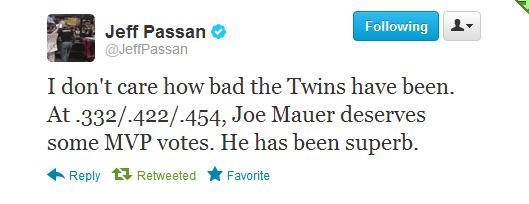
Yahoo! Sports columnist Jeff Passan tweeted today that Joe Mauer's hitting line of .332/.422/.454 should earn him some MVP considerations: With one of the AL's top batting averages (currently third) and the highest on-base percentage in the league, it is easy to give it some consideration. However, given that there are eight other players with better weighted on-base averages (wOBA) and WAR, the advanced statistics do not support Mauer's candidacy for the most valuable title.
-
Sid Hartman: Ryan is not tipping his hand on Liriano
Parker Hageman replied to Parker Hageman's topic in Minnesota Twins Talk
Hartman is really working the phones today... -
You can view the page at http://twinsdaily.com/content.php?841-Minnesota-Twins-Alexi-Casilla-not-in-the-swing-of-things
-
Last season, the switch-hitting Alexi Casilla had produced at a very good rate against right-handed pitching. In 247 plate appearances in the left-handed batter’s box, he hit .274/.350/.400 – not too shabby for a middle infielder. This was a significant improvement for someone who had hit .228/.299/.320 from the left-side over the two previous seasons (2009 and 2010) in 314 plate appearances. Most analysts would likely dismiss his 2011 breakout as a statistical glitch of the effects of a small sample galaxy in comparison to his vast universe of career suck-i-tude. Meanwhile, before this season started I presented the argument that Casilla, at the ripe baseball age of 27, was finally ready to breakout. Based upon his mechanical changes he made in 2011 and his impressive winter ball performance which yielded some very good numbers, I was optimistic that Casilla would more than earn his $1.4 million payday and pick up where he left off in July of 2011. Of course, rather than being motivated to prove my thesis correct, Casilla continued to do his best Luis Rivas impersonation. After posting a career-best 750 OPS against right-handed pitching in 2011, Casilla has struggled to even reach 500 mark (currently at 475 OPS). In fact, his .192 average against right-handers is the fourth-lowest in the American League and the lowest among those with the platoon advantage. Once again, although it may be easy to simplify his performance to regression, Casilla’s offensive downturn has more to do with his mechanics and timing. The first clip is a swing from June 2011 that exemplifies his approach from May through July of 2011. Watch his lower half and witness a fluid and unison leg lift, a front toe tap that comes after the pitcher releases the ball and a noticeably violent lower-half weight transfer: http://apps.startribune.com/blogs/user_images/Casilla_FV_May2011.gif Casilla implemented these mechanics from May onward of last season and experienced terrific results. This gives his swing pop, instead of the slap-hitting Casilla we became accustom to seeing over the majority of his career. Compare that swing to his pre-May 2011 approach: http://apps.startribune.com/blogs/user_images/Casilla_FV_April2011v3.gif Notice that his stride is completed prior to the pitcher’s release of the ball (in the first version, he started his stride mid-pitch), leaving him flat-footed and simply shifting his weight from back to front and using more of his upper body in his swing. Casilla’s current mechanics are almost identical to those he used before his hot streak in 2011. Note the foot plant well before the pitcher’s release and muted weight shift: http://apps.startribune.com/blogs/user_images/Casilla_FV_2012.gif There is no clear reason as to why Casilla abandoned the method which proved the most fruitful for one that is quickly expediting his career out of professional baseball. Perhaps it is that his sporadic time between starts has thrown off his timing. Maybe it is something that the coaching staff has encouraged him to revert back to the old approach. Whatever the rationale behind it, it would seem to make more sense to attempt to revisit video of his swing from last year and attempt to resurrect his mechanics from that stretch of baseball.
-
Minnesota Twins' Alexi Casilla not in the swing of things
Parker Hageman commented on Parker Hageman's blog entry in Over the Baggy
Last season, the switch-hitting Alexi Casilla had produced at a very good rate against right-handed pitching. In 247 plate appearances in the left-handed batter’s box, he hit .274/.350/.400 – not too shabby for a middle infielder. This was a significant improvement for someone who had hit .228/.299/.320 from the left-side over the two previous seasons (2009 and 2010) in 314 plate appearances. Most analysts would likely dismiss his 2011 breakout as a statistical glitch of the effects of a small sample galaxy in comparison to his vast universe of career suck-i-tude. Meanwhile, before this season started I presented the argument that Casilla, at the ripe baseball age of 27, was finally ready to breakout. Based upon his mechanical changes he made in 2011 and his impressive winter ball performance which yielded some very good numbers, I was optimistic that Casilla would more than earn his $1.4 million payday and pick up where he left off in July of 2011. Of course, rather than being motivated to prove my thesis correct, Casilla continued to do his best Luis Rivas impersonation. After posting a career-best 750 OPS against right-handed pitching in 2011, Casilla has struggled to even reach 500 mark (currently at 475 OPS). In fact, his .192 average against right-handers is the fourth-lowest in the American League and the lowest among those with the platoon advantage. Once again, although it may be easy to simplify his performance to regression, Casilla’s offensive downturn has more to do with his mechanics and timing. The first clip is a swing from June 2011 that exemplifies his approach from May through July of 2011. Watch his lower half and witness a fluid and unison leg lift, a front toe tap that comes after the pitcher releases the ball and a noticeably violent lower-half weight transfer: http://apps.startribune.com/blogs/user_images/Casilla_FV_May2011.gif Casilla implemented these mechanics from May onward of last season and experienced terrific results. This gives his swing pop, instead of the slap-hitting Casilla we became accustom to seeing over the majority of his career. Compare that swing to his pre-May 2011 approach: http://apps.startribune.com/blogs/user_images/Casilla_FV_April2011v3.gif Notice that his stride is completed prior to the pitcher’s release of the ball (in the first version, he started his stride mid-pitch), leaving him flat-footed and simply shifting his weight from back to front and using more of his upper body in his swing. Casilla’s current mechanics are almost identical to those he used before his hot streak in 2011. Note the foot plant well before the pitcher’s release and muted weight shift: http://apps.startribune.com/blogs/user_images/Casilla_FV_2012.gif There is no clear reason as to why Casilla abandoned the method which proved the most fruitful for one that is quickly expediting his career out of professional baseball. Perhaps it is that his sporadic time between starts has thrown off his timing. Maybe it is something that the coaching staff has encouraged him to revert back to the old approach. Whatever the rationale behind it, it would seem to make more sense to attempt to revisit video of his swing from last year and attempt to resurrect his mechanics from that stretch of baseball.
