



Parker Hageman
-
Posts
4,152 -
Joined
-
Last visited
-
Days Won
6
Content Type
Profiles
Minnesota Twins News, Rumors & Analysis
Minnesota Twins Videos
2026 Minnesota Twins Top Prospect Rankings
2022 Minnesota Twins Draft Picks & Signing Bonuses
Minnesota Twins Trade & Free Agent Rumors
Minnesota Twins Fan Guides & Resources
2023 Minnesota Twins Draft Picks & Signing Bonuses
The Minnesota Twins Players Project
2024 Minnesota Twins Draft Picks & Signing Bonuses
2025 Minnesota Twins Draft Picks & Signing Bonuses
2026 Minnesota Twins Draft Picks & Signing Bonuses
Forums
Blogs
Events
Store
Downloads
Gallery
Everything posted by Parker Hageman
-
Brian Dozier’s profile was elevated quickly thanks to a strong spring training performance. The shortstop was lifted on to Twins fan’s radars when favorable reports emerged from Florida, touting him as the Twins’ next “big” prospect -- ignoring for a moment that at 25 years old he was far from a rising prospect or the fact that when he was excelling in the minors he was doing so at levels in which he was much older than the surrounding competition. Dozier arrived with the big club and begin to hit above many analysts’ expectations. Through his first 49 plate appearances, he was hitting .298/.327/.489 with five extra base hits including two home runs. Regression, unfortunately, would come rapidly as he would be unable to sustain that early pace, sliding into a 6-for-41 (.146) skid since May 18. This is not an unexpected turn of events for a young player. Anecdotally, when Boston’s rookie Will Middlebrooks pounded the ball all over New England, teammate, veteran and Sweatiest Man of the Year finalist Kevin Youkilis noted that while Middlebrooks’ production was impressive, the real challenge was yet to come. When Dozier, like Middlebrooks, first arrived to the major league level the book on him was rather thin. Like a tangled shoelace knot, teams tried to pick him apart by simply attacking the middle and seeing what works. Clearly, judging from Dozier’s Pitch F/X swing zone from Dozier’s first 11 games, opponents were throwing stuff over the heart of the plate a bit more frequently: So, when Dozier demonstrated some success, teams adjusted their plan on him. While Dozier proved he could handle the stuff over the middle of the zone, the opposing teams’ advanced scout would soon begin to crack Dozier’s code. He would be pitched away more often. Pitchers would elevate their fastballs that he would chase. He would see more sliders off the plate that we would chase: Dozier, who showed a decent amount of balance at the plate in the minors (151-to-168 walks-to-strikeouts), has not practiced the same restraint he had in the past. While he did not show a wellspring of discipline during his hot stretch, just a pair of walks compared to eight strikeouts, Dozier would have a 1-to-12 BB-to-K ratio during his most recent 44 plate appearances bringing his BB-to-K total to 3-to-20 in 93 plate appearances. This, as Youkilis pointed out to the Boston media, was just the pitfalls of success: To some degree, this is what happened to Chris Parmelee. Parmelee’s September outburst drew attention from opposing teams and they tailored a game plan that would stymie the first baseman this spring. Young hitters like Parmelee and Dozier need to adjust with the competition. Specifically for Dozier, offensive progress means trying to re-calibrate his swing zone. If pitchers are going to continue to pound away, make sure you start going with that pitch instead of turning it over (CC: Danny Valencia). If they are trying to get you to fish, try to wait for something in the zone (which is always easier said than done). Being a successful everyday contributor means being able to make adjustments quickly. Now we will see if Dozier has a response for his opponents.
-
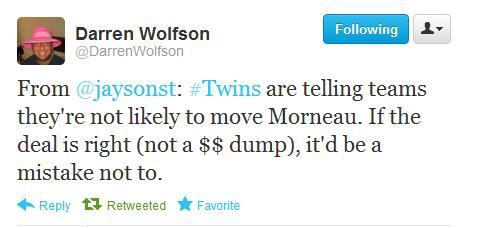
 5 Eyewitness New's jack-of-all-trades Darren Wolfson relayed a note today on Twitter from ESPN.com's Jayson Stark. The Twins say they are not interested in trading Justin Morneau: Given his injury history, age and remaining contract (2014, $14 million), I have to agree with Wolfson, it behooves the Twins to consider their options if teams come calling. After all, there are only so many pitchers you can buy on the free agent market. The Rangers were discussed as a potential suitor by Jim Bowden. The Cardinals and Blue Jays could also use a first baseman. According to MinorLeagueBall.com, Blue Jays (1), Rangers (3) and Cardinals (5) have farm systems that are highly thought of so it is possible that the Twins may be able to restock their depleted pitching with a trade of Morneau. Your thoughts?
-
You can view the page at http://twinsdaily.com/content.php?582-Ben-Revere-and-The-Real-Estate-Market
-
Ben Revere and The Real Estate Market
Parker Hageman commented on Parker Hageman's blog entry in Over the Baggy
The book on Ben Revere is that he is a slap-hitting, bloop-knocking, fast-running, somersaulting offensive contributor. In his first full season at the major league level last year, he demonstrated outstanding contact. Of course, the catch was that his contact did not go anywhere. Revere would drive the ball into the ground and try to leg it out. In fact, among those with at least 400 plate appearances last year, his 68.5% ground ball rate led baseball. When he did put the ball in the air, the majority of the time it was a dying quail just past the arms of an outstretched infielder. Had Revere been on a slow-pitch softball team, none of his hits would have left the yard. From his hit distribution chart from TexasLeaguers.com (an aptly named website in this case) of his 2011 batted balls, you can see the Twins would need to haul in their fences a good 150 feet in order to turn Revere into a home run hitter: http://apps.startribune.com/blogs/user_images/Revere_2011.png The rookie season results were none too impressive for the outfielder. In 450 plate appearances, Revere posted a .267 average but matched that with a disappointing on-base percentage (.310) and non-existent slugging percentage (.309). Because of his lack of power, any extra base hits would have to come in the form of shooting the ball through the drawn in outfield alignment. While his time with the Twins in 2012 has been brief, it has felt like he is getting a bit more distance on the ball than he had a year ago. In Milwaukee he doubled on a ball that one-hopped the warning track – a veritable Thome-ian blast for Revere. Later, he flew out to center in which the center fielder had to gallop all the way to the dirt to field. Last night in Chicago, he sent White Sox center fielder Alejandro De Aza near the warning track to nab another fly ball. Perhaps this was all based on a small sample sized memory but it felt like Revere was sending more pitches deeper into the ballpark then he ever did last year. Turns out, I wasn't crazy. A cursory check at the website BaseballHeatMaps.com confirms that the sophomore is indeed getting more distance on his drives versus a year ago. In 2011, his fly balls and line drives averaged 243.47 feet off of his bat. This year, he’s added almost 30 feet, hitting his flies and liners 272.87 feet. Twins fans like to offer the Kirby Puckett comparison for Ben Revere’s potential. After all, Puckett, like Revere, began his career as a light-hitting speedster. And it was not until Puck’s third year in the majors that he hit 31 home runs after hitting a total of four in the previous two seasons. Eternal Twins optimists believe that maybe, just maybe, the 24-year-old Revere can somehow elevate his power the same way Puckett did at age-26. Now after watching him for almost two seasons worth of at bats, I do not see in anyway Revere adds legitimate clout like Puckett had. His swing is too direct to the ball and drives down at the pitch, leading to a high amount of grounders and line drives – which is perfectly suited to fit his speed. If Revere is not capable of developing any sort of real power, why would the fact that he’s driving his few fly balls and occasional liners a tad further noteworthy? Because Revere’s spray chart became so predictable – to the point where a manager in 2011 could draw a chalk line at the edge of where Revere’s batted balls would go – defending him became easier. Outfielders played in and cut down some of the bloop hits and were also positioned close enough to the infield to keep Twins base-runners from advancing beyond one base if Revere happened to hit cleanly. For obvious reasons, you do not want to encourage a ground ball hitter like Revere putting the ball in the air too frequently but, if he’s able to redirect the occasional pitch towards the deeper part of the park, opposing teams may rethink their defensive alignment against Revere and move their starting position further back. This may open up the portion of the field that he excelled at doinking pitches towards in 2011. In all, because he does not draw a high percentage of walks, Revere’s on-base numbers are strongly correlated with his ability to hit safely. In his minor league career, he routinely had batting averages on balls in play (BABIP) well above the .330 mark. At the major league level, his BABIP has decreased to .262 through 558 plate appearances. Now oh-for his past two games, dropping his 2012 line from a pre-game .270/.341/.432 to a replacement-level .244/.311/.390, Revere needs every inch of the field opened up to his advantage. Keeping the opposing outfielders honest may be a way to clear up some real estate and get a few more hits. -
The book on Ben Revere is that he is a slap-hitting, bloop-knocking, fast-running, somersaulting offensive contributor. In his first full season at the major league level last year, he demonstrated outstanding contact. Of course, the catch was that his contact did not go anywhere. Revere would drive the ball into the ground and try to leg it out. In fact, among those with at least 400 plate appearances last year, his 68.5% ground ball rate led baseball. When he did put the ball in the air, the majority of the time it was a dying quail just past the arms of an outstretched infielder. Had Revere been on a slow-pitch softball team, none of his hits would have left the yard. From his hit distribution chart from TexasLeaguers.com (an aptly named website in this case) of his 2011 batted balls, you can see the Twins would need to haul in their fences a good 150 feet in order to turn Revere into a home run hitter: http://apps.startribune.com/blogs/user_images/Revere_2011.png The rookie season results were none too impressive for the outfielder. In 450 plate appearances, Revere posted a .267 average but matched that with a disappointing on-base percentage (.310) and non-existent slugging percentage (.309). Because of his lack of power, any extra base hits would have to come in the form of shooting the ball through the drawn in outfield alignment. While his time with the Twins in 2012 has been brief, it has felt like he is getting a bit more distance on the ball than he had a year ago. In Milwaukee he doubled on a ball that one-hopped the warning track – a veritable Thome-ian blast for Revere. Later, he flew out to center in which the center fielder had to gallop all the way to the dirt to field. Last night in Chicago, he sent White Sox center fielder Alejandro De Aza near the warning track to nab another fly ball. Perhaps this was all based on a small sample sized memory but it felt like Revere was sending more pitches deeper into the ballpark then he ever did last year. Turns out, I wasn't crazy. A cursory check at the website BaseballHeatMaps.com confirms that the sophomore is indeed getting more distance on his drives versus a year ago. In 2011, his fly balls and line drives averaged 243.47 feet off of his bat. This year, he’s added almost 30 feet, hitting his flies and liners 272.87 feet. Twins fans like to offer the Kirby Puckett comparison for Ben Revere’s potential. After all, Puckett, like Revere, began his career as a light-hitting speedster. And it was not until Puck’s third year in the majors that he hit 31 home runs after hitting a total of four in the previous two seasons. Eternal Twins optimists believe that maybe, just maybe, the 24-year-old Revere can somehow elevate his power the same way Puckett did at age-26. Now after watching him for almost two seasons worth of at bats, I do not see in anyway Revere adds legitimate clout like Puckett had. His swing is too direct to the ball and drives down at the pitch, leading to a high amount of grounders and line drives – which is perfectly suited to fit his speed. If Revere is not capable of developing any sort of real power, why would the fact that he’s driving his few fly balls and occasional liners a tad further noteworthy? Because Revere’s spray chart became so predictable – to the point where a manager in 2011 could draw a chalk line at the edge of where Revere’s batted balls would go – defending him became easier. Outfielders played in and cut down some of the bloop hits and were also positioned close enough to the infield to keep Twins base-runners from advancing beyond one base if Revere happened to hit cleanly. For obvious reasons, you do not want to encourage a ground ball hitter like Revere putting the ball in the air too frequently but, if he’s able to redirect the occasional pitch towards the deeper part of the park, opposing teams may rethink their defensive alignment against Revere and move their starting position further back. This may open up the portion of the field that he excelled at doinking pitches towards in 2011. In all, because he does not draw a high percentage of walks, Revere’s on-base numbers are strongly correlated with his ability to hit safely. In his minor league career, he routinely had batting averages on balls in play (BABIP) well above the .330 mark. At the major league level, his BABIP has decreased to .262 through 558 plate appearances. Now oh-for his past two games, dropping his 2012 line from a pre-game .270/.341/.432 to a replacement-level .244/.311/.390, Revere needs every inch of the field opened up to his advantage. Keeping the opposing outfielders honest may be a way to clear up some real estate and get a few more hits.
-
If the Twins ever do decide to move the fences in at Target Field, they’ll join two other teams to contemplate the shift to improve offensive output. The season began with the Mets altering their fences in order to attempt to inflate their scoring at home. Now, both the Padres and the Mariners are weighing the pros and cons. The Seattle Mariners, whose lack of home run power appears to derive from the quality of personnel just as much as the home confines, are bandying the idea around this season. Per Larry Stone of the Seattle Times: Last month, the San Diego Padres, who have hit 166 home runs at home from 2009 through 2011 (in comparison, Toronto hit 146 at home in 2010 alone), acknowledged that they will be making a strong consideration to move their fences in at Petco Park: This comes on the heels of the New York Mets’ decision to alter Citi Field’s dimensions this past offseason: How has the new configuration fared in Flushings? So far, the returns have not been that favorable as the Mets have hit just 8 home runs at Citi Field, the second-lowest home total in baseball. Clearly, simply moving the fences in is not a cure all for offensive woes. So the Twins wouldn’t be alone in bringing the fences in. However, as we see with the Mets, just moving the fences in is not necessary a boost to the bats.
-
Article: Teams Throwing Morneau a Wrinkle
Parker Hageman replied to Parker Hageman's topic in Twins Daily Front Page News
@jharaldson -- I wouldn't call it a goal but more of a barometer to how he is seeing and reacting to pitches. Morneau's ability to go the other way directly correlates to how opposing teams were pitching to him. In 2011, he was attempting to yank all of the pitches on the outer-half as his front side opened up too quickly. If he shows he is capable of driving that pitch the other way, teams will likely throw a few more pitches on the inner-half where he has proven he can pull hard. -
Many people may have noticed during last night’s game that Twins starter P.J. Walters etched the initials “AFW” into the back of the mound. In his two previous starts, Walters also placed these letters on the back of the mound. The initials are those of the daughter who passed away after just 52 short days - an unimaginably devastating loss, no doubt. I assume for most viewers, this gesture of memorial for the daughter he and his wife lost seems appropriate. As a pitcher, Walters will approach the mound from the back and see his daughter’s initials and be reminded of her. However, at Uni-Watch.com, the proprietor and several commenters have found this practice to be inappropriate. First opinion is from a commenter named “Phil”: In response, Paul Lukas, the blog’s owner, writes: Personally, I do not think there is a statute of limitations to how long a person should grieve a loss of a family member – particularly one’s own child. Having the good fortune of not losing anyone close to me, I cannot fully speak towards the topic but I would assume the pain lingers on day six hundred as it does on day two. Secondly, in response to the “grandstanding” comment, it would appear (although Seth Stohs or a Rochester correspondent would have to confirm) that Walters has performed this act prior to coming to the majors when cameras were around. As I said above, most pitchers climb the mound from the back (or at least circle behind it frequently) and the position of the initials would give Walters the best view. To summarize my sentiments on the issue, I direct you to Clarence Swamptown’s tweet in reply to the article: Amen, brother and shame on Uni-watch.com.
-
Article: Teams Throwing Morneau a Wrinkle
Parker Hageman replied to Parker Hageman's topic in Twins Daily Front Page News
"Humbug!!!!" -- Care to elaborate? -
You can view the page at http://twinsdaily.com/content.php?570-Teams-Throwing-Morneau-a-Wrinkle
-
-
Teams Throwing Morneau a Wrinkle
Parker Hageman commented on Parker Hageman's blog entry in Over the Baggy
[ATTACH=CONFIG]1024[/ATTACH]Since his return to the lineup this month, Justin Morneau has seemingly been driving the ball to the opposite field not only better but also more frequently. In Detroit, the big left-hander crushed a home run over the left-center field fence and then went the other way with pitches in Milwaukee over the weekend – one for a bloop single and the other for a sacrifice fly. In all, nine of his 17 balls in play prior to last night’s game went to the left of dead center. While it is a small sample size, Morneau has hit 52% of his ball to the left of center in May which dwarf’s April’s 28%. Positive as that may be, Morneau’s season has been a bit perplexing, particularly in the plate discipline department. Although he has always had the tendency to chase pitches out of the zone, the level at which he is straying after pitches has reached a career-high of 40%. In 2011, while he was having issues keeping his weight back and his hip closed, the strategy that opposing teams implemented was to keep the ball out of the strike zone and allow the Twins first baseman to get himself out – particularly when being pitched away. Often, Morneau would be out ahead of the pitch and harmless turnover on the pitch to the right-side of the infield. This year teams are pretty much attacking him in the same many only now they have added a wrinkle: more curves. One significant change is that opponents have been pumping him curve balls this season. It would seem that the league-wide scouting report on Morneau is that his eagerness to catch up with the fastball away has ripened him for a stream of curve balls to disrupt his timing on the hard stuff. And, so far, the league has been successful in shutting him down with this pitch. [ATTACH=CONFIG]1023[/ATTACH] In 2010, the last year Morneau was truly “dialed in”, the first baseman hit curve balls at 5.0 runs above average clip according the Fangraphs.com Pitch Value system. That year, Morneau drove those hanging curve balls fairly well. While seeing fewer than 10% of the overall pitch distribution as curves, Pitch F/X data found at JoeLefkowicz.com says that he went 10-for-30 on curve balls put into play (a very good .333 BABIP) while hitting another four for home runs. Meanwhile, this year, Morneau has seen a steady increase in the amount of breaking pitches thrown his direction, receiving curves 18% of the time in 2012. Unlike his 2010 campaign, Morneau has not had nearly as much success against the hook. By Fangraphs.com’s Pitch Value metric, he has posted a career-low 2.2 runs below average which is based on the fact that he is just 1-for-11 on curves in play (.090 BABIP) – including a fly out to center off of one of Gavin Floyd’s benders in the third inning last night - while putting a high margin of those in play as grounders. Given the fact that he is starting to rekindle his love affair with driving the outside pitch to left field, there are reasons to remain optimistic for his production. By driving the ball to left, Morneau is demonstrating he can keep his weight and hands back - two main elements that help in adjusting to the curve ball. For Morneau, the season is still fairly young and he certainly has the capabilities of rebounding, that is, if he can remain healthy. -
Since his return to the lineup this month, Justin Morneau has seemingly been driving the ball to the opposite field not only better but also more frequently. In Detroit, the big left-hander crushed a home run over the left-center field fence and then went the other way with pitches in Milwaukee over the weekend – one for a bloop single and the other for a sacrifice fly. In all, nine of his 17 balls in play prior to last night’s game went to the left of dead center. While it is a small sample size, Morneau has hit 52% of his balls to the left of center in May which dwarf’s April’s 28%. [PRBREAK][/PRBREAK] Positive as that may be, Morneau’s season has been a bit perplexing, particularly in the plate discipline department. Although he has always had the tendency to chase pitches out of the zone, the level at which he is straying after pitches has reached a career-high of 40%. In 2011, while he was having issues keeping his weight back and his hip closed, the strategy that opposing teams implemented was to keep the ball out of the strike zone and allow the Twins first baseman to get himself out – particularly when being pitched away. Often, Morneau would be out ahead of the pitch and harmless turnover on the pitch to the right-side of the infield. This year teams are pretty much attacking him in the same many only now they have added a wrinkle: more curves. One significant change is that opponents have been pumping him curve balls this season. It would seem that the league-wide scouting report on Morneau is that his eagerness to catch up with the fastball away has ripened him for a stream of curve balls to disrupt his timing on the hard stuff. And, so far, the league has been successful in shutting him down with this pitch. In 2010, the last year Morneau was truly “dialed in”, the first baseman hit curve balls at 5.0 runs above average clip according the Fangraphs.com Pitch Value system. That year, Morneau drove those hanging curve balls fairly well. While seeing fewer than 10% of the overall pitch distribution as curves, Pitch F/X data found at JoeLefkowicz.com says that he went 10-for-30 on curve balls put into play (a very good .333 BABIP) while hitting another four for home runs. Meanwhile, this year, Morneau has seen a steady increase in the amount of breaking pitches thrown his direction, receiving curves 18% of the time in 2012. Unlike his 2010 campaign, Morneau has not had nearly as much success against the hook. By Fangraphs.com’s Pitch Value metric, he has posted a career-low 2.2 runs below average which is based on the fact that he is just 1-for-11 on curves in play (.090 BABIP) – including a fly out to center off of one of Gavin Floyd’s benders in the third inning last night - while putting a high margin of those in play as grounders. Given the fact that he is starting to rekindle his love affair with driving the outside pitch to left field, there are reasons to remain optimistic for his production. By driving the ball to left, Morneau is demonstrating he can keep his weight and hands back - two main elements that help in adjusting to the curve ball. For Morneau, the season is still fairly young and he certainly has the capabilities of rebounding, that is, if he can remain healthy.
-
Per LaVelle Neal's twitter feed, here is tonight's Twins lineup: (1) Denard Span - CF (2) Ben Revere - RF (3) Joe Mauer - C (4) Josh Willingham - LF (5) Justin Morneau - 1B (6) Ryan Doumit - DH (7) Brian Dozier - SS (8) Alexi Casilla - 2B (9) Jamey Carroll - 3B (P) PJ Walters
-
@one_eyed_jack: Relax, it's a hypothetical question created to spark the discussion on the two coaches.
-
According to the Long Island Ducks' Twitter feed, the Orioles have signed Lew Ford and have assigned him to their AAA team. Ford is my most favorite Twins player to start a game with a wispy goatee only to shave it mid-game. Welcome back to baseball, The Great Lewtardo.
-
Let's say the Twins get to the point over the next few weeks that an inevitable shake-up needs to occur. Similar to what the Angels just did with the firing of hitting coach Mickey Hatcher, let's say the Twins front office decide to send a message to the clubhouse by axing either hitting coach Joe Vavra or pitching coach Rick Anderson. Which of the two would you fire and why? Note: One or the other and not both. No cheating by saying Ron Gardenhire or Terry Ryan.
-
You can view the page at http://twinsdaily.com/content.php?555-Shoulder-stifling-Pavano-s-repertoire
-
It was revealed a week ago that Carl Pavano’s shoulder was hurting and that the team had him undergo an MRI for precautionary measures. [PRBREAK][/PRBREAK] Fortunately for the already thin pitching staff, the MRI showed nothing more than inflammation and, in preventative efforts, the Twins eased up on their workhorse, limiting his pitches and allowed him to miss the recent series in Detroit to have some soft-tissue therapy on his shoulder. The hopes are that by lightening his load, Pavano will heal and not require a cortisone shot following his next start. Since the beginning of the season, Pavano’s velocity drop has had team officials concerned. While the tests showed no significant injury, the big right-hander admitted that he feels that he cannot get proper extension on his pitches and his results suggest there may be something to that. While his peripheral numbers are actually a slight improvement over his 2011 campaign – his strikeout rate is up, his walk rate is down – his ability to generate ground balls has dissipated over the course of the season. Currently holding a 44.2% ground ball rate, it is his lowest amount of turf-killer since the year he came over to the Twins in ’09. Because hitters are able to elevate the ball, he is allowing home runs at a higher clip – going from 0.93 home runs per nine innings to 1.29. Through his first four starts of the year, Pavano pitched like business-as-usual. He was able to miss bats (8% swinging strikes) and induced more grounders than fly balls (1.18 GB/FB). From his April 22 start against the Royals onward, likely when the Twins began to limit his pitch count, Pavano was a different pitcher. Hitters were making outstanding contact (just a 3% swinging strike rate) and the ground balls dried up (0.65 GB/FB). Outside of his fastball’s velocity, the biggest causality of his sore shoulder has been his second most used pitch, his changeup, and one of the reasons the grounders have become fly balls. In 2010 and 2011, Pavano’s change was one of the game’s best according to Fangraphs.com’s Pitch Value. His 18.1 runs above average on the pitch was tied for ninth-best in that span, placing him with such change artists as Felix Hernandez, James Shields, Shaun Marcum and Ricky Romero. This season, his change-up is now 2.6 runs below average, making it one of the bottom-dwellers in that category. In theory, a change thrown with a good differential and down in the zone should induce plenty of weak contact as hitters find themselves unable to hold up and turn over on the pitch. A year ago, his change-up was able to get a ground ball on 51.6% on all contact (including fouls, home runs, etc) which is a very strong rate. Comparatively, this season, Pavano’s change has only incited grounders just 39.3% - meaning opponents are squaring up on his secondary pitch. What’s more is that in 2011 he was able to get a swing-and-miss on 27% when opponents swung but that has declined to 15% in 2012. As I speculated following his first start, the decrease in his fastball’s velocity was going to adversely affect his change-up as the speed differential closes. Baseball Info Solutions’ pitch charting states that while his fastball is down (from 89 to 86 miles per hour) his change’s top speed has also decreased (from 80 to 78 miles per hour). This means the differential has not been that substantial at all. Pitch F/X, on the other hand, shows that Pavano’s vertical movement on his change is quite different. As I discussed in my analysis of Jason Marquis at Twins Daily on Wednesday, research has shown that the optimal place to get the most ground balls is between 0.0 inches and 3.0. The previous two seasons, his changeup had a vertical finish of 2.0 and 2.7, meaning it was down in the zone. This season it is up to 3.8. In laymen’s terms, Pavano’s changeup has been up in the zone more frequently therefore resulting in fewer grounders and swing-and-misses on that particular pitch. Another factor that might explain the in-season drop in grounders and missed bats is the sudden disappearance of his slider. According to Pitch F/X data, in his first four starts he threw his slider 45 times (11% overall). In his last four starts, he threw it just 8 times (3% overall). His sore shoulder, his inability to get extension and a lack of feel for the pitches may contribute to why he has not spotted his changeup well and why he has ignored his slider as of late. Will the rest and rehab approach prove to be fruitful? Answers will be provided on Saturday when Pavano makes his regularly scheduled start in Milwaukee. Attention should be paid not only to the radar gun readings but also to the performance of his off-speed pitches.
-
-
Shoulder stifling Pavano's repertoire
Parker Hageman commented on Parker Hageman's blog entry in Over the Baggy
[ATTACH=CONFIG]982[/ATTACH]It was revealed a week ago that Carl Pavano’s shoulder was hurting and that the team had him undergo an MRI for precautionary measures. Fortunately for the already thin pitching staff, the MRI showed nothing more than inflammation and, in preventative efforts, the Twins eased up on their workhorse, limiting his pitches and allowed him to miss the recent series in Detroit to have some soft-tissue therapy on his shoulder. The hopes are that by lightening his load, Pavano will heal and not require a cortisone shot following his next start. Since the beginning of the season, Pavano’s velocity drop has had team officials concerned. While the tests showed no significant injury, the big right-hander admitted that he feels that he cannot get proper extension on his pitches and his results suggest there may be something to that. While his peripheral numbers are actually a slight improvement over his 2011 campaign – his strikeout rate is up, his walk rate is down – his ability to generate ground balls has dissipated over the course of the season. Currently holding a 44.2% ground ball rate, it is his lowest amount of turf-killer since the year he came over to the Twins in ’09. Because hitters are able to elevate the ball, he is allowing home runs at a higher clip – going from 0.93 home runs per nine innings to 1.29. Through his first four starts of the year, Pavano pitched like business-as-usual. He was able to miss bats (8% swinging strikes) and induced more grounders than fly balls (1.18 GB/FB). From his April 22 start against the Royals onward, likely when the Twins began to limit his pitch count, Pavano was a different pitcher. Hitters were making outstanding contact (just a 3% swinging strike rate) and the ground balls dried up (0.65 GB/FB). Outside of his fastball’s velocity, the biggest causality of his sore shoulder has been his second most used pitch, his changeup, and one of the reasons the grounders have become fly balls. In 2010 and 2011, Pavano’s change was one of the game’s best according to Fangraphs.com’s Pitch Value. His 18.1 runs above average on the pitch was tied for ninth-best in that span, placing him with such change artists as Felix Hernandez, James Shields, Shaun Marcum and Ricky Romero. This season, his change-up is now 2.6 runs below average, making it one of the bottom-dwellers in that category. In theory, a change thrown with a good differential and down in the zone should induce plenty of weak contact as hitters find themselves unable to hold up and turn over on the pitch. A year ago, his change-up was able to get a ground ball on 51.6% on all contact (including fouls, home runs, etc) which is a very strong rate. Comparatively, this season, Pavano’s change has only incited grounders just 39.3% - meaning opponents are squaring up on his secondary pitch. What’s more is that in 2011 he was able to get a swing-and-miss on 27% when opponents swung but that has declined to 15% in 2012. As I speculated following his first start, the decrease in his fastball’s velocity was going to adversely affect his change-up as the speed differential closes. Baseball Info Solutions’ pitch charting states that while his fastball is down (from 89 to 86 miles per hour) his change’s top speed has also decreased (from 80 to 78 miles per hour). This means the differential has not been that substantial at all. Pitch F/X, on the other hand, shows that Pavano’s vertical movement on his change is quite different. As I discussed in my analysis of Jason Marquis at Twins Daily on Wednesday, research has shown that the optimal place to get the most ground balls is between 0.0 inches and 3.0. The previous two seasons, his changeup had a vertical finish of 2.0 and 2.7, meaning it was down in the zone. This season it is up to 3.8. In laymen’s terms, Pavano’s changeup has been up in the zone more frequently therefore resulting in fewer grounders and swing-and-misses on that particular pitch. Another factor that might explain the in-season drop in grounders and missed bats is the sudden disappearance of his slider. According to Pitch F/X data, in his first four starts he threw his slider 45 times (11% overall). In his last four starts, he threw it just 8 times (3% overall). His sore shoulder, his inability to get extension and a lack of feel for the pitches may contribute to why he has not spotted his changeup well and why he has ignored his slider as of late. Will the rest and rehab approach prove to be fruitful? Answers will be provided on Saturday when Pavano makes his regularly scheduled start in Milwaukee. Attention should be paid not only to the radar gun readings but also to the performance of his off-speed pitches. -
I think that is a fair assessment. Outside of Marquis (and possibly Zumaya), Ryan's offseason signings have all met or exceeded my expectations. Willingham has exceeded... Doumit's performing up to snuff... Burton has exceeded expectations...Sure, Carroll's not hitting well but considering he was switching leagues, I certainly did not expect his Dodgers production to continue.
-
You can view the page at http://twinsdaily.com/content.php?550-Jason-Marquis-and-that-sinking-feeling
-
Once upon a time, in a land far away on the other side of downtown, covered by a beautiful white bubble – where the weather was always a pleasant 72 degrees – there was a starting pitching staff who understood the intrinsic value of working ahead of opponents. In the last decade, from 2000 to 2010, one of the pillars of the Twins Way was to dominate the airspace above the plate. The starters made it their business to pepper the strike zone from the get-go, leading baseball with a 62.8% first-pitch strike rate. Brad Radke paced baseball with a 69% first-pitch strike rate as other members of the team – notably Carlos Silva, Kevin Slowey and Johan Santana - also finishing within the top ten. True, the quality of the arms, particularly Santana and Radke, were vastly superior to the current crop, however, by comparison, the 2012 Twins staff have completely deviated from this philosophy. This season, the staff has posted the worst first-pitch strike rate in baseball meaning just barely over half of the pitcher-batter engagements (53.8%) have resulted in the Twins pitcher registering strike one on the first pitch. While most would think “Liriano” right off the bat, it’s actually Jason Marquis who has been the team’s biggest offender. Heading into yesterday’s contest, Marquis’ 47.5% First-Pitch Strike rate was the second worst in baseball. Beyond just working ahead, Marquis has struggled to find the zone overall. Once again, while we all peg Liriano as the poster wild child, it is actually Marquis who has been missing the plate more frequently (35% versus Liriano’s 36.2% rate). What’s more is that the veteran is not missing any bats. In fact, his 3.5% swinging strike rate heading into yesterday’s outing against the Indians was the lowest in baseball (minimum 20 innings pitched). If we are looking for little victories inside his sixth start of the year, Marquis did improve his attack on the strike zone, jumping ahead for a strike 56% of the time on Tuesday afternoon. Likewise, after not inducing many swinging strikes on any of his secondary pitches, he got four (count ‘em, four) swinging strikes: three on his slider, one on his changeup. After the game, ESPN1500.com’s Phil Mackey relayed Ron Gardenhire’s assessment on the two starters, Cleveland’s Derek Lowe and Marquis: Two of the home runs Marquis allowed to the Indians came on his sinker, which certainly did not appear to be of the highest caliber that day. But, the most recent performance notwithstanding, believe it or not, his sinker is getting the best results in years. Those familiar with Pitch F/X know that the system of cameras inside the ballpark captures (almost) every pitch thrown, which measures the release point, speed, movement, spin, where it crosses the plate, and so on. By using this data, we find that Marquis’ sinker is coming in at a different vertical level than it had in more recent seasons. Before this year, his sinker had averaged vertical movement of 5.2, 6.0, 5.2 and 5.9 inches respectively. This year it’s at 2.9. Sinkers have a tendency to demonstrate, on average, a rise of five inches (not in the gravitational sense but relative to other pitches). For the past several years, Marquis’ sinker was very consistent with this average. However, this year, it is only rising 2.9 inches – meaning it is staying down. What makes this interesting is that Pitch F/X research - like the one found at It’s About The Money Stupid from 2011 - has shown that one of the ways ground balls are achieved the most when a pitch is thrown with 0.0 to 3.0 vertical movement. This has led to a near 60% ground ball rate. (From ItsAboutTheMoney.net) Derek Lowe, who finished the Twins off in short order yesterday by making them burn balls into the ground, had a 63% ground ball rate. His sinker has averaged vertical movement of 1.3, right in that aforementioned sweet spot, helping explain why he incited so many grass-killers off bats. Of course, in Marquis’ case, this only accounts for when opponents put the ball into play that they are knocking it into the ground. Sure, he has a career-high 57% ground ball rate but prior to yesterday’s game, he had only thrown his sinker for a strike just 48% of the time, well below the 62% mark from 2011. Hitters, not finding a diving ball appetizing, and have swung at fewer sinkers than previous seasons. This, in a nutshell, is why his results have been so poor. He cannot throw his best pitch for a strike consistently enough to entice hitters to swing. To make matters worse, he has been falling behind hitters to the point where he has to throw one over the plate. Most importantly, if he wants to that sinker to become even more effective, start with strike one. It is an old recipe that has worked for years.
