



Parker Hageman
-
Posts
4,152 -
Joined
-
Last visited
-
Days Won
6
Content Type
Profiles
Minnesota Twins News, Rumors & Analysis
Minnesota Twins Videos
2026 Minnesota Twins Top Prospect Rankings
2022 Minnesota Twins Draft Picks & Signing Bonuses
Minnesota Twins Trade & Free Agent Rumors
Minnesota Twins Fan Guides & Resources
2023 Minnesota Twins Draft Picks & Signing Bonuses
The Minnesota Twins Players Project
2024 Minnesota Twins Draft Picks & Signing Bonuses
2025 Minnesota Twins Draft Picks & Signing Bonuses
2026 Minnesota Twins Draft Picks & Signing Bonuses
Forums
Blogs
Events
Store
Downloads
Gallery
Everything posted by Parker Hageman
-
-

Jason Marquis and that sinking feeling
Parker Hageman commented on Parker Hageman's blog entry in Over the Baggy
[ATTACH=CONFIG]963[/ATTACH]Once upon a time, in a land far away on the other side of downtown, covered by a beautiful white bubble – where the weather was always a pleasant 72 degrees – there was a starting pitching staff who understood the intrinsic value of working ahead of opponents. In the last decade, from 2000 to 2010, one of the pillars of the Twins Way was to dominate the airspace above the plate. The starters made it their business to pepper the strike zone from the get-go, leading baseball with a 62.8% first-pitch strike rate. Brad Radke paced baseball with a 69% first-pitch strike rate as other members of the team – notably Carlos Silva, Kevin Slowey and Johan Santana - also finishing within the top ten. True, the quality of the arms, particularly Santana and Radke, were vastly superior to the current crop, however, by comparison, the 2012 Twins staff have completely deviated from this philosophy. This season, the staff has posted the worst first-pitch strike rate in baseball meaning just barely over half of the pitcher-batter engagements (53.8%) have resulted in the Twins pitcher registering strike one on the first pitch. While most would think “Liriano” right off the bat, it’s actually Jason Marquis who has been the team’s biggest offender. Heading into yesterday’s contest, Marquis’ 47.5% First-Pitch Strike rate was the second worst in baseball. Beyond just working ahead, Marquis has struggled to find the zone overall. Once again, while we all peg Liriano as the poster wild child, it is actually Marquis who has been missing the plate more frequently (35% versus Liriano’s 36.2% rate). What’s more is that the veteran is not missing any bats. In fact, his 3.5% swinging strike rate heading into yesterday’s outing against the Indians was the lowest in baseball (minimum 20 innings pitched). If we are looking for little victories inside his sixth start of the year, Marquis did improve his attack on the strike zone, jumping ahead for a strike 56% of the time on Tuesday afternoon. Likewise, after not inducing many swinging strikes on any of his secondary pitches, he got four (count ‘em, four) swinging strikes: three on his slider, one on his changeup. After the game, ESPN1500.com’s Phil Mackey relayed Ron Gardenhire’s assessment on the two starters, Cleveland’s Derek Lowe and Marquis: Two of the home runs Marquis allowed to the Indians came on his sinker, which certainly did not appear to be of the highest caliber that day. But, the most recent performance notwithstanding, believe it or not, his sinker is getting the best results in years. Those familiar with Pitch F/X know that the system of cameras inside the ballpark captures (almost) every pitch thrown, which measures the release point, speed, movement, spin, where it crosses the plate, and so on. By using this data, we find that Marquis’ sinker is coming in at a different vertical level than it had in more recent seasons. Before this year, his sinker had averaged vertical movement of 5.2, 6.0, 5.2 and 5.9 inches respectively. This year it’s at 2.9. Sinkers have a tendency to demonstrate, on average, a rise of five inches (not in the gravitational sense but relative to other pitches). For the past several years, Marquis’ sinker was very consistent with this average. However, this year, it is only rising 2.9 inches – meaning it is staying down. What makes this interesting is that Pitch F/X research - like the one found at It’s About The Money Stupid from 2011 - has shown that one of the ways ground balls are achieved the most when a pitch is thrown with 0.0 to 3.0 vertical movement. This has led to a near 60% ground ball rate. [ATTACH=CONFIG]962[/ATTACH] (From ItsAboutTheMoney.net) Derek Lowe, who finished the Twins off in short order yesterday by making them burn balls into the ground, had a 63% ground ball rate. His sinker has averaged vertical movement of 1.3, right in that aforementioned sweet spot, helping explain why he incited so many grass-killers off bats. Of course, in Marquis’ case, this only accounts for when opponents put the ball into play that they are knocking it into the ground. Sure, he has a career-high 57% ground ball rate but prior to yesterday’s game, he had only thrown his sinker for a strike just 48% of the time, well below the 62% mark from 2011. Hitters, not finding a diving ball appetizing, and have swung at fewer sinkers than previous seasons. This, in a nutshell, is why his results have been so poor. He cannot throw his best pitch for a strike consistently enough to entice hitters to swing. To make matters worse, he has been falling behind hitters to the point where he has to throw one over the plate. Most importantly, if he wants to that sinker to become even more effective, start with strike one. It is an old recipe that has worked for years. -
According to the Star Tribune's Joe Christensen, the Twins are starting to identify who their number two overall draft choice might be next month: Kyle Boddy of DrivelineMechanics.com had a great breakdown of Appel's mechanics along with a fantastic scouting report on the Stanford right-hander who touches triple-digits. Boddy's knock on Appel was that he was not throwing his slider for strikes consistently. Meanwhile Zimmer, who pitches out of the West Coast Conference, has impressed scouts by hitting 98 miles per hour and peppering the strike zone. Said one scout to Baseball America back in February: Buxton, on the other hand, is a toolsy high school outfielder with off-the-chart projections of the youngster. The only hindrance is that he has not faced difficult competition. For the Twins, who are clearly short on pitching, either Appel or Zimmer would fit well into their immediate plans while someone like Buxton could be a key player in the outfield for years to come.
-
You can view the page at http://twinsdaily.com/content.php?534-Is-Joe-Mauer-hurt-or-just-slumping
-
Is Joe Mauer hurt or just slumping?
Parker Hageman commented on Parker Hageman's blog entry in Over the Baggy
On April 29th, while catching Joe Mauer took a Brayan Pena sharp foul ball off the inside part of his left knee. Up to that point, the seemingly healthy Mauer was hitting a robust .325/.419/.438. He had hit a home run, triple and four doubles in those 93 plate appearances. Since then, he has gone to hitting safely in just four of his last 31 at-bats (.129), including a gentle double and a ground ball that Mariners shortstop Brendan Ryan likely should have converted. Now, many wonks will argue comparing 93 plate appearances to the outcome of another 36 plate appearances is the ultimate exercise in small sample size analysis. Additionally, the fact that he has faced a regiment of Jered Weaver (twice) and Felix Hernandez may lend credence to the notion that he is just slumping in May. However, because this performance drop-off started with the foul ball incident, it is hard to ignore the influence a shot to a load bearing limb may have on his swing. You have to wonder if Mauer is currently hurting more than he wants everyone to believe. At the start of the season, Mauer was a line drive machine. In the season’s first month, nearly 30% of all balls off of his bat were hit on a line. So far this month, he has managed to hit just one line drive in 36 plate appearances since absorbing the Pena foul ball. The majority of his balls in play have been grounders. [ATTACH=CONFIG]926[/ATTACH] Without the assistance of the high percentage of line drives and the huge increase in ground balls, it is easy to see why Mauer’s numbers have taken a tumble. Visually, through the monthly spray charts found at TexasLeaguers.com, we find that he has struggled to pull the ball in May as effectively as he did in April: [ATTACH=CONFIG]927[/ATTACH] [ATTACH=CONFIG]928[/ATTACH] Mauer’s left knee, the one Pena’s foul ball ricocheted off of, has been a source of pain for him in the past. In 2010, he had arthroscopic surgery after tissue inflammation experienced throughout the season. Last year, his bi-lateral leg weakness was concocted from what Mauer described as leg soreness from not properly working out his lower half following the 2010 arthroscopic surgery. If it was indeed re-aggravated, the left knee – the one he would pivot and drive off of during his swing – would keep him from pulling the ball with authority. While the shot to the knee may be downplayed in the media, it would seem that the Twins have taken precautionary measures that would suggest that they are a bit more concerned about him. This month, manager Ron Gardenhire clearly recognized the need to alleviate the pressure on Mauer’s knees as since sitting out post-foul tip he has played nine games and only two behind the plate. Meanwhile, the front office, perhaps concerned over his resiliency, recalled Drew Butera from Rochester to serve as the third catcher in spite of a thin bench. To Mauer’s credit, the majority of the ribbing last year appeared to be focused on his inability to work his way into the lineup and that his “bi-lateral” injuries were simply an excuse to avoid playing for a terrible team. This season, he’s played 30 of the 31 total contests, perhaps proving to his critics that he can play through the pain. Unfortunately, if he is in pain stemming from the foul ball, his performance has obviously taken a downturn. Understandably, with Justin Morneau unable to play, the Twins are counting on their $23 Million Dollar Man to get out there and play. At the same time, if the team wants to ensure that he is available throughout the duration of the season, they may need to sit him a little more regularly than they have been doing up to this point. -
-
On April 29th, while catching Joe Mauer took a Brayan Pena sharp foul ball off the inside part of his left knee. Up to that point, the seemingly healthy Mauer was hitting a robust .325/.419/.438. He had hit a home run, triple and four doubles in those 93 plate appearances. Since then, he has gone to hitting safely in just four of his last 31 at-bats (.129), including a gentle double and a ground ball that Mariners shortstop Brendan Ryan likely should have converted. Now, many wonks will argue comparing 93 plate appearances to the outcome of another 36 plate appearances is the ultimate exercise in small sample size analysis. Additionally, the fact that he has faced a regiment of Jered Weaver (twice) and Felix Hernandez may lend credence to the notion that he is just slumping in May. However, because this performance drop-off started with the foul ball incident, it is hard to ignore the influence a shot to a load bearing limb may have on his swing. You have to wonder if Mauer is currently hurting more than he wants everyone to believe. At the start of the season, Mauer was a line drive machine. In the season’s first month, nearly 30% of all balls off of his bat were hit on a line. So far this month, he has managed to hit just one line drive in 36 plate appearances since absorbing the Pena foul ball. The majority of his balls in play have been grounders. Without the assistance of the high percentage of line drives and the huge increase in ground balls, it is easy to see why Mauer’s numbers have taken a tumble. Visually, through the monthly spray charts found at TexasLeaguers.com, we find that he has struggled to pull the ball in May as effectively as he did in April: Mauer’s left knee, the one Pena’s foul ball ricocheted off of, has been a source of pain for him in the past. In 2010, he had arthroscopic surgery after tissue inflammation experienced throughout the season. Last year, his bi-lateral leg weakness was concocted from what Mauer described as leg soreness from not properly working out his lower half following the 2010 arthroscopic surgery. If it was indeed re-aggravated, the left knee – the one he would pivot and drive off of during his swing – would keep him from pulling the ball with authority. While the shot to the knee may be downplayed in the media, it would seem that the Twins have taken precautionary measures that would suggest that they are a bit more concerned about him. This month, manager Ron Gardenhire clearly recognized the need to alleviate the pressure on Mauer’s knees as since sitting out post-foul tip he has played nine games and only two behind the plate. Meanwhile, the front office, perhaps concerned over his resiliency, recalled Drew Butera from Rochester to serve as the third catcher in spite of a thin bench. To Mauer’s credit, the majority of the ribbing last year appeared to be focused on his inability to work his way into the lineup and that his “bi-lateral” injuries were simply an excuse to avoid playing for a terrible team. This season, he’s played 30 of the 31 total contests, perhaps proving to his critics that he can play through the pain. Unfortunately, if he is in pain stemming from the foul ball, his performance has obviously taken a downturn. Understandably, with Justin Morneau unable to play, the Twins are counting on their $23 Million Dollar Man to get out there and play. At the same time, if the team wants to ensure that he is available throughout the duration of the season, they may need to sit him a little more regularly than they have been doing up to this point.
-
You can view the page at http://twinsdaily.com/content.php?527-What-Happened-to-Chris-Parmelee
-
What Happened to Chris Parmelee?
Parker Hageman commented on Parker Hageman's blog entry in Over the Baggy
[ATTACH=CONFIG]904[/ATTACH]Only eight short months ago, Chris Parmelee was the talk of what was left of this baseball town in the aftermath of a 99-loss season. A September call-up, straight from Double-A no less, Parmelee went out and mashed pitching at the major league level. In a short span of time, he impressed people by demonstrating a keen batting eye, an excellent line drive swing and was able to put the occasional charge into the ball. He seemed immune to the crumbling franchise around him. While the other youngsters of the team, reportedly referred to as “the fun bunch”, enjoyed simply being called major leaguers, Parmelee went out and produced, even when the outcomes did not matter. He was an oasis in what has become a prospect-less desert for the Twins. His impressive spring training performance the following March (combined with Justin Morneau’s uncertainty) only served as fuel the discussion that this kid was ready to join the big league club full-time. However, after the same amount of games in 2012 as he had in the 2011 season, Parmelee’s results are vastly different. Last year in 88 plate appearances, he raked to the tune of .355/.443/.592. In 79 plate appearances this year, he is checking in with a .205/.266/.301 batting line. The first is that the opposition has concocted a game plan. At the end of September of last year, I forewarned that the scouts would be vicious on Parmelee, targeting his weak spot out over the plate. Opponents have stayed away from the left-handed first baseman this year, giving him fewer pitches middle-middle and middle-low where he was driving the ball a year ago. As such, he is swinging at pitches he did not do so with regularity in September. The second reason Parmelee’s numbers are down is that he is having some mechanical issues at the plate. During a recent broadcast, former Twin and FSN commentator Roy Smalley accurately noted that Parmelee was opening up far too quickly with his hips, causing his bat speed to drag through the zone. Sure enough, video replays confirmed this. This makes it particularly more difficult to get to pitches on the outer-half – where, as noted above, pitchers have been targeting him - and drive them with authority. Last, perhaps in response to the opposing teams pitching him better or because he has been pressing while slumping, his lauded plate discipline has all but disappeared. In 2011 he drew 12 walks to 13 strikeouts but has managed to coax just 4 free passes to 20 strikeouts this season. Prior to the 2010 season, Parmelee’s track record is indicative of someone who has the tendency to whiff a bit. From 2006 through 2009, he struck out in 21.5% of his total plate appearances. From 2010 to 2011, he shaved that down to a more manageable 15%. So it is possible that Parmelee, who has struck out in roughly 25% of his plate appearances this year, has reverted back to his old ways once the competition caught up to him. Pitchers have also thrown him fewer in-zone pitches as well this year (dropping from 46% to a below average 38%) and Parmelee, who has a disciplined eye, has increased his rate of chasing after pitches out of the strike zone – also likely a byproduct of (1) game plan changes and (2) trying to break out of a slump. While those are three explanations behind why Parmelee has not been producing in 2012 - his plate discipline being the most troubling -there are reasons that may lead one to believe he can rebound from this slow start. The first is his high baseball aptitude. For statheads, this sounds like jargon (and rightly so) but in this case, it refers to his ability to make adjustments. In the minors he worked with his coaches to change his swing from an upper-cut variety to a more level swing. As such, his line drive rate increased as did his batting average in the latter minor years. If he is able to adapt under those circumstances, he is likely able to adjust to how the opposition is game planning him – work on keeping those hips in and driving pitches on the outer-half. Secondly, and more importantly, when he does connect, he is hitting a high percentage of line drives. A year ago, he hit a high amount of line drives (19%) and was blessed with an unsustainable .390 batting average on balls in play. It was not just the line drives that were finding turf, his grounders and fly balls found empty real estate just as frequently and well above average. This, by the way, is not unusual in a small sample size. So far in 2012, Parmelee has hit a higher percentage of line drives (23%) but the BABIP gods have eschewed him, giving him a .283 batting average on balls in play. Those ground balls and fly balls have now found their way to defenders (perhaps a result of teams being about to position better against him). If Parmelee corrects his discipline and maintains that high line drive rate, balls will begin to find vacant land once again. The bigger question is can the Twins wait on that to happen at the major league level? In the end, Parmelee may be better served with a stretch in Rochester to right his course. -
-
Only eight short months ago, Chris Parmelee was the talk of what was left of this baseball town in the aftermath of a 99-loss season. A September call-up, straight from Double-A no less, Parmelee went out and mashed pitching at the major league level. In a short span of time, he impressed people by demonstrating a keen batting eye, an excellent line drive swing and was able to put the occasional charge into the ball. He seemed immune to the crumbling franchise around him. While the other youngsters of the team, reportedly referred to as “the fun bunch”, enjoyed simply being called major leaguers, Parmelee went out and produced, even when the outcomes did not matter. He was an oasis in what has become a prospect-less desert for the Twins. His impressive spring training performance the following March (combined with Justin Morneau’s uncertainty) only served as fuel the discussion that this kid was ready to join the big league club full-time. However, after the same amount of games in 2012 as he had in the 2011 season, Parmelee’s results are vastly different. Last year in 88 plate appearances, he raked to the tune of .355/.443/.592. In 79 plate appearances this year, he is checking in with a .205/.266/.301 batting line. The first is that the opposition has concocted a game plan. At the end of September of last year, I forewarned that the scouts would be vicious on Parmelee, targeting his weak spot out over the plate. Opponents have stayed away from the left-handed first baseman this year, giving him fewer pitches middle-middle and middle-low where he was driving the ball a year ago. As such, he is swinging at pitches he did not do so with regularity in September. The second reason Parmelee’s numbers are down is that he is having some mechanical issues at the plate. During a recent broadcast, former Twin and FSN commentator Roy Smalley accurately noted that Parmelee was opening up far too quickly with his hips, causing his bat speed to drag through the zone. Sure enough, video replays confirmed this. This makes it particularly more difficult to get to pitches on the outer-half – where, as noted above, pitchers have been targeting him - and drive them with authority. Last, perhaps in response to the opposing teams pitching him better or because he has been pressing while slumping, his lauded plate discipline has all but disappeared. In 2011 he drew 12 walks to 13 strikeouts but has managed to coax just 4 free passes to 20 strikeouts this season. Prior to the 2010 season, Parmelee’s track record is indicative of someone who has the tendency to whiff a bit. From 2006 through 2009, he struck out in 21.5% of his total plate appearances. From 2010 to 2011, he shaved that down to a more manageable 15%. So it is possible that Parmelee, who has struck out in roughly 25% of his plate appearances this year, has reverted back to his old ways once the competition caught up to him. Pitchers have also thrown him fewer in-zone pitches as well this year (dropping from 46% to a below average 38%) and Parmelee, who has a disciplined eye, has increased his rate of chasing after pitches out of the strike zone – also likely a byproduct of (1) game plan changes and (2) trying to break out of a slump. While those are three explanations behind why Parmelee has not been producing in 2012 - his plate discipline being the most troubling -there are reasons that may lead one to believe he can rebound from this slow start. The first is his high baseball aptitude. For statheads, this sounds like jargon (and rightly so) but in this case, it refers to his ability to make adjustments. In the minors he worked with his coaches to change his swing from an upper-cut variety to a more level swing. As such, his line drive rate increased as did his batting average in the latter minor years. If he is able to adapt under those circumstances, he is likely able to adjust to how the opposition is game planning him – work on keeping those hips in and driving pitches on the outer-half. Secondly, and more importantly, when he does connect, he is hitting a high percentage of line drives. A year ago, he hit a high amount of line drives (19%) and was blessed with an unsustainable .390 batting average on balls in play. It was not just the line drives that were finding turf, his grounders and fly balls found empty real estate just as frequently and well above average. This, by the way, is not unusual in a small sample size. So far in 2012, Parmelee has hit a higher percentage of line drives (23%) but the BABIP gods have eschewed him, giving him a .283 batting average on balls in play. Those ground balls and fly balls have now found their way to defenders (perhaps a result of teams being about to position better against him). If Parmelee corrects his discipline and maintains that high line drive rate, balls will begin to find vacant land once again. The bigger question is can the Twins wait on that to happen at the major league level? In the end, Parmelee may be better served with a stretch in Rochester to right his course.
-
1500ESPN.com's Phil Mackey reported that Twins owner Jim Pohlad was on the field pre-game before the Twins/Angels contest. In response to the recent requests for the firings of many staffers, the owner said: You have to respect the owner's loyalty to his staff but you have to wonder, is it merited?
-
Cafardo: Denard Span remains on Nationals' radar.
Parker Hageman replied to Parker Hageman's topic in Minnesota Twins Talk
From what I understand, they are targeting Span more as a lead-off hitter. After all, they are using Ian Desmond, who has a .295 OBP, as their lead off guy right now. -
Uff da. Nine hits in the past four games? These games are getting unbearable. Fortunately, for those who are in the Central time zone, you don't have to stay up until midnight to watch opposing pitchers celebrate their one-hitters - this one is on at 3:10 locally. Here is today's Murderer's Row via the Twins twitter feed: Couple of notes: (1) Mauer is 1-for-13 since taking the foul ball off of his left knee and has not yet hit a line drive in 15 plate appearances this month. (2) Twins lineup does not much experience with Mariners starter Hector Noesi. Willingham has the most plate appearances (4) and doe not have a hit against him. (3) That nine hits in four games stat is actually a record according to Elias: Ouch.
-
According to the Boston Globe's Nick Cafardo, the Washington Nationals still have interest in Twins' center fielder Denard Span, whom they had shown interest in a year ago. As I noted the first time around when the Span-for-Storen rumors cropped up, (1) I did not like the idea of trading a position player for a closer and (2) Storen's arm action led me to believe that he will eventually have elbow problems (eventually, by the way, became this spring and he still has yet to throw a pitch in 2012). I sincerely doubt (or at least hold out hope) that the Twins still are interested in that particular proposal. Nonetheless, with the current record, focus will begin to slowly shift towards the future of this club. Obviously there will be a gaping need in the rotation and some critical positions (such as second base, third base, etc) will need to be addressed. Right now with Span hitting .308/.357/.383, playing solid defense in center and signed to a team-friendly contract, he appears to be the Twins' lone trading chip that can actually land the organization decent players. The Nationals have developed a good farm system (John Sickels at MinorLeagueBall.com ranks them 13th overall) so there may be an opportunity to address some needs for 2013 and beyond. What do you think? If the Twins current pace remains, do you move Denard Span and what do you want in return?
-
Span's Sour Grapes Comment on Weaver's No-Hitter
Parker Hageman replied to powrwrap's topic in Minnesota Twins Talk
I'm not justifying the rocks comment, although different backdrops can be difficult to hit against, but I'm pointing out that Weaver has a deceptive angle and throws cross-body, just like Span said. This is Weaver's release point from last night: You can see how this would be difficult for left-handed hitters (or right-handers considering that is released nearly behind them) to pick up. I was not suggesting he was tougher on lefties vs righties but he is still very good against left-handers -- since 2007, Weaver's .298 wOBA vs LHBs is the sixth lowest among qualified starters -- which somewhat validates Span's comments.

-
Span's Sour Grapes Comment on Weaver's No-Hitter
Parker Hageman replied to powrwrap's topic in Minnesota Twins Talk
Span was not referring to Weaver's arm angle but rather in the way in which he lands with his front foot near the third base side of the mound and throws across his body: What this motion does is hide the ball better to left-handed hitters. Not surprising, lefties are hitting just .165 off of him this season. It's no excuse not to hit but with his pure stuff and his ability to deceive opposite-handed hitters, it explains a bit why he is so dominating at times.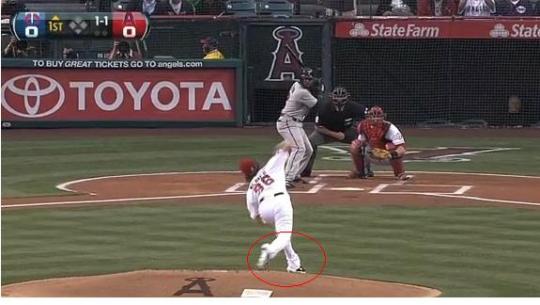
-
You can view the page at http://twinsdaily.com/content.php?500-Positive-steps-for-Liriano
-
-
Positive steps for Liriano?
Parker Hageman commented on Parker Hageman's blog entry in Over the Baggy
[ATTACH=CONFIG]837[/ATTACH]I have stated for some time that I believe Francisco Liriano’s greatest impediment to success is his erratic mechanics. One can argue that he may be struggling mentally but that would be a chicken-and-egg argument – is he getting down on himself because his inconsistent delivery or is his delivery out of whack because he is in his own head? Either way, getting him back to a consistent base in his mechanics would likely alleviate the mental side of his game. However, Liriano’s second biggest barrier to success – or perhaps issue 1B – is his inability to retire right-handed batters regularly. On Tuesday night, he made strides towards improving in both areas. Last month, I highlighted Liriano’s delivery issues in that he was failing to remain over his front leg and, far too often, pulling off to the third base side. This wreaked havoc on his ability to control his pitches, particularly his two-seam fastball which ran too far to the pitcher’s hand side of the zone and into the left handed batter’s box. From Angels Stadium’s off-set center field camera, we were not able to get a clear view of whether or not he remained over his front leg but FSN analyst Roy Smalley raved about how he was “stacked” better, which was essentially the crux of my analysis. Two things jump out from the Pitch F/X data which may confirm Smalley’s assessment: His fastball location was significantly better, throwing it for a strike a season-high 63% of time, and his slider was much crisper, getting a swing-and-miss 25% of the time, also a season-high. The latter stat, his slider’s performance, also carries into addressing Liriano’s pitching issue 1B. Retiring righties is a serious matter for Liriano as opposing managers have figured out that he struggles mightily against them. Prior to last night’s game, managers have allowed Liriano the platoon advantage in just 15% of his match-ups, the second-lowest behind Baltimore’s Brian Matusz. What’s more is after the Angels slotted all right-handed hitters to face him on Tuesday night, Liriano is likely to move ahead of Matusz as the pitcher with the least amount of advantageous match-ups. Liriano had become all too enamored with his changeup when facing right-handed opponents. Through his first four starts he would throw his change to righties as 25% of his pitch mix. This was not too far off his pace from the 2011 season in which he threw righties changeups 26% of his pitch distribution. However, so far into the 2012 season, the old standard of leaning on his changeup was not producing results – after all, his .474 weighted On Base Average (wOBA) against right-handed batters was a baseball-high and he had walked 10 and struck out 10. Liriano took steps to remedy his right-handed problem on Tuesday by easing up on the slow stuff and exchanging it for more sliders. In his first four starts, Liriano threw at least 13 changeups, maxing out at 25 against the Rays in his most recent start. In Anaheim, Liriano deployed just three changes to an Angels lineup featuring all right-handed batters. (Unfortunately, one wound up a Torii Hunter home run.) Instead, the Twins erratic lefty mixed in more fastballs and sliders. Tuesday night’s pitch distribution was much more consistent with his 2010 methods in which he would throw 40% fastballs and 30% sliders to righties rather than the 47% fastballs and 25% changeups he was throwing prior to the start this year. And it was not just that he threw sliders, it was that he had success with sliders. Compared to the rest of the year, Liriano’s slider has been far from the devastating whiff machine it had been in 2010. That year, he missed bats at the rate of 23%. Even last year he was getting hitters to miss at 21% of his sliders. This year, it had dropped to 15%. [ATTACH=CONFIG]836[/ATTACH] Liriano went to work attempting to improve that number by getting swing-and-misses on seven of his 28 thrown, his best rate of the season thus far. Part of what made his slider effective on Tuesday was regaining his mechanical base as well as being able to locate his fastball for a strike. Following the game, he sounded satisfied in his overall performance in spite of shouldering the loss: Don’t misunderstand: Liriano has a long road back to becoming a contributing member of the Twins rotation; however, Tuesday’s start should be viewed as a positive step towards turning things around. -
I have stated for some time that I believe Francisco Liriano’s greatest impediment to success is his erratic mechanics. One can argue that he may be struggling mentally but that would be a chicken-and-egg argument – is he getting down on himself because his inconsistent delivery or is his delivery out of whack because he is in his own head? Either way, getting him back to a consistent base in his mechanics would likely alleviate the mental side of his game. However, Liriano’s second biggest barrier to success – or perhaps issue 1B – is his inability to retire right-handed batters regularly. On Tuesday night, he made strides towards improving in both areas. Last month, I highlighted Liriano’s delivery issues in that he was failing to remain over his front leg and, far too often, pulling off to the third base side. This wreaked havoc on his ability to control his pitches, particularly his two-seam fastball which ran too far to the pitcher’s hand side of the zone and into the left handed batter’s box. From Angels Stadium’s off-set center field camera, we were not able to get a clear view of whether or not he remained over his front leg but FSN analyst Roy Smalley raved about how he was “stacked” better, which was essentially the crux of my analysis. Two things jump out from the Pitch F/X data which may confirm Smalley’s assessment: His fastball location was significantly better, throwing it for a strike a season-high 63% of time, and his slider was much crisper, getting a swing-and-miss 25% of the time, also a season-high. The latter stat, his slider’s performance, also carries into addressing Liriano’s pitching issue 1B. Retiring righties is a serious matter for Liriano as opposing managers have figured out that he struggles mightily against them. Prior to last night’s game, managers have allowed Liriano the platoon advantage in just 15% of his match-ups, the second-lowest behind Baltimore’s Brian Matusz. What’s more is after the Angels slotted all right-handed hitters to face him on Tuesday night, Liriano is likely to move ahead of Matusz as the pitcher with the least amount of advantageous match-ups. Liriano had become all too enamored with his changeup when facing right-handed opponents. Through his first four starts he would throw his change to righties as 25% of his pitch mix. This was not too far off his pace from the 2011 season in which he threw righties changeups 26% of his pitch distribution. However, so far into the 2012 season, the old standard of leaning on his changeup was not producing results – after all, his .474 weighted On Base Average (wOBA) against right-handed batters was a baseball-high and he had walked 10 and struck out 10. Liriano took steps to remedy his right-handed problem on Tuesday by easing up on the slow stuff and exchanging it for more sliders. In his first four starts, Liriano threw at least 13 changeups, maxing out at 25 against the Rays in his most recent start. In Anaheim, Liriano deployed just three changes to an Angels lineup featuring all right-handed batters. (Unfortunately, one wound up a Torii Hunter home run.) Instead, the Twins erratic lefty mixed in more fastballs and sliders. Tuesday night’s pitch distribution was much more consistent with his 2010 methods in which he would throw 40% fastballs and 30% sliders to righties rather than the 47% fastballs and 25% changeups he was throwing prior to the start this year. And it was not just that he threw sliders, it was that he had success with sliders. Compared to the rest of the year, Liriano’s slider has been far from the devastating whiff machine it had been in 2010. That year, he missed bats at the rate of 23%. Even last year he was getting hitters to miss at 21% of his sliders. This year, it had dropped to 15%. Liriano went to work attempting to improve that number by getting swing-and-misses on seven of his 28 thrown, his best rate of the season thus far. Part of what made his slider effective on Tuesday was regaining his mechanical base as well as being able to locate his fastball for a strike. Following the game, he sounded satisfied in his overall performance in spite of shouldering the loss: Don’t misunderstand: Liriano has a long road back to becoming a contributing member of the Twins rotation; however, Tuesday’s start should be viewed as a positive step towards turning things around.
-
Lots of Twins Minor League Transactions
Parker Hageman replied to Seth Stohs's topic in Twins Minor League Talk
He also went from a one-inning reliever to a starter, which dragged down his strikeout rate no doubt. -
According to MLBTradeRumors.com, the Angels have released veteran outfielder-DH Bobby Abreu. The Angels have decided to surf the youth movement by recalling super prospect Mike Trout rather than continuing with the 38-year-old Abreu. Because of defensive limitations, the Angels used Abreu more as a role player than a starter, which supposedly frustrated the long-time starter and former All Star when his time was reduced. Unable to provide much in the ways of defense, Abreu's offensive output has taken a downward as well. Prior to the 2010 season, Abreu reached base at a very impressive .404 clip. Since his age-35 season, however, he has managed to reach safely at a .353 rate. Likewise, his vaunted line drive rate, which averaged 25% prior to the 2010 season, has dipped to 15% the last three years helping explain why Abreu's on-base percentage has taken a hit. On the flip side, he's still a professional hitter who grinds out at bats and wears pitchers down but making them throw 4.30 pitches per plate appearance. If you were the general manager of the Twins, would you be interested in bring Bobby Abreu on-board at this point? Why or why not?
-
Game 21 - Twins vs. Royals - 4/28/12
Parker Hageman replied to John Bonnes's topic in Archived Game Threads
Nothing to see here folks, game's been called and rescheduled to June 30th. -
In 2005, Baseball America looked at baseball talent across the country ages 12-to-25. At the age-16 level, they anointed Twins minor leaguer Danny Rams as the nation's best catcher: This number three ranked talent from the high school class of 2007, was picked up by the Twins in later portion of the second round. Outside of his second stint in the Appalachian League at 20 years old, Rams's "outstanding power potential" has yet to manifest itself. Part of the reason he has never reached his full potential is because of his extremely bad contact rate. Dating back to 2010, Rams has struck out in 32% of his plate appearances resulting in very poor averages and on-base percentages. Rams, like so many other young prospects which entities like Baseball America like to rank, still prove that no matter how talented you are at 13, 14, 16 or 18 years old, that may never translate into professional success.


