



Parker Hageman
-
Posts
4,152 -
Joined
-
Last visited
-
Days Won
6
Content Type
Profiles
Minnesota Twins News, Rumors & Analysis
Minnesota Twins Videos
2026 Minnesota Twins Top Prospect Rankings
2022 Minnesota Twins Draft Picks & Signing Bonuses
Minnesota Twins Trade & Free Agent Rumors
Minnesota Twins Fan Guides & Resources
2023 Minnesota Twins Draft Picks & Signing Bonuses
The Minnesota Twins Players Project
2024 Minnesota Twins Draft Picks & Signing Bonuses
2025 Minnesota Twins Draft Picks & Signing Bonuses
2026 Minnesota Twins Draft Picks & Signing Bonuses
Forums
Blogs
Events
Store
Downloads
Gallery
Everything posted by Parker Hageman
-
Don’t look now, but Samuel Deduno has not walked a batter yet this spring. I know, I know: It has been five meaningless spring innings. Give it time, right? And, sure, four of those innings were against Spain in the World Baseball Classic, a team whose lineup was littered with players lacking even minor league deals. Pump the brakes, Parker. [PRBREAK][/PRBREAK] The reality is that last year he handed out more free passes than the gals standing out front of Dream Girls gentlemen’s club. With 121 innings split between Rochester and the Twins, he walked 75, or 14% of all the hitters he faced. Five measly innings of not throwing four balls in a given at-bat is not going to change that fact. His inability to work ahead of hitters put Deduno in many precarious situations in 2012. A whopping 8% of his match-ups resulted in 3-0 counts (league average being 5%). Overall, hitters knew his reputation and refrained from chasing much of anything outside of the strike zone. According to Fangraphs.com Deduno got opponents to chase after just 23.5% of all out-of-zone offerings – the second lowest rate in baseball with a minimum of 70 innings pitched. Here’s the catch: Despite being behind hitters frequently, he was not damaged significantly. He walked plenty, but teams were unable to put the ball in play sharply. Thanks to his incredible movement of his fastball which had an MLB-best 67% ground ball rate, the opposition showed they simply could not square up. Even in situations where they should have an advantage, they were unsuccessful. While the rest of the American League’s pitching staffs had a .299/.465/.513 batting line when behind in the count, Deduno produced a walk-heavy yet respectable .244/.524/.389 line. With his nearly unhittable fastball (not to mention decent curve), Deduno has the foundations to be a very good pitcher. The giant elephant on his chest is his incapability to throw the ball over the plate consistently. Behind the small sample size, there may be some reason why he is throwing the ball better. Look how free and easy his motion is – particularly his finish - while in the World Baseball Classic compared to last season: Notice the “Francisco Liriano” twirl with his back leg after his follow through. He is finishing higher with his upper body. This is the follow through of someone who is not over-thinking, not aiming, not over-throwing on every pitch. He’s just letting it fly, as they say. Maybe that is all that it takes with him to achieve that next level. Then again, who is to say that this will carry over to the season? At 29 years old, he’s had numerous opportunities to try to get his walk rate in order and failed. Frankly, Deduno represents a fringe player; one whose skill set can get him near the top level but never fully entrench him into a starting rotation. That said, it is still important for a an organization to have a pitcher like Deduno available. As Russell Charlton’s research at Baseball Prospectus showed that pitchers who have had previous injuries have high odds of a reoccurrence. For example, pitchers who have had elbow injuries have had a 27.4% chance of re-injury. That means three-fifths of the projected rotation - Vance Worley, Scott Diamond and Mike Pelfrey – stand the likelihood of spending time on the DL in 2013. If Deduno is able to harness his control, he could be a valuable contributor in some capacity. Deduno will get the start for the Dominican Republic on Thursday, taking on a far superior Team USA lineup. Watch his command, walk total and scrutinize his mechanics – if he is throwing free and easy, it could translate to a rough day for Team USA in the WBC.
-

Samuel Deduno showing progress in World Baseball Classic
Parker Hageman commented on Parker Hageman's blog entry in Over the Baggy
[ATTACH=CONFIG]3475[/ATTACH]Don’t look now, but Samuel Deduno has not walked a batter yet this spring. I know, I know: It has been five meaningless spring innings. Give it time, right? And, sure, four of those innings were against Spain in the World Baseball Classic, a team whose lineup was littered with players lacking even minor league deals. Pump the brakes, Parker. The reality is that last year he handed out more free passes than the gals standing out front of Dream Girls gentlemen’s club. With 121 innings split between Rochester and the Twins, he walked 75, or 14% of all the hitters he faced. Five measly innings of not throwing four balls in a given at-bat is not going to change that fact. His inability to work ahead of hitters put Deduno in many precarious situations in 2012. A whopping 8% of his match-ups resulted in 3-0 counts (league average being 5%). Overall, hitters knew his reputation and refrained from chasing much of anything outside of the strike zone. According to Fangraphs.com Deduno got opponents to chase after just 23.5% of all out-of-zone offerings – the second lowest rate in baseball with a minimum of 70 innings pitched. Here’s the catch: Despite being behind hitters frequently, he was not damaged significantly. He walked plenty, but teams were unable to put the ball in play sharply. Thanks to his incredible movement of his fastball which had an MLB-best 67% ground ball rate, the opposition showed they simply could not square up. Even in situations where they should have an advantage, they were unsuccessful. While the rest of the American League’s pitching staffs had a .299/.465/.513 batting line when behind in the count, Deduno produced a walk-heavy yet respectable .244/.524/.389 line. With his nearly unhittable fastball (not to mention decent curve), Deduno has the foundations to be a very good pitcher. The giant elephant on his chest is his incapability to throw the ball over the plate consistently. Behind the small sample size, there may be some reason why he is throwing the ball better. Look how free and easy his motion is – particularly his finish - while in the World Baseball Classic compared to last season: file:///C:/Documents%20and%20Settings/JHageman/My%20Documents/Downloads/Sam2.gif file:///C:/Documents%20and%20Settings/JHageman/My%20Documents/Downloads/Sam3.gif file:///C:/Documents%20and%20Settings/JHageman/My%20Documents/Downloads/Sam4.gif file:///C:/Documents%20and%20Settings/JHageman/My%20Documents/Downloads/Sam5.gif file:///C:/Documents%20and%20Settings/JHageman/My%20Documents/Downloads/Sam6.gif Notice the “Francisco Liriano” twirl with his back leg after his follow through. He is finishing higher with his upper body. This is the follow through of someone who is not over-thinking, not aiming, not over-throwing on every pitch. He’s just letting it fly, as they say. Maybe that is all that it takes with him to achieve that next level. Then again, who is to say that this will carry over to the season? At 29 years old, he’s had numerous opportunities to try to get his walk rate in order and failed. Frankly, Deduno represents a fringe player; one whose skill set can get him near the top level but never fully entrench him into a starting rotation. That said, it is still important for a an organization to have a pitcher like Deduno available. As Russell Charlton’s research at Baseball Prospectus showed that pitchers who have had previous injuries have high odds of a reoccurrence. For example, pitchers who have had elbow injuries have had a 27.4% chance of re-injury. That means three-fifths of the projected rotation - Vance Worley, Scott Diamond and Mike Pelfrey – stand the likelihood of spending time on the DL in 2013. If Deduno is able to harness his control, he could be a valuable contributor in some capacity. Deduno will get the start for the Dominican Republic on Thursday, taking on a far superior Team USA lineup. Watch his command, walk total and scrutinize his mechanics – if he is throwing free and easy, it could translate to a rough day for Team USA in the WBC. -
Samuel Deduno showing progress in World Baseball Classic
Parker Hageman posted a blog entry in Over the Baggy
-
It's hard to say. I do know that when I interviewed Jack Goin in the front office, his team was tasked with helping implement new strategies for monitoring injuries. The are running tests and creating a database that they believe will help them learn more about various injuries and recovery. It is still probably a few years off from actually seeing dividends though.
-
Vance Worley's night against the Rays was of mixed reviews. The coaching staff was impressed by his movement but he allowed five hits (four of which went for extra bases) in four innings. According to MLB.com's Rhett Bollinger, Worley was pleased with his work: Don't expect Worley to sit in the mid-90s with his fastball. Over his career, Worley has maxed out near 94 each season but has resided at 90-miles per hour on average. While I believe his stuff is legit, particular the action on his two-seam fastball (the same one Luke Scott hit for a home run), and his command is solid, however, it appears that he may need to firm up his secondary pitches.
-
Neal: Twins investment in Tonkin paying off
Parker Hageman replied to Parker Hageman's topic in Twins Minor League Talk
Yes, Dustin Morse confirmed that Tonkin will start at New Britain this year. -
The Stanley Cup. The MacNaughton Cup. The Dukes Cup? The Twins and the Rays have a standing tradition called the Knutson Classic in which the two teams vie for superiority in the meaningless Grapefruit League games. The Twins and Red Sox have their Mayors’ Cup, which is the battle for Fort Myers, however, that does not have the same, um, interesting trophy. The Pioneer Press’ Mike Berardino tweeted out a picture of Dukes’ Cup, the trophy that is awarded to the winner of the Knutson Classic. It is, well, interesting: For those who were thinking that the cup may have once been property to the former Ray, Elijah Dukes, it is not. Apparently, the Knutson Classic is named for Dukes Knutson, a longtime press box attendant at Tropicana Field. According to La Velle Neal, Knutson was also originally from Duluth and attended the University of Minnesota. With three games to go, the Rays are up 3-rip on the Twins and will earned the right to drink out of the beloved trophy (if they so choose).
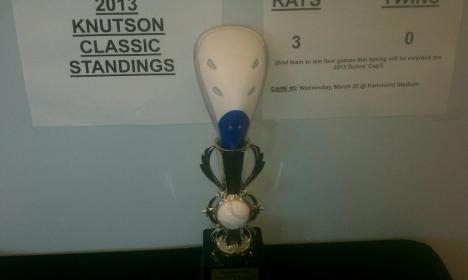
-
With Mariano Rivera announcing his retirement this weekend, the game will lose its most legendary specialist at the conclusion of the 2013 season. Looking back, Rivera dominating the Twins for nearly two decades, throwing mid-90s cutters to shatter an entire forest of bats, and was only shackled with the loss to the Twins just three times in his career: (1) Denny Hocking singled up the middle at Yankee Stadium to score Torii Hunter in the top of the 9th for a 2-1 victory. (2) In 2001, once again at the big ballpark in the Bronx, Yankees catcher Joe Oliver allowed a Rivera pitch to scoot by him and AJ Pierzynski scooted home for the go-ahead run. (3) At the Dome in 2006, with Luis Castillo and Joe Mauer on second and third with two outs, Justin Morneau chips a broken back single into right to score the tying and winning runs. Then there is the Jason Kubel grand slam in 2010. While this one shot in the top of the eighth inning (yes, at 40 years old, Rivera was being asked for two-inning saves) put the Twins out-front, it would be Joba Chamberlain who would be credited with the loss since he put the first two runners on base. To me, it was the Morneau walk-off that stands as the best achievement the Twins had against the elite closer. Although a bit past his prime, Rivera was still hucking mid-90s fastballs at home and missing plenty of bats. Without question, this competitor will surely be missed.
-
Neal: Twins investment in Tonkin paying off
Parker Hageman posted a topic in Twins Minor League Talk
The Twins signed Michael Tonkin in the 30th round of the 2008 draft and handed the big-bodied high schooler a princely sum of $230,000 to sign. So far, that investment has been well spent for the Twins, writes the Star Tribune's La Velle Neal. Those who watched Friday night's broadcast were treated to an inning of Tonkin's work and saw him display a mid-90s fastball with solid movement coupled with a curve with some impressive tilt. Tonkin's addition of those pitches may make him a lethal option for the Twins in the very near future. -
You can view the page at http://twinsdaily.com/content.php?r=1433-What-does-Liam-Hendriks-need-to-do-to-succeed
-
What does Liam Hendriks need to do to succeed?
Parker Hageman commented on Parker Hageman's blog entry in Over the Baggy
[ATTACH=CONFIG]3413[/ATTACH]Liam Hendriks could very well be one of the five starting pitchers the Minnesota Twins take north when camp breaks at the end of the month. He has the minor league numbers to show that he capable of retiring batters. He just needs to do the same against major league hitters. One area he needs to improve on in 2013 is achieving better result when he releases a slider from his fingertips. Coming off the season he had last year, no one would blame him from shelving the pitch indefinitely. Just under 200 times, Hendriks twirled his slider towards home. He retired a batter on that pitch in less than 5% of those occasions – the lowest rate in baseball with a minimum of 100 pitches in 2012. On seven instances, that slider became a home run. Admittedly, six other pitchers managed to surrender more jack jobs on the slide piece but those pitchers also threw the breaking ball at least 300 more times than Hendriks did. Those are some stomach-churning results. A 2012 interview with MILB.com’s Andrew Pentis may help illuminate Hendriks’ struggles with the pitch. According to the interview, the then Rochester Red Wing told Pentis that he had acquired the slider in 2008 from former reliever Graeme Lloyd, another hurler of Australian descent who was coaching down under. Hendriks said that the slider is his “fourth pitch”, behind his two fastballs and change, and he likes to throw it in on lefties and away to righties. When it comes to the latter, therein lies the problem. Last year I examined some of Hendriks’ tendencies and video to find that his closed landing foot causes an inability to hit the outer-half of the plate to righties as effectively as he would hitting the inside corner. Here we see his heat map of where his slider crossed the plate: [ATTACH=CONFIG]3414[/ATTACH] While it appears that he is trying to work away with his slider -- as evidenced by his sporadic spotting down and away -- the majority of his offerings fall within the zone, specifically in the dreaded “middle-middle” location. These are easily feasted upon and have led to a .341 average against (15-for-44) with seven of those hits becoming home runs in 2012. His second start of the spring, a three-inning affair, showed promise that his future remains bright. Following the game, Hendriks told reporters that he had been working on his mechanics: Hendriks continued by saying he did want to remain closed “a little bit” to add to the deception. That may not be a bad thing. After all, it may be a part of this deception which allowed him to maintain a reverse split: a .786 OPS facing lefties and a .998 OPS facing righties. But the improvement in the motion could be enough to allow for better placement of his slider – something that he told reporters felt better after his second spring start. With sustained success in the majors his ultimate goal, finding a stable breaking offering to throw to right-handers will be somewhat critical. If this mechanical adjustment can help facilitate that, then he may be able to replicate some of his minor league triumphs at the big league level. -
-
Liam Hendriks could very well be one of the five starting pitchers the Minnesota Twins take north when camp breaks at the end of the month. He has the minor league numbers to show that he capable of retiring batters. He just needs to do the same against major league hitters. One area he needs to improve on in 2013 is achieving better result when he releases a slider from his fingertips. [PRBREAK][/PRBREAK] Coming off the season he had last year, no one would blame him from shelving the pitch indefinitely. Just under 200 times, Hendriks twirled his slider towards home. He retired a batter on that pitch in less than 5% of those occasions – the lowest rate in baseball with a minimum of 100 pitches in 2012. On seven instances, that slider became a home run. Admittedly, six other pitchers managed to surrender more jack jobs on the slide piece but those pitchers also threw the breaking ball at least 300 more times than Hendriks did. Those are some stomach-churning results. A 2012 interview with MILB.com’s Andrew Pentis may help illuminate Hendriks’ struggles with the pitch. According to the interview, the then Rochester Red Wing told Pentis that he had acquired the slider in 2008 from former reliever Graeme Lloyd, another hurler of Australian descent who was coaching down under. Hendriks said that the slider is his “fourth pitch”, behind his two fastballs and change, and he likes to throw it in on lefties and away to righties. When it comes to the latter, therein lies the problem. Last year I examined some of Hendriks’ tendencies and video to find that his closed landing foot causes an inability to hit the outer-half of the plate to righties as effectively as he would hitting the inside corner. Here we see his heat map of where his slider crossed the plate: While it appears that he is trying to work away with his slider -- as evidenced by his sporadic spotting down and away -- the majority of his offerings fall within the zone, specifically in the dreaded “middle-middle” location. These are easily feasted upon and have led to a .341 average against (15-for-44) with seven of those hits becoming home runs in 2012. His second start of the spring, a three-inning affair, showed promise that his future remains bright. Following the game, Hendriks told reporters that he had been working on his mechanics: Hendriks continued by saying he did want to remain closed “a little bit” to add to the deception. That may not be a bad thing. After all, it may be a part of this deception which allowed him to maintain a reverse split: a .786 OPS facing lefties and a .998 OPS facing righties. But the improvement in the motion could be enough to allow for better placement of his slider – something that he told reporters felt better after his second spring start. With sustained success in the majors his ultimate goal, finding a stable breaking offering to throw to right-handers will be somewhat critical. If this mechanical adjustment can help facilitate that, then he may be able to replicate some of his minor league triumphs at the big league level.
-
According to MLB.com's twitter feed, the Team USA lineup in their pre-WBC exhibition match against the White Sox are going a little unconventional: Joe Mauer is batting cleanup. While that may not be noteworthy had Mauer been playing for Team Italy, however, America's team has such notable sluggers as the Marlins' Giancarlo Stanton (.553 career slugging%), Yankees' first baseman Mark Teixeira (.527) and Mets' third baseman David Wright (.503) hitting behind Mauer (.468). The Twins catcher has batted fourth just seven times in his career according to MLB.com's Rhett Bollinger and Aaron Gleeman adds that it has been since '06 when Mauer batted there last. But it's a practice of a practice game so who really cares, right?
-
Hmm. That really has not played out in terms of pitch value across the league. If you look at the research done at Hardball Times Annual 2010 or 2011 you see that down and away is by far the most effective location for a changeup. Certainly speed differential and deception will allow for getting away with leaving a ball thigh-high but keeping the change in the proper spot will make it more successful. Overall, completely agree that Worley needs to disguise it more.
-
Right. But Burton doesn't actually split his fingers, it's just named for the similar movement to a split-finger.
-
I think it is a misconception that Burton throws a split-change. According to this piece in the Pioneer Press, it is actually a circle change that has the action of a split-finger (hence the name, splangeup): I'd like someone to get full confirmation on that grip. Depends on your definition of effective. He seldom threw it (less than 8% of the time) and threw it will very little separation from his fastball's velocity (6 mph differential). Opponents hit .429 off of it with six of the nine hits going for extra bases.
-
To be clear, he throws a curve and a slider too. Neither have been effective. His focus has been to refine the changeup to give him that velocity separation.
-
You can view the page at http://twinsdaily.com/content.php?r=1421-Vance-Worley-and-the-need-for-a-third-pitch
-
Vance Worley is poised for his second unofficial start for the Minnesota Twins today. Compared to the other recent additions to the rotation, the 25-year-old right-hander’s first outing in the Grapefruit League was very positive. He worked two innings, allowed a pair of hits but didn’t allow any runs. Feedback from his new manager was good. “I like him. He looks like a gunslinger with that windup,” Ron Gardenhire told reporters following the team’s 5-4 victory over the Pirates. “It looks like he’s ready to draw a pistol. I always liked guys like that.” Of course, first impressions are sort of Worley’s thing. It is meeting people a second and third time that the newest member of the team needs to work on, as you will see. Heading into the 2012 season Worley grew concerned that the rest of the league was going to catch on to his sinker, a pitch that had been wildly successful for him in 2011 when he finished 11-3 with a 3.01 ERA in 131.2 innings and took third in the Rookie of the Year voting. “I need to develop a change-up this spring so I can have it ready for this season,” Worley toldYahoo.com’s Dave Brown, “The whole league knows I throw a sinker now, and my cutter is OK; it can be good at times. But definitely I need a third pitch.” True to his word, Worley set out to install the change as his third pitch. Up to that point in his career, his version of the change was the standard “circle” grip, named such because when the pitcher’s thumb and index finger make the “OK” symbol and the ball is thrown with the aid of the three remaining fingers. Still, the results on the pitch in 2011 were lackluster. Because he threw this change at a high velocity (averaging 84.7 mph according to Fangraphs.com) he had little separation between that and his sinker and cutter (thrown on average at 90 mph). Opponents smacked the change around to the tune of a .309 average. Even coming off his solid rookie campaign, Phillies pitching coach Rich Dubee reiterated the need for Worley to add an additional pitch. “Hitters will adjust after seeing him,” he told the media. “He has to adjust, too.” Worley had the good fortune of being employed alongside one of the best pitchers in the game, Roy Halladay. Just a few years prior, Halladay learned a new change-up grip that helped win him the National League Cy Young Away in 2010. Rather than the circle grip he split his ring and middle fingers out wide on what would have been a prototypical two-seam fastball grip, a less wide version of the split-finger fastball. What the former Cy Young winner did was develop a “split-change” that had heavy sink and enough speed variation to make it extremely effective. In camp in 2012, Worley hoped to come away with the new version of his change-up but despite the fact he had shaved a tad off of the velocity (down to 83 mph), he still did not feel comfortable throwing it frequently throughout the year. Nevertheless, Worley had success despite not missing bats was due to his deceptive delivery andoutstanding movement on his sinker/two-seamer. He froze opponents regularly, ringing up a baseball-high 57% of his strikeouts looking. What’s more is that umpires (with some help from his catcher) gave him nearly 10% of his pitches not swung at and thrown OUTSIDE of the strike zone a strike. That’s well above the league average of 7%. It appears, at least judging by the statistics, that opponents figured out not to be fooled as much by the movement or deceptive delivery the second or third time around. Worley’s splits may show signs of how he was affected by his shallow arsenal. According to Baseball-Reference.com’s pitching splits, Worley labored as the lineup continued to turnover in 2012. After the first time through the order, the spectacled one held the opposition to a 620 OPS coupled with a 22% strikeout rate. This success would slide significantly as the game progressed. The second time through the OPS increased to 863 while his strikeout rate dropped to 17%. The third time around, the floodgates would open as his OPS allowed spiked to 971 while his strikeout rate came in at 13%. With a lack of a solid third pitch, was the shifting numbers a result of opponents zeroing in on his sinker and cutter? While those segmentations are small sample sizes, the OPS allowed in the second and third time through the order were noticeably higher than the league average. As Worley said prior to the 2012 season, he was in need of an additional pitch. He threw a solid cutter, one that had the highest percentage of swing-and-misses among his repertoire last season, but that has been below average among all pitch types in that department. There’s probably some hesitation as to why Worley had mistrust in his change. It is a “feel” pitch and, given the fact that he allowed three of the 12 home runs surrendered on the pitch while throwing it less than 8% of the time. Look at his intended location versus his actual location for this change when facing Pittsburgh’s Pedro Alverez: http://apps.startribune.com/blogs/user_images/theeight_1362146832_Worley_Spot1.PNG http://apps.startribune.com/blogs/user_images/Worley_Result1.PNG Yes. That ball went way far, far away. The reason was that instead of down and away as desired, this slow mover went middle-in and allowed Alverez to nearly send that pitch back to the other side of the state of Pennsylvania. If a pitcher does not have confidence to hit his spots consistently, that pitcher may withhold throwing that pitch. And it appears that Worley still does not have faith in that offering either. “My changeup is usually just terrible all around, all the time,” Worley told reporters after his first outing this spring. “So if I can not use it, I won’t use it.” True, Worley only faced eight batters so he did not have the lineup turn on him and likely did not need to show them anything else. Yet switching to the American League, where, thanks to the DH, lineups are more robust, it should accelerate the need to refine that pitch. If he is able to hone that pitch, he may have better success against his opponent that second and third time through the order in 2013.
-
Vance Worley and the need for a third pitch
Parker Hageman commented on Parker Hageman's blog entry in Over the Baggy
Vance Worley is poised for his second unofficial start for the Minnesota Twins today. Compared to the other recent additions to the rotation, the 25-year-old right-hander’s first outing in the Grapefruit League was very positive. He worked two innings, allowed a pair of hits but didn’t allow any runs. Feedback from his new manager was good. “I like him. He looks like a gunslinger with that windup,” Ron Gardenhire told reporters following the team’s 5-4 victory over the Pirates. “It looks like he’s ready to draw a pistol. I always liked guys like that.” Of course, first impressions are sort of Worley’s thing. It is meeting people a second and third time that the newest member of the team needs to work on, as you will see. Heading into the 2012 season Worley grew concerned that the rest of the league was going to catch on to his sinker, a pitch that had been wildly successful for him in 2011 when he finished 11-3 with a 3.01 ERA in 131.2 innings and took third in the Rookie of the Year voting. “I need to develop a change-up this spring so I can have it ready for this season,” Worley toldYahoo.com’s Dave Brown, “The whole league knows I throw a sinker now, and my cutter is OK; it can be good at times. But definitely I need a third pitch.” True to his word, Worley set out to install the change as his third pitch. Up to that point in his career, his version of the change was the standard “circle” grip, named such because when the pitcher’s thumb and index finger make the “OK” symbol and the ball is thrown with the aid of the three remaining fingers. Still, the results on the pitch in 2011 were lackluster. Because he threw this change at a high velocity (averaging 84.7 mph according to Fangraphs.com) he had little separation between that and his sinker and cutter (thrown on average at 90 mph). Opponents smacked the change around to the tune of a .309 average. Even coming off his solid rookie campaign, Phillies pitching coach Rich Dubee reiterated the need for Worley to add an additional pitch. “Hitters will adjust after seeing him,” he told the media. “He has to adjust, too.” Worley had the good fortune of being employed alongside one of the best pitchers in the game, Roy Halladay. Just a few years prior, Halladay learned a new change-up grip that helped win him the National League Cy Young Away in 2010. Rather than the circle grip he split his ring and middle fingers out wide on what would have been a prototypical two-seam fastball grip, a less wide version of the split-finger fastball. What the former Cy Young winner did was develop a “split-change” that had heavy sink and enough speed variation to make it extremely effective. In camp in 2012, Worley hoped to come away with the new version of his change-up but despite the fact he had shaved a tad off of the velocity (down to 83 mph), he still did not feel comfortable throwing it frequently throughout the year. Nevertheless, Worley had success despite not missing bats was due to his deceptive delivery andoutstanding movement on his sinker/two-seamer. He froze opponents regularly, ringing up a baseball-high 57% of his strikeouts looking. What’s more is that umpires (with some help from his catcher) gave him nearly 10% of his pitches not swung at and thrown OUTSIDE of the strike zone a strike. That’s well above the league average of 7%. It appears, at least judging by the statistics, that opponents figured out not to be fooled as much by the movement or deceptive delivery the second or third time around. Worley’s splits may show signs of how he was affected by his shallow arsenal. According to Baseball-Reference.com’s pitching splits, Worley labored as the lineup continued to turnover in 2012. After the first time through the order, the spectacled one held the opposition to a 620 OPS coupled with a 22% strikeout rate. This success would slide significantly as the game progressed. The second time through the OPS increased to 863 while his strikeout rate dropped to 17%. The third time around, the floodgates would open as his OPS allowed spiked to 971 while his strikeout rate came in at 13%. With a lack of a solid third pitch, was the shifting numbers a result of opponents zeroing in on his sinker and cutter? While those segmentations are small sample sizes, the OPS allowed in the second and third time through the order were noticeably higher than the league average. As Worley said prior to the 2012 season, he was in need of an additional pitch. He threw a solid cutter, one that had the highest percentage of swing-and-misses among his repertoire last season, but that has been below average among all pitch types in that department. There’s probably some hesitation as to why Worley had mistrust in his change. It is a “feel” pitch and, given the fact that he allowed three of the 12 home runs surrendered on the pitch while throwing it less than 8% of the time. Look at his intended location versus his actual location for this change when facing Pittsburgh’s Pedro Alverez: http://apps.startribune.com/blogs/user_images/theeight_1362146832_Worley_Spot1.PNG http://apps.startribune.com/blogs/user_images/Worley_Result1.PNG Yes. That ball went way far, far away. The reason was that instead of down and away as desired, this slow mover went middle-in and allowed Alverez to nearly send that pitch back to the other side of the state of Pennsylvania. If a pitcher does not have confidence to hit his spots consistently, that pitcher may withhold throwing that pitch. And it appears that Worley still does not have faith in that offering either. “My changeup is usually just terrible all around, all the time,” Worley told reporters after his first outing this spring. “So if I can not use it, I won’t use it.” True, Worley only faced eight batters so he did not have the lineup turn on him and likely did not need to show them anything else. Yet switching to the American League, where, thanks to the DH, lineups are more robust, it should accelerate the need to refine that pitch. If he is able to hone that pitch, he may have better success against his opponent that second and third time through the order in 2013. -
Vance Worley is poised for his second unofficial start for the Minnesota Twins today. Compared to the other recent additions to the rotation, the 25-year-old right-hander’s first outing in the Grapefruit League was very positive. He worked two innings, allowed a pair of hits but didn’t allow any runs. Feedback from his new manager was good. “I like him. He looks like a gunslinger with that windup,” Ron Gardenhire told reporters following the team’s 5-4 victory over the Pirates. “It looks like he’s ready to draw a pistol. I always liked guys like that.” Of course, first impressions are sort of Worley’s thing. It is meeting people a second and third time that the newest member of the team needs to work on, as you will see. Heading into the 2012 season Worley grew concerned that the rest of the league was going to catch on to his sinker, a pitch that had been wildly successful for him in 2011 when he finished 11-3 with a 3.01 ERA in 131.2 innings and took third in the Rookie of the Year voting. “I need to develop a change-up this spring so I can have it ready for this season,” Worley toldYahoo.com’s Dave Brown, “The whole league knows I throw a sinker now, and my cutter is OK; it can be good at times. But definitely I need a third pitch.” True to his word, Worley set out to install the change as his third pitch. Up to that point in his career, his version of the change was the standard “circle” grip, named such because when the pitcher’s thumb and index finger make the “OK” symbol and the ball is thrown with the aid of the three remaining fingers. Still, the results on the pitch in 2011 were lackluster. Because he threw this change at a high velocity (averaging 84.7 mph according to Fangraphs.com) he had little separation between that and his sinker and cutter (thrown on average at 90 mph). Opponents smacked the change around to the tune of a .309 average. Even coming off his solid rookie campaign, Phillies pitching coach Rich Dubee reiterated the need for Worley to add an additional pitch. “Hitters will adjust after seeing him,” he told the media. “He has to adjust, too.” Worley had the good fortune of being employed alongside one of the best pitchers in the game, Roy Halladay. Just a few years prior, Halladay learned a new change-up grip that helped win him the National League Cy Young Away in 2010. Rather than the circle grip he split his ring and middle fingers out wide on what would have been a prototypical two-seam fastball grip, a less wide version of the split-finger fastball. What the former Cy Young winner did was develop a “split-change” that had heavy sink and enough speed variation to make it extremely effective. In camp in 2012, Worley hoped to come away with the new version of his change-up but despite the fact he had shaved a tad off of the velocity (down to 83 mph), he still did not feel comfortable throwing it frequently throughout the year. Nevertheless, Worley had success despite not missing bats was due to his deceptive delivery andoutstanding movement on his sinker/two-seamer. He froze opponents regularly, ringing up a baseball-high 57% of his strikeouts looking. What’s more is that umpires (with some help from his catcher) gave him nearly 10% of his pitches not swung at and thrown OUTSIDE of the strike zone a strike. That’s well above the league average of 7%. It appears, at least judging by the statistics, that opponents figured out not to be fooled as much by the movement or deceptive delivery the second or third time around. Worley’s splits may show signs of how he was affected by his shallow arsenal. According to Baseball-Reference.com’s pitching splits, Worley labored as the lineup continued to turnover in 2012. After the first time through the order, the spectacled one held the opposition to a 620 OPS coupled with a 22% strikeout rate. This success would slide significantly as the game progressed. The second time through the OPS increased to 863 while his strikeout rate dropped to 17%. The third time around, the floodgates would open as his OPS allowed spiked to 971 while his strikeout rate came in at 13%. With a lack of a solid third pitch, was the shifting numbers a result of opponents zeroing in on his sinker and cutter? While those segmentations are small sample sizes, the OPS allowed in the second and third time through the order were noticeably higher than the league average. As Worley said prior to the 2012 season, he was in need of an additional pitch. He threw a solid cutter, one that had the highest percentage of swing-and-misses among his repertoire last season, but that has been below average among all pitch types in that department. There’s probably some hesitation as to why Worley had mistrust in his change. It is a “feel” pitch and, given the fact that he allowed three of the 12 home runs surrendered on the pitch while throwing it less than 8% of the time. Look at his intended location versus his actual location for this change when facing Pittsburgh’s Pedro Alverez: http://apps.startribune.com/blogs/user_images/theeight_1362146832_Worley_Spot1.PNGhttp://apps.startribune.com/blogs/user_images/Worley_Result1.PNG Yes. That ball went way far, far away. The reason was that instead of down and away as desired, this slow mover went middle-in and allowed Alverez to nearly send that pitch back to the other side of the state of Pennsylvania. If a pitcher does not have confidence to hit his spots consistently, that pitcher may withhold throwing that pitch. And it appears that Worley still does not have faith in that offering either. “My changeup is usually just terrible all around, all the time,” Worley told reporters after his first outing this spring. “So if I can not use it, I won’t use it.” True, Worley only faced eight batters so he did not have the lineup turn on him and likely did not need to show them anything else. Yet switching to the American League, where, thanks to the DH, lineups are more robust, it should accelerate the need to refine that pitch. If he is able to hone that pitch, he may have better success against his opponent that second and third time through the order in 2013.
-
Article: Joe Mauer Is Having Twins
Parker Hageman replied to John Bonnes's topic in Twins Daily Front Page News
Coors lights! #silverbullet #taptherockies #frostbrewed -
Eric Fisher of the SportsBusiness Journal tweeted today that the Cleveland Indians will be slashing prices on concessions at their ballpark this year, dropping hot dogs to $3 and beers to $4, among other items. Fisher said the Indians were inspired to lower prices after research showed that the cost of concessions was a major inhibitor towards purchasing tickets so they are knocking a buck-fifty off the foamy sticker price. Meanwhile, heading into the 2012 season, at $7 a cup, the Minnesota Twins had the third-highest beer prices among all MLB teams - only the Marlins, Phillies and Tigers charged more for their brew on average. With the Twins projecting another decrease in attendance, wouldn't following the Indians' suit make sense? UPDATE: Twins president Dave St. Peter responded to the post on this pricing change and tweeted that the team has implemented a discount of 10% off concessions to all season ticket holders this year.
-
Lots of good reports about Kyle Gibson...
Parker Hageman replied to John Bonnes's topic in Minnesota Twins Talk
I've heard Hammond runs a bit hot however reports from the AZ Fall League this year also had Gibson touching 96 a few times -- pitch F/X says the same. Could be fluky too but I don't think it is inconceivable that he got up there.
