



Parker Hageman
-
Posts
4,152 -
Joined
-
Last visited
-
Days Won
6
Content Type
Profiles
Minnesota Twins News, Rumors & Analysis
Minnesota Twins Videos
2026 Minnesota Twins Top Prospect Rankings
2022 Minnesota Twins Draft Picks & Signing Bonuses
Minnesota Twins Trade & Free Agent Rumors
Minnesota Twins Fan Guides & Resources
2023 Minnesota Twins Draft Picks & Signing Bonuses
The Minnesota Twins Players Project
2024 Minnesota Twins Draft Picks & Signing Bonuses
2025 Minnesota Twins Draft Picks & Signing Bonuses
2026 Minnesota Twins Draft Picks & Signing Bonuses
Forums
Blogs
Events
Store
Downloads
Gallery
Everything posted by Parker Hageman
-

Aaron Hicks defense graffes draws manager's ire
Parker Hageman commented on Parker Hageman's blog entry in Over the Baggy
[ATTACH=CONFIG]4017[/ATTACH]On Tuesday night in Boston, Aaron Hicks compounded his issues with the manager with a seemingly innocuous action on the field in the eighth inning with the Twins securely up by six runs. With Jonny Gomes up at the plate, the Sox’s beefy right fielder lifted a fly ball into short center field. Hicks came racing in from the deepest regions of center field Fenway (which is also shallow Maine) and in one motion nabs the falling sphere and flips it to second baseman Brian Dozier. Afterwards, the Fox Sports North camera transitioned to the ancient Fenway dugout to capture manager Ron Gardenhire mimicking Hicks’ maneuver to one of the coaches and displaying general displeasure for what his center fielder just did. The broadcast team went over the play several times and then provided a close-up of Hicks who seemed to be peeking towards the direction of the dugout while his manager fumed. Here you can find a quick glimpse of the play in question: When he came in after the inning, Hicks was greeted by Gardenhire, who, if he had any sense of Lou Brown/Major League humor at all, would have said “Nice catch Hicks, now don’t ever f**king do that again.” Instead, in the far corners of the green dugout, Gardenhire subjected Hicks to a Twins Way re-education seminar. Again, it is simple enough. Nothing overtly flashy or egregious. It was not as if the rookie has flipped the ball behind his back or between his legs at Dozier. He did not take a pen out of his back pocket and sign it or did the Sam Cassell “big ball” celebration dance. While one cannot say for certain, this feels like a move that Torii Hunter and Carlos Gomez have at least done a handful of times during their tenure with the Minnesota Twins. Still, when you are put on Gardy’s double-secret probation list, the slightest indiscretion triggers these types of reactions. Hicks’ recent defensive gaffes had pushed him out of the lineup on Tuesday. On Monday, the center fielder allowed a seemingly catchable fly ball drop to the earth while, later, he overshot his cut by four states – a play that was only salvaged because Pedro Florimon was able to make a strong throw home and Joe Mauer was able to sell the fact that he applied the tag when no tag was made. Ron Gardenhire thought the play should have been much easier than that. Monday night was not the first time this year in which the manager had to take a moment to lecture his young player on the merits of hitting the cut-off man. During spring training, Hicks missed his cut and Gardenhire talked to him afterwards in the dugout. "It was perfectly understandable why he got into me," Hicks told reporters after the spring training game. "I have to be able to hit the cutoff man. That's my job. That's what needed to be done, and I didn't do it." Overall, his defensive performance has been even more troublesome than just those two isolated instances. According to UZR/150, his mark of -14.2 runs is 18th out of 23 qualified center fielders. Meanwhile, his Revised Zone Rate (RZR) of .862 ranks 22 out of 23 – meaning that he is making just 86.2% of in-zone plays that center fielders should make. Last, Baseball Info Solution’s Plus/Minus has his contributions at -5. Certainly the small sample size warning applies but the three metrics all agree and appear to confirm the eye test that Hicks is not a defensive wizard to this point in the season. There is no question that Hicks has the speed to cover copious amounts of real estate and an arm to shut down opponents’ running games. He still has a lot to learn about how the game is played at the major league level. Gardenhire wants him to understand that you cannot have a million dollar arm and a ten cent head. -
On Tuesday night in Boston, Aaron Hicks compounded his issues with the manager with a seemingly innocuous action on the field in the eighth inning, with the Twins securely up by six runs. With Jonny Gomes up at the plate, the Sox’s beefy right fielder lifted a fly ball into short center field. Hicks came racing in from the deepest regions of center field in Fenway (which is also shallow Maine) and in one motion nabs the falling sphere and flips it to second baseman Brian Dozier. [PRBREAK][/PRBREAK] Afterwards, the Fox Sports North camera transitioned to the ancient Fenway dugout to capture manager Ron Gardenhire mimicking Hicks’ maneuver to one of the coaches and displaying general displeasure for what his center fielder just did. The broadcast team went over the play several times and then provided a close-up of Hicks who seemed to be peeking in the direction of the dugout while his manager fumed. Here you can find a quick glimpse of the play in question: When he came in after the inning, Hicks was greeted by Gardenhire, who, if he had any sense of Lou Brown/Major League humor at all, would have said “Nice catch Hicks, now don’t ever f**king do that again.” Instead, in the far corners of the green dugout, Gardenhire subjected Hicks to a Twins Way re-education seminar. Again, it was simple enough. Nothing overtly flashy or egregious. It was not as if the rookie had flipped the ball behind his back or between his legs. He did not take a pen out of his back pocket and sign it nor did he perform the Sam Cassell “big ball” celebration dance. While one cannot say for certain, this feels like a move that Torii Hunter and Carlos Gomez had done a handful of times during their tenure with the Minnesota Twins. Still, when you are put on Gardy’s double-secret probation list, the slightest indiscretion triggers these types of reactions. Hicks’ recent defensive gaffes had pushed him out of the lineup on Tuesday. On Monday, the center fielder allowed a seemingly catchable fly ball to drop to the earth and on a later play he overshot his cutoff man by four states – a play that was only salvaged because Pedro Florimon was able to make a strong throw home and Joe Mauer was able to sell the fact that he applied the tag when no tag was made. Ron Gardenhire thought the play should have been much easier than that. Monday night was not the first time this year in which the manager had to take a moment to lecture his young player on the merits of hitting the cut-off man. During spring training, Hicks missed his cut and Gardenhire talked to him afterwards in the dugout. "It was perfectly understandable why he got into me," Hicks told reporters after the spring training game. "I have to be able to hit the cutoff man. That's my job. That's what needed to be done, and I didn't do it." Overall, his defensive performance has been even more troublesome than just those two isolated instances. According to UZR/150, his mark of -14.2 runs is 18th out of 23 qualified center fielders. Meanwhile, his Revised Zone Rate (RZR) of .862 ranks 22 out of 23 – meaning that he is making just 86.2% of in-zone plays that center fielders should make. Lastly, Baseball Info Solution’s Plus/Minus has his contribution at -5. Certainly the small sample size warning applies but the three metrics all agree and appear to confirm the eye test that Hicks is not a defensive wizard to this point in the season. There is no question that Hicks has the speed to cover copious amounts of real estate and an arm to shut down opponents’ running games. He still has a lot to learn about how the game is played at the major league level. Gardenhire wants him to understand that you cannot have a million dollar arm and a ten cent head.
-
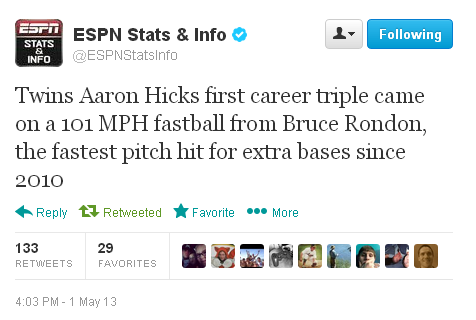
Aaron Hicks' second extra base hit of the season came in the form of a triple on a 1-2 count in the top of the seventh from the Tigers'reliever Bruce Rendon. Rendon's fastball registered 101 miles per hour by SportsVision's PitchF/X system. Seemed really fast to me. Turns out it was. ESPN Stats & Info Department tweeted out any interesting nugget about that hit: Good for Hicks.
-
Article: What is the matter with Joe Mauer?
Parker Hageman replied to Parker Hageman's topic in Twins Daily Front Page News
I tend to agree. If you watched the broadcast last night, Coomer made it sound as if there was some mechanical issues (i.e. pulling open) but reviewing film from the past two weeks, there hasn't been anything that jumps out. At least not as obvious as say Morneau. There are some terrible swings such as the one induced by Verlander above, but that may be pressing while fatigued. Two days off should give him some time off to recoup and collect himself. "All the line drives"? He's hit three line drives during the slump. He knocked into a smashed grounder double-play in the Texas series that was a well-hit ball but it was right at Andrus who was playing up the middle for two. Outside of that, not recalling too many other instances where he's squared up well. It's just not there. -
Article: What is the matter with Joe Mauer?
Parker Hageman replied to Parker Hageman's topic in Twins Daily Front Page News
It's basically the same thing that has plagued him since 2011. I had a post on my old site that showed this in action. It's two years later and he still has the exact same issue. Might revisit that for Friday. -
You can view the page at http://twinsdaily.com/content.php?r=1652-What-is-the-matter-with-Joe-Mauer
-
After a slow start in the season’s opening week, Joe Mauer was once again cracking line drives – right on schedule – but has more recently found himself in one of the worst stretches of offensive baseball of his career and quite possibly the worst since he was a fetus. Pardon the arbitrary endpoints, but from April 6 to April 20, Mauer had collected 18 hits in 35 at bats (a whopping .514 batting average). In that time, the Twins catcher was blistering the baseball to the opposite field, accumulating five of his seven extra base hits in that direction, including both of his home runs (per the Mauer norm). Then, as quick as the flick of his wrists for an outer-half offering, his production disappeared. Since April 21, he has he has gotten just three hits (including Tuesday night’s single off of Verlander) in his last 33 at bats, making this nine-game span’s batting average a puny .090. According to Fangraphs.com’s Splits Leaderboard, over the last seven days Mauer’s .077 batting average is the fourth-worst in baseball, besting only Drew Stubbs, Ryan Raburn and Adam LaRoche. While it may be easy to dismiss this output as a product of the baseball gods correcting his absurd balls in play average over the previous stretch, Mauer’s drought may be structurally based. Far be it from me to deconstruct one of the smoothest, most mechanically sound swings the game has ever seen. That would be like a St Cloud State art major trying to criticize the painting on the ceiling of the Sistine Chapel. Ron Coomer, on the other hand, presented his thoughts on what has suddenly happened to this beautiful motion. During last night’s broadcast on Fox Sports North, Coomer observed that Mauer is opening up slightly, thereby elongating his swing. This, he said, altered the contact point to some extent and has been causing him to not square up on the ball. It is hard to see clear evidence of this in available video clips yet there is no denying Mauer has recently taken some of his most un-Mauerian cuts ever at pitches and those have resulted in very few line drives over his last 33 at bats. In fact, last night’s line drive single was just the second line drive he has hit since April 21. Hell, over the weekend we nearly witnessed him pop out to the infield – an event that has occurred just once in the last three seasons. Consider this awkward swing in this screen grab from his strike out last night: Notice how far Mauer’s head moved offline in order to track Verlander’s curveball. Full disclosure, Justin Verlander makes a lot of great hitters look stupid. That said, Joe Mauer - with his career 1.072 OPS against Verlander - is typically not one of them. To Coomer’s point, Mauer has taken more swings at pitches middle and in during this cold streak compared to his hot streak in which he had swung at more pitches middle and away – the kinds he was driving to left field. Part of the reason for the increase on the swings on the inner-half of the plate could be due to pulling off the ball a bit. Teams have also changed their approach with him. Perhaps the reports from the advanced scouts indicated that there was less concern with Mauer at this point because, beginning in the Rangers series, opponents simply stopped missing the strike zone. In his 14 games leading up to April 26, pitchers had landed 59% of their pitches for strikes against him. Since then, that rate has shot up to 76%. So, he has been seeing tons of potentially hittable pitches. What is going on with Minnesota’s $184 Million Dollar Hit Man? The simplest answer is that it is a short time frame and everyone is susceptible to these statistical anomalies in a small sample size, which in this case, is 38 plate appearances. Within that regression lie a handful of drivers that are pulling his numbers down – a subtle mechanical flaw here, poor swing decisions there and strike zone aggressiveness of the opposition. Success in baseball is fluid. Those like Mauer who have been able to hit consistently over .300 in their careers are able to do so because they can make changes and corrections relatively quickly. If we all just take a deep breath, at some point in the near future he will snap out of this dry spell.
-
What is the matter with Joe Mauer?
Parker Hageman commented on Parker Hageman's blog entry in Over the Baggy
[ATTACH=CONFIG]3957[/ATTACH]After a slow start in the season’s opening week, Joe Mauer was once again cracking line drives – right on schedule – but has more recently found himself in one of the worst stretches of offensive baseball of his career and quite possibly the worst since he was a fetus. Pardon the arbitrary endpoints, from April 6 to April 20, Mauer had collected 18 hits in 35 at bats (a whopping .514 batting average). In that time, the Twins catcher was blistering the baseball to the opposite field, accumulating five of his seven extra base hits that direction, including both of his home runs (per the Mauer norm). Then, as quick as the flick of his wrists for an outer-half offering, his production disappeared. Since April 21, he has he has gotten just three hits (including Tuesday night’s single off of Verlander) in his last 33 at bats, making this nine-game span’s batting average a puny .090. According to Fangraphs.com’s Splits Leaderboard, over the last seven days Mauer’s .077 batting average is the fourth-worst in baseball, besting only Drew Stubbs, Ryan Raburn and Adam LaRoche. While it may be easy to dismiss this output as a product of the baseball gods correcting his absurd balls in play average over the previous stretch, Mauer’s drought may be structural based. Far be it from me to deconstruct one of the smoothest, most mechanically sound swings the game has ever seen. That would be like a St Cloud State art major trying to criticize the painting on the ceiling of the Sistine Chapel. Ron Coomer, on the other hand, presented his thoughts on what has suddenly happened to this beautiful motion. During last night’s broadcast on Fox Sports North, Coomer observed that Mauer is opening up slightly, thereby elongating his swing. This, he said, altered his contact point to some extent and has been causing him not to square up on the ball. It is hard to see clear evidence of this in available video clips yet there is no denying Mauer has taken some of his most un-Mauer-ian cuts at pitches as of late and those have resulted in very few line drives over his past 33 at bats. In fact, last night’s line drive single was just the second line drive he has hit since April 21. Hell, over the weekend we nearly witnessed him pop out to the infield – an event that has occurred just once in the last three seasons. Consider this awkward swing in this screen grab from his strike out last night: [ATTACH=CONFIG]3959[/ATTACH] Notice how far Mauer’s head moved offline in order to track Verlander’s curveball. Full disclosure, Justin Verlander makes a lot of great hitters look stupid. That said, Joe Mauer - with his career 1.072 OPS against Verlander - is typically not one of them. To Coomer’s point, Mauer has taken more swings at pitches middle and in during this cold streak compared to his hot streak in which he had swung at more pitches middle and away – those kinds he was driving to left field. Part of the reason for the increase on the swings on the inner-half of the plate could be due to pulling off the ball a bit. [ATTACH=CONFIG]3958[/ATTACH] The teams have also changed their approach with him too. Perhaps the reports from the advanced scouts indicated that there was less to be concerned over with Mauer at this point because, beginning in the Rangers series, opponents simply stopped missing the strike zone. In his 14 games leading up to April 26, pitchers had landed 59% of their pitches for strikes against him. Since then, that rate has shot up to 76%. In theory,he has been seeing tons of hittable pitches. What is going on with Minnesota’s $184 Million Dollar Hit Man? The simplest answer is that it is a short timeframe and everyone is susceptible to these statistical anomalies in a small sample size over 38 plate appearances. Within that regression lie a handful of drivers that is pulling his numbers down – a subtle mechanical flaw here, poor swing decisions there and topped off with the strike zone aggressiveness of the opposition. Success in baseball is fluid. Those like Mauer who have been able to hit consistently over .300 in their careers are able to do so because they can make changes and corrections relatively quick. If we all just breathe for a second, at some point in the near future he will snap out of this dry spell. -
-
You can view the page at http://twinsdaily.com/content.php?r=1623-There-is-a-lot-wrong-with-Mike-Pelfrey-right-now
-
Just a month removed from being celebrated for his amazingly quick recovery from Tommy John surgery less than 11 months ago, Mike Pelfrey’s numbers through his first four starts in a Twins uniform have been extremely disappointing. This raises the question of whether or not Pelfrey is completely ready for re-introduction into the major leagues. After all, this is in line with the plight of Joe Nathan in 2010 who rushed through his rehab only to hit a wall a month into the season. Despite being the owner of a 7.94 ERA through 17 innings in 2013, the notion of removing Pelfrey from the rotation at this point appears moot. [PRBREAK][/PRBREAK]The idea was quickly shot down by manager Ron Gardenhire following his most recent start, said Pioneer Press beat writer Mike Bernadino. Clearly, Pelfrey has a lot of things going wrong right now. If you were listening to the broadcasts, you were told that the reason that the big right-hander is struggling is due to his decline in velocity. But let’s be honest here: It’s not as if Pelfrey is suddenly throwing the Henry Rowengartner floater pitch to every batter he sees. It’s less than a mile per hour slower. In 2011, his last full season at the major leagues, he was throwing his fastball at 92.2 miles per hour. This year, it has been at 91.3. All things considered, that is not substantial. Let’s take a look at the things that are really plaguing him in 2013. (1) Command. Experts and those who have gone through the procedure agree that command is the last skill to return after Tommy John surgery. Last week, Jeff Zimmerman of Fangraphs.com interviewed Kansas City Royals’ pitching coach Dave Eiland – someone who had gone through the surgical process and recovery in his playing days – echoed that sentiment. “One of the last things to come back is the command.” Eiland told Zimmerman, “You might feel strong. You might be fast. You might be good to go. Pitching off the mound and competing in a game is all together different then throwing sides and batting practice. My suggestion is if you think everything feels good, take another month.” Pelfrey’s return was heralded as nothing short of miraculous. And in many ways it was. No other pitcher on record has come back from the surgery in fewer than 12 months and competed in a major league game. However, we have seen his struggles to command the ball. Like Eiland said, you can feel great in many other facets of the game, but once the real games start, your precision may not be all there. In Pelfey’s case, his ability to locate the ball in the strike zone has been one of the worst in the league. After his first three outings, Pelfrey’s in-zone percentage – the number of pitches he has thrown in the strike zone – is 39.8%, the sixth-lowest in baseball. Worse, the five below him throw a high percentage of breaking balls – pitches that are harder to command and are often supposed to be out of the strike zone -- while Pelfrey has been throwing his fastball/sinker 70% of the time. Fortunately, Pelfrey found the zone more frequently in his start against the Marlins on Tuesday (58 of 94 pitches) to increase his zone presence. What is more worrisome than not throwing the ball over the plate is his missing his spots. Here is a recent example of this malfeasance. This sinker to Rob Brantley was supposed to be down and away, per Ryan Doumit’s request, but wound up in the middle of the zone: This particular pitch was lasered to the right field gap for a two-run double. Some such pitches and outcomes have not been that detrimental but a lot of the contact allowed, even on the ground, has been loud and solid. (2) His pitches are staying up in the zone. What the noise from the bats is telling the ball guys around the stadium, the data from pitch f/x confirms: Pelfrey’s pitches just are not moving the way they did prior to the injury. When it comes to his sinker, the pitch is staying up in the zone, on average, an inch high than it has in the past. Where it was coming in at 5.5 inches in 2010, 6.7 in 2011 and 6.2 in 2012, it has shot up to 7.5 inches this season, meaning there is less of a sink. Less sink from a sinkerball pitcher is not a good thing. Results wind up like the aforementioned example. His slider, his most often used secondary pitch, has had less vertical drop compared to previous seasons. In 2010, his vertical finish was 3.4 inches. Same in 2011. This year, it is 6.8, a little over three inches higher than his last two healthy seasons, meaning less downward movement. This is very comparable to Joe Nathan during his recovery with the Twins in 2010. Prior to heading back to Rochester, Nathan's slider stayed in the 6-to-7 inch range while in the past there was much more substantial drop than that. Finally, his split-finger change, a pitch he throws mainly to lefties, has been splattered across the field the few times it has been thrown. Opponents are 4-for-6 off it and, you guessed it, it too is staying up in the zone. This has translated into a whole lot of contact and a whole lot of well-struck contact – even if the majority of it has resulted in grounders. That is how you “scatter” 29 hits over 17 innings. (3) Release point. This ties in to the first two items. His release point is measurably lower than his 2011 season. Two years ago, Pelfrey was releasing his pitches a little over six feet high. That has since dropped to under five-feet-nine-inches, according to BrooksBaseball.net. The angles are different, but the release point is captured well in these examples. In 2011, you see the higher release point – a great thing considering his overall large stature. In 2012, that leveled out some. While a few inches may not seem like much, this lowered released point is likely one of the reasons he is not seeing the usual downward movement, since his sinker and slider flatten out when his arm angle drops and he is unable to stay on top of the ball. (4) Mound Presence. Sinkerball pitchers are a finicky lot. Former Met teammate and once-upon-a-time sinkerballer, R.A. Dickey, told reporters in 2011 how easy it is to completely lose the feel for the pitch after Pelfrey continued to have issues that spring. “There’s so many different things that can impact the movement of the pitch,” Dickey told reporters, “that you do, sometimes, lose it for a period.” Dickey went on to say that a slight change in the grip or the arm action could cause a loss of movement that he would struggle to regain. The Mets discovered that Pelfrey is someone who had a history of needing to readjust regularly. Early in his career, he kept his glove at chest level when he started his windup. He changed that to keeping his hands at belt-level before his windup. In spring training of 2012, he went to bringing his hands over his head in order to get more of a downward plane and stay on top of his sinker, the same motion he uses today. Additionally, after being a guy who had worked off the third base side of the rubber for most of the previous two seasons, he swapped that practice for the far left side of the rubber, pitching instead off the first base side. Take a look: It may be minor, but when you add up all the changes and alterations in the past several years, in addition to the recovery from the Tommy John surgery, these may be affecting his ability to repeat his mechanics consistently to the point where he can't command all his pitches effectively. (5) Tempo. Mike Hargrove, in his playing days with Texas and Cleveland in the late ‘70s and early ‘80s, was affectionately known as “The Human Rain Delay” for his . Meanwhile, Mike Pelfrey, a few decades later and sixty-feet-and-six-inches away from the batter’s box, is doing his own version of that in 2013. While not nearly as OCD as Hargrove, Pelfrey’s pace on the mound is staggeringly slow. After maintaining a normal pace of around 22 seconds per pitch, the right-hander is lulling opponents and fans to sleep with his 27.5 seconds between each pitch. By comparison, Houston’s Bud Norris, the next slowest pitcher in the majors, is nearly two seconds quicker with his delivery to home. Is this a lack of confidence in his stuff, not being on the same page as his catcher or simply a pace slowed by 11 months of rust? There is a lot to be read into the fact that Pelfrey has been holding the ball a lot longer than usual. **** Pelfrey has an extensive list of things that are not going right for him. Lack of command and movement, a noticeably lowered release point, an evolving mound presence and a tempo problem that is wearing down his own defense and spectators have all been reasons why he has struggled so much at the opening of the season. At this point, management is letting him fight through his own issues. That said, with a few more outings like the one against the lowly Marlins, don’t be surprised if Pelfrey is on the outside of the rotation looking in.
-
There is a lot wrong with Mike Pelfrey right now
Parker Hageman commented on Parker Hageman's blog entry in Over the Baggy
[ATTACH=CONFIG]3861[/ATTACH]Just a month removed from being celebrated for his amazingly quick recovery from Tommy John surgery less than 11 months ago, Mike Pelfrey’s numbers through his first four starts in a Twins uniform have been extremely disappointing. This raises the questions of whether or not Pelfrey is completely ready for reintroduction into the major leagues. After all, this follows step with the plight of Joe Nathan in 2010 who rushed through his rehab only to hit a wall a month into the season. Despite being the owner of a 7.94 ERA through 17 innings in 2013, the notion of removing Pelfrey from the rotation at this point appears moot. The idea was quickly shot down by manager Ron Gardenhire following his most recent start, said Pioneer Press beat writer Mike Bernadino. Clearly, Pelfrey has a lot of things going wrong right now. If you were listening to the broadcasts, you would be told that the reason that the big right-hander is struggling is due to his decline in velocity. But let’s be honest here: It’s not as if Pelfrey is sudden throwing the Henry Rowengartner floater pitch to every batter he sees. It’s less than a mile per hour of difference. In 2011, his last full season at the major leagues, he was throwing his fastball at 92.2 miles per hour. This year, it has been at 91.3. All things considered, that is not substantial. Let’s take a look at the things that are really plaguing him in 2013. (1) Command. Experts and those who have gone through the procedure agree that command is the last skill to return after Tommy John surgery. Last week, Jeff Zimmerman of Fangraphs.com interviewed Kansas City Royals’ pitching coach Dave Eiland – someone who had gone through the surgical process and recover in his playing days – echoed that sentiment. “One of the last things to come back is the command.” Eiland told Zimmerman, “You might feel strong. You might be fast. You might be good to go. Pitching off the mound and competing in a game is all together different then throwing sides and batting practice. My suggestion is if you think everything feels good, take another month.” Pelfrey’s return was heralded as nothing short of miraculous. And in many ways, it was. No other pitcher on record had comeback from the surgery in less than 12 months and competed in a major league game. However, what we have seen is his struggles to command the ball. Like Eiland said, you can feel great in many other facets of the game, but once the real games start, your precision may not be all there. In Perlfey’s case, his ability to locate the ball in the strike zone has been one of the worst in the league. In after his first three outings, Pelfrey’s in-zone percentage – the number of pitches he has thrown in the strike zone – is at 39.8%, the sixth-lowest in baseball. To make matters worse, the five ahead of him throw a high percentage of breaking balls – pitches that are harder to command and are often suppose to be out of the strike zone -- while Pelfrey has throwing his fastball/sinker 70% of the time. Fortunately, Pelfrey found the zone more frequently in his start against the Marlins on Tuesday (58 of 94 pitches) to increase his zone presence. What is more worrisome than not throwing the ball over the plate is his missing his spots. Here is a recent example of this malfeasance. This sinker to Rob Brantley was supposed to be down and away, per Ryan Doumit’s request, but wound up in the middle of the zone: [ATTACH=CONFIG]3862[/ATTACH] [ATTACH=CONFIG]3863[/ATTACH] This particular pitch was lasered to the right field gap for a two-run double. Some are not nearly that detrimental but a lot of the contact allowed, even on the ground, has been loud. (2) His pitches are staying up in the zone. What the noise off of the bats may tell the ball guys around the stadium, the data from pitch f/x confirms: Pelfrey’s pitches just are not moving the same way they did prior to the injury. When it comes to his sinker, the pitch is staying up in the zone – on average – above an inch high than it had in the past. Where it was coming in at 5.5 inches in 2010, 6.7 in 2011 and 6.2 in 2012, it has shot up to 7.5 inches this season, meaning there is less of a sink. Less sink from a sinkerball pitcher is not a good thing. Results wind up like the aforementioned example above. His slider, his most often used secondary pitch, has had less vertical drop compared to previous season. In 2010, his vertical finish was 3.4 inches. Same in 2011. This year, it is 6.8, a little over three inches higher than his last two healthy seasons, meaning less downward movement. This is very comparable to Joe Nathan during his recovery with the Twins in 2010. Prior to heading back to Rochester, his slider stayed in the 6-to-7 inch range after being much more substantial prior to that. Lastly, his split-finger change, a pitch he throws mainly to lefties, has been splattered across the field the few times he has thrown. Opponents are 4-for-6 off of it and, you guessed it, it too is staying up in the zone. This has translated into a whole lot of contact and a whole lot of well-struck contact – even if the majority of it has been on the ground. That is how you “scatter” 29 hits over 17 innings. (3) Release point. This ties into the first two items and that is his release point is measurably lower than his 2011 season. Two years ago, Pelfrey was releasing his pitches a little over six feet high. That has since dropped to under five-feet-nine-inches, according to BrooksBaseball.net. [ATTACH=CONFIG]3864[/ATTACH] [ATTACH=CONFIG]3865[/ATTACH] The angles are different, but the release point is captured well in these examples. In 2011, you see the taller release point – a great thing considering his overall large stature. In 2012, that is leveled out some. While a few inches may not seem like much, this lowered released point is likely one of the reasons he is not seeing the movement as his sinker and slider flatten out when his arm angle drops and his unable to stay on top of the ball. (4) Mound Presence. Sinkerball pitchers are a finicky lot. Former Met teammate and once-upon-a-time sinkerballer, R.A. Dickey, told reporters in 2011 how easy it is to completely lose the feel for the pitch after Pelfrey continued to have issues that spring. “There’s so many different things that can impact the movement of the pitch,” Dickey told reporters, “that you do, sometimes, lose it for a period.” Dickey went on to say that the slight change in the grip or the arm action could cause a loss of movement that he would struggle to regain. The Mets have discovered that Pelfrey is someone who has a history of needing to readjust regularly. Early in his career, he had kept his glove at his chest level when he started his windup. He changed that to keeping his hands at belt-level before his windup. In spring training of 2012, he went to bringing his hands over his head in order to get better downward plan and stay on top of his sinker, the same motion he uses today. Additionally, after being a guy who had worked off the third base side of the rubber for most of the previous two seasons, he swapped that practice for the far left side of the rubber, pitching instead off the first base side. Take a look: [ATTACH=CONFIG]3866[/ATTACH] It may be minor, but when you add up all these changes and alterations in the past several years in addition to the recovery from the Tommy John surgery, it may be affecting his ability to repeat his mechanics consistently to the point where he can command all of his pitches effectively. (5) Tempo. Mike Hargrove, in his playing days with Texas and Cleveland in the late ‘70s and early ‘80s, was affectionate known as “The Human Rain Delay” for his . Meanwhile, Mike Pelfrey, a few decades and sixty-feet-and-six-inches away from the batter’s box, is doing his own version of that in 2013. While not nearly as OCD as Hargrove, Pelfrey’s pace on the mound is staggeringly slow. After maintaining a normal pace of around 22 seconds per pitch, the right-hander is lulling opponents and fans to sleep with his 27.5 seconds between each pitch. By comparison, Houston’s Bud Norris, the next slowest pitcher in the majors, is nearly two seconds quicker with his delivery to home. Is this a lack of confidence in his stuff, not being on the same page as his catcher or simply a paced slowed by 11 months of rust? There is a lot to be read into the fact that Pelfrey has been holding the ball a lot longer than usual. **** Pelfrey has an extensive list of things that are not going right for him. Lack of command, movement, a noticeably lowered release point, a revolving mound presence and a tempo problem that is wearing down his own defense and spectators alike have been just part of the reason he has struggled so much to open the season. At this point, management is convinced to let him fight through his own issues. That said, a few more outings like the one against the lowly Marlins don’t be surprised if Pelfrey himself trying to figure out what is wrong in Rochester. -
There is a lot wrong with Mike Pelfrey right now
Parker Hageman posted a blog entry in Over the Baggy
-
You can view the page at http://twinsdaily.com/content.php?r=1599-Vance-Worley-s-change-still-a-work-in-progress
-
After his start on Opening Day, I chatted with Twins starter Vance Worley about his on-going efforts to add a change-up to his arsenal. Worley’s response was that he had not been quite comfortable throwing this particular pitch. Being a “feel” pitch, the right-hander bounced between throwing a split-finger change and a more conventional circle changeand he admitted to rarely throwing a change-up[PRBREAK][/PRBREAK] On Saturday at USCellular Field, Worley told reporters after his start that he threw two change-ups to the White Sox lead-off hitter, Alejandro De Aza. In the second pitch of the game, Worley tossed an 80 mile per hour change in the middle of the zone that De Aza fouled off to move it to a 0-2 count. After a fastball for a ball, Worley went back to the change. This time, De Aza jacked it for a solo home run. Here’s what Worley said after that game: It was the only really bad pitch in Worley’s otherwise flawless afternoon – one in which he struck out seven in seven innings while allowing just five hits. In terms of his on-going development process, we see that Worley may not be quite ready to throw the change regularly. On that particular change to De Aza, we see a few things. The first is that he used a split-change – as you can see by his grip: A split-change is a downgraded version of the split-finger fastball, in which a pitcher spreads the index and middle finger some, giving it some vertical drop while decreasing the velocity. Of the three he threw on Saturday, Worley’s change showed a velocity decrease of 7-to-9 miles per hour compared to his fastball, adding some needed deception. The issue, as Worley said a few weeks ago, is gaining the “feel” for the pitch – ball guy lingo for being able to locate at will. This offering to De Aza did not reach the intended target, in fact, it drifted all the way back over the plate into the Chicago outfielder’s swing zone. Here we see Mauer’s requested target – down and away where change-ups have a high percentage of success. Note the red circle where the pitch actually reached the zone: What we can deduce from this is that Worley’s changeup is still very much a work in progress. It’s possible that instances like this may shake his confidence in the pitch and keep him from using it, especially considering he threw it only one other time after the De Aza at-bat. Still, with his two-seam sinking fastball, his cutter and slow curve, Worley was able to keep the White Sox lineup from doing any further damage. The extra pitch may eventually be just a “show-me” pitch that is used sparingly.
-
Vance Worley's change still a work-in-progress
Parker Hageman commented on Parker Hageman's blog entry in Over the Baggy
[ATTACH=CONFIG]3820[/ATTACH]After his start on Opening Day, I chatted with Twins starter Vance Worley about his on-going efforts to add a change-up to his arsenal. Worley’s response was that he had not quite comfortable throwing this particular pitch. Being a “feel” pitch, the right-hander bounced between throwing a split-finger change and a more conventional circle change, he admitted to rarely throwing it. On Saturday at USCellular Field, Worley told reporters after his start that he threw two change-ups to the White Sox lead-off hitter, Alejandro De Aza. In the second pitch of the game, Worley tossed an 80 mile per hour change in the middle of the zone that De Aza fouled off to move it to a 0-2 count. After a fastball for a ball, Worley went back to the change. This time, De Aza jacked it for a solo home run. Here’s what Worley said after that game: It was the only real bad pitch in Worley’s otherwise flawless afternoon – one in which he struck out seven in seven innings while allowing just five hits. In terms of his on-going development process, we see that Worley may not be quite as ready to throw the change regularly. On that particular change to De Aza, we see a few things. The first being that he used a split-change – as you can see by his grip: [ATTACH=CONFIG]3821[/ATTACH] A split-change is a downgraded version of the split-finger fastball, in which a pitcher spreads the index and middle finger some, giving it some vertical drop while decreasing the velocity. Of the three he threw on Saturday, Worley’s change showed a velocity variation of 7-to-9 miles per hour slower than his fastball, adding some needed deception. The issue, as Worley said a few weeks ago, is gaining the “feel” for the pitch – ball guy lingo for being able to locate at will. This offering to De Aza did not reach the intended target, in fact, drifting all the way back over the plate into the Chicago outfielder’s swing zone. Here we see Mauer’s requested target – down and away where changeup have a high percentage of success. Note the red circle where the pitch actually reached the zone: [ATTACH=CONFIG]3822[/ATTACH] [ATTACH=CONFIG]3823[/ATTACH] What we can deduce from this is that Worley’s changeup is still very much a work in progress. It’s possible that instances like this may shake his confidence in the pitch and keep him from using it, especially considering he threw it only one other time after the De Aza at bat. Still, with his two-seam sinking fastball, his cutter and slow curve, Worley was able to keep the White Sox lineup from doing any further damage. The extra pitch may eventually be just a “show-me” pitch that is used sparingly. -
-
You can view the page at http://twinsdaily.com/content.php?r=1587-Why-You-Should-Expect-A-Rebound-From-Brian-Dozier
-
[ATTACH=CONFIG]3807[/ATTACH]Let’s just say Brian Dozier has had a slow start to his 2013 season. Repping a less than stellar.189/.279/.243 batting line through his first 44 plate appearances, the Twins’ second baseman has been extremely inoffensive and has statistically continued where he left off during following his demotion in August of last year. Despite this slow beginning, there is reasons to not lose hope that Dozier’s career will fall into a no-hit middle infielder that has plagued the Twins for the better part of the new millennium.[PRBREAK][/PRBREAK] The first encouraging sign from Dozier is that he is (1) sporting a much improved strikeout-to-walk ratio. This is supremely important to any future success for the middle infielder. As a minor leaguer, Dozier owned a decent 1.2 strikeouts-to-walks ratio – meaning he drew nearly as many walks as he did strikeout. When he was promoted to the majors last year, that ability to hone the zone dissipated. He took just 16 walks in 340 plate appearances while striking out 58 times - or a 3.63 strikeout-to-walk ratio – a true indicator that he was not completely comfortable at the major league level. But, through 13 games this year, he’s had a much improved walk rate and has a 1.8 strikeout-to-walk ratio, closer mirroring his minor league track record. Those few free passes in 2012 resulted in a 4.7% walk rate which placed him in the bottom third in that category. Much of that derived from overextending the strike zone (35% out-of-zone swing rate compared to the 30% league average) and having an overall overzealous approach at the plate. Again, in the small sampling this year, he’s increased his walk rate to a significantly improved 11.4% - the fifth-highest among qualified second basemen. The story has been slightly different for Dozier in 2013. He has trimmed his swing zone down to a more manageable area (chasing just 26% of out-of-zone pitches) and has been able to fight off a high number pitches to extend his at bats. So far this year, he’s 39% of his strikes have originated from foul balls while the rest of the league’s average is 27%. Consider this: When Ron Gardenhire put him in the lead-off spot after Darin Mastroianni was pushed to the DL on Tuesday, Dozier’s first at bat against the Angels’ Jason Vargas consisted of him fouling off five fastballs – working the left-hander over for ten pitches total. While the at bat resulted in an out, Dozier got Vargas’s pitch count rising from the get-go. In the fourth inning, he got enough of Vargas’s 0-2 down-and-dirty curve in order to see a fastball the next pitch which he drilled into right field for a base hit. Fouling off pitches is not a repeatable skill, per se, but it has aided him in prolonging his at bats which has led to a higher frequency of walks. The end game -- more walks and high on-base percentage -- bodes very well for Dozier’s contributions for the rest of the season. The second reason Dozier is rather than attempting to pull every pitch, he’s (2) going the other way and back up the middle. Check out his breakdown of batted balls by direction hit from last year to this year: [TABLE=align: center] [TD=colspan: 4]Dozier’s Batted Ball By Location[/TD] [/TD][TD]Pulled Center Opposite 2012 40% 41% 19% 2013 26% 37% 37% [/TABLE] Without question, Dozier is going the other way with the pitches that are on the outer-half of the strike zone rather than trying to yank everything under the sun. As I outlined at Twins Daily last year, opponents recognized this tendency and lambasted him with fastball away and an abundance of sliders. I concluded that analysis by writing: “Specifically for Dozier, offensive progress means trying to re-calibrate his swing zone. If pitchers are going to continue to pound away, make sure you start going with that pitch instead of turning it over (CC: Danny Valencia). If they are trying to get you to fish, try to wait for something in the zone (which is always easier said than done). Being a successful everyday contributor means being able to make adjustments quickly.” As mentioned above, Dozier’s keying in on pitches in the zone better. Additionally, what we see out of him is a much better ability to go with the pitch rather than turn on everything. He is allowing the ball to travel deeper into the zone before contact. As such, he keeps his weight back well and that helps drive the ball to center and opposite field. Here’s a still comparison of the point of impact and his improved mechanical balance. The first two images are his swings in 2013. Notice how he has a firm front side and keeps his weight back on these pitches middle-up and middle-away: http://apps.startribune.com/blogs/user_images/theeight_1366379669_Dozier_1.PNG http://apps.startribune.com/blogs/user_images/Dozier_2.PNG There are examples of swings that Dozier displayed in spring training, in which I advised to watch for this year. While the results have been not been there, the form is much better. Compare those two examples to two from 2012. Both instances came against left-handed pitches, both locations were away and both wound up grounders to the left side. In both cases, Dozier’s weight gets out in front of him as he reaches for – and pulls – both pitches thrown on the outer-half of the zone. Notice, too, that his front foot comes unglued in the samples. This is creating a less than solid base to swing from. http://apps.startribune.com/blogs/user_images/Dozier_3.PNG http://apps.startribune.com/blogs/user_images/Dozier_4.PNG Dozier has a much more solid fundamental approach at the plate this season - something that was not present a year ago. With a more discriminating eye at the plate and now functional mechanics in place to drive the ball to all areas of the ballpark, his numbers should steadily improve as the season progresses.
-
Why You Should Expect A Rebound From Brian Dozier
Parker Hageman commented on Parker Hageman's blog entry in Over the Baggy
[ATTACH=CONFIG]3807[/ATTACH]Let’s just say Brian Dozier has had a slow start to his 2013 season. Repping a less than stellar.189/.279/.243 batting line through his first 44 plate appearances, the Twins’ second baseman has been extremely inoffensive and has statistically continued where he left off during following his demotion in August of last year. Despite this slow beginning, there is reasons to not lose hope that Dozier’s career will fall into a no-hit middle infielder that has plagued the Twins for the better part of the new millennium. The first encouraging sign from Dozier is that he is (1) sporting a much improved strikeout-to-walk ratio. This is supremely important to any future success for the middle infielder. As a minor leaguer, Dozier owned a decent 1.2 strikeouts-to-walks ratio – meaning he drew nearly as many walks as he did strikeout. When he was promoted to the majors last year, that ability to hone the zone dissipated. He took just 16 walks in 340 plate appearances while striking out 58 times - or a 3.63 strikeout-to-walk ratio – a true indicator that he was not completely comfortable at the major league level. But, through 13 games this year, he’s had a much improved walk rate and has a 1.8 strikeout-to-walk ratio, closer mirroring his minor league track record. Those few free passes in 2012 resulted in a 4.7% walk rate which placed him in the bottom third in that category. Much of that derived from overextending the strike zone (35% out-of-zone swing rate compared to the 30% league average) and having an overall overzealous approach at the plate. Again, in the small sampling this year, he’s increased his walk rate to a significantly improved 11.4% - the fifth-highest among qualified second basemen. The story has been slightly different for Dozier in 2013. He has trimmed his swing zone down to a more manageable area (chasing just 26% of out-of-zone pitches) and has been able to fight off a high number pitches to extend his at bats. So far this year, he’s 39% of his strikes have originated from foul balls while the rest of the league’s average is 27%. Consider this: When Ron Gardenhire put him in the lead-off spot after Darin Mastroianni was pushed to the DL on Tuesday, Dozier’s first at bat against the Angels’ Jason Vargas consisted of him fouling off five fastballs – working the left-hander over for ten pitches total. While the at bat resulted in an out, Dozier got Vargas’s pitch count rising from the get-go. In the fourth inning, he got enough of Vargas’s 0-2 down-and-dirty curve in order to see a fastball the next pitch which he drilled into right field for a base hit. Fouling off pitches is not a repeatable skill, per se, but it has aided him in prolonging his at bats which has led to a higher frequency of walks. The end game -- more walks and high on-base percentage -- bodes very well for Dozier’s contributions for the rest of the season. The second reason Dozier is rather than attempting to pull every pitch, he’s (2) going the other way and back up the middle. Check out his breakdown of batted balls by direction hit from last year to this year: [TABLE=align: center] [TD=colspan: 4]Dozier’s Batted Ball By Location[/TD] [/TD][TD]Pulled Center Opposite 2012 40% 41% 19% 2013 26% 37% 37% [/TABLE] Without question, Dozier is going the other way with the pitches that are on the outer-half of the strike zone rather than trying to yank everything under the sun. As I outlined at Twins Daily last year, opponents recognized this tendency and lambasted him with fastball away and an abundance of sliders. I concluded that analysis by writing: “Specifically for Dozier, offensive progress means trying to re-calibrate his swing zone. If pitchers are going to continue to pound away, make sure you start going with that pitch instead of turning it over (CC: Danny Valencia). If they are trying to get you to fish, try to wait for something in the zone (which is always easier said than done). Being a successful everyday contributor means being able to make adjustments quickly.” As mentioned above, Dozier’s keying in on pitches in the zone better. Additionally, what we see out of him is a much better ability to go with the pitch rather than turn on everything. He is allowing the ball to travel deeper into the zone before contact. As such, he keeps his weight back well and that helps drive the ball to center and opposite field. Here’s a still comparison of the point of impact and his improved mechanical balance. The first two images are his swings in 2013. Notice how he has a firm front side and keeps his weight back on these pitches middle-up and middle-away: http://apps.startribune.com/blogs/user_images/theeight_1366379669_Dozier_1.PNG http://apps.startribune.com/blogs/user_images/Dozier_2.PNG There are examples of swings that Dozier displayed in spring training, in which I advised to watch for this year. While the results have been not been there, the form is much better. Compare those two examples to two from 2012. Both instances came against left-handed pitches, both locations were away and both wound up grounders to the left side. In both cases, Dozier’s weight gets out in front of him as he reaches for – and pulls – both pitches thrown on the outer-half of the zone. Notice, too, that his front foot comes unglued in the samples. This is creating a less than solid base to swing from. http://apps.startribune.com/blogs/user_images/Dozier_3.PNG http://apps.startribune.com/blogs/user_images/Dozier_4.PNG Dozier has a much more solid fundamental approach at the plate this season - something that was not present a year ago. With a more discriminating eye at the plate and now functional mechanics in place to drive the ball to all areas of the ballpark, his numbers should steadily improve as the season progresses. -
Why You Should Expect A Rebound From Brian Dozier
Parker Hageman posted a blog entry in Over the Baggy
[ATTACH=CONFIG]3807[/ATTACH]Let’s just say Brian Dozier has had a slow start to his 2013 season. Repping a less than stellar.189/.279/.243 batting line through his first 44 plate appearances, the Twins’ second baseman has been extremely inoffensive and has statistically continued where he left off during following his demotion in August of last year. Despite this slow beginning, there is reasons to not lose hope that Dozier’s career will fall into a no-hit middle infielder that has plagued the Twins for the better part of the new millennium. The first encouraging sign from Dozier is that he is (1) sporting a much improved strikeout-to-walk ratio. This is supremely important to any future success for the middle infielder. As a minor leaguer, Dozier owned a decent 1.2 strikeouts-to-walks ratio – meaning he drew nearly as many walks as he did strikeout. When he was promoted to the majors last year, that ability to hone the zone dissipated. He took just 16 walks in 340 plate appearances while striking out 58 times - or a 3.63 strikeout-to-walk ratio – a true indicator that he was not completely comfortable at the major league level. But, through 13 games this year, he’s had a much improved walk rate and has a 1.8 strikeout-to-walk ratio, closer mirroring his minor league track record. Those few free passes in 2012 resulted in a 4.7% walk rate which placed him in the bottom third in that category. Much of that derived from overextending the strike zone (35% out-of-zone swing rate compared to the 30% league average) and having an overall overzealous approach at the plate. Again, in the small sampling this year, he’s increased his walk rate to a significantly improved 11.4% - the fifth-highest among qualified second basemen. The story has been slightly different for Dozier in 2013. He has trimmed his swing zone down to a more manageable area (chasing just 26% of out-of-zone pitches) and has been able to fight off a high number pitches to extend his at bats. So far this year, he’s 39% of his strikes have originated from foul balls while the rest of the league’s average is 27%. Consider this: When Ron Gardenhire put him in the lead-off spot after Darin Mastroianni was pushed to the DL on Tuesday, Dozier’s first at bat against the Angels’ Jason Vargas consisted of him fouling off five fastballs – working the left-hander over for ten pitches total. While the at bat resulted in an out, Dozier got Vargas’s pitch count rising from the get-go. In the fourth inning, he got enough of Vargas’s 0-2 down-and-dirty curve in order to see a fastball the next pitch which he drilled into right field for a base hit. Fouling off pitches is not a repeatable skill, per se, but it has aided him in prolonging his at bats which has led to a higher frequency of walks. The end game -- more walks and high on-base percentage -- bodes very well for Dozier’s contributions for the rest of the season. The second reason Dozier is rather than attempting to pull every pitch, he’s (2) going the other way and back up the middle. Check out his breakdown of batted balls by direction hit from last year to this year: [TABLE=align: center] [TD=colspan: 4]Dozier’s Batted Ball By Location[/TD] [/TD][TD]Pulled Center Opposite 2012 40% 41% 19% 2013 26% 37% 37% [/TABLE] Without question, Dozier is going the other way with the pitches that are on the outer-half of the strike zone rather than trying to yank everything under the sun. As I outlined at Twins Daily last year, opponents recognized this tendency and lambasted him with fastball away and an abundance of sliders. I concluded that analysis by writing: “Specifically for Dozier, offensive progress means trying to re-calibrate his swing zone. If pitchers are going to continue to pound away, make sure you start going with that pitch instead of turning it over (CC: Danny Valencia). If they are trying to get you to fish, try to wait for something in the zone (which is always easier said than done). Being a successful everyday contributor means being able to make adjustments quickly.” As mentioned above, Dozier’s keying in on pitches in the zone better. Additionally, what we see out of him is a much better ability to go with the pitch rather than turn on everything. He is allowing the ball to travel deeper into the zone before contact. As such, he keeps his weight back well and that helps drive the ball to center and opposite field. Here’s a still comparison of the point of impact and his improved mechanical balance. The first two images are his swings in 2013. Notice how he has a firm front side and keeps his weight back on these pitches middle-up and middle-away: http://apps.startribune.com/blogs/user_images/theeight_1366379669_Dozier_1.PNG http://apps.startribune.com/blogs/user_images/Dozier_2.PNG There are examples of swings that Dozier displayed in spring training, in which I advised to watch for this year. While the results have been not been there, the form is much better. Compare those two examples to two from 2012. Both instances came against left-handed pitches, both locations were away and both wound up grounders to the left side. In both cases, Dozier’s weight gets out in front of him as he reaches for – and pulls – both pitches thrown on the outer-half of the zone. Notice, too, that his front foot comes unglued in the samples. This is creating a less than solid base to swing from. http://apps.startribune.com/blogs/user_images/Dozier_3.PNG http://apps.startribune.com/blogs/user_images/Dozier_4.PNG Dozier has a much more solid fundamental approach at the plate this season - something that was not present a year ago. With a more discriminating eye at the plate and now functional mechanics in place to drive the ball to all areas of the ballpark, his numbers should steadily improve as the season progresses. -
Why You Should Expect A Rebound From Brian Dozier
Parker Hageman commented on Parker Hageman's blog entry in Over the Baggy
[ATTACH=CONFIG]3807[/ATTACH]Let’s just say Brian Dozier has had a slow start to his 2013 season. Sporting a less than stellar.189/.279/.243 batting line through his first 44 plate appearances, the Twins’ second baseman has been extremely inoffensive and has statistically continued from where he left off following his demotion in August of last year. Despite this slow beginning, there are reasons to hope that Dozier’s career will not fall into the no-hit-middle infielder-hole that has plagued the Twins for the better part of the new millennium. The first encouraging sign from Dozier is that he is (1) sporting a much improved strikeout-to-walk ratio. This is supremely important to any future success for the middle infielder. As a minor leaguer, Dozier owned a decent 1.2 strikeouts-to-walks ratio – meaning he drew nearly as many walks as he did strikeouts. When he was promoted to the majors last year that ability to control the zone dissipated. He took just 16 walks in 340 plate appearances while striking out 58 times - or a 3.63 strikeout-to-walk ratio – a true indicator that he was not completely comfortable at the major league level. But, through 13 games this year, he’s had a much improved walk rate and has a 1.8 strikeout-to-walk ratio, more closely mirroring his minor league track record. Those few free passes in 2012 resulted in a 4.7% walk rate which placed him in the bottom third in that category. Much of that derived from overextending the strike zone (35% out-of-zone swing rate compared to the 30% league average) and having an over-zealous approach at the plate. Again, in the small sampling this year, he’s increased his walk rate to a significantly improved 11.4% - the fifth-highest among qualified second basemen. The story has been slightly different for Dozier in 2013. He has trimmed his swing zone down to a more manageable area (chasing just 26% of out-of-zone pitches) and has been able to fight off a high number pitches to extend his at bats. So far this year, 39% of his strikes have originated from foul balls while the rest of the league’s average is 27%. Consider this: When Ron Gardenhire put him in the lead-off spot after Darin Mastroianni was pushed to the DL on Tuesday, Dozier’s first at bat against the Angels’ Jason Vargas consisted of him fouling off five fastballs – working the left-hander over for ten pitches total. While the at bat resulted in an out, Dozier got Vargas’s pitch count rising from the get-go. In the fourth inning, he fouled off Vargas’s 0-2 down-and-dirty curve. The next pitch was a fastball which he drilled into right field for a base hit. Fouling off pitches is not a repeatable skill, per se, but it has helped him prolong his at- bats which has led to a higher frequency of walks. The end game -- more walks and higher on-base percentage -- bodes very well for Dozier’s contributions for the rest of the season. The second reason for hope is that rather than attempting to pull every pitch he’s going the other way and back up the middle. Check out his breakdown of batted balls by direction hit from last year to this year: [TABLE=align: center] [TD=colspan: 4]Dozier’s Batted Ball By Location [/TD] [/TD][TD]Pulled Center Opposite 2012 40% 41% 19% 2013 26% 37% 37% [/TABLE] Without question, Dozier is going the other way with the pitches that are on the outer-half of the strike zone rather than trying to yank everything under the sun. As I outlined at Twins Daily last year, opponents recognized this tendency and challenged him with fastballs away and an abundance of sliders. I concluded that analysis by writing: “Specifically for Dozier, offensive progress means trying to re-calibrate his swing zone. If pitchers are going to continue to pound away, make sure you start going with that pitch instead of turning it over (CC: Danny Valencia). If they are trying to get you to fish, try to wait for something in the zone (which is always easier said than done). Being a successful everyday contributor means being able to make adjustments quickly.” As mentioned above, Dozier is keying in on pitches in the zone better. Additionally, what we see from him is a much better ability to go with the pitch rather than turning on everything. He is allowing the ball to travel deeper into the zone before contact. Thus, he is keeping his weight back and that helps drive the ball to center and left fields. Here’s a comparison of the point of impact and his improved mechanical balance. The first two images are his swings in 2013. Notice how he has a firm front side and keeps his weight back on these pitches middle-up and middle-away: http://apps.startribune.com/blogs/user_images/theeight_1366379669_Dozier_1.PNG http://apps.startribune.com/blogs/user_images/Dozier_2.PNG These are examples of swings that Dozier displayed in spring training this year. Commenting on his swing, I advised to watch for this year. While the results have been not been there, the form is much better. Compare those two examples to two from 2012. Both came against left-handed pitchers, both pitches were away and both produced grounders to the left side. In each case, Dozier’s weight gets out in front of him as he reaches for – and pulls – both pitches thrown on the outer-half of the zone. Notice, too, that his front foot comes unglued in the samples. This is creating a less than solid base to swing from. http://apps.startribune.com/blogs/user_images/Dozier_3.PNG http://apps.startribune.com/blogs/user_images/Dozier_4.PNG Dozier has a much more solid fundamental approach at the plate this season - something that was not present a year ago. With a more discriminating eye at the plate and now functional mechanics in place to drive the ball to all areas of the ballpark, his numbers should steadily improve as the season progresses. -
Why You Should Expect A Rebound From Brian Dozier
Parker Hageman posted a blog entry in Over the Baggy
-
Article: Joe Mauer and catcher framing
Parker Hageman replied to Parker Hageman's topic in Twins Daily Front Page News
@Willihammer, I don't think you are incorrect in questioning the impact of a catcher's ability to corral more strikes, because I don't think there is a straight line you can draw and say this skill is worth X amount of wins. However, Mike Fast at BP (now an Astros front office staff) attempted to quantify it. His research said an elite catcher like Jose Molina was work 72 runs over five season -- roughly 7 wins. To me, what it is, which I attempted to explain in the begin, is the butterfly effect caused by a catcher's inability to get a strike called -- similar to a fielder's inability to make a play on a batted ball. The totals may be few -- as you pointed out -- but the events that transpire after that occurrence is what may effect the pitcher/team. Not a Zoolander fan? Is that reference too dated? Am I getting that old? -
You can view the page at http://twinsdaily.com/content.php?r=1578-Joe-Mauer-and-catcher-framing
