



Parker Hageman
-
Posts
4,152 -
Joined
-
Last visited
-
Days Won
6
Content Type
Profiles
Minnesota Twins News, Rumors & Analysis
Minnesota Twins Videos
2026 Minnesota Twins Top Prospect Rankings
2022 Minnesota Twins Draft Picks & Signing Bonuses
Minnesota Twins Trade & Free Agent Rumors
Minnesota Twins Fan Guides & Resources
2023 Minnesota Twins Draft Picks & Signing Bonuses
The Minnesota Twins Players Project
2024 Minnesota Twins Draft Picks & Signing Bonuses
2025 Minnesota Twins Draft Picks & Signing Bonuses
2026 Minnesota Twins Draft Picks & Signing Bonuses
Forums
Blogs
Events
Store
Downloads
Gallery
Everything posted by Parker Hageman
-
Injuring what was one of his hottest in the month of June to what could have been an avoidable play by Indians’ catcher Yan Gomes is not lost on manager Ron Gardenhire. Ryan Doumit had been hitting .278/.345/.481 with three home runs, five doubles and a triple in June prior to suffering a sprained ankle in Cleveland on June 23. Since the incident, Doumit has sat out three games and has gone 5-for-20 (.250) without any extra base hits in his 21 plate appearances. Doumit, who was coming into score on Oswaldo Arcia’s double, was forced to stutter step around home plate as Gomes swings left leg across the plate area for a brief moment. From his vantage point, Gardenhire’s contends that this move was an intentional attempt to divert Doumit’s current path. "We had a great view from the dugout and the catcher didn't have the ball and at the last second he stuck his foot back on top of home plate," Gardenhire said on his 1500ESPN radio show. "Just kind of reached out behind him and stuck his foot there before the ball got home. That's kind of one of those not good plays in baseball. (Doumit) ends up spraining his ankle and we were pretty upset about that.” Here is a clip of the offending play: http://i.imgur.com/rBHPRO2.gif From the advantage of the replay, we can see that the play was all but over when Doumit arrive to the plate. The ball was both late and offline. Ignoring Gomes for a moment. The interesting thing here is that Doumit does not slide. Certainly this does not change the fact that Gomes was in a place he shouldn’t be, but a slide would have made for a safe and injury-free arrival to home plate. Just three days prior when the Twins were taking on the White Sox, Doumit was thrown out at the plate on a close play (video here). Notice that Doumit does not slide at this play either – despite the fact that Justin Morneau was clearly waving for him to hit the deck. This play had just as much likelihood of Doumit injuring himself as did the Gomes play. Someone teach this man to slide. [ATTACH=CONFIG]4675[/ATTACH] Gomes could have been thinking for a split-second that he may have an opportunity to block a slide (which Doumit should have been doing) and apply a quick tag. That notion likely disappeared quickly as the chances of the ball beating Doumit to the plate vanished. Also, judging from the flight of the ball, he may have had intentions of trying to reposition himself to receive it but thought better of it as Doumit approached. The fact is it is hard to say if what Gomes did had malicious intent. Going by the book, Gomes had no right to be positioned in the place that he was. In fact, simply being there is against the rules. According to the MLB rulebook, Rule 7.06 states that: This rule has rarely, if ever, been enforced by umpires. On the other hand, baseball’s unwritten rules state that Gomes’ behavior was a huge no-no and could, ultimately, warrant retaliation. "In that play, the plate was open, the ball wasn't going to be there and the next thing you know the guy sticks his leg out," Gardenhire said on his show. "(That) is not a good thing in baseball. It's kind of one of those unwritten rules that blocking the plate without the ball or trying to trip somebody ... (you look for) payback." Eye for an eye. Tooth for a tooth. Catcher for a catcher. Mostly due to the injuries to San Francisco’s Buster Posey or St. Louis’s Yadier Molina because of collisions at the plate, MLB’s rule has been debated at length over the past several years. It could prove to be a difficult act to completely abolish mostly because it is an event that takes two to tango: One, the runners barreling in and two, with the catchers walling off home plate. In most cases catchers are portrayed as innocent victims, catchers have their own methods which can force the runner into a full-out offensive – be it a hard slide or a lowered shoulder. While MLB could suspend those runners who turn their bodies into projectiles, there still exists the practice of teaching catchers how to block home plate from the incoming runner which exposes the catchers to a variety of injuries. Ryan Doumit is no stranger to this education process considering in 2008 while he was in camp with the Pittsburgh Pirates, then-manager John Russell, a former catcher himself, gave Doumit additional attention showing him techniques to “blocking home plate”. These lessons obviously were handy when Doumit suffered an ankle sprain in 2011 after the Cubs’ Carlos Pena wiped out his left ankle in a slide at home plate (of which Doumit was blocking like a solar eclipse). Had Doumit remained inside of the baseline and not attempted to block Pena with his leg, he would have had an easy sweep tag and a healthy ankle. The Oakland Athletics -- those damn nerdy book-types -- took note of what happened to the franchise backstop across the Bay in 2011 and made an edict from the top to keep their catchers out of harm’s way. Then-A’s catcher Kurt Suzuki said that Billy Beane told him specifically to give the runner the right-of-way to avoid contact at the plate. Likewise, the New York Mets had this conversation broached in spring training when manager Terry Collins ordered catcher Travis d’Arnaud to avoid blocking the plate with his left leg because of the prior knee injuries. Mets GM Sandy Alderson – and chairman of the rules committee, by the way – responded to Collins’ request to his catcher shortly after, suggesting that the organization needs to look at their policy on the subject of plate-blocking. “Whether that will be permanent with him or permanent with all of our catching prospects of something [Mets catcher] John Buck will adopt, or the spike tag will becomes standard for catchers in the big leagues- I don’t know,” Alderson told a group of Mets bloggers. “But I think it’s an issue we have to address globally, rather than just in the case of Travis d’Arnaud. And to some extent we have an obligation to treat everyone the same way.” Then there are instances that make you question whether certain teams are going the extra mile to instill in their catchers to protect the plate at all costs; that they are the last line of defense between one more run. As mentioned above, Pittsburgh took time to instill plate-blocking techniques. While it could all be coincidental, Cleveland has had a recent string of catchers taking some beatings at home plate. In 2010, rookie catcher Carlos Santana had his knee ligaments rearranged while Boston’s Ryan Kalish bulled into his lower half that was straddling the baseline before the ball’s arrival. That was not even Santana’s first run-in at the dish that year. In his third game of his career, the White Sox’s Adam Dunn tried to separate him from his equipment for standing directly in front of home (and the throw was cut-off by the first baseman). Meanwhile, this April, Indians catcher Lou Marson was blown up at the plate by the Rays’ Desmond Jennings after a bang-bang play when Jennings tried to score from third on an infield grounder to the third baseman. Marson was up the line and consuming the entire route home. Afterwards, Marson provided insight on his technique in that situation, which is to get the runner to hesitate before the collision. "I'm trying to block the plate and make you make a decision,” said the catcher. “Are you going to slide, or are you going to try to blow me up? I feel like that split second they have to decide kind of slows them down, at least a little bit." Gomes, who is new to the Indians organization in 2013, may have been preparing to do something similar to what Marson described on the play. Block the plate and brace for contact. From Gomes’ perspective, there could have been a play at the plate forthcoming. It was not as if the ball was heading for a cut-off man. And it was not as if Ryan Doumit was running like a bat out of hell either. Plus there was the added caveat of the throw being outside the third base line while Gomes was set up inside the line. With a runner on base, Gomes may have been beginning to maneuver to corral the throw which was now heading behind the scampering Doumit. Of course, superseding what was going on inside Gomes’ head is the fact that both MLB’s rules and baseball’s code – the unwritten rules of the game – both explicitly say that the catcher shouldn’t be anywhere near the base without the ball. Had Doumit been a different kind of individual, he may have leveled Gomes like Dunn did to Santana and would have been completely vindicated in the baseball world. Doumit didn’t and suffered a sprained ankle for his troubles. Even Gomes’ own manager, Terry Francona, would have likely condoned Doumit running into Gomes as a “baseball play”. "If you don't want to have a collision, instruct your catcher to move. That's really easy, but you can't make a rule,” Francona said not long after his catcher Lou Marson was removed from his spikes. “The rule is the catcher can't block the plate until he has the ball. For the very most part, that's when you see guys get hit. They're the gritty guys, but they try to block the plate before they have the ball, and there's a bobble, or they get in late, and they can't brace themselves. That's where you see the problems.” Will the Twins retaliate when the Indians come to town in a little over a week? The fireworks will be on display on July 4 but if Ron Gardenhire makes good on his promises, there may be a second show later this month.
-

Play at the plate angers Twins’ manager
Parker Hageman commented on Parker Hageman's blog entry in Over the Baggy
Injuring what was one of his hottest in the month of June to what could have been an avoidable play by Indians’ catcher Yan Gomes is not lost on manager Ron Gardenhire. Ryan Doumit had been hitting .278/.345/.481 with three home runs, five doubles and a triple in June prior to suffering a sprained ankle in Cleveland on June 23. Since the incident, Doumit has sat out three games and has gone 5-for-20 (.250) without any extra base hits in his 21 plate appearances. Doumit, who was coming into score on Oswaldo Arcia’s double, was forced to stutter step around home plate as Gomes swings left leg across the plate area for a brief moment. From his vantage point, Gardenhire’s contends that this move was an intentional attempt to divert Doumit’s current path. "We had a great view from the dugout and the catcher didn't have the ball and at the last second he stuck his foot back on top of home plate," Gardenhire said on his 1500ESPN radio show. "Just kind of reached out behind him and stuck his foot there before the ball got home. That's kind of one of those not good plays in baseball. (Doumit) ends up spraining his ankle and we were pretty upset about that.” Here is a clip of the offending play: http://i.imgur.com/rBHPRO2.gif From the advantage of the replay, we can see that the play was all but over when Doumit arrive to the plate. The ball was both late and offline. Ignoring Gomes for a moment. The interesting thing here is that Doumit does not slide. Certainly this does not change the fact that Gomes was in a place he shouldn’t be, but a slide would have made for a safe and injury-free arrival to home plate. Just three days prior when the Twins were taking on the White Sox, Doumit was thrown out at the plate on a close play (video here). Notice that Doumit does not slide at this play either – despite the fact that Justin Morneau was clearly waving for him to hit the deck. This play had just as much likelihood of Doumit injuring himself as did the Gomes play. Someone teach this man to slide. [ATTACH=CONFIG]4675[/ATTACH] Gomes could have been thinking for a split-second that he may have an opportunity to block a slide (which Doumit should have been doing) and apply a quick tag. That notion likely disappeared quickly as the chances of the ball beating Doumit to the plate vanished. Also, judging from the flight of the ball, he may have had intentions of trying to reposition himself to receive it but thought better of it as Doumit approached. The fact is it is hard to say if what Gomes did had malicious intent. Going by the book, Gomes had no right to be positioned in the place that he was. In fact, simply being there is against the rules. According to the MLB rulebook, Rule 7.06 states that: This rule has rarely, if ever, been enforced by umpires. On the other hand, baseball’s unwritten rules state that Gomes’ behavior was a huge no-no and could, ultimately, warrant retaliation. "In that play, the plate was open, the ball wasn't going to be there and the next thing you know the guy sticks his leg out," Gardenhire said on his show. "(That) is not a good thing in baseball. It's kind of one of those unwritten rules that blocking the plate without the ball or trying to trip somebody ... (you look for) payback." Eye for an eye. Tooth for a tooth. Catcher for a catcher. Mostly due to the injuries to San Francisco’s Buster Posey or St. Louis’s Yadier Molina because of collisions at the plate, MLB’s rule has been debated at length over the past several years. It could prove to be a difficult act to completely abolish mostly because it is an event that takes two to tango: One, the runners barreling in and two, with the catchers walling off home plate. In most cases catchers are portrayed as innocent victims, catchers have their own methods which can force the runner into a full-out offensive – be it a hard slide or a lowered shoulder. While MLB could suspend those runners who turn their bodies into projectiles, there still exists the practice of teaching catchers how to block home plate from the incoming runner which exposes the catchers to a variety of injuries. Ryan Doumit is no stranger to this education process considering in 2008 while he was in camp with the Pittsburgh Pirates, then-manager John Russell, a former catcher himself, gave Doumit additional attention showing him techniques to “blocking home plate”. These lessons obviously were handy when Doumit suffered an ankle sprain in 2011 after the Cubs’ Carlos Pena wiped out his left ankle in a slide at home plate (of which Doumit was blocking like a solar eclipse). Had Doumit remained inside of the baseline and not attempted to block Pena with his leg, he would have had an easy sweep tag and a healthy ankle. The Oakland Athletics -- those damn nerdy book-types -- took note of what happened to the franchise backstop across the Bay in 2011 and made an edict from the top to keep their catchers out of harm’s way. Then-A’s catcher Kurt Suzuki said that Billy Beane told him specifically to give the runner the right-of-way to avoid contact at the plate. Likewise, the New York Mets had this conversation broached in spring training when manager Terry Collins ordered catcher Travis d’Arnaud to avoid blocking the plate with his left leg because of the prior knee injuries. Mets GM Sandy Alderson – and chairman of the rules committee, by the way – responded to Collins’ request to his catcher shortly after, suggesting that the organization needs to look at their policy on the subject of plate-blocking. “Whether that will be permanent with him or permanent with all of our catching prospects of something [Mets catcher] John Buck will adopt, or the spike tag will becomes standard for catchers in the big leagues- I don’t know,” Alderson told a group of Mets bloggers. “But I think it’s an issue we have to address globally, rather than just in the case of Travis d’Arnaud. And to some extent we have an obligation to treat everyone the same way.” Then there are instances that make you question whether certain teams are going the extra mile to instill in their catchers to protect the plate at all costs; that they are the last line of defense between one more run. As mentioned above, Pittsburgh took time to instill plate-blocking techniques. While it could all be coincidental, Cleveland has had a recent string of catchers taking some beatings at home plate. In 2010, rookie catcher Carlos Santana had his knee ligaments rearranged while Boston’s Ryan Kalish bulled into his lower half that was straddling the baseline before the ball’s arrival. That was not even Santana’s first run-in at the dish that year. In his third game of his career, the White Sox’s Adam Dunn tried to separate him from his equipment for standing directly in front of home (and the throw was cut-off by the first baseman). Meanwhile, this April, Indians catcher Lou Marson was blown up at the plate by the Rays’ Desmond Jennings after a bang-bang play when Jennings tried to score from third on an infield grounder to the third baseman. Marson was up the line and consuming the entire route home. Afterwards, Marson provided insight on his technique in that situation, which is to get the runner to hesitate before the collision. "I'm trying to block the plate and make you make a decision,” said the catcher. “Are you going to slide, or are you going to try to blow me up? I feel like that split second they have to decide kind of slows them down, at least a little bit." Gomes, who is new to the Indians organization in 2013, may have been preparing to do something similar to what Marson described on the play. Block the plate and brace for contact. From Gomes’ perspective, there could have been a play at the plate forthcoming. It was not as if the ball was heading for a cut-off man. And it was not as if Ryan Doumit was running like a bat out of hell either. Plus there was the added caveat of the throw being outside the third base line while Gomes was set up inside the line. With a runner on base, Gomes may have been beginning to maneuver to corral the throw which was now heading behind the scampering Doumit. Of course, superseding what was going on inside Gomes’ head is the fact that both MLB’s rules and baseball’s code – the unwritten rules of the game – both explicitly say that the catcher shouldn’t be anywhere near the base without the ball. Had Doumit been a different kind of individual, he may have leveled Gomes like Dunn did to Santana and would have been completely vindicated in the baseball world. Doumit didn’t and suffered a sprained ankle for his troubles. Even Gomes’ own manager, Terry Francona, would have likely condoned Doumit running into Gomes as a “baseball play”. "If you don't want to have a collision, instruct your catcher to move. That's really easy, but you can't make a rule,” Francona said not long after his catcher Lou Marson was removed from his spikes. “The rule is the catcher can't block the plate until he has the ball. For the very most part, that's when you see guys get hit. They're the gritty guys, but they try to block the plate before they have the ball, and there's a bobble, or they get in late, and they can't brace themselves. That's where you see the problems.” Will the Twins retaliate when the Indians come to town in a little over a week? The fireworks will be on display on July 4 but if Ron Gardenhire makes good on his promises, there may be a second show later this month. -
-
Play at the plate angers Twins’ manager
Parker Hageman commented on Parker Hageman's blog entry in Over the Baggy
Injuring what was one of his hottest in the month of June to what could have been an avoidable play by Indians’ catcher Yan Gomes is not lost on manager Ron Gardenhire. Ryan Doumit had been hitting .278/.345/.481 with three home runs, five doubles and a triple in June prior to suffering a sprained ankle in Cleveland on June 23. Since the incident, Doumit has sat out three games and has gone 5-for-20 (.250) without any extra base hits in his 21 plate appearances. Doumit, who was coming into score on Oswaldo Arcia’s double, was forced to stutter step around home plate as Gomes swings left leg across the plate area for a brief moment. From his vantage point, Gardenhire’s contends that this move was an intentional attempt to divert Doumit’s current path. "We had a great view from the dugout and the catcher didn't have the ball and at the last second he stuck his foot back on top of home plate," Gardenhire said on his 1500ESPN radio show. "Just kind of reached out behind him and stuck his foot there before the ball got home. That's kind of one of those not good plays in baseball. (Doumit) ends up spraining his ankle and we were pretty upset about that.” Here is a clip of the offending play: http://i.imgur.com/rBHPRO2.gif From the advantage of the replay, we can see that the play was all but over when Doumit arrive to the plate. The ball was both late and offline. Ignoring Gomes for a moment. The interesting thing here is that Doumit does not slide. Certainly this does not change the fact that Gomes was in a place he shouldn’t be, but a slide would have made for a safe and injury-free arrival to home plate. Just three days prior when the Twins were taking on the White Sox, Doumit was thrown out at the plate on a close play (video here). Notice that Doumit does not slide at this play either – despite the fact that Justin Morneau was clearly waving for him to hit the deck. This play had just as much likelihood of Doumit injuring himself as did the Gomes play. Someone teach this man to slide. [ATTACH=CONFIG]4675[/ATTACH] Gomes could have been thinking for a split-second that he may have an opportunity to block a slide (which Doumit should have been doing) and apply a quick tag. That notion likely disappeared quickly as the chances of the ball beating Doumit to the plate vanished. Also, judging from the flight of the ball, he may have had intentions of trying to reposition himself to receive it but thought better of it as Doumit approached. The fact is it is hard to say if what Gomes did had malicious intent. Going by the book, Gomes had no right to be positioned in the place that he was. In fact, simply being there is against the rules. According to the MLB rulebook, Rule 7.06 states that: This rule has rarely, if ever, been enforced by umpires. On the other hand, baseball’s unwritten rules state that Gomes’ behavior was a huge no-no and could, ultimately, warrant retaliation. "In that play, the plate was open, the ball wasn't going to be there and the next thing you know the guy sticks his leg out," Gardenhire said on his show. "(That) is not a good thing in baseball. It's kind of one of those unwritten rules that blocking the plate without the ball or trying to trip somebody ... (you look for) payback." Eye for an eye. Tooth for a tooth. Catcher for a catcher. Mostly due to the injuries to San Francisco’s Buster Posey or St. Louis’s Yadier Molina because of collisions at the plate, MLB’s rule has been debated at length over the past several years. It could prove to be a difficult act to completely abolish mostly because it is an event that takes two to tango: One, the runners barreling in and two, with the catchers walling off home plate. In most cases catchers are portrayed as innocent victims, catchers have their own methods which can force the runner into a full-out offensive – be it a hard slide or a lowered shoulder. While MLB could suspend those runners who turn their bodies into projectiles, there still exists the practice of teaching catchers how to block home plate from the incoming runner which exposes the catchers to a variety of injuries. Ryan Doumit is no stranger to this education process considering in 2008 while he was in camp with the Pittsburgh Pirates, then-manager John Russell, a former catcher himself, gave Doumit additional attention showing him techniques to “blocking home plate”. These lessons obviously were handy when Doumit suffered an ankle sprain in 2011 after the Cubs’ Carlos Pena wiped out his left ankle in a slide at home plate (of which Doumit was blocking like a solar eclipse). Had Doumit remained inside of the baseline and not attempted to block Pena with his leg, he would have had an easy sweep tag and a healthy ankle. The Oakland Athletics -- those damn nerdy book-types -- took note of what happened to the franchise backstop across the Bay in 2011 and made an edict from the top to keep their catchers out of harm’s way. Then-A’s catcher Kurt Suzuki said that Billy Beane told him specifically to give the runner the right-of-way to avoid contact at the plate. Likewise, the New York Mets had this conversation broached in spring training when manager Terry Collins ordered catcher Travis d’Arnaud to avoid blocking the plate with his left leg because of the prior knee injuries. Mets GM Sandy Alderson – and chairman of the rules committee, by the way – responded to Collins’ request to his catcher shortly after, suggesting that the organization needs to look at their policy on the subject of plate-blocking. “Whether that will be permanent with him or permanent with all of our catching prospects of something [Mets catcher] John Buck will adopt, or the spike tag will becomes standard for catchers in the big leagues- I don’t know,” Alderson told a group of Mets bloggers. “But I think it’s an issue we have to address globally, rather than just in the case of Travis d’Arnaud. And to some extent we have an obligation to treat everyone the same way.” Then there are instances that make you question whether certain teams are going the extra mile to instill in their catchers to protect the plate at all costs; that they are the last line of defense between one more run. As mentioned above, Pittsburgh took time to instill plate-blocking techniques. While it could all be coincidental, Cleveland has had a recent string of catchers taking some beatings at home plate. In 2010, rookie catcher Carlos Santana had his knee ligaments rearranged while Boston’s Ryan Kalish bulled into his lower half that was straddling the baseline before the ball’s arrival. That was not even Santana’s first run-in at the dish that year. In his third game of his career, the White Sox’s Adam Dunn tried to separate him from his equipment for standing directly in front of home (and the throw was cut-off by the first baseman). Meanwhile, this April, Indians catcher Lou Marson was blown up at the plate by the Rays’ Desmond Jennings after a bang-bang play when Jennings tried to score from third on an infield grounder to the third baseman. Marson was up the line and consuming the entire route home. Afterwards, Marson provided insight on his technique in that situation, which is to get the runner to hesitate before the collision. "I'm trying to block the plate and make you make a decision,” said the catcher. “Are you going to slide, or are you going to try to blow me up? I feel like that split second they have to decide kind of slows them down, at least a little bit." Gomes, who is new to the Indians organization in 2013, may have been preparing to do something similar to what Marson described on the play. Block the plate and brace for contact. From Gomes’ perspective, there could have been a play at the plate forthcoming. It was not as if the ball was heading for a cut-off man. And it was not as if Ryan Doumit was running like a bat out of hell either. Plus there was the added caveat of the throw being outside the third base line while Gomes was set up inside the line. With a runner on base, Gomes may have been beginning to maneuver to corral the throw which was now heading behind the scampering Doumit. Of course, superseding what was going on inside Gomes’ head is the fact that both MLB’s rules and baseball’s code – the unwritten rules of the game – both explicitly say that the catcher shouldn’t be anywhere near the base without the ball. Had Doumit been a different kind of individual, he may have leveled Gomes like Dunn did to Santana and would have been completely vindicated in the baseball world. Doumit didn’t and suffered a sprained ankle for his troubles. Even Gomes’ own manager, Terry Francona, would have likely condoned Doumit running into Gomes as a “baseball play”. "If you don't want to have a collision, instruct your catcher to move. That's really easy, but you can't make a rule,” Francona said not long after his catcher Lou Marson was removed from his spikes. “The rule is the catcher can't block the plate until he has the ball. For the very most part, that's when you see guys get hit. They're the gritty guys, but they try to block the plate before they have the ball, and there's a bobble, or they get in late, and they can't brace themselves. That's where you see the problems.” Will the Twins retaliate when the Indians come to town in a little over a week? The fireworks will be on display on July 4 but if Ron Gardenhire makes good on his promises, there may be a second show later this month. -
Aaron Hicks returns to Minnesota
Parker Hageman replied to Parker Hageman's topic in Minnesota Twins Talk
You know you Sportive guys love Hicks, Marth. -
According to Rochester Democrat & Chronicle's Jim Mandelaro, Aaron Hicks is being shipped back to Minneapolis as a precautionary measure in the event Josh Willingham is placed on the disabled list. Hicks' rehab stint in Rochester has lasted six games. In 23 plate appearances, he's going 4-for-21 (.190) with one extra base hit, a walk and four strikeouts. UPDATE: It's official. Twins announce Willingham to the DL, Hicks activated from DL.
-
1500ESPN.com's Brandon Warne reported that manager Ron Gardenhire told SiriusXM that Mike Pelfrey will be starting in Toronto on Saturday. On Monday night, Mike Pelfrey made a rehab start in Cedar Rapids (Low A). The results were decent enough: After surrendering a home run in the first inning, Pelfrey settled in and worked six innings of two-run ball, striking out six not walking any. As Cedar Rapids correspondent SD Buhr wrote today, Pelfrey was suppose to throw either 75 pitches or five innings, whichever came first. He was at 54 pitches through five and went out for the sixth. According to Buhr, Pelfrey said: “We got there in the fourth and the fifth and they said, ‘hey you’re done.’ I said, ‘hey I want to go back out for one more.’ I was just starting to get the command of my fastball back, which is very important to have to succeed, obviously, at the Big League level.” Saturday is Scott Diamond's turn in the rotation and, after his respectable performance against the Yankees' Triple-A lineup, he likely has earned an additional start while the struggling P.J. Walters will likely be sent back to Rochester. [NOTE: As Jeremy Nygaard points out, Walters is out of options and would require to be designated for assignment and pass through waivers to return to Rochester. Given his current production level, odds are he returns to Rochester.]
-
You can view the page at http://twinsdaily.com/content.php?r=1977-Fastball-key-to-Samuel-Deduno-s-success
-
Fastball key to Samuel Deduno's success
Parker Hageman commented on Parker Hageman's blog entry in Over the Baggy
Samuel Deduno likes to refer to his fastball as “crazy”, hinting that the pitch has a mind of its own. As opponents haplessly attempt to put wood on it, Deduno’s fastball also confuses the Pitchf/x computer system. Deduno’s movement – the diving, the darting, the running, et cetera -- tricks the system into believe he has multiple variations of a fastball. Plenty of those offerings are bucketed as a cut fastball. However, when asked about his fastball last year, catcher Joe Mauer confirmed that it is the same four-seam fastball with unpredictable movement. The movement is not only unpredictable but it is extraordinary as well. The sink action on his fastball has been one of the best in the game. According to BaseballProspectus.com’s Pitchf/x leaderboard, Deduno’s sink on his fastball (2.88) is head and shoulders above (or is it below?) any other pitchers dating back to the installment of the Pitchf/x cameras. In fact, the next closest in terms of movement is Cleveland’s sinkerballer Justin Masterson (4.36). Deduno’s fastball’s vertical movement more closely resembles a splitter than it does a standard fastball. Not surprising, because of the pitch’s action, Deduno has been able to get nearly 70% of all fastballs put into play to be beaten into the ground. The next closest pitcher in that category is St Louis’s Jaime Garcia (55%). Of course, the downside to Deduno’s heat is that he exhibits little control over its final destination. He throws his fastball in the zone less than 50% of the time. Mauer said that his approach is to sit down the middle and let the natural movement take over. Watch the action of his fastball at the :23 second mark of this video. Mauer sets up down the middle and the ball runs across the zone and the left-handed hitting Alex Gordon is unable to make contact. There are a lot of factors that contribute to the movement of this fastball. The whipping action at the release will make the ball dance. Another reason for the movement is his fastball grip. Consider what Stephen Strasburg demonstrates as his four-seam fastball grip: [ATTACH=CONFIG]4600[/ATTACH] Note the thumb positioning on the seam. Pitchers have variations on this placement, like putting their finger on the leather rather than the seam or curling their thumb in as well. Deduno takes the latter to the extreme. Take a look at the way he holds his fastball: [ATTACH=CONFIG]4599[/ATTACH] Deduno’s thumb is essentially at a right angle when he holds the ball. In the example above, the thumb is placed in a position to provide stability and improve command. Meanwhile, Deduno’s grip exchanges control for movement. Rather than the pad of the thumb making contact with the ball, the side of Deduno’s thumb is finessing the ball. This is better highlighted in a comparison of rotation-mate Kevin Correia’s grip. [ATTACH=CONFIG]4598[/ATTACH] [ATTACH=CONFIG]4597[/ATTACH] To be sure, Deduno’s grip is not exclusive to him. In just the Twins stable of pitchers alone, Jared Burton and Scott Diamond both have similar grips on their fastballs, both of which have had decent success with the pitch as well. Deduno’s impressive if not erratic fastball has been one of his keys for success in 2013. While we may not understand how he flirts with disaster with his inability to target the strike zone consistently, we can see that what he hurls at home plate is very difficult to hit and the reason why he has a 3.32 ERA through seven starts. -
-
Samuel Deduno likes to refer to his fastball as “crazy”, hinting that the pitch has a mind of its own. As opponents haplessly attempt to put wood on it, Deduno’s fastball also confuses the Pitchf/x computer system. Deduno’s movement – the diving, the darting, the running, et cetera -- tricks the system into believing he has multiple variations of a fastball. Plenty of those offerings are bucketed as cut fastballs. However, when asked about his fastball last year, catcher Joe Mauer confirmed that it is the same four-seam fastball with unpredictable movement. [PRBREAK][/PRBREAK] The movement is not only unpredictable but it is extraordinary as well. The sink action on his fastball has been one of the best in the game. According to BaseballProspectus.com’s Pitchf/x leaderboard, Deduno’s sink on his fastball (2.88) is head and shoulders above (or is it below?) any other pitcher's dating back to the installation of the Pitchf/x cameras. In fact, the next closest in terms of movement is Cleveland’s sinkerballer Justin Masterson (4.36). Deduno’s fastball’s vertical movement more closely resembles a splitter than it does a standard fastball. Not surprisingly, because of the pitch’s action, Deduno has been able to get nearly 70% of all fastballs put into play to be beaten into the ground. The next closest pitcher in that category is St Louis’s Jaime Garcia (55%). Of course, the downside to Deduno’s heat is that he exhibits little control over its final destination. He throws his fastball in the zone less than 50% of the time. Mauer said that his approach is to sit down the middle and let the natural movement take over. Watch the action of his fastball at the :23 second mark of this video: Mauer sets up down the middle and the ball runs across the zone and the left-handed hitting Alex Gordon is unable to make contact. There are a lot of factors that contribute to the movement of this fastball. The whipping action at the release will make the ball dance. Another reason for the movement is his fastball grip. Consider what Stephen Strasburg demonstrates as his four-seam fastball grip: Note the thumb positioning on the seam. Pitchers have variations on this placement, like putting their finger on the leather rather than the seam or curling their thumb in as well. Deduno takes the latter to the extreme. Take a look at the way he holds his fastball: Deduno’s thumb is essentially at a right angle when he holds the ball. In the example above, the thumb is placed in a position to provide stability and improve command. Meanwhile, Deduno’s grip exchanges control for movement. Rather than the pad of the thumb making contact with the ball, the side of Deduno’s thumb is finessing the ball. This is better highlighted in a comparison of rotation-mate Kevin Correia’s grip. To be sure, Deduno’s grip is not exclusive to him. In just the Twins stable of pitchers alone, Jared Burton and Scott Diamond both have similar grips on their fastballs, both of who have had decent success with the pitch as well. Deduno’s impressive if not erratic fastball has been one of his keys for success in 2013. While we may not understand how he flirts with disaster with his inability to target the strike zone consistently, we can see that what he hurls at home plate is very difficult to hit and the reason why he has a 3.32 ERA through seven starts.
-
Buxton, Sano added to Futures Game
Parker Hageman replied to Parker Hageman's topic in Twins Minor League Talk
It happens frequently. Kolten Wong and Taijuan Walker will both be playing in their second straight Futures Game this year. -
Given their pedigree, it should come as a simple formality but Dustin Morse with the Twins' PR department tweeted today that the team's top two highest rated prospects - Byron Buxton (USA) and Miguel Sano (World) - will represent the organization in this summer's Futures Game in New York. Baseball Prospectus just name Buxton the top prospect in the game with Sano five spots behind him at number six, giving the Twins a formidable duo to be on display at Citi Field on Sunday, July 14th.
-
You can view the page at http://twinsdaily.com/content.php?r=1962-Twins-Clete-Thomas-figures-it-out
-
What Clete Thomas experienced last year at the major league level was the opposition's complete ownership of the airspace in and around the strike zone. He was, as the internet kids say, pwned. In 29 plate appearances in 2012, he struck out 16 times and did not draw a walk. What the data tells us, but does not need to, is that in this small sampling Thomas was a complete free-swinger. Not only that, he was chasing after anything that moved in the general vicinity of the stadium. This resulted in a quick and much needed demotion to Rochester. The whiffing did not stop while playing in The Flower City (Author’s note: it’s a thing, look it up) either. He was thrown a chair a whopping 109 times in 426 plate appearances. After parting ways briefly in November, the Twins re-enlisted Thomas in December for organizational outfield depth. He was told to tone down his swing and improve his contact. The idea of retooling a player's swing or pitching mechanics fascinates me – particularly for guys on the fringe. You know that thing you have complete muscle memory for and are comfortable with? Change it. If it doesn't work? Oh well, you may be out of baseball. Pat on the butt and best of luck. Plenty of struggling players are asked to rework this or tinker with that and the vast majority of them seem to stay at or near the level of production they had before the overhaul. That said, there are a few notable players who have turned their careers around by changing things up, like Roy Halladay or Jose Bautista. But players like these are the exceptions, not the rule. Locally, Twins hitter Trevor Plouffe made improvements to his swing and that turned into one of the most potent 30-day power binges this state has ever seen. Although the third baseman has had trouble at third and staying healthy, he has shown an ability to drive the ball better since his re-education. On the other hand, players like Delmon Young and Luke Hughes also made some adjustments that helped fuel brief hot stretches but never really made much long term progress. On the recent FSN broadcasts, Dick Bremer and Bert Blyleven lauded Thomas’s work to improve his contact rates; this effort helped him produce a fantastic start with Rochester this year. True, Thomas’ strikeout rate stayed the same but it was not due to wild swinging. The edict to change not only incited alterations in Thomas’ mental approach (i.e. plate discipline, pitch selection) but also in his mechanics to ensure a greater rate of contact. He improved his walk rate from 6% to 12% and with that came an increase in strikeouts looking. When he put the bat on the ball, it packed some punch. He raised his slugging percentage from .405 to .576 thanks to nine home runs in 36 games, after hitting 12 in 109 last year. Thomas’s changes started with the set. In 2012 (right) he stood more upright, holding his hands higher and keeping his front foot opened. Comparatively, this year, Thomas has brought the front leg inward, lowered his hand level and has a more compacted stance. The side-by-side differences are evident but how did they affect his swing? http://i.imgur.com/MU0bepq.gif Thomas has had a long, looping swing that generated some power but far more empty swings – as evidence by his 23% strikeout rate in the minors and a 25% rate in the majors. With an opened and upright stance, Thomas exhibited a sizable load with his hands prior to bringing the bat through the zone. During his swing, his head would change planes, likely causing some hand-eye issues and resulting in the hefty in-zone swinging strike rates. Though many hitters have open-stances like pre-2013 Thomas had, those players typically have a toe-tap or other timing mechanism (not unlike former Twin Jason Kubel) to keep their weight back and evenly distributed. In Thomas’ case, the front side is all drifting away from the plate leaving him susceptible to pitches away. http://i.imgur.com/Wrl1O56.gif?1 The most noticeable change in how muted his hand-load is this: instead of drawing his hands as far back as he did in 2012, he has a smaller loading point which quickens his hands and bat through the zone. With bat speed being one key to power, this alteration is part of the reason for the increase in power. Second, with the compacted stance, his head does not change planes as much which leads to better vision. If a hitter’s eye level is changed during the swing he will have additional difficulty squaring up on the ball. Last, with the more closed stance, his weight stays centered at the middle of the hitter's field rather than pulling open, giving him better plate coverage. Dating back to his tenure with the Detroit Tigers and their minor league organization, Thomas always had high levels of whiffability but also displayed enough power and speed to continue being considered a fourth outfielder candidate stashed away in Triple-A. However, once at the major league level, pitchers would exploit his deficiencies and render him fairly useless at the plate. The work ethic shown in being able to revamp his approach and swing has made him a useful component to the Twins. His stay with the Twins may be short-lived once Aaron Hicks proves ready to return; nevertheless, give Thomas credit for being willing and able to make enough adjustments in his approach and mechanics to have given himself value to the Twins .
-
New swing helps Twins' Clete Thomas contribute
Parker Hageman commented on Parker Hageman's blog entry in Over the Baggy
[ATTACH=CONFIG]4548[/ATTACH]What Clete Thomas experienced last year at the major league level was complete the oppositions’ complete ownership of the airspace in and around the strike zone. He was, as the internet kids say, pwned. In 29 plate appearances in 2012, he struck out 16 times and did not draw a walk. What the data tells us, but does not need to, in that small sampling is that Thomas was a complete free-swinger. Not only that, he was chasing after anything that moved in the general vicinity of the stadium. This resulted in a quick and much needed demotion to Rochester. The whiffing did not stop while playing in The Flower City (Author’s note: it’s a thing, look it up) either. He was thrown a chair a whopping 109 times in 426 plate appearances. After parting ways briefly in November, the Twins re-enlisted Thomas in December for outfield depth. He would be instructed to tone down his swing and improve his contact. The idea of retooling a players’ swing or pitching mechanics fascinates me – particularly for guys on the fringe. You know that thing you have complete muscle memory for and are comfortable with? Change it. If it doesn't work? Oh well, you may be out of baseball. Pat on the butt and best of luck. Plenty of struggling players are asked to rework this or tinker with that and the vast majority of them seem to stay at or near the level of production they had before the overhaul. That said, there are a few notable players who have turned their careers around by changing things up, like Roy Halladay or Jose Bautista. But Halladay and Bautista are the exception, not the rule. Locally, Twins hitters like Trevor Plouffe made improvements to his swing and that turned into one of the most potent 30-day power binges this state has ever seen. Although the third baseman has had trouble at third and staying healthy, he has shown signs of an ability to drive the ball better since his re-education. On the other hand, players like Delmon Young and Luke Hughes also made some adjustments that helped fuel brief hot stretches but never really made much progress long-term. On the recent FSN broadcasts, Dick Bremer and Bert Blyleven lauded Thomas’s task of improving his contact rates helped to produce a fantastic start with Rochester in 2013. True, Thomas’s strikeout rate stayed the same with the Red Wings but it was not due to a wild swing. This edict not only incited changes in Thomas’s approach (i.e. plate discipline, pitch selection) but also in his mechanics to ensure a greater rate of contact. He improved his walk rate from 6% to 12% and with it came an increase in strikeouts looking. When he did put the bat on the ball, it packed punch. He raised his slugging percentage from .405 to .576 thanks to nine home runs in 36 games after hitting 12 in 109 last year. Thomas’s changes started with the set. In 2012 (right) he stood more upright, holding his hands higher and kept his front foot opened. Comparatively, this year, Thomas has brought the front leg inward, lowered his hand level and a more compacted stance. [ATTACH=CONFIG]4549[/ATTACH] The side-by-side differences are evident but how did it affect his swing? http://i.imgur.com/MU0bepq.gif Thomas has had a long, looping swing that has generated some power but far more empty swings – as evidence by his 23% strikeout rate in the minors and a 25% rate in the majors. With an opened and upright stance, Thomas exhibited a sizable load with his hands prior to bringing the bat through the zone. During his swing, his head would change planes, likely causing some hand-eye issues and resulting in the hefty in-zone swinging strike rates. Though many hitters have open-stances like pre-2013 Thomas has, those players typically have a toe-tap or timing mechanics (not unlike former Twin Jason Kubel) to keep their weight back and evenly distributed. In Thomas’s case, the front side is all drifting away from the plate leaving him susceptible to pitches away. http://i.imgur.com/Wrl1O56.gif?1 The most noticeable change is how muted his hand-load is. Instead of drawing back his hands as far as he did in 2012, he has a smaller loading point which quickens his hands and bat through the zone. With bat speed being one key to power, this alteration is part of the reason for the increase in power. Second, with the compacted stance, his head does not change planes as much which leads to added vision. If a hitter’s eye level is changed during the swing the hitter will have added difficulty squaring up on the ball. Last, with the more closed stance, his weight stays centered at the middle of the field rather than pulling open, giving him better plate coverage. Dating back to his tenure with the Detroit Tigers and within their minor league organization, Thomas always had high levels of whiffability but also displayed enough power and speed to continue to be a considered a fourth outfielder candidate to be stashed away in Triple-A. However, once at the major league level, pitchers would exploit his deficiencies and render him uses at the plate. His work ethic of being able to revamp his approach and swing has made him a useful component to the organization. Thomas’s stay with the Twins may be short-lived once Aaron Hicks proves ready to return, nevertheless, credit him for being willing and able to make adjustments late in his career to provide value. -
-
The return of pitching prospect Alex Meyer, the bounty received in the Denard Span trade this past offseason, is still an unknown.According to Twins assistant GM Rob Antony, Meyer will likely return to the mound in the "next week or two" tweets the Pioneer Press's Mike Berardino. Meyer, who had a 3-3 record with a 3.69 ERA and a decent 71-to-27 strikeout-to-walk ratio over 61 innings in New Britain, has not thrown a pitch since June 1. The Twins had Meyer undergo a precautionary MRI on his shoulder which reveal nothing of significance. The Twins are understandably overcautious with this top pitching prospect. GM Terry Ryan said that they will be "very conservative" in their approach to bringing Meyer back around to avoid any setbacks in his development. At the same time, with just over two months remaining in the Eastern League season, the Twins would like to get Meyer above the 129 inning-mark he threw a year ago.
-
Baseball Prospectus’s prospect guru Jason Parks released his mid-season Top-50 list and headlining it is Twins superhuman, Byron Buxton. Parks, who coined the phrase “Super Magic Unicorn Good” when describing Buxton’s talents, had this to say about the center fielder after a half-season in the Midwest League: Hunter, who between the ages of 25 and 30 averaged 3.8 wins above replacement per season (essentially an All-Star level), would be a fantastic floor. If All-Star is the floor, to paraphrase Macklemore’s latest hit, the ceiling can’t hold Buxton. The rest of the article is behind a paywall and requires subscription.
-
Vance Worley named Rochester's Player of the Week
Parker Hageman replied to Parker Hageman's topic in Twins Minor League Talk
You can find that on the player's gamelogs at Baseball-Reference.com: Vance Worley 2013 Minor League Gamelogs & Splits - Baseball-Reference.com -
Vance Worley named Rochester's Player of the Week
Parker Hageman replied to Parker Hageman's topic in Twins Minor League Talk
He has been at 6% swinging strike rate with Rochester. That's moderately better than his 3.9% rate while with the Twins. -
The Rochester Red Wings announced today that right-handed starter Vance Worley, who struggled mightily with the Twins this season, has been named the Batavia Downs Player of the Week as well as the International League Pitcher of the Week honors following two strong starts. Worley threw 16.1 innings, allowing 11 hits and only one run while striking out seven and walking just one. Since his demotion, Worley is now 3-3 with a 3.07 ERA and a 22-to-8 strikeout-to-walk ratio.
-
Twins not looking to trade Correia
Parker Hageman replied to Parker Hageman's topic in Minnesota Twins Talk
I debate sometimes whether to use xFIP or FIP. For those unfamiliar, xFIP normalizes the HR rate so that it does not punish pitchers in overly hitter-friendly parks (Yankee) or reward them for extreme pitcher parks (Petco). In Correia's case, he's given up tons of home runs and at Target Field which skews to the pitcher's side. His FIP, which you cited, is more of an accurate representation of his season versus the "expected" FIP. -
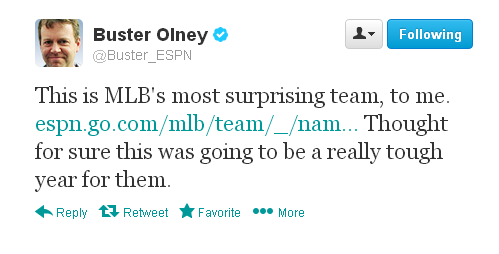
After the Twins completed the dismantling of the Chicago White Sox on Thursday afternoon, ESPN.com's Buster Olney tweeted out that his "most surprising team" is the Minnesota Twins. The Twins, now 33-36, were originally projected to finish with 64.5 wins totals by Las Vegas in February. Now the Twins are on pace to obtained 77 wins. It may come as a surprise to Olney that the Twins are a middle-of-the-road team instead of one that completely falls flat on their face but they are beating up on sub-.500 teams well (19-14) while teams with above-.500 winning percentages still have knocked them around (14-22). Is this team surprising you?
-
Prior to Thursday's day game against the Chicago White Sox, Twins assistant GM Rob Antony spoke candidly with reporters regarding the upcoming trade deadline. Antony noted that the team was indeed fielding calls from teams seeking a trading partner. He also told reporters that the team was not looking to deal starting pitcher Kevin Correia, says the Associated Press's Dave Campbell. Correia, who signed a two-year deal worth $10M in December, has pitched well for the team through his first 14 starts, even if it has been blessed by the baseball gods. His 3.87 ERA is outperforming his 4.08 xFIP, indicating that his numbers may turn on him as the season progresses. But his season may not follow those predictions -- over his last three starts, he's struck out 6 or more hitters while registering a 10% swinging strike rate. Prior to that he has struck out just 29 in 70.1 innings while achieving a swinging strike rate of 6%. That said, Correia has allowed 11 home runs in his past seven starts and his value may never be higher than now. Correia will be 33 in August and due $5.5 million in 2014. Without much certainty for next year's rotation, Correia could provide inexpensive veteran presence (a bird-in-the-hand, if you will). Of course, missing the opportunity to move him now would be yet another example of the organization's poor timing when it comes to trading at optimal value.
