



Steven Buhr
-
Posts
1,682 -
Joined
-
Last visited
Content Type
Profiles
Minnesota Twins News, Rumors & Analysis
Minnesota Twins Videos
2026 Minnesota Twins Top Prospect Rankings
2022 Minnesota Twins Draft Picks & Signing Bonuses
Minnesota Twins Trade & Free Agent Rumors
Minnesota Twins Fan Guides & Resources
2023 Minnesota Twins Draft Picks & Signing Bonuses
The Minnesota Twins Players Project
2024 Minnesota Twins Draft Picks & Signing Bonuses
2025 Minnesota Twins Draft Picks & Signing Bonuses
2026 Minnesota Twins Draft Picks & Signing Bonuses
Forums
Blogs
Events
Store
Downloads
Gallery
Everything posted by Steven Buhr
-
You can view the page at http://twinsdaily.com/content.php/2944-ZONING-with-Kernels-Pitching-Coach-Ivan-Arteaga
-
Ivan Arteaga is in his first year serving as the Cedar Rapids Kernels pitching coach, but he’s far from being a rookie when it comes to working with young pitchers in the Twins organization. After bouncing around the minor leagues for much of the 1990s with the Expos, Rockies and Mets organizations, the Venezuela native began coaching young pitchers for the Twins organization in 2001 and he’s been helping to develop the organization’s young arms ever since. Arteaga spent several years as the pitching coordinator for the Twins’ Venezuelan Academy and coached at both Rookie League levels before serving as the pitching coach for the High-A Fort Myers Miracle a year ago. This season, he and Gary Lucas (the 2013 Kernels pitching coach) traded assignments, bringing Arteaga to Cedar Rapids. http://knuckleballsblog.com/blog/wp-content/uploads/2014/05/ArteagaMauer11.jpg Kernels pitching coach Ivan Arteaga and manager Jake Mauer share a light moment while watching a pair of Kernels pitchers work out. (Photo: SD Buhr/Knuckleballsblog.com) Several hours before game time, you can find Arteaga, often sporting a shirt with the word “ZONING” across the back, working with his pitchers in the Kernels bullpen down the right field line at Veterans Memorial Stadium. Recently, he agreed to sit down and talk about his work with the Kernels and the Twins organization. First things first. What’s with the ZONING shirt? “We’re trying to implement, as an organization, visualization, focus, concentration – actually throwing the ball to one spot without thinking how to throw the ball,” Arteaga answered. The secret to doing that, according to the coach, is visualization. “First, you know what you throw in certain situations and you know where you want to throw it, right? That should be how we pitch. Knowing your strengths and your weaknesses and how to apply that to the hitters’ tendencies. http://knuckleballsblog.com/blog/wp-content/uploads/2014/05/Arteaga2014a-300x225.jpg Ivan Arteaga “So zoning is basically, we’ve been working for the last couple of years on having the pitchers visualize the pitch before they throw it. OK I have an 0-0 count, I want to throw a breaking ball, I don’t want to throw it down in the dirt, I want to throw it for a strike. So I’ll visualize the pitch how I want to throw it.” Arteaga was quick to point out, however, that it’s not a cookie-cutter approach to teaching pitching. “Everybody’s doing it for the most part, (but) everybody has his own way of doing it. Getting in to the process of thinking about pitching, and throwing the ball; not thinking about the process of ‘how do I throw the ball? My mechanics are off, or this or that.’ You throw the way you throw and it’s kind of hard for us to change that.” It’s not that pitchers don’t need to work on mechanics, of course, but those thoughts are ideally confined to the bullpen workout sessions. Pitchers can’t afford to be thinking about that kind of thing on the mound during games. “You shouldn’t and if you’re doing that, then something’s wrong,” confirmed Arteaga. While he’s an advocate for the Zoning philosophy, Arteaga doesn’t believe that simply subscribing to the approach will assure a young pitcher’s success. “I don’t think that success will be dictated by the Zoning or by how you run or by how you lift or if you sleep enough or how heavy you are or how skinny you are,” said the coach. “Success is a combination of all those factors, plus talent. Success is how you put together the whole package. Mental toughness and talent all together and you apply that in to the game.” Arteaga has been entrusted this season with a number of the Twins organization’s top pitching prospects. Some were high draft choices, others highly coveted international signings, but the coach sees similarities in what each of the pitchers on his staff must overcome. “Facing adversity,” Arteaga said. “Because that’s the main thing. The game is full of adversity. I’ve seen guys with a lot of talent, but they cannot get people out. And I’ve seen guys with lesser talent that are just great, because they’re mentally tough and they know how to apply their talent to the game and to the hitters’ tendencies. “So, to say that the guys that are pitching well are doing the Zoning and the guys that are not are not doing it, I don’t think that would be very smart on my part. I think that everybody’s doing it, it’s just that this is a level where everybody’s so young and so inexperienced. There’s a lot of things they’re working on at the same time. Holding runners. Getting in a routine. Playing every day. Some of these guys just worked on Saturdays or Fridays. Now they come to the ballpark every day.” While subscribing to the Zoning philosophy, in itself, won’t assure success, Arteaga believes there is one thing that a pitcher must develop. “As a pitching coach, if I have to pinpoint one thing that is going to make these guys succeed throughout the year, it’s mental toughness. Mental toughness is part of the Zoning. Mental toughness is part of who you are as a pitcher when adversity strikes. Adversity could be having a cold, you’re sick. Maybe homesick. That’s adversity. It’s just the way it is.” It’s hard sometimes to imagine that such things can enter in to the mind of a professional ballplayer when he’s on the mound during a game but, said Arteaga, “It’ll be there. But how do you set your priorities straight, being able to put all that aside and go and perform?” One thing you hear a lot about with pitchers spending their first year or two as professionals is that organizations try to limit the number of different pitches they work on in a given season. A pitcher who threw a variety of pitches in high school or college sometimes seems to focus on just a fastball and one variety of off-speed pitch early in his professional career. Do the Twins or Arteaga take that approach with the Kernels’ pitchers? There’s no one answer to that question, according to the coach. “Always depends on the player, always.” Arteaga also doesn’t believe there’s a single right approach. “If I tell you that there’s a philosophy out there that is successful, everybody would be doing it,” Arteaga said with a laugh. “So everybody’s different and as a coach you have to fluctuate, not only man to man, player to player, but day by day. There are some days that will be cold, some days will be rainy. You have to learn to adjust to that and as a coach you have to let the guys pitch and learn. “There are some days that the change up might not be there or the breaking balls won’t be there or they’re very good in the bullpen, but not so good on the mound. Or you see that they’ve had a bad week, headaches or something. And the day of the game, everything goes away and they have a great game. “So this is baseball. There’s nothing set in stone. There’s nothing for you to do every day and you’re going to be successful. There’s no guidelines for that.” http://knuckleballsblog.com/blog/wp-content/uploads/2014/05/ArteagaSlegers2014-484x600.jpg Kernels pitching coach Ivan Arteaga and pitcher Aaron Slegers (photo: SD Buhr/Knuckleballsblog.com) For Arteaga, that means treating every player as an individual. “As a coach, I’ve got to adjust to every single one of them and understand what they do and how they do it and how they can be successful by doing that. “Now, yeah, we want to establish the fastball in and out, throw the ball down. We want them to have at least ten per cent change ups every day they throw, the starters, and about 15 per cent the sliders or curve. That’s what we do. “It’s a very simple philosophy. Attack the hitters. Be athletic around the mound. Pitch inside. Throw the ball down and attack. Attack.” Treating each player as an individual must be a challenge, given the widely varying backgrounds that pitchers at the Class A level have. Some were still pitching for their high schools a year ago, some were in college and some have been working their way up through a couple of years of short-season rookie leagues within the Twins organization. Arteaga believes it’s important for him to demonstrate consistency in his approach, even as he works with players individually. “Number one, I am the coach so I try to be the same every day, regardless of the score or regardless of what happened. I won’t panic. I won’t get too high or too low. If they see that in me, they understand that I am under control. I’m fine with what they’re doing. “Now, if I pay enough attention, they will tell me what they need. Once I pay attention, and I get to know them and they get to know me, we establish a relationship. Then I can treat everybody in a different way. “For the most part, yes, you have a standard. That’s who I am. I’m not going to be different to you than I’m going to be to them. That’s who I am.” The individual approach enters during individual instruction, according to Arteaga. “Now, how do I teach you? How do I approach the teaching part of it? That is different. You have different needs as a lefty than as a righty. Different needs as a starter than as a reliever. Different needs as a long reliever than as a closer. So, yes, I have to adjust to each and every one of them.” Since Arteaga was working at the next level up in the organization, with the Miracle in Fort Myers, a year ago, he hadn’t had an opportunity to work much with this year’s crop of Kernels pitchers prior to spring training this year. That means they’ve had just a couple of months to get to know each other. Has that been enough time to establish those individual relationships? “Yes, it’s all about paying attention. It’s all about spending the time with them. When you’re on the road, this is your family. You’re spending 14 hours on a bus ride in this class. You get to know them a little bit. “I believe that they know me well. They know how I’m going to act and react and what I like and not only me, as a coach, but what the Twins want. I’m basically an extension of what the Twins philosophy is. Twins first, then yes, as a person, you put out your knowledge and experience and what you are and you try to teach them the way you teach.” The speculation in the media and among others who follow the Twins minor leagues has been that the Twins had Arteaga and Lucas swap coaching assignments this season because the Twins knew they’d have a number of significant Latin American prospects on the Kernels’ staff and they may find it helpful from a communication standpoint to have a Spanish-speaking pitching coach. Arteaga isn’t certain that was really a significant factor, however. “I don’t know if that’s the case,” observed Arteaga, concerning such speculation. “I guess that it’s got something to do with it. Obviously, the communication factor is important. “Yeah, I think that helps, but at the same time, I think I have one half (of the pitching staff) that were born in the United States. They’re college guys, some of them are very good prospects. So I have to be able to teach baseball. “Personally, I think that I can communicate with anyone. I’ve worked on my English for a long time and keep working on it. I prepare myself all the time to be able to communicate in both languages. Not only in baseball terms, but in life. Understand the culture, understand how Americans go about their everyday lives. I’ve spent half of my life learning that, because I was here, playing and coaching.” Speaking of top prospects, his Kernels staff has a lot of them. Does he feel any additional pressure to make sure all of the high-priced pitching talent with the Kernels this summer progresses the way the Twins want? “I feel motivation. I have a plan every day and I do my best every day so they can get better. I’m not pitching anymore, so I don’t have stress or sense of urgency because I do everything that I can every day to teach these guys how the game is, the game that we want them to pitch, the Minnesota Twins. So I have my own plan that I have learned over the last 14 years with the Twins. “So to have guys, regardless of how much talent they have, to be able to coach them every day, that’s my motivation. If not, I wouldn’t be here. That’s what moves me every day, to have the motivation to teach somebody and to actually help them with the game and with life.” Certainly, a coach like Arteaga must get a sense of satisfaction from seeing his pitchers succeed, though. “You do,” Arteaga confirmed. Yet it isn’t just seeing pitchers advance through the ranks that gives him satisfaction. “I think I get most satisfied when we make eye contact, regardless of the situation, that’s the best communication you can have with a human being.” “I can talk to you all day,” Arteaga continued, “but when you’re pitching and I’m coaching and you pitch a good inning or a bad inning or a bad at-bat or something, and you walk in to the dugout or I go to the mound and there’s eye contact, you should know what is what and how I feel. That’s the relationship thing you create with the player, regardless of whether he’s going to be here for one day or ten days or 25 years. Because you care.” http://knuckleballsblog.com/blog/wp-content/uploads/2014/05/ArteagaSlegersb.jpg Ivan Arteaga having a between-innings chat with Aaron Slegers (photo: SD Buhr/Knuckleballs) Arteaga understands that’s not an aspect of the game that many outsiders can appreciate. “People don’t see that. Fans don’t see that. Journalists don’t see that. TV cameras don’t see that. TV cameras will look at emotions and what is exciting for everybody. But as a coach when, for whatever reason, your team gave up 14 runs that night, then you make eye contact and you’re able to assure those guys, ‘you know what, it’s okay, it’s going to be fine, we’ll work on it.’” The night before Arteaga sat for the interview, two Kernels pitchers had been victimized for a combined 12 runs. Can he communicate that kind of assurance to those guys after that kind of night? “Of course, because that’s baseball, It’s every day,” assured Arteaga. “Because what if I overreact last night and I tell them that they’re not good enough? Maybe because I don’t feel well. That’s me, but it’s not about me. It’s about them. So what if I overreact and I tell them they’re not good? The next thing you know, I’ve lost all that the staff had for me because I overreacted. So maybe apologizing might not be enough after that. “So, I’m with them every pitch. Yeah, we lost a game, fine. Then today is a different day and make no mistake, these guys are going to work today to get better so they can pitch well tomorrow. It’s a 142 game season.” Through the first week or so of May, Arteaga’s work with the Kernels is beginning to pay off. Two Kernels starters (Aaron Slegers and Kohl Stewart) are among the top 10 Midwest League pitchers in WHIP, two (Slegers and Ryan Eades) are in the top 10 in strikeouts and two more among the top 10 in saves (Hudson Boyd and the recently promoted Brandon Peterson). Nine Kernels pitchers have ERAs of 3.00 or below.
-
So MLB went overboard in their police action, ticked off a significant portion of their most deeply invested fans, and then backtracked and blamed it all on someone else. Shocking.
-
There's really only one thing we can all be sure of. This is about money. MLB either wants more of it or they're doing this at the request of those who already are paying for media rights and have threatened, or at least implied, that they will pay MLB less if they don't come down on podcasts and, one can assume eventually, blogs and other internet based media. MLB is just about as tone-deaf an organization as you'll find when it comes to PR and building strong fan relations. They could hire Rutgers University's PR staff and it would be an improvement.
-
'ZONING' with Kernels Pitching Coach Ivan Arteaga
Steven Buhr posted a blog entry in SD Buhr/Jim Crikket
Ivan Arteaga is in his first year serving as the Cedar Rapids Kernels pitching coach, but he’s far from being a rookie when it comes to working with young pitchers in the Twins organization. After bouncing around the minor leagues for much of the 1990s with the Expos, Rockies and Mets organizations, the Venezuela native began coaching young pitchers for the Twins organization in 2001 and he’s been helping to develop the organization’s young arms ever since. Arteaga spent several years as the pitching coordinator for the Twins’ Venezuelan Academy and coached at both Rookie League levels before serving as the pitching coach for the Class high-A Fort Myers Miracle a year ago. This season, he and Gary Lucas (the 2013 Kernels pitching coach) traded assignments, bringing Arteaga to Cedar Rapids. http://knuckleballsblog.com/blog/wp-content/uploads/2014/05/ArteagaMauer11.jpg Kernels pitching coach Ivan Arteaga and manager Jake Mauer share a light moment while watching a pair of Kernels pitchers work out. (Photo: SD Buhr/Knuckleballsblog.com) Several hours before game time, you can find Arteaga, often sporting a shirt with the word “ZONING” across the back, working with his pitchers in the Kernels bullpen down the right field line at Veterans Memorial Stadium. Recently, he agreed to sit down and talk about his work with the Kernels and the Twins organization. First things first. What’s with the ZONING shirt? “We’re trying to implement, as an organization, visualization, focus, concentration – actually throwing the ball to one spot without thinking how to throw the ball,” Arteaga answered. The secret to doing that, according to the coach, is visualization. “First, you know what you throw in certain situations and you know where you want to throw it, right? That should be how we pitch. Knowing your strengths and your weaknesses and how to apply that to the hitters’ tendencies. http://knuckleballsblog.com/blog/wp-content/uploads/2014/05/Arteaga2014a-300x225.jpg Ivan Arteaga “So zoning is basically, we’ve been working for the last couple of years on having the pitchers visualize the pitch before they throw it. OK I have an 0-0 count, I want to throw a breaking ball, I don’t want to throw it down in the dirt, I want to throw it for a strike. So I’ll visualize the pitch how I want to throw it.” Arteaga was quick to point out, however, that it’s not a cookie-cutter approach to teaching pitching. “Everybody’s doing it for the most part, (but) everybody has his own way of doing it. Getting in to the process of thinking about pitching, and throwing the ball; not thinking about the process of ‘how do I throw the ball? My mechanics are off, or this or that.’ You throw the way you throw and it’s kind of hard for us to change that.” It’s not that pitchers don’t need to work on mechanics, of course, but those thoughts are ideally confined to the bullpen workout sessions. Pitchers can’t afford to be thinking about that kind of thing on the mound during games. “You shouldn’t and if you’re doing that, then something’s wrong,” confirmed Arteaga. While he’s an advocate for the Zoning philosophy, Arteaga doesn’t believe that simply subscribing to the approach will assure a young pitcher’s success. “I don’t think that success will be dictated by the Zoning or by how you run or by how you lift or if you sleep enough or how heavy you are or how skinny you are,” said the coach. “Success is a combination of all those factors, plus talent. Success is how you put together the whole package. Mental toughness and talent all together and you apply that in to the game.” Arteaga has been entrusted this season with a number of the Twins organization’s top pitching prospects. Some were high draft choices, others highly coveted international signings, but the coach sees similarities in what each of the pitchers on his staff must overcome. “Facing adversity,” Arteaga said. “Because that’s the main thing. The game is full of adversity. I’ve seen guys with a lot of talent, but they cannot get people out. And I’ve seen guys with lesser talent that are just great, because they’re mentally tough and they know how to apply their talent to the game and to the hitters’ tendencies. “So, to say that the guys that are pitching well are doing the Zoning and the guys that are not are not doing it, I don’t think that would be very smart on my part. I think that everybody’s doing it, it’s just that this is a level where everybody’s so young and so inexperienced. There’s a lot of things they’re working on at the same time. Holding runners. Getting in a routine. Playing every day. Some of these guys just worked on Saturdays or Fridays. Now they come to the ballpark every day.” While subscribing to the Zoning philosophy, in itself, won’t assure success, Arteaga believes there is one thing that a pitcher must develop. “As a pitching coach, if I have to pinpoint to one thing that is going to make these guys succeed throughout the year, it’s mental toughness. Mental toughness is part of the Zoning. Mental toughness is part of who you are as a pitcher when adversity strikes. Adversity could be having a cold, you’re sick. Maybe homesick. That’s adversity. It’s just the way it is.” It’s hard sometimes to imagine that such things can enter in to the mind of a professional ballplayer when he’s on the mound during a game but, said Arteaga, “It’ll be there. But how do you set your priorities straight, being able to put all that aside and go and perform?” One thing you hear a lot about with pitchers spending their first year or two as professionals is that organizations try to limit the number of different pitches they work on in a given season. A pitcher who threw a variety of pitches in high school or college sometimes seems to focus on just a fastball and one variety of off-speed pitch early in his professional career. Do the Twins or Arteaga take that approach with the Kernels’ pitchers? There’s no one answer to that question, according to the coach. “Always depends on the player, always.” Arteaga also doesn’t believe there’s a single right approach. “If I tell you that there’s a philosophy out there that is successful, everybody would be doing it,” Arteaga said with a laugh. “So everybody’s different and as a coach you have to fluctuate, not only man to man, player to player, but day by day. There are some days that will be cold, some days will be rainy. You have to learn to adjust to that and as a coach you have to let the guys pitch and learn. “There are some days that the change up might not be there or the breaking balls won’t be there or they’re very good in the bullpen, but not so good on the mound. Or you see that they’ve had a bad week, headaches or something. And the day of the game, everything goes away and they have a great game. “So this is baseball. There’s nothing set in stone. There’s nothing for you to do every day and you’re going to be successful. There’s no guidelines for that.” http://knuckleballsblog.com/blog/wp-content/uploads/2014/05/ArteagaSlegers2014-484x600.jpg Kernels pitching coach Ivan Arteaga and pitcher Aaron Slegers (photo: SD Buhr/Knuckleballsblog.com) For Arteaga, that means treating every player as an individual. “As a coach, I’ve got to adjust to every single one of them and understand what they do and how they do it and how they can be successful by doing that. “Now, yeah, we want to establish the fastball in and out, throw the ball down. We want them to have at least ten per cent change ups every day they throw, the starters, and about 15 per cent the sliders or curve. That’s what we do. “It’s a very simple philosophy. Attack the hitters. Be athletic around the mound. Pitch inside. Throw the ball down and attack. Attack.” Treating each player as an individual must be a challenge, given the widely varying backgrounds that pitchers at the Class A level have. Some were still pitching for their high schools a year ago, some were in college and some have been working their way up through a couple of years of short-season rookie leagues within the Twins organization. Arteaga believes it’s important for him to demonstrate consistency in his approach, even as he works with players individually. “Number one, I am the coach so I try to be the same every day, regardless of the score or regardless of what happened. I won’t panic. I won’t get too high or too low. If they see that in me, they understand that I am under control. I’m fine with what they’re doing. “Now, if I pay enough attention, they will tell me what they need. Once I pay attention, and I get to know them and they get to know me, we establish a relationship. Then I can treat everybody in a different way. “For the most part, yes, you have a standard. That’s who I am. I’m not going to be different to you than I’m going to be to them. That’s who I am.” The individual approach enters during individual instruction, according to Arteaga. “Now, how do I teach you? How do I approach the teaching part of it? That is different. You have different needs as a lefty than as a righty. Different needs as a starter than as a reliever. Different needs as a long reliever than as a closer. So, yes, I have to adjust to each and every one of them.” Since Arteaga was working at the next level up in the organization, with the Miracle in Fort Myers, a year ago, he hadn’t had an opportunity to work much with this year’s crop of Kernels pitchers prior to spring training this year. That means they’ve had just a couple of months to get to know each other. Has that been enough time to establish those individual relationships? “Yes, it’s all about paying attention. It’s all about spending the time with them. When you’re on the road, this is your family. You’re spending 14 hours on a bus ride in this class. You get to know them a little bit. “I believe that they know me well. They know how I’m going to act and react and what I like and not only me, as a coach, but what the Twins want. I’m basically an extension of what the Twins philosophy is. Twins first, then yes, as a person, you put out your knowledge and experience and what you are and you try to teach them the way you teach.” The speculation in the media and among others who follow the Twins minor leagues has been that the Twins had Arteaga and Lucas swap coaching assignments this season because the Twins knew they’d have a number of significant Latin American prospects on the Kernels’ staff and they may find it helpful from a communication standpoint to have a Spanish-speaking pitching coach. Arteaga isn’t certain that was really a significant factor, however. “I don’t know if that’s the case,” observed Arteaga, concerning such speculation. “I guess that it’s got something to do with it. Obviously, the communication factor is important. “Yeah, I think that helps, but at the same time, I think I have one half (of the pitching staff) that were born in the United States. They’re college guys, some of them are very good prospects. So I have to be able to teach baseball. “Personally, I think that I can communicate with anyone. I’ve worked on my English for a long time and keep working on it. I prepare myself all the time to be able to communicate in both languages. Not only in baseball terms, but in life. Understand the culture, understand how Americans go about their everyday lives. I’ve spent half of my life learning that, because I was here, playing and coaching.” Speaking of top prospects, his Kernels staff has a lot of them. Does he feel any additional pressure to make sure all of the high-priced pitching talent with the Kernels this summer progresses the way the Twins want? “I feel motivation. I have a plan every day and I do my best every day so they can get better. I’m not pitching anymore, so I don’t have stress or sense of urgency because I do everything that I can every day to teach these guys how the game is, the game that we want them to pitch, the Minnesota Twins. So I have my own plan that I have learned over the last 14 years with the Twins. “So to have guys, regardless of how much talent they have, to be able to coach them every day, that’s my motivation. If not, I wouldn’t be here. That’s what moves me every day, to have the motivation to teach somebody and to actually help them with the game and with life.” Certainly, a coach like Arteaga must get a sense of satisfaction from seeing his pitchers succeed, though. “You do,” Arteaga confirmed. Yet it isn’t just seeing pitchers advance through the ranks that gives him satisfaction. “I think I get most satisfied when we make eye contact, regardless of the situation, that’s the best communication you can have with a human being.” “I can talk to you all day,” Arteaga continued, “but when you’re pitching and I’m coaching and you pitch a good inning or a bad inning or a bad at-bat or something, and you walk in to the dugout or I go to the mound and there’s eye contact, you should know what is what and how I feel. That’s the relationship thing you create with the player, regardless of whether he’s going to be here for one day or ten days or 25 years. Because you care.” http://knuckleballsblog.com/blog/wp-content/uploads/2014/05/ArteagaSlegersb.jpg Ivan Arteaga having a between-innings chat with Aaron Slegers (photo: SD Buhr/Knuckleballs) Arteaga understands that’s not an aspect of the game that many outsiders can appreciate. “People don’t see that. Fans don’t see that. Journalists don’t see that. TV cameras don’t see that. TV cameras will look at emotions and what is exciting for everybody. But as a coach when, for whatever reason, your team gave up 14 runs that night, then you make eye contact and you’re able to assure those guys, ‘you know what, it’s okay, it’s going to be fine, we’ll work on it.’” The night before Arteaga sat for the interview, two Kernels pitchers had been victimized for a combined 12 runs. Can he communicate that kind of assurance to those guys after that kind of night? “Of course, because that’s baseball, It’s every day,” assured Arteaga. “Because what if I overreact last night and I tell them that they’re not good enough? Maybe because I don’t feel well. That’s me, but it’s not about me. It’s about them. So what if I overreact and I tell them they’re not good? The next thing you know, I’ve lost all that the staff had for me because I overreacted. So maybe apologizing might not be enough after that. “So, I’m with them every pitch. Yeah, we lost a game, fine. Then today is a different day and make no mistake, these guys are going to work today to get better so they can pitch well tomorrow. It’s a 142 game season.” Through the first week or so of May, Arteaga’s work with the Kernels is beginning to pay off. Two Kernels starters (Aaron Slegers and Kohl Stewart) are among the top 10 Midwest League pitchers in WHIP, two (Slegers and Ryan Eades) are in the top 10 in strikeouts and two more among the top 10 in saves (Hudson Boyd and the recently promoted Brandon Peterson). Nine Kernels pitchers have ERAs of 3.00 or below. -
Montanez had a rough morning Tuesday, but he has been one of those guys who can move in and out of the rotation with some level of ease. I can't say for sure what the Twins thinking is, because I haven't asked Arteaga or Mauer, but when Randy Rosario went on the DL, I would guess they wanted a guy they could plug in to the rotation for 2-3 starts and then move back to the pen. I just don't think they'd have Landa relieve for a few weeks, start for a few weeks and then relieve again when Rosario is healthy. I expect to see Rosario back in the rotation, in Montanez's spot, relatively soon. Although I suppose they could even let him work out of the pen for a week or so until he's stretched back out to start. Landa has looked great, going 2-3 innings at a time. At this level, though, it's not at all uncommon for them to have guys start part of the season and work in the pen another stretch of the year to keep their innings in check. It wouldn't surprise me to see Landa in the rotation the second half of the season at some point, while someone currently in the rotation moves to a relief role.
-
I'll always be JC to a lot of people... no problem! As for when Slegers could be promoted, June is probably the logical answer. That said, if something happened right now and Fort Myers needed a starting pitcher, he'd be the guy I would guess would get the call. He's had 2 dominant starts in a row. If he has a couple more like that, anything could happen.
-
You can view the page at http://twinsdaily.com/content.php/2940-Kernels-Report-Aaron-Slegers-is-Standing-Tall
-
The Cedar Rapids Kernels brought a highly heralded group of pitchers north out of spring training. The opening day pitching staff was littered with highly rated prospects obtained with high draft picks and big-money international free agency signings. Even among top prospects, however, you’re never sure what kind of start you’ll get in a Midwest League season. Some of these pitchers are still teenagers. Some are a long way away from home for the first time. Some have seldom, if ever, pitched in front of a sizable crowd. Some have never experienced the kind of bone-chilling spring weather that is commonplace in Cedar Rapids and other MWL locations. Any of those factors can cause a pitcher to get off to a slow start, but if you can find a guy who’s already spent a few years away from home, matured as a pitcher, pitched in high-pressure situations and is no stranger to cold weather, he just might have a chance to impress early. But where could you possibly find such a pitcher? Maybe a guy who has spent the last three years away from home at college, pitching in front of big crowds in big games and regularly played in cold weather during his college years. Meet Kernels starting pitcher Aaron Slegers. http://knuckleballsblog.com/blog/wp-content/uploads/2014/05/Slegers2014j.jpg Aaron Slegers (photo: SD Buhr/Knuckleballs) The 21 year-old Slegers, who was selected by the Minnesota Twins in the fifth round of the 2013 Major League June Amateur Draft out of the University of Indiana, is 3-0 for the Kernels and carries a 2.52 ERA after six starts. He’s struck out 33 batters in 35.2 innings, while walking just six. Slegers threw seven shutout innings on Saturday night against the Peoria Chiefs and sat down for an interview the following morning. Slegers is mature and converses his way through an interview easily, despite the fact that he must know, by now, that the first question every interviewer is going to start with will be about his height. At 6′ 10”, it’s impossible to overlook the obvious. http://knuckleballsblog.com/blog/wp-content/uploads/2014/05/Slegers2014g.jpg Aaron Slegers (photo: SD Buhr/Knuckleballs) As he told a group of Kernels boosters at the club’s welcome dinner the day before the season started, he’s not even the tallest member of his family. “My dad’s seven feet tall,” he said on Sunday, just as he told the gathering a month ago. So there was never much doubt that the pitcher would be long in the frame. “Yeah, there’s a funny story about that,” offered Slegers. “In the Big Ten Tournament at Target Field, my mom was interviewed by the Big Ten Network and the sideline reporter asked her, ‘when did you know Aaron was going to be so tall?’ She thought to herself, ‘I guess when I married a seven foot guy.’ I don’t think she said that to the reporter, though.” Too bad. It’s the kind of line reporters love. He also has an older sister, in New York City. “She’s about six foot, 6’ 1”. She played volleyball in college,” said Slegers. Height can be an advantage for a pitcher, but it can also come with certain challenges, including additional levels of stress and strain on important joints. Slegers fought through a number of injuries in college, but he doesn’t feel they were related to his height. “The injuries were kind of freak, they weren’t really related to growing or anything,” Slegers explained. “I took a line drive my freshman year in an intrasquad the first week of the season. The first pitch I threw to our starting shortstop that year was a fastball right down the middle and he hit it right back at me off my throwing wrist. That broke my wrist and I was out for the year on a medical redshirt. “The next year, was a little more my fault, but I showed up a minute late for the bus that was leaving the hotel for the field and the punishment for that was running the entire batting practice. Because of that, I got shin splints in my right shin. It hurt to walk and, again, out for the year after seven innings my sophomore year. “It was a tough little stretch there when I was in Indiana the first couple of years. It was a tough go on with the injuries.” Things got better before he left Bloomington, however. Slegers and his Indiana teammates made it all the way to the College World Series in Omaha last year. Slegers threw a complete game in his final appearance as a Hoosier, but lost to Oregon State 1-0. Despite the way it ended, the trip made all of the early challenges at Indiana worthwhile. “A hundred percent, exactly right,” Slegers agreed, smiling. “The College World Series makes everything OK.” The sight of a 6′ 10” pitcher on the mound brings to mind memories of Randy Johnson, the certain future Hall of Fame pitcher who’s fastball periodically clocked in excess of 100 miles per hour. But that’s not Slegers’ style. His fastball regularly sits in the low 90s, which is good, but not considered overpowering. The big righthander isn’t concerned about his velocity, however. “Velocity’s always nice, but that’s sort of something that comes secondary,” explained Slegers. The primary thing, according to Slegers, is getting the preparation work done and preparing to compete. http://knuckleballsblog.com/blog/wp-content/uploads/2014/05/ArteagaSlegersc-436x600.jpg Aaron Slegers having a between-innings conversation with pitching coach Ivan Arteaga (photo: SD Buhr/Knuckleballs) “Working in the bullpen, working on your mechanics, long-toss. When you go out and compete, you’re doing exactly that. Going out and competing, trying to repeat (the delivery) and throw strikes and throw all your pitches for strikes. Velocity’s just sort of one of those things that happens.” So you won’t see Slegers turning around to check his pitch speed on the Kernels’ video board after every pitch. “That’s something they’re trying to steer us away from,” Slegers agreed, smiling. Slegers saw a lot of success in college, but he realizes he’s working at a new level now and that it requires work to improve, even if he’s not focused on adding velocity to his fastball right now. “I’m throwing my slider and change up more since I got in pro ball; trying to keep the hitters off balance. You can’t just keep pumping in fastballs over and over. They’re pretty good at learning those pitches. I’m kind of moving the baseball more than in college.” One thing Slegers hasn’t had to do is adjust to pitching in cold Midwestern weather. His time pitching in the Big Ten assured he’d be prepared for that aspect of his first full season of professional ball. “Oh yeah, oh yeah,” said a smiling Slegers. “We would go down south the whole month of February, but when we’d come up to school, if it was above 35, we were out on the field practicing and trying to hit BP. So, yeah, I’m more than accustomed to it. And those late March home games will toughen you up in a hurry, in terms of the weather.” Being accustomed to cold weather doesn’t mean he spends any more time in it than he has to, however. Slegers may have gone to school in Indiana, but he and his family live in Arizona and that’s where he spends his offseason. Slegers stays active both in the offseason and, to the degree possible, during off days during the season. “I like to fish and golf, primarily,” Slegers said, concerning his off-the-field interests. “I like to golf as much as possible. In terms of exercising, I like cycling, road biking. That always takes up my time when I want a good cardio workout. It’s kind of unusual for a guy my size to ride a road bike, but mostly golf and fishing are my relaxing off day hobbies.”
-
He was placed on the DL April 9 (retroactive to April 7) with a left rotator cuff strain. He stuck around CR for a while but my understanding is that he's back down in Ft Myers at this time.
-
Kernels Report: Aaron Slegers is Standing Tall
Steven Buhr posted a blog entry in SD Buhr/Jim Crikket
The Cedar Rapids Kernels brought a highly heralded group of pitchers north out of spring training. The opening day pitching staff was littered with highly rated prospects obtained with high draft picks and big-money international free agency signings. Even among top prospects, however, you’re never sure what kind of start you’ll get in a Midwest League season. Some of these pitchers are still teenagers. Some are a long way away from home for the first time. Some have seldom, if ever, pitched in front of a sizable crowd. Some have never experienced the kind of bone-chilling spring weather that is commonplace in Cedar Rapids and other MWL locations. Any of those factors can cause a pitcher to get off to a slow start, but if you can find a guy who’s already spent a few years away from home, matured as a pitcher, pitched in high-pressure situations and is no stranger to cold weather, he just might have a chance to impress early. But where could you possibly find such a pitcher? Maybe a guy whose spent the last three years away from home at college, pitching in front of big crowds in big games, regularly played in cold weather, during his college years. Meet Kernels starting pitcher Aaron Slegers. http://knuckleballsblog.com/blog/wp-content/uploads/2014/05/Slegers2014j.jpg Aaron Slegers (photo: SD Buhr/Knuckleballs) The 21 year-old Slegers, who was selected by the Minnesota Twins in the fifth round of the 2013 Major League June Amateur Draft out of the University of Indiana, is 3-0 for the Kernels and carries a 2.52 ERA after six starts. He’s struck out 33 batters in 35.2 innings, while walking just six. Slegers threw seven shutout innings on Saturday night against the Peoria Chiefs and sat down for an interview the following morning. Slegers is mature and converses his way through an interview easily, despite the fact that he must know, by now, that the first question every interviewer is going to start with will be about his height. At 6′ 10”, it’s impossible to overlook the obvious. http://knuckleballsblog.com/blog/wp-content/uploads/2014/05/Slegers2014g.jpg Aaron Slegers (photo: SD Buhr/Knuckleballs) As he told a group of Kernels boosters at the club’s welcome dinner the day before the season started, he’s not even the tallest member of his family. “My dad’s seven feet tall,” he said on Sunday, just as he told the gathering a month ago. So there was never much doubt that the pitcher would be long in the frame. “Yeah, there’s a funny story about that,” offered Slegers. “In the Big Ten Tournament at Target Field, my mom was interviewed by the Big Ten Network and the sideline reporter asked her, ‘when did you know Aaron was going to be so tall?’ She thought to herself, ‘I guess when I married a seven foot guy.’ I don’t think she said that to the reporter, though.” Too bad. It’s the kind of line reporters love. He also has an older sister, in New York City. “She’s about six foot, 6’ 1”. She played volleyball in college,” said Slegers. Height can be an advantage for a pitcher, but it can also come with certain challenges, including additional levels of stress and strain on important joints. Slegers fought through a number of injuries in college, but he doesn’t feel they were related to his height. “The injuries were kind of freak, they weren’t really related to growing or anything,” Slegers explained. “I took a line drive my freshman year in an intrasquad the first week of the season. The first pitch I threw to our starting shortstop that year was a fastball right down the middle and he hit it right back at me off my throwing wrist. That broke my wrist and I was out for the year on a medical redshirt. “The next year, was a little more my fault, but I showed up a minute late for the bus that was leaving the hotel for the field and the punishment for that was running the entire batting practice. Because of that, I got shinsplints in my right shin. It hurt to walk and, again, out for the year after seven innings my sophomore year. “It was a tough little stretch there when I was in Indiana the first couple of years. It was a tough go on the injuries.” Things got better before he left Bloomington, however. Slegers and his Indiana teammates made it all the way to the College World Series in Omaha last year. Slegers threw a complete game in his final appearance as a Hoosier, but lost to Oregon State 1-0. Despite the way it ended, the trip made all of the early challenges at Indiana worthwhile. “A hundred percent, exactly right,” Slegers agreed, smiling. “The College World Series makes everything OK.” The sight of a 6′ 10” pitcher on the mound brings to mind memories of Randy Johnson, the certain future Hall of Fame pitcher who’s fastball periodically clocked in excess of 100 miles per hour. But that’s not Slegers’ style. His fastball regularly sits in the low 90s, which is good, but not considered overpowering. The big righthander isn’t concerned about his velocity, however. “Velocity’s always nice, but that’s sort of something that comes secondary,” explained Slegers. The primary thing, according to Slegers, is getting the preparation work done and preparing to compete. http://knuckleballsblog.com/blog/wp-content/uploads/2014/05/ArteagaSlegersc-436x600.jpg Aaron Slegers having a between-innings conversation with pitching coach Ivan Arteaga (photo: SD Buhr/Knuckleballs) “Working in the bullpen, working on your mechanics, long-toss. When you go out and compete, you’re doing exactly that. Going out and competing, trying to repeat (the delivery) and throw strikes and throw all your pitches for strikes. Velocity’s just sort of one of those things that happens.” So you won’t see Slegers turning around to check his pitch speed on the Kernels’ video board after every pitch. “That’s something they’re trying to steer us away from,” Slegers agreed, smiling. Slegers saw a lot of success in college, but he realizes he’s working at a new level now and that requires work to improve, even if he’s not focused on adding velocity to his fastball right now. “I’m throwing my slider and change up more since I got in pro ball; trying to keep the hitters off balance. You can’t just keep pumping in fastballs over and over. They’re pretty good at learning those pitches. I’m kind of moving the baseball more than in college.” One thing Slegers hasn’t had to do is adjust to pitching in cold Midwestern weather. His time pitching in the Big Ten assured he’d be prepared for that aspect of his first full season of professional ball. “Oh yeah, oh yeah,” said a smiling Slegers. “We would go down south the whole month of February, but when we’d come up to school, if it was above 35, we were out on the field practicing and trying to hit BP So, yeah, I’m more than accustomed to it. And those late March home games will toughen you up in a hurry, in terms of the weather.” Being accustomed to cold weather doesn’t mean he spends any more time in it than he has to, however. Slegers may have gone to school in Indiana, but he and his family live in Arizona and that’s where he spends his offseason. Slegers stays active both in the offseason and, to the degree possible, during off days during the season. “I like to fish and golf, primarily,” Slegers said, concerning his off-the-field interests. “I like to golf as much as possible. In terms of exercising, I like cycling, road biking. That always takes up my time when I want a good cardio workout. It’s kind of unusual for a guy my size to ride a road bike, but mostly golf and fishing are my relaxing offday hobbies.” -
Article: Ten Questions with Trevor May
Steven Buhr replied to Christopher Fee's topic in Twins Daily Front Page News
Great interview, Chris. The change in May's mentality is, I think, telling. I also think it's a healthy change and the results are encouraging, to this point. -
Beresford hit just the second home run of his career last night and it was a big one, a grand slam that accounted for all four of the Red Wings' runs. Unfortunately, it wasn't enough to get the team a win. You can see a video at the link below from the local TV news report. It also starts out with a pretty nifty defensive play by Beresford. http://www.whec.com/sports/stories/S3424450.shtml?cat=571
-
Thanks, Eric. I knew I recalled that he didn't play that summer, so he got about half a season later start than top draft picks have had since then.
-
Perhaps, but you can bet there would be plenty of criticism about the Twins not pushing him aggressively enough. That said, wasn't Michael in the last draft class under the old rules where he essentially lost his entire first summer after he was drafted because players could hold out until pretty much the whole season was over? The question for me is simply whether he would have transitioned easier simply by spending 2012 in Beloit. Of course, we'll never know.
-
Peterson is on his way up to Fort Myers today.
-
I give Eades credit for battling when he really didn't have his best stuff. He was working behind in the count a lot. But the best Kernels pitcher of the day was Landa. Faced the minimum 9 batters in 3 innings (an infield single was erased by a DP) and Peoria had no answer for him. He's been on fire the last week or so out of the bullpen.
-
Anyone not paying attention to Landa yet should start doing so. Another dominating performance today for CR. He went three innings, facing the minimum. Gave up an infield single that was erased by a DP. 4 Ks. Dominant performance. He's got serious juice.
-
I'm hearing Hicks has been placed on the 7 day DL with a back issue.
-
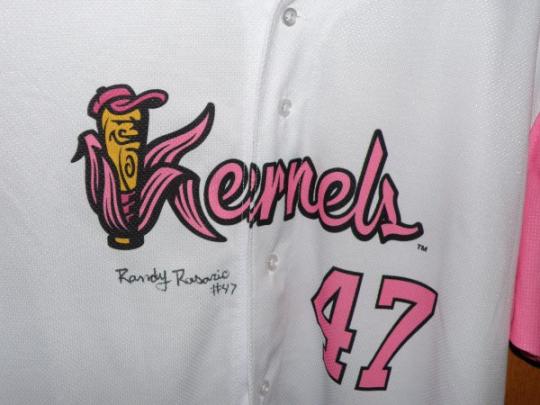
Rosario remains on the Kernels' Disabled List, but hopes he's within a week or so of rejoining the team. Saturday night was one of the Kernels' special jersey nights, this one benefiting the American Cancer Society with a silent auction of the white/pink jerseys the players and coaches wore. I won the bidding of Rosario's jersey and found another reason for Rosario fans to like him - he has an autograph that Killebrew and Cuddyer would be proud of.
-
Agree, regardless of how you feel each pitcher is performing on the season or where they fit in the organization's pecking order, Diamond had the better performance and earned the pitcher of the day.
-
Exactly and this, I suspect, is what's going on. Throwing a bunch of sliders for out-pitches would make his Class A stats look better, but do little to prepare him to be a better MLB pitcher. Locating his fastball and other pitches better is more important than making sure his Ks per inning stats look good.
-
I haven't really seen Larson have to demonstrate his speed much. He does have 3 SBs without being caught and stole a dozen bases in rookie leagues a year ago (caught twice). Covers enough ground, I think, in the corner OF spots.
-
You can view the page at http://www.twinsdaily.com/content.php/2914-Kernels-Report-Tanner-Vavra-and-Zack-Larson
-
Neal: Rosario has nothing to do but wait
Steven Buhr replied to Seth Stohs's topic in Twins Minor League Talk
Brock, I understand you being willing to pass on a job that imposes drug testing that you feel is unwarranted and/or a violation of your privacy rights. It's fine (some might even say laudible) that you would take such a stand. I just have to ask whether you'd be quite so firm in your convictions if (a) the job you were being offered had a very high chance of turning in to a $500,000/year gig... at a MINIMUM... if you turn out to be as good at your job as that potential employer believes you can be; and ( there is no other alternative employer you could move on to and get any kind of similar job for more than, say, 1% of that compensation level. Taking a stand for your beliefs is all well and good, but you have to be willing to accept the consequences. Your consequences are you have to move on and get other work elsewhere. Rosario's consequences are similar, but I suspect much more financially risky.
