



Ted Schwerzler
-
Posts
5,149 -
Joined
-
Last visited
Content Type
Profiles
News
Minnesota Twins Videos
2026 Minnesota Twins Top Prospects Ranking
2022 Minnesota Twins Draft Picks
Minnesota Twins Free Agent & Trade Rumors, Notes, & Tidbits
Guides & Resources
2023 Minnesota Twins Draft Picks
The Minnesota Twins Players Project
2024 Minnesota Twins Draft Picks
2025 Minnesota Twins Draft Pick Tracker
2026 Minnesota Twins Draft Tracker: Picks & Bonuses
Forums
Blogs
Events
Store
Downloads
Gallery
Everything posted by Ted Schwerzler
-
The Blank Check For Matt Wieters
Ted Schwerzler commented on Ted Schwerzler 's blog entry in Off The Baggy
Now re-reading again, I see it! -
Sometimes, there's an applicable use for the statement "elephant in the room," but when it comes to the Twins catching problem, that might not do the situation justice. Kurt Suzuki was less than mediocre in 2015, and there isn't much help on the horizon. Those developments put the Twins in an interesting position. What remains to be seen is whether or not they'll dole out the big payday Matt Wieters has coming to him. ESPN, Twins Daily, heck even here at Off The Baggy, Wieters has been linked to the Twins. He's a living, breathing, and capable catcher on a free agent market void of many options. Outside of the Twins trading for a backstop, the pickings are left relatively slim. With A.J. Pierzynski as a likely backup option, the Twins must consider Wieters. The question is to what extent. In 2015, Wieters was in the final year of a deal that paid him $8.3 million for the season. Although he's a year removed from Tommy John surgery, he's also a Scott Boras client, and a 29 year-old catcher looking for his big payday. With his one chance, he'll likely be holding out for the highest bidder. This past year, Wieters played 75 games for the Orioles, but was behind the plate for just 55 of them. He slashed .267/.319/.422 (or essentially his career numbers). Although he played less than half a season, Wieters mustered just eight long balls and 25 runs batted in; he added 14 doubles and tripled once. Behind the dish, Wieters arm was tested 26 times, and he caught eight base stealers (31%). That mark is just one off the league average of 32% and significantly better than the 15% Suzuki threw out. Looking at how to address the catching situation, much of the Wieters discussion centers around what he should be perceived to be going forward. No doubt his production was muted in 2015, but how much of it was due to being eased back in following injury? He's just 29, and should have plenty of run on him into the future. Spending big on Wieters however, requires the Twins to be of the belief he will produce both at and behind the plate. As things stand, the Twins need their catcher of the future. A.J. Pierzynski would be a far cry from a fix to that situation. While the former Twin makes a lot of sense on a one-year deal, he creates a the same problem in 2017. Wieters on the other hand, could fill the gap if the Twins believe in his projections going forward. Prior to his arm injury, Wieters had caught at least 125 games in every season since 2010. He's consistently thrown out would be base stealers around a 35% clip, and his bat is regarded as an asset (launching 20+ homers three different times). In signing Wieters, the Twins would likely be getting a more polished all around version of Josmil Pinto (and a significantly better defensive version). We are just a few days away from the Twins having to muster up the dollars to present an offer. Wieters should have plenty of suitors, and there's little doubt Boras is going to drive the market as much as he can. It may take a big blank check from the Twins (something their payroll can handle), but the belief that better times are ahead must be there. Whether it's Wieters or Pierzynski, I think both make a great deal of sense in Minnesota for significantly different reasons. Noting that A.J.'s market is going to be secondary, I'd hope the Twins would go all in on Wieters, until it doesn't make sense to do so. Use the secondary market for what it is, a fallback option. For more from Off The Baggy, click here. Follow @tlschwerz
-
The Twins Next Reunion Tour
Ted Schwerzler commented on Ted Schwerzler 's blog entry in Off The Baggy
I'd put a hefty sum on Cuddyer not coming back. -
The Twins Next Reunion Tour
Ted Schwerzler commented on Ted Schwerzler 's blog entry in Off The Baggy
Based on how your comment ended, I'm going to assume you are assimilating reunion with the past application of the word. You couldn't be more off on AJ. He has never been as lowly as a Fryer or Butera type, and even if he regresses slightly, he still is very good against righties making him an ideal platoon split for Suzuki. If the Twins want to throw money bags at Wieters, I'm on board. If they don't and want another solid option, A.J. is absolutely that. -
In recent seasons, the Twins have been more than well known for taking some flyers on the players of yesteryear. There was Matt Geurrier, Jason Kubel, and even Jason Bartlett. While Torii Hunter had more appeal than those players, more often than not, it's not a winning strategy. However, in 2016, it could actually be a path that makes a lot of sense. To be fair, there's plenty of reason to tread cautiously. Geurrier all but forced his way to the big leagues with his contract suggesting he be added to the 25 man or leave. Jason Kubel offered the Twins next to nothing in 45 games in 2014. Then there was Bartlett, who was put in the outfield and quickly was worth -2 DRS (defensive runs saved), in just 7.0 innings. While Hunter wasn't the trainwreck of those before him, he was more liability in the field than he wasn't, and his greatest asset came in the clubhouse. With the Twins in a position to take another step forward in the upcoming season, there's a couple of options that could make a decent bit of sense. With the bulk of the roster being set, and holes being more position related than the team as a whole, Paul Molitor and Terry Ryan could find fits from at least two of three former Twins. Let's start with the guy that probably doesn't make sense to bring back; Justin Morneau. The Colorado Rockies recently declined the team option on his contract, and the former league MVP and batting champ now is a free agent. He'll be 35 next year, and is coming off of a season that was once again cut short by a concussion. In two seasons with the Rockies, Morneau slashed .316/.363/.487. Coors Field no doubt aided in his increased slash line, and he's a prime candidate for regression no matter where he goes (Morneau hadn't hit about .267 since 2010 previously). While hitting for average, Morneau hit only 17 homers a year ago, and just three in 2015. On top of the expected dip in production, Morneau is a first basemen or designated hitter, two places the Twins already have too many options. This one is a pass. Next, it's time to touch on the fit behind the plate again. A.J. Pierzynski is an ideal fit on a one-year deal to pair with Kurt Suzuki. Should the Twins not want to shell out big money to Matt Wieters, it's Pierzynski they should turn to. I've made all of the points as to why he would work here (go read it please). He's going to be playing at age 39 this upcoming year, and while the age should cause him to regress, the same argument could have been made in 2015. Unlike past scenarios, putting A.J. behind the plate in the year ahead would be much more about production than it would a reunion or feel good story. If the opportunity is there, the Twins should take it. Finally, and maybe most interestingly, the Twins have a bullpen option to consider. Looking to improve upon one of the worst relief situations in all of baseball, Minnesota has plenty to consider. Former closer Joe Nathan is one of the names they could choose to look at. The Tigers declined his $10 million option (sensibly), as he's returning from Tommy John surgery. Nathan's last deal was a two-year, $20 million contract from Detroit. In his four years since leaving the Twins, he owns a 2.93 ERA and has converted 116 saves. He still strikes a ton of batters out (9.91 K/9), although being admittedly dangerous the past two years (3.1 BB/9 in 2013 4.5 BB/9 in 2014). The caveat here is that in Minnesota, he wouldn't have to close. I'm not sure what the market will look like for a guy like Nathan. When he signed that $20 million deal, he was coming off an All Star season with the Tigers. Now, he's trying to rebuild his value (both from injury and ineffectiveness). If Ryan gets an opportunity to bring Nathan in on a minor-league deal with a spring training invite, Minnesota should do so in a heartbeat. Allowing him to pitch in a Casey Fien role seems to make a lot of sense. Although in recent seasons the Twins have made a habit of bringing back retreads in hopes of finding a former spark, they aren't in a position to do that in 2016. You can't have has-beens taking meaningful at bats, but in Pierzynski and Nathan, the expectation would be much higher. If there's a reunion tour this time around, expect it to make much more sense. For more from Off The Baggy, click here. Follow @tlschwerz
-
You play to win the game, a phrase many a coach has muttered. While it's not the feelings of some, you can count me among the group that thinks participation medals and pats on the back have no place in competitive sports. You win or you lose, there is no gray area. When you lose, you've come short of the ultimate goal. In professional sports though, where there is a clear cut number of teams, and only one ultimate winner, what defines success? Looking at the Twins and Royals, this has become an interesting topic. Just a few days ago, the Kansas City Royals capped off their 2015 Major League Baseball season as World Series champions. The title was the first for the franchise since 1985, and separated 20 losing seasons between the two championships. Between being the best in the big leagues, the Royals lost over 100 games four times, and 90 or more another nine times. Having both good and bad put into context, local radio personality Phil Mackey posed a question: <blockquote class="twitter-tweet" lang="en"><p lang="en" dir="ltr">For Twins fans discrediting Royals franchise, which 15-yr run would you rather have: Twins '01-15? Or KC '01-15? (TEN 90-L seasons + WS)?</p>— Phil Mackey (@PhilMackey) <a href="https://twitter.com/PhilMackey/status/661586177770786816">November 3, 2015</a></blockquote> <script async src="//platform.twitter.com/widgets.js" charset="utf-8"></script> So what's the answer then? For me, the answer seemed pretty simple. Give me a franchise with the performance of the Twins every single day. While the World Series hasn't been won in the Twin Cities since 1991, victories in baseball are measured by much different standards. The sport deems the best hitters in the world fail seven out of ten times. Some of the best pitchers give up around three runs per game. Over the course of 162 games, the winners are losers are often decided by less than three victories, and even the best teams lose well over one-third of the games they play. Watching, following, and being a fan of a franchise for that one trophy endeavor is a long and lonely road. Since 2001 (not 1985), the Twins have lost 90 games just four times. Minnesota has won six AL Central Division titles, while producing nine winning seasons. They've had batting champions as well as two league MVP's. Since 2001, the Twins have enjoyed baseball being relevant, and one of the most important sports in the upper midwest. Now, while the answer is simple for some, it's more than fair to consider why it isn't for others. There's no doubt winning a World Series (and all that comes with it), is the ultimate prize. The celebration parade, bringing the Commissioner's Trophy home, the champagne, it's all represents the highest goal. For Royals fans, or really any franchise, it's also fair to wonder if a recency effect comes into play. Outside of San Francisco Giants fans, you'd be hard pressed to find many that care who won the 2014 World Series. Baseball fans as a whole can marvel at the performance that Madison Bumgarner turned in over a seven game series, but the eventual result is a thing of the past. So to will that become for the Royals. As the calendar quickly turns to the offseason, only in Kansas City will the Crown be celebrated. Of course there's no wrong answer here, it's a matter of opinion. When looking at a sport where failure is more prevalent than success though, I see no reason to not revel in the production a team does achieve. Greatness is earned by only one a year, but franchises that have sustainability on their side are generally the ones most often celebrated. Give me meaningful outcomes over years of despair for the tradeoff that one game erases it all. For more from Off The Baggy, click here. Follow @tlschwerz
-
The day after the World Series comes to a close may be one of the saddest in baseball. With the realization that the offseason has officially commenced, it's time to buckle in for the winter. For the Twins, 2016 represents tet start of what should be a renewed run of playoff contention. To accomplish that, modeling after both World Series teams seems to be a good starting place.In taking a top-down view at both the New York Mets and Kansas City Royals, both teams have relatively apparent strengths. For the Mets, it is no doubt a pitching staff of fireballers that could all be regarded as true aces. From Harvey to Syndergaard, and those in between, the Mets don't miss a beat. The reigning NL Rookie of the Year isn't their number one, and Zack Wheeler didn't factor in at all during 2015. It's safe to say the Mets are plenty strong in the pitching department. Then you have the Royals, and their foundation built on creating havoc and sustaining leads. A lineup full of guys that simply put the ball in play, backed by a bullpen that doesn't surrender runs. While Ned Yost isn't always the cleanest in his execution, it's the combination of putting pressure on the opposition while breathing easy with a lead that makes his club dangerous. For Minnesota, Paul Molitor and Terry Ryan have yet to achieve either of those teams qualities thus far. There's no doubt the Twins lineup has been given a boost with the emergence of young stars, but the fact remains that there are some significant holes. On the mound, both starting pitching and relief work pale in comparison to the World Series finalists. The rotation is composed of more good-not-great types; the Twins don't project to be like the Mets on the bump any time soon. Owning one of the worst bullpens in baseball this past season, Minnesota knew a lead was never safe. Despite a strong first half from closer Glen Perkins, there were apparent deficiencies from the get go. For the Twins to turn the corner, taking bits and pieces from the two November squads would be a good start. Looking at what the Twins should have in the rotation to start 2016, not much will change. Jose Berrios or Trevor May could be added into the group, but at least at the start, a true ace doesn't appear to be on the horizon. While every team would love to have a go-to number one, Minnesota has to look no further than the Royals to see that isn't necessary. Getting quality outings on a nightly basis to keep you in games is much more sustainable. Fixing the bullpen makes that strategy much more workable. In trying to copy the offensive production of both squads, ironing out a more complete lineup has to be a goal. Adding players who can advance the order, Paul Molitor would have plenty more tools to work with. The Royals created runs on the basepaths and by protecting the zone. The Mets took the approach of the longball and working counts. While no doubt Kansas City's plan of attack is more sustainable, both approaches (with complete lineups), should produce positive results. At this point, the Twins can effectively rule out being either the Royals or the Mets. What they can do however, is focus on what they do and don't want to emulate. Building a stronger bullpen, while filling out a complete lineup is a good start. Having a more advanced defense than New York, it's not out of line to suggest the Twins can put together something plenty special on their own. Only two teams advance to the series that matters most each year, but in watching it unfold, the Twins learn to make the necessary tweaks to draw much nearer. For more from Off The Baggy, click here. Follow @tlschwerz Click here to view the article
-
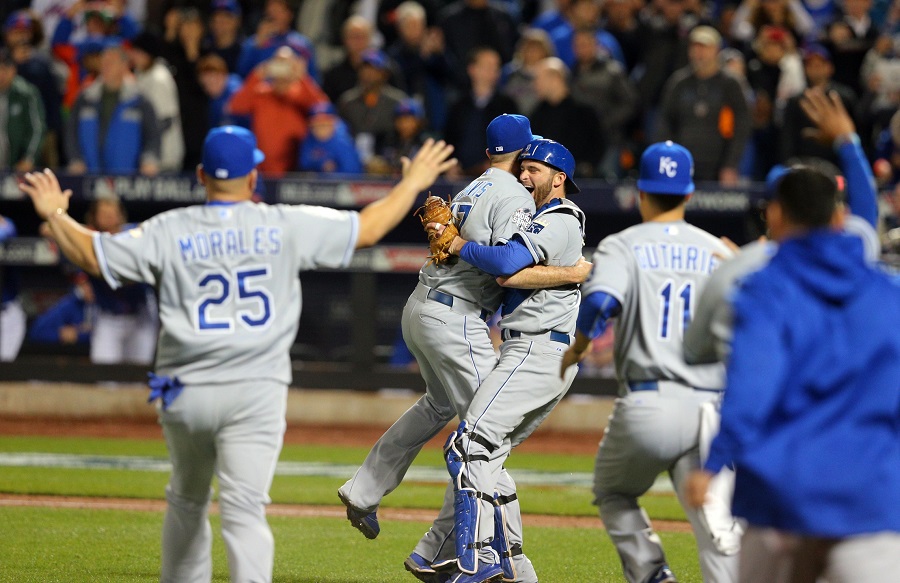 In taking a top-down view at both the New York Mets and Kansas City Royals, both teams have relatively apparent strengths. For the Mets, it is no doubt a pitching staff of fireballers that could all be regarded as true aces. From Harvey to Syndergaard, and those in between, the Mets don't miss a beat. The reigning NL Rookie of the Year isn't their number one, and Zack Wheeler didn't factor in at all during 2015. It's safe to say the Mets are plenty strong in the pitching department. Then you have the Royals, and their foundation built on creating havoc and sustaining leads. A lineup full of guys that simply put the ball in play, backed by a bullpen that doesn't surrender runs. While Ned Yost isn't always the cleanest in his execution, it's the combination of putting pressure on the opposition while breathing easy with a lead that makes his club dangerous. For Minnesota, Paul Molitor and Terry Ryan have yet to achieve either of those teams qualities thus far. There's no doubt the Twins lineup has been given a boost with the emergence of young stars, but the fact remains that there are some significant holes. On the mound, both starting pitching and relief work pale in comparison to the World Series finalists. The rotation is composed of more good-not-great types; the Twins don't project to be like the Mets on the bump any time soon. Owning one of the worst bullpens in baseball this past season, Minnesota knew a lead was never safe. Despite a strong first half from closer Glen Perkins, there were apparent deficiencies from the get go. For the Twins to turn the corner, taking bits and pieces from the two November squads would be a good start. Looking at what the Twins should have in the rotation to start 2016, not much will change. Jose Berrios or Trevor May could be added into the group, but at least at the start, a true ace doesn't appear to be on the horizon. While every team would love to have a go-to number one, Minnesota has to look no further than the Royals to see that isn't necessary. Getting quality outings on a nightly basis to keep you in games is much more sustainable. Fixing the bullpen makes that strategy much more workable. In trying to copy the offensive production of both squads, ironing out a more complete lineup has to be a goal. Adding players who can advance the order, Paul Molitor would have plenty more tools to work with. The Royals created runs on the basepaths and by protecting the zone. The Mets took the approach of the longball and working counts. While no doubt Kansas City's plan of attack is more sustainable, both approaches (with complete lineups), should produce positive results. At this point, the Twins can effectively rule out being either the Royals or the Mets. What they can do however, is focus on what they do and don't want to emulate. Building a stronger bullpen, while filling out a complete lineup is a good start. Having a more advanced defense than New York, it's not out of line to suggest the Twins can put together something plenty special on their own. Only two teams advance to the series that matters most each year, but in watching it unfold, the Twins learn to make the necessary tweaks to draw much nearer. For more from Off The Baggy, click here. Follow @tlschwerz
 -
The day after the World Series comes to a close may be one of the saddest in baseball. With the realization that the offseason has officially commenced, it's time to buckle in for the winter. For the Twins, 2016 represents that start of what should be a renewed run of playoff contention. To accomplish that, modeling after both World Series teams seems to be a good starting place. In taking a top down view at both the New York Mets and Kansas City Royals, both teams have relatively apparent strengths. For the Mets, it was no doubt a pitching staff of fireballers that could all be regarded as true aces. From Harvey to Syndergaard, and those in between, the Mets don't miss a beat. The reigning NL Rookie of the Year isn't their number one, and Zack Wheeler didn't factor in at all during 2015. It's safe to say the Mets are plenty strong in the pitching department. Then you have the Royals, and their foundation built on creating havoc and sustaining leads. A lineup full of guys that simply put the ball in play, backed by a bullpen that doesn't surrender runs. While Ned Yost isn't always the cleanest in his execution, it's the combination of putting pressure on the opposition while breathing easy with a lead that makes his club dangerous. For Minnesota, Paul Molitor and Terry Ryan have yet to accomplish either of those teams qualities thus far. There's no doubt the Twins lineup has been given a boost with the emergence of young stars, but the fact remains that there are some significant holes. On the mound, both starting pitching and relief work pales in comparison to the World Series finalists. A rotation composes more a good-not-great types, the Twins don't project to be like the Mets on the bump any time soon. Owning one of the worst bullpens in baseball this past season, Minnesota knew a lead was never safe. Despite a strong first half from closer Glen Perkins, there were apparent deficiencies from the get go. For the Twins to turn the corner, taking bits and pieces from the two November squads would be a good start. Looking at what the Twins should have in the rotation to start 2016, not much will change. Jose Berrios or Trevor May could be added into the grouping, but at least from the start, a true ace doesn't appear to be on the horizon. While every team would love to have a go-to number one, Minnesota has to look no further than the Royals to see that isn't necessary. Getting quality outings on a nightly basis to keep you in games is much more sustainable. Fixing the bullpen makes that strategy much more workable. In trying to copy the offensive production of both squads, ironing out a more complete lineup has to be a goal. Working around the inclusion of players that can't advance the order, Paul Molitor would have plenty more tools to work with. The Royals created runs on the basepaths, and by protecting the zone. The Mets took the approach of the longball, and working counts. While no doubt Kansas City's plan of attack is more sustainable, both approaches (with complete lineups), should produce positive results. At this point, the Twins can effectively rule out being either the Royals or the Mets. What they can do however, is focus on what they do and don't want to emulate. Building a stronger bullpen, while filling out a complete lineup is a good start. Having a more advanced defense than New York, it's not out of line to suggest the Twins can put together something plenty special on their own. Only two teams advance to the series that matters most each year, but in watching it unfold, the Twins can make the necessary tweaks to draw much more even. For more from Off The Baggy, click here. Follow @tlschwerz
-
Torii Hunter's Departure Ushers In New Twins Outfield
Ted Schwerzler commented on Ted Schwerzler 's blog entry in Off The Baggy
And as you mention, a 19 game sample size isn't anything to look into... -
Torii Hunter's Departure Ushers In New Twins Outfield
Ted Schwerzler commented on Ted Schwerzler 's blog entry in Off The Baggy
I'm not sure how a guy that profiles as little more than an AAAA player can be "underrated." Maybe 4 or 5 years ago when the Twins system wasn't loaded, but he's not a realistic MLB option at this point. -
Torii Hunter's Departure Ushers In New Twins Outfield
Ted Schwerzler commented on Ted Schwerzler 's blog entry in Off The Baggy
He slashed .248/.295/.430 at Triple-A last year and has never been regarded as having a high ceiling. I wouldn't waste a 40 man spot on him. -
Torii Hunter's Departure Ushers In New Twins Outfield
Ted Schwerzler posted a blog entry in Off The Baggy
Torii Hunter has officially announced his retirement from baseball. For fans around Twins Territory, this should come with mixed emotions. While Hunter was a player beloved by many, he was an aging player well past his prime. Now with the Twins set to move on, they can focus on crafting their outfield for the future. What exactly does that look like however? In 2015, Hunter started 121 games in right field for the Twins. He contributed 1,035 innings, made 231 putouts, and added six outfield assists. On the offensive side of things, the fan favorite slashed .240/.293/.409 with 22 homers and 81 runs batted in. From a top down view, that's what the Twins are looking to replace. Broadening the scope though, there's some other factors at play with Hunter's departure. As an outfield, Hunter has been a liability for some time now. He made a career high five errors, and had the second lowest fielding percentage (.979) of his 19 year career. Looking into the advanced metrics, the Arkansas native was worth -8 defensive runs saved this past season, and he owned a lackluster 0.3 ultimate zone rating. To summarize, Torii Hunter the outfielder is addition by subtraction for the Twins. Going into 2016, the assume outfield configuration (or at least the one for the bulk of the season), should be Eddie Rosario, Byron Buxton, and Aaron Hicks from left to right. It wouldn't be surprising to see Buxton start at Triple-A, but he'll likely spend 75% of his season with the Twins. Despite having those three locked in, Minnesota has been afforded some other options with Hunter's retirement. While Hicks has the ability to be a 20/20 guy if he can build of his impressive 2015, Rosario and Buxton are tougher to project. Buxton could still face some growing pains, and Rosario's free swinging tendencies make him a prime candidate to face some regression. With that in mind, the focus turns to who's behind the main three. On what is almost assuredly his final chance, Oswaldo Arcia will need to impress. The defensively lacking outfielder didn't contribute anything significant to the Twins in 2015. Despite a hot homer stretch at Triple-A, his final average was actually below the Mendoza Line. However, Arcia is just a year removed from a 20 homer season at the big league level. Out of options in 2016, Arcia will be given every opportunity to turn the corner. After Arcia, it's another intriguing prospect, and the Twins Minor League Hitter of the Year, Max Kepler. 23 next season, Kepler broke out big time in 2015. He slashed .318/.410/.520 spending 112 games with Double-A Chattanooga. With nine homers, and 13 triples, Kepler's power and speed combination is exciting. Having gotten a cup of coffee to end the 2015 season, there's no doubt the German wants to be at the big league level for good. By retiring, Hunter likely saved the Twins from themselves. After playing on a one-year, $10.5 million deal in 2015, a similar situation was going to play out in 2016 had he wanted to return (likely for less money). Instead, Minnesota is afforded an open roster spot, and the position to integrate the talented youth providing outfield depth. Going into the 2015 season, the Twins had far from a sure thing in Hicks, and Rosario (despite a strong spring) wasn't yet ready for the big time. Hunter manned the outfield with the likes of Arcia and vets Jordan Schafer and Shane Robinson. This time around, it's the kids time to run with it. Behind the main three, both Arcia or Kepler can be included among the 25 man to round out the outfield grouping. Should Buxton start on the farm, it'll be Arcia in right with the 4th spot up for grabs. At the end of the day, Minnesota has plenty of options to pick up where Hunter left off. Almost all of them provide a net gain in being better defensive fits, and the offensive ceiling should only be pushed as time goes on. Although the Torii Hunter era has ended, it's the best case scenario for Minnesota, and Paul Molitor has plenty of weapons at his disposal. For more from Off The Baggy, click here. Follow @tlschwerz -
Last night, Torii Hunter decided to officially hang up his cleats after 19 seasons playing Major League Baseball. Having spent the majority of his career with the Twins, the fan favorite no doubt will go down as one of the most celebrated Minnesota sports figures ever. What he should not do though is see his number hung from the rafters (er above Barrio in left field). Instead, his next stop should be the mound for a ceremonial first pitch. There's little denying that Torii Hunter gave both the Minnesota Twins and the game of baseball a significant amount of lift. He was a nine-time Gold Glove award winner, he went to four All Star games, and he won two Silver Sluggers in his career. The Arkansas native belted 353 career home runs, tallied 2,452 hits, and drove in 1,391 runs. By all measurable standards it was a great career. That also presents the issue for Hunter in regards to retiring number 48. It was great, but not exceptional. As things stand currently, the Minnesota Twins have retired just seven numbers. Those include Kirby Puckett, Harmon Killebrew, Kent Hrbek, Tony Oliva, Rod Carew, Tom Kelly, and Bert Blyleven. Four of those players are in the Hall of Fame, one is an eight-time All Star, another is a two-time World Series manager, and the final is somewhat of a by-product of being a hometown hero. So, where does Torii fit among that grouping? In terms of statistical quantification, Hunter has compiled a career 41.6 fWAR. That number is higher than only Tony Oliva (40.7 fWAR) and Kent Hrbek (37.6 fWAR). It trails significantly behind Kirby Puckett (66.1 fWAR), Rod Carew (72.3 fWAR), and Bert Blyleven (102.9). Hunter's best season by fWAR standards came in 2012 (with the Angels) when he posted a 5.2 mark. On a per season basis, he's averaged just 2.19 fWAR. To put that into context, Eddie Rosario posted a 2.3 fWAR for the Twins in 2013. When deciding whether or not to retire Hunter's number, it's probably less about the numbers than the other factors surrounding it. Looking back on his career, you'd be hard pressed to argue that Hunter's value across Twins Territory was not first and foremost felt through an emotional attachment. He was fun to watch, played the game the right way, and got it done. As noted above though, he was great, but not exceptional. Allowing him in the club opens up a difficult door. Looking back at some of the teams Torii was best known for, there's two other names that would seem to be in his class. Both Brad Radke and Joe Nathan could have a similar claim to make should Hunter's jersey be no more. Radke owned a 38.7 fWAR despite being a pitcher and playing for only 12 seasons (he also was with the Twins for all of them). While Nathan can't be quantified through WAR, his Twins record saves total comes full circle. In total, the suggestion is far from Torii Hunter not being celebrated, he absolutely should. However, he should not be revered, and the honor of a number no longer being available should remain a sacred right of passage. Hunter has my vote to throw out the first pitch on Opening Day 2016, but leave the jersey retiring to those who achieved more. For more from Off The Baggy, click here. Follow @tlschwerz
-
Spider-Man In The Flesh, Torii Hunter Says Goodbye
Ted Schwerzler posted a blog entry in Off The Baggy
After 19 seasons, and a final farewell, Torii Hunter has decided to hang up his cleats. There was no tour as he completed his final 139 games, there was no final moment, and there wasn't even an at bat in the Twins final game. For Torii, things ended the same way they started, on his terms. After being the 20th overall selection by the Minnesota Twins in the 1993 Major League Baseball draft, Hunter debuted in 1997 at the age of 21. Becoming a regular two years later, the 23 year-old would go on (unbeknownst to him) to be one of the most celebrated Twins in history. Thinking about the 408ft marker out in centerfield at the Hubert H. Humphrey Metrodome was not possible without Torii's image emblazoned in front of it. For his career, Torii was a man of moments. Despite being celebrated as a defensive superstar, it was the awe inspiring and jaw dropping catches that truly defined his prowess. While not the fastest in center, and without the strongest arm, Hunter relied on instinct and feel. Robbing home runs became his calling card, both at the Metrodome and on the road. While sabermetrics suggest that Hunter was average at best defensively for much of his career, moments such as his robbing Barry Bonds during the 2002 All Star game only took his defensive lore to new heights. In fact, it was actually the bat that paced Hunter for many of his 19 seasons. Owning a career .277/.331/.461 slash line, Hunter compiled 2,452 hits, 353 homers, and 1,391 runs batted in. He produced his two highest averages of his career at the ages of 36 and 37, and eight times he batted .280 or higher. Then, there was his durability. Over the course of his 19 seasons, Hunter showed up each and every day. He competed in at least 135 games in 14 of those seasons, and played in over 150 on four different occasions. In his final tour with the Twins in 2015, it was that ability to show up that drew Terry Ryan and Paul Molitor to bring the veteran back one last time. With young talent such as Byron Buxton and Eddie Rosario needing mentorship, it was Hunter who was there to provide it. Throughout spring training and into the season, it was Hunter who dictated clubhouse life, and led the outfielders down the path of success. With his track record behind him, the young prospects on board were able to emulate what they one day would hope to become. Now with the certainty that Torii Hunter's career has come to an end, the Twins can move on and move forward into a new era. Having bridged the gap between what was and what is to come, centerfield is now being turned over to a new crop of talent. For everything Torii was to Twins Territory, the likes of Aaron Hicks and Byron Buxton will never be able to replace him. What they can do however, is hope to follow his example and light their own path. For everything, the good the bad, ups and downs, excitement and failures, thank you Torii Hunter. For more from Off The Baggy, click here. Follow @tlschwerz -
Questions Still Loom For Twins 40 Man
Ted Schwerzler commented on Ted Schwerzler 's blog entry in Off The Baggy
FWIW, catcher is going to be addressed, so the hints are relatively unnecessary. To address a part of the comment though, Gilmartin played on a team that outperformed Graham's, his usage reflected that. While him being a lefty carries value, Graham pushes into the upper 90s and that's significantly more valuable in the long run. -
Weeding Through Molitor's Messages
Ted Schwerzler commented on Ted Schwerzler 's blog entry in Off The Baggy
Hunter being back is no doubt on Hunter, I remain of the opinion that under no circumstance should the Twins want that. At least as a player (and Hunter doesn't want to coach). It's going to though (likely) and that's unfortunate. Suggesting Hicks having a good six week is selling the season short (I think), but it's not an egregious assesment. That's the outfield configuration of most logic, but of course there's growing pains to be had there. -
Between blogs (hopefully this is your first stop), traditional newspaper outlets, and advanced media such as radio and television, the Twins are well covered in the Twin Cities. Making a regularly scheduled appearance on ESPN Radio with Patrick Reusse, Paul Molitor provided some interesting tidbits yesterday. Over the course of his 45 minute candid appearance, there were some Twins notes that definitely are worth addressing. Paul Molitor is heading into his first offseason having been the acting manager the season before. With a full year of evaluation, Molitor now has the task of positioning the active roster for sustained competitiveness in the years to come. Judging by his interview, he's already given the process some serious thought. Early on when talking to Reusse, Molitor addressed the bullpen, and suggested Neal Cotts could be brought back. As things stand currently, Cotts (acquired from the Brewers) is headed to free agency. There's been some buzz that the Twins would look into bringing him back needing a left-handed arm in relief. Cotts pitched on a one-year, $3 million deal in 2015, and no doubt would be looking for more. He owned a 3.95 ERA across 13.2 IP for the Twins, but had a 5.99 FIP (fielding independent pitching) and a 1.390 WHIP. Cotts struck out just 5.9 per nine and walked 3.3 per nine (walks mirroring his career numbers). If you're looking to fix the pen, Cotts isn't where I'd start. Following the pen discussion, Molitor then turned his attention toward some of the youth in the Twins organization. First noting pitcher Jose Berrios, Molitor had good things to say of his performance in 2015. With a 2.87 ERA and 9.5 K/9 in 2015, it's hard not to be excited about the production. The Twins skipper did touch on concerns of workload (Berrios pitched 166.1 innings in 2015, previous high was 139.2), despite noting his work ethic and conditioning. There was plenty of angst towards the Twins in not promoting Berrios down the stretch. Molitor suggested that he was in favor of keeping the Puerto Rican hurler on the farm, and that service time and contracts unfortunately come into play. He'll be pushing for time out of Spring Training, but it doesn't sound like Molitor plans on opening that door too easily. From the mound to the outfield, Molitor then discussed Byron Buxton's performance down the stretch. Despite not getting into too much action, Molitor noted the staff "saw lots of signs of improvement," also noting his "athleticism is off the charts." It doesn't appear that the organization is convinced Buxton will open 2016 with the big league club however. Buxton shouldn't have a prolonged stay in Triple-A, but beginning the season there seems like the route that may be taken. Staying in the outfield, Torii Hunter then became a talking point. Molitor praised his season (at least the 20 HR 80 RBI portion of it), and said there's "interest on our side," in regards to bringing him back. It doesn't sound like Torii has made up his mind as to what he'd like to do. Despite Reusse suggesting most don't understand defensive metrics outside of the organization, it's the defensive metrics that should have Twins fans wanting Hunter out the door. He posted an ugly -8 DRS (defensive runs saved) and a poor 0.3 UZR (ultimate zone rating) in 2015. His roster spot is better used on someone more than just a figurehead. Interestingly enough, and despite the youth out in the outfield, Molitor seems to believe the Twins outfield depth isn't where he wants it. Noting that Hicks is off to a good start but needs to continue that path, and having some other unproven youth, he took the conversation to an unexpected place. Suggesting it's "not out of the realm of possibility" to play Miguel Sano in the outfield, it doesn't seem the Twins are concerned about getting him out of being solely a DH. Lastly addressing the infield, Molitor quickly suggested that Eduardo Escobar is their shortstop. He earned the role in 2015, and should be allowed to run with it for the immediate future. His fWAR ranks 12th among 72 shortstops with 100 or more plate appearances since 2014 (credit @Brandon_Warne). With Escobar locking down short, Molitor offered that "We're (Twins) going to run into issues with (Danny) Santana, out of options and all." The problem with this line of thinking is that there really is no problem at all. Both Escobar and Eduardo Nunez filled super utility roles for the Twins in the past. Santana seems like the ideal candidate to do so at least in 2016, and that decision becomes even more clear when not wasting roster spots on players like Hunter. As a whole, the conversation was extremely candid, and often times Molitor lets slip some very good tidbits of information. The Twins have begun to trim their 40 man roster already, and more decisions loom this offseason. Minnesota needs to take another step forward in 2016, and seeing how that happens will be interesting. For more from Off The Baggy, click here. Follow @tlschwerz
-
Minnesota's Next Free Agent Arm?
Ted Schwerzler commented on Ted Schwerzler 's blog entry in Off The Baggy
Sure, we could always so or stand pat with anything...kind of negates the point. Also, of those three, the only with potential to be what Zimmerman is would be Berrios. -
As with all major league organizations, the offseason brings change. The Twins have been done with baseball games since the first week of October. Now looking ahead to preparing for 2016, roster decisions begin. The first came with three players being removed from the 40 man roster. Shane Robinson, Eric Fryer, and Aaron Thompson were all outrighted to Triple-A and cleared waivers. Heading into 2015, Robinson was signed strictly as a veteran outfielder to provide depth, a move that the Twins missed on the year before. Paired with Jordan Schafer, it was Robinson who proved vital and gave the Twins everything they asked of him. Fryer is was little more than catching depth this past season, and despite getting big league action, it was more out of necessity than anything. Thompson, a former first round pick (by the Florida Marlins), put together a strong first couple months before eventually falling off the deep end for the Twins. Now with all three players allowed to either accept the assignment to Triple-A or elect free agency (as I would expect Shane Robinson will and should), the Twins 40 man roster stands at 37. With both Logan Darnell and Ryan Pressly on the 60 day DL and needing to be activated, that leaves one opening of the 40. Minnesota no doubt needs more space however. Before even considering free agency or trade acquisitions, Terry Ryan has some internal housekeeping to do. Minor leaguers Taylor Rogers, J.T. Chargois, Zack Jones, Felix Jorge, Travis Harrison, and Adam Brett Walker all need to be added to the 40 man or be vulnerable in the Rule 5 Draft. Each of those players would seem likely for the Twins to want to protect. In total, that's seven needs with just one open spot. Having yet to do so, Minnesota has room to trim more from the 40 man however. A.J. Achter came up late in the season and pitched out of the pen, but his minor league success didn't follow, he would seem to be someone that would go unclaimed on waivers and could be outrighted. Ryan O'Rourke would also fit that mold. Concerning more "big-league" type names, Blaine Boyer, Brian Duensing, Chris Herrmann, and Eduardo Nunez are all possibilities. I'd assume that Minnesota would be open to bringing Boyer back in 2016. Despite pitcher over his head for the most part, he could have a role in an improved pen. Duensing likely won't (and shouldn't) be offered a new deal, so I'd expect him to be on the way out. For Herrman, his place is in secure if the Twins don't address their need for a catcher (they likely will, but that means Herrmann's removal will be spoken for). I'm not quite sure on a read for Nunez and his spot with the Twins going forward. He's arbitration eligible, but he could be bumped if the Twins want to use Danny Santana (who's out of options) in the utility role. Looking at those raw numbers in a quick sense though, it would seem they open up only three more guaranteed 40 man roster spots. In total, that gives the Twins four openings with seven guys needing protection, and outside help likely on the way. Trades could address some of the roster crunch, and we're sure to see things unfold more completely as the offseason drags on. The only other guaranteed openings for the Twins come through the removal (or assumed removal) of free agents. Minnesota has five: Torii Hunter, Mike Pelfrey, Duensing, Boyer, and Neal Cotts. Hunter is a wile card, while Pelfrey is anything but. Duensing is assumed gone, and Boyer is up in the air. The Twins will likely talk to Cotts, but his performance down the stretch should have them being cautious, left-handed thrower and all. For now however, those guys on the bubble have to be wondering where they fit for the Twins going forward. In the Rule 5 Draft this past season, the Twins selected J.R. Graham from the Atlanta Braves, and they lost Sean Gilmartin to the Mets. For more from Off The Baggy, click here. Follow @tlschwerz
-
After the 2015 Major League Baseball season that the Minnesota Twins just experienced, expectations for the upcoming 2016 year are at an all time high. Having not made the playoffs since the 2010 season, this offseason is pivotal. Terry Ryan and the Twins brain-trust will be expected to make some key moves to push the Twins over the top. Once again, could it be another free agent pitcher that highlights the winter? Each of the past few seasons, the Twins have made a splash. First it was Ricky Nolasco and Phil Hughes. Last offseason, it was Ervin Santana. Now with pitching as more of a strength, and looking to push the attitude towards a higher quality than simply a quantity of arms, a different type of starter could emerge. The free agent pool for starting pitchers this offseason has multiple different tiers covered. There's the unrealistic types such as Johnny Cueto, Zack Greinke, and David Price. Then there's more of the same (similar to Hughes or Santana) in names like Yovani Gallardo, Jaime Garcia, Scott Kazmir, and even Clay Bucholz. One name not mentioned, and a guy that could be a potential fit, Jordan Zimmerman. After seven seasons with the Washington Nationals, Zimmerman is ready to move on. Coming off a 2 year, $24 million deal, he's ready for his first big payday. Something in the five year, $90-100 million range seems expected, and for a guy who will be 30 in May, that sounds about right. In 2015, Zimmerman posted his worst full season with the Nationals. The good news is he was still pretty good. Owning a 3.66 ERA across 33 starts and 201.2 IP, he backed his performance with a 3.75 FIP (fielding independent pitching). His walk numbers (1.7 BB/9) fit in well with the Twins staff, and despite not being a strikeout master (7.3 K/9), he'd be among the Twins best. Having never pitched in the American League, there's no doubt the Twins would be taking a chance on bringing him over. His sparkling 2.84 ERA at home in 2015 helped to downplay a 4.87 ERA in 14 road starts. Over the course of his career, Zimmerman has mad 24 Inter-League starts. In those games, he owns a 3.05 ERA and has struck out batters at a 7.3 K/9 rate. The expectation should be that he could continue being an above average pitcher in Minnesota. To be fair, the Twins don't have to go an find a top of the rotation starter this offseason. The Kansas City Royals are going to the World Series without one (Cueto has been anything but), and the New York Mets have shown how important it is to have guys that give you a chance every single night. However, should the Twins target Zimmerman, the next question becomes whether or not the financial implications are doable. Needing to address the catcher role, and relief pitching, Minnesota has some other priorities this offseason. In 2015, the payroll sat just over $106 million. As things stand right now, Minnesota has contracts handed out to seven players worth a total of $73 million. Obviously that number is going to rise, and before Zimmerman, I'd expect the Twins to be in the $107 million ballpark for 2016. With that said, adding an arm like the former Nationals starter would put the Twins somewhere around $125 million in the year ahead. That jump is significant, and a mark the club has never seen before. It's hard to fathom them being comfortable with that for one player, even if the dollars are accesible (I believe they are). At the end of the day, Zimmerman is a Midwest native (hailing from Wisconsin), the Twins have a need (potentially), and Minnesota has the money (ideally). It would take an absolute perfect storm for a deal to come together, but it may be the best plan of action. Rather than adding another depth rotation arm, solidifying the top of the rotation may be the best thing for Molitor and Ryan. There's little room to argue Zimmerman is anything but a longshot, but over the likes of Kazmir, Bucholz, or Jeff Samardzija, give me the guy looking to get paid. For more from Off The Baggy, click here. Follow @tlschwerz
-
The Twins Newest (And Oldest) Backstop
Ted Schwerzler commented on Ted Schwerzler 's blog entry in Off The Baggy
Part of the problem in pairing Turner with Zuk is what you aren't accomplishing. Suzuki isn't good defensively, he's horrible, and he's well below average offensively. Turner is borderline terrible offensively (at least as he'd be extrapolated immediately to MLB) despite his defensive aptitude. What your suggesting being in favor of is essentially a younger Drew Butera. Butera played here behind Mauer. He plays behind Salvador Perez now. You can't have an automatic out in both of your catchers offensively. A.J. is an ideal platoon partner for Suzuki if you aren't making a trade to get a long term answer. -
For Twins fans, this is a position that Minnesota has not been in for quite some time. Experiencing a starting rotation drought that had the Twins five at the bottom of baseball for years, a new wave is being ushered in. Now with depth, and improved quality on the mound, Paul Molitor has some tough choices to make going into 2016. However, with more arms than openings, it may be time to consider a more aggressive quality over quantity approach. As always, there's five openings in the starting rotation. Phil Hughes, Ervin Santana, and Kyle Gibson are absolutely locked in for three of them. That leaves a slew of arms including Ricky Nolasco, Tyler Duffey, Tommy Milone, Trevor May, Jose Berrios, and even Alex Meyer to fight over the final two spots. While not all of those options are ideal, a handful of them are. That said, Minnesota could opt to make an aggressive move that may pay dividends both now and into the future. Formerly a first round draft pick back in 2009, Minnesota selected Kyle Gibson out of the University of Missouri. As a college pitcher, he was expected to accelerate through the farm quickly. Tommy John surgery derailed the debut somewhat, but he surfaced at the age of 25 in 2013. Now 73 big league games under his belt, Gibson turned in a 2015 worthy of turning some heads. In 32 starts, Gibson owned a 3.84 ERA. It was backed by a 3.96 FIP and a 1.289 WHIP. His 6.7 K/9 mark was a career best and his 3.0 BB/9 tally was in line with his past totals. Gibson also allowed a career low 8.6 H/9 and was virtually one start away from compiling his first 200 inning season. By all standard statistics, Kyle Gibson's 2015 was a breakout year. Then there's the advanced statistics. They tell a very similar story. Over the past year, Gibson allowed hard contact on just 27.3% of his pitches, in line with his career totals. He also generated ground balls on over 53% of his pitches put into play. While he gave up more home runs than at any other point in his major league career, that may have been his lone blemish. Gibson's 35.7% out-of-zone swings were a career high, and he pushed his swinging strike percentage to 9.8 (also a career best). So why then would the Twins look to trade a young pitcher at the top of his game? The answer is two fold, and not necessarily cut and dry. First and foremost, Kyle Gibson is not nearly as young as you'd believe. 28 years old on October 23rd, Gibson is most definitely a late bloomer. While he is under team control until 2020, and doesn't hit arbitration until 2017, the expectation should be that his prime could be somewhat muted. As much as team control is an asset to the Twins, it is also a commodity to a trade partner in any scenario as well. Then things circle back to the idea of the rotation construction for the Twins. At his best, Gibson may be a number two starter, but more likely is a three or four. Minnesota is in a position to begin a window of competitiveness for years to come. The rotation is currently comprised of arms that would likely top out as a number two starter at best. Moving Gibson could clear the way for that to change. Both May or Berrios could immediately pick up Gibson's slack, and may have higher ceilings. Any move that would send Gibson away from the Twins would also need to command quite a return. Taking on a veteran, or a higher ceiling prospect with front of the rotation stuff could be something that would move the needle for Terry Ryan. While a significant longshot, and something I myself am not even convinced I would entertain, there's definite reason to explore what the return for Kyle Gibson would look like. With the Twins entering a time where they should again be good, raising their own floor through higher ceiling acquisitions needs to be a part of the strategy. Whether Gibson is a part of the Twins future or not, his potential to help Minnesota could come on the mound just as likely as it could come off of it. For more from Off The Baggy, click here. Follow @tlschwerz
-
The Twins Newest (And Oldest) Backstop
Ted Schwerzler commented on Ted Schwerzler 's blog entry in Off The Baggy
I'll disagree with this strongly. After the season Turner had last year (and his pro results to date) under no circumstances would he be considered in 2016 at the big league level. Further, A.J. is not cut from the Torii mold. On a one or two year deal, he absolutely fits a strategy of winning. He still contributes at a high level both offensively and defensively. Should the Twins see an emergence from a younger catcher within the org, he also blocks no one. Also, remember as the article states, Pierzynski's acquisition would be only under the assumption a trade for a young backstop to go into the future with, doesn't take place. -
In 2015, there's little denying that the catcher position was one of the largest deficiencies for the Minnesota Twins. After an All Star caliber 2014, Kurt Suzuki regressed towards his career norms. Never a good defensive catcher, his offensive production waned as well. Going forward, it's an area that Terry Ryan knows he needs to address. Following a season in which Suzuki slashed just .240/.296/.314 and threw out an MLB worst 15% of would be base stealers, things need to change. Suzuki is with the Twins for another year (signed through 2016), but Paul Molitor can't afford to pair him with the likes of Chris Herrmann or Eric Fryer going forward. On a team looking to take the next step, the needle absolutely needs to be pushed. So, barring a trade bringing in long term depth to help supplement the organization's catching woes, free agency is going to have to be the route. For Minnesota, the most high-profile name is no doubt Matt Wieters. The guy once billed as the next Joe Mauer (when Mauer was a Hall of Fame type of backstop) has never lived up to that status. However, he's a career .258/.320/.423 hitter having spent all seven of his big league years with the Orioles. He owns a solid 32% caught stealing rate, but does have arm concerns after undergoing Tommy John surgery in 2014. That all said, the Twins answer isn't Wieters. In fact, it's probably even more of a familiar face. Welcome back A.J. Pierzynski. The 38 year old catcher is coming off a one year, $2 million deal with the Atlanta Braves. After a dip in production since leaving Texas in 2013, Pierzynski turned in a very strong 2015 campaign. Across 113 games for the Braves, A.J. caught 107 while slashing .300/.339/.430. He added 24 doubles, nine homers, and 49 runs batted in. Striking out just 37 times in 436 plate appearances, Pierzynski's plate discipline scoffs at even Suzuki's (who's regarded as a tough hitter to strike out). Knowing that Suzuki is not going anywhere, Pierzynski profiles as a solid platoon mate for the upcoming year. Having slashed .309/.342/.457 against right-handed pitching, it would be A.J. picking up the slack for Suzuki (who slashed .232/.284/.303 vs RHP). Pierzynski's 28% caught stealing rate would also be a welcomed addition to a Twins team that was far too easily run on the past season. Now, there's no doubt Pierzynski has been on both sides of the fence among Twins fans. What matters though is that production is always reality, and getting contributions from the former Twin would quiet those issues. Providing a veteran presence with a high level of production is something that a young Twins roster would no doubt benefit from. Ideally, Minnesota sees significant improvement from catchers Stuart Turner and Mitch Garver in 2016. Both are playing in the Arizona Fall League, and are regarded as some of the little depth the Twins system has. With Josmil Pinto being a major question mark after an injury riddled 2015, Minnesota buying time with a Pierzynski type makes a lot of sense. While Wieters may be the bigger name, he's also going to command a much higher price. With uncertainties ahead, he may also not solve the Twins issues going forward. Pierzynski gives the Twins a real positive option in the immediate future, with the ability to not force a decision before the organization has to. If there's a more realistic trade target out there that solidifies the catcher position going forward, the Twins should make it. The possibility of it coming with as little risk as bringing back A.J. Pierzynski seems far-fetched however, and calling upon an old friend is something Paul Molitor and Terry Ryan should make a plan A this offseason. For more from Off The Baggy, click here. Follow @tlschwerz
