



Ted Schwerzler
-
Posts
5,149 -
Joined
-
Last visited
Content Type
Profiles
News
Minnesota Twins Videos
2026 Minnesota Twins Top Prospects Ranking
2022 Minnesota Twins Draft Picks
Minnesota Twins Free Agent & Trade Rumors, Notes, & Tidbits
Guides & Resources
2023 Minnesota Twins Draft Picks
The Minnesota Twins Players Project
2024 Minnesota Twins Draft Picks
2025 Minnesota Twins Draft Pick Tracker
2026 Minnesota Twins Draft Tracker: Picks & Bonuses
Forums
Blogs
Events
Store
Downloads
Gallery
Everything posted by Ted Schwerzler
-
Who Goes North for the Twins
Ted Schwerzler commented on Ted Schwerzler 's blog entry in Off The Baggy
Rodney isn't going anywhere, even with a bad spring. Sano likely is going to get some sort of discipline, so that remains up in the air. I don't believe Wilson has any real shot of making the club. I'd prefer to see them walk away from Hughes if his production suffers, but don't see that happening on Opening Day. One of the unsigned two (Lynn/Cobb) probably still remains in play. -
With the Minnesota Twins now involved in spring training action, and exhibition games well under way, it's a good time to take a look at the 25 that will head north with the club at the end of March. Having had significant turnover and uncertainty throughout seasons in recent memory, 2018 brings a breath of fresh air. This club should be relatively simple to project, and that's the mark of a strong team. Following up a Postseason berth and a strong showing over the course of the 2017 Major League Baseball season, the Twins had a few key areas to improve in order to take the next step. This offseason, Derek Falvey and Thad Levine have executed a near flawless blueprint, and they have the product on the field positioned to make a run for the AL Central division title. Although not set in stone, there's significant clarity when it comes to deciphering the Opening Day 25 man, and here's a good bet at what it could look like: Infielders (9) Jason Castro C Mitch Garver C Ehire Adrianza Util Brian Dozier 2B Eduardo Escobar Util Joe Mauer 1B Jorge Polanco SS Miguel Sano 3B Logan Morrison 1B Both catcher positions are all but locked in, and the starting combination up the middle should be set. Joe Mauer is inked at first, and Logan Morrison will back him up while serving as the full-time designated hitter. Although Adrianza could be pushed by Erick Aybar for a job, I think the former's best chance to get on the roster is a potential suspension to Miguel Sano. Sano is already set to play the field in spring training games, so his injury recovery should be all but over. Major League Baseball has yet to speak with Miguel in regards to allegations, and no matter what the outcome, I'd think a 30 game suspension is the max penalty. Outside of the third basemen, there really is no level of intrigue here. Outfielders (4) Byron Buxton CF Robbie Grossman LF/RF Max Kepler RF Eddie Rosario LF This group is virtually locked in as well. The trio of "Nothing falls but raindrops" is a given, and their rotational fourth should end up being Grossman. Zack Granite is a significantly better defender, and would provide a nice speed option on the bench, but he has options remaining and is available to Minnesota at any point in time. I could see Granite forcing his way onto the roster this spring, but the more likely scenario is that Grossman sticks until it no longer works. The Twins would need to DFA him, and doing that before necessary doesn't seem like a pressing matter. Pitchers (12) Jose Berrios SP Tyler Duffey RP Zach Duke RP Kyle Gibson SP Trevor Hildenberger RP Phil Hughes SP Adalberto Mejia SP Jake Odorizzi SP Ryan Pressly RP Addison Reed RP Fernando Rodney RP Taylor Rogers RP Despite not having Ervin Santana available to them out of the gate, I'd still imagine the Twins go with a full five-man starting rotation. That group would include Berrios, Odorizzi, Gibson, Mejia, and Hughes. The last two spots are somewhat up in the air, but Hughes' contract should afford him an opportunity, and Minnesota would need to see significant improvement from Anibal Sanchez this spring to pencil him in. The relief corps is vastly improved, and that group should be relatively set in stone. If Minnesota is serious about using Duffey as a starter, I suppose a trip to Triple-A could make some sense, in which case Alan Busenitz takes his spot in the bullpen. Again, in comparison to recent years, this Minnesota Twins squad has the least amount of question marks when looking at Opening Day. Obviously that's a great thing, and a testament to the talent available to Paul Molitor. Having defined roles and positions from the get go is a good place to be, and allows the club to work from depth as situations present themselves. For more from Off The Baggy, click here. Follow @tlschwerz
- 5 comments
-
- 2
-

-
- minnesota twins
- spring training
- (and 1 more)
-
A year ago, in January to be specific, I penned a piece suggesting that the Minnesota Twins time to rebuild was over and that the new focus should be around building and supplementing the core. From that point, the organization experienced an 85 win season and a postseason berth. Heading into 2018, Derek Falvey and Thad Levine are all systems go in regards to the building effort. When the dust settled following a one game defeat in The Bronx, Minnesota had a few clear cut avenues for improvement. They needed a starting arm, at least one. Paul Molitor needed a revamped bullpen, and a bat remained a relative luxury. As the hometown nine remains on a collision course with Opening Day, they've checked off all of the boxes and then some. Going the relief route first, Addison Reed was the first surprise move to take place. Arguably among the best relievers, not named Wade Davis, to be available this winter, he provides a huge boost for Minnesota. Fernando Rodney and Zach Duke come in on one year deals and both provide significant upside with little room to be a disaster. On top of being outside additions, Paul Molitor now also has the luxury of using the reinforcements to strengthen the overall depth at his disposal. Names like Alan Busenitz and John Curtiss are now on the outside looking in, despite being more than capable of producing at the highest level. When it comes to relief, check off that box. In the rotation, the goal was to bring in a pitcher that would slot among the Twins top three. With Ervin Santana and Jose Berrios at the top, Minnesota has two quality options and a bunch of question marks behind them. In solidifying three-fifths of the rotation, the names bringing up the rear are in a position to force only the best performers an opportunity to consistently be considered. The front office flipped Jermaine Palacios, a nice player that wasn't going to factor in at Target Field, for a pitcher that fits the mold in Jake Odorizzi. Sure, it's still somewhat deflating that Minnesota couldn't land Yu Darvish, but the reality is that he was the top player on the market and someone like that landing with the Twins is a long shot at best. As things stand right now, the rotation box can also be marked off, but a surprise addition of Lance Lynn or Alex Cobb would take things to an even higher level. Finally, and least important, a bat looked like an avenue for improvement. In a steal of a deal, Logan Morrison joins Minnesota. Coming off a breakout season with 38 homers and a slugging percentage north of .500, he adds an incredible amount of thump to an already potent lineup. Minnesota has an opportunity to bat five players in the top two-thirds of their lineup that accounted for just under 150 home runs a season ago. Morrison removes the uncertainty of Kennys Vargas from the equation, and if Miguel Sano can consistently be ran out at third base, things get even more enticing. If this was the optional box to check, Falvey and Levine made sure to cross it off as well. If we've seen anything this offseason, it's that there should never be a point in which you expect what comes next. The dollars have been depressed, but the deals have still come. When it appears Minnesota may be done making moves, another announcement is on the horizon. With some money yet to spend, Lynn or Cobb would seemingly be the final piece to a well constructed puzzle. No matter what though, the landscape has been navigated wonderfully. While bringing in a significant amount of talent, the front office has managed to commit only to situations in their favor. Only Addison Reed has a guaranteed contract into 2019 of the new acquisitions, and there's plenty of options on the table that allow for the Twins to capitalize on the upside available to them. Not only has it been a strong blueprint for talent acquisition, but the savvy spending shouldn't be overlooked either. As the Twins embark on one of the most promising seasons in recent memory, they'll do so following one of the best offseasons in organization history. With the growth and development of a core capable of winning, Minnesota's front office has put their faith behind them and helped to build a contender. Cleveland is still where the division winner must go through, but Minnesota is hardly a far cry from wrangling that title away. If a 2017 postseason berth wasn't going to get you excited for what lies ahead, the off the field action should absolutely do the trick. For more from Off The Baggy, click here. Follow @tlschwerz
-
- 1
-
-
- minnesota twins
- derek falvey
- (and 1 more)
-
In 2014, the Minnesota Twins employed Kurt Suzuki as their starting catcher. He was brought in as a free agent to take over for Joe Mauer, who had to step out from behind the plate. In his first season with the Twins, Suzuki posted a then career-best .727 OPS and made his only All-Star Game. After falling off from there, Minnesota has been searching for answers. It seems as though 2017 helped to find a recipe that may fit.Since 2014, the Twins have had catchers by the names of Suzuki, Eric Fryer, Chris Herrmann, Juan Centeno and John Ryan Murphy. None of them filled the role with any semblance of staying power. Prior to the 2017 season, Jason Castro was handed a three-year, $24.5 million deal from Derek Falvey and Thad Levine in hopes he would provide a high level of performance and consistency behind the plate. Looking back at year one, Castro provided the best output behind the dish since Suzuki’s All-Star appearance. His 1.6 fWAR slotted in just behind Suzuki’s 2.0 fWAR mark, and the tandem with Chris Gimenez (1.0 fWAR) proved to be a decent pairing. While plenty was made about Castro’s pitch framing, his receiving and throw skills should get plenty of notice as well. After Suzuki failed to be league average or better, topping out at 25% in regard to catching base runners, Castro bested that mark a year ago and was run on significantly less. On the offensive side of things, Castro put forth the best season of his career since being named an All-Star with the Astros in 2013. On top of seeing a significant boost in the average department, he also got back to his ways of being an on-base threat. Despite the .720 OPS leaving some room for improvement, it’s actually the splits that Minnesota fans can begin to salivate over. As a lefty, Castro presents Paul Molitor with an opportunity to maximize his future output. A year ago, the Twins backstop actually had similar splits facing righties and lefties, if not a bit skewed towards the reverse. His .737 OPS against lefties slotted in just a bit higher than the .714 OPS he posted against right-handed pitchers. Over the course of his career however, Castro’s splits tell a different story. The .568 OPS against lefties is buoyed by a .747 OPS against righties, leaving a relatively exposable deficiency. Enter his assumed partner for the 2018 Twins season, Mitch Garver. At Triple-A Rochester in 2017, Garver post a .928 OPS (a career high) across 88 games. It was quite the jump from the .753 OPS at Double-A in 2016 (95 games), and even a boost from the .815 OPS in his first 22 games of Triple-A action. After having a strong 2017, it’s not surprising that Garver’s numbers tallied well against both lefties (.938 OPS) and righties (.870). Over the course of his career however, he’s proven capable of mashing against lefties. You can expect that there will still be a learning curve, and a significant bit of development needing to take place in 2018 for the former New Mexico Lobos backstop. He has just 52 major league plate appearances to his name, and despite being 27 years old, he’ll be thrown into a sink-or-swim scenario. Fortunately, there’s plenty of room for him to bring the water level of the Twins backstops up a notch. The bar Chris Gimenez set in 2017 is what Garver should be looking to clear. He was given 54 starts, which could be a number that Mitch expands upon. A 30% caught stealing rate was great, but ten passed balls was something that was an apparent issue when Gimenez was behind the dish a season ago. His .731 OPS was a career high (over at least a 40 game sample size), and will be the offensive mark that Garver is looking to best. Last year, the Castro and Gimenez duo actually performed above average across the big leagues. The 2.8 fWAR put up by the duo, was good enough for tenth in the major leagues. In the American League, only the Mariners, Orioles, Yankees, and Tigers put up better fWAR totals from the catching position. In 2018, Minnesota will be looking to do no worse than replicate that scenario. In short, Joe Mauer catching is the last scenario in which the Twins could legitimately point to the catcher position as being an asset long term. Suzuki’s 2014 outburst appeared fluky, and proved to be as such during the rest of his tenure with the Twins. He was paired with fly-by-night types who had little opportunity of sticking, and it wasn’t until 2017 when something clicked for the Twins backstop position. The Castro signing paved the way for the role to be held by a strong duo, and the torch can now be passed to Garver. There’s more than enough reason to believe Jason Castro is above strict platoon, and there’s plenty of reason to be skeptical about what Garver will contribute during his rookie season, but a blueprint is in place. Minnesota may not have a solo superstar behind the dish anymore, but it appears they’ve got a tandem plan that will work just fine. Click here to view the article
-
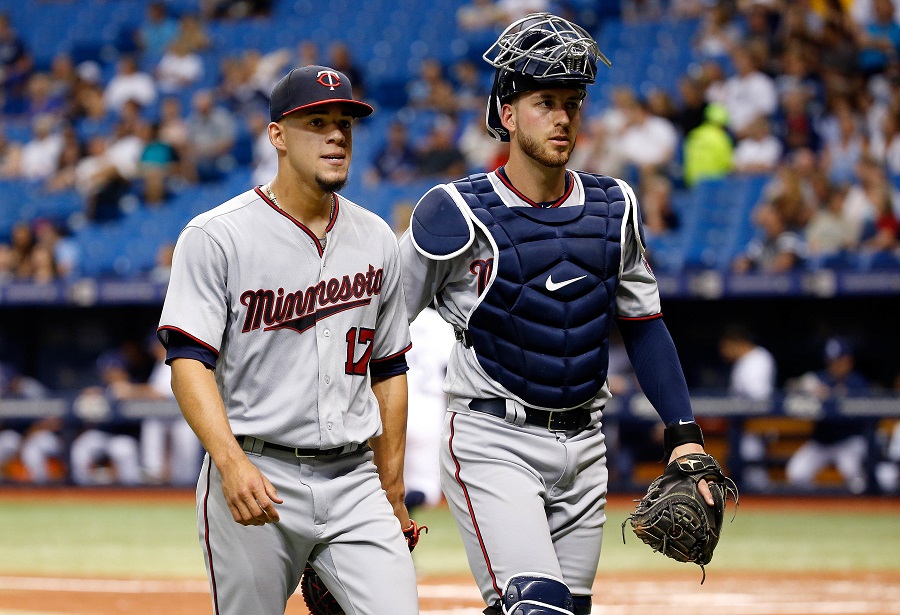 Since 2014, the Twins have had catchers by the names of Suzuki, Eric Fryer, Chris Herrmann, Juan Centeno and John Ryan Murphy. None of them filled the role with any semblance of staying power. Prior to the 2017 season, Jason Castro was handed a three-year, $24.5 million deal from Derek Falvey and Thad Levine in hopes he would provide a high level of performance and consistency behind the plate. Looking back at year one, Castro provided the best output behind the dish since Suzuki’s All-Star appearance. His 1.6 fWAR slotted in just behind Suzuki’s 2.0 fWAR mark, and the tandem with Chris Gimenez (1.0 fWAR) proved to be a decent pairing. While plenty was made about Castro’s pitch framing, his receiving and throw skills should get plenty of notice as well. After Suzuki failed to be league average or better, topping out at 25% in regard to catching base runners, Castro bested that mark a year ago and was run on significantly less. On the offensive side of things, Castro put forth the best season of his career since being named an All-Star with the Astros in 2013. On top of seeing a significant boost in the average department, he also got back to his ways of being an on-base threat. Despite the .720 OPS leaving some room for improvement, it’s actually the splits that Minnesota fans can begin to salivate over. As a lefty, Castro presents Paul Molitor with an opportunity to maximize his future output. A year ago, the Twins backstop actually had similar splits facing righties and lefties, if not a bit skewed towards the reverse. His .737 OPS against lefties slotted in just a bit higher than the .714 OPS he posted against right-handed pitchers. Over the course of his career however, Castro’s splits tell a different story. The .568 OPS against lefties is buoyed by a .747 OPS against righties, leaving a relatively exposable deficiency. Enter his assumed partner for the 2018 Twins season, Mitch Garver. At Triple-A Rochester in 2017, Garver post a .928 OPS (a career high) across 88 games. It was quite the jump from the .753 OPS at Double-A in 2016 (95 games), and even a boost from the .815 OPS in his first 22 games of Triple-A action. After having a strong 2017, it’s not surprising that Garver’s numbers tallied well against both lefties (.938 OPS) and righties (.870). Over the course of his career however, he’s proven capable of mashing against lefties. You can expect that there will still be a learning curve, and a significant bit of development needing to take place in 2018 for the former New Mexico Lobos backstop. He has just 52 major league plate appearances to his name, and despite being 27 years old, he’ll be thrown into a sink-or-swim scenario. Fortunately, there’s plenty of room for him to bring the water level of the Twins backstops up a notch. The bar Chris Gimenez set in 2017 is what Garver should be looking to clear. He was given 54 starts, which could be a number that Mitch expands upon. A 30% caught stealing rate was great, but ten passed balls was something that was an apparent issue when Gimenez was behind the dish a season ago. His .731 OPS was a career high (over at least a 40 game sample size), and will be the offensive mark that Garver is looking to best. Last year, the Castro and Gimenez duo actually performed above average across the big leagues. The 2.8 fWAR put up by the duo, was good enough for tenth in the major leagues. In the American League, only the Mariners, Orioles, Yankees, and Tigers put up better fWAR totals from the catching position. In 2018, Minnesota will be looking to do no worse than replicate that scenario. In short, Joe Mauer catching is the last scenario in which the Twins could legitimately point to the catcher position as being an asset long term. Suzuki’s 2014 outburst appeared fluky, and proved to be as such during the rest of his tenure with the Twins. He was paired with fly-by-night types who had little opportunity of sticking, and it wasn’t until 2017 when something clicked for the Twins backstop position. The Castro signing paved the way for the role to be held by a strong duo, and the torch can now be passed to Garver. There’s more than enough reason to believe Jason Castro is above strict platoon, and there’s plenty of reason to be skeptical about what Garver will contribute during his rookie season, but a blueprint is in place. Minnesota may not have a solo superstar behind the dish anymore, but it appears they’ve got a tandem plan that will work just fine.
 -
Handicapping The Twins Rotation
Ted Schwerzler commented on Ted Schwerzler 's blog entry in Off The Baggy
Again, he is being stretched out, but I considered Duffey a 0% because I can't see him getting a rotation shot before any of the other options. He'll be the long man in the pen, where the extra innings will also be of benefit. -
Handicapping The Twins Rotation
Ted Schwerzler commented on Ted Schwerzler 's blog entry in Off The Baggy
I don't disagree with that, but solely for Opening Day, I see 0% for Enns, Jorge, or Littell. I considered them all, but opined that if the Twins are going with a drastic shot for the 5th starter, they're aiming for their highest upside guys. Slegers doesn't fall into this category as he's the safe bet if they go younger. -
Handicapping The Twins Rotation
Ted Schwerzler commented on Ted Schwerzler 's blog entry in Off The Baggy
These are targets for the “Opening Day Rotation.” Santanw is shelved for a few weeks and Trevor May is on the 60 day DL... -
Handicapping The Twins Rotation
Ted Schwerzler commented on Ted Schwerzler 's blog entry in Off The Baggy
The math isn't intended to add up to 100% as much as the percentages are reflective of each player's individual opportunity out of 100% Also, there's an outside chance the group starts out with just four. -
The Minnesota Twins are set to kick of spring training action with their first exhibition against the University of Minnesota on Thursday February 22. Following Stephen Gonsalves' first pitch in that tilt, the club will then play a full month's slate of games before embarking on Target Field. There's some certainties in the rotation, but there's some serious question marks too. Before digging into some of the more uncertain options, it makes some semblance of sense to start with what we know. Right now, there's two locks, and they include: Jose Berrios RHP In line to get his first Opening Day start of his career, Berrios will serve as the Twins de facto ace while Ervin Santana is on the shelf. Coming off what was nearly a full year at the big league level, the Puerto Rican shined. His 3.89 ERA was in line with the 3.84 FIP. His 8.6 K/9 was a breath of fresh air for the Twins, and the 3.0 BB/9 was hardly detrimental. There's room for growth here, and expecting Berrios to push the ceiling of a true number two starter is hardly a bat bet. Jake Odorizzi RHP After being acquired for Jermaine Palacios, Odorizzi immediately slots in among the Twins top three pitchers. A strong middle-of-the-rotation arm, there's reason to believe he's much better than his 2017 output. Even with a career worst 5.43 FIP, he kept the ERA in check at 4.14. Home runs have been an issue on a three year trend, but there's a strike out pitcher here that is a few small tweaks away from taking the next step. After those two guys, the Opening Day rotation gets murkier. Given the Twins schedule, there's opportunity to skip a 5th arm and get more work in for the top dogs. If they do decide to round out the group and go with five hurlers as long as Santana is sidelined, the list is long and plentiful. Kyle Gibson RHP Back on a one-yea, $4.2 million arbitration deal, Gibson is probably the next closest thing to a lock. While there was a significant period in 2017 where he looked like a non-tender candidate, it was his performance down the stretch that played a large part in getting the Twins to the Postseason. From July 16 on, he posted a 3.76 ERA and .701 OPS against. Across his final eight starts of the year, Gibson owned a 2.92 ERA and .684 OPS against. It's hard to imagine Kyle living up to the hype generated as a 1st round pick in 2009, but if he can replicate his late season surge, he'll be more than valuable for Paul Molitor. OD Rotation Likelihood: 99% Adalberto Mejia LHP His first extended taste in the big leagues had a significant amount of ups and downs for the 24 year old. After being a top-100 prospect, Mejia was seen as a nice get for Minnesota from the San Francisco Giants. His 4.50 ERA in 2017 is hardly anything to write home about, but he showed flashes of a durable starter with the potential to miss bats. In 2018, decreasing the 4.0 BB/9 will be huge, and should play a large part in helping to extend his outings as a whole (avg start was just 4.2 IP in 2017). OD Rotation Likelihood: 75% Phil Hughes RHP There's a good deal of reasons as to why Phil Hughes is the leader in the clubhouse for the 5th and final rotation spot, 26 million to be exact. Minnesota is still on the hook for two-years and $26 million thanks to the extension Terry Ryan prematurely handed the former Yankees pitcher. Hughes was great in year one for Minnesota, and serviceable in year two. Since then, he's made a combined 20 starts over the past two seasons, and owns a 5.91 ERA. The walk rate has doubled (although is still solid), and injuries have mounted. Coming back from another surgery in relation to his Thoracic Outlet procedures, he'll have to prove he's healthy. If he can make it through spring training with some semblance of effectiveness, he should get the final nod. There's also a chance he begins the season on the DL. OD Rotation Likelihood: 50% Anibal Sanchez RHP Given a current 40 man spot and no other assurances, Sanchez's deal is interesting. He's only guaranteed $2.5 million if he makes the club, and can earn up to double that. The 2.57 ERA leading Detroit Tiger from 2013 is a far cry from the pitcher he's been the past three seasons. With a ballooning ERA (5.67) and a HR/9 that surpassed the 2.0 mark a season ago, the Twins have to make some changes. Working down in the zone is an area that seems of benefit to the former Tigers, and if the Twins think they've unlocked something while in Fort Myers, he could squeak his way in. OD Rotation Likelihood: 20% Aaron Slegers RHP Making his MLB debut on August 17th against the Indians, Slegers turned in a quality start against the division winning Cleveland Indians. From there, he put up a clunker in St. Pete, and fizzled in relief against the Blue Jays. His 2017 ended with an outing somewhat in the middle, giving up three runs across 4.1 IP against the Tigers. At Triple-A last year, a 3.40 ERA, 7.2 K/9, and 1.8 BB/9 looked like numbers of a guy ready for a new challenge. Now with the goosebumps out of the way, Slegers looks like a decent, strong floor, fallback option for the Twins. OD Rotation Likelihood: 10% Stephen Gonsalves LHP For the second straight season, Gonsalves is seen as a top-100 prospect across baseball, and viewed by many as the Twins best pitcher on the farm. Spending another half season at Double-A Chattanooga, he posted a .268 ERA across 87.1 IP. The 9.9 K/9 was a bit down from his 2016 total, but he halved his 4.5 BB/9 all the way down to 2.4 BB/9. The knock continues to be a third pitch, but Gonsalves has a good feel for the fastball and changeup. Minnesota will probably try to slow-play him a bit at Triple-A, and continued command development will only push his ceiling higher. OD Rotation Likelihood: 5% Fernando Romero RHP As a new 23 year-old, Romero has officially been listed on his first top-100 prospect lists. He's been the recipient of a significant amount of praise over the past season and a half, and the national scene has taken notice with another strong year. Hitting Double-A for a full season, his 125.0 IP turned into a 3.53 ERA and an 8.6 K/9. Walks did rise back above the 3.0 per 9 mark, which is something he controlled better in 2016. The ceiling is a potential ace with velocity topping out near triple digits. There's also some level of concern that Romero may end up being just a good reliever, which is hopefully at least a few years from becoming a reality. Like Gonsalves, Romero would need a handful of things to break in his favor this spring, but a nice showing would set up a promising Triple-A tour. OD Rotation Likelihood: 1% For more from Off The Baggy, click here. Follow @tlschwerz
-
Article: Sano Going To Let It Eat
Ted Schwerzler replied to Ted Schwerzler 's topic in Twins Daily Front Page News
Which is really more the point here than weight is at all. Sano has the talent to be a superstar, but has the dedication of accepting that he's been an All Star. -
Article: Sano Going To Let It Eat
Ted Schwerzler replied to Ted Schwerzler 's topic in Twins Daily Front Page News
As "weight" continues to be a theme in so many of these comments, try this practice... Replace "weight" with "responsibility" and understand that's more of the problem. Again, there shouldn't be doubt about whether or not Miguel Sano can mash at 300 lbs, yes he can. There is concern about what level of production he's ok with from himself, both now and in the future, based on his level of responsibility both to his craft and his employer. -
Article: Sano Going To Let It Eat
Ted Schwerzler replied to Ted Schwerzler 's topic in Twins Daily Front Page News
That's referenced (and linked to) in the piece that the Rays immediately said no to that. In fact, that's half the point. A guy who mashes without a position simply doesn't have the same level of value. J.D. Martinez is great, but even if they were the same age, you aren't getting the same return for him as Kris Bryant -
Article: Sano Going To Let It Eat
Ted Schwerzler replied to Ted Schwerzler 's topic in Twins Daily Front Page News
This came up on Twitter as well. Big Papi is arguably the greatest DH ever, and was also about 30 lbs lighter than Sano. Sano can mash, but if you're hoping he becomes on par with the best DH ever, it's probably in his best interest to handle all responsibilities with more importance. Also, Cabrera's body has broken down significantly, and while he has had a great career, dark times lie ahead. -
Article: Sano Going To Let It Eat
Ted Schwerzler replied to Ted Schwerzler 's topic in Twins Daily Front Page News
And on top of the weight part of it, by not maximizing or detracting from peak body performance now, you're likely impacting your decline at an advanced stage. -
Article: Sano Going To Let It Eat
Ted Schwerzler replied to Ted Schwerzler 's topic in Twins Daily Front Page News
I believe Pat opined on Twitter today that he's staring 300 in the face. Back in 2015, when he wrote the article (and spoke at the Star Trib event) he said he "knew" the number was 290. -
Article: Sano Going To Let It Eat
Ted Schwerzler replied to Ted Schwerzler 's topic in Twins Daily Front Page News
While many of the comments are in relation to the weight, I think your reply grasps the bigger issue that I alluded to here. If the Twins asked Sano to stay in shape and he's failed to do so, it says more about him than the number on the scale. Regardless of the outcome for any assault charges, the responsibility to carry himself professionally has been called into question in other instances as well. Both of these scenarios are far scarier than whatever poundage rounds out to be. Superstars are guys that stop at nothing to push their ceiling. There's a ton of talent here, and if it doesn't bother you to see a cornerstone of the current Twins franchise demanding the most of that talent, you're probably ok with being good enough. -
Article: Sano Going To Let It Eat
Ted Schwerzler replied to Ted Schwerzler 's topic in Twins Daily Front Page News
Reading through some of the comments, here's some hard truths that seem to be points of frustration seen as opinion or detractions: Sano's weight is not an issue that will (or immediately will) detract from his ability to hit 30+ HRs in multiple seasons. Even in ripping doubles, he's fine. Sano wasn't likely going to stick at 3B, and there were no guarantees he would stick at 1B either. Sano's injuries thus far have not been reflections of or caused due to weight. Now here's some fallout for those realities that are also not entirely opinion: As solely a hitter, even at 24 yrs old, his DH production would need to be ELITE to command the level of value perceived or projected for him. As a heavy player, he will have a more difficult time rehabbing any lower body injury, and likely any injury at all. When not in peak physical form, you're going to find more resistance to recovery, that's pretty cut and dry. Finally, his employer has asked him to watch and monitor his weight responsibly in recent offseasons as a 3B. He's decided against doing that. If there's a further fallout knowing he doesn't play the field, what does that look like? -
Article: Sano Going To Let It Eat
Ted Schwerzler replied to Ted Schwerzler 's topic in Twins Daily Front Page News
No one is "ripping Sano." If that's your takeaway here, you've missed the point. I don't care if he weighs 1,000 pounds, he'll still likely crush baseballs. From an baseball roster standpoint, being overweight to the point of removing positional flexibility and perceived value to other organizations is of detriment to Minnesota. Simply. -
Article: Sano Going To Let It Eat
Ted Schwerzler replied to Ted Schwerzler 's topic in Twins Daily Front Page News
At this given moment, thinking (Sano or not) a 1B/DH with massive power numbers is ever going to net a top tier pitcher under team control for more than a couple seasons is certainly a stretch. How it works out down the road is one thing, but it's not shocking in the least to see that offer dismissed. -
Article: Sano Going To Let It Eat
Ted Schwerzler replied to Ted Schwerzler 's topic in Twins Daily Front Page News
I don't think it's the end of the world either. At the end of the day, you're talking about a DH/1B that crushes 30 plus HRs a year, many teams want that. A DH though is somewhat of a dead roster spot as the ability is solely in the bat. It's not directly effecting Sano as much as it is the realization that the opportunity cost of having to backfill him with an inferior player is unfortunate. -
Article: Sano Going To Let It Eat
Ted Schwerzler replied to Ted Schwerzler 's topic in Twins Daily Front Page News
Sano was serviceable at 3B last year, you aren't wrong. The problem is when this is a yearly trend, you get to a point where serviceable is the ceiling instead of the floor. As a DH, or even a 1B, his bat is going to play. It just negates some of the ways he can impact the game, bring value to the team, or in a trade. -
Article: Sano Going To Let It Eat
Ted Schwerzler replied to Ted Schwerzler 's topic in Twins Daily Front Page News
Speaking personally, I have no issue with Sano being overweight, other than a belief that it will limit his long term ceiling. I fully expect him to crush 30+ HRs in 2018 and for many seasons beyond. Being a 1B or DH instead of a capable 3B and doing so limits his value significantly however. -
Mauer posted a 2.3 fWAR...of course that's low (16th) compared to other 1B. He doesn't hit for power, and his greatest asset at this dish is OBP... Right now, Mauer's value isn't derived from what he does at the plate. His defensive metrics make him more valuable than a player with his offensive output should be.
-
With big expectations, there are big responsibilities. It's fair to say that since signing with the Minnesota Twins as a teenager, Miguel Sano has been the focal point of some very big expectations. His massive power potential has long been the narrative, and despite being signed as a shortstop, the feeling was always that his bat and frame would push him from the position. Fast forward to 2018 and we've got a near-25 year-old who's toyed with those expectations, but has overlooked some of the responsibilities.Entering the regular season, Miguel Sano finds himself in somewhat of a limbo. After being accused of sexual assault over the offseason (from an incident stemming years earlier), he awaits his fate as MLB conducts their investigation. My assumption is that some sort of discipline will be handed down, and given previous league decisions, it should come in somewhere under 30 games. Coming off a year in which he played 114 games for the Twins, he should still have opportunity to top that output. That being said, it's yet again another responsibility he's failed to make good on. With reporters descending on Fort Myers for the beginning of Spring Training, it's once again come to light that Sano is significantly overweight. Derek Falvey hinted at that notion, suggesting the Minnesota third basemen's recovery from injury has gone well, but that he needs to now focus on getting to where he needs to be with his conditioning. That is a politically correct way of putting it, and in previous seasons Patrick Reusse has called it what it is. Miguel Sano is overweight. Looking back to Reusse's column in March 2016, I had an issue with there seemingly being a suggested link between Sano being hurt because of being fat. While that may not have been fair, the Star Tribune columnist has been spot on when it comes to pegging the poundage for young Miguel. Once again, he's entered camp staring at 300 pounds and comes in around the 290 mark. To suggest that hampers relative production is unfair, but there are more than a few takeaways when it comes to what the scale is telling us. First and foremost, there's a real lack of accountability to Minnesota for Sano. Having invested in him heavily as a player, and his development, the Twins have worked with him to stay on the infield dirt far earlier than the new regime's days. While shortstop was never going to be a reality, positional value at third base is significantly higher than having to be moved across the diamond as Joe Mauer's heir, or worse, solely a designated hitter. Despite having employed nutritionists in the clubhouse, and undoubtedly using offseason check-ins, Sano hasn't accomplished the Twins' goals in multiple seasons when it comes to his habits. Secondly, there's the fallout in regard to the lack of accountability. Because of allowing his weight to balloon, the reality is that Sano's long-term value is sapped exponentially. Forget the reality that an increase to injury potential is a by-product of being overweight, the loss of a position makes one of the Twins greatest assets one dimensional. Even if he heads to first base, which is far from a foregone conclusion, Sano isn't viewed as the asset he could be if he was able to stick at the hot corner. Recently, KSTP's Darren Wolfson noted what was suspected all along: Sano wasn't going to entice the Rays into dealing Archer when seen as a one dimensional player. At the end of the day, there are a few hard and fast realities for the Twins and Miguel Sano. First and foremost, they have a 24 year old who has failed to hold himself accountable, and has done so on multiple occasions. Secondly, they also have an extremely good ballplayer, who's capable of producing some of the greatest power outputs the game has seen on a year-by-year basis. I believe that in 2018 and beyond, Miguel Sano will put up multiple 30-plus homer seasons, and that he'll be of significant value going forward. I do also believe that the only person lowering his ceiling is himself. No matter how his assault case shakes out, it seems as if there are multiple aspects of growing up when it comes to the opposite sex. No matter what his weight gets to, it's apparent there's a significant level of responsibility that can yet be adhered to. For both Miguel Sano and the Minnesota Twins, a stronger commitment to oneself from the player benefits all involved. Right now, there's a very talented ballplayer who can compete and produce at a very high level. If there is a comfortable situation here, where a point has been reached that improvement isn't demanded of the player to unlock superstar potential, well then, we'll only be able to wonder, what if? Click here to view the article
