



Parker Hageman
-
Posts
4,152 -
Joined
-
Last visited
-
Days Won
6
Content Type
Profiles
Minnesota Twins News, Rumors & Analysis
Minnesota Twins Videos
2026 Minnesota Twins Top Prospect Rankings
2022 Minnesota Twins Draft Picks & Signing Bonuses
Minnesota Twins Trade & Free Agent Rumors
Minnesota Twins Fan Guides & Resources
2023 Minnesota Twins Draft Picks & Signing Bonuses
The Minnesota Twins Players Project
2024 Minnesota Twins Draft Picks & Signing Bonuses
2025 Minnesota Twins Draft Picks & Signing Bonuses
2026 Minnesota Twins Draft Picks & Signing Bonuses
Forums
Blogs
Events
Store
Downloads
Gallery
Everything posted by Parker Hageman
-

Spring Training - Who's going and when?
Parker Hageman replied to Jim Crikket's topic in Minnesota Twins Talk
Jim -- I'll be down from the 26-29. -
Great background and insight, Tony. Thanks so much for sharing. Looking forward to more!
-
Joe Mauer just another catcher
Parker Hageman replied to travistwinstalk's topic in Minnesota Twins Talk
Jack, that's completely inaccurate, or rather, incomplete assessment just based on those three statistics. What's more, is that he can certainly be worth $23M a season even while hitting what you consider "average production." In 2008, Mauer hit .328, had 9 HRs and knocked in 85 RBIs. In 2010, Mauer hit .327, had 9 HRs and drove in 75 RBIs. In those respective seasons his value was worth $28.1M and $22.5M. What those three stats do not show was Mauer's ability to get on base (.413 and .402) or his ability to play a vital position that offers little in terms of offense compared to the league average. The real thing that would inhibit him reaching his contractual value would be if he was no longer a regular catcher - which may still be a very real possibility. -
Kept having the same photo issue where it was added as an attachment and not an image.
-
Awesome picture of Livan Hernandez.
-
According to Baseball America, Twins relief prospect Carlos Gutierrez has added a cutter to his arsenal. Armed with a power sinker as his main pitch, the 25-year-old posted a 62% ground ball rate in Rochester in 2011. Interestingly enough, Gutierrez held lefties to a .179 average against last year but same-sided opponents hit .303. The cutter, geared to run in on the hands of lefties and away from right-hander's swings, would be a solid complement to his already above-average sinker. Gutierrez, one of the team's top relief prospects, has an outside shot of making the opening day roster but will very likely see some time in Minnesota's bullpen at some point in the 2012 season.
-
You can view the page at http://twinsdaily.com/content.php?214-Will-Francisco-Liriano-rebound-in-2012
-
Will Francisco Liriano rebound in 2012?
Parker Hageman commented on Parker Hageman's blog entry in Over the Baggy
Without a doubt, there will be plenty of storylines to monitor during spring training this year. One of the bigger ones that you should keep an eye on in Fort Myers is Francisco Liriano’s fastball. Injuries took him out of the 2011 season but it was clear that the southpaw was not the same pitcher as he was the season before. Between a decrease in velocity, an inability to locate his fastball and regularly falling behind his opponents, Liriano posted a career high in walks (75) and his second-worst ERA of his career (5.09). Perhaps a bit predictably based upon his delivery and past history, he succumbed to injuries midway through last season and missed a significant amount of time. Suddenly, not signing Liriano to a long-term deal became one of Bill Smith’s finest moves as a GM. For his part, Liriano, who was admonished for not following through with offseason workouts before last season, opted to participate in winter ball – the same platform that helped him regain his form two seasons ago. Unfortunately, the results were not quite as enticing this year as they were in the past. He threw 24.2 innings and posted a 25/16 K/BB ratio in winter ball. This outcome was a distant cry from his 2009 winter league performance in which he reintroduced himself to baseball as one of the more filthy pitchers in baseball. That year in 20 innings Liriano posted a 30/5 K/BB ratio on his way to becoming one of the Twins more dominating starters in the 2010 regular season. Admittedly, each pitch thrown between November and April means very little in the grand scheme yet the signs are not wholly positive at this juncture. What can Liriano do to become the pitcher the Twins so desperately need in 2012? There’s no question that he still has the nasty slider that can catapult him towards being a Cy Young-caliber pitcher, however, as I detailed following Liriano’s first outing this offseason in the Dominican, the main question is whether he can command his fastball. According to BrooksBaseball.net’s pitch f/x data, Liriano’s fastball was vastly different from the 2010 predecessor: [TABLE] [TD=colspan: 4, align: center]Liriano’s Fastballs (2010 vs 2011)[/TD] [TD=align: center][/TD] [TD=align: center]MPH[/TD] [TD=align: center]Called Strike[/TD] [TD=align: center]Whiff[/TD] [TD=align: center]2010 Four-Seamer[/TD] [TD=align: center]94.6[/TD] [TD=align: center]17.6%[/TD] [TD=align: center]15.1%[/TD] [TD=align: center]2010 Two-Seamer[/TD] [TD=align: center]94.3[/TD] [TD=align: center]21.2%[/TD] [TD=align: center]13.1%[/TD] [TD=align: center]2011 Four-Seamer[/TD] [TD=align: center]92.4[/TD] [TD=align: center]17.2%[/TD] [TD=align: center]10.8%[/TD] [TD=align: center]2011 Two-Seamer[/TD] [TD=align: center]92.5[/TD] [TD=align: center]14.7%[/TD] [TD=align: center]12.3%[/TD] [/TABLE] In addition to the decrease in velocity, notice the sharp decline in the amount of called strikes with his two-seamed fastball. This is the pitch he uses most often against right-handed opponents. This may explain why his walk rate when facing righties jumped from 8.5% in 2010 to 12.8% in 2011. Having scouted a couple of Liriano’s outings in the Dominican, you can see that he was still struggling to place the pitch in the Caribbean – specifically his two-seamed fastball against right-handers. Outside of Scott Baker, the Twins have little in their rotation of being an elite pitcher. In order to reach that echelon which the team so desperately needs, Liriano, besides being healthy, needs to see an improved fastball in 2012. -
Without a doubt, there will be plenty of storylines to monitor during spring training this year. One of the bigger ones that you should keep an eye on in Fort Myers is Francisco Liriano’s fastball. Injuries took him out of the 2011 season but it was clear that the southpaw was not the same pitcher as he was the season before. Between a decrease in velocity, an inability to locate his fastball and regularly falling behind his opponents, Liriano posted a career high in walks (75) and his second-worst ERA of his career (5.09). Perhaps a bit predictably based upon his delivery and past history, he succumbed to injuries midway through last season and missed a significant amount of time. Suddenly, not signing Liriano to a long-term deal became one of Bill Smith’s finest moves as a GM. For his part, Liriano, who was admonished for not following through with offseason workouts before last season, opted to participate in winter ball – the same platform that helped him regain his form two seasons ago. Unfortunately, the results were not quite as enticing this year as they were in the past. He threw 24.2 innings and posted a 25/16 K/BB ratio in winter ball. This outcome was a distant cry from his 2009 winter league performance in which he reintroduced himself to baseball as one of the more filthy pitchers in baseball. That year in 20 innings Liriano posted a 30/5 K/BB ratio on his way to becoming one of the Twins more dominating starters in the 2010 regular season. Admittedly, each pitch thrown between November and April means very little in the grand scheme yet the signs are not wholly positive at this juncture. What can Liriano do to become the pitcher the Twins so desperately need in 2012? There’s no question that he still has the nasty slider that can catapult him towards being a Cy Young-caliber pitcher, however, as I detailed following Liriano’s first outing this offseason in the Dominican, the main question is whether he can command his fastball. According to BrooksBaseball.net’s pitch f/x data, Liriano’s fastball was vastly different from the 2010 predecessor: [TABLE] [TD=colspan: 4, align: center]Liriano’s Fastballs (2010 vs 2011)[/TD] [TD=align: center][/TD] [TD=align: center]MPH[/TD] [TD=align: center]Called Strike[/TD] [TD=align: center]Whiff[/TD] [TD=align: center]2010 Four-Seamer[/TD] [TD=align: center]94.6[/TD] [TD=align: center]17.6%[/TD] [TD=align: center]15.1%[/TD] [TD=align: center]2010 Two-Seamer[/TD] [TD=align: center]94.3[/TD] [TD=align: center]21.2%[/TD] [TD=align: center]13.1%[/TD] [TD=align: center]2011 Four-Seamer[/TD] [TD=align: center]92.4[/TD] [TD=align: center]17.2%[/TD] [TD=align: center]10.8%[/TD] [TD=align: center]2011 Two-Seamer[/TD] [TD=align: center]92.5[/TD] [TD=align: center]14.7%[/TD] [TD=align: center]12.3%[/TD] [/TABLE] In addition to the decrease in velocity, notice the sharp decline in the amount of called strikes with his two-seamed fastball. This is the pitch he uses most often against right-handed opponents. This may explain why his walk rate when facing righties jumped from 8.5% in 2010 to 12.8% in 2011. Having scouted a couple of Liriano’s outings in the Dominican, you can see that he was still struggling to place the pitch in the Caribbean – specifically his two-seamed fastball against right-handers. Outside of Scott Baker, the Twins have little in their rotation of being an elite pitcher. In order to reach that echelon which the team so desperately needs, Liriano, besides being healthy, needs to see an improved fastball in 2012.
-
Without a doubt, there will be plenty of storylines to monitor during spring training this year. One of the bigger ones that you should keep an eye on in Fort Myers is Francisco Liriano’s fastball. Injuries took him out of the 2011 season but it was clear that the southpaw was not the same pitcher as he was the season before. Between a decrease in velocity, an inability to locate his fastball and regularly falling behind his opponents, Liriano posted a career high in walks (75) and his second-worst ERA of his career (5.09). Perhaps a bit predictably based upon his delivery and past history, he succumbed to injuries midway through last season and missed a significant amount of time. Suddenly, not signing Liriano to a long-term deal became one of Bill Smith’s finest moves as a GM. [PRBREAK][/PRBREAK] For his part, Liriano, who was admonished for not following through with offseason workouts before last season, opted to participate in winter ball – the same platform that helped him regain his form two seasons ago. Unfortunately, the results were not quite as enticing this year as they were in the past. He threw 24.2 innings and posted a 25/16 K/BB ratio in winter ball. This outcome was a distant cry from his 2009 winter league performance in which he reintroduced himself to baseball as one of the more filthy pitchers in baseball. That year in 20 innings Liriano posted a 30/5 K/BB ratio on his way to becoming one of the Twins more dominating starters in the 2010 regular season. Admittedly, each pitch thrown between November and April means very little in the grand scheme yet the signs are not wholly positive at this juncture. What can Liriano do to become the pitcher the Twins so desperately need in 2012? There’s no question that he still has the nasty slider that can catapult him towards being a Cy Young-caliber pitcher, however, as I detailed following Liriano’s first outing this offseason in the Dominican, the main question is whether he can command his fastball. According to BrooksBaseball.net’s pitch f/x data, Liriano’s fastball was vastly different from the 2010 predecessor: [TABLE] [TD=colspan: 4, align: center]Liriano’s Fastballs (2010 vs 2011)[/TD] [TD=align: center][/TD] [TD=align: center]MPH[/TD] [TD=align: center]Called Strike[/TD] [TD=align: center]Whiff[/TD] [TD=align: center]2010 Four-Seamer[/TD] [TD=align: center]94.6[/TD] [TD=align: center]17.6%[/TD] [TD=align: center]15.1%[/TD] [TD=align: center]2010 Two-Seamer[/TD] [TD=align: center]94.3[/TD] [TD=align: center]21.2%[/TD] [TD=align: center]13.1%[/TD] [TD=align: center]2011 Four-Seamer[/TD] [TD=align: center]92.4[/TD] [TD=align: center]17.2%[/TD] [TD=align: center]10.8%[/TD] [TD=align: center]2011 Two-Seamer[/TD] [TD=align: center]92.5[/TD] [TD=align: center]14.7%[/TD] [TD=align: center]12.3%[/TD] [/TABLE] In addition to the decrease in velocity, notice the sharp decline in the amount of called strikes with his two-seamed fastball. This is the pitch he uses most often against right-handed opponents. This may explain why his walk rate when facing righties jumped from 8.5% in 2010 to 12.8% in 2011. Having scouted a couple of Liriano’s outings in the Dominican, you can see that he was still struggling to place the pitch in the Caribbean – specifically his two-seamed fastball against right-handers. Outside of Scott Baker, the Twins have little in their rotation of being an elite pitcher. In order to reach that echelon which the team so desperately needs, Liriano, besides being healthy, needs to see an improved fastball in 2012.
-
Are you just picking up on this fact?! I've maintained the stance that they should keep the field as is, simply gear the personnel to the field - if that is more speed/line drive hitters, power hitters who pull or guys who hit line drives to center instead of fly balls (like Cuddyer did).
-
Great stuff Andrew.
-
You can view the page at http://twinsdaily.com/content.php?209-Twins-hitting-coach-looking-to-fix-team-s-approach-at-the-plate
-
Twins hitting coach looking to fix team's approach at the plate
Parker Hageman posted an article in Twins
Hitting coach Joe Vavra recently shared some ideas behind what was causing the drought at the plate with the Pioneer Press’s Tom Powers. Plenty of factors played into the team’s offensive ineptitude but for those who did make it to the plate, Vavra felt that the approach was fundamentally lacking: Despite some fans objections to the contrary, Joe Vavra comes off as a smart, intelligent and process-oriented hitting coach. I have personally never had the opportunity to meet with him however in interviews and articles about him, he comes off as someone who has a keen understanding of the art and science of hitting. After all, as stated in this column and in previous interviews, he has a history of checking data to assist in his techniques and teachings – and advanced viewpoint coming from a position that has historically been of the “see ball, hit ball, spit chew, little bingo, how now brown cow” ilk. In that particular piece, Vavra does not outright say what constitutes “struggling” or rather which metric he uses to gauge that, however, he cited batting average a number of times. Because pull-hitting often takes a toll on a player’s average, you can see why the Twins would want to discourage this practice. Using more of the field is an indication that a hitter is able to handle more pitches in more zones. For example, if a right-handed hitter gets too pull-happy and attempts to turn on a pitch on the outer-half, odds are they will be pulling something towards the shortstop rather than “going with the pitch” to right field. In theory, opposing teams will recognize this and attack the outer-half more which will incite a player to turn-over on the pitch more often and drag down his batting average. This more or less seems to be what Vavra is saying happened to the 2011 squad, particularly the young right-handed hitters. Given that the Twins cycled through a greater number of younger hitters through the lineup that hit from the right side (Trevor Plouffe, Luke Hughes, Drew Butera, Joe Benson, etc) Vavra’s theory makes sense. Not surprising, the data indicates that the right-handers turned on 29.9% of their balls in play – a sizeable jump from the 24.3% pull rate in 2010. As such, righties hit .237 as a group, their lowest in the past three seasons: http://2.bp.blogspot.com/-_hKDcxyuj2I/TzyTeNq-oVI/AAAAAAAAAT0/cYEjF4OJWXA/s1600/RHB_Pulling.jpg Now, the batted ball data shows the outcome but it clearly does not show intent. That is something that hitting coaches can detect and video can reveal a bit more on what a hitter was trying to do when being pitched away. While a near 30% pull rate is high, there may be more outer-half pitches that hitters attempted to pull but directed them towards center instead of right field. What data might show some of that is the precipitous drop in using the opposite field successfully over the past three years. The idea is that if a hitter is focused on going oppo, the result should be better: http://1.bp.blogspot.com/-NLvtY0KW4pI/TzyTkrDc0iI/AAAAAAAAAT8/_MP1V7hKNUw/s1600/RHB_Oppo.jpg As you can glean, the 2011 Twins were considerably less successful at going the opposite direction than their predecessors. If the 2011 lineup was indeed less focused on driving shots to right field, it is reflective in those splits. So, redirecting those players who may have grown too pull-happy like Trevor Plouffe or Danny Valencia back towards the big part of the field may help bolster their batting average but what of the power? As I’ve written about extensively here, Target Field plays more favorably for pull hitters. This offseason, Josh Willingham and Ryan Doumit were added to the lineup and both hitters showed clear pull tendencies over their careers. In Willingham’s case, he moved to Oakland and grew increasingly pull-happy to combat the spacious park. Although he set a career high in home runs (29) that came at the expense of over 20 batting average points and a significant amount of on-base numbers. If the team wants the home runs added to the repertoire, they should encourage Willingham to keep the same approach he had as an Athletic. Not long ago, the Twins tinkered with Hardy’s approach at the plate, suggesting he was getting too pull-happy. Hardy had incorporated the opposite-field mentality to his approach which the Orioles hitting coach told him to forget. Not only did Hardy’s batting average remain at a high level after going back to being a pull hitter, he also jacked 30 home runs. Will Vavra allow Willingham and Doumit to retain their approaches? Of course it is up to the individual but it sounds as if Vavra had his way, it sounds like he would discourage the pair from this method. According to Tom Powers’ column, the Pioneer Press scribe posited the question if power hitters should try “to yank the ball” to which Vavra replied “I’d challenge them on that”. The reasoning behind Vavra’s contention was never clarified but I would speculate that it has to do with what amounts to a batting average drain. Clearly, talent certainly played a key factor in the degeneration of the batting average from the right-side for the Twins but the inexperience and the pull-heavy tendencies also contributed. The old adage “hit it where it’s pitched” applies. Still, pulling the ball is not as big of an enemy to the offense as some would think. -
Twins hitting coach looking to fix team's approach at the plate
Parker Hageman commented on Parker Hageman's blog entry in Over the Baggy
Hitting coach Joe Vavra recently shared some ideas behind what was causing the drought at the plate with the Pioneer Press’s Tom Powers. Plenty of factors played into the team’s offensive ineptitude but for those who did make it to the plate, Vavra felt that the approach was fundamentally lacking: Despite some fans objections to the contrary, Joe Vavra comes off as a smart, intelligent and process-oriented hitting coach. I have personally never had the opportunity to meet with him however in interviews and articles about him, he comes off as someone who has a keen understanding of the art and science of hitting. After all, as stated in this column and in previous interviews, he has a history of checking data to assist in his techniques and teachings – and advanced viewpoint coming from a position that has historically been of the “see ball, hit ball, spit chew, little bingo, how now brown cow” ilk. In that particular piece, Vavra does not outright say what constitutes “struggling” or rather which metric he uses to gauge that, however, he cited batting average a number of times. Because pull-hitting often takes a toll on a player’s average, you can see why the Twins would want to discourage this practice. Using more of the field is an indication that a hitter is able to handle more pitches in more zones. For example, if a right-handed hitter gets too pull-happy and attempts to turn on a pitch on the outer-half, odds are they will be pulling something towards the shortstop rather than “going with the pitch” to right field. In theory, opposing teams will recognize this and attack the outer-half more which will incite a player to turn-over on the pitch more often and drag down his batting average. This more or less seems to be what Vavra is saying happened to the 2011 squad, particularly the young right-handed hitters. Given that the Twins cycled through a greater number of younger hitters through the lineup that hit from the right side (Trevor Plouffe, Luke Hughes, Drew Butera, Joe Benson, etc) Vavra’s theory makes sense. Not surprising, the data indicates that the right-handers turned on 29.9% of their balls in play – a sizeable jump from the 24.3% pull rate in 2010. As such, righties hit .237 as a group, their lowest in the past three seasons: http://2.bp.blogspot.com/-_hKDcxyuj2I/TzyTeNq-oVI/AAAAAAAAAT0/cYEjF4OJWXA/s1600/RHB_Pulling.jpg Now, the batted ball data shows the outcome but it clearly does not show intent. That is something that hitting coaches can detect and video can reveal a bit more on what a hitter was trying to do when being pitched away. While a near 30% pull rate is high, there may be more outer-half pitches that hitters attempted to pull but directed them towards center instead of right field. What data might show some of that is the precipitous drop in using the opposite field successfully over the past three years. The idea is that if a hitter is focused on going oppo, the result should be better: http://1.bp.blogspot.com/-NLvtY0KW4pI/TzyTkrDc0iI/AAAAAAAAAT8/_MP1V7hKNUw/s1600/RHB_Oppo.jpg As you can glean, the 2011 Twins were considerably less successful at going the opposite direction than their predecessors. If the 2011 lineup was indeed less focused on driving shots to right field, it is reflective in those splits. So, redirecting those players who may have grown too pull-happy like Trevor Plouffe or Danny Valencia back towards the big part of the field may help bolster their batting average but what of the power? As I’ve written about extensively here, Target Field plays more favorably for pull hitters. This offseason, Josh Willingham and Ryan Doumit were added to the lineup and both hitters showed clear pull tendencies over their careers. In Willingham’s case, he moved to Oakland and grew increasingly pull-happy to combat the spacious park. Although he set a career high in home runs (29) that came at the expense of over 20 batting average points and a significant amount of on-base numbers. If the team wants the home runs added to the repertoire, they should encourage Willingham to keep the same approach he had as an Athletic. Not long ago, the Twins tinkered with Hardy’s approach at the plate, suggesting he was getting too pull-happy. Hardy had incorporated the opposite-field mentality to his approach which the Orioles hitting coach told him to forget. Not only did Hardy’s batting average remain at a high level after going back to being a pull hitter, he also jacked 30 home runs. Will Vavra allow Willingham and Doumit to retain their approaches? Of course it is up to the individual but it sounds as if Vavra had his way, it sounds like he would discourage the pair from this method. According to Tom Powers’ column, the Pioneer Press scribe posited the question if power hitters should try “to yank the ball” to which Vavra replied “I’d challenge them on that”. The reasoning behind Vavra’s contention was never clarified but I would speculate that it has to do with what amounts to a batting average drain. Clearly, talent certainly played a key factor in the degeneration of the batting average from the right-side for the Twins but the inexperience and the pull-heavy tendencies also contributed. The old adage “hit it where it’s pitched” applies. Still, pulling the ball is not as big of an enemy to the offense as some would think. -
Twins hitting coach looking to fix team's approach at the plate
Parker Hageman posted a blog entry in Over the Baggy
Hitting coach Joe Vavra recently shared some ideas behind what was causing the drought at the plate with the Pioneer Press’s Tom Powers. Plenty of factors played into the team’s offensive ineptitude but for those who did make it to the plate, Vavra felt that the approach was fundamentally lacking: Despite some fans objections to the contrary, Joe Vavra comes off as a smart, intelligent and process-oriented hitting coach. I have personally never had the opportunity to meet with him however in interviews and articles about him, he comes off as someone who has a keen understanding of the art and science of hitting. After all, as stated in this column and in previous interviews, he has a history of checking data to assist in his techniques and teachings – and advanced viewpoint coming from a position that has historically been of the “see ball, hit ball, spit chew, little bingo, how now brown cow” ilk. In that particular piece, Vavra does not outright say what constitutes “struggling” or rather which metric he uses to gauge that, however, he cited batting average a number of times. Because pull-hitting often takes a toll on a player’s average, you can see why the Twins would want to discourage this practice. Using more of the field is an indication that a hitter is able to handle more pitches in more zones. For example, if a right-handed hitter gets too pull-happy and attempts to turn on a pitch on the outer-half, odds are they will be pulling something towards the shortstop rather than “going with the pitch” to right field. In theory, opposing teams will recognize this and attack the outer-half more which will incite a player to turn-over on the pitch more often and drag down his batting average. This more or less seems to be what Vavra is saying happened to the 2011 squad, particularly the young right-handed hitters. Given that the Twins cycled through a greater number of younger hitters through the lineup that hit from the right side (Trevor Plouffe, Luke Hughes, Drew Butera, Joe Benson, etc) Vavra’s theory makes sense. Not surprising, the data indicates that the right-handers turned on 29.9% of their balls in play – a sizeable jump from the 24.3% pull rate in 2010. As such, righties hit .237 as a group, their lowest in the past three seasons: http://2.bp.blogspot.com/-_hKDcxyuj2I/TzyTeNq-oVI/AAAAAAAAAT0/cYEjF4OJWXA/s1600/RHB_Pulling.jpg Now, the batted ball data shows the outcome but it clearly does not show intent. That is something that hitting coaches can detect and video can reveal a bit more on what a hitter was trying to do when being pitched away. While a near 30% pull rate is high, there may be more outer-half pitches that hitters attempted to pull but directed them towards center instead of right field. What data might show some of that is the precipitous drop in using the opposite field successfully over the past three years. The idea is that if a hitter is focused on going oppo, the result should be better: http://1.bp.blogspot.com/-NLvtY0KW4pI/TzyTkrDc0iI/AAAAAAAAAT8/_MP1V7hKNUw/s1600/RHB_Oppo.jpg As you can glean, the 2011 Twins were considerably less successful at going the opposite direction than their predecessors. If the 2011 lineup was indeed less focused on driving shots to right field, it is reflective in those splits. So, redirecting those players who may have grown too pull-happy like Trevor Plouffe or Danny Valencia back towards the big part of the field may help bolster their batting average but what of the power? As I’ve written about extensively here, Target Field plays more favorably for pull hitters. This offseason, Josh Willingham and Ryan Doumit were added to the lineup and both hitters showed clear pull tendencies over their careers. In Willingham’s case, he moved to Oakland and grew increasingly pull-happy to combat the spacious park. Although he set a career high in home runs (29) that came at the expense of over 20 batting average points and a significant amount of on-base numbers. If the team wants the home runs added to the repertoire, they should encourage Willingham to keep the same approach he had as an Athletic. Not long ago, the Twins tinkered with Hardy’s approach at the plate, suggesting he was getting too pull-happy. Hardy had incorporated the opposite-field mentality to his approach which the Orioles hitting coach told him to forget. Not only did Hardy’s batting average remain at a high level after going back to being a pull hitter, he also jacked 30 home runs. Will Vavra allow Willingham and Doumit to retain their approaches? Of course it is up to the individual but it sounds as if Vavra had his way, it sounds like he would discourage the pair from this method. According to Tom Powers’ column, the Pioneer Press scribe posited the question if power hitters should try “to yank the ball” to which Vavra replied “I’d challenge them on that”. The reasoning behind Vavra’s contention was never clarified but I would speculate that it has to do with what amounts to a batting average drain. Clearly, talent certainly played a key factor in the degeneration of the batting average from the right-side for the Twins but the inexperience and the pull-heavy tendencies also contributed. The old adage “hit it where it’s pitched” applies. Still, pulling the ball is not as big of an enemy to the offense as some would think. -
From my understanding, Maloney is sort of a Scott Diamond-redux. He lacks the velocity but has some decent secondary pitches and good location. Some reports I've read from Baseball America make it sound as if he was never given a full shot with the Reds after putting up fairly impressive minor league numbers while on the other hand other scouting reports seemed to suggest that his failure in the small sampling of MLB appearances is based upon a poor fastball. Still, with the rotation almost spoken for and the left-handed bullpen spots all but solidified by Perkins and Duensing (not to mention Diamond), it's hard to understand where the Twins are projecting him to be after spring training. And, I would bet that if he has a decent spring, the Twins won't be able to slip him through waivers to hide him in Rochester.
-
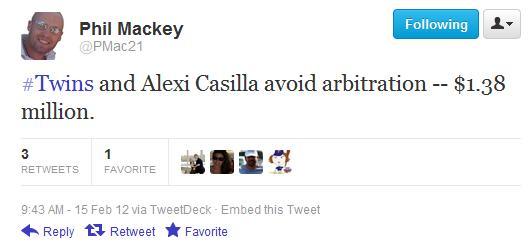
According to Phil Mackey, the Twins and Alexi Casilla have reached a one-year agreement worth $1.38 million. Because of injuries, Casilla played in only 97 games last year and hit .260/.322/.368 with 15 stolen bases while scoring 52 runs. In doses he has proven that he is capable of holding down a starting position and it appears that he will be the team's starting second baseman at the beginning of the year. Please comment on this story here. [PRBREAK][/PRBREAK]
-
According to Phil Mackey, the Twins and Alexi Casilla have reached a one-year agreement worth $1.38 million. Because of injuries, Casilla played in only 97 games last year and hit .260/.322/.368 with 15 stolen bases while scoring 52 runs. In doses he has proven that he is capable of holding down a starting position and it appears that he will be the team's starting second baseman at the beginning of the year.
-
Joe Mauer delivers the most Joe Mauer quote ever.
Parker Hageman commented on Parker Hageman's blog entry in Over the Baggy
Each spring fans are entertained by non-news news from the southern camps in Florida relating to how great of shape a player is in, how re-dedicated they are, etc, etc. Early February brings a lot of "I feel great" moments from players who were injured the previous season and, of course, wealthy catcher Joe Mauer is one such player who draws this kind of attention from the media. In January, right around TwinsFest when Mauer made a quick circuit of local appearances, reports spread that the catcher had put on nearly 30 pounds - some of which was weight that needed to be replaced after supposedly losing so much over the course of the 2011 season. Mauer, who has a home in the Ft Myers area, has joined in with some of the early arrivals to get back into game shape. Reporters, milling around for a story, inquired about the added weight to which Mauer said: What may be important to the baseball-side of this quote is that according to the Twins roster, Mauer is listed at 235 pounds - roughly 10-15 pounds from where he is now. Since his marvelous 2009 season in which he slugged 28 home runs in 606 plate appearances, Mauer has tagged just 12 in his last 917 plate appearances dating back to 2010. So putting 10-to-15 pounds of muscle on his 6-foot-5 frame would be a good start towards hitting those 2009-type numbers again. Unfortunately, with the season a little over a month-and-a-half away, adding poundage seems like a tall task given the amount of conditioning and weight-loss players typically encounter in the spring. -
Joe Mauer delivers the most Joe Mauer quote ever.
Parker Hageman posted a blog entry in Over the Baggy
Each spring fans are entertained by non-news news from the southern camps in Florida relating to how great of shape a player is in, how re-dedicated they are, etc, etc. Early February brings a lot of "I feel great" moments from players who were injured the previous season and, of course, wealthy catcher Joe Mauer is one such player who draws this kind of attention from the media. In January, right around TwinsFest when Mauer made a quick circuit of local appearances, reports spread that the catcher had put on nearly 30 pounds - some of which was weight that needed to be replaced after supposedly losing so much over the course of the 2011 season. Mauer, who has a home in the Ft Myers area, has joined in with some of the early arrivals to get back into game shape. Reporters, milling around for a story, inquired about the added weight to which Mauer said: What may be important to the baseball-side of this quote is that according to the Twins roster, Mauer is listed at 235 pounds - roughly 10-15 pounds from where he is now. Since his marvelous 2009 season in which he slugged 28 home runs in 606 plate appearances, Mauer has tagged just 12 in his last 917 plate appearances dating back to 2010. So putting 10-to-15 pounds of muscle on his 6-foot-5 frame would be a good start towards hitting those 2009-type numbers again. Unfortunately, with the season a little over a month-and-a-half away, adding poundage seems like a tall task given the amount of conditioning and weight-loss players typically encounter in the spring. -
Each spring fans are entertained by non-news news from the southern camps in Florida relating to how great of shape a player is in, how re-dedicated they are, etc, etc. Early February brings a lot of "I feel great" moments from players who were injured the previous season and, of course, wealthy catcher Joe Mauer is one such player who draws this kind of attention from the media. In January, right around TwinsFest when Mauer made a quick circuit of local appearances, reports spread that the catcher had put on nearly 30 pounds - some of which was weight that needed to be replaced after supposedly losing so much over the course of the 2011 season. Mauer, who has a home in the Ft Myers area, has joined in with some of the early arrivals to get back into game shape. Reporters, milling around for a story, inquired about the added weight to which Mauer said: His reply neither confirmed nor denied whether or not he added 30 pounds or exactly what his weight was after the brutal 2011 campaign. Not that it is important from a baseball perspective but it is an interesting nonetheless. He realizes that his name is affixed to plenty of rumors and tall-tales yet he rarely takes the opportunity to address them head-on (not that he obligated to dispel every rumor that comes floating by). What may be important to the baseball-side of this quote is that according to the Twins roster, Mauer is listed at 235 pounds - roughly 10-15 pounds from where he is now. Since his marvelous 2009 season in which he slugged 28 home runs in 606 plate appearances, Mauer has tagged just 12 in his last 917 plate appearances dating back to 2010. So putting 10-to-15 pounds of muscle on his 6-foot-5 frame would be a good start towards hitting those 2009-type numbers again. Unfortunately, with the season a little over a month-and-a-half away, adding poundage seems like a tall task given the amount of conditioning and weight-loss players typically encounter in the spring.
-
It's an interesting situation for Liriano and the Twins but like Nick said, I believe he's out of here no matter what happens in the season. He's got too many injury/mechanical issues that the Twins just cannot/should not commit themselves too. The unfortunately reality is, they should have moved him after the 2010 season. Now they are faced with the situation of losing him for nothing at the end of the season or potentially moving him in-season exchanging him for a diminished return from what they could have had after '10. Like Travis said, they've certainly painted themselves in the corner with him.
-
Article: What to Watch in 2012: Perkins' Slider
Parker Hageman replied to Nick Nelson's topic in Twins Daily Front Page News
I wrote in October detailing a bit about Perkins' slider: http://overthebaggy.blogspot.com/2011/10/perkins-is-worthy-of-twins-top-pitching.html -
Gardy Shares Projected Starting Lineup for Twins
Parker Hageman replied to Seth Stohs's topic in Minnesota Twins Talk
I think once the Twins run into more left-handed starting pitching, you'll likely see Willingham inserted between Mauer/Morneau much like Cuddyer had been in the past...To Seth's point about protection, this notion has been almost thoroughly debunked as being a overhyped factor. Essentially, studies have shown that the beneficiary receives just about the same types of pitches. Where they get some effect from having a good hitter behind them is that during 3-2 counts, they are more likely the receive a strike/fastball as the pitcher often does not want to put an additional hitter on base with a good hitter coming up. That said, the overall effects have been immeasurably small. There may be some psychological value to it but the performance has not shown "protection" makes an ounce of difference.
