



Parker Hageman
-
Posts
4,152 -
Joined
-
Last visited
-
Days Won
6
Content Type
Profiles
Minnesota Twins News, Rumors & Analysis
Minnesota Twins Videos
2026 Minnesota Twins Top Prospect Rankings
2022 Minnesota Twins Draft Picks & Signing Bonuses
Minnesota Twins Trade & Free Agent Rumors
Minnesota Twins Fan Guides & Resources
2023 Minnesota Twins Draft Picks & Signing Bonuses
The Minnesota Twins Players Project
2024 Minnesota Twins Draft Picks & Signing Bonuses
2025 Minnesota Twins Draft Picks & Signing Bonuses
2026 Minnesota Twins Draft Picks & Signing Bonuses
Forums
Blogs
Events
Store
Downloads
Gallery
Everything posted by Parker Hageman
-
 You can view the page at http://twinsdaily.com/content.php?423-A-new-look-Nick
-
On Monday against the Angels, Nick Blackburn, despite taking the loss in a 5-1 contest, provided the team with some assurance that he may be able to outperform the lowly expectations that have been outlined for him based on his track record the last two years. What has been the most impressive about his 2012 debut was his ability to miss bats. After all, at an 89.9% rate over the past two seasons, he has allowed more contact than any other qualified starting pitcher. It has been like his pitches are heat-seeking bat finders. However, with a healed elbow along with some minor modifications to his mechanical approach, Blackburn has seemingly turned a corner. This spring, the previously highly mashable right-hander held opponents to a 73% contact rate, says 1500ESPN’s Phil Mackey, a huge difference from his career rate. That trend continued into the home opener as Blackburn managed to fend off bats, obtaining a swing-and-miss on 7.1% of the total offerings. What’s more is his fastball, previously a strong candidate to get annihilated, actually missed six bats out of the 30 thrown on the cold April afternoon. Now, that certainly is not Liriano-like but for someone who has spent the past two years at the 4% mark, this is a significant step in the right direction. Let’s take a peek at his changes and see what, if anything, this may have done to improve his game and if this output might continue. At the beginning of March, Pioneer Press columnist Tom Powers noted that Blackburn had made two noteworthy changes to his approach: (1) shifting over to the third base side of the rubber and (2) switching to a higher, over-the-top arm angle. The first change is very apparent. In the first image, you see that Blackburn has started on the first base side of the rubber. In the ensuing shot, he has moved his starting position to the third base side. By his account, this is now enabling him to pound his fastball on the inner-half of the zone better to right-handed opponents. The second change, his arm angle, did not seem to stick with him through spring camp. In his televised spring training start against the Yankees, Nick Blackburn was seemingly throwing from a more over-the-top type arm angle versus his standard three-quarters release that we have been accustom to. Contrary to what was relayed this spring, in his first start of the season, Blackburn was actually throwing at a lowered release point this season than he did the previous one. The top image (from 2011) shows a slightly more tilted (read: higher) release angle than the second image (2012): Furthermore, the Target Field pitch f/x camera system concurs that, in addition to having his release point shift over several inches towards the right-handed batter’s box, it has also dropped a few inches as well: These changes have allowed Blackburn to hammer righties down and in, getting under their swing and avoiding the meaty part of the zone. According to Fangraphs.com’s heat maps chart, we see that on Monday (below), Blackburn pounded the inner-half of the plate with his two-seamer whereas the prior season (above), the majority of those pitchers were finishing out over the plate: Essentially, his off-season alterations have led to more pitching arm side movement of his two-seamer which dropping significantly as well. It’s easy to see with this type of spotting why Blackburn was able to generate an increase in his swing-and-misses and, not to mention, a decent uptick in ground ball production (a near 70% rate against Los Angeles). Of course, we have seen the feast-or-famine Blackburn act before, so it’s hard to say if he can continue this output over the duration of the season. Nevertheless, based on these findings, if he can maintain a swing-and-miss rate around 7% while keeping that ground ball rate at or above 60%, he could be in line for a much needed bounce back season.
-
On Monday against the Angels, Nick Blackburn, despite taking the loss in a 5-1 contest, provided the team with some assurance that he may be able to outperform the lowly expectations that have been outlined for him based on his track record the last two years. What has been the most impressive about his 2012 debut was his ability to miss bats. After all, at an 89.9% rate over the past two seasons, he has allowed more contact than any other qualified starting pitcher. It has been like his pitches are heat-seeking bat finders. However, with a healed elbow along with some minor modifications to his mechanical approach, Blackburn has seemingly turned a corner. This spring, the previously highly mashable right-hander held opponents to a 73% contact rate, says 1500ESPN’s Phil Mackey, a huge difference from his career rate. That trend continued into the home opener as Blackburn managed to fend off bats, obtaining a swing-and-miss on 7.1% of the total offerings. What’s more is his fastball, previously a strong candidate to get annihilated, actually missed six bats out of the 30 thrown on the cold April afternoon. Now, that certainly is not Liriano-like but for someone who has spent the past two years at the 4% mark, this is a significant step in the right direction. Let’s take a peek at his changes and see what, if anything, this may have done to improve his game and if this output might continue. At the beginning of March, Pioneer Press columnist Tom Powers noted that Blackburn had made two noteworthy changes to his approach: (1) shifting over to the third base side of the rubber and (2) switching to a higher, over-the-top arm angle. The first change is very apparent. In the first image, you see that Blackburn has started on the first base side of the rubber. In the ensuing shot, he has moved his starting position to the third base side. By his account, this is now enabling him to pound his fastball on the inner-half of the zone better to right-handed opponents. [ATTACH=CONFIG]578[/ATTACH] [ATTACH=CONFIG]579[/ATTACH] The second change, his arm angle, did not seem to stick with him through spring camp. In his televised spring training start against the Yankees, Nick Blackburn was seemingly throwing from a more over-the-top type arm angle versus his standard three-quarters release that we have been accustom to. Contrary to what was relayed this spring, in his first start of the season, Blackburn was actually throwing at a lowered release point this season than he did the previous one. The top image (from 2011) shows a slightly more tilted (read: higher) release angle than the second image (2012): [ATTACH=CONFIG]580[/ATTACH] [ATTACH=CONFIG]581[/ATTACH] Furthermore, the Target Field pitch f/x camera system concurs that, in addition to having his release point shift over several inches towards the right-handed batter’s box, it has also dropped a few inches as well: [ATTACH=CONFIG]582[/ATTACH][ATTACH=CONFIG]583[/ATTACH] These changes have allowed Blackburn to hammer righties down and in, getting under their swing and avoiding the meaty part of the zone. According to Fangraphs.com’s heat maps chart, we see that on Monday (below), Blackburn pounded the inner-half of the plate with his two-seamer whereas the prior season (above), the majority of those pitchers were finishing out over the plate: [ATTACH=CONFIG]584[/ATTACH][ATTACH=CONFIG]585[/ATTACH] Essentially, his off-season alterations have led to more pitching arm side movement of his two-seamer which dropping significantly as well. It’s easy to see with this type of spotting why Blackburn was able to generate an increase in his swing-and-misses and, not to mention, a decent uptick in ground ball production (a near 70% rate against Los Angeles). Of course, we have seen the feast-or-famine Blackburn act before, so it’s hard to say if he can continue this output over the duration of the season. Nevertheless, based on these findings, if he can maintain a swing-and-miss rate around 7% while keeping that ground ball rate at or above 60%, he could be in line for a much needed bounce back season.
-
-
That's true. As I noted, he's got other resources like his changeup and slider and throws the fastball with very good precision that moves a lot. He rarely walks people and gets a high amount of grounders. He's overall decent. The concern is, going forward, he may not have the same margin for error when he misses his spots now that the velocity has diminished and his fastball and change are starting to converge.
-
Jim Mandelaro -- the Rochester Democrat Chronicle's Red Wings beat writer -- tweeted that Brian Dozier "tweaked" his back in the game on Monday but stayed in the game only to hit a 2-run HR.
-
It does compared to the 2002 squad says MinnPost.com's Pat Borzi. In efforts to remind fans of the recent glory days, the Twins organization had brought several members of the '02 squad - aka "The Get To Know 'Em Boys" - into the home opener to throw out the ceremonial first pitch. In reminiscing about that era, Borzi accuses the current Twins of lacking the same hustle, grit, intensity, etc, etc, as the previous model. Borzi does give an in-game example of what he means by lacking hustle on the Twins part: The slow-footed Albert Pujols, rarely known for hustling as a Cardinal, lumbered from first to third in the first inning because center fielder Denard Span – normally one of the most aggressive Twins – chased a Kendrick Morales single to his left as if it had a lit fuse. Two runs followed. Based on that play, Mientkiewicz made this comment: “We would first-and-third you to death,” said Mientkiewicz, the old first baseman and a rookie hitting coach in the Dodgers system. “I hear that in my sleep sometimes.” The '02 club hustled like no other. At least that is what we hear all the time. They took third base constantly and at every opportunity - much better than "the heavily left-handed slugging team, perfect for the Metrodome but ill-suited to the unfriendly winds of Target Field." Those lumbering lugs couldn't get to third base from first even if the batter hit a triple. Or, wait... According to Baseball-Reference.com's base-running database, the 2011 team - the Twins who wore concrete shoes when running the bases - actually excelled at take third base on singles better than the '02 club did. In 2002, the Twins had a runner on first base 310 times when a single was hit and 92 times that runner scampered to third (29.6%). Meanwhile, last year's team had a runner on first 305 times when a single was hit and advanced to third 100 times, the most in the AL (32.7%). What's more is that the 2011 team was also superior at taking the extra base in general, moving up a bag 44% of the time (the 2nd highest in AL) versus 39% of the time in '02 (fifth from the bottom). The '11 team also stole more bases than that club as well. Obviously, there are other ways to try to quantify hustle -- such as playing defense, which the 2011 club certainly didn't do. With all the descriptives that have applied to the 2002 team (scrappy, gritty, piranha), it's easy to think that they were far better at "hustling", like going first-to-third, than the more late model teams. But, of course, it would help to check to see if that was true. Without running an EKG, it's hard to determine if what Borzi is saying is true - you need access of that action because there are no stats that measures heart. Perhaps this is his interpretation based on some occasional on-field lapses combined with clubhouse observations - that the '02 clubhouse was more "loosey-goosey" and played more practical jokes and had more tickle fights than the environment of the modern-day Twins. And because the current locker room is not nearly as "fun-loving" as the days of Hunter and company, this '12 team lacks heart. What do you think? Does the 2012 squad lack "heart"?
-
Right, GameDay's classifications always seem off for Pavano because of (1) his low velocity and (2) the movement on his fastball. Baseball Info Solutions had a more accurate read of his pitch types saying he threw 75% fastballs (two, four and sink) and 16.8% changeups.
-
You can view the page at http://twinsdaily.com/content.php?414-Decrease-in-velocity-should-be-a-concern-for-Pavano
-
Decrease in velocity should be a concern for Pavano
Parker Hageman commented on Parker Hageman's blog entry in Over the Baggy
The Twins recently announced that Target Field would be a smoke-free facility starting in 2012. Apparently, they were not referencing tobacco products but rather Carl Pavano’s fastball. Minnesota’s inning-eating stalwart of the past several seasons entered Opening Day in Baltimore and was not impressing any radar gun enthusiasts by tossing his fastball a touch over 85 miles an hour. On Saturday, Star Tribune columnist Jim Souhan reported that there were some organizational staffers were “alarmed” at this development. [ATTACH=CONFIG]557[/ATTACH] At Baseball Prospectus, former analyst and current Houston Astros’ staffer Mike Fast found that pitchers’ velocity is a bell curve over the course of the season: “Fastball speed for an average major-league pitcher starts at its lowest point in early April, rises by about 1.0-1.5 mph to a peak in the month of July, and declines gradually thereafter. These trends apply similarly to starting pitchers and relief pitchers.” As you can see from the chart above, like Fast’s research which showed velocity increased throughout the season, Pavano also had a gradual climb in velocity as the season progressed. In 2009 and 2010, he added roughly 2 miles an hour to his fastball. Last year, however, he was only able to dial up his heat 0.2 miles an hour. Meanwhile, this year, he has begun at his lowest starting point in the past four years. At 36 years old and coming off of two straight seasons of throwing over 222 innings -- not to mention a failure to ratchet up his fastball in 2011 like he did in 2009 and 2010 -- this may be an early indication that he could be wearing down indefinitely. To be fair, Pavano, who has never been a hard thrower even in the early stages of his career, has always relied on his fastball’s command and movement over power. Because of its pedestrian nature in comparison to the rest of the league, when he misses his spots over the plate opponents have been able to lacerate his fastball (such as what happened when Nick Markakis launched a two-run home run off of him in the first inning of Friday’s contest). For instance, in 2009, the year in which the Twins traded for him at the waiver deadline, Pavano’s fastball was valued at -23.8 runs below average by Fangraphs.com – the worst rate in baseball among qualified starters. The following year it came in at -7.2, a fair improvement but still near the bottom of the league. Last season his fastball finished at -25.6, second only to A.J. Burnett’s -34. Despite all of that, Pavano has managed to remain a pitcher who has turned in consecutive seasons of 3 wins above replacement since 2009. What allowed him to succeed despite the sheer obliteration of his heater was guile – throwing a decent combination of a slider and changeup that incited plenty of opponents to expand the strike zone and swing at less than favorable pitches. Between 2009 and 2011, he was able to get hitters to swing at 34.4 percent of out-of-zone pitches – the second-highest amount in baseball. In short, opponents were less likely to square up on a ball that is off the plate leading to more outs for Pavano in spite of chucking a lackluster fastball. But here’s another factor that should be considered as his velocity declines: the differential between his fastball and his off-speed pitches is eroding. Along with his command and movement, the secondary pitches provided Pavano with a change of speed that disrupted the opposition’s timing. Baseball researcher Dave Allen discovered that the optimal differential between a fastball and a changeup to be effective is between 5% and 12%. In essence, anything below 5% and anything above 12% gives the hitter a better read on the pitch. For Pavano, in 2009 and 2010, he had an approximate nine mile per hour differential between his fastball and his changeup. This resulted in differentials of 10.2% in ‘09 and 9.4% in ’10. Last season, he posted a differential of 8.8%, still within the sweet spot Allen described but was definitely trending downward as his fastball’s velocity decreased. In just his one start, he held a differential of 4.5% slightly below the threshold for effectiveness. In theory, if Pavano continues to throw his fastball and changeup in this range, he will lose the ability to fool hitters with the off-speed stuff. Yes, it is just one outing, and his first of the year at that, but there are some signs which suggest Pavano may be in line for a hard season if he is unable to add some MPHs to his fastball. -
Decrease in velocity should be a concern for Pavano
Parker Hageman posted a blog entry in Over the Baggy
-
The Twins recently announced that Target Field would be a smoke-free facility starting in 2012. Apparently, they were not referencing tobacco products but rather Carl Pavano’s fastball. Minnesota’s inning-eating stalwart of the past several seasons entered Opening Day in Baltimore and was not impressing any radar gun enthusiasts by tossing his fastball a touch over 85 miles an hour. On Saturday, Star Tribune columnist Jim Souhan reported that there were some organizational staffers who were “alarmed” at this development. [PRBREAK][/PRBREAK] At Baseball Prospectus, former analyst and current Houston Astros’ staffer Mike Fast found that pitchers’ velocity is a bell curve over the course of the season: “Fastball speed for an average major-league pitcher starts at its lowest point in early April, rises by about 1.0-1.5 mph to a peak in the month of July, and declines gradually thereafter. These trends apply similarly to starting pitchers and relief pitchers.” As you can see from the chart above, like Fast’s research which showed velocity increased throughout the season, Pavano also had a gradual climb in velocity as the season progressed. In 2009 and 2010, he added roughly 2 miles an hour to his fastball. Last year, however, he was only able to dial up his heat 0.2 miles an hour. Meanwhile, this year, he has begun at his lowest starting point in the past four years. At 36 years old and coming off of two straight seasons of throwing over 222 innings -- not to mention a failure to ratchet up his fastball in 2011 like he did in 2009 and 2010 -- this may be an early indication that he could be wearing down indefinitely. To be fair, Pavano, who has never been a hard thrower even in the early stages of his career, has always relied on his fastball’s command and movement over power. Because of its pedestrian nature in comparison to the rest of the league, when he misses his spots over the plate opponents have been able to lacerate his fastball (such as what happened when Nick Markakis launched a two-run home run off of him in the first inning of Friday’s contest). For instance, in 2009, the year in which the Twins traded for him at the waiver deadline, Pavano’s fastball was valued at -23.8 runs below average by Fangraphs.com – the worst rate in baseball among qualified starters. The following year it came in at -7.2, a fair improvement but still near the bottom of the league. Last season his fastball finished at -25.6, second only to A.J. Burnett’s -34. Despite all of that, Pavano has managed to remain a pitcher who has turned in consecutive seasons of 3 wins above replacement since 2009. What allowed him to succeed despite the sheer obliteration of his heater was guile – throwing a decent combination of a slider and changeup that incited plenty of opponents to expand the strike zone and swing at less than favorable pitches. Between 2009 and 2011, he was able to get hitters to swing at 34.4 percent of out-of-zone pitches – the second-highest amount in baseball. In short, opponents were less likely to square up on a ball that is off the plate leading to more outs for Pavano in spite of chucking a lackluster fastball. But here’s another factor that should be considered as his velocity declines: the differential between his fastball and his off-speed pitches is eroding. Along with his command and movement, the secondary pitches provided Pavano with a change of speed that disrupted the opposition’s timing. Baseball researcher Dave Allen discovered that the optimal differential between a fastball and a changeup to be effective is between 5% and 12%. In essence, anything below 5% and anything above 12% gives the hitter a better read on the pitch. For Pavano, in 2009 and 2010, he had an approximate nine mile per hour differential between his fastball and his changeup. This resulted in differentials of 10.2% in ‘09 and 9.4% in ’10. Last season, he posted a differential of 8.8%, still within the sweet spot Allen described but was definitely trending downward as his fastball’s velocity decreased. In just his one start, he held a differential of 4.5% slightly below the threshold for effectiveness. In theory, if Pavano continues to throw his fastball and changeup in this range, he will lose the ability to fool hitters with the off-speed stuff. Yes, it is just one outing, and his first of the year at that, but there are some signs which suggest Pavano may be in line for a hard season if he is unable to add some MPHs to his fastball.
-
You can view the page at http://twinsdaily.com/content.php?411-How-much-hardship-do-minor-leaguers-experience
-
Lily Rothman of Slate.com recently wrote a very interesting piece on the treatment of minor league baseball players and their plight to make ends meet. Rothman noted that these “hidden underclass of workers” make a salary comprising of $1,100 a month and receive that pay for only half the year. As opposed to their major league brethren, minor leaguers have little or no protection as a working class. There have been some players within the system who have championed for some labor changes. According to the article: The last player to talk seriously about minor-league unionization was Garrett Broshuis. In 2006, Broshuis was playing for the Connecticut Defenders, the AA affiliate of the San Francisco Giants. The pitcher, who was sharing an apartment with some teammates in a bad neighborhood in Norwich, Conn., got radicalized after an upstairs toilet clogged and flooded the place. “That was kind of the moment where I realized this isn’t really fair,” he remembers. “It’s not fair that I’m playing in front of seven or 8,000 people each night and making pennies.” Broshuis, who is a good follow on Twitter, tried to make some inroads with his fellow minor leaguers and convince them that unionizing was in their best interest. Nothing came of it. Things are even worse for the independent leaguers who do not have the incentive of being within a major league team’s system, you get little pay and no assurance that you may have a chance of reaching the next level: But there will always be players like Tom Zebroski, a 45th-round draft pick by the Kansas City Royals in 2010. As a first-year player, he made $1,100 a month before taxes, and his bonus wasn’t any bigger. Zebroski had promised himself he would never play in an independent league, with no direct route to the big leagues and even less money than you get in the minors. But when he got released by the Royals last year, Zebroski changed his mind. He decided to work in the offseason to save up for the chance to have a chance. “It's one of those things that, if you give it up before you're ready to, you'll be questioning yourself,” he says. “Like, what if I'd done this, what if I'd done that, what if I'd given it one more year?” He now plays for the Traverse City Beach Bums in the Frontier League, where the salary cap is $75,000 per team and the minimum salary is $600 a month. Books like Dirk Hayhurst’s Bullpen Gospels and Out Of My League in addition to Matt McCarthy’s Odd Man Out provide inside glimpses to the world of a minor leaguer. Most of us consider these players extremely fortunate to be doing what they do for a living but forget that because of the lack of pay, they are often living three deep in a one bedroom apartment and sustaining off of peanut butter sandwiches. Here at Twins Daily, we are lucky to have a consortium of minor league players who have provided us a look into their on-field experience (and a bit of the off-field summertime work) but I think it would be interesting to hear about the day-to-day life of a minor leaguer away from the ballpark. Is it really as grim as Rothman portrays it, or is it similar to a college experience where you are eating wish sandwiches (you know, “boy I wish this Ramen was a sandwich”) and living off of well short of $1,000 a month that minor leaguers make? It sounded like squalid living reflecting back on it now but at the time you just rolled with the punches. Perhaps that is how minor league life is as well. Either way, the Slate.com article is an interesting read and it is a topic worth mulling over.
-
How much hardship do minor leaguers experience?
Parker Hageman commented on Parker Hageman's blog entry in Over the Baggy
[ATTACH=CONFIG]548[/ATTACH]Lily Rothman of Slate.com recently wrote a very interesting piece on the treatment of minor league baseball players and their plight to make ends meet. Rothman noted that these “hidden underclass of workers” make a salary comprising of $1,100 a month and receive that pay for only half the year. As opposed to their major league brethren, minor leaguers have little or no protection as a working class. There have been some players within the system who have championed for some labor changes. According to the article: The last player to talk seriously about minor-league unionization was Garrett Broshuis. In 2006, Broshuis was playing for the Connecticut Defenders, the AA affiliate of the San Francisco Giants. The pitcher, who was sharing an apartment with some teammates in a bad neighborhood in Norwich, Conn., got radicalized after an upstairs toilet clogged and flooded the place. “That was kind of the moment where I realized this isn’t really fair,” he remembers. “It’s not fair that I’m playing in front of seven or 8,000 people each night and making pennies.” Broshuis, who is a good follow on Twitter, tried to make some inroads with his fellow minor leaguers and convince them that unionizing was in their best interest. Nothing came of it. Things are even worse for the independent leaguers who do not have the incentive of being within a major league team’s system, you get little pay and no assurance that you may have a chance of reaching the next level: But there will always be players like Tom Zebroski, a 45th-round draft pick by the Kansas City Royals in 2010. As a first-year player, he made $1,100 a month before taxes, and his bonus wasn’t any bigger. Zebroski had promised himself he would never play in an independent league, with no direct route to the big leagues and even less money than you get in the minors. But when he got released by the Royals last year, Zebroski changed his mind. He decided to work in the offseason to save up for the chance to have a chance. “It's one of those things that, if you give it up before you're ready to, you'll be questioning yourself,” he says. “Like, what if I'd done this, what if I'd done that, what if I'd given it one more year?” He now plays for the Traverse City Beach Bums in the Frontier League, where the salary cap is $75,000 per team and the minimum salary is $600 a month. Books like Dirk Hayhurst’s Bullpen Gospels and Out Of My League in addition to Matt McCarthy’s Odd Man Out provide inside glimpses to the world of a minor leaguer. Most of us consider these players extremely fortunate to be doing what they do for a living but forget that because of the lack of pay, they are often living three deep in a one bedroom apartment and sustaining off of peanut butter sandwiches. Here at Twins Daily, we are lucky to have a consortium of minor league players who have provided us a look into their on-field experience (and a bit of the off-field summertime work) but I think it would be interesting to hear about the day-to-day life of a minor leaguer away from the ballpark. Is it really as grim as Rothman portrays it, or is it similar to a college experience where you are eating wish sandwiches (you know, “boy I wish this Ramen was a sandwich”) and living off of well short of $1,000 a month that minor leaguers make? It sounded like squalid living reflecting back on it now but at the time you just rolled with the punches. Perhaps that is how minor league life is as well. Either way, the Slate.com article is an interesting read and it is a topic worth mulling over. -
How much hardship do minor leaguers experience?
Parker Hageman posted a blog entry in Over the Baggy
-
I see what you did there.
-
I'm not allowed to win, but if it were me, I'd take Denard Span.
-
Game 1 (Opening Day!!!) - at Baltimore
Parker Hageman replied to Parker Hageman's topic in Archived Game Threads
This was the aftermath of last year's opening day: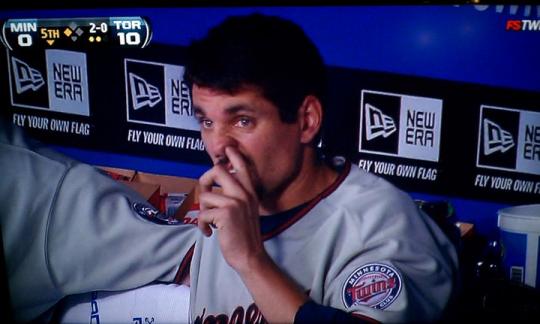
-
The Twins announced their lineup yesterday. While the O's will trot this out: The Twins haven't seen much of Arrieta, with Alexi Casilla's five plate appearances being the most among Minnesota's hitters. Arrieta has a four-pitch arsenal - fastball, slider, curve and change - and had been very inconsistent against left-handed opponents, walking 14.6% of all lefties faced. This should bode well for the Twins port-siders. By the way, stop by the "Pick 2 Cliq" contest, select which Twins hitter you think will perform the best today and win $50 in free liquor.
-
You can view the page at http://twinsdaily.com/content.php?404-Pitching-will-be-biggest-issue-in-2012
-
Pitching will be biggest issue in 2012
Parker Hageman commented on Parker Hageman's blog entry in Over the Baggy
On Thursday, Ron Gardenhire announced his opening day lineup. Giving it the once over, you will notice that the lineup is filled with “professional” hitters, a start contrast to the motley crew that the manager was forced to field at the end of last year. Headlining names like Joe Mauer, Justin Morneau and Denard Span have returned. It is deep enough that Chris Parmelee, who hit in the heart of the order in September, is batting eighth. With the offseason additions of Josh Willingham, Ryan Doumit and Jamey Carroll, there is optimism that this offense will not finish at the bottom of the league in runs scored. [ATTACH=CONFIG]523[/ATTACH]Of course, while the offense is providing some warm fuzzies, it’s the pitching staff that is the real concern. And it’s already off to an ominous start. Scott Baker, in efforts to rehab an arm issue he experienced this spring, made a start for the Ft Myers Miracle yesterday. It did not go well. Just 11 pitches into the outing, he was pulled, stating he was unable to get loose. The News-Press’s David Dorsey tweeted that Miracle manager Jake Mauer said “the radar guns were 80 to 84 or whatever the heck it was. He wasn’t comfortable at all.” There is no clarity as to what is actually wrong with Baker, either. Earlier in the day, general manager Terry Ryan was on KFAN with Dan Barreiro and said, of Baker, “the only concern I have is that he’s not injured. There’s nothing wrong; we’ve done all the test and so forth.” Baker’s situation is starting to sound somewhat similar to Glen Perkins’ plight in 2010. That season, Perkins complained about shoulder pain which sidelined him for an extended period of time and drew the ire of Twins officials who were “privately questioning his pain tolerance and willingness to compete.” As we know, Perkins rebounded swimmingly, assuming the set-up man’s position in the bullpen and earning himself a three-year deal after a terrific 2011 season. Baker, meanwhile, has now had multiple seasons now end with arm issues and this one, much like Perkins in 2010, does not have a clear diagnosis. Is he now receiving the Perkins treatment from the team’s inner circle? In August of last year, Baker headed for the disabled list, saying that he noticed a “lack of velocity and less sharpness in his breaking pitches.” Back then he was still hitting the upper-80s despite the discomfort. This spring, the radar gun has said he has been at 86 miles per hour and below. As someone who lives up in the zone and allows a high percentage of fly balls, the drop in velocity would be fuel to the fire. It’s frustrating, as Ryan told Barreiro, because despite throwing just over 130 innings last year, Baker was undoubtedly the rotation’s lone bright spot through the first half of the season. He was a breath of fresh air as a strikeout pitcher (whiffing 22.5% of batters faced) in a sea of contact artists (Carl Pavano, Nick Blackburn) and zone avoiders (Francisco Liriano). Now it appears there is no timeline in which Baker will recover in the near future. His absence will also further highlight the Twins lack of depth in the system when it comes to the starting rotation. Liam Hendriks, who pitched decently in September, will assume his spot however, if any other injuries crop up, there is little left in the farm system to replace them. There are no Matt Garzas, Kevin Sloweys or Francisco Lirianos waiting in the wings. And what of the bullpen? A year ago, the reinforcements blew 20 save opportunities and were responsible for 28 losses (the most in the American League) while allowing 4.96 runs per game (the second most in the AL). Have the Twins improved themselves in this area? Matt Capps’ spring - following up a tumultuous 2011 season - has not reassured fans much that he’s turned things around. Likewise, the one pitcher who may have added a dominating force to last year’s group, Joel Zumaya, lasted 13 spring pitches. The Twins have also lost Joe Nathan and have not replaced him with a similar right-handed reliever. This doesn’t inspire much confidence, does it? Well, you are not alone in that sentiment. Ryan was also equally as uncertain by the unit he put together. “The biggest question is the bullpen,” said Ryan Thursday afternoon over the airwaves. “The bullpen has a bunch of question marks…I’m worried about the bullpen just like you are.” At the very least, the honesty is refreshing. It’s not like the front office is trying to feed us a spoon full of sugar to help the medicine go do. The reality is this pitching staff may very well leave a bitter taste. -
-
On Thursday, Ron Gardenhire announced his opening day lineup. Giving it the once over, you will notice that the lineup is filled with “professional” hitters, a stark contrast to the motley crew that the manager was forced to field at the end of last year. Headlining names like Joe Mauer, Justin Morneau and Denard Span have returned. It is deep enough that Chris Parmelee, who hit in the heart of the order in September, is batting eighth. With the offseason additions of Josh Willingham, Ryan Doumit and Jamey Carroll, there is optimism that this offense will not finish at the bottom of the league in runs scored. Of course, while the offense is providing some warm fuzzies, it’s the pitching staff that is the real concern. And it’s already off to an ominous start.[PRBREAK][/PRBREAK] Scott Baker, in efforts to rehab an arm issue he experienced this spring, made a start for the Ft Myers Miracle yesterday. It did not go well. Just 11 pitches into the outing, he was pulled, stating he was unable to get loose. The News-Press’s David Dorsey tweeted that Miracle manager Jake Mauer said “the radar guns were 80 to 84 or whatever the heck it was. He wasn’t comfortable at all.” There is no clarity as to what is actually wrong with Baker, either. Earlier in the day, general manager Terry Ryan was on KFAN with Dan Barreiro and said, of Baker, “the only concern I have is that he’s not injured. There’s nothing wrong; we’ve done all the test and so forth.” Baker’s situation is starting to sound somewhat similar to Glen Perkins’ plight in 2010. That season, Perkins complained about shoulder pain which sidelined him for an extended period of time and drew the ire of Twins officials who were “privately questioning his pain tolerance and willingness to compete.” As we know, Perkins rebounded swimmingly, assuming the set-up man’s position in the bullpen and earning himself a three-year deal after a terrific 2011 season. Baker, meanwhile, has now had multiple seasons now end with arm issues and this one, much like Perkins in 2010, does not have a clear diagnosis. Is he now receiving the Perkins treatment from the team’s inner circle? In August of last year, Baker headed for the disabled list, saying that he noticed a “lack of velocity and less sharpness in his breaking pitches.” Back then he was still hitting the upper-80s despite the discomfort. This spring, the radar gun has said he has been at 86 miles per hour and below. As someone who lives up in the zone and allows a high percentage of fly balls, the drop in velocity would be fuel to the fire. It’s frustrating, as Ryan told Barreiro, because despite throwing just over 130 innings last year, Baker was undoubtedly the rotation’s lone bright spot through the first half of the season. He was a breath of fresh air as a strikeout pitcher (whiffing 22.5% of batters faced) in a sea of contact artists (Carl Pavano, Nick Blackburn) and zone avoiders (Francisco Liriano). Now it appears there is no timeline in which Baker will recover in the near future. His absence will also further highlight the Twins lack of depth in the system when it comes to the starting rotation. Liam Hendriks, who pitched decently in September, will assume his spot however, if any other injuries crop up, there is little left in the farm system to replace them. There are no Matt Garzas, Kevin Sloweys or Francisco Lirianos waiting in the wings. And what of the bullpen? A year ago, the reinforcements blew 20 save opportunities and were responsible for 28 losses (the most in the American League) while allowing 4.96 runs per game (the second most in the AL). Have the Twins improved themselves in this area? Matt Capps’ spring - following up a tumultuous 2011 season - has not reassured fans much that he’s turned things around. Likewise, the one pitcher who may have added a dominating force to last year’s group, Joel Zumaya, lasted 13 spring pitches. The Twins have also lost Joe Nathan and have not replaced him with a similar right-handed reliever. This doesn’t inspire much confidence, does it? Well, you are not alone in that sentiment. Ryan was also equally as uncertain by the unit he put together. “The biggest question is the bullpen,” said Ryan Thursday afternoon over the airwaves. “The bullpen has a bunch of question marks…I’m worried about the bullpen just like you are.” At the very least, the honesty is refreshing. It’s not like the front office is trying to feed us a spoon full of sugar to help the medicine go do. The reality is this pitching staff may very well leave a bitter taste.
-
You can view the page at http://twinsdaily.com/content.php?403-CONTEST-Pick-2-Cliq
