stewthornley
-
Posts
76 -
Joined
-
Last visited
Content Type
Profiles
Minnesota Twins News, Rumors & Analysis
Minnesota Twins Videos
2026 Minnesota Twins Top Prospect Rankings
2022 Minnesota Twins Draft Picks & Signing Bonuses
Minnesota Twins Trade & Free Agent Rumors
Minnesota Twins Fan Guides & Resources
2023 Minnesota Twins Draft Picks & Signing Bonuses
The Minnesota Twins Players Project
2024 Minnesota Twins Draft Picks & Signing Bonuses
2025 Minnesota Twins Draft Picks & Signing Bonuses
2026 Minnesota Twins Draft Picks & Signing Bonuses
Forums
Blogs
Events
Store
Downloads
Gallery
Everything posted by stewthornley
-
"CBD is short for cannabidiol" Thanks for explaining it. I first saw the press release from Major League Baseball and had no idea of what CBD was. (I hate acronyms, so thanks for spelling it out.) From what you wrote, it sounds like this will be a legal substance for players - at least off the field. It sounds like it could be a nice product to use with several benefits. Not that I've ever been in danger of going all "Reefer Madness" and have managed to keep alcohol as my only drug of abuse, I might try CBD. I am also subject to the joint player-management drug testing and rules, so I'll confirm that I won't get in trouble for it. Is it legal in Minnesota yet, so that I can buy it at a local Walgreen's? Thanks again for this. Good article.
-
At some point they will be called out for abandoning the basepath, too. Meanwhile, the great J. W. Gregory cited 9.12(a)(3) about charging an error to a fielder who catches a thrown ball or ground ball in time to put out the batter-runner and fails to tag first or the batter-runner.
-
In June 1973 I was at an Angels-Twins game. Richie Scheinblum was on first with no or one out when Ken Berry hit a squibber down the first-base line. Joe Decker fielded it and was about to tag Berry, but Berry turned and beat cheeks the other way, running across the plate and beyond. Scheinblum was going to second on the play anyway, and I think Berry was being intentionally comical. I recall the newspaper story saying Berry was out as soon as he crossed the plate. I'm not sure if that's correct or if it was when he was beyond home, abandoning the basepath. It was a funny play with no effect - unlike the Will Craig brainfart.
-
Twig spoke to our SABR chapter in the spring of 1986 at the Normandy Inn. He asked if someone could drive him back to the Metrodome for the game that night. I took him. At the time I sold a product line for Bradley Exterminating and had a company van with the name emblazoned all over it along with a large picture of a dead bug. Twig thought it was a hoot and said he hoped Herbie or Kirby or Bruno or someone would be out front and see him getting dropped off in that. Twig mentioned his wife, and I asked if she had been here with him in Minneapolis when he played for the Millers. "Nah, not that one anymore," he said, adding with great enthusiasm, "I got a young one now." He was great.
-
A friend said he heard Buckeyes suggested, which could be cool since it would honor the city's former Negro League team, except THE OSU would probably object. My friend then offered the Woodies. The first game I ever went to, between Cleveland and Minnesota, Woodie Held played shortstop for Cleveland. Woodie Held is also on my all-name baseball team. The entire team is available upon request.
-
And oversnark apologies to the Pensacola Blue Wahoos, who suggested my name first.
-
Steamers!
-
The win has to go to Kolarek unless the scorer considered him to be brief and ineffective. A guideline for brief and ineffective is less than an inning and allowing two earned runs, including inherited runners, to score. He allowed one inherited runner. I wouldn't apply the brief/ineffective rule in this case. He was the pitcher of record when the Dodgers scored two in the third and didn't give up the lead.
-
Some of you may have seen this from Wednesday's Angels at Minnesota game. Shohei Ottani hit a comebacker to Jake Odorizzi, who jogged toward first and may an underhanded toss that C. J. Cron didn't react to. The ball went by him, and Ohtani went to second. Here are a couple links to the play: https://sports.yahoo.com/did-twins-infielder-trick-his-own-teammates-into-committing-a-ridiculous-error-233250569.html https://www.reddit.com/r/baseball/comments/bp1k0h/cj_cron_doesnt_realize_odorizzi_fielded_a/ I gave Cron an error (with an assist to Ohtani). The next day I heard that Cron's confusion was caused by second-baseman Jonathan Schoop miming the play, sort of like what Starlin Castro did a few years ago: https://www.mlb.com/video/must-c-castro-copies-bryant-c104783183 With Castro's mime, it didn't cause a misplay although first-baseman Anthony Rizzo wasn't happy about it. I looked at the play again from a couple different sources and wondered if it would be appropriate to switch the error to Schoop (I still had about three hours to do so). I looked at the rule: Rule 9.12(a)(1) Comment reads, ". . . The official scorer shall charge an error to a fielder who causes another fielder to misplay a ball—for example, by knocking the ball out of the other fielder’s glove. On such a play, when the official scorer charges an error to the interfering fielder, the official scorer shall not charge an error to the fielder with whom the other fielder interfered." The part about knocking the ball out of another fielder's glove is given as an example of such interference, but it doesn't limit it to physical contact. I checked with Elias Sports Bureau and was told that this should not constitute an error on Schoop, so I left the call alone. It was one of the more interesting plays I've seen. No runs scored, so the Twins have been able to joke about it, and Cron has been a good sport even though he ended up with an error on his record for it. I'm guessing that this might end players horsing around with miming plays. Or not. Stew
- 20 replies
-
- 10
-

-
As an official scorer, I enjoy reconstructing an inning after an error or passed ball to see if any runs that score are earned or unearned. Next to my regular scoresheet, with the play-by-play as it happens, I start an alternative-fact account on a separate notepad. Errors fall into two primary categories: missed-out errors, which also create or extend the life of a baserunner, and advancement errors, which do not affect the number of outs or the number of baserunners, only the placement of the baserunners. Stew Thornley is one of the Twins official scorers and a baseball historian. He will occasionally provide insight to the decisions official scorers make. If you have any questions you would like him to address in a future story, you can ask them in this Twins Daily thread. You can also read more from Stew at StewThornley.net. Missed-out errors are usually straightforward in reconstruction. If a player reaches base on an error, such as a shortstop booting his ground ball, and scores, his run is unearned. In addition, any runs that score after two out are unearned, at least to the team and also to the pitcher if he was in the game at the time the error occurred. Advancement errors, such as an outfielder fumbling the ball after a hit, are more likely to require a judgment call if a run scores. Also, a run that scores because of an advancement error may be unearned but may become earned depending on subsequent events. When an error or passed ball occurs, scorers should consider the impact after each ensuing play. Consider this sequence: A runner on first steals second and continues to third on an overthrow by the catcher. Situation: runner on third who would be on second without the error. The runner from third scores on a sacrifice fly. The run is unearned at this time although it could become earned depending on subsequent events. The scorer should determine at this time if the runner would have advanced from second to third on the fly. Even though the runner scored from third, it does not mean he could have gone from second to third on the fly. If the fly was of medium depth to left field, the scorer may determine that the runner would still be on second if not for the error. If the fly was to deep right field, the scorer may determine that the runner would have advanced to third on the fly. (If the scorer is unsure, the benefit of the doubt should be given to the pitcher and the judgment made that the runner would still be on second.) The next batter singles. If the scorer’s judgment was that the runner would have advanced to third on the fly ball in the preceding play, then the run that scored on the sacrifice fly becomes earned. If the judgment was that the runner would have remained at second on the fly, then the scorer must make another judgment on whether he could have scored from second on the single. This judgment should be made at the time of the single and tracked as part of the inning being reconstructed if the error had not occurred. The remaining batter or batters complete the inning by making outs with no plays occurring that would have created additional advancement by the runner. In determining if a runner would have been able to score from second on a single to the outfield, as noted above, the scorer may consider many factors. Some obvious ones are the speed of the runner, the strength of the outfielder’s arm, and the nature of the hit. Situational factors should also be considered: Number of outs when the single occurred—the difference between two out and fewer than two out. With two out a runner can get a better jump on a batted ball. He does not have to hold up to see if a line drive or fly ball is caught or hesitate to see if a ground ball makes it through the left side of the infield. With fewer than two out, the runner sometimes has to hold up, and it is more likely that it can be considered that he would not have scored on the hit. Likelihood of the third-base coach sending the runner home. This can be dependent on the number of outs as well as other factors, such as the score of the game. With two out, it is more likely that a team will take a chance and send the runner home. With one out, the coach may be more cautious and likely to hold the runner, determining that there is still a good chance he will be driven in by the batters who follow. With no outs, this is even more likely. If a team is trailing by a large margin, it is less likely to take a chance. Therefore, the scorer has more reason to assume that the runner would not have been waved home. This can be the case even in a two-run game if it is the potential final inning for the batting team and the runner in question is not the tying run. The inning has to be reconstructed based on what follows, even if logic dictates that the inning would have played out differently: a batter singles and goes to second when the outfielder lets the ball by him. The next batter is intentionally walked. The next batter homers. All three runs are earned. We know that the intentional walk would not have occurred if not for the error; however, intentional walks are treated the same as any other walk in reconstructing an inning. Try this one: with one out, a batter reaches first on an error. The next batter triples, scoring the runner (unearned). The next batter hits a routine grounder to the shortstop, who throws home late trying to get the runner coming from third. Can the scorer assume that, without the error, there would have been two outs and the shortstop would have thrown to first for the final out? No. The plays and actions by fielders that occur after an error must be assumed when reconstructing an inning. However, a situation could arise where an out could be assumed if it does not assume any decisions made on the part of fielders. Example: With fewer than two out Simmons singles and advances to second when the center fielder bobbles the ball for an error. Torriente strikes out on a pitch that gets by the catcher. The wild pitch allows Simmons to go to third and Torriente to reach first. If not for the error, Simmons would have been on first, and Torriente—with first base occupied and fewer than two out—would be out automatically. An out on the strikeout could be assumed in this situation. I’ve never gotten heat on the reconstruction of an inning. Give the pitcher the benefit of the doubt when making judgments (benefit of the doubt, not an outright gift). The team in the field is usually happy, and the team at bat doesn’t care. However, what happens if the pitcher affected is battling for the league lead in earned-run average with a pitcher on the other team? I’m hoping to avoid that scenario. Image courtesy of © Jordan Johnson-USA TODAY Sports View full article
-
 Stew Thornley is one of the Twins official scorers and a baseball historian. He will occasionally provide insight to the decisions official scorers make. If you have any questions you would like him to address in a future story, you can ask them in this Twins Daily thread. You can also read more from Stew at StewThornley.net. Missed-out errors are usually straightforward in reconstruction. If a player reaches base on an error, such as a shortstop booting his ground ball, and scores, his run is unearned. In addition, any runs that score after two out are unearned, at least to the team and also to the pitcher if he was in the game at the time the error occurred. Advancement errors, such as an outfielder fumbling the ball after a hit, are more likely to require a judgment call if a run scores. Also, a run that scores because of an advancement error may be unearned but may become earned depending on subsequent events. When an error or passed ball occurs, scorers should consider the impact after each ensuing play. Consider this sequence: A runner on first steals second and continues to third on an overthrow by the catcher. Situation: runner on third who would be on second without the error. The runner from third scores on a sacrifice fly. The run is unearned at this time although it could become earned depending on subsequent events. The scorer should determine at this time if the runner would have advanced from second to third on the fly. Even though the runner scored from third, it does not mean he could have gone from second to third on the fly. If the fly was of medium depth to left field, the scorer may determine that the runner would still be on second if not for the error. If the fly was to deep right field, the scorer may determine that the runner would have advanced to third on the fly. (If the scorer is unsure, the benefit of the doubt should be given to the pitcher and the judgment made that the runner would still be on second.) The next batter singles. If the scorer’s judgment was that the runner would have advanced to third on the fly ball in the preceding play, then the run that scored on the sacrifice fly becomes earned. If the judgment was that the runner would have remained at second on the fly, then the scorer must make another judgment on whether he could have scored from second on the single. This judgment should be made at the time of the single and tracked as part of the inning being reconstructed if the error had not occurred. The remaining batter or batters complete the inning by making outs with no plays occurring that would have created additional advancement by the runner. In determining if a runner would have been able to score from second on a single to the outfield, as noted above, the scorer may consider many factors. Some obvious ones are the speed of the runner, the strength of the outfielder’s arm, and the nature of the hit. Situational factors should also be considered: Number of outs when the single occurred—the difference between two out and fewer than two out. With two out a runner can get a better jump on a batted ball. He does not have to hold up to see if a line drive or fly ball is caught or hesitate to see if a ground ball makes it through the left side of the infield. With fewer than two out, the runner sometimes has to hold up, and it is more likely that it can be considered that he would not have scored on the hit. Likelihood of the third-base coach sending the runner home. This can be dependent on the number of outs as well as other factors, such as the score of the game. With two out, it is more likely that a team will take a chance and send the runner home. With one out, the coach may be more cautious and likely to hold the runner, determining that there is still a good chance he will be driven in by the batters who follow. With no outs, this is even more likely. If a team is trailing by a large margin, it is less likely to take a chance. Therefore, the scorer has more reason to assume that the runner would not have been waved home. This can be the case even in a two-run game if it is the potential final inning for the batting team and the runner in question is not the tying run. The inning has to be reconstructed based on what follows, even if logic dictates that the inning would have played out differently: a batter singles and goes to second when the outfielder lets the ball by him. The next batter is intentionally walked. The next batter homers. All three runs are earned. We know that the intentional walk would not have occurred if not for the error; however, intentional walks are treated the same as any other walk in reconstructing an inning. Try this one: with one out, a batter reaches first on an error. The next batter triples, scoring the runner (unearned). The next batter hits a routine grounder to the shortstop, who throws home late trying to get the runner coming from third. Can the scorer assume that, without the error, there would have been two outs and the shortstop would have thrown to first for the final out? No. The plays and actions by fielders that occur after an error must be assumed when reconstructing an inning. However, a situation could arise where an out could be assumed if it does not assume any decisions made on the part of fielders. Example: With fewer than two out Simmons singles and advances to second when the center fielder bobbles the ball for an error. Torriente strikes out on a pitch that gets by the catcher. The wild pitch allows Simmons to go to third and Torriente to reach first. If not for the error, Simmons would have been on first, and Torriente—with first base occupied and fewer than two out—would be out automatically. An out on the strikeout could be assumed in this situation. I’ve never gotten heat on the reconstruction of an inning. Give the pitcher the benefit of the doubt when making judgments (benefit of the doubt, not an outright gift). The team in the field is usually happy, and the team at bat doesn’t care. However, what happens if the pitcher affected is battling for the league lead in earned-run average with a pitcher on the other team? I’m hoping to avoid that scenario.
-
Official Scoring Questions for Stew
stewthornley replied to stewthornley's topic in Minnesota Twins Talk
spinowner: Regarding bottom of the sixth August 4 - that was my call. I went with hit based on the difficulty of the throw. Beltre made a nice backhand of a tricky hop. He was playing the grounder defensively, which can indictate he's having trouble with it. That doesn't mean he can't be charged with an error on the throw that followed (two parts to the play). He did pound the glove before the throw, which is a sign he's set, but he still didn't appear to be in a good position - feet not lined up directly toward first - and he threw a bit across the body from a low arm slot. He often throws from a low arm slot, so that could be ordinary effort for him. But I thought with a throw from that distance, I'd like to see him a little more set in the right alignment to consider it ordinary effort. Judgement call, and I went with hit. Thanks for asking. Good question. -
Official Scoring Questions for Stew
stewthornley replied to stewthornley's topic in Minnesota Twins Talk
Old Twins Cap: No -
The Stew Review: Run Scoring Triple Plays
stewthornley replied to stewthornley's topic in Twins Daily Front Page News
No on that one. The second out wasn't a force. The idea with a GIDP is that the batter does something that will create a double play, regardless by decisions by the runners. In this case a runner tried to stretch and was thrown out, so it's a ground ball that's a double play but no GIDP. -
Official Scoring Questions for Stew
stewthornley replied to stewthornley's topic in Minnesota Twins Talk
Good questions from the San Diego series. (I didn't see the double-switch that got asked about. What happened?) Regarding Myers's throw to second on Berrios's bunt, I also wondered how that would be scored. Had the runner beaten the throw, then it would be a fielder's choice with a sacrifice for Berrios. From the replay, it looked like a good throw would have had the runner beat, so it was an error on Myers for failure to get the out at second. In that case, no sacrifice for Berrios. On the sacrifice fly with an RBI, the way a batter can't get an RBI on a double play is if he grounds into a force or reverse-force double play and is charged with a grounded into double play (GIDP). As it happens, I just wrote about this in what John has dubbed "The Stew Review" after Todd Frazier grounded into a triple play. A standard 643 double play - force at second, batter out at first - is a GIDP. So is a 3-6 reverse force - batter out with a throw to second to tag the runner coming in from first. No RBI on first. But a batter can get an RBI on other kinds of double plays, including ground balls that turn into two outs but don't have two force outs or a reverse-force. In the sacrifice fly in the Twins game, the third out was made on a tag play, with the runner from second trying to go to third. This is a time play (not a timing play, the umpires tell me; they use the term time play). The run crossed before the third out. Since the third out wasn't a force, the run counts and the batter gets an RBI. Here is more of a playing than scoring rules question. What if the runner from second had been doubled off the base rather than tagged out after tagging and trying to advance? Could a run score on that if the runner crossed the plate before the third out? Yes, although this is confusing to a lot of folks, including players and managers. Getting doubled off a base isn't a force, even though it has the same element as a force in that the runner doesn't have to be tagged. In 2010 the Twins lost a run by not knowing this. Punto on third, Span on second with one out and a long fly to center. Punto tagged, Span took off. The ball was caught, and Span was going to be doubled off for the third out. What Punto needed to do was beat cheeks to the plate to cross before the third out. However, he was more focused on waving at Span to get back. He then jogged toward the plate because he thought it wouldn't matter since he thought his run couldn't count if Span was doubled off. There was a lot in the game story the next day about how no one realized that this was still a time play and that Punto's run would have counted had he gotten home before they doubled Span off second. And then the next year the same thing happened with Alexi Casilla. Always pays to know the rules. -
The Stew Review: Run Scoring Triple Plays
stewthornley posted a topic in Twins Daily Front Page News
The official scoring scene at Twins games has been quiet the last few home stands. We like quiet, but it doesn’t leave much upon which to comment, so I will instead go to my favorite city in the world, where a run-scoring triple play occurred Tuesday, July 25, which ties to a similar play from Twins history, and leads to some interesting questions. Image courtesy of © Brad Penner-USA TODAY Sports The official scoring scene at Twins games has been quiet the last few home stands. We like quiet, but it doesn’t leave much upon which to comment, so I will instead go to my favorite city in the world, where a run-scoring triple play occurred Tuesday, July 25, which ties to a similar play from Twins history, and leads to some interesting questions. Stew Thornley is one of the Twins official scorers and a baseball historian. He will occasionally provide insight to the decisions official scorers make. If you have any questions you would like him to address in a future story, you can ask them in this Twins Daily thread. You can also read more from Stew at StewThornley.net. The Play In the bottom of the second the Yankees had Matt Holliday at third, Didi Gregorius on second, and Chase Headley on first. Todd Frazier hit a low liner toward short that froze Gregorius, not wanting to take off before making sure the ball wasn’t caught. Cincinnati shortstop Jose Peraza fielded the ball on one hop, ran to second to force Headley, and threw to Joey Votto at first for the double play. But the Reds weren’t done. Gregorius, with his late break from second, got hung up between the bases. Votto threw to Eugenio Suarez, the third baseman, who tossed to Peraza. Gregorius was called out for running out of the baseline trying to avoid Suarez. Since the final out of the inning was not a force, Holliday’s run counted since he had crossed the plate before the final out. Home Sweet Home Jacob Pomrenke of the Society for American Baseball Research (SABR) keeps the SABR Triple Play database and reports that the last run-scoring triple play was May 27, 2006 at the beloved Metrodome. The Mariners, down 8-4 to the Twins in that game, loaded the bases in the eighth. Juan Rincon relieved Jesse Crain and, on his first pitch, got Kenji Johjima to hit a grounder to second. As Richie Sexson scored from third and Carl Everett went from second to third, Luis Castillo tagged out Adrian Beltre, the runner from first, and threw to Justin Morneau to retire Johjima. Morneau then threw across the diamond as Everett had rounded third too far. Tony Batista took Morneau’s throw and tagged out Everett coming back to the bag for a triple play. The Quiz Here’s the quiz regarding these plays: 1. Were the batters charged with a grounded into double play (GIDP)? 2. Were the batters credited with a run batted in (RBI)? A runner is charged with a GIDP for grounding into a force or reverse-force double play. We all know that a batter cannot be credited with an RBI on a GIDP. In these cases, because of the add-on out that occurred after a force double play, the batters are not charged with a GIDP. Since the batters were not charged with GIDPs, do they get an RBI? Also no. This was the decision by Elias Sports Bureau, which is empowered by Major League Baseball to interpret the rules. At Yankee Stadium, an Elias representative was in the press box and was able to consult with Billy Altman, the official scorer. Elias has been consistent in this interpretation through the years; in the 2006 game at the Metrodome, Johjima also did not get an RBI. The Counter Example Can a batter ever get an RBI when he hits into a run-scoring triple play? John Labombarda of Elias Sports Bureau was able to come up with at least one example of such: On June 3, 1977 the Kansas City Royals, trailing the Baltimore Orioles 7-5 in the bottom of the ninth, loaded the bases when John Wathan flied out. Al Cowens scored from third and Dave Nelson went from second to third. I’m not sure exactly how Fred Patek, who was on first, was put out after right-fielder Pat Kelly threw the ball in, but as this was happening, Nelson bolted for home, only to be run down for a game-ending triple play. Wathan received a sacrifice fly and RBI. A Triple Play Database kept by SABR members Steve Boren, Herm Krabbenhoft, and Jim Smith shows 22 run-scoring triple plays in the history of the major leagues. For rarity, this puts in about on a par with perfect games. And, once in a while, it involves a decision by the official scorer. Meanwhile, please keep the questions and comments coming on this forum: http://twinsdaily.com/topic/26198-official-scoring-questions-for-stew View full article -
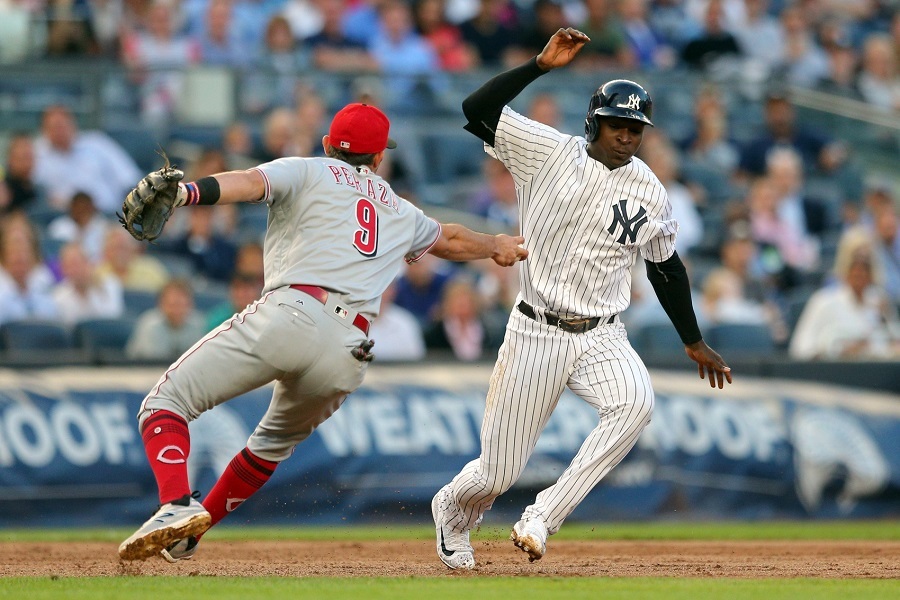 Stew Thornley is one of the Twins official scorers and a baseball historian. He will occasionally provide insight to the decisions official scorers make. If you have any questions you would like him to address in a future story, you can ask them in this Twins Daily thread. You can also read more from Stew at StewThornley.net. The Play In the bottom of the second the Yankees had Matt Holliday at third, Didi Gregorius on second, and Chase Headley on first. Todd Frazier hit a low liner toward short that froze Gregorius, not wanting to take off before making sure the ball wasn’t caught. Cincinnati shortstop Jose Peraza fielded the ball on one hop, ran to second to force Headley, and threw to Joey Votto at first for the double play. But the Reds weren’t done. Gregorius, with his late break from second, got hung up between the bases. Votto threw to Eugenio Suarez, the third baseman, who tossed to Peraza. Gregorius was called out for running out of the baseline trying to avoid Suarez. Since the final out of the inning was not a force, Holliday’s run counted since he had crossed the plate before the final out. Home Sweet Home Jacob Pomrenke of the Society for American Baseball Research (SABR) keeps the SABR Triple Play database and reports that the last run-scoring triple play was May 27, 2006 at the beloved Metrodome. The Mariners, down 8-4 to the Twins in that game, loaded the bases in the eighth. Juan Rincon relieved Jesse Crain and, on his first pitch, got Kenji Johjima to hit a grounder to second. As Richie Sexson scored from third and Carl Everett went from second to third, Luis Castillo tagged out Adrian Beltre, the runner from first, and threw to Justin Morneau to retire Johjima. Morneau then threw across the diamond as Everett had rounded third too far. Tony Batista took Morneau’s throw and tagged out Everett coming back to the bag for a triple play. The Quiz Here’s the quiz regarding these plays: 1. Were the batters charged with a grounded into double play (GIDP)? 2. Were the batters credited with a run batted in (RBI)? A runner is charged with a GIDP for grounding into a force or reverse-force double play. We all know that a batter cannot be credited with an RBI on a GIDP. In these cases, because of the add-on out that occurred after a force double play, the batters are not charged with a GIDP. Since the batters were not charged with GIDPs, do they get an RBI? Also no. This was the decision by Elias Sports Bureau, which is empowered by Major League Baseball to interpret the rules. At Yankee Stadium, an Elias representative was in the press box and was able to consult with Billy Altman, the official scorer. Elias has been consistent in this interpretation through the years; in the 2006 game at the Metrodome, Johjima also did not get an RBI. The Counter Example Can a batter ever get an RBI when he hits into a run-scoring triple play? John Labombarda of Elias Sports Bureau was able to come up with at least one example of such: On June 3, 1977 the Kansas City Royals, trailing the Baltimore Orioles 7-5 in the bottom of the ninth, loaded the bases when John Wathan flied out. Al Cowens scored from third and Dave Nelson went from second to third. I’m not sure exactly how Fred Patek, who was on first, was put out after right-fielder Pat Kelly threw the ball in, but as this was happening, Nelson bolted for home, only to be run down for a game-ending triple play. Wathan received a sacrifice fly and RBI. A Triple Play Database kept by SABR members Steve Boren, Herm Krabbenhoft, and Jim Smith shows 22 run-scoring triple plays in the history of the major leagues. For rarity, this puts in about on a par with perfect games. And, once in a while, it involves a decision by the official scorer. Meanwhile, please keep the questions and comments coming on this forum: http://twinsdaily.com/topic/26198-official-scoring-questions-for-stew
-
Official Scoring Questions for Stew
stewthornley replied to stewthornley's topic in Minnesota Twins Talk
Hi gang - I've been lazy, but I will get something new on the blog soon - Frazier's run-scoring triple play gives me some material. Sorry I haven't responded, but I looked at some of the recent questions. The only play I remember regarding these questions is the squibber (not a bunt) by Mauer. I wasn't the official scorer that night. The OS called it a hit and later changed it to an error on the pitcher. I thought it was a 50-50. The pitcher should have made that play. He should have been able to field the ball cleanly with time to go to first for the out. However, what he appeared to be doing was making a glove-flip to the first baseman. Not real wise, and it didn't work. However, that's what he decided to do. Normally, I wouldn't give an error for a botched glove flip. This doesn't fit totally into the "normally" category because he shouldn't have tried it. But sometimes we have to go with what a fielder decides to do, unless it's really blatant. That's why I say it's a 50-50, could have gone either way. Send some more questions, and I'll try to be more diligent about checking this and responding. By the way, when it's just venting with a series of "Why the fruck wasn't that an error?", I probably won't respond. But go ahead with it anyway. Thanks. Stew -
A common conundrum for official scorers (and my last story) surrounds which pitcher gets a “Win.” This happened again twice last Saturday, June 17, as the Twins lost two games to Cleveland. The latter of these decisions led to a milestone win for a reliever, and kept him from climbing towards a record. A First Win In the first game, Gregg Wong was the official scorer and had a pretty straightforward call, awarding the win to Zach McAllister, who relieved starter Ryan Merritt in the fifth and pitched two scoreless innings. But in the night game, I had more possibilities. A rain delay in the top of the fifth meant Mike Clevinger wouldn’t be back in the bottom of the inning. Nick Goody came in with Cleveland ahead 2-1 and pitched a scoreless inning. Cleveland expanded its lead to 5-1 before Goody gave up a home run to Brian Dozier leading off the last of the sixth. He got the next two batters out and was relieved, so he pitched 1-2/3 innings with one earned run. Boone Logan, Cody Allen, and Andrew Miller pitched scoreless ball after that, but I awarded the win to Goody. In the context of each situation, all were effective. It turned out to be Goody’s first major-league win in his 58th pitching appearance. (I also tipped off the Cleveland public-relations representative so he could get word to the dugout to keep the game ball for Goody.) I suppose Goody was happy to get the win, but he had been climbing the charts for “Player Who Pitched The Most Games But Never Got A Win.” Juan Alvarez (1999-2003) and Ed Olwine (1986-1988) hold that record with 80 games without a win. Goody was the active pitcher with the most, and eighth overall. For what it’s worth, the Twins have two players in the top 11; older fans will remember Terry Felton didn’t get a win in his 55 appearances (9th place). And the new active player at the top of the list (11th overall) is Twins reliever Ryan O’Rourke, who is active, but underwent Tommy John surgery in May. A First Loss (And Then Not) The win was Goody’s first decision of any type, but he originally was charged with a loss a couple of years ago, only to have it removed a couple of days later. Unlike assigning the win – in which the scorer may have some discretion – this one had to be done according to the rules, but it was a tricky situation in which an interpretation had to be made. July 30, 2015 the Yankees and Rangers were tied 6-6 at Texas going into the last of the ninth. Goody walked Delino DeShields to start the inning and was relieved by Andrew Miller. With one out Leonys Martin hit a grounder that struck DeShields. DeShields was out, and Martin was credited with a single. Martin went to second when Adrian Beltre walked and scored on a single by Josh Hamilton to end the game. Who gets the loss? The question comes down to whether or not DeShields being hit by the batted ball is a fielder’s choice. If Martin had hit a grounder that resulted in DeShields being forced at second, Martin would still be Goody’s responsibility, because a fielder’s choice constitutes a swap of the runners. On the other hand, if Martin had grounded a single to right and DeShields was out trying to go to third, Goody would be off the hook, his runner erased. What did happen – a runner hit by a batted ball – takes on the characteristics of the latter play described above. It is not a fielder’s choice. Thus, Martin became the responsibility of Miller. When Martin scored, the run and the loss were charged to Miller. There was precedent for this interpretation, which you can read about in a conundrum in the newsletter of the Official Scoring Committee of the Society for American Baseball Research (SABR): http://sabr.org/content/official-scoring-committee-spring-summer-2016-newsletter#conundrum Who Gets The Unearned Run? How about another poser, regarding which pitcher gets an unearned run? I’ll reconstruct this inning from the last of the seventh inning in the Twins’ 20-7 win over Seattle on June 13, as though the error hadn’t occurred: 1. With Casey Lawrence on the mound, Jason Castro singles. 2. Polanco singles and Castro stops at second base. 3. Eddie Rosario flies out. 4. Brian Dozier doubles, scoring Castro with Polanco going to third. 5. Marc Rzepczynski relieves. 6. Joe Mauer hits a comebacker to Rzepczynski, and Polanco is trapped off third. Rzepczynski runs him back toward the bag and throws to third-baseman Kyle Seager, who muffs the throw, allowing Polanco to avoid being put out and to race home. The ruling was a fielder’s choice-error on Seager with no run batted in. (Polanco would have been out if not for the error.) 7. Robbie Grossman singles, loading the bases. 8. Max Kepler singles to bring in Dozier. 9. Kennys Vargas singles to score Mauer. 10. Eduardo Escobar singles to score Grossman. 11. Castro singles to bring in two more, although Castro was out trying to stretch the hit to a double. 12. After a pitching change, Polanco grounded out to end the inning. Polanco’s run is unearned and is the only unearned run because all the runs after the error occurred before two were out. Which pitcher, Lawrence or Rzepczynski, gets the unearned run applied to his line? The answer is Rzepczynski, even though Polanco, who scored the unearned run, was put on base by the Lawrence. That’s because the fielder’s choice on Mauer’s grounder was a fielder’s choice; even though there was not an out, it’s still considered a swap of the runners because of an error. This type of situation was discussed in another committee conundrum: http://sabr.org/content/official-scoring-committee-summer-2016-newsletter#conundrum Gratuitous Promotion As long as I’m plugging these conundrums, here is a pitch to join SABR (http://sabr.org) and its Official Scoring Committee: http://sabr.org/research/official-scoring-research-committee Thanks to those who have posted questions and comments on the forum for official scoring questions (http://twinsdaily.com/topic/26198-official-scoring-questions-for-stew). Keep them coming. Stew Thornley is one of the Twins official scorers and a baseball historian. He will occasionally provide insight to the decisions official scorers make. If you have any questions you would like him to address in a future story, you can ask them in this Twins Daily thread. You can also read more from Stew at StewThornley.net. View full article
- 1 reply
-
- 1
-
-
- jorge polanco
- joe mauer
- (and 2 more)
-
 A First Win In the first game, Gregg Wong was the official scorer and had a pretty straightforward call, awarding the win to Zach McAllister, who relieved starter Ryan Merritt in the fifth and pitched two scoreless innings. But in the night game, I had more possibilities. A rain delay in the top of the fifth meant Mike Clevinger wouldn’t be back in the bottom of the inning. Nick Goody came in with Cleveland ahead 2-1 and pitched a scoreless inning. Cleveland expanded its lead to 5-1 before Goody gave up a home run to Brian Dozier leading off the last of the sixth. He got the next two batters out and was relieved, so he pitched 1-2/3 innings with one earned run. Boone Logan, Cody Allen, and Andrew Miller pitched scoreless ball after that, but I awarded the win to Goody. In the context of each situation, all were effective. It turned out to be Goody’s first major-league win in his 58th pitching appearance. (I also tipped off the Cleveland public-relations representative so he could get word to the dugout to keep the game ball for Goody.) I suppose Goody was happy to get the win, but he had been climbing the charts for “Player Who Pitched The Most Games But Never Got A Win.” Juan Alvarez (1999-2003) and Ed Olwine (1986-1988) hold that record with 80 games without a win. Goody was the active pitcher with the most, and eighth overall. For what it’s worth, the Twins have two players in the top 11; older fans will remember Terry Felton didn’t get a win in his 55 appearances (9th place). And the new active player at the top of the list (11th overall) is Twins reliever Ryan O’Rourke, who is active, but underwent Tommy John surgery in May. A First Loss (And Then Not) The win was Goody’s first decision of any type, but he originally was charged with a loss a couple of years ago, only to have it removed a couple of days later. Unlike assigning the win – in which the scorer may have some discretion – this one had to be done according to the rules, but it was a tricky situation in which an interpretation had to be made. July 30, 2015 the Yankees and Rangers were tied 6-6 at Texas going into the last of the ninth. Goody walked Delino DeShields to start the inning and was relieved by Andrew Miller. With one out Leonys Martin hit a grounder that struck DeShields. DeShields was out, and Martin was credited with a single. Martin went to second when Adrian Beltre walked and scored on a single by Josh Hamilton to end the game. Who gets the loss? The question comes down to whether or not DeShields being hit by the batted ball is a fielder’s choice. If Martin had hit a grounder that resulted in DeShields being forced at second, Martin would still be Goody’s responsibility, because a fielder’s choice constitutes a swap of the runners. On the other hand, if Martin had grounded a single to right and DeShields was out trying to go to third, Goody would be off the hook, his runner erased. What did happen – a runner hit by a batted ball – takes on the characteristics of the latter play described above. It is not a fielder’s choice. Thus, Martin became the responsibility of Miller. When Martin scored, the run and the loss were charged to Miller. There was precedent for this interpretation, which you can read about in a conundrum in the newsletter of the Official Scoring Committee of the Society for American Baseball Research (SABR): http://sabr.org/content/official-scoring-committee-spring-summer-2016-newsletter#conundrum Who Gets The Unearned Run? How about another poser, regarding which pitcher gets an unearned run? I’ll reconstruct this inning from the last of the seventh inning in the Twins’ 20-7 win over Seattle on June 13, as though the error hadn’t occurred: 1. With Casey Lawrence on the mound, Jason Castro singles. 2. Polanco singles and Castro stops at second base. 3. Eddie Rosario flies out. 4. Brian Dozier doubles, scoring Castro with Polanco going to third. 5. Marc Rzepczynski relieves. 6. Joe Mauer hits a comebacker to Rzepczynski, and Polanco is trapped off third. Rzepczynski runs him back toward the bag and throws to third-baseman Kyle Seager, who muffs the throw, allowing Polanco to avoid being put out and to race home. The ruling was a fielder’s choice-error on Seager with no run batted in. (Polanco would have been out if not for the error.) 7. Robbie Grossman singles, loading the bases. 8. Max Kepler singles to bring in Dozier. 9. Kennys Vargas singles to score Mauer. 10. Eduardo Escobar singles to score Grossman. 11. Castro singles to bring in two more, although Castro was out trying to stretch the hit to a double. 12. After a pitching change, Polanco grounded out to end the inning. Polanco’s run is unearned and is the only unearned run because all the runs after the error occurred before two were out. Which pitcher, Lawrence or Rzepczynski, gets the unearned run applied to his line? The answer is Rzepczynski, even though Polanco, who scored the unearned run, was put on base by the Lawrence. That’s because the fielder’s choice on Mauer’s grounder was a fielder’s choice; even though there was not an out, it’s still considered a swap of the runners because of an error. This type of situation was discussed in another committee conundrum: http://sabr.org/content/official-scoring-committee-summer-2016-newsletter#conundrum Gratuitous Promotion As long as I’m plugging these conundrums, here is a pitch to join SABR (http://sabr.org) and its Official Scoring Committee: http://sabr.org/research/official-scoring-research-committee Thanks to those who have posted questions and comments on the forum for official scoring questions (http://twinsdaily.com/topic/26198-official-scoring-questions-for-stew). Keep them coming. Stew Thornley is one of the Twins official scorers and a baseball historian. He will occasionally provide insight to the decisions official scorers make. If you have any questions you would like him to address in a future story, you can ask them in this Twins Daily thread. You can also read more from Stew at StewThornley.net.
-
Official Scoring Questions for Stew
stewthornley replied to stewthornley's topic in Minnesota Twins Talk
John is right. I'll have a new article done after this homestand. I think I've responded to most of the questions on this forum, but there was one about an infielder missing a pop up with the infield fly rule called and how I annotate it. When the IFF rule is called and the ball is caught, as it usually is, I put in the usual P4 or P6 (whatever) and add I.F. If it dropped, I'd probably write in something, such as IF dropped. If a runner advance when the ball got away, it would probably be an error for the advancement. If that happened, I'd call Elias Sports Bureau to confirm, but giving the player the put out for the infield fly and then adding an advancement error for letting the ball get away would seem reasonable. -
Official Scoring Questions for Stew
stewthornley replied to stewthornley's topic in Minnesota Twins Talk
Maybe so, but I was never deported back to the upper deck. *** Good for you for finding the sanctuary section. -
Official Scoring Questions for Stew
stewthornley replied to stewthornley's topic in Minnesota Twins Talk
A few replies. Parker: Legend has it that cf Johnny Mostil but the people who look into legends determined that this legend was of the urban type. Regarding questions about how I got into scoring and how to score the shift, there were a couple of articles about it, one by me, in the current issue of the newsletter SABR Official Scoring Committee (another plug for joining SABR and this committee: http://sabr.org/content/official-scoring-committee-january-2017-newsletter#shift My contribution addresses the shift and then goes into my waxing eloquent about scoring as I grew up. We're about to come out with a new newsletter, and in the one after that I think I have something in the hopper about how I got into official scoring, but a recap: In the 1980s and 1990s - with community college tournaments and the Minneapolis Loons independent team - it was public-address announcing that sometimes had me doing both jobs. As I prepared to be one of the Twins official scorers, I tuned up by doing Saints games for a couple years. Maybe I'll use that in my next article on Twins Daily. Have scorers gravitated more toward hits in the past decades? I don't know. Errors per game have definitely gone down, but I also believe players are better - in many ways, including fielding. Look at how good every first baseman - not just the Gold Glovers - are in picking throws in the dirt and saving a teammate an error. I don't recall them being that good when I was a kid (and I'll admit that recollection is a squishy thing). But if they are better, can the increase in first baseman scooping throws in the dirt be enough to account for fewer errors per game? I don't know, but I think about it a lot - especially when I'm in meetings at my regular job and should be thinking about other things. It's helped that since 2012 we've been able to meet each year, look at plays, discuss situations with the aim of standardizing our calls. Joe Torre, who decides on scoring decisions that have been sent in by a team or a player, has been with us, showing video of plays and discussing them. In my opinion, this has helped a lot. I wrote in an intro for our manual that the line between hit and error will always be fuzzy, not fine. But by meeting and doing what we do, we can reduce that band of fuzziness. And I think we have. We try to gravitate to one another in how we make our decisions. This is about in only thing in my life in which I am a conformist. -
Official Scoring Questions for Stew
stewthornley replied to stewthornley's topic in Minnesota Twins Talk
Hey, folks, thanks for the questions. Junior member, we've had a few times that a right-fielder has been brought into the infielder, so there was a chance for a 6-9 play. Nice. Chi Town Twins Fan - I have something I'm going to include in a newsletter for the SABR Official Scoring Committee that gets into how I started scoring when I was a kid. Not sure when it will appear - later this year - but it gives me a chance to make a plug for SABR (sabr.org) and it official scoring committee: http://sabr.org/research/official-scoring-research-committee More later. -
An official scoring decision in the May 31, 2017 Houston at Minnesota game drew a lot of questions regarding which pitcher was awarded the "win." Michael Feliz entered the game in the last of the ninth with the Astros leading 17-6. He retired the side with one hit - and was credited with the win. "How could that be?", asked people at the ball park, fans from around the country, and members of a Facebook page devoted to college sports information directors. Starter David Paulino pitched four innings, giving up two runs. Houston led 5-2 when James Hoyt came in for the bottom of the fifth. In the sixth (after the Astros had scored another in the top of the inning) Hoyt gave up a one-out homer to Eddie Rosario and two-out single to Chris Gimenez. Tony Sipp relieved, and Jason Castro greeted him with a home run to center. Stew Thornley is one of the Twins official scorers and a baseball historian. He will occasionally provide insight to the decisions official scorers make. If you have any questions you would like him to address in a future story, you can ask them in this Twins Daily thread. You can also read more from Stew at StewThornley.net. Houston padded its lead with six runs in the seventh, and Reymin Guduan made his major-league debut. In his second inning on the mound, in the eighth, Guduan gave up a double and a walk and allowed one of the runners to score on a wild pitch. Then Feliz pitched the ninth, allowing a two-out double. I wasn’t the scorer in this game, but I was sitting next to Gregg Wong, the official scorer, who knew he was going to have to assign the win to one of the relievers. Rule 9.17( states that the starting pitcher must complete five innings of a game that lasts six or more innings on defense to receive a win. If the starter doesn’t go that long but leaves with his team in the lead, and his team holds the lead, then “the official scorer shall credit as the winning pitcher the relief pitcher, if there is only one relief pitcher, or the relief pitcher who, in the official scorer’s judgment was the most effective, if there is more than one relief pitcher.” A comment reads, “It is the intent of Rule 9.17( that a relief pitcher pitch at least one complete inning or pitch when a crucial out is made, within the context of the game (including the score), in order to be credited as the winning pitcher. If the first relief pitcher pitches effectively, the official scorer should not presumptively credit that pitcher with the win, because the rule requires that the win be credited to the pitcher who was the most effective, and a subsequent relief pitcher may have been most effective. The official scorer, in determining which relief pitcher was the most effective, should consider the number of runs, earned runs and base runners given up by each relief pitcher and the context of the game at the time of each relief pitcher’s appearance. If two or more relief pitchers were similarly effective, the official scorer should give the presumption to the earlier pitcher as the winning pitcher.” So if you the official scorer, to whom would you credit the win? A number of writers approached Gregg in the late innings and asked if Hoyt (two earned runs allowed in 1-2/3 innings) would get the win. Wonger’s consistent reply was, “I don’t know yet.” Tony Sipp wasn’t going to get it; that was clear. What about Guduan? Two innings with one run allowed wasn’t awful, but how could it be more effective than a scoreless inning, provided by Feliz at the end? Even that didn’t become certain as Feliz gave up a two-out double to Ehire Adrianza. One more hit would bring him in, and all of a sudden Feliz’s line isn’t that effective. Gregg said if Adrianza scored that Guduan would get the win; otherwise, it would go to Feliz. I agreed completely. It wasn’t until Eddie Rosario swung and missed to end the game that Wonger could make his decision. Some people criticized it and said, under these circumstances, it would make sense to give the win to the starter, Paulino. But official scorers have to go by the rule book, not by their opinion of a particular rule. Gregg is an experienced and insightful official scorer who made, in my opinion, the only decision that made sense by the rules. By the way, it is possible for a starter to get a win without completing five innings. The starting pitcher, assuming he is the pitcher of record, may receive a win for pitching four innings of a game that lasts five innings on defense, according to Rule 9.17( . The last time this happened was June 1, 2001 in a Cleveland at New York Yankees game. C. C. Sabathia of Cleveland completed four innings and was relieved to begin the bottom of the fifth with Cleveland ahead 5-4. Cleveland extended its lead to 7-4 and, in bottom of the sixth, the game was called by rain after an error (on a dropped pop foul). Sabathia received the win. Image courtesy of © Dennis Wierzbicki-USA TODAY Sports View full article