



Patrick Wozniak
-
Posts
383 -
Joined
-
Last visited
-
Days Won
1
Content Type
Profiles
Minnesota Twins News, Rumors & Analysis
Minnesota Twins Videos
2026 Minnesota Twins Top Prospect Rankings
2022 Minnesota Twins Draft Picks & Signing Bonuses
Minnesota Twins Trade & Free Agent Rumors
Minnesota Twins Fan Guides & Resources
2023 Minnesota Twins Draft Picks & Signing Bonuses
The Minnesota Twins Players Project
2024 Minnesota Twins Draft Picks & Signing Bonuses
2025 Minnesota Twins Draft Picks & Signing Bonuses
2026 Minnesota Twins Draft Picks & Signing Bonuses
Forums
Blogs
Events
Store
Downloads
Gallery
Everything posted by Patrick Wozniak
-
Let's Make A Deal, Part III: The Ammunition
Patrick Wozniak replied to Jeremy Nygaard's topic in Twins Daily Front Page News
Great article. Gilberto Celestino could be another outfielder of interest. He started the season slow but has been heating up in July and can handle center.- 20 replies
-
- 1
-

-
- trevor larnach
- royce lewis
- (and 3 more)
-
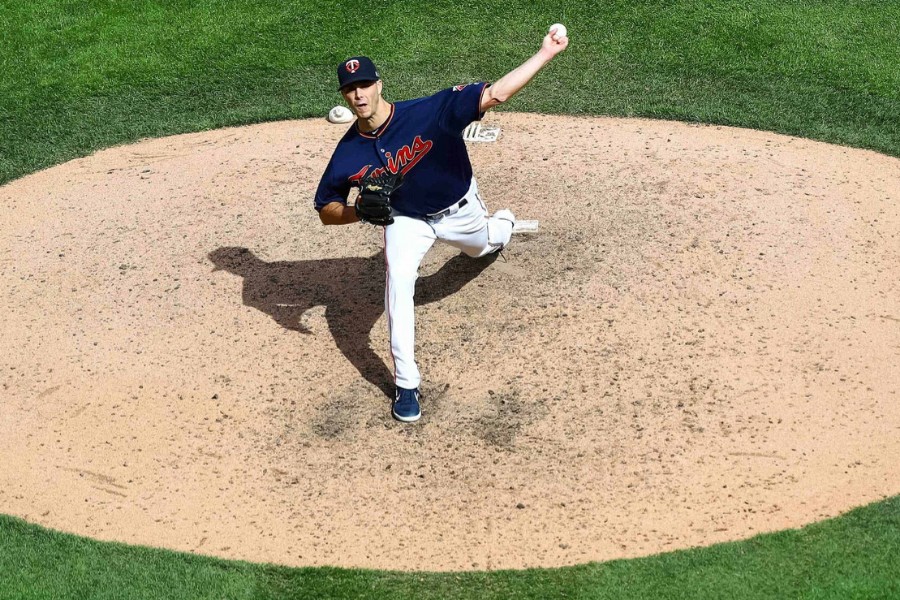
Coming into the season, I think it is fair to say that most Twins fans were underwhelmed at best with what the front office did to address the bullpen. With the trade deadline fast approaching fans are anxious for the team to upgrade a few relief arms. Assuming the Twins do add a few arms, is it possible that Derrek Falvey and Thad Levine have actually created a new efficiency in creating a bullpen? Image courtesy of © David Berding-USA TODAY Sports Coming into the season, I think it is fair to say that most Twins fans were underwhelmed at best with what the front office did to address the bullpen. With the trade deadline fast approaching fans are anxious for the team to upgrade a few relief arms. Assuming the Twins do add a few arms, is it possible that Derrek Falvey and Thad Levine have actually created a new efficiency in creating a bullpen? Aside from adding Blake Parker, who seemed like a rather marginal upgrade, the Twins really didn’t do much to address the bullpen during the offseason. Instead they extended Jorge Polanco and Max Kepler and made several key offensive additions). Rather than adding any big-named, high-priced relievers, the Twins have chosen to roll with minor league free agent signings and their own internal candidates. In some cases it worked remarkably well (as expected with Taylor Rogers and somewhat surprisingly with Ryne Harper), others have been serviceable but haven’t quite taken the step forward that we would have hoped (Trevor May), and some have been a disaster (Fernando Romero and Trevor Hildenberger). The Twins have relied upon the Rochester/Minneapolis shuttle and found some useful pieces, most recently in Zack Littell. Tyler Duffey has also been pretty good for the most part and Devin Smeltzer, Kohl Stewart, and Sean Poppen have provided some useful outings, both starting and in relief. The bullpen is currently sixth in the American League in ERA and first in WPA (Thanks Taylor Rogers!). Although the Twin’s bullpen has been surprisingly effective this year, I don’t think anyone would argue that they couldn’t use at least one more late-inning shut-down reliever along with a quality middle reliever, preferably a lefty. However, not jumping in to make a big off-season reliever signing or two is looking more and more prudent. A quick glance at the stat lines of the top free agent relievers will show how inconsistent the signings were, Well, outside of the Yankees, unfortunately. In general, signing free agent relievers seems to be a crapshoot, as the past couple of seasons have shown. Even with the somewhat suppressed contract amounts of the last two seasons, staying clear of the FA reliever market was shrewd in that Twins avoided the burden of being committed to a potentially ineffective reliever for multiple years. This of course saves the Twins money, but more importantly it keeps them from feeling an obligation to continue running out an ineffective reliever because of money owed, as it is much easier to cut a player who isn’t tied to a large salary (as we’ve seen recently with Matt Magill and Mike Morin). It also makes it more palatable to take on added salary in a trade, whether starter or reliever. This brings us to the potential beauty of the Twins’ plan, if it is in fact their plan. If they do decide to add relievers through trades they have a much better idea of what they are getting than they would through free agency. The Twins are obviously closely monitoring potential trade targets and are aware of how relievers have pitched recently. Although there is always the risk that a player could regress for the remainder of the regular season and/or in the postseason, the odds are certainly lower than that of an off-season acquisition. Plus, relievers who have some years of team control left tend to be younger and therefore less likely for regression than more volatile, older free agents through the remainder of their time with the Twins. Waiting gives the Twins the advantage of seeing the direction in which the potential trade target is trending. They have the luxury of going after the hot hand(s). The Twins are in a great position to make some trades. With a stacked farm system, the Twins can afford to part with a few quality prospects to go after a high-quality reliever or two with some years of team control left, and/or go after upcoming free agents without giving up any top prospects. Falvey and Levine have done a nice job of building the farm system and definitely place a high value on prospects. They undoubtedly have a notion of which prospects are untouchable and seem unlikely to needlessly give away prospects. The front office seems keen to keep the best long- term interests of the team intact (as they should), but with a first place team they are almost obligated to strengthen the pen through some trades. Whether or not this is something the front office cleverly plotted out or just fell into. That is, staying away from free agent relievers, testing/developing internal options, and waiting to make a trade or two (or three) appears ingenious in hindsight. We’ll find out soon enough. View full article
- 10 replies
-
- 1
-
-
- taylor rogers
- blake parker
- (and 3 more)
-
 Aside from adding Blake Parker, who seemed like a rather marginal upgrade, the Twins really didn’t do much to address the bullpen during the offseason. Instead they extended Jorge Polanco and Max Kepler and made several key offensive additions). Rather than adding any big-named, high-priced relievers, the Twins have chosen to roll with minor league free agent signings and their own internal candidates. In some cases it worked remarkably well (as expected with Taylor Rogers and somewhat surprisingly with Ryne Harper), others have been serviceable but haven’t quite taken the step forward that we would have hoped (Trevor May), and some have been a disaster (Fernando Romero and Trevor Hildenberger). The Twins have relied upon the Rochester/Minneapolis shuttle and found some useful pieces, most recently in Zack Littell. Tyler Duffey has also been pretty good for the most part and Devin Smeltzer, Kohl Stewart, and Sean Poppen have provided some useful outings, both starting and in relief. The bullpen is currently sixth in the American League in ERA and first in WPA (Thanks Taylor Rogers!). Although the Twin’s bullpen has been surprisingly effective this year, I don’t think anyone would argue that they couldn’t use at least one more late-inning shut-down reliever along with a quality middle reliever, preferably a lefty. However, not jumping in to make a big off-season reliever signing or two is looking more and more prudent. A quick glance at the stat lines of the top free agent relievers will show how inconsistent the signings were, Well, outside of the Yankees, unfortunately. In general, signing free agent relievers seems to be a crapshoot, as the past couple of seasons have shown. Even with the somewhat suppressed contract amounts of the last two seasons, staying clear of the FA reliever market was shrewd in that Twins avoided the burden of being committed to a potentially ineffective reliever for multiple years. This of course saves the Twins money, but more importantly it keeps them from feeling an obligation to continue running out an ineffective reliever because of money owed, as it is much easier to cut a player who isn’t tied to a large salary (as we’ve seen recently with Matt Magill and Mike Morin). It also makes it more palatable to take on added salary in a trade, whether starter or reliever. This brings us to the potential beauty of the Twins’ plan, if it is in fact their plan. If they do decide to add relievers through trades they have a much better idea of what they are getting than they would through free agency. The Twins are obviously closely monitoring potential trade targets and are aware of how relievers have pitched recently. Although there is always the risk that a player could regress for the remainder of the regular season and/or in the postseason, the odds are certainly lower than that of an off-season acquisition. Plus, relievers who have some years of team control left tend to be younger and therefore less likely for regression than more volatile, older free agents through the remainder of their time with the Twins. Waiting gives the Twins the advantage of seeing the direction in which the potential trade target is trending. They have the luxury of going after the hot hand(s). The Twins are in a great position to make some trades. With a stacked farm system, the Twins can afford to part with a few quality prospects to go after a high-quality reliever or two with some years of team control left, and/or go after upcoming free agents without giving up any top prospects. Falvey and Levine have done a nice job of building the farm system and definitely place a high value on prospects. They undoubtedly have a notion of which prospects are untouchable and seem unlikely to needlessly give away prospects. The front office seems keen to keep the best long- term interests of the team intact (as they should), but with a first place team they are almost obligated to strengthen the pen through some trades. Whether or not this is something the front office cleverly plotted out or just fell into. That is, staying away from free agent relievers, testing/developing internal options, and waiting to make a trade or two (or three) appears ingenious in hindsight. We’ll find out soon enough.
-
Cole Sands and Kai-Wei Teng have really seemed to emerge. Do you see either of them as future big league starters?
-
Adding Bauer to the team wouldn't really be fair to Kepler.
-
End of the Rope for Schoop?
Patrick Wozniak commented on Patrick Wozniak's blog entry in Patrick Wozniak's Blog
Yeah, I have no problem keeping Schoop around, but I think a reduced roll would be pertinent. -
End of the Rope for Schoop?
Patrick Wozniak commented on Patrick Wozniak's blog entry in Patrick Wozniak's Blog
I knew that homer was coming! -
With the trade deadline quickly approaching Twins fans are rightly focused on adding pitching to the major league roster. The offensive is still on a record setting home run pace and has great major and minor league depth, so any offensive additions would be superfluous. However, the Twins may be able to add by subtraction. Jonathan Schoop may have been the least significant off season offense upgrade the Twins added due to the savvy additions of Nelson Cruz and Marwin Gonzales. However, the front office still had high hopes for Schoop who was signed on a one year deal. Schoop, of course was an all-star in 2017, when he had a career year with Baltimore slashing .293/.338/.503 for an OPS of .841. He mashed 32 long balls and 105 RBI in a 160 games. Schoop came crashing back down to earth in 2018 with and ugly .682 OPS between Baltimore and Milwaukee. While Falvey and company many have been dreaming of a return to 2017, it certainly wasn’t out of the question to expect something closer to Schoop's career averages. And to be fair to Schoop this is what he has done. He is currently slashing .256/.305/.458 for an OPS of .763 while playing slightly above average second base. This is even slightly better than Schoop’s career averages. He has been good for 1.5 Bref WAR and by all accounts is a beloved member in the clubhouse. However, while Schoop looked like his former 2017 self coming out of the gate (OPS of .819 through May 31), more recently he has looked like the Schoop of 2018 (OPS of .672 since June 1). More frustrating to fans, Schoop seems to excel in blowout games (how many garbage time HRs has he hit?) while consistently striking out in “clutch” situations. The numbers seem to back up the eye as Schoop is hitting .163/.230/.438 with RISP and .205/.279/.231 in late inning pressure situations. The problem is with a lineup full of power hitters, Schoop becomes a bit redundant, and more importantly the Twins have better options for second base. Plenty of them as it turns out. Let’s take a look. All Arraez Luis Arraez has been nothing short of amazing in his first big league stint. He is currently slashing .385/.444/.510 for an OPS of .955. In 29 games he has already accumulated 1.1 Bref WAR. Arraez is obviously playing a bit over his head right now, but he has been a good hitter throughout his minor league career and between AA-AAA this year he hit .344/.409/.401. He is not going to hit .400 or slug over .500 long term but his plate approach is very refreshing. On a team of free swingers and power hitters Arraez looks like a nice table setter and in his short time with the twins has come up with several “clutch” hits. His rather twitchy batting style is also extremely entertaining to watch. Arraez has played all over the field for the Twins, including third base, short stop, and left field, but he is clearly best suited for second base where he has spent the majority of his minor league career. Arraez is firmly implanted as the front runner for second base next year and it is also becoming increasingly apparent that he is the answer now. The Others Both Marwin Gonzales and Ehire Adrianza currently appear to be better options than Schoop at second base as well. A large part of the value in both of these players is their versatility, so sticking Arraez at second clearly makes the most sense. However, were something to happen to Arraez both of these players are more than capable of filling in. Both players started the year ice cold so their stats took a bit of a dip because of this (pretty much the opposite of Schoop). Gonzales currently has an OPS of .748 with a 1.9 Bref War and Adrianza has a .788 OPS with a 1.1 Bref War in only 148 plate appearances. If one of them were to fill in at second for Schoop (or Arraez) the other would still be available for the utility role. What to do with Schoop? Cutting Schoop is probably ill advised. Although it would give more at bats to the previously mention trio, Schoop has played well enough that cutting him wouldn’t really make sense. Could he be traded for pitching? This is very unlikely as he is on a one-year deal and the Twins will most likely be trading with non-contenders who are uninterested in a rental. There are, however, a couple of long-shot possibilities. One would be a three-way trade with Schoop going to another contender (presumably because of an injuring to the team’s second baseman) and a pitcher from the third non-contending club coming to the twins. Another possibility could be Schoop being a thrown-in to offshoot an incoming player’s salary (similar to the Twins acquiring Logan Forsythe from the Dodgers in the Dozier trade). Again, this is unlikely. The best course of action is probably just to keep Schoop and relegate him to a bench role with less and less playing time. He could occasionally fill in against lefties and seems like the ideal guy to have around the clubhouse (assuming he doesn’t become bitter about his decreased roll). He would also be a valuable depth piece as we have seen how hard injuries can hit. What do you think? Should Schoop be our starting second baseman, a role player, or be removed from the team all together?
