



Steven Buhr
-
Posts
1,682 -
Joined
-
Last visited
Content Type
Profiles
Minnesota Twins News, Rumors & Analysis
Minnesota Twins Videos
2026 Minnesota Twins Top Prospect Rankings
2022 Minnesota Twins Draft Picks & Signing Bonuses
Minnesota Twins Trade & Free Agent Rumors
Minnesota Twins Fan Guides & Resources
2023 Minnesota Twins Draft Picks & Signing Bonuses
The Minnesota Twins Players Project
2024 Minnesota Twins Draft Picks & Signing Bonuses
2025 Minnesota Twins Draft Picks & Signing Bonuses
2026 Minnesota Twins Draft Picks & Signing Bonuses
Forums
Blogs
Events
Store
Downloads
Gallery
Everything posted by Steven Buhr
-
Kernels and Twins near extension of PDA
Steven Buhr replied to Steven Buhr's topic in Twins Minor League Talk
Yeah. I could go with PDC, Player Development Contract, if you prefer. -
Kernels and Twins near extension of PDA
Steven Buhr replied to Steven Buhr's topic in Twins Minor League Talk
Thanks. I'll try that next time. It's a brand new laptop so yeah probably IE 11. Haven't gotten around to figuring out how to make Firefox my default browser in Win 8.1 yet. -
Kernels and Twins near extension of PDA
Steven Buhr replied to Steven Buhr's topic in Twins Minor League Talk
Thanks for the assist, JB. Not sure what I'm doing wrong, but figuring it out will have to wait until I get home from this business trip. And, yes, chances are I'll be in CR through 2020 anyway. And on the off chance I do retire before that AND I move away from CR, there's a good chance I would move TO Fort Myers, so I could just flip to reporting on the Miracle, I guess. -
Jim Ecker of MetroSportsReport.com is reporting that the Kernels and Twins met today in Cedar Rapids and that an announcement concerning a 4 year extension of their affiliation agreement could come Wednesday. The agreement would extend the PDA through the 2020 season. (I don't know if it's the new TD format or me just not being able to figure out my new laptop, but I can't get anything to "paste" here, nor can I get any links to imbed in this, so to read the story, just go to MetroSportsReport.com and click on the Kernels tab to find the story.)
-
James bounced back well after the inauspicious start to his July. On the month, as a whole, he hit .250 and had a .702 OPS. That's down from his earlier efforts, but considering he struggled to reach the Mendoza line the first 10 days or so of July, it's not bad at all. On the year, he's at .273. But his 20 doubles, 2 triples and 2 HRs show the real improvement in his game this year. It reflects the most extra-base hits he's had in any season since his 2010 year at Beloit (low-A), and there's still another month left in this season. It would be nice to see him finish strong. Depending on the Twins' 40-man roster situation, maybe he could get a September call. But even if that doesn't happen, a strong finish would set him up for 2015. I admit, however, that I kind of hope he elects minor league free agency this year and finds an organization where he might have a better opportunity to take that next step in 2015.
-
Celebrating the affiliation agreement with the Minnesota Twins has been pretty much an “all season long” thing for the Cedar Rapids Kernels and their fans, but this weekend was the official Twins Weekend event in Cedar Rapids. Guests of honor have included all-time Twins great Tony Oliva, Twins organist Sue Nelson and mascot TC Bear. All three made appearances at the Kernels’ game with visiting Peoria on Friday night. Oliva signed autographs for a long line of fans before the game, Nelson treated fans to her talents on an electric organ during the game and TC teamed with Kernels mascot Mr. Shucks to entertain fans throughout the game.[PRBREAK][/PRBREAK] (This article was originally posted on Knuckleballsblog.com) On Saturday morning, all three joined several Kernels players and coaches, along with over 100 fans, for a breakfast event benefiting the Cedar Rapids Convention & Visitors Bureau. As a fan who grew up in Minnesota in the 1960s watching Oliva play ball for the Twins at Metropolitan Stadium, I have to say it was a really big deal to me to have an opportunity to interview Oliva alongside other local media Friday evening during the Kernels game. It was even a bigger deal to find myself alone with Oliva in the press box for several minutes a short while after the formal media interview and having the opportunity to just watch a ballgame and talk about a number of the young Twins prospects with Oliva. On Saturday morning, during his remarks at the breakfast and in a “Q & A” session, Oliva shared a number of observations and anecdotes with the crowd. If you’re interested in reading some of Oliva’s comments to the media from Friday night, click here to read my story for Metro Sports Report, which include Oliva’s thoughts on the current Major Leaguers from his native Cuba. Cedar Rapids Gazette reporter Jeff Johnson also has a story focusing on Oliva’s comments concerning PED usage in baseball. Here are a few photos I took from the weekend’s events. http://knuckleballsblog.com/blog/wp-content/uploads/2013/07/OlivaAuto-600x399.jpg Tony Oliva patiently signed autographs for about an hour before the game http://knuckleballsblog.com/blog/wp-content/uploads/2013/07/SueNelson.jpg Twins organist Sue Nelson http://knuckleballsblog.com/blog/wp-content/uploads/2013/07/TCBear2.jpg TC Bear entertained fans and posed for pictures http://knuckleballsblog.com/blog/wp-content/uploads/2013/07/OlivaMedia.jpg Tony Oliva met with local media on Friday during the Kernels game http://knuckleballsb...reakfastLee.jpg Kernels pitcher and Twins prospect Brett Lee answers a question during the breakfast event Saturday morning as Niko Goodrum, Adam Brett Walker, Kernels broadcaster Morgan Hawk, Tony Oliva, Jake Mauer and Tommy Watkins look on. http://knuckleballsb...vaBreakfast.jpg Tony Oliva speaking to fans at the Breakfast event Saturday http://knuckleballsb...kfastWalker.jpg Kernels outfielder and Twins prospect Adam Brett Walker answers fan questions during Saturday’s breakfast http://knuckleballsb.../Breakfast3.jpg From left to right: Mike Gonzales, Dallas Gallant, Morgan Hawk (standing), Niko Goodrum, Brett Lee, Adam Brett Walker, Tony Oliva, Jake Mauer and Tommy Watkins Click here to view the article
-
Almost exactly six years ago, I sat several rows up from home plate as Scott Baker took a perfect game in to the ninth inning against the Kansas City Royals. While he didn't complete his date with immortality, it was the closest I've ever come to seeing a Major League no-hitter in person. On Wednesday night, I watched Baker continue to try to work his way back to the Big Leagues with the Chicago Cubs with a rehabilitation start for the Kane County Cougars against the future Twins suiting up for the Cedar Rapids Kernels. [PRBREAK][/PRBREAK] http://knuckleballsblog.com/blog/wp-content/uploads/2013/08/Baker1.jpg Scott Baker, Kane County Cougar (This article was originally posted at Knuckleballsblog.com) I never saw Baker get above 86 mph on the scoreboard, so even giving him an extra tick or two due to the Cedar Rapids scoreboard's reputation for being slightly slower than the speed guns of the scouts who perch directly behind home plate most nights, the former Twins pitcher never hit any higher than 88 mph and he didn't mix in more than a couple of off-speed pitches each inning. But on this night, that was good enough to handcuff the Kernels as only a fifth inning infield single by Adam Brett Walker kept Baker from completing five perfect innings. Jorge Polanco and Travis Harrison each reached the warning track off of Baker in their first plate appearances of the night, but that was the closest anyone came to doing any damage to the former Twins star. http://knuckleballsblog.com/blog/wp-content/uploads/2013/08/Berrios2.jpg Jose Berrios Jose Berrios, the 19-year-old that Twins fans hope will be one of the anchors of a future Twins rotation, fared far worse. Berrios has been tabbed as the starting pitcher in the first game of the Kernels' postseason next Wednesday, but tonight he struggled with his control. Berrios walked three hitters and gave up five hits, including two home runs, as the Kernels fell 9-1 to Baker's Kane County Cougars. SD Buhr covers the Cedar Rapids Kernels for MetroSportsReport.com. His alter-ego, Jim Crikket, opines about the Twins and Kernels at Knuckleballsblog.com. Click here to view the article
-
Twins Sign Undrafted Brandon Poulson
Steven Buhr replied to Seth Stohs's topic in Twins Minor League Talk
As a Twins fan, I hope this works out and he's an All-Star bullpen arm in a couple years. But I gotta say, if I were a mid-to-low minor leaguer in the Twins organization who worked my butt off for 3-4 years in college, signed for a fraction of what Poulson got and is trying to pay my bills on $1200 a month while putting in 9-10 hour days at the ballpark, I'd be less than pleased to see my organization hand over a quarter mil to a guy based on seeing him throw 18 pitches. Maybe that's just me. -
Twins Minor League Report (7/29): Berrios Injured
Steven Buhr replied to John Bonnes's topic in Twins Daily Front Page News
It really is a pretty good group of starters, but what's really impressive right now is the bullpen. Granted, there are reasons for that, such as a few guys who are older and arguably should be pitching at a higher class already, but the velo of some of these guys is pretty amazing. While talking to media after Wednesday's win, where Burdi and Gallant each K'd 5 guys in 2 innings of relief, Jake Mauer mentioned that he and Tommy Watkins were talking about it and recalled that when they were playing together at this level, they had like 1 pitcher who could throw 95. The rest were upper 80s-low 90s. This group of Kernels has 4-5 guys consistently throwing 95+. That kind of bullpen allows the Twins/Kernels to get away with limiting pitches for these 18-20 year old starters without blowing a bunch of games in the last 3- innings. -
I'm getting the same thing, both last night on my MS Surface and my laptop at work today, so both would be some version of IE as a browser. I use Firefox at home with my laptop there, but haven't noticed the same prompt there.
-
Download attachment: Melotakis_Mason_Standing_Othr_458.jpg Through May 21, the Cedar Rapids Kernels had built up an impressive 30-13 record and held a five game lead over their closest competition in the Western Division of the Midwest League. They then left town for a quick three-game road trip to Beloit after taking three out of four from Kane County. They had no clue at that time that they not only would get swept by the second place Snappers, but would return home and drop all three games of a series against the last place Burlington Bees.[PRBREAK][/PRBREAK] But that's exactly what happened to the Kernels as almost every part of their game seemed to fall apart at the same time over the past week. The defense not only started committing more errors than usual, but those errors seemed to come at precisely the worst possible time. The timely hitting that had almost become a trademark of the team through the first six weeks of the season disappeared as they hit safely just 13 times in 54 opportunities with runners in scoring position during their losing streak and scored just three runs in four of the six games. Perhaps most concerning, the Kernels' starting pitching rotation averaged less than five innings of work per game over the six losses. The rotation arms gave up a whopping 45 hits and 33 runs (28 of them earned) in 29 2/3 innings during that stretch of games. Kernels pitching coach Gary Lucas was asked what had gone wrong with the team's starting pitching. “I don't know. These teams that begin with the letter B, Beloit and Burlington, took it to us,” conceded Lucas, after Tuesday night's 9-4 win over Clinton. “I can't explain it. It's been a little bit of everything here. It's a bump in the road that all teams have, good and bad. Burlington's turning some things around, Beloit's turning some things around. We've got to overcome a losing streak and get back to our winning ways and hopefully this starts that process.” Tuesday's starting pitcher, Mason Melotakis, gave his team seven strong innings of work. That's the first game a Kernels starting pitcher has worked seven innings since Tyler Duffey went 7 2/3 innings in a May 18 extra-inning win over Kane County. Melotakis and Duffey are two of the Twins organization's “conversion projects” this summer. Both were relief pitchers in college, but the Twins want to see if they are capable of playing a starting pitching role in the professional ranks. To be successful, both pitchers will need to refine their secondary pitches – their breaking balls and change ups - rather than just rely on their ability to throw fastballs over 90 miles per hour. Melotakis feels the key for him is not letting hitters dig in against him. “I like to work in and out and make the hitters uncomfortable. I try to keep them uncomfortable and off balance in the box.” Lucas feels that Melotakis is making progress in that area. “He is always going to attack with his fastball and he's learning how to use it on both sides of the plate. The change-up and the breaking ball are still works in progress.” “I think the fact that he's using them over longer stretches, being a starter now and not a reliever, he's got to do different things with those pitches,” Lucas added. “He probably didn't use a change up much as a reliever. In fact, I know when he was with us last year he didn't. I think just staying on top of these kids and just developing touch/feel with their pitches. It's a little inconsistent right now, but hopefully with innings, it'll come. He (Melotakis) shows flashes of really being a consistent competitor with that fastball on both sides of the plate.” In addition to developing other pitches, Duffey and Melotakis will also have to throw a lot more innings over the course of a season than they have in the past. The Kernels are utilizing a six-man rotation that they hope will allow their starting pitchers to get through an entire season of rotation work without putting excessive wear and tear on their arms. It's also hoped that doing so will make the conversion process easier for pitchers like Duffey and Melotakis. But with the Kernels starting pitching struggling of late, could it be that some of these pitchers are tiring a bit as the team nears the half-way point of their season? “It's a good point. We should watch that to see at some point how they react and how their strength and how their stamina and their endurance (hold up).” Lucas said. But Lucas isn't ready to buy in to the theory already. “Both Melotakis and Duffey, the key guys that used to be relievers and now are starters, they've got durability on their side. They're strong. They're hard workers. So I think they'll be fine over the long haul. And they're on a six man rotation so they usually get an extra day. We're hoping that pays dividends as we move along.” The Kernels added Hein Robb, a lefty from South Africa who just turned 21 on May 12, to their rotation this week. Robb replaced Matt Tomshaw, who was promoted to the Fort Myers Miracle. Lucas indicated Robb would be inserted in to the rotation after Duffey, who is scheduled to pitch for the Kernels Wednesday night. That would mean Robb should make his Midwest League debut against Clinton on Thursday in Cedar Rapids. SD Buhr covers the Kernels for MetroSportsReport.com in Cedar Rapids. Click here to view the article
-
Twins Minor League Report (7/30): May Day Approaches
Steven Buhr replied to Seth Stohs's topic in Twins Daily Front Page News
Not only did the Kernels win, but that win moved them in to a first place tie with Kane County in the MWL's Western Division standings. Yes, I know the team success (or lack thereof) isn't a big deal to Twins fans who are only concerned about how soon they'll see these guys in a Twins uniform, but for a writer covering the team, it's just a lot more interesting (and fun) to cover a team in a pennant race. The Kernels have now won 7 straight series. Not too shabby.- 13 replies
-
- 4
-

-
- trevor may
- jason wheeler
- (and 3 more)
-
Cedar Rapids Kernels pitcher Mason Melotakis and first baseman Dalton (DJ) Hicks are roommates this summer, sharing the same host family during their stay in Cedar Rapids. Both players played major roles as the team qualified for the Midwest League Playoffs by finishing second in the league’s Western Division during the first half of the season. Both could be candidates for promotion at some point this summer. Melotakis leads the Kernels pitching staff in wins with six and innings pitched with 64 2/3. Those six wins are good for fourth spot among Midwest League pitchers. The lefty has been perhaps the most consistently reliable member of the Kernels’ rotation in recent weeks. [PRBREAK][/PRBREAK] Hicks has been one of the biggest power hitting threats in the Midwest League. He leads the Midwest League with 63 RBI in 66 games played for the Kernels and is third in the League with 12 home runs (just one home run behind co-leaders Renato Nunez of Beloit and Rock Shoulders of Kane County). Hicks is one of eight Kernels named to the Midwest League's Western Division All-Star Team. Melotakis was drafted in the second round of the 2012 First-year Player Draft by the Twins out of Northwestern State University. Hicks was the Twins’ 17th round draft choice the same year out of the University of Central Florida. On the final Saturday before the end of the first half of their Midwest League season, Hicks and Melotakis both sat down for interviews and reflected on their seasons, so far. (The interviews were conducted separately, but since similar questions were asked of each player, we’ve combined their responses here.) SD Buhr: DJ, How do you feel the first couple of months in Cedar Rapids have gone for you personally? http://knuckleballsblog.com/blog/wp-content/uploads/2013/06/Hicks11-442x600.jpg Dalton (DJ) Hicks DJ Hicks: I feel good. You know, baseball is a tough game. You’re obviously going to have some ups and downs. The thing is, you’ve got to be the same person day in and day out and I think that’s the key to success is not to get too high or too low, just stay the same. SDB: Mason, you’re one of the pitchers the Twins organization is looking at converting to a starting pitching role after spending most of your time prior to this season working out of the bullpen. How do you think things have gone with that so far? Mason Melotakis: I think it’s going well. I mean every day is a new day and every outing is a new outing. Different stuff is working for me on that day. It’s a lot of learning how to pitch and how to adjust as the game goes on versus as a reliever, you’d better have your good stuff right then and there. As a starter, you can kind of turn it on later on. Early in the year, I struggled in the first inning or early in the game, then it seemed like I settled in. Now I’m adjusting to starting off strong and continuing strong. SDB: DJ, you profile as a first baseman/designated hitter. That’s a similar profile to a couple other guys in the organization ahead of you, such as Kennys Vargas, for example. Do you pay attention to what other guys at your position are doing? Hicks: No idea, because that’s something I can’t control. I can’t control what they do. I wish them the best, especially a guy like Vargas. He’s an awesome guy. I got to work with him in spring training, great guy. But that’s out of my hands. I can only control how I play. http://knuckleballsblog.com/blog/wp-content/uploads/2013/05/Melotakis4.jpg Mason Melotakis SDB: Mason, the ‘book’ on you coming in to the year was ‘hard throwing lefty, nice slider, needs work on the change up. Needs to develop his secondary pitches.’ Is that what you’ve been working on the past couple months? Melotakis: Absolutely. SDB: How do you feel that’s gone? Melotakis: I don’t think I’m ever going to stop working on that, honestly, because you can always get better and better. But we are completely doing it all over again. I’m throwing a new change up grip and a new slider grip. We’re going back to square one. It’s all about throwing strikes and keeping them (hitters) off balance. SDB: Are you doing that because what you were doing before wasn’t working or is it just a new idea, trying a couple of different things? Melotakis: It’s more of a better feel. When I was throwing my change up in a game, it seemed like I was not having a good feel for it. Same with the curve ball, I couldn’t really throw it for a strike. So, if you can’t throw whatever for a strike, then they’re not going to swing at it. So you’ve got to keep them off balance and be able to throw it for a strike. I really wasn’t throwing (the change up) for strikes or even close sometimes. As for my slider, this one I have a good feel for, so I’m going to throw it for a strike. You know, who knows? It could be two lethal weapons now versus just throwing them out there. SDB: DJ, I understand a couple of years ago, you had some health issues you had to fight through. A collapsed lung, I believe. What happened there? Hicks: I was in the Valley League the summer after my freshman year of college. I dove at first base. I think I hit the grass. I felt a little weird. The next at-bat I hit a double and was really out of breath, really fighting it. The next morning, I couldn’t breathe on my right side, waking up. I just couldn’t breathe. So we thought I cracked a rib or something. So I took maybe a week or two weeks off in the league. Then the playoffs started so I finished maybe a couple of games in playoffs. A month later, when I got to UCF, I felt a sharper pain again, so we saw a rib doctor, a specialist, and he said everything was fine. Then we saw just a regular doctor, they took an x-ray and they rushed me to the hospital. http://knuckleballsblog.com/blog/wp-content/uploads/2013/06/Hicks12.jpg Dalton (DJ) Hicks SDB: How much baseball time did you miss with that? Hicks: A lot. I was in the hospital for like 16 days. I had to have a couple of different operations because the first one didn’t work. They kind of told me I was done (with baseball) from the beginning. Then they kind of said maybe like eight months to a year and a half, pushing two years. I couldn’t do anything for the first three months, I couldn’t even hold a backpack. Nothing. But at five months, I thought I was good enough to play. I want to say I played a weekend series and by Sunday it was hard to breathe. It was just too much, so we kind of laid off. I took the rest of the year off. That was my red-shirt sophomore year. I played a little bit in that summer, but it was still bothering me. Then when I came back, it was just trying to run again and get in shape again. That was definitely the hardest part. Trying to condition with the team and just the warm-ups and I was done. SDB: Mason, the perception is that, in many cases, for someone that can throw a mid-90s fastball, the path to the Big Leagues might be a little quicker for a relief pitcher than a starter, while a starting pitcher’s career could be more lucrative. Did any of that go through your mind when the Twins told you they wanted to make a starting pitcher out of you? Melotakis: Absolutely. It’s a good career path to be a starter versus a reliever. Right now, we’re developing me in to a good pitcher, as in pitching and not just throwing. Having three pitches I can throw for strikes versus just having the two and just blowing by fastballs. My fastball’s there, it’s ready, but it’s the other stuff I need to work on. Making me a starter will give me more innings and I’ll also have a chance to work with adversity, adjustments, learning to throw strikes. It’s just all about development this year. Who knows what my path is? But right now I’m enjoying where I’m at. SDB: DJ, You’re on Twitter like a lot of the guys are. Are you active on Social Media sort of things? Do you go out and read what people write about you, about the team? Hicks: Not at all, to be honest with you. I’m on Twitter. I like Twitter. I like to keep tabs on all my friends, former teammates, guys that aren’t playing any more. I use it for that. Of course, you’re going to run in to stories and see your name and stuff like that, but I really do try to stay away from that stuff ‘cuz that stuff just gets in your head. SDB: Tell me a little about your interests and hobbies off the field. What do you like to do when you’re not playing baseball? Hicks: I like to hang out with the family. I’m a big family guy. I’m definitely missing my nephews, my niece. My niece actually just beat cancer at nine months old so that was definitely a struggle. Obviously, we’ve been cheering ever since we heard the news. She’s a tough little girl. But other than that, I like to play basketball. I’m a big basketball guy. SDB: Do they let you play basketball? Hicks: No, not any more. Now I stick to video game basketball (laughing). Any kind of little activities, any kind of games. I like doing stuff. I hate sleeping in. Mason gets mad at me all the time, ‘cuz I’m always waking him up. http://knuckleballsblog.com/blog/wp-content/uploads/2013/06/Melotakis1-433x600.jpg Mason Melotakis SDB: Mason, what do you like to do when you’re not on the pitcher’s mound? Melotakis: Honestly, I don’t really know, man. Whenever we have off days, we don’t do anything. We don’t know what to do with our lives (laughing). I work out, try to get better. I don’t really do video games, I’ve never golfed. I’m going to golf for the first time on Monday over the All-Star break. We might see how that goes. I’m not a big video game guy. I watch movies, I guess. I’m a big movie guy. SDB: What’s your favorite movie? Melotakis: My favorite movie’s got to be the Batmans. All the Batmans, even old Batmans. Those are the best, I grew up on that. SDB: Down the road, what do you think you’ll remember about playing in Cedar Rapids? Have there been particular highlights during your time here so far that you think will stand out? Melotakis: Honestly, just the guys. We’re all a pretty tight-knit team. Being in first place the majority of the year. I’m going to really remember that, just us winning more than anything. Just enjoying our time here. But when you’re winning, everything seems to be a lot better. Hicks: One, we have a great team. Obviously, when you win, that makes everything way better. When you’ve got guys like (Byron) Buxton bringing in crowds, just for him, that’s something special. You don’t see the kind of player he is every day. Guys like JD (Williams) , it’s been fun playing with him. He’s a different character. It’s a great town, great host family. I can’t complain about anything in Cedar Rapids at all. SD Buhr covers the Kernels for MetroSportsReport.com in Cedar Rapids. Click here to view the article
-
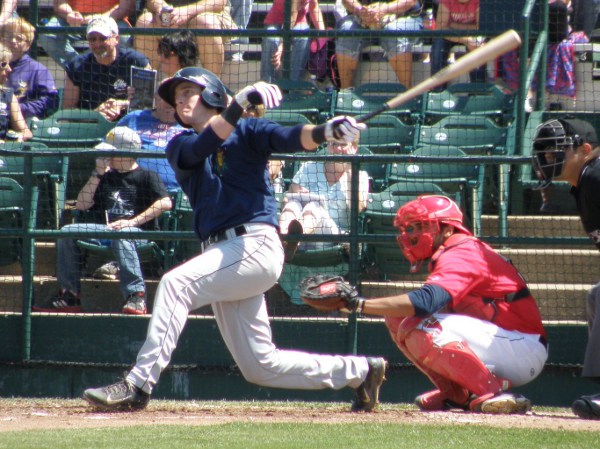 With Peoria, Wisconsin and Quad Cities all assembling winning records in the first half, it was logical to assume that those three teams would contend for the Western Division’s two second-half playoff spots – and they have been doing just that. Entering Wednesday, Peoria and Quad Cities were tied for second place in the Division’s second-half standings, trailing Kane County by just one game, and Wisconsin is two games back. Clinton and Beloit have repeated their first-half fortunes, each at least 11 games under .500 and filling the final two spots in the standings, as they did in the first half. And then there’s the Cedar Rapids Kernels. Rather stealthily, manager Jake Mauer’s Kernels have turned around what, as recently as three weeks ago, looked likely to become a lost season. http://knuckleballsblog.com/blog/wp-content/uploads/2014/05/ArteagaMauer11.jpg - There weren’t a lot of reasons for Kernels pitching coach Ivan Arteaga and manager Jake Mauer to smile in the season’s first half, but that’s changing. The Kernels lost four of their first five series to begin the second-half schedule and had compiled just a 6-11 second-half record through July 6. They haven’t lost a series since. Cedar Rapids has taken six consecutive series, against six different clubs, while putting together a 15-5 record in that time and launching themselves in to a second place tie with Peoria and Quad Cities, just one game behind Division leader Kane County in the MWL’s Western Division standings. Since the Cougars and the Burlington Bees locked in their postseason spots in the first half, it doesn’t matter where they finish in the second-half standings so, from a practical standpoint, Cedar Rapids was tied entering Wednesday, with Quad Cities and Clinton, for the top available playoff spot, with Wisconsin trailing that group by one game. The Kernels will face those three rivals 12 times in August and nine of those games will be on Perfect Game Field at Veterans Memorial Stadium in Cedar Rapids, where the Kernels have accumulated an 11-5 home record in the season’s second half. How have the Kernels propelled themselves in to a four-team dogfight for playoff spots entering the final month of the regular season? And can they keep it up? The answer to the first question is pretty clear when you look at the numbers and there is no way to know the answer to the second. In the first three series of their current six series winning streak, Cedar Rapids essentially bludgeoned the opposition. In those ten games, they scored 6.7 runs per game. It’s a good thing, too, because their pitching was allowing 4.2 runs per game. The offense stepped up in those series, but since then, things have taken a pretty dramatic turn. In the nine games covering the last three series of this stretch, the results have come from pitching. While Kernels hitters were averaging just 3.9 runs per game, themselves, the pitching was giving up only two runs per game. http://knuckleballsblog.com/blog/wp-content/uploads/2014/05/Quesada2014d.jpg - Michael Quesada Digging deeper, it’s tough to find much in the offensive statistics that indicate a significant turnaround. About half the club’s current position players hit a bit better in July than they had been hitting and about half had fallen off a notch, perhaps. Catcher/DH Michael Quesada appears to have found his stroke and is hitting .270 in July, with a pair of home runs, after a dreadful June in which he managed just .150 with no extra-base hits. Fellow catcher (turned primary right fielder) Alex Swim is hitting .364 in July after posting a .267 mark in June. http://knuckleballsblog.com/blog/wp-content/uploads/2014/07/Swim2014g.jpg - Alex Swim But a number of their teammates, including Mitch Garver and Chad Christensen, who have been among the team’s offensive leaders all season, have seen some of their numbers fade slightly in July, too, so it’s hard to credit this turnaround strictly to the offense. Perhaps the most important contribution the offense has made has been its consistency. Before Tuesday’s game with the Burlington Bees, Mauer emphasized the importance of that consistency. “Knock on wood, we’ve had a steady core group,” Mauer said. “Obviously, (Jason) Kanzler was (promoted), but we’ve had that set core group for about four weeks. “Position player wise, we haven’t really changed much. It’s pretty much the same group of guys other than Swim and Wade playing a bigger part. Christensen, Garver, Haar, 3-4-5, have been that way since about May.” The pitching side of the ledger tells a slightly different story, however. As the Kernels’ manager observed, “The starting pitching’s been good, bullpen’s been outstanding.” Indeed. Of the ten pitchers currently on the Kernels roster who made appearances in June and July for Cedar Rapids, nine dropped his ERA in July, as compared to June. The tenth, reliever Dallas Gallant, couldn’t cut his. He had a 0.00 ERA in his three June appearances and has exactly the same 0.00 ERA through eight trips to the mound in July. Fellow bullpen arm Jake Reed also has a perfect 0.00 ERA in his six appearances in July after posting a 4.50 mark in June. Chris Mazza hasn’t been that perfect in relief. His July ERA is 0.69. It was 2.25 in June. Jared Wilson has slashed his ERA from 4.60 in June to 1.84 in July. Hudson Boyd did the same. He had a 10.00 in June and a 1.13 in July. (Boyd, however, was suspended on Tuesday for an unspecified period of time for violating team rules.) The sharpest drop, however, has to be Nick Burdi, the Twins’ second round draft pick in June of this year. How can you beat a drop from infinity to 2.25? Burdi made one infamous appearance upon joining the Kernels at the end of June in which he walked all four batters he faced and all four came around to score. In July, he has allowed just a pair of earned runs. He has also struck out 16 batters in his eight July innings, while walking just three. The rotation arms are getting in to the act, as well. Aaron Slegers, who leads the Kernels with 113.1 innings pitched this season, struggled in June to a 7.97 ERA in four starts. It sits at 1.96 through six starts in July. http://knuckleballsblog.com/blog/wp-content/uploads/2014/05/Slegers2014a-600x449.jpg - Aaron Slegers 18 year old Lewis Thorpe posted a 6.50 ERA in his four June starts, but he’s cut that to 3.51 in his six starts this month. Kohl Stewart, Minnesota’s top draft pick in 2013, had an ERA of 2.16 in June. That’s pretty good. In fact, it was better than Stewart posted in April or May. But he’s bettered that in July, posting at 1.32. Stewart, unfortunately, finds himself on the 7-day Disabled List at the moment, with a sore shoulder. His replacement in the rotation is Stephen Gonsalves, freshly arrived from the Twins’ Appalachian League affiliate in Elizabethton. Gonsalves has made just one appearance for the Kernels since arriving, but the lefty threw six shutout innings against Dayton on Sunday. Chih-Wei Hu, the 20 year old from Taiwan, wasn’t with the Kernels in June, but he’s posted a 1.50 ERA in four July starts for Cedar Rapids. Earned Run Average is not the only important pitching statistic. Arguably, it’s not even the most important, especially among relief pitchers. But when your entire pitching staff is slashing their ERA from one month to the next, that’s a sign that good things are happening for your team. The Kernels have put themselves in to contention for postseason play, but they’re going to need to overcome some challenges over the final month to earn one of those final MWL playoff spots. They may need Stewart to come back from his DL stint healthy and effective. They lost their center fielder, Jason Kanzler, who was contributing with his bat and his glove, to promotion this week. He has been replaced by Max Murphy, who was tearing up the Appy League to the tune of a .371 batting average and nine home runs. Murphy, however, got off to an inauspicious start, going 0-4 with three strikeouts and a walk in his Kernels debut on Tuesday. The Twins’ high-A affiliate in Fort Myers is already postseason-bound, having clinched a spot in the first half of their Florida State League season. There’s certainly no assurance the Twins won’t tab more Kernels for promotion to aide the Miracle’s own playoff preparations. In fact, with the way some of the players in Cedar Rapids are performing this month, you can probably count on it. However, right at this moment, the Kernels are in serious contention for the postseason and that’s not something many fans would have envisioned just three weeks ago.
-
In mid-June, after a brutal first half to their Midwest League season, the Cedar Rapids Kernels limped in to the MWL’s All-Star break with a 31-39 record, not only 14 games behind Western Division leader Kane County, but also 7.5 games behind the Burlington Bees. The latter is important because, in the world of Class A minor league baseball, seasons are split in to two halves, with the first and second place teams in each division, each half-season, earning berths in the postseason playoff series. Kane County and Burlington snatched the MWL West spots in the first half, leaving Cedar Rapids, Quad Cities, Clinton, Beloit, Peoria and Wisconsin to slug it out in the second half for two more spots, with each team starting with fresh 0-0 records on June 19. In mid-June, after a brutal first half to their Midwest League season, the Cedar Rapids Kernels limped in to the MWL’s All-Star break with a 31-39 record, not only 14 games behind Western Division leader Kane County, but also 7.5 games behind the Burlington Bees. The latter is important because, in the world of Class A minor league baseball, seasons are split in to two halves, with the first and second place teams in each division, each half-season, earning berths in the postseason playoff series. Kane County and Burlington snatched the MWL West spots in the first half, leaving Cedar Rapids, Quad Cities, Clinton, Beloit, Peoria and Wisconsin to slug it out in the second half for two more spots, with each team starting with fresh 0-0 records on June 19. With Peoria, Wisconsin and Quad Cities all assembling winning records in the first half, it was logical to assume that those three teams would contend for the Western Division’s two second-half playoff spots – and they have been doing just that. Entering Wednesday, Peoria and Quad Cities were tied for second place in the Division’s second-half standings, trailing Kane County by just one game, and Wisconsin is two games back. Clinton and Beloit have repeated their first-half fortunes, each at least 11 games under .500 and filling the final two spots in the standings, as they did in the first half. And then there’s the Cedar Rapids Kernels. Rather stealthily, manager Jake Mauer’s Kernels have turned around what, as recently as three weeks ago, looked likely to become a lost season. http://knuckleballsblog.com/blog/wp-content/uploads/2014/05/ArteagaMauer11.jpg - There weren’t a lot of reasons for Kernels pitching coach Ivan Arteaga and manager Jake Mauer to smile in the season’s first half, but that’s changing. The Kernels lost four of their first five series to begin the second-half schedule and had compiled just a 6-11 second-half record through July 6. They haven’t lost a series since. Cedar Rapids has taken six consecutive series, against six different clubs, while putting together a 15-5 record in that time and launching themselves in to a second place tie with Peoria and Quad Cities, just one game behind Division leader Kane County in the MWL’s Western Division standings. Since the Cougars and the Burlington Bees locked in their postseason spots in the first half, it doesn’t matter where they finish in the second-half standings so, from a practical standpoint, Cedar Rapids was tied entering Wednesday, with Quad Cities and Clinton, for the top available playoff spot, with Wisconsin trailing that group by one game. The Kernels will face those three rivals 12 times in August and nine of those games will be on Perfect Game Field at Veterans Memorial Stadium in Cedar Rapids, where the Kernels have accumulated an 11-5 home record in the season’s second half. How have the Kernels propelled themselves in to a four-team dogfight for playoff spots entering the final month of the regular season? And can they keep it up? The answer to the first question is pretty clear when you look at the numbers and there is no way to know the answer to the second. In the first three series of their current six series winning streak, Cedar Rapids essentially bludgeoned the opposition. In those ten games, they scored 6.7 runs per game. It’s a good thing, too, because their pitching was allowing 4.2 runs per game. The offense stepped up in those series, but since then, things have taken a pretty dramatic turn. In the nine games covering the last three series of this stretch, the results have come from pitching. While Kernels hitters were averaging just 3.9 runs per game, themselves, the pitching was giving up only two runs per game. http://knuckleballsblog.com/blog/wp-content/uploads/2014/05/Quesada2014d.jpg - Michael Quesada Digging deeper, it’s tough to find much in the offensive statistics that indicate a significant turnaround. About half the club’s current position players hit a bit better in July than they had been hitting and about half had fallen off a notch, perhaps. Catcher/DH Michael Quesada appears to have found his stroke and is hitting .270 in July, with a pair of home runs, after a dreadful June in which he managed just .150 with no extra-base hits. Fellow catcher (turned primary right fielder) Alex Swim is hitting .364 in July after posting a .267 mark in June. http://knuckleballsblog.com/blog/wp-content/uploads/2014/07/Swim2014g.jpg - Alex Swim But a number of their teammates, including Mitch Garver and Chad Christensen, who have been among the team’s offensive leaders all season, have seen some of their numbers fade slightly in July, too, so it’s hard to credit this turnaround strictly to the offense. Perhaps the most important contribution the offense has made has been its consistency. Before Tuesday’s game with the Burlington Bees, Mauer emphasized the importance of that consistency. “Knock on wood, we’ve had a steady core group,” Mauer said. “Obviously, (Jason) Kanzler was (promoted), but we’ve had that set core group for about four weeks. “Position player wise, we haven’t really changed much. It’s pretty much the same group of guys other than Swim and Wade playing a bigger part. Christensen, Garver, Haar, 3-4-5, have been that way since about May.” The pitching side of the ledger tells a slightly different story, however. As the Kernels’ manager observed, “The starting pitching’s been good, bullpen’s been outstanding.” Indeed. Of the ten pitchers currently on the Kernels roster who made appearances in June and July for Cedar Rapids, nine dropped his ERA in July, as compared to June. The tenth, reliever Dallas Gallant, couldn’t cut his. He had a 0.00 ERA in his three June appearances and has exactly the same 0.00 ERA through eight trips to the mound in July. Fellow bullpen arm Jake Reed also has a perfect 0.00 ERA in his six appearances in July after posting a 4.50 mark in June. Chris Mazza hasn’t been that perfect in relief. His July ERA is 0.69. It was 2.25 in June. Jared Wilson has slashed his ERA from 4.60 in June to 1.84 in July. Hudson Boyd did the same. He had a 10.00 in June and a 1.13 in July. (Boyd, however, was suspended on Tuesday for an unspecified period of time for violating team rules.) The sharpest drop, however, has to be Nick Burdi, the Twins’ second round draft pick in June of this year. How can you beat a drop from infinity to 2.25? Burdi made one infamous appearance upon joining the Kernels at the end of June in which he walked all four batters he faced and all four came around to score. In July, he has allowed just a pair of earned runs. He has also struck out 16 batters in his eight July innings, while walking just three. The rotation arms are getting in to the act, as well. Aaron Slegers, who leads the Kernels with 113.1 innings pitched this season, struggled in June to a 7.97 ERA in four starts. It sits at 1.96 through six starts in July. http://knuckleballsblog.com/blog/wp-content/uploads/2014/05/Slegers2014a-600x449.jpg - Aaron Slegers 18 year old Lewis Thorpe posted a 6.50 ERA in his four June starts, but he’s cut that to 3.51 in his six starts this month. Kohl Stewart, Minnesota’s top draft pick in 2013, had an ERA of 2.16 in June. That’s pretty good. In fact, it was better than Stewart posted in April or May. But he’s bettered that in July, posting at 1.32. Stewart, unfortunately, finds himself on the 7-day Disabled List at the moment, with a sore shoulder. His replacement in the rotation is Stephen Gonsalves, freshly arrived from the Twins’ Appalachian League affiliate in Elizabethton. Gonsalves has made just one appearance for the Kernels since arriving, but the lefty threw six shutout innings against Dayton on Sunday. Chih-Wei Hu, the 20 year old from Taiwan, wasn’t with the Kernels in June, but he’s posted a 1.50 ERA in four July starts for Cedar Rapids. Earned Run Average is not the only important pitching statistic. Arguably, it’s not even the most important, especially among relief pitchers. But when your entire pitching staff is slashing their ERA from one month to the next, that’s a sign that good things are happening for your team. The Kernels have put themselves in to contention for postseason play, but they’re going to need to overcome some challenges over the final month to earn one of those final MWL playoff spots. They may need Stewart to come back from his DL stint healthy and effective. They lost their center fielder, Jason Kanzler, who was contributing with his bat and his glove, to promotion this week. He has been replaced by Max Murphy, who was tearing up the Appy League to the tune of a .371 batting average and nine home runs. Murphy, however, got off to an inauspicious start, going 0-4 with three strikeouts and a walk in his Kernels debut on Tuesday. The Twins’ high-A affiliate in Fort Myers is already postseason-bound, having clinched a spot in the first half of their Florida State League season. There’s certainly no assurance the Twins won’t tab more Kernels for promotion to aide the Miracle’s own playoff preparations. In fact, with the way some of the players in Cedar Rapids are performing this month, you can probably count on it. However, right at this moment, the Kernels are in serious contention for the postseason and that’s not something many fans would have envisioned just three weeks ago. View full article
-
With Tuesday night's rainout in Wisconsin, the Kernels have five games under their belts. It's far too soon to draw any firm conclusions about this year's club, but those games were enough to make some first impressions. First of all, they've put up a 4-1 record, so that's a pretty good first impression, in itself. With the obvious “small sample size” warning label appropriately affixed, here are just a few more things that have stood out to me over the first five games of the season: 1) Byron Buxton can play baseball.[PRBREAK][/PRBREAK] In an attempt to somewhat temper the extremely high expectations placed on Buxton, fans have been reminded that this is the Georgia native’s first exposure to full-season professional baseball, as well as his first time playing ball in chilly Midwest April temperatures, so we shouldn’t be surprised if it takes Buxton a while to become acclimated to Midwest League play. So far, I think he's acclimating well. http://knuckleballsblog.com/blog/wp-content/uploads/2013/04/Buxton31.jpg Byron Buxton (Photo: Knuckleballsblog.com) Through the first five games of the season, Buxton is hitting an even .500, with a Midwest League-leading OPS of 1.515. His .950 slugging percentage was more than 100 points higher than anyone else in the MWL going in to Tuesday's games. He's hit two home runs, a triple and a double among his ten hits overall. The question that's already being posed almost daily is, "how long will Buxton stay in Cedar Rapids?” The Kernels management would obviously like to see him stick around all season and one of the selling points the Twins brass made to Cedar Rapids during their affiliation dance last fall was that they don't rush their prospects through their system. They cited Miguel Sano spending all of 2012 in Beloit as an example. But Sano had issues to work through last year, specifically on defense. Buxton doesn't have those issues. If he keeps hitting for average and power during the first half of the season, I won't be surprised to see him move up to Fort Myers some time near mid-season. 2) The six-man rotation. The Twins are trying to find out whether some of the power-arms they have drafted the past couple of years can be converted from bullpen roles to starting pitchers and manager Jake Mauer's six-man rotation allows them to look at more starting pitching candidates. In addition, it helps them limit the number of innings the pitchers put on their arms over the course of the season and, in particular, during the cooler days and nights of April in the Midwest. Mauer asked for and received a 13th pitcher from the Twins as a replacement for Drew Leachman, who went on the 7-day Disabled List with a bum shoulder. Of course, that could leave the Kernels manager a little short on position players on the bench, especially considering that the team carries three catchers. But Mauer pointed out Sunday that Tyler Grimes, who’s in his first season behind the plate, would be available to play the infield in an emergency. As for their performance through five games, the Kernels' pitching has been impressive. How impressive? Consider this: a week ago, the writing staff at MiLB.com published their picks for the top offensive line ups in each affiliated minor league in the country. Their pick for the top line up in the Midwest League was the Beloit Snappers, the team the Kernels hosted in their opening four-game series of the season. MiLB.com specifically mentioned Snappers Matt Olson, Renato Nunez, Bruce Maxwell and Aaron Shipman as demonstrating the ”remarkable depth” of the Snappers offense and concluding, “This potent collection of youth and talent give Beloit the lineup with the most upside top-to-bottom in the league.” Kernels pitchers held that foursome to a .183 batting average with 23 strike outs in that series. Overall, through five games, the Kernels staff was leading the MWL in team ERA (1.80) and WHIP (1.022), while striking out 50 hitters in 45 innings of work. All 13 pitchers have made at least one appearance in the first five games and seven of them... Tyler Duffey, Tyler Jones, Taylor Rogers, Steven Gruver, Matt Tomshaw, Brett Lee and Tim Atherton... survived those games with perfect 0.00 ERAs. Obviously, the pitching can't keep that level of performance up forever, but so far both the rotation and the bullpen have been outstanding. 3) Byron Buxton's not the only position player off to a good start. While Buxton gets most of the attention among the Kernels' position players, there were other impressive performances over the first five games. Dalton Hicks has started the season hitting .389 and getting on base at an even .500 clip. Add in his .722 slugging percentage and you get an impressive 1.222 OPS to start the season. Among his seven hits, he's belted out three doubles and a home run. J.D. Williams has also gotten off to a fast start, putting together a slash line of .385/.526/.462 for a .988 OPS. He's shown good plate discipline out of the #9 spot in the order, accumulating five walks against just a pair of strikeouts. In total, going in to Tuesday night, Cedar Rapids led the league in slugging (.450) and OPS (.797). Kernels hitters struck out 30 times in the first five games, the fewest in the league. There's at least one more Kernels player that I think warrants a mention. Coming in to the season, the perception of third baseman Travis Harrison was that he was another infield "project," along the lines of Miguel Sano a year ago. I'm no expert on all of the ins and outs of playing third base, but I saw Sano in an early-season series a year ago and I've now seen Harrison play three games at the position. For my money, Harrison is well ahead of where Sano was defensively a year ago. Harrison not only wants to get better, he wants to be good at the position, and he's putting in the work to make that happen. 4) The no-hitter. I’d never seen a no-hitter at the professional level before Sunday. The closest I’d come was being present at the Metrodome a few years back when the Royals' Mike Sweeney broke up Twins pitcher Scott Baker’s perfect game in the ninth inning. Thanks to Tyler Duffey and friends, I can check “see a no-hitter” off my Bucket List. http://knuckleballsblog.com/blog/wp-content/uploads/2013/04/Duffey2-441x600.jpg Tyler Duffey (Photo: Knuckleballsblog.com) Duffey was remarkable through his seven innings of perfect work. Between he and his catcher, Jairo Rodriguez, they had the Snappers off balance through most of those innings. That said, he got some pretty impressive defensive help behind him, as well. Just off the top of my head, I can recall outstanding plays by Harrison at third base, Williams in left field, Niko Goodrum at shortstop and Hicks at first base. I’m sure there were others, as well. It was tough for Mauer and pitching coach Gary Lucas to pull Duffey from a perfect game, but it’s April and this is Iowa and there’s no way they, or the Twins brass, would allow Duffey to go much beyond his allotted 75 pitch limit… nor should they. You can’t fault Josue Montanez, who arrived in Cedar Rapids the night before as the replacement for Leachman, if he was a bit nervous coming in to relieve Duffey in the eighth inning. He walked three and coughed up the shutout on a sacrifice fly, but he kept the no-hitter intact. Tim Atherton walked one hitter in the ninth inning, but struck out the other three batters he faced to put a pretty emphatic exclamation point on the no-hitter. SD Buhr covers the Kernels for MetroSportsReport.comin Cedar Rapids. His alter-ego, "Jim Crikket," is a co-founder of Knuckleballsblog.com. Click here to view the article
-
Hall of Famer Paul Molitor was in Cedar Rapids over the course of most of the past homestand in his capacity as roving minor league instructor with the Twins organization. He was also gracious enough to answer some questions last Thursday, the first day of his stay in Cedar Rapids, as well as a few follow-up questions Monday afternoon after the final game of the Kernels’ homestand. I used several excerpts from the Thursday interview in an article posted at MetroSportsReport.com last week, but there was so much good material that I couldn't fit it all in that article. So, I'm sharing all of Molitor's comments here. [PRBREAK][/PRBREAK] First off, I asked Molitor to describe his formal role these days with the Twins organization. Molitor: Titles are overrated a little bit. Technically, part of the player development team. I’m the Minor League Coordinator for Baserunning and Infield Play. It’s an opportunity for me to travel around the system and help try to teach, along with the staff on each club and I do focus on those two areas but invariably get involved with some of the hitting aspects. Our hitting coordinator for minor leagues does an incredible job, considering you have to try to put a hit plan together for about 200 guys. One of the things I enjoy, in addition to the teaching is that a lot of these guys are transitioning from wherever their roots have brought them from and it’s a process of evolving from sometimes teenagers in to men and so there’s mentoring involved, too. Just how to help these guys develop an understanding of the professional life style. We try to do what we can to try to help them progress in those areas, too. http://knuckleballsblog.com/blog/wp-content/uploads/2013/06/Molitor9.jpg Paul Molitor (4) observing Kernels C Jhonatan Arias (23) take batting practice I mentioned that a lot is made about players having to transition to using wood bats and asked Molitor if he thought that was toughest thing about transitioning to the professional game for young players. Molitor: Some of the collegiate kids have had a chance to play in wood bat leagues in the summer time. A lot of times it’s a big transition just from maybe never having left home, particularly maybe never left your country and you have to try to claw your way in to professional ball and learn a system that particular organization teaches. We don’t try to overwhelm them. We let them play a little bit in the beginning til we kind of get a feel for who they are and what they do, what they do well and what we need to improve on. But the transition can be tough, depending on the guy’s experience. The college guys are usually better at understanding how to carry themselves and how to go about their business day to day. Another change is that very few of these kids have played in seasons where there’s 140 games so it’s understanding how to maintain and prepare yourself to withstand the rigors of a professional season. I asked if playing baseball in the upper midwest in April was difficult for players entering their first season of “full season” professional baseball. Molitor: The guys from warm climates, whether its Florida, California, Texas or the Dominican or Puerto Rico, you throw them up here in April and it’s not only a culture shock, but the weather is something they really never had to play in those type of conditions. So that’s a process. We see a lot of guys that haven’t had that experience start a little bit slower, just adapting to the weather itself. I jokingly pointed out that Byron Buxton is a southern guy that didn’t seem to take long to adjust. Molitor: He’s just a rare individual with a skill set that’s off the charts. I saw him last year in instructional ball for a little bit and you could see the rawness of a high school kid, but somehow this winter I think he put a lot of time in to conditioning and preparation. He was much more advanced this spring than I expected him to be and he’s been able to carry it undoubtedly in to the first 9-10 weeks of the season. You know, he’s got things to work on I’m sure. I’m looking forward to seeing him now compared to even two months ago. Over the next five days. I’ll be watching particularly how he handles himself on the basepaths. On a professional grading scale of 2-8, he’s an 8 runner and I haven’t for the past three decades seen many players that can compete with him in terms of just raw speed. Now how he can translate that in to base stealing is going to be the key. Obviously, this year he’s had over 30 attempts. He’s been caught some, but he’s been fairly successful for a young guy and probably in some ways, in this league, he’s been outrunning the ball. There’s two parts of base stealing: The mechanical, finding the best way to get your body to accelerate from a standstill position; and then there’s the mental side of understanding how they’re trying to slow you down and picking good pitches, good counts, reading pitchers pick-off moves, all those type of things. A lot of times, when you get caught is when you should learn the most. Whether you didn’t get a good jump or you ran on a pitch out or you didn’t anticipate the guy going home or you were tentative. There’s a lot of ways to learn to get better. So it’s a process. The more you do it, the better you get at it. We’re glad to see he’s out running. At least not having fear in athat area to this point. http://knuckleballsblog.com/blog/wp-content/uploads/2013/06/Molitor4.jpg Paul Molitor hitting ground balls to Kernels 3B Travis Harrison I asked Molitor for his thoughts on Kernels third baseman Travis Harrison, who is still somewhat learning the position. Molitor: Ive been around him some, mostly spring traning and instructional ball. I’m sure there’s some adaption for him going on. He has relatively good hands. I think his footwork is something that needs to be improved. Being so close in proximity to home plate, you don’t have a lot of time to react to get your body in position to catch the ball. The better he can get control of his feet and be in the right spot, his hands are going to be OK. Throwing, he’s had some issues at times with consistency. He’s a little bit mechanical, but I think he’s learning that if he doesn’t try to guide the ball and throws it, he’s better off. So those are areas where we expect young kids to make errors and just like the baserunning, when you make mistakes, you figure out why and hopefully you can make adjustments. I asked for Molitor's thoughts concerning the defensive progress at third base of Harrison, as compared to Miguel Sano (this was a couple of days prior to Sano’s promotion to AA). Molitor: I think that’s a fair question. We’re all hoping that Sano, who’s a little farther along in the organization and in growth, in terms of getting close to the Major Leagues. Not unexpectedly, he made a ton of errors last year, his first year of being a third baseman in a full season and it was a plethora of mistakes. It was misreading balls, it was rushing balls, it was throwing balls he shouldn’t have thrown. Trying to force an out when it wasn’t there. But having seen him twice already this year, he’s made maybe a dozen errors so far and a lot of them are similar things. But he’s been very diligent and asking for extra work and trying to correct mistakes. I’m hoping his future is as a third baseman. Travis, it’s a little bit early to see how it pans out. A lot of times, you can play three or four years in the minor leagues and then you get to the Big Leagues and there’s no room in that position and all of a sudden you’ve got to maybe transition. So you kind of hope that you get these guys a little bit more well-rounded. As far as their strength position, you want to try to see them develop that the most. After the game on Monday, a Kernels win that was broadcast back to the Twin Cities on Fox Sports North, I asked Molitor about his impressions after having spent five days with the Kernels in Cedar Rapids. Molitor: Well it was good to see them bounce back after three tough losses. I feel like we got some things accomplished with some of the infielders defensively. It was good to see (Candido) Pimentel back out there today. He had a better day. He still had one play where he got a little anxious about turning his back to the runner and he didn’t keep his eye on the ball and that’s kind of one of the things he’s got to work on is just catching the ball and understanding the speed of the baserunners on the play. And then with baserunning, we had some guys out working on their jumps today and they’ve been aggressive trying to steal, so I’m pleased with that. But yeah, I had a lot of fun seeing these guys and kind of seeing where they’re at at this point in the season and hopefully I’ll get a chance to get back and see them again. Since Molitor had indicated he would be working with Byron Buxton on his base stealing, I asked if we should blame him for Buxton being picked off first base during Monday’s game (yes, I was kidding). Molitor: You can blame me for that if you want. The (pitcher) did a nice job of holding the ball. I think he kind of built a little tension. The longer the guy holds it, you really have to concentrate on staying relaxed and he might have given him a little bit of a balk move, but that’s, again, learning time. A hitter can help your baserunner out when he’s holding the ball. Call a time out, things like that. But that’s how you learn. I asked for Molitor’s impression of Jorge Polanco, specifically whether he thinks Polanco can stick at shortstop. Molitor: You know, I’ve seen him a fair amount and his arm’s probably competent at short but I still think he probably profiles a little better at second base in the long run. Working on his footwork a little bit. He can get a little false step on his breaks to the ball and it seems like balls you think he might have a chance to get he comes up a little bit short. So we’ll try to improve his range a little bit and give him a chance. At 19, it’s certainly too early to close the book on any one position. Offensively, he’s just getting a little bit stronger and he’s got nice loose hands at the plate and being a switch hitter is generally to his advantage. But I keep trying to keep them versatile in the middle of the field and hopefully one of the positions will pan out. But I have a feeling probably second base in the long run. Since we had discussed third baseman Travis Harrison earlier, I asked if he had any final impressions of Harrison. Molitor: He’s got a great attitude about work ethic and he wants to get better. I think the main thing for him is going to continue to work on his footwork so his range is competent to stay over there, too. But his throwing’s improved. He’s a lot more accurate. I think he’s comfortable over there. He’s still feeling for positioning a little bit. Sometimes I catch him maybe not quite in the right spot. There’s a reason you are where you are on every pitch and I think he’s learning that and trying to take some pride in it. It was a pleasure to talk a little baseball with Paul Molitor and I appreciate him taking the time to answer questions. I think the thought he put in to his comments clearly demonstrates just how seriously he takes his work with the Twins’ young players and how much he enjoys doing what he’s doing. Click here to view the article
-
Twins Minor League Report (7/29): Berrios Injured
Steven Buhr replied to John Bonnes's topic in Twins Daily Front Page News
Slegers has a 1.96 ERA in 6 July starts. 31/5 K/BB ratio in 36.2 IP for the month and a .224 BAA. If they need a SP in Fort Myers, I can't imagine them promoting anyone else. -
Twins Minor League Report (7/29): Berrios Injured
Steven Buhr replied to John Bonnes's topic in Twins Daily Front Page News
The Kernels only have one more scheduled off day during the regular season. I suspect they may go back to a 6-man rotation when Stewart comes off the DL. That said, I don't expect Jorge to return to CR this season unless there's an opening caused by promotion/injury to someone currently with the Kernels. Doubt Ryan Eades will be dropped from the rotation during the regular season. His last couple starts have not been too bad and they'll want to give him every opportunity to finish the seaon on a positive note. He's also nowhere near any kind of innings limit for a pitcher in his first full season out of college. -
I've never been someone that pays an enormous amount of attention to the MLB First-Year Player Draft. Most years, I would glance at a few writers focusing on who the Twins might draft in the first round, but the draft itself held little interest for me. I suppose, like many people, it seemed that it was going to be several years before I would ever see any of the young players drafted in a given year put on a Twins uniform. There was little point in spending much of my time on the draft. I'm coming around, though, and, yes, it has a lot to do with the Twins now being affiliated with my local minor league team, the Cedar Rapids Kernels.http://knuckleballsblog.com/blog/wp-content/uploads/2013/04/Buxton31.jpg [PRBREAK][/PRBREAK] Byron Buxton in photo During their last several years as an Angels affiliate, it seemed to me that the parent organization seldom sent many of their top prospects to Cedar Rapids right away (if at all). That may be unfair, I don't know. I honestly never looked up whether my perception of things was backed up by facts. But I do know this: With less than two weeks left before the end of the first half of the season, players drafted by the Twins in 2012 have played critical roles in putting the Kernels atop the Midwest League Western Division. How critical? I'm glad you asked. The newest Kernel, infielder Joel Licon, who joined the team from extended spring training just this week, is the ninth player drafted last summer to suit up for the Kernels this season. While Kernels fans haven't had a chance to get to know Licon yet, the other eight members of the 2012 draft class have made significant impacts. Consider these bats: Byron Buxton (1st round)): .333/.435/.545 (.980) 11 2Bs, 5 3Bs, 7 HRs Adam Brett Walker (3rd): .270/.321/.530 (.851) 12 2Bs, 5 3Bs, 10 HRs Dalton Hicks (17th): .299/.376/.485 (.861) 17 2Bs, 7 HRs I'm not sure where the Kernels would be without these bats this season, but they'd have been a lot less fun to watch. But if that's impressive, check out these pitchers: Jose Berrios (Supp 1st round): 4-2, 39 IP, 2.54 ERA, 44 Ks, 1.28 WHIP Mason Melotakis (2nd): 5-2, 51.1 IP, 3.68 ERA, 42 Ks, 1.52 WHIP Tyler Duffey (5th): 3-2, 58.1 IP, 2.78 ERA, 47 Ks, 0.94 WHIP Taylor Rogers (11th): 0-1, 10 IP, 7.20 ERA, 10 Ks, 1.80 WHIP Alex Muren (12th): 3-0, 15.2 IP, 2.87 ERA, 10 Ks, 1.21 WHIP Clearly, anyone who wants a sneak peek at who is likely to be playing big roles for the 2014 Cedar Rapids Kernels should pay close attention to both who the Twins pick with the 4th overall choice and any college age players drafted in the following 15 rounds or so. http://knuckleballsblog.com/blog/wp-content/uploads/2013/04/Berrios2.jpg Jose Berrios Of the nine players listed above, only first round picks Buxton and Berrios were selected following their senior seasons of high school baseball. The others all had at least some college experience prior to being selected and signed by the Twins. The Twins’ brass have their work cut out for themselves: to replace that level of productivity from the draft class of 2012 with that from this year's draft class. Of course, most players drafted this week won’t wear a Kernels uniform next year. More will likely arrive in Cedar Rapids the following year during the 2015 campaign. Eleven of this year’s Kernels were selected by the Twins in the 2011 draft. That list includes third baseman Travis Harrison, catcher Tyler Grimes and eight pitchers who have toed the rubber this season as members of the Kernels pitching staff. All together, 20 of the 32 players who have appeared in a Kernels uniform this season were drafted by the Twins in the past two years and several more could still arrive in Cedar Rapids this summer as promotions and injuries create roster openings. Of course, Kernels fans may not have to wait until 2014 to get a look at some of this year’s draft talent. Under the terms of the current Collective Bargaining Agreement, players with college eligibility remaining must be signed by July 15. That's much earlier than under the agreement in place before last year, which makes protracted contract negotiations almost impossible. As a result, some of the players selected in this week’s draft may be assigned to Cedar Rapids before the end of this season. Last year, the Twins sent a handful of pitchers from their 2012 draft class to their Midwest League affiliate, the Beloit Snappers, to help the Snappers during their playoff run. The first and second rounds of the 2013 MLB Amateur Draft will be broadcast on the MLB Network and streamed live on MLB.com Thursday evening, beginning at 6:00 CT. Rounds 3-10 will be streamed on MLB.com beginning Friday afternoon and rounds 11-40 will be streamed on MLB.com beginning Saturday afternoon. Editor's note: You can also follow @TwinsDaily on Twitter to get updates on the key picks the Twins make this week. SD Buhr covers the Kernels for MetroSportsReport.com in Cedar Rapids. Photos: SD Buhr/Knuckleballsblog.com Click here to view the article
-
There was no rain in Fort Myers on Wednesday. That’s the good news. The bad news is that it was pretty breezy and high temperatures for the day barely, if at all, reached 70 degrees. I know that sounds good to a lot of people, but I had to wear long sleeves much of the day at the ballpark and was a bit chilly eating dinner outdoors tonight! But I toughed it out, because I know my readers expect me to do whatever it takes to get the story. Today, that story comes from the minor league side of the Twins organization. Rather than watch the Twins and Pirates at Hammond Stadium, I fought the Daniels Parkway traffic toward the Red Sox complex to watch the Twins’ Class A groups take on their Sox counterparts. After the game, Kernels manager Jake Mauer shared some thoughts about the way his club is shaping up as they enter the final few days of camp. Mauer indicated that just a handful of roster spots are still unresolved. One player still “on the bubble” with the Kernels as final decisions are being made is Chad Christensen, who prepped at Cedar Rapids Washington High School before playing ball for the University of Nebraska. Christensen was drafted by the Twins last June and played last summer for the Twins’ Gulf Coast League rookie level affiliate in Fort Myers. http://knuckleballsblog.com/blog/wp-content/uploads/2014/03/P3260170-2-600x432.jpg Chad Christensen It sounds like the Kernels’ manager would like to bring Christensen to Cedar Rapids next week. “Chad’s been working real hard and he’s somebody that gives us some flexibility. He’s played both (corner) outfield positions and both corner infield positions and I wouldn’t be afraid to put him at shortstop once in a while,” said Mauer. “We’ve got about six or seven guys we’ve got to make decisions on and he’s in that mix, but there’s no doubt that he’s somebody we’d like to take north with us.” Mauer knows his squad of Kernels is going to have to take a different approach than last year’s team, now that last year’s power hitters have moved up the organizational ladder. “We’re going to have to be real good at the small things right away,” the manager acknowledged. “We’re going to have to run the bases well. We’re going to have to be able to execute the small game, hit and runs, getting bunts down, doing things like that. Try to create runs that way.” According to Mauer, there should be five or six familiar faces for Kernels fans to welcome back to Cedar Rapids. Among the likely returnees are catchers Michael Quesada and Bo Altobelli. Said Mauer, “We plan on taking both those guys north, along with (Mitchell) Garver. We’re probably going to take three (catchers) to start, at least.” That means flexibility will be key among other position players because, according to the skipper, he expects the final roster to contain just 12 position players, allowing 13 roster spots for the pitching staff that will once again utilize a six-man starting rotation. It’s that pitching staff that many in the Twins organization, as well as their fans, are eager to see. “I think we’ll be starter-heavy. We should have some quality arms, starting-wise,” said Mauer. “We’ve got a lot of young, quality arms. It just depends on how many we decide to bring up with us.” In particular, there are a number of pitchers that will push their fastballs consistently to the middle-to-upper 90s on the speed gun. This group includes young Dominican pitchers Yorman Landa, who was hitting 96 mph in Wednesday’s game, and Randy Rosario. In addition, the Twins’ first round pick in 2013 (and fourth pick overall) Kohl Stewart is a hard throwing 19-year-old who is still on the Kernels roster as camp is drawing to a close. As Kernels fans know, however, the team’s success is not solely determined by the players that start the season with the club. Between injuries and promotions, it’s equally important to have talented players at the lower levels of the organization preparing to join the Kernels as the season develops. According to Mauer, there’s plenty of potential mid-season help available, as well. “You know we’ve got some young boys down there, too, (Lewis) Thorpe and (Stephen) Gonsalves. Kids that have some pretty good arms that we’ll probably see at some point throughout the year.” The Kernels will break camp on Monday. There will be a “Meet the Kernels” event open to the public at no charge on April 1 at Veterans Memorial Stadium in Cedar Rapids and Opening Day is Thursday, April 3, when the Kernels host the Clinton Lumber Kings. Click here to view the article
-
The Cedar Rapids Kernels have ripped through nine straight wins as they head in to a two week long road trip, but the streak hasn't come without a little drama. Take this past Saturday, for one instance. Most of you have probably already read or heard about the strange finish to that night's 8-7 Kernels win, but for those who haven't here are the basics of what you need to know: Adam Brett Walker hit a game-tying three-run home run with two out in the bottom of the ninth inning to send the game in to extra innings.[PRBREAK][/PRBREAK] In the bottom of the 11th inning, the Kernels loaded the bases and Manager Jake Mauer sent Travis Harrison to the plate to pinch hit. Harrison had been the only Kernels player to have started every game this season up and Mauer had told him earlier in the game that he wouldn't be used unless the game was on the line. If you’ll pardon the quality of the video from my phone, I’ll share what happened next: Niko Goodrum, the runner on third base, trotted in to score the winning run, the other two runners, Dalton Hicks and Walker apparently did not complete their advancing to home before peeling off and joining the celebration in the infield. It appears both eventually did make their way to home, ahead of Harrison. Whether Hicks and Walker crossed the plate in the correct order is certainly open to question. Great Lakes manager Razor Shines clearly is getting in the ear of the home plate umpire by the time Harrison crosses home plate. In the end, the umpires ruled that while Goodrum scored the winning run and everyone else successfully advanced at least one base, Harrison and the other two runners, at some point, abandoned their efforts to advance . The result is that Harrison was credited with a walk-off RBI single, not a grand slam HR, and the Kernels won 8-7, rather than the 11-7 score that a two thousand fans thought it was when they left the ballpark. The odd finish didn't seem to bother the Kernels much as they went on to sweep a three game series with Lansing on Sunday, Monday and Tuesday, extending their winning streak to nine games. If the Kernels start their road trip with another W, they'll earn a dinner in the nearby Amana Colonies, compliments of the Kernels Board of Directors. Even if they earn the dinner, they'll have to wait a while to collect, however, since their next home game isn't until May14. Click here to view the article
-
I haven't figured out yet how to embed a video in a forum post using the new TD format, so I'm just posting a link to YouTube, where I posted a video of Lewis Thorpe's 3rd inning last night vs Burlington, for anyone interested in seeing Thorpe in action. He had 2 Ks in the inning and, as a bonus, you'll see Michael Quesada throw a strike to second base to nail a runner trying to steal. https://www.youtube.com/watch?v=w5h8qHbhwBU&feature=player_detailpage
-
Kernels In A Dogfight For Mwl Postseason Spot
Steven Buhr posted a blog entry in SD Buhr/Jim Crikket
In mid-June, after a brutal first half to their Midwest League season, the Cedar Rapids Kernels limped in to the MWL’s All-Star break with a 31-39 record, not only 14 games behind Western Division leader Kane County, but also 7.5 games behind the Burlington Bees. The latter is important because, in the world of Class A minor league baseball, seasons are split in to two halves, with the first and second place teams in each division, each half-season, earning berths in the postseason playoff series. Kane County and Burlington snatched the MWL West spots in the first half, leaving Cedar Rapids, Quad Cities, Clinton, Beloit, Peoria and Wisconsin to slug it out in the second half for two more spots, with each team starting with fresh 0-0 records on June 19. With Peoria, Wisconsin and Quad Cities all assembling winning records in the first half, it was logical to assume that those three teams would contend for the Western Division’s two second-half playoff spots – and they have been doing just that. Entering Wednesday, Peoria and Quad Cities were tied for second place in the Division’s second-half standings, trailing Kane County by just one game, and Wisconsin is two games back. Clinton and Beloit have repeated their first-half fortunes, each at least 11 games under .500 and filling the final two spots in the standings, as they did in the first half. And then there’s the Cedar Rapids Kernels. Rather stealthily, manager Jake Mauer’s Kernels have turned around what, as recently as three weeks ago, looked likely to become a lost season. http://knuckleballsblog.com/blog/wp-content/uploads/2014/05/ArteagaMauer11.jpg - There weren’t a lot of reasons for Kernels pitching coach Ivan Arteaga and manager Jake Mauer to smile in the season’s first half, but that’s changing. The Kernels lost four of their first five series to begin the second-half schedule and had compiled just a 6-11 second-half record through July 6. They haven’t lost a series since. Cedar Rapids has taken six consecutive series, against six different clubs, while putting together a 15-5 record in that time and launching themselves in to a second place tie with Peoria and Quad Cities, just one game behind Division leader Kane County in the MWL’s Western Division standings. Since the Cougars and the Burlington Bees locked in their postseason spots in the first half, it doesn’t matter where they finish in the second-half standings so, from a practical standpoint, Cedar Rapids was tied entering Wednesday, with Quad Cities and Clinton, for the top available playoff spot, with Wisconsin trailing that group by one game. The Kernels will face those three rivals 12 times in August and nine of those games will be on Perfect Game Field at Veterans Memorial Stadium in Cedar Rapids, where the Kernels have accumulated an 11-5 home record in the season’s second half. How have the Kernels propelled themselves in to a four-team dogfight for playoff spots entering the final month of the regular season? And can they keep it up? The answer to the first question is pretty clear when you look at the numbers and there is no way to know the answer to the second. In the first three series of their current six series winning streak, Cedar Rapids essentially bludgeoned the opposition. In those ten games, they scored 6.7 runs per game. It’s a good thing, too, because their pitching was allowing 4.2 runs per game. The offense stepped up in those series, but since then, things have taken a pretty dramatic turn. In the nine games covering the last three series of this stretch, the results have come from pitching. While Kernels hitters were averaging just 3.9 runs per game, themselves, the pitching was giving up only two runs per game. http://knuckleballsblog.com/blog/wp-content/uploads/2014/05/Quesada2014d.jpg - Michael Quesada Digging deeper, it’s tough to find much in the offensive statistics that indicate a significant turnaround. About half the club’s current position players hit a bit better in July than they had been hitting and about half had fallen off a notch, perhaps. Catcher/DH Michael Quesada appears to have found his stroke and is hitting .270 in July, with a pair of home runs, after a dreadful June in which he managed just .150 with no extra-base hits. Fellow catcher (turned primary right fielder) Alex Swim is hitting .364 in July after posting a .267 mark in June. http://knuckleballsblog.com/blog/wp-content/uploads/2014/07/Swim2014g.jpg - Alex Swim But a number of their teammates, including Mitch Garver and Chad Christensen, who have been among the team’s offensive leaders all season, have seen some of their numbers fade slightly in July, too, so it’s hard to credit this turnaround strictly to the offense. Perhaps the most important contribution the offense has made has been its consistency. Before Tuesday’s game with the Burlington Bees, Mauer emphasized the importance of that consistency. “Knock on wood, we’ve had a steady core group,” Mauer said. “Obviously, (Jason) Kanzler was (promoted), but we’ve had that set core group for about four weeks. “Position player wise, we haven’t really changed much. It’s pretty much the same group of guys other than Swim and Wade playing a bigger part. Christensen, Garver, Haar, 3-4-5, have been that way since about May.” The pitching side of the ledger tells a slightly different story, however. As the Kernels’ manager observed, “The starting pitching’s been good, bullpen’s been outstanding.” Indeed. Of the ten pitchers currently on the Kernels roster who made appearances in June and July for Cedar Rapids, nine dropped his ERA in July, as compared to June. The tenth, reliever Dallas Gallant, couldn’t cut his. He had a 0.00 ERA in his three June appearances and has exactly the same 0.00 ERA through eight trips to the mound in July. Fellow bullpen arm Jake Reed also has a perfect 0.00 ERA in his six appearances in July after posting a 4.50 mark in June. Chris Mazza hasn’t been that perfect in relief. His July ERA is 0.69. It was 2.25 in June. Jared Wilson has slashed his ERA from 4.60 in June to 1.84 in July. Hudson Boyd did the same. He had a 10.00 in June and a 1.13 in July. (Boyd, however, was suspended on Tuesday for an unspecified period of time for violating team rules.) The sharpest drop, however, has to be Nick Burdi, the Twins’ second round draft pick in June of this year. How can you beat a drop from infinity to 2.25? Burdi made one infamous appearance upon joining the Kernels at the end of June in which he walked all four batters he faced and all four came around to score. In July, he has allowed just a pair of earned runs. He has also struck out 16 batters in his eight July innings, while walking just three. The rotation arms are getting in to the act, as well. Aaron Slegers, who leads the Kernels with 113.1 innings pitched this season, struggled in June to a 7.97 ERA in four starts. It sits at 1.96 through six starts in July. http://knuckleballsblog.com/blog/wp-content/uploads/2014/05/Slegers2014a-600x449.jpg - Aaron Slegers 18 year old Lewis Thorpe posted a 6.50 ERA in his four June starts, but he’s cut that to 3.51 in his six starts this month. Kohl Stewart, Minnesota’s top draft pick in 2013, had an ERA of 2.16 in June. That’s pretty good. In fact, it was better than Stewart posted in April or May. But he’s bettered that in July, posting at 1.32. Stewart, unfortunately, finds himself on the 7-day Disabled List at the moment, with a sore shoulder. His replacement in the rotation is Stephen Gonsalves, freshly arrived from the Twins’ Appalachian League affiliate in Elizabethton. Gonsalves has made just one appearance for the Kernels since arriving, but the lefty threw six shutout innings against Dayton on Sunday. Chih-Wei Hu, the 20 year old from Taiwan, wasn’t with the Kernels in June, but he’s posted a 1.50 ERA in four July starts for Cedar Rapids. Earned Run Average is not the only important pitching statistic. Arguably, it’s not even the most important, especially among relief pitchers. But when your entire pitching staff is slashing their ERA from one month to the next, that’s a sign that good things are happening for your team. The Kernels have put themselves in to contention for postseason play, but they’re going to need to overcome some challenges over the final month to earn one of those final MWL playoff spots. They may need Stewart to come back from his DL stint healthy and effective. They lost their center fielder, Jason Kanzler, who was contributing with his bat and his glove, to promotion this week. He has been replaced by Max Murphy, who was tearing up the Appy League to the tune of a .371 batting average and nine home runs. Murphy, however, got off to an inauspicious start, going 0-4 with three strikeouts and a walk in his Kernels debut on Tuesday. The Twins’ high-A affiliate in Fort Myers is already postseason-bound, having clinched a spot in the first half of their Florida State League season. There’s certainly no assurance the Twins won’t tab more Kernels for promotion to aide the Miracle’s own playoff preparations. In fact, with the way some of the players in Cedar Rapids are performing this month, you can probably count on it. However, right at this moment, the Kernels are in serious contention for the postseason and that’s not something many fans would have envisioned just three weeks ago. -
Cedar Rapids Kernels outfielder JaDamion (J.D.) Williams is in his fourth season with the Minnesota Twins organization. He was drafted by the Twins in the 10th round of the 2010 amateur draft. After a very productive 2011 season at Rookie League level Elizabethton, where he hit .324, Williams hit only .237 for the Beloit Snappers a year ago and accumulated an on-base percentage of .311. In his second year in the Midwest League, Williams is off to a much better start for the Kernels. [/hr] Hitting out of the ninth spot in Manager Jake Mauer's batting order, Williams spent most of the first three weeks of the season with a batting average approaching .300. Perhaps more impressively, he was reaching base at about a .450 rate. He's also hit four doubles and three home runs, leading to a slugging percentage sufficient to put his OPS (on-base percentage plus slugging percentage) near the 1.000 mark. Those numbers are almost certainly not sustainable, but they reflect a new, more aggressive approach to hitting this season. Williams sat down for an interview over the weekend to discuss his first few weeks in Cedar Rapids and his role, thus far, with the Kernels. SD Buhr: This is your second season in the Midwest League. Is there anything specifically different about how you feel going in to this year as opposed to starting last year in Beloit? J.D. Williams: Just the fact that I’ve had a year here in this league and I’ve learned a lot more. I'm more of a mature player, mature as a hitter and fielder. Learning from different guys. Our hitting coach Tommy Watkins; this is my second year working with him. Guys such as (Twins minor league hitting coordinator) Bill Springman, those guys just teaching me not necessarily the athletic side of the game but baseball mentality. Just learning to be a baseball player, not just running around. SDB: Was it disappointing to find out you were going to be coming back to the Midwest League or was that something you were pretty much prepared for happening this year? JDW: I wasn’t sure what was going to happen, but like they say, as long as you got a jersey on, somebody likes you. I didn’t do what I wanted to do here (in the Midwest League) last year, so it doesn’t bother me that I’m back. I’m playing a lot better this year, so it is what it is. http://knuckleballsblog.com/blog/wp-content/uploads/2013/04/Williams11.jpg SDB: Did the Twins give you anything specific to work on? Did they say, “this is what we really want you to work on going in to the season. That’s what you're going to have to do to advance.”? JDW: Basically, they wanted me to cut down on my strikeouts and put the ball in play a lot more because I can run but you can't steal first base, like they say. So, I think I’m doing a lot better at that this year. I’m walking a lot more, not just going up there swinging at every pitch I see, as opposed to like I was doing last year. http://knuckleballsblog.com/blog/wp-content/uploads/2013/04/WilliamsBuxton.jpg JD Williams watches Byron Buxton as he waits his turn for batting practice SDB: They probably don’t exactly encourage you to run a lot with Byron Buxton coming up behind you, though. JDW: (Laughs) He talks to me a lot. He tells me he’s going to give me a few pitches to run. We’ve got our little sign for when I’m gonna run and whatnot. So we work on that a lot, try to get each other a couple of bases. SDB: Growing up, did you have a favorite player, someone you wanted to be like? JDW: Growing up I liked to watch Brandon Phillips. That was back when I was an infielder and I’m an outfielder now. Of course, I like Denard Span, Michael Bourne, Juan Pierre, those guys that can run, get on base, steal a couple of bases. I want to be just like those guys. SDB: Is there anything about coming to Cedar Rapids that you've found different than what you expected it to be? JDW: Yeah, I love the atmosphere here, the stadium, the people. It’s a lot bigger than Beloit, obviously. Just a lot louder atmosphere. It’s fun playing here. Much more fun team this year, the guys, everything is different this year. SDB: You’re making a statement at the bottom of the order. There’s a cliché about the number nine guy being a second leadoff hitter, but that’s not just a cliché with the way you’re getting on base. JDW: That’s what Jake told me at the beginning of the season. He told me I was probably going to bat ninth and I told him that didn’t bother me at all. If Buxton’s doing a great job at the top of the order, I’ll score a bunch of runs batting in front of him so I’m not gonna argue with that at all. Basically, like I said, we’re just having fun, man. I enjoy hitting in the nine hole in front of those guys. SDB: Is there anything that Twins fans and Kernels fans don’t know about you that you’d like the fans to know about you? JDW: I’m not sure what they know about me yet (laughs), probably not a lot, yet. I’m going to try to change that in the future though, you know? Let these guys know who I am. Not many people know who I am. ~~~ Williams and his Kernels team mates are off to a very good start, leading the Midwest League's Western Division by two games over Quad Cities through the first 20 games of the year. If they keep it up, Kernels fans will be getting to know him much better. http://knuckleballsblog.com/blog/wp-content/uploads/2013/04/Williams2.jpg JD Williams with some pregame stretching Click here to view the article
