



Steven Buhr
-
Posts
1,682 -
Joined
-
Last visited
Content Type
Profiles
News
Minnesota Twins Videos
2026 Minnesota Twins Top Prospects Ranking
2022 Minnesota Twins Draft Picks
Minnesota Twins Free Agent & Trade Rumors, Notes, & Tidbits
Guides & Resources
2023 Minnesota Twins Draft Picks
The Minnesota Twins Players Project
2024 Minnesota Twins Draft Picks
2025 Minnesota Twins Draft Pick Tracker
2026 Minnesota Twins Draft Tracker: Picks & Bonuses
Forums
Blogs
Events
Store
Downloads
Gallery
Everything posted by Steven Buhr
-
Cedar Rapids Kernels pitcher Mason Melotakis and first baseman Dalton (DJ) Hicks are roommates this summer, sharing the same host family during their stay in Cedar Rapids. Both players played major roles as the team qualified for the Midwest League Playoffs by finishing second in the league’s Western Division during the first half of the season. Both could be candidates for promotion at some point this summer. Melotakis leads the Kernels pitching staff in wins with six and innings pitched with 64 2/3. Those six wins are good for fourth spot among Midwest League pitchers. The lefty has been perhaps the most consistently reliable member of the Kernels’ rotation in recent weeks. [PRBREAK][/PRBREAK] Hicks has been one of the biggest power hitting threats in the Midwest League. He leads the Midwest League with 63 RBI in 66 games played for the Kernels and is third in the League with 12 home runs (just one home run behind co-leaders Renato Nunez of Beloit and Rock Shoulders of Kane County). Hicks is one of eight Kernels named to the Midwest League's Western Division All-Star Team. Melotakis was drafted in the second round of the 2012 First-year Player Draft by the Twins out of Northwestern State University. Hicks was the Twins’ 17th round draft choice the same year out of the University of Central Florida. On the final Saturday before the end of the first half of their Midwest League season, Hicks and Melotakis both sat down for interviews and reflected on their seasons, so far. (The interviews were conducted separately, but since similar questions were asked of each player, we’ve combined their responses here.) SD Buhr: DJ, How do you feel the first couple of months in Cedar Rapids have gone for you personally? http://knuckleballsblog.com/blog/wp-content/uploads/2013/06/Hicks11-442x600.jpg Dalton (DJ) Hicks DJ Hicks: I feel good. You know, baseball is a tough game. You’re obviously going to have some ups and downs. The thing is, you’ve got to be the same person day in and day out and I think that’s the key to success is not to get too high or too low, just stay the same. SDB: Mason, you’re one of the pitchers the Twins organization is looking at converting to a starting pitching role after spending most of your time prior to this season working out of the bullpen. How do you think things have gone with that so far? Mason Melotakis: I think it’s going well. I mean every day is a new day and every outing is a new outing. Different stuff is working for me on that day. It’s a lot of learning how to pitch and how to adjust as the game goes on versus as a reliever, you’d better have your good stuff right then and there. As a starter, you can kind of turn it on later on. Early in the year, I struggled in the first inning or early in the game, then it seemed like I settled in. Now I’m adjusting to starting off strong and continuing strong. SDB: DJ, you profile as a first baseman/designated hitter. That’s a similar profile to a couple other guys in the organization ahead of you, such as Kennys Vargas, for example. Do you pay attention to what other guys at your position are doing? Hicks: No idea, because that’s something I can’t control. I can’t control what they do. I wish them the best, especially a guy like Vargas. He’s an awesome guy. I got to work with him in spring training, great guy. But that’s out of my hands. I can only control how I play. http://knuckleballsblog.com/blog/wp-content/uploads/2013/05/Melotakis4.jpg Mason Melotakis SDB: Mason, the ‘book’ on you coming in to the year was ‘hard throwing lefty, nice slider, needs work on the change up. Needs to develop his secondary pitches.’ Is that what you’ve been working on the past couple months? Melotakis: Absolutely. SDB: How do you feel that’s gone? Melotakis: I don’t think I’m ever going to stop working on that, honestly, because you can always get better and better. But we are completely doing it all over again. I’m throwing a new change up grip and a new slider grip. We’re going back to square one. It’s all about throwing strikes and keeping them (hitters) off balance. SDB: Are you doing that because what you were doing before wasn’t working or is it just a new idea, trying a couple of different things? Melotakis: It’s more of a better feel. When I was throwing my change up in a game, it seemed like I was not having a good feel for it. Same with the curve ball, I couldn’t really throw it for a strike. So, if you can’t throw whatever for a strike, then they’re not going to swing at it. So you’ve got to keep them off balance and be able to throw it for a strike. I really wasn’t throwing (the change up) for strikes or even close sometimes. As for my slider, this one I have a good feel for, so I’m going to throw it for a strike. You know, who knows? It could be two lethal weapons now versus just throwing them out there. SDB: DJ, I understand a couple of years ago, you had some health issues you had to fight through. A collapsed lung, I believe. What happened there? Hicks: I was in the Valley League the summer after my freshman year of college. I dove at first base. I think I hit the grass. I felt a little weird. The next at-bat I hit a double and was really out of breath, really fighting it. The next morning, I couldn’t breathe on my right side, waking up. I just couldn’t breathe. So we thought I cracked a rib or something. So I took maybe a week or two weeks off in the league. Then the playoffs started so I finished maybe a couple of games in playoffs. A month later, when I got to UCF, I felt a sharper pain again, so we saw a rib doctor, a specialist, and he said everything was fine. Then we saw just a regular doctor, they took an x-ray and they rushed me to the hospital. http://knuckleballsblog.com/blog/wp-content/uploads/2013/06/Hicks12.jpg Dalton (DJ) Hicks SDB: How much baseball time did you miss with that? Hicks: A lot. I was in the hospital for like 16 days. I had to have a couple of different operations because the first one didn’t work. They kind of told me I was done (with baseball) from the beginning. Then they kind of said maybe like eight months to a year and a half, pushing two years. I couldn’t do anything for the first three months, I couldn’t even hold a backpack. Nothing. But at five months, I thought I was good enough to play. I want to say I played a weekend series and by Sunday it was hard to breathe. It was just too much, so we kind of laid off. I took the rest of the year off. That was my red-shirt sophomore year. I played a little bit in that summer, but it was still bothering me. Then when I came back, it was just trying to run again and get in shape again. That was definitely the hardest part. Trying to condition with the team and just the warm-ups and I was done. SDB: Mason, the perception is that, in many cases, for someone that can throw a mid-90s fastball, the path to the Big Leagues might be a little quicker for a relief pitcher than a starter, while a starting pitcher’s career could be more lucrative. Did any of that go through your mind when the Twins told you they wanted to make a starting pitcher out of you? Melotakis: Absolutely. It’s a good career path to be a starter versus a reliever. Right now, we’re developing me in to a good pitcher, as in pitching and not just throwing. Having three pitches I can throw for strikes versus just having the two and just blowing by fastballs. My fastball’s there, it’s ready, but it’s the other stuff I need to work on. Making me a starter will give me more innings and I’ll also have a chance to work with adversity, adjustments, learning to throw strikes. It’s just all about development this year. Who knows what my path is? But right now I’m enjoying where I’m at. SDB: DJ, You’re on Twitter like a lot of the guys are. Are you active on Social Media sort of things? Do you go out and read what people write about you, about the team? Hicks: Not at all, to be honest with you. I’m on Twitter. I like Twitter. I like to keep tabs on all my friends, former teammates, guys that aren’t playing any more. I use it for that. Of course, you’re going to run in to stories and see your name and stuff like that, but I really do try to stay away from that stuff ‘cuz that stuff just gets in your head. SDB: Tell me a little about your interests and hobbies off the field. What do you like to do when you’re not playing baseball? Hicks: I like to hang out with the family. I’m a big family guy. I’m definitely missing my nephews, my niece. My niece actually just beat cancer at nine months old so that was definitely a struggle. Obviously, we’ve been cheering ever since we heard the news. She’s a tough little girl. But other than that, I like to play basketball. I’m a big basketball guy. SDB: Do they let you play basketball? Hicks: No, not any more. Now I stick to video game basketball (laughing). Any kind of little activities, any kind of games. I like doing stuff. I hate sleeping in. Mason gets mad at me all the time, ‘cuz I’m always waking him up. http://knuckleballsblog.com/blog/wp-content/uploads/2013/06/Melotakis1-433x600.jpg Mason Melotakis SDB: Mason, what do you like to do when you’re not on the pitcher’s mound? Melotakis: Honestly, I don’t really know, man. Whenever we have off days, we don’t do anything. We don’t know what to do with our lives (laughing). I work out, try to get better. I don’t really do video games, I’ve never golfed. I’m going to golf for the first time on Monday over the All-Star break. We might see how that goes. I’m not a big video game guy. I watch movies, I guess. I’m a big movie guy. SDB: What’s your favorite movie? Melotakis: My favorite movie’s got to be the Batmans. All the Batmans, even old Batmans. Those are the best, I grew up on that. SDB: Down the road, what do you think you’ll remember about playing in Cedar Rapids? Have there been particular highlights during your time here so far that you think will stand out? Melotakis: Honestly, just the guys. We’re all a pretty tight-knit team. Being in first place the majority of the year. I’m going to really remember that, just us winning more than anything. Just enjoying our time here. But when you’re winning, everything seems to be a lot better. Hicks: One, we have a great team. Obviously, when you win, that makes everything way better. When you’ve got guys like (Byron) Buxton bringing in crowds, just for him, that’s something special. You don’t see the kind of player he is every day. Guys like JD (Williams) , it’s been fun playing with him. He’s a different character. It’s a great town, great host family. I can’t complain about anything in Cedar Rapids at all. SD Buhr covers the Kernels for MetroSportsReport.com in Cedar Rapids. Click here to view the article
-
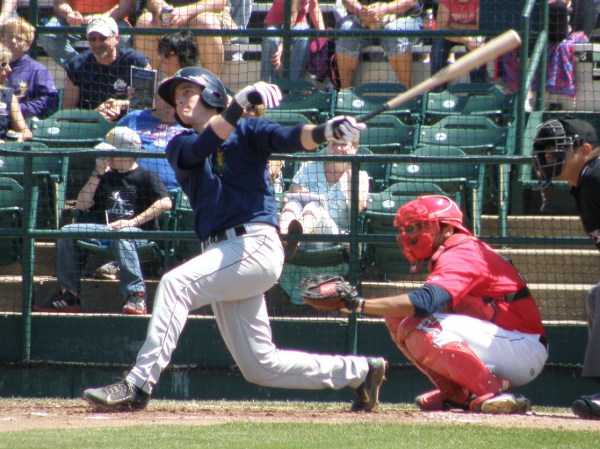 With Peoria, Wisconsin and Quad Cities all assembling winning records in the first half, it was logical to assume that those three teams would contend for the Western Division’s two second-half playoff spots – and they have been doing just that. Entering Wednesday, Peoria and Quad Cities were tied for second place in the Division’s second-half standings, trailing Kane County by just one game, and Wisconsin is two games back. Clinton and Beloit have repeated their first-half fortunes, each at least 11 games under .500 and filling the final two spots in the standings, as they did in the first half. And then there’s the Cedar Rapids Kernels. Rather stealthily, manager Jake Mauer’s Kernels have turned around what, as recently as three weeks ago, looked likely to become a lost season. http://knuckleballsblog.com/blog/wp-content/uploads/2014/05/ArteagaMauer11.jpg - There weren’t a lot of reasons for Kernels pitching coach Ivan Arteaga and manager Jake Mauer to smile in the season’s first half, but that’s changing. The Kernels lost four of their first five series to begin the second-half schedule and had compiled just a 6-11 second-half record through July 6. They haven’t lost a series since. Cedar Rapids has taken six consecutive series, against six different clubs, while putting together a 15-5 record in that time and launching themselves in to a second place tie with Peoria and Quad Cities, just one game behind Division leader Kane County in the MWL’s Western Division standings. Since the Cougars and the Burlington Bees locked in their postseason spots in the first half, it doesn’t matter where they finish in the second-half standings so, from a practical standpoint, Cedar Rapids was tied entering Wednesday, with Quad Cities and Clinton, for the top available playoff spot, with Wisconsin trailing that group by one game. The Kernels will face those three rivals 12 times in August and nine of those games will be on Perfect Game Field at Veterans Memorial Stadium in Cedar Rapids, where the Kernels have accumulated an 11-5 home record in the season’s second half. How have the Kernels propelled themselves in to a four-team dogfight for playoff spots entering the final month of the regular season? And can they keep it up? The answer to the first question is pretty clear when you look at the numbers and there is no way to know the answer to the second. In the first three series of their current six series winning streak, Cedar Rapids essentially bludgeoned the opposition. In those ten games, they scored 6.7 runs per game. It’s a good thing, too, because their pitching was allowing 4.2 runs per game. The offense stepped up in those series, but since then, things have taken a pretty dramatic turn. In the nine games covering the last three series of this stretch, the results have come from pitching. While Kernels hitters were averaging just 3.9 runs per game, themselves, the pitching was giving up only two runs per game. http://knuckleballsblog.com/blog/wp-content/uploads/2014/05/Quesada2014d.jpg - Michael Quesada Digging deeper, it’s tough to find much in the offensive statistics that indicate a significant turnaround. About half the club’s current position players hit a bit better in July than they had been hitting and about half had fallen off a notch, perhaps. Catcher/DH Michael Quesada appears to have found his stroke and is hitting .270 in July, with a pair of home runs, after a dreadful June in which he managed just .150 with no extra-base hits. Fellow catcher (turned primary right fielder) Alex Swim is hitting .364 in July after posting a .267 mark in June. http://knuckleballsblog.com/blog/wp-content/uploads/2014/07/Swim2014g.jpg - Alex Swim But a number of their teammates, including Mitch Garver and Chad Christensen, who have been among the team’s offensive leaders all season, have seen some of their numbers fade slightly in July, too, so it’s hard to credit this turnaround strictly to the offense. Perhaps the most important contribution the offense has made has been its consistency. Before Tuesday’s game with the Burlington Bees, Mauer emphasized the importance of that consistency. “Knock on wood, we’ve had a steady core group,” Mauer said. “Obviously, (Jason) Kanzler was (promoted), but we’ve had that set core group for about four weeks. “Position player wise, we haven’t really changed much. It’s pretty much the same group of guys other than Swim and Wade playing a bigger part. Christensen, Garver, Haar, 3-4-5, have been that way since about May.” The pitching side of the ledger tells a slightly different story, however. As the Kernels’ manager observed, “The starting pitching’s been good, bullpen’s been outstanding.” Indeed. Of the ten pitchers currently on the Kernels roster who made appearances in June and July for Cedar Rapids, nine dropped his ERA in July, as compared to June. The tenth, reliever Dallas Gallant, couldn’t cut his. He had a 0.00 ERA in his three June appearances and has exactly the same 0.00 ERA through eight trips to the mound in July. Fellow bullpen arm Jake Reed also has a perfect 0.00 ERA in his six appearances in July after posting a 4.50 mark in June. Chris Mazza hasn’t been that perfect in relief. His July ERA is 0.69. It was 2.25 in June. Jared Wilson has slashed his ERA from 4.60 in June to 1.84 in July. Hudson Boyd did the same. He had a 10.00 in June and a 1.13 in July. (Boyd, however, was suspended on Tuesday for an unspecified period of time for violating team rules.) The sharpest drop, however, has to be Nick Burdi, the Twins’ second round draft pick in June of this year. How can you beat a drop from infinity to 2.25? Burdi made one infamous appearance upon joining the Kernels at the end of June in which he walked all four batters he faced and all four came around to score. In July, he has allowed just a pair of earned runs. He has also struck out 16 batters in his eight July innings, while walking just three. The rotation arms are getting in to the act, as well. Aaron Slegers, who leads the Kernels with 113.1 innings pitched this season, struggled in June to a 7.97 ERA in four starts. It sits at 1.96 through six starts in July. http://knuckleballsblog.com/blog/wp-content/uploads/2014/05/Slegers2014a-600x449.jpg - Aaron Slegers 18 year old Lewis Thorpe posted a 6.50 ERA in his four June starts, but he’s cut that to 3.51 in his six starts this month. Kohl Stewart, Minnesota’s top draft pick in 2013, had an ERA of 2.16 in June. That’s pretty good. In fact, it was better than Stewart posted in April or May. But he’s bettered that in July, posting at 1.32. Stewart, unfortunately, finds himself on the 7-day Disabled List at the moment, with a sore shoulder. His replacement in the rotation is Stephen Gonsalves, freshly arrived from the Twins’ Appalachian League affiliate in Elizabethton. Gonsalves has made just one appearance for the Kernels since arriving, but the lefty threw six shutout innings against Dayton on Sunday. Chih-Wei Hu, the 20 year old from Taiwan, wasn’t with the Kernels in June, but he’s posted a 1.50 ERA in four July starts for Cedar Rapids. Earned Run Average is not the only important pitching statistic. Arguably, it’s not even the most important, especially among relief pitchers. But when your entire pitching staff is slashing their ERA from one month to the next, that’s a sign that good things are happening for your team. The Kernels have put themselves in to contention for postseason play, but they’re going to need to overcome some challenges over the final month to earn one of those final MWL playoff spots. They may need Stewart to come back from his DL stint healthy and effective. They lost their center fielder, Jason Kanzler, who was contributing with his bat and his glove, to promotion this week. He has been replaced by Max Murphy, who was tearing up the Appy League to the tune of a .371 batting average and nine home runs. Murphy, however, got off to an inauspicious start, going 0-4 with three strikeouts and a walk in his Kernels debut on Tuesday. The Twins’ high-A affiliate in Fort Myers is already postseason-bound, having clinched a spot in the first half of their Florida State League season. There’s certainly no assurance the Twins won’t tab more Kernels for promotion to aide the Miracle’s own playoff preparations. In fact, with the way some of the players in Cedar Rapids are performing this month, you can probably count on it. However, right at this moment, the Kernels are in serious contention for the postseason and that’s not something many fans would have envisioned just three weeks ago.
 -
In mid-June, after a brutal first half to their Midwest League season, the Cedar Rapids Kernels limped in to the MWL’s All-Star break with a 31-39 record, not only 14 games behind Western Division leader Kane County, but also 7.5 games behind the Burlington Bees. The latter is important because, in the world of Class A minor league baseball, seasons are split in to two halves, with the first and second place teams in each division, each half-season, earning berths in the postseason playoff series. Kane County and Burlington snatched the MWL West spots in the first half, leaving Cedar Rapids, Quad Cities, Clinton, Beloit, Peoria and Wisconsin to slug it out in the second half for two more spots, with each team starting with fresh 0-0 records on June 19.With Peoria, Wisconsin and Quad Cities all assembling winning records in the first half, it was logical to assume that those three teams would contend for the Western Division’s two second-half playoff spots – and they have been doing just that. Entering Wednesday, Peoria and Quad Cities were tied for second place in the Division’s second-half standings, trailing Kane County by just one game, and Wisconsin is two games back. Clinton and Beloit have repeated their first-half fortunes, each at least 11 games under .500 and filling the final two spots in the standings, as they did in the first half. And then there’s the Cedar Rapids Kernels. Rather stealthily, manager Jake Mauer’s Kernels have turned around what, as recently as three weeks ago, looked likely to become a lost season. http://knuckleballsblog.com/blog/wp-content/uploads/2014/05/ArteagaMauer11.jpg - There weren’t a lot of reasons for Kernels pitching coach Ivan Arteaga and manager Jake Mauer to smile in the season’s first half, but that’s changing. The Kernels lost four of their first five series to begin the second-half schedule and had compiled just a 6-11 second-half record through July 6. They haven’t lost a series since. Cedar Rapids has taken six consecutive series, against six different clubs, while putting together a 15-5 record in that time and launching themselves in to a second place tie with Peoria and Quad Cities, just one game behind Division leader Kane County in the MWL’s Western Division standings. Since the Cougars and the Burlington Bees locked in their postseason spots in the first half, it doesn’t matter where they finish in the second-half standings so, from a practical standpoint, Cedar Rapids was tied entering Wednesday, with Quad Cities and Clinton, for the top available playoff spot, with Wisconsin trailing that group by one game. The Kernels will face those three rivals 12 times in August and nine of those games will be on Perfect Game Field at Veterans Memorial Stadium in Cedar Rapids, where the Kernels have accumulated an 11-5 home record in the season’s second half. How have the Kernels propelled themselves in to a four-team dogfight for playoff spots entering the final month of the regular season? And can they keep it up? The answer to the first question is pretty clear when you look at the numbers and there is no way to know the answer to the second. In the first three series of their current six series winning streak, Cedar Rapids essentially bludgeoned the opposition. In those ten games, they scored 6.7 runs per game. It’s a good thing, too, because their pitching was allowing 4.2 runs per game. The offense stepped up in those series, but since then, things have taken a pretty dramatic turn. In the nine games covering the last three series of this stretch, the results have come from pitching. While Kernels hitters were averaging just 3.9 runs per game, themselves, the pitching was giving up only two runs per game. http://knuckleballsblog.com/blog/wp-content/uploads/2014/05/Quesada2014d.jpg - Michael Quesada Digging deeper, it’s tough to find much in the offensive statistics that indicate a significant turnaround. About half the club’s current position players hit a bit better in July than they had been hitting and about half had fallen off a notch, perhaps. Catcher/DH Michael Quesada appears to have found his stroke and is hitting .270 in July, with a pair of home runs, after a dreadful June in which he managed just .150 with no extra-base hits. Fellow catcher (turned primary right fielder) Alex Swim is hitting .364 in July after posting a .267 mark in June. http://knuckleballsblog.com/blog/wp-content/uploads/2014/07/Swim2014g.jpg - Alex Swim But a number of their teammates, including Mitch Garver and Chad Christensen, who have been among the team’s offensive leaders all season, have seen some of their numbers fade slightly in July, too, so it’s hard to credit this turnaround strictly to the offense. Perhaps the most important contribution the offense has made has been its consistency. Before Tuesday’s game with the Burlington Bees, Mauer emphasized the importance of that consistency. “Knock on wood, we’ve had a steady core group,” Mauer said. “Obviously, (Jason) Kanzler was (promoted), but we’ve had that set core group for about four weeks. “Position player wise, we haven’t really changed much. It’s pretty much the same group of guys other than Swim and Wade playing a bigger part. Christensen, Garver, Haar, 3-4-5, have been that way since about May.” The pitching side of the ledger tells a slightly different story, however. As the Kernels’ manager observed, “The starting pitching’s been good, bullpen’s been outstanding.” Indeed. Of the ten pitchers currently on the Kernels roster who made appearances in June and July for Cedar Rapids, nine dropped his ERA in July, as compared to June. The tenth, reliever Dallas Gallant, couldn’t cut his. He had a 0.00 ERA in his three June appearances and has exactly the same 0.00 ERA through eight trips to the mound in July. Fellow bullpen arm Jake Reed also has a perfect 0.00 ERA in his six appearances in July after posting a 4.50 mark in June. Chris Mazza hasn’t been that perfect in relief. His July ERA is 0.69. It was 2.25 in June. Jared Wilson has slashed his ERA from 4.60 in June to 1.84 in July. Hudson Boyd did the same. He had a 10.00 in June and a 1.13 in July. (Boyd, however, was suspended on Tuesday for an unspecified period of time for violating team rules.) The sharpest drop, however, has to be Nick Burdi, the Twins’ second round draft pick in June of this year. How can you beat a drop from infinity to 2.25? Burdi made one infamous appearance upon joining the Kernels at the end of June in which he walked all four batters he faced and all four came around to score. In July, he has allowed just a pair of earned runs. He has also struck out 16 batters in his eight July innings, while walking just three. The rotation arms are getting in to the act, as well. Aaron Slegers, who leads the Kernels with 113.1 innings pitched this season, struggled in June to a 7.97 ERA in four starts. It sits at 1.96 through six starts in July. http://knuckleballsblog.com/blog/wp-content/uploads/2014/05/Slegers2014a-600x449.jpg - Aaron Slegers 18 year old Lewis Thorpe posted a 6.50 ERA in his four June starts, but he’s cut that to 3.51 in his six starts this month. Kohl Stewart, Minnesota’s top draft pick in 2013, had an ERA of 2.16 in June. That’s pretty good. In fact, it was better than Stewart posted in April or May. But he’s bettered that in July, posting at 1.32. Stewart, unfortunately, finds himself on the 7-day Disabled List at the moment, with a sore shoulder. His replacement in the rotation is Stephen Gonsalves, freshly arrived from the Twins’ Appalachian League affiliate in Elizabethton. Gonsalves has made just one appearance for the Kernels since arriving, but the lefty threw six shutout innings against Dayton on Sunday. Chih-Wei Hu, the 20 year old from Taiwan, wasn’t with the Kernels in June, but he’s posted a 1.50 ERA in four July starts for Cedar Rapids. Earned Run Average is not the only important pitching statistic. Arguably, it’s not even the most important, especially among relief pitchers. But when your entire pitching staff is slashing their ERA from one month to the next, that’s a sign that good things are happening for your team. The Kernels have put themselves in to contention for postseason play, but they’re going to need to overcome some challenges over the final month to earn one of those final MWL playoff spots. They may need Stewart to come back from his DL stint healthy and effective. They lost their center fielder, Jason Kanzler, who was contributing with his bat and his glove, to promotion this week. He has been replaced by Max Murphy, who was tearing up the Appy League to the tune of a .371 batting average and nine home runs. Murphy, however, got off to an inauspicious start, going 0-4 with three strikeouts and a walk in his Kernels debut on Tuesday. The Twins’ high-A affiliate in Fort Myers is already postseason-bound, having clinched a spot in the first half of their Florida State League season. There’s certainly no assurance the Twins won’t tab more Kernels for promotion to aide the Miracle’s own playoff preparations. In fact, with the way some of the players in Cedar Rapids are performing this month, you can probably count on it. However, right at this moment, the Kernels are in serious contention for the postseason and that’s not something many fans would have envisioned just three weeks ago. Click here to view the article
-
With Tuesday night's rainout in Wisconsin, the Kernels have five games under their belts. It's far too soon to draw any firm conclusions about this year's club, but those games were enough to make some first impressions. First of all, they've put up a 4-1 record, so that's a pretty good first impression, in itself. With the obvious “small sample size” warning label appropriately affixed, here are just a few more things that have stood out to me over the first five games of the season: 1) Byron Buxton can play baseball.[PRBREAK][/PRBREAK] In an attempt to somewhat temper the extremely high expectations placed on Buxton, fans have been reminded that this is the Georgia native’s first exposure to full-season professional baseball, as well as his first time playing ball in chilly Midwest April temperatures, so we shouldn’t be surprised if it takes Buxton a while to become acclimated to Midwest League play. So far, I think he's acclimating well. http://knuckleballsblog.com/blog/wp-content/uploads/2013/04/Buxton31.jpg Byron Buxton (Photo: Knuckleballsblog.com) Through the first five games of the season, Buxton is hitting an even .500, with a Midwest League-leading OPS of 1.515. His .950 slugging percentage was more than 100 points higher than anyone else in the MWL going in to Tuesday's games. He's hit two home runs, a triple and a double among his ten hits overall. The question that's already being posed almost daily is, "how long will Buxton stay in Cedar Rapids?” The Kernels management would obviously like to see him stick around all season and one of the selling points the Twins brass made to Cedar Rapids during their affiliation dance last fall was that they don't rush their prospects through their system. They cited Miguel Sano spending all of 2012 in Beloit as an example. But Sano had issues to work through last year, specifically on defense. Buxton doesn't have those issues. If he keeps hitting for average and power during the first half of the season, I won't be surprised to see him move up to Fort Myers some time near mid-season. 2) The six-man rotation. The Twins are trying to find out whether some of the power-arms they have drafted the past couple of years can be converted from bullpen roles to starting pitchers and manager Jake Mauer's six-man rotation allows them to look at more starting pitching candidates. In addition, it helps them limit the number of innings the pitchers put on their arms over the course of the season and, in particular, during the cooler days and nights of April in the Midwest. Mauer asked for and received a 13th pitcher from the Twins as a replacement for Drew Leachman, who went on the 7-day Disabled List with a bum shoulder. Of course, that could leave the Kernels manager a little short on position players on the bench, especially considering that the team carries three catchers. But Mauer pointed out Sunday that Tyler Grimes, who’s in his first season behind the plate, would be available to play the infield in an emergency. As for their performance through five games, the Kernels' pitching has been impressive. How impressive? Consider this: a week ago, the writing staff at MiLB.com published their picks for the top offensive line ups in each affiliated minor league in the country. Their pick for the top line up in the Midwest League was the Beloit Snappers, the team the Kernels hosted in their opening four-game series of the season. MiLB.com specifically mentioned Snappers Matt Olson, Renato Nunez, Bruce Maxwell and Aaron Shipman as demonstrating the ”remarkable depth” of the Snappers offense and concluding, “This potent collection of youth and talent give Beloit the lineup with the most upside top-to-bottom in the league.” Kernels pitchers held that foursome to a .183 batting average with 23 strike outs in that series. Overall, through five games, the Kernels staff was leading the MWL in team ERA (1.80) and WHIP (1.022), while striking out 50 hitters in 45 innings of work. All 13 pitchers have made at least one appearance in the first five games and seven of them... Tyler Duffey, Tyler Jones, Taylor Rogers, Steven Gruver, Matt Tomshaw, Brett Lee and Tim Atherton... survived those games with perfect 0.00 ERAs. Obviously, the pitching can't keep that level of performance up forever, but so far both the rotation and the bullpen have been outstanding. 3) Byron Buxton's not the only position player off to a good start. While Buxton gets most of the attention among the Kernels' position players, there were other impressive performances over the first five games. Dalton Hicks has started the season hitting .389 and getting on base at an even .500 clip. Add in his .722 slugging percentage and you get an impressive 1.222 OPS to start the season. Among his seven hits, he's belted out three doubles and a home run. J.D. Williams has also gotten off to a fast start, putting together a slash line of .385/.526/.462 for a .988 OPS. He's shown good plate discipline out of the #9 spot in the order, accumulating five walks against just a pair of strikeouts. In total, going in to Tuesday night, Cedar Rapids led the league in slugging (.450) and OPS (.797). Kernels hitters struck out 30 times in the first five games, the fewest in the league. There's at least one more Kernels player that I think warrants a mention. Coming in to the season, the perception of third baseman Travis Harrison was that he was another infield "project," along the lines of Miguel Sano a year ago. I'm no expert on all of the ins and outs of playing third base, but I saw Sano in an early-season series a year ago and I've now seen Harrison play three games at the position. For my money, Harrison is well ahead of where Sano was defensively a year ago. Harrison not only wants to get better, he wants to be good at the position, and he's putting in the work to make that happen. 4) The no-hitter. I’d never seen a no-hitter at the professional level before Sunday. The closest I’d come was being present at the Metrodome a few years back when the Royals' Mike Sweeney broke up Twins pitcher Scott Baker’s perfect game in the ninth inning. Thanks to Tyler Duffey and friends, I can check “see a no-hitter” off my Bucket List. http://knuckleballsblog.com/blog/wp-content/uploads/2013/04/Duffey2-441x600.jpg Tyler Duffey (Photo: Knuckleballsblog.com) Duffey was remarkable through his seven innings of perfect work. Between he and his catcher, Jairo Rodriguez, they had the Snappers off balance through most of those innings. That said, he got some pretty impressive defensive help behind him, as well. Just off the top of my head, I can recall outstanding plays by Harrison at third base, Williams in left field, Niko Goodrum at shortstop and Hicks at first base. I’m sure there were others, as well. It was tough for Mauer and pitching coach Gary Lucas to pull Duffey from a perfect game, but it’s April and this is Iowa and there’s no way they, or the Twins brass, would allow Duffey to go much beyond his allotted 75 pitch limit… nor should they. You can’t fault Josue Montanez, who arrived in Cedar Rapids the night before as the replacement for Leachman, if he was a bit nervous coming in to relieve Duffey in the eighth inning. He walked three and coughed up the shutout on a sacrifice fly, but he kept the no-hitter intact. Tim Atherton walked one hitter in the ninth inning, but struck out the other three batters he faced to put a pretty emphatic exclamation point on the no-hitter. SD Buhr covers the Kernels for MetroSportsReport.comin Cedar Rapids. His alter-ego, "Jim Crikket," is a co-founder of Knuckleballsblog.com. Click here to view the article
-
Hall of Famer Paul Molitor was in Cedar Rapids over the course of most of the past homestand in his capacity as roving minor league instructor with the Twins organization. He was also gracious enough to answer some questions last Thursday, the first day of his stay in Cedar Rapids, as well as a few follow-up questions Monday afternoon after the final game of the Kernels’ homestand. I used several excerpts from the Thursday interview in an article posted at MetroSportsReport.com last week, but there was so much good material that I couldn't fit it all in that article. So, I'm sharing all of Molitor's comments here. [PRBREAK][/PRBREAK] First off, I asked Molitor to describe his formal role these days with the Twins organization. Molitor: Titles are overrated a little bit. Technically, part of the player development team. I’m the Minor League Coordinator for Baserunning and Infield Play. It’s an opportunity for me to travel around the system and help try to teach, along with the staff on each club and I do focus on those two areas but invariably get involved with some of the hitting aspects. Our hitting coordinator for minor leagues does an incredible job, considering you have to try to put a hit plan together for about 200 guys. One of the things I enjoy, in addition to the teaching is that a lot of these guys are transitioning from wherever their roots have brought them from and it’s a process of evolving from sometimes teenagers in to men and so there’s mentoring involved, too. Just how to help these guys develop an understanding of the professional life style. We try to do what we can to try to help them progress in those areas, too. http://knuckleballsblog.com/blog/wp-content/uploads/2013/06/Molitor9.jpg Paul Molitor (4) observing Kernels C Jhonatan Arias (23) take batting practice I mentioned that a lot is made about players having to transition to using wood bats and asked Molitor if he thought that was toughest thing about transitioning to the professional game for young players. Molitor: Some of the collegiate kids have had a chance to play in wood bat leagues in the summer time. A lot of times it’s a big transition just from maybe never having left home, particularly maybe never left your country and you have to try to claw your way in to professional ball and learn a system that particular organization teaches. We don’t try to overwhelm them. We let them play a little bit in the beginning til we kind of get a feel for who they are and what they do, what they do well and what we need to improve on. But the transition can be tough, depending on the guy’s experience. The college guys are usually better at understanding how to carry themselves and how to go about their business day to day. Another change is that very few of these kids have played in seasons where there’s 140 games so it’s understanding how to maintain and prepare yourself to withstand the rigors of a professional season. I asked if playing baseball in the upper midwest in April was difficult for players entering their first season of “full season” professional baseball. Molitor: The guys from warm climates, whether its Florida, California, Texas or the Dominican or Puerto Rico, you throw them up here in April and it’s not only a culture shock, but the weather is something they really never had to play in those type of conditions. So that’s a process. We see a lot of guys that haven’t had that experience start a little bit slower, just adapting to the weather itself. I jokingly pointed out that Byron Buxton is a southern guy that didn’t seem to take long to adjust. Molitor: He’s just a rare individual with a skill set that’s off the charts. I saw him last year in instructional ball for a little bit and you could see the rawness of a high school kid, but somehow this winter I think he put a lot of time in to conditioning and preparation. He was much more advanced this spring than I expected him to be and he’s been able to carry it undoubtedly in to the first 9-10 weeks of the season. You know, he’s got things to work on I’m sure. I’m looking forward to seeing him now compared to even two months ago. Over the next five days. I’ll be watching particularly how he handles himself on the basepaths. On a professional grading scale of 2-8, he’s an 8 runner and I haven’t for the past three decades seen many players that can compete with him in terms of just raw speed. Now how he can translate that in to base stealing is going to be the key. Obviously, this year he’s had over 30 attempts. He’s been caught some, but he’s been fairly successful for a young guy and probably in some ways, in this league, he’s been outrunning the ball. There’s two parts of base stealing: The mechanical, finding the best way to get your body to accelerate from a standstill position; and then there’s the mental side of understanding how they’re trying to slow you down and picking good pitches, good counts, reading pitchers pick-off moves, all those type of things. A lot of times, when you get caught is when you should learn the most. Whether you didn’t get a good jump or you ran on a pitch out or you didn’t anticipate the guy going home or you were tentative. There’s a lot of ways to learn to get better. So it’s a process. The more you do it, the better you get at it. We’re glad to see he’s out running. At least not having fear in athat area to this point. http://knuckleballsblog.com/blog/wp-content/uploads/2013/06/Molitor4.jpg Paul Molitor hitting ground balls to Kernels 3B Travis Harrison I asked Molitor for his thoughts on Kernels third baseman Travis Harrison, who is still somewhat learning the position. Molitor: Ive been around him some, mostly spring traning and instructional ball. I’m sure there’s some adaption for him going on. He has relatively good hands. I think his footwork is something that needs to be improved. Being so close in proximity to home plate, you don’t have a lot of time to react to get your body in position to catch the ball. The better he can get control of his feet and be in the right spot, his hands are going to be OK. Throwing, he’s had some issues at times with consistency. He’s a little bit mechanical, but I think he’s learning that if he doesn’t try to guide the ball and throws it, he’s better off. So those are areas where we expect young kids to make errors and just like the baserunning, when you make mistakes, you figure out why and hopefully you can make adjustments. I asked for Molitor's thoughts concerning the defensive progress at third base of Harrison, as compared to Miguel Sano (this was a couple of days prior to Sano’s promotion to AA). Molitor: I think that’s a fair question. We’re all hoping that Sano, who’s a little farther along in the organization and in growth, in terms of getting close to the Major Leagues. Not unexpectedly, he made a ton of errors last year, his first year of being a third baseman in a full season and it was a plethora of mistakes. It was misreading balls, it was rushing balls, it was throwing balls he shouldn’t have thrown. Trying to force an out when it wasn’t there. But having seen him twice already this year, he’s made maybe a dozen errors so far and a lot of them are similar things. But he’s been very diligent and asking for extra work and trying to correct mistakes. I’m hoping his future is as a third baseman. Travis, it’s a little bit early to see how it pans out. A lot of times, you can play three or four years in the minor leagues and then you get to the Big Leagues and there’s no room in that position and all of a sudden you’ve got to maybe transition. So you kind of hope that you get these guys a little bit more well-rounded. As far as their strength position, you want to try to see them develop that the most. After the game on Monday, a Kernels win that was broadcast back to the Twin Cities on Fox Sports North, I asked Molitor about his impressions after having spent five days with the Kernels in Cedar Rapids. Molitor: Well it was good to see them bounce back after three tough losses. I feel like we got some things accomplished with some of the infielders defensively. It was good to see (Candido) Pimentel back out there today. He had a better day. He still had one play where he got a little anxious about turning his back to the runner and he didn’t keep his eye on the ball and that’s kind of one of the things he’s got to work on is just catching the ball and understanding the speed of the baserunners on the play. And then with baserunning, we had some guys out working on their jumps today and they’ve been aggressive trying to steal, so I’m pleased with that. But yeah, I had a lot of fun seeing these guys and kind of seeing where they’re at at this point in the season and hopefully I’ll get a chance to get back and see them again. Since Molitor had indicated he would be working with Byron Buxton on his base stealing, I asked if we should blame him for Buxton being picked off first base during Monday’s game (yes, I was kidding). Molitor: You can blame me for that if you want. The (pitcher) did a nice job of holding the ball. I think he kind of built a little tension. The longer the guy holds it, you really have to concentrate on staying relaxed and he might have given him a little bit of a balk move, but that’s, again, learning time. A hitter can help your baserunner out when he’s holding the ball. Call a time out, things like that. But that’s how you learn. I asked for Molitor’s impression of Jorge Polanco, specifically whether he thinks Polanco can stick at shortstop. Molitor: You know, I’ve seen him a fair amount and his arm’s probably competent at short but I still think he probably profiles a little better at second base in the long run. Working on his footwork a little bit. He can get a little false step on his breaks to the ball and it seems like balls you think he might have a chance to get he comes up a little bit short. So we’ll try to improve his range a little bit and give him a chance. At 19, it’s certainly too early to close the book on any one position. Offensively, he’s just getting a little bit stronger and he’s got nice loose hands at the plate and being a switch hitter is generally to his advantage. But I keep trying to keep them versatile in the middle of the field and hopefully one of the positions will pan out. But I have a feeling probably second base in the long run. Since we had discussed third baseman Travis Harrison earlier, I asked if he had any final impressions of Harrison. Molitor: He’s got a great attitude about work ethic and he wants to get better. I think the main thing for him is going to continue to work on his footwork so his range is competent to stay over there, too. But his throwing’s improved. He’s a lot more accurate. I think he’s comfortable over there. He’s still feeling for positioning a little bit. Sometimes I catch him maybe not quite in the right spot. There’s a reason you are where you are on every pitch and I think he’s learning that and trying to take some pride in it. It was a pleasure to talk a little baseball with Paul Molitor and I appreciate him taking the time to answer questions. I think the thought he put in to his comments clearly demonstrates just how seriously he takes his work with the Twins’ young players and how much he enjoys doing what he’s doing. Click here to view the article
-
Slegers has a 1.96 ERA in 6 July starts. 31/5 K/BB ratio in 36.2 IP for the month and a .224 BAA. If they need a SP in Fort Myers, I can't imagine them promoting anyone else.
-
The Kernels only have one more scheduled off day during the regular season. I suspect they may go back to a 6-man rotation when Stewart comes off the DL. That said, I don't expect Jorge to return to CR this season unless there's an opening caused by promotion/injury to someone currently with the Kernels. Doubt Ryan Eades will be dropped from the rotation during the regular season. His last couple starts have not been too bad and they'll want to give him every opportunity to finish the seaon on a positive note. He's also nowhere near any kind of innings limit for a pitcher in his first full season out of college.
-
I've never been someone that pays an enormous amount of attention to the MLB First-Year Player Draft. Most years, I would glance at a few writers focusing on who the Twins might draft in the first round, but the draft itself held little interest for me. I suppose, like many people, it seemed that it was going to be several years before I would ever see any of the young players drafted in a given year put on a Twins uniform. There was little point in spending much of my time on the draft. I'm coming around, though, and, yes, it has a lot to do with the Twins now being affiliated with my local minor league team, the Cedar Rapids Kernels.http://knuckleballsblog.com/blog/wp-content/uploads/2013/04/Buxton31.jpg [PRBREAK][/PRBREAK] Byron Buxton in photo During their last several years as an Angels affiliate, it seemed to me that the parent organization seldom sent many of their top prospects to Cedar Rapids right away (if at all). That may be unfair, I don't know. I honestly never looked up whether my perception of things was backed up by facts. But I do know this: With less than two weeks left before the end of the first half of the season, players drafted by the Twins in 2012 have played critical roles in putting the Kernels atop the Midwest League Western Division. How critical? I'm glad you asked. The newest Kernel, infielder Joel Licon, who joined the team from extended spring training just this week, is the ninth player drafted last summer to suit up for the Kernels this season. While Kernels fans haven't had a chance to get to know Licon yet, the other eight members of the 2012 draft class have made significant impacts. Consider these bats: Byron Buxton (1st round)): .333/.435/.545 (.980) 11 2Bs, 5 3Bs, 7 HRs Adam Brett Walker (3rd): .270/.321/.530 (.851) 12 2Bs, 5 3Bs, 10 HRs Dalton Hicks (17th): .299/.376/.485 (.861) 17 2Bs, 7 HRs I'm not sure where the Kernels would be without these bats this season, but they'd have been a lot less fun to watch. But if that's impressive, check out these pitchers: Jose Berrios (Supp 1st round): 4-2, 39 IP, 2.54 ERA, 44 Ks, 1.28 WHIP Mason Melotakis (2nd): 5-2, 51.1 IP, 3.68 ERA, 42 Ks, 1.52 WHIP Tyler Duffey (5th): 3-2, 58.1 IP, 2.78 ERA, 47 Ks, 0.94 WHIP Taylor Rogers (11th): 0-1, 10 IP, 7.20 ERA, 10 Ks, 1.80 WHIP Alex Muren (12th): 3-0, 15.2 IP, 2.87 ERA, 10 Ks, 1.21 WHIP Clearly, anyone who wants a sneak peek at who is likely to be playing big roles for the 2014 Cedar Rapids Kernels should pay close attention to both who the Twins pick with the 4th overall choice and any college age players drafted in the following 15 rounds or so. http://knuckleballsblog.com/blog/wp-content/uploads/2013/04/Berrios2.jpg Jose Berrios Of the nine players listed above, only first round picks Buxton and Berrios were selected following their senior seasons of high school baseball. The others all had at least some college experience prior to being selected and signed by the Twins. The Twins’ brass have their work cut out for themselves: to replace that level of productivity from the draft class of 2012 with that from this year's draft class. Of course, most players drafted this week won’t wear a Kernels uniform next year. More will likely arrive in Cedar Rapids the following year during the 2015 campaign. Eleven of this year’s Kernels were selected by the Twins in the 2011 draft. That list includes third baseman Travis Harrison, catcher Tyler Grimes and eight pitchers who have toed the rubber this season as members of the Kernels pitching staff. All together, 20 of the 32 players who have appeared in a Kernels uniform this season were drafted by the Twins in the past two years and several more could still arrive in Cedar Rapids this summer as promotions and injuries create roster openings. Of course, Kernels fans may not have to wait until 2014 to get a look at some of this year’s draft talent. Under the terms of the current Collective Bargaining Agreement, players with college eligibility remaining must be signed by July 15. That's much earlier than under the agreement in place before last year, which makes protracted contract negotiations almost impossible. As a result, some of the players selected in this week’s draft may be assigned to Cedar Rapids before the end of this season. Last year, the Twins sent a handful of pitchers from their 2012 draft class to their Midwest League affiliate, the Beloit Snappers, to help the Snappers during their playoff run. The first and second rounds of the 2013 MLB Amateur Draft will be broadcast on the MLB Network and streamed live on MLB.com Thursday evening, beginning at 6:00 CT. Rounds 3-10 will be streamed on MLB.com beginning Friday afternoon and rounds 11-40 will be streamed on MLB.com beginning Saturday afternoon. Editor's note: You can also follow @TwinsDaily on Twitter to get updates on the key picks the Twins make this week. SD Buhr covers the Kernels for MetroSportsReport.com in Cedar Rapids. Photos: SD Buhr/Knuckleballsblog.com Click here to view the article
-
There was no rain in Fort Myers on Wednesday. That’s the good news. The bad news is that it was pretty breezy and high temperatures for the day barely, if at all, reached 70 degrees. I know that sounds good to a lot of people, but I had to wear long sleeves much of the day at the ballpark and was a bit chilly eating dinner outdoors tonight! But I toughed it out, because I know my readers expect me to do whatever it takes to get the story. Today, that story comes from the minor league side of the Twins organization. Rather than watch the Twins and Pirates at Hammond Stadium, I fought the Daniels Parkway traffic toward the Red Sox complex to watch the Twins’ Class A groups take on their Sox counterparts. After the game, Kernels manager Jake Mauer shared some thoughts about the way his club is shaping up as they enter the final few days of camp. Mauer indicated that just a handful of roster spots are still unresolved. One player still “on the bubble” with the Kernels as final decisions are being made is Chad Christensen, who prepped at Cedar Rapids Washington High School before playing ball for the University of Nebraska. Christensen was drafted by the Twins last June and played last summer for the Twins’ Gulf Coast League rookie level affiliate in Fort Myers. http://knuckleballsblog.com/blog/wp-content/uploads/2014/03/P3260170-2-600x432.jpg Chad Christensen It sounds like the Kernels’ manager would like to bring Christensen to Cedar Rapids next week. “Chad’s been working real hard and he’s somebody that gives us some flexibility. He’s played both (corner) outfield positions and both corner infield positions and I wouldn’t be afraid to put him at shortstop once in a while,” said Mauer. “We’ve got about six or seven guys we’ve got to make decisions on and he’s in that mix, but there’s no doubt that he’s somebody we’d like to take north with us.” Mauer knows his squad of Kernels is going to have to take a different approach than last year’s team, now that last year’s power hitters have moved up the organizational ladder. “We’re going to have to be real good at the small things right away,” the manager acknowledged. “We’re going to have to run the bases well. We’re going to have to be able to execute the small game, hit and runs, getting bunts down, doing things like that. Try to create runs that way.” According to Mauer, there should be five or six familiar faces for Kernels fans to welcome back to Cedar Rapids. Among the likely returnees are catchers Michael Quesada and Bo Altobelli. Said Mauer, “We plan on taking both those guys north, along with (Mitchell) Garver. We’re probably going to take three (catchers) to start, at least.” That means flexibility will be key among other position players because, according to the skipper, he expects the final roster to contain just 12 position players, allowing 13 roster spots for the pitching staff that will once again utilize a six-man starting rotation. It’s that pitching staff that many in the Twins organization, as well as their fans, are eager to see. “I think we’ll be starter-heavy. We should have some quality arms, starting-wise,” said Mauer. “We’ve got a lot of young, quality arms. It just depends on how many we decide to bring up with us.” In particular, there are a number of pitchers that will push their fastballs consistently to the middle-to-upper 90s on the speed gun. This group includes young Dominican pitchers Yorman Landa, who was hitting 96 mph in Wednesday’s game, and Randy Rosario. In addition, the Twins’ first round pick in 2013 (and fourth pick overall) Kohl Stewart is a hard throwing 19-year-old who is still on the Kernels roster as camp is drawing to a close. As Kernels fans know, however, the team’s success is not solely determined by the players that start the season with the club. Between injuries and promotions, it’s equally important to have talented players at the lower levels of the organization preparing to join the Kernels as the season develops. According to Mauer, there’s plenty of potential mid-season help available, as well. “You know we’ve got some young boys down there, too, (Lewis) Thorpe and (Stephen) Gonsalves. Kids that have some pretty good arms that we’ll probably see at some point throughout the year.” The Kernels will break camp on Monday. There will be a “Meet the Kernels” event open to the public at no charge on April 1 at Veterans Memorial Stadium in Cedar Rapids and Opening Day is Thursday, April 3, when the Kernels host the Clinton Lumber Kings. Click here to view the article
-
The Cedar Rapids Kernels have ripped through nine straight wins as they head in to a two week long road trip, but the streak hasn't come without a little drama. Take this past Saturday, for one instance. Most of you have probably already read or heard about the strange finish to that night's 8-7 Kernels win, but for those who haven't here are the basics of what you need to know: Adam Brett Walker hit a game-tying three-run home run with two out in the bottom of the ninth inning to send the game in to extra innings.[PRBREAK][/PRBREAK] In the bottom of the 11th inning, the Kernels loaded the bases and Manager Jake Mauer sent Travis Harrison to the plate to pinch hit. Harrison had been the only Kernels player to have started every game this season up and Mauer had told him earlier in the game that he wouldn't be used unless the game was on the line. If you’ll pardon the quality of the video from my phone, I’ll share what happened next: Niko Goodrum, the runner on third base, trotted in to score the winning run, the other two runners, Dalton Hicks and Walker apparently did not complete their advancing to home before peeling off and joining the celebration in the infield. It appears both eventually did make their way to home, ahead of Harrison. Whether Hicks and Walker crossed the plate in the correct order is certainly open to question. Great Lakes manager Razor Shines clearly is getting in the ear of the home plate umpire by the time Harrison crosses home plate. In the end, the umpires ruled that while Goodrum scored the winning run and everyone else successfully advanced at least one base, Harrison and the other two runners, at some point, abandoned their efforts to advance . The result is that Harrison was credited with a walk-off RBI single, not a grand slam HR, and the Kernels won 8-7, rather than the 11-7 score that a two thousand fans thought it was when they left the ballpark. The odd finish didn't seem to bother the Kernels much as they went on to sweep a three game series with Lansing on Sunday, Monday and Tuesday, extending their winning streak to nine games. If the Kernels start their road trip with another W, they'll earn a dinner in the nearby Amana Colonies, compliments of the Kernels Board of Directors. Even if they earn the dinner, they'll have to wait a while to collect, however, since their next home game isn't until May14. Click here to view the article
-
Kernels In A Dogfight For Mwl Postseason Spot
Steven Buhr posted a blog entry in SD Buhr/Jim Crikket
In mid-June, after a brutal first half to their Midwest League season, the Cedar Rapids Kernels limped in to the MWL’s All-Star break with a 31-39 record, not only 14 games behind Western Division leader Kane County, but also 7.5 games behind the Burlington Bees. The latter is important because, in the world of Class A minor league baseball, seasons are split in to two halves, with the first and second place teams in each division, each half-season, earning berths in the postseason playoff series. Kane County and Burlington snatched the MWL West spots in the first half, leaving Cedar Rapids, Quad Cities, Clinton, Beloit, Peoria and Wisconsin to slug it out in the second half for two more spots, with each team starting with fresh 0-0 records on June 19. With Peoria, Wisconsin and Quad Cities all assembling winning records in the first half, it was logical to assume that those three teams would contend for the Western Division’s two second-half playoff spots – and they have been doing just that. Entering Wednesday, Peoria and Quad Cities were tied for second place in the Division’s second-half standings, trailing Kane County by just one game, and Wisconsin is two games back. Clinton and Beloit have repeated their first-half fortunes, each at least 11 games under .500 and filling the final two spots in the standings, as they did in the first half. And then there’s the Cedar Rapids Kernels. Rather stealthily, manager Jake Mauer’s Kernels have turned around what, as recently as three weeks ago, looked likely to become a lost season. http://knuckleballsblog.com/blog/wp-content/uploads/2014/05/ArteagaMauer11.jpg - There weren’t a lot of reasons for Kernels pitching coach Ivan Arteaga and manager Jake Mauer to smile in the season’s first half, but that’s changing. The Kernels lost four of their first five series to begin the second-half schedule and had compiled just a 6-11 second-half record through July 6. They haven’t lost a series since. Cedar Rapids has taken six consecutive series, against six different clubs, while putting together a 15-5 record in that time and launching themselves in to a second place tie with Peoria and Quad Cities, just one game behind Division leader Kane County in the MWL’s Western Division standings. Since the Cougars and the Burlington Bees locked in their postseason spots in the first half, it doesn’t matter where they finish in the second-half standings so, from a practical standpoint, Cedar Rapids was tied entering Wednesday, with Quad Cities and Clinton, for the top available playoff spot, with Wisconsin trailing that group by one game. The Kernels will face those three rivals 12 times in August and nine of those games will be on Perfect Game Field at Veterans Memorial Stadium in Cedar Rapids, where the Kernels have accumulated an 11-5 home record in the season’s second half. How have the Kernels propelled themselves in to a four-team dogfight for playoff spots entering the final month of the regular season? And can they keep it up? The answer to the first question is pretty clear when you look at the numbers and there is no way to know the answer to the second. In the first three series of their current six series winning streak, Cedar Rapids essentially bludgeoned the opposition. In those ten games, they scored 6.7 runs per game. It’s a good thing, too, because their pitching was allowing 4.2 runs per game. The offense stepped up in those series, but since then, things have taken a pretty dramatic turn. In the nine games covering the last three series of this stretch, the results have come from pitching. While Kernels hitters were averaging just 3.9 runs per game, themselves, the pitching was giving up only two runs per game. http://knuckleballsblog.com/blog/wp-content/uploads/2014/05/Quesada2014d.jpg - Michael Quesada Digging deeper, it’s tough to find much in the offensive statistics that indicate a significant turnaround. About half the club’s current position players hit a bit better in July than they had been hitting and about half had fallen off a notch, perhaps. Catcher/DH Michael Quesada appears to have found his stroke and is hitting .270 in July, with a pair of home runs, after a dreadful June in which he managed just .150 with no extra-base hits. Fellow catcher (turned primary right fielder) Alex Swim is hitting .364 in July after posting a .267 mark in June. http://knuckleballsblog.com/blog/wp-content/uploads/2014/07/Swim2014g.jpg - Alex Swim But a number of their teammates, including Mitch Garver and Chad Christensen, who have been among the team’s offensive leaders all season, have seen some of their numbers fade slightly in July, too, so it’s hard to credit this turnaround strictly to the offense. Perhaps the most important contribution the offense has made has been its consistency. Before Tuesday’s game with the Burlington Bees, Mauer emphasized the importance of that consistency. “Knock on wood, we’ve had a steady core group,” Mauer said. “Obviously, (Jason) Kanzler was (promoted), but we’ve had that set core group for about four weeks. “Position player wise, we haven’t really changed much. It’s pretty much the same group of guys other than Swim and Wade playing a bigger part. Christensen, Garver, Haar, 3-4-5, have been that way since about May.” The pitching side of the ledger tells a slightly different story, however. As the Kernels’ manager observed, “The starting pitching’s been good, bullpen’s been outstanding.” Indeed. Of the ten pitchers currently on the Kernels roster who made appearances in June and July for Cedar Rapids, nine dropped his ERA in July, as compared to June. The tenth, reliever Dallas Gallant, couldn’t cut his. He had a 0.00 ERA in his three June appearances and has exactly the same 0.00 ERA through eight trips to the mound in July. Fellow bullpen arm Jake Reed also has a perfect 0.00 ERA in his six appearances in July after posting a 4.50 mark in June. Chris Mazza hasn’t been that perfect in relief. His July ERA is 0.69. It was 2.25 in June. Jared Wilson has slashed his ERA from 4.60 in June to 1.84 in July. Hudson Boyd did the same. He had a 10.00 in June and a 1.13 in July. (Boyd, however, was suspended on Tuesday for an unspecified period of time for violating team rules.) The sharpest drop, however, has to be Nick Burdi, the Twins’ second round draft pick in June of this year. How can you beat a drop from infinity to 2.25? Burdi made one infamous appearance upon joining the Kernels at the end of June in which he walked all four batters he faced and all four came around to score. In July, he has allowed just a pair of earned runs. He has also struck out 16 batters in his eight July innings, while walking just three. The rotation arms are getting in to the act, as well. Aaron Slegers, who leads the Kernels with 113.1 innings pitched this season, struggled in June to a 7.97 ERA in four starts. It sits at 1.96 through six starts in July. http://knuckleballsblog.com/blog/wp-content/uploads/2014/05/Slegers2014a-600x449.jpg - Aaron Slegers 18 year old Lewis Thorpe posted a 6.50 ERA in his four June starts, but he’s cut that to 3.51 in his six starts this month. Kohl Stewart, Minnesota’s top draft pick in 2013, had an ERA of 2.16 in June. That’s pretty good. In fact, it was better than Stewart posted in April or May. But he’s bettered that in July, posting at 1.32. Stewart, unfortunately, finds himself on the 7-day Disabled List at the moment, with a sore shoulder. His replacement in the rotation is Stephen Gonsalves, freshly arrived from the Twins’ Appalachian League affiliate in Elizabethton. Gonsalves has made just one appearance for the Kernels since arriving, but the lefty threw six shutout innings against Dayton on Sunday. Chih-Wei Hu, the 20 year old from Taiwan, wasn’t with the Kernels in June, but he’s posted a 1.50 ERA in four July starts for Cedar Rapids. Earned Run Average is not the only important pitching statistic. Arguably, it’s not even the most important, especially among relief pitchers. But when your entire pitching staff is slashing their ERA from one month to the next, that’s a sign that good things are happening for your team. The Kernels have put themselves in to contention for postseason play, but they’re going to need to overcome some challenges over the final month to earn one of those final MWL playoff spots. They may need Stewart to come back from his DL stint healthy and effective. They lost their center fielder, Jason Kanzler, who was contributing with his bat and his glove, to promotion this week. He has been replaced by Max Murphy, who was tearing up the Appy League to the tune of a .371 batting average and nine home runs. Murphy, however, got off to an inauspicious start, going 0-4 with three strikeouts and a walk in his Kernels debut on Tuesday. The Twins’ high-A affiliate in Fort Myers is already postseason-bound, having clinched a spot in the first half of their Florida State League season. There’s certainly no assurance the Twins won’t tab more Kernels for promotion to aide the Miracle’s own playoff preparations. In fact, with the way some of the players in Cedar Rapids are performing this month, you can probably count on it. However, right at this moment, the Kernels are in serious contention for the postseason and that’s not something many fans would have envisioned just three weeks ago. -
Cedar Rapids Kernels outfielder JaDamion (J.D.) Williams is in his fourth season with the Minnesota Twins organization. He was drafted by the Twins in the 10th round of the 2010 amateur draft. After a very productive 2011 season at Rookie League level Elizabethton, where he hit .324, Williams hit only .237 for the Beloit Snappers a year ago and accumulated an on-base percentage of .311. In his second year in the Midwest League, Williams is off to a much better start for the Kernels. [/hr] Hitting out of the ninth spot in Manager Jake Mauer's batting order, Williams spent most of the first three weeks of the season with a batting average approaching .300. Perhaps more impressively, he was reaching base at about a .450 rate. He's also hit four doubles and three home runs, leading to a slugging percentage sufficient to put his OPS (on-base percentage plus slugging percentage) near the 1.000 mark. Those numbers are almost certainly not sustainable, but they reflect a new, more aggressive approach to hitting this season. Williams sat down for an interview over the weekend to discuss his first few weeks in Cedar Rapids and his role, thus far, with the Kernels. SD Buhr: This is your second season in the Midwest League. Is there anything specifically different about how you feel going in to this year as opposed to starting last year in Beloit? J.D. Williams: Just the fact that I’ve had a year here in this league and I’ve learned a lot more. I'm more of a mature player, mature as a hitter and fielder. Learning from different guys. Our hitting coach Tommy Watkins; this is my second year working with him. Guys such as (Twins minor league hitting coordinator) Bill Springman, those guys just teaching me not necessarily the athletic side of the game but baseball mentality. Just learning to be a baseball player, not just running around. SDB: Was it disappointing to find out you were going to be coming back to the Midwest League or was that something you were pretty much prepared for happening this year? JDW: I wasn’t sure what was going to happen, but like they say, as long as you got a jersey on, somebody likes you. I didn’t do what I wanted to do here (in the Midwest League) last year, so it doesn’t bother me that I’m back. I’m playing a lot better this year, so it is what it is. http://knuckleballsblog.com/blog/wp-content/uploads/2013/04/Williams11.jpg SDB: Did the Twins give you anything specific to work on? Did they say, “this is what we really want you to work on going in to the season. That’s what you're going to have to do to advance.”? JDW: Basically, they wanted me to cut down on my strikeouts and put the ball in play a lot more because I can run but you can't steal first base, like they say. So, I think I’m doing a lot better at that this year. I’m walking a lot more, not just going up there swinging at every pitch I see, as opposed to like I was doing last year. http://knuckleballsblog.com/blog/wp-content/uploads/2013/04/WilliamsBuxton.jpg JD Williams watches Byron Buxton as he waits his turn for batting practice SDB: They probably don’t exactly encourage you to run a lot with Byron Buxton coming up behind you, though. JDW: (Laughs) He talks to me a lot. He tells me he’s going to give me a few pitches to run. We’ve got our little sign for when I’m gonna run and whatnot. So we work on that a lot, try to get each other a couple of bases. SDB: Growing up, did you have a favorite player, someone you wanted to be like? JDW: Growing up I liked to watch Brandon Phillips. That was back when I was an infielder and I’m an outfielder now. Of course, I like Denard Span, Michael Bourne, Juan Pierre, those guys that can run, get on base, steal a couple of bases. I want to be just like those guys. SDB: Is there anything about coming to Cedar Rapids that you've found different than what you expected it to be? JDW: Yeah, I love the atmosphere here, the stadium, the people. It’s a lot bigger than Beloit, obviously. Just a lot louder atmosphere. It’s fun playing here. Much more fun team this year, the guys, everything is different this year. SDB: You’re making a statement at the bottom of the order. There’s a cliché about the number nine guy being a second leadoff hitter, but that’s not just a cliché with the way you’re getting on base. JDW: That’s what Jake told me at the beginning of the season. He told me I was probably going to bat ninth and I told him that didn’t bother me at all. If Buxton’s doing a great job at the top of the order, I’ll score a bunch of runs batting in front of him so I’m not gonna argue with that at all. Basically, like I said, we’re just having fun, man. I enjoy hitting in the nine hole in front of those guys. SDB: Is there anything that Twins fans and Kernels fans don’t know about you that you’d like the fans to know about you? JDW: I’m not sure what they know about me yet (laughs), probably not a lot, yet. I’m going to try to change that in the future though, you know? Let these guys know who I am. Not many people know who I am. ~~~ Williams and his Kernels team mates are off to a very good start, leading the Midwest League's Western Division by two games over Quad Cities through the first 20 games of the year. If they keep it up, Kernels fans will be getting to know him much better. http://knuckleballsblog.com/blog/wp-content/uploads/2013/04/Williams2.jpg JD Williams with some pregame stretching Click here to view the article
-
Wednesday, May 8, was supposed to be a big night for fans that follow the top minor league prospects in professional baseball. Quad Cities shortstop Carlos Correa, selected with the No. 1 pick overall by the Astros in last June’s amateur draft, was set to go head-to-head against Cedar Rapids Kernels’ center fielder Byron Buxton, chosen as the No. 2 pick overall in the same draft by the Twins. According to MiLB.com, it was the first time two position players of high school age were drafted in the first two spots in over 20 years. As a result, it is almost inevitable that Correa and Buxton will be compared closely to one another throughout their careers. [PRBREAK][/PRBREAK] http://knuckleballsblog.com/blog/wp-content/uploads/2013/05/Buxton1.jpg Byron Buxton (Photo: SD Buhr) But thanks to a pitch that hit Correa in the hand a week ago, their first match up on the same field will have to wait. The question is, for how long? Correa was placed on the Bandits’ 7-day Disabled List on Friday, May 3, which would make him eligible to be reactivated for this Friday’s series finale with the Kernels. However, there’s been no indication from the team that they intend to do so. After this series, the Kernels and River Bandits are scheduled to face one another next on June 5 in Cedar Rapids. Then again, if Buxton continues to perform at current levels, there is legitimate reason to question whether he will still be wearing a Kernels uniform at that point. If Correa and Buxton don’t face one another this season, it’s unlikely they’ll match up again in a regular season game until they wear Big League uniforms for the Astros and Twins. The two organizations have no high-A, AA or AAA affiliates playing in the same league. How rare would an early meeting of No. 1 and No. 2 picks from the same draft be? Only three times have the top two picks in the draft made their full-season debuts in the same league in the same season. It hasn’t happened in the Midwest League since the No. 1 pick in the 1983 draft, Tim Belcher*, opened the following season with the Madison Muskies and No. 2 pick Kurt Stillwell was in a Cedar Rapids Reds uniform. It’s not difficult to understand, then, why many fans have looked forward to seeing Correa and Buxton on the same field this season. Though we may not see Buxton and Correa share a ball field this week, we can take a look at how their first years of full-season professional baseball have compared so far. There’s no doubt that Buxton is off to the better start. While there is already considerable speculation concerning how soon the Kernels’ center fielder might be promoted to the next level in the Twins’ minor league organization, there has been little, if any, such speculation where Correa is concerned. http://knuckleballsblog.com/blog/wp-content/uploads/2013/04/Buxton31.jpg Byron Buxton (Photo: SD Buhr) Five weeks in to the season, Buxton has played in all but one of the Kernels’ 29 games and has the second highest batting average in the Midwest League at .373. Correa was having some trouble staying on the field for the River Bandits even before his current stint on the Disabled List. He has already missed 11 of Quad Cities’ 29 games and is hitting just .221 on the year. Buxton leads the MWL with a .488 on-base percentage and also leads the league with a .647 slugging percentage. Combined, that puts his OPS (on-base plus slugging) at a league-high 1.135. Of Buxton’s 38 hits, 15 (or almost 40 per cent) have been for extra bases. He has seven doubles, three triples and five home runs. Buxton has walked more times (24) than he has struck out (21) and has stolen 13 bases in 17 attempts. Correa has reached base at a .384 clip and is slugging just .397, for a .781 OPS. He has three doubles and three home runs. Correa has drawn 15 walks while striking out 23 times. He has one stolen base and has been caught stealing once. Five very early weeks in the professional careers of these two prospects mean very little, of course, in terms of predicting their ultimate success or failure as Major League ballplayers. If both men stay with their current organizations long term, fans should eventually have plenty of opportunities for side by side comparisons at the Major League level, now that Correa’s Astros are in the American League. Regardless of whether Correa is activated in time to face Buxton and the Kernels this week, fans in Cedar Rapids should get their first opportunity to see the No. 1 pick in last year’s draft on June 5 when the River Bandits make their first appearance of the season at Veterans Memorial Stadium. Whether Byron Buxton will still be around to greet him remains to be seen. -SDB *As long time Twins fans know, Tim Belcher had been selected No. 1 by Minnesota in the 1983 draft and did not sign. He then was drafted No. 1 by the Yankees in the subsequent January 1984 Secondary Draft and ended up with the Athletics organization as a Free Agent Compensation selection a month later. SD Buhr covers the Kernels for MetroSportsReport.com in Cedar Rapids. Click here to view the article
-
The people who pay attention to such things during professional baseball’s offseason were pretty much in agreement in their expectations for this team coming out of spring training in Fort Myers. The starting pitching should be quite improved, perhaps the best it has been in a few years. The bullpen should once again be sound. But when the topic turned to the offense, one question was nearly universal, “Where will the runs come from?” Now, roughly two weeks in to the 2014 season, there have been a couple of surprises. First, the supposed much improved rotation was a little slow getting out of the gate, but now we’re seeing results that look much closer to what we had hoped we would see from some of the starting pitchers. But the offense is not what was expected. Instead of struggling to score runs consistently, we’re seeing an offense that sits at or near the top of several offensive statistics. Granted, the season is still young, but the rate at which the team is scoring runs is certainly encouraging. All of which begs the question, “Who are these guys?” Coincidental or not, that question could be answered in either of two ways and both would be accurate. We could certainly be talking about the Minnesota Twins, who came through the past weekend’s series sweep of their American League Central Division rival Kansas City Royals averaging 5.6 runs per game, good for a third place tie in all of Major League Baseball. All three of their starting pitchers in the Royals series chalked up quality starts (at least six innings, giving up three runs or less). But we could equally be describing the Twins’ Class A Midwest League affiliate, the Cedar Rapids Kernels. The Kernels are expected to have one of the top rotations in minor league baseball this season, staffed with several of the organization’s top prospects, including the Twins’ first and second round draft picks a year ago, Kohl Stewart and Ryan Eades, among others. The Kernels’ pitching certainly has been showing glimpses of their talent and arguably have done a better job of living up to their pre-season expectations than their counterparts with the parent Twins. http://knuckleballsblog.com/blog/wp-content/uploads/2013/08/Boyd1.jpg Hudson Boyd Through Tuesday’s games, relievers Brandon Bixler, Josue Montanez, Brandon Peterson and Hudson Boyd have each averaged at least a strikeout per inning pitched and have given up just four earned runs combined, among the four of them. After struggling a little bit during the season’s chilly opening series at home, the rotation started to find their groove during last week’s eastern road trip, as well. Aaron Slegers has just a 1-0 record to show for his efforts, but he’s racked up 14 strikeouts in just 16 innings of work, while walking only a single batter. Kernels pitching coach Ivan Arteaga indicated Monday night that he was pleased with the work his starting pitching corps did during their recent 5-1 road trip. “This early in the season, you hope they give a good effort every night, which they did,” Arteaga said of his rotation arms. “They pretty much took us where we wanted them to take us.” Arteaga added, “We have a pitch limit, everybody knows that. It’s a team effort. The relievers are giving us a chance every night, we can’t ask for more than that. The bullpen’s doing a great job.” That swing out east last week also seemed to wake up some of the Kernels’ bats, a fact not lost on hitting coach Tommy Watkins who, while praising catcher Mitch Garver for an outstanding road trip, also saw progress from others. “It was different guys every night,” said Watkins. “The hitters did a good job having quality at-bats. The main thing is they had a pretty decent approach and they stuck to it.” That approach is showing up in the offensive statistics. After Tuesday’s game, the Kernels were second in the MWL in runs scored (60) and at the top of the league in both slugging percentage (.442) and OPS (.777). Cedar Rapids hitters have notched 11 home runs, tying them for the MWL lead with Lake County and Wisconsin. They also rank fourth in the league in doubles (23) and sit atop the MWL list in triples (8). The power surge wasn’t something that Kernels manager Jake Mauer expected to see at this point. “That (the home runs) has been a surprise,” Mauer said Monday night. “We know Garver and (Bryan) Haar have some pop, without a doubt, but I’d say the frequency that they’ve hit them, to this point, has been surprising. But they’ve also had some pretty good at-bats with runners in scoring position and we’ve been able to keep that carousel moving. We were a little concerned early that we’d only be able to score one run (at a time), but we’ve found a way to score multiple runs and that’s encouraging.” http://knuckleballsblog.com/blog/wp-content/uploads/2014/04/Garver.jpg Mitch Garver Garver, the Twins’ 9th round draft pick a year ago, has accounted for nine of the team’s extra-base hits. He has three doubles, a triple and is leading the MWL in home runs with five. The combination has lifted his slugging percentage to a league leading .825 and his OPS to 1.254, good enough for second highest in the league. Garver and Haar also lead the Kernels with 10 RBI each. As Watkins pointed out, however, the offensive contributions haven’t been limited to just a couple of guys. Outfielder Zach Larson’s six doubles have him tied for the MWL lead in that category and, while seeing action in just seven of the Kernels’ 12 games, through Tuesday, infielder Tanner Vavra has made the most of his opportunities to get to the plate and leads the club with a .360 batting average, a single point above Haar’s .359. After Monday’s come-from-behind win over South Bend, Mauer summarized his team’s efforts thus far. “The pitching has been really good, really good. The defense, for the most part, has been pretty good. We’ve gotten some big hits. We’re proud of the boys. They really don’t give up.” Mauer credits the work the hitters have been doing with their hitting coach for their offensive progress early in the year. “I think that’s what Tommy Watkins has been doing with these guys, just learning how to trust their hands and try see the ball a little bit. He’s got a pretty good plan that I think the boys are starting to buy in to. Overall, the quality of the at-bats has been much better,” Mauer said on Monday. The season is young and less than 10% of the Kernels’ regular season games are behind them, but if early hitting trends can be maintained and their pitching turns out to be as improved as it was expected to be, this Cedar Rapids club could turn out to be quite competitive. Of course, you could perhaps say something similar about the Minnesota Twins. Click here to view the article
-
Cedar Rapids Kernels middle infielder Niko Goodrum was drafted by the Minnesota Twins in the second round of the 2010 First Year Player Draft and spent the past two years playing for the Twins short season rookie league team in Elizabethton. http://knuckleballsblog.com/blog/wp-content/uploads/2013/07/Goodrum1.jpg The 21 year old switch-hitter from Georgia got off to a good start with the Kernels, most often batting second in Manager Jake Mauer’s batting order, behind lead off hitter Byron Buxton. He was named to the Midwest League’s Western Division All-Star team.[PRBREAK][/PRBREAK] On June 2, Goodrum collided with Kane County catcher Willson Contreras and came away with a concussion that sidelined him on the team’s Disabled List right up until the final day of the first half of the Midwest League season on June 16. His activation that day allowed him to participate in the MWL All-Star Game on June 18. A few days ago, Goodrum talked about his season, so far, his injury and a number of other topics. SD Buhr: You’ve now played in about the same number of games you played in an entire year of rookie league ball. Have you been able to tell a difference in the full season of a Midwest League season, compared to the short season rookie leagues? Niko Goodrum: You’ve got more games and if you’re in a slump, there’s no way to stretch it out (in short season). So that’s better. Body wise, there’s more on your body in a full season, but I don’t really feel a big difference between the rookie ball and the full season. They say it’s a big jump, but my body’s holding up well. SDB: You got of to a pretty good start to this season and then you had the issue over in Kane County. Exactly what happened there? Goodrum: I was on first base and stole second base. Jorge Polanco was up and hit a line drive to left field. Jake (Manager Jake Mauer) rounded me around third base so I’m headed home. But then the catcher was up the line so it was either just stop or, if I try to slide, he’d probably end up dogging me or something. My first reaction was try to run him over. He kind of punched me in my chin. I don’t remember contact at all. I didn’t feel anything. I was down. I woke up and I was just strapped on to a cart. SDB: How long after that did it take before you felt like you could be playing? Goodrum: I had headaches for probably three days after I had the concussion. But after that, when I started back to activities, I felt like “I’m ready to play,” but it was just a long process they had to do with concussions. Sending paperwork up to Minnesota and MLB so they can clear it, so it was a long process but I felt like I could play after the headaches went away. I felt ready to go. SDB: I recall you were hoping to get cleared a day or two earlier than it actually happened. Goodrum: They told me I was going to be cleared on Saturday so we were just waiting for Saturday to come and then they told me they didn’t hear anything back from them. Then once the game finally started, that’s when they ended up telling them I’m cleared to play. So I ended up getting cleared for Sunday. SDB: The team struggled a bit while you were out of the line up. That had to be kind of tough to sit and watch while the lead in the standings dropped from five games, four games and so on. And there was nothing you could do about it. http://knuckleballsblog.com/blog/wp-content/uploads/2013/07/Goodrum2.jpg Niko Goodrum Goodrum: Yeah, it was. It was tough watching and knowing I can’t do anything to help them. Not even a chance I could get in to maybe play defense or pinch hit or run or something. There was nothing. So it was tough watching and seeing my team go down like that. SDB: Tell me about the All-Star Game experience. That must have been a good time. Goodrum: It was fun. Being around guys from other teams. The atmosphere. The home run derby was fun, watching that. Playing in front of ten thousand people was fun. Just the atmosphere. It was just great, a great time, I had a good time, yeah. SDB: With Byron Buxton’s promotion, your role has changed perhaps a little bit. You’ve had some opportunities to bat lead off. Do you take a different approach when you lead off or do you just try to get on base? Goodrum: Yeah, just get on base. That’s all I’m worried about is trying to get on base. SDB: I know your father was in Cedar Rapids early in April. Has your family been back up to see you play? How do they follow how you’re doing with the Kernels? Goodrum: Most of my family does it online, they look at the game play-by-play online. All my family came up to the All-Star Game to see me play. My dad hasn’t been back up yet, but my mom and my brother and my girlfriend, they came up to CR to see me play. They’ve been up here a couple times. SDB: Tell me about your hobbies and interests off the field. What do you like to do away from the ballpark? http://knuckleballsblog.com/blog/wp-content/uploads/2013/07/Goodrum11.jpg Niko Goodrum Goodrum: Sometimes I play video games, go to movies. Chill. I’m pretty much at Tyler Grimes’ house, me and JD (Williams) are pretty much over there hanging out. But we don’t really do too much. SDB: You’ve been in Cedar Rapids for over three months now. What’s been the best part of the Cedar Rapids experience so far? Goodrum: New city, it’s always fun playing in front of new fans. It’s a great field, great stadium. A great coaching staff, so it’s always good.Overall, it’s a big jump from Elizabethton, city-wise, so all around, it’s good. SDB: Have you set any specific personal or team goals for the rest of the year? Goodrum: Try to win a championship. Click here to view the article
-
Cedar Rapids Kernels hitting coach Tommy Watkins knows his way around a minor league field, having spent parts of 11 seasons as a player in the Minnesota Twins minor league system. Toward the end of the 2007 season, he got to live the dream of every player who ever put on a minor league uniform when he was called up to the Big Leagues by the Twins. Since 2009, Watkins has been coaching in the Twins minor league organization and this season is his fourth as the hitting coach for the Twins’ Class A affiliate in the Midwest League (the first three coming with the Twins’ then-affiliate, the Beloit Snappers). Watkins recently sat down and talked about his role with the Kernels and more. [PRBREAK][/PRBREAK] http://knuckleballsblog.com/blog/wp-content/uploads/2013/07/WatkinsHarrison.jpg Tommy Watkins hitting ground balls to third baseman Travis Harrison (This article was originally posted at Knuckleballsblog.com) SD Buhr: This is the first year in Cedar Rapids for you and the team after spending a few years in Beloit. How do you feel things are going here? Tommy Watkins: Things are going great here. The people are amazing, just like the people in Beloit were pretty amazing. But things have jumped off here pretty well. The facility is one of the best in the league, especially in our division. In the other division, you’ve got a lot of the newer parks, but we’ve got one of the best parks in our division and we get a lot of Twins fans, which is fun. For me, the (batting) cage is right outside the clubhouse so if the guys want to get some extra work, we can go right out and get right to it. It’s been fun. SDB: Describe the work you do as the hitting coach. I’ve been told the organization puts a plan together for all the players in the minor leagues. How do you go about implementing that plan with the hitters? Watkins: Everybody’s different. We have a hit plan that we stick to throughout the organization, but each guy is different with the drills they like to do or things they need to work on. So, like I said, we’ve got a hit plan over the whole minor leagues. Bill Springman (Twins Minor League Hitting Coordinator) put that together for everybody. And then we go through and we get individual hit plans for each guy. SDB: That sounds like a lot of work. Watkins: It’s a lot of work, but I’m only dealing with twelve or thirteen guys at a time, so it’s not too bad. SDB: I understand the Twins have implemented some kind of “balance” program for the players in Cedar Rapids and Fort Myers. A program Jim Dwyer (the hitting coach for the Fort Myers Miracle, the next level up the Twins organizational chain) recommended. How’s that going? Watkins: I think it’s good. The guys all take it pretty serious. I just think it’s training your brain. Just like we go out and take BP every day, they get on that balance board to train their brain. It helps with a lot of things, concentration being one of them I think, for me. I’ve even heard a couple guys talk about getting on it to help their golf game to focus and train your brain. Jimmy (Dwyer), he got in to it big time last year. Just to see the guys do those exercises, he saw a change in their on-field stuff. It’s just like anything, you’ve got to train your body and you’ve got to use your brain to play and I think it helps you focus more. We’ve even had guys in the dugout doing it during Batting Practice. SDB: I’ve heard that you sometimes serve as a translator for some of the guys from Latin America. I’d think it must be tough as a coach to communicate with players that don’t speak English. Are you bilingual? http://knuckleballsblog.com/blog/wp-content/uploads/2013/07/Watkins1a.jpgKernels Hitting Coach Tommy Watkins Watkins: I like to call it Spanglish. It’s not really Spanish. It’s English mixed with Spanish. All of our guys speak (English) enough. The Twins do a good job of giving the guys classes during spring training and instructional league. I went down to the Dominican and we had an English teacher down there. So, the Twins do a really good job of trying to help these guys learn English. I think it’s a big part of development and making it to the Big Leagues is learning how to speak the language. The Twins gave me Rosetta Stone in Spanish. I’ll use it on the bus. It’s pretty good. But I think you learn a lot more by actually dealing with people and talking to people. SDB: During a game, fans can see you motioning to players in the field, moving them around some. Do you have particular in-game responsibilities? Watkins: I think me and Jake (manager Jake Mauer), we work together on moving the defense around, depending on the batter, depending on the pitcher. We keep a book on what they (opponents) do, so it kind of helps us plan for how we play them defensively. That’s one of the things I do with defense. When it’s late in a game, we’ll play a guy back in “no doubles,” I’ll let them know that. Or throwing the ball to the cutoff man or whatnot. Just those kind of details. Hitting wise, I just try to watch their at-bats and see if I can help them out with anything. With approach or maybe a swing they took. A lot of times just trying to see what they were thinking and just get some feedback from them. The guys are good to work with, all of them. We just talk a lot about approach. I ask them what they see and tell them what I see and try to fix whatever it may be. SDB: Do you get video of your hitters’ at-bats to review with them? Watkins: We get video of a couple guys every night. Maybe we’ve got a lefty pitching (against us) and we’ll get all the right handed hitters that day. We’ll put it on the video and guys can go back there and take a look at it, analyze it. I have my iPad and sometimes I like to get video on that. They’ve got the video any time they need it. I think they also send it out within the organization so they can see it, too. SDB: You made it to the Major Leagues for a bit as a player with the Twins. Now you’re in your next career as a coach. Is it your goal to work your way back up to that level? Watkins: I love the coaching part of it and coaching in the Big Leagues is a goal of mine. That’s what I want to shoot for, whether it be managing, coaching third base, first base, whatever it may be. I would love to have a chance to get up there and coach in the Big Leagues. SDB: Just as an observer, the guys seem to really like working with you. It’s got to be easier to coach a guy that you have some sort of rapport with. Watkins: Yeah it is. We’ve got a bunch of good guys on the team and they get along with each other just as well as they get along with the staff. SDB: They see how you turned Byron Buxton from a nobody in to a prospect like that. It really gives you instant credibility, right? (question posed with a smile and tongue firmly in cheek) Watkins: (Laughing) Yeah, yeah, right. SDB: That has to give your resume a pretty good shot. “I was Byron Buxton’s hitting coach.” Watkins: I thank him. He might be able to help me out a lot! No, but Buxton’s got tremendous talent, as everyone can see. You know, I just tried not to mess him up. When he left, I was like “alright, good.” I was joking with Jim, “hey, Dwyer, don’t mess him up.” He was a fun guy to watch, man. Easy to coach. You’d suggest something to him, he’d listen and try to work on it. What was good about him was that he could apply it. A couple times, he’d go 0 for 2 and he’d say, “what am I doing?” I’d say, “you’re alright, you’re OK.” Then the next two he’d hit right up the middle by the pitcher. I just try to keep all the guys happy and just try to make them feel comfortable. I think that’s the biggest thing. Being comfortable, confident and just trusting in your ability. SD Buhr covers the Cedar Rapids Kernels for MetroSportsReport.com. His alter-ego, Jim Crikket, opines about the Twins and Kernels at Knuckleballsblog.com. Click here to view the article
-
It occurs to me that since I’ve been a little preoccupied with writing about the Cedar Rapids Kernels the past five months, I have written very little about the Minnesota Twins. Now that the Kernels’ season has come to a close, I’m going to try to remedy that situation and I’m going to begin by posing a question to the Twns’ front office: Why the heck have you not announced that you are shutting Joe Mauer down for the season? I mean it. Shut Joe Mauer down and do it right frigging now![PRBREAK][/PRBREAK] (This article was originally posted at Knuckleballsblog.com) I know he wants to play. I know he wants to put on the gear and get behind the plate again this season. I know he doesn’t like sitting and watching his teammates play (and frankly, many days, the rest of us aren’t enjoying it much either). I don’t care. He is not (or at least he shouldn’t be) the one calling the shots. Check out these quotes that Star-Tribune beat reporter LaVelle E. Neal III attributed to Mauer in Neal’s blog post Thursday: “I start feeling symptoms when I start to get my heart rate up,” Mauer said between workouts at Target Field on Thursday. Mauer is determined to return to the Twins lineup before the end of the regular season – but he has to wait until the symptoms go away for good. “This process has been a little longer than I hoped,” Mauer said. Tell me that doesn’t sound like something we might have heard Justin Morneau say during the summer of 2010. That summer, Jerry Crasnick of ESPN.com authored a piece on the concussions of Morneau and Jason Bay, and quoted another former member of the Twins, Corey Koskie, extensively. This quote from Koskie should resound with Twins fans who think Mauer should return to the field for any part of what’s left of this third straight lost season: Koskie doesn’t profess to know everything about concussions, but he’s compiled a list of “do’s” and “don’ts.” He advises any athlete with concussion symptoms to consult a doctor with no vested interest in the player’s return to the field. His blood pressure also spikes when he reads a news story that Player X suffered a “mild” concussion in the line of duty. “That’s a pet peeve of mine,” Koskie said. “The brain is the most important organ in the body. You’d never hear somebody say, ‘This guy just had a minor heart attack. He should be able to play in two days.’ ” When Morneau caught a knee to the helmet in Toronto three years ago, he was hitting .345 and had an OPS of 1.055. Last week he was traded for two guys 99% of us had never heard of. http://knuckleballsblog.com/blog/wp-content/uploads/2011/03/MauerST11h.jpg Joe Mauer Look, I’ve got plans to attend a Twins game a week from Saturday (assuming I survive the #GrandDrunkRailroad pregame festivities) and I’d like to see Mauer play. I don’t care if he doesn’t hit home runs, I appreciate what he does with a bat and he’s almost certainly going to be enshrined in Cooperstown someday. I want to see him play any chance I can get. But Justin Morneau’s career path was just as promising as Joe Mauer’s three seasons ago and a concussion that was originally thought to be minor robbed Twins fans of getting to see him at his best in his prime… not to mention robbing us of the opportunity to see what difference he might have made in a couple of Twins’ postseason appearances in 2010 and 2011. I want to see the Twins improve in 2014 and I want to see them return to contention in 2015 and beyond. The Twins organization has a number of very good prospects who will be arriving by then. But if prospects like Miguel Sano or Byron Buxton had been concussed with three or four weeks left in their seasons, is there any way the Twins WOULDN’T just shut them down immediately rather than try to get them back on the field for a couple weeks at the end of the season, even if it might involve minor league postseason games? There is no way they would take that kind of risk with such critical assets. After all, the chances of the Minnesota Twins returning to relevancy in the next few years depend on a healthy Miguel Sano and a healthy Byron Buxton. They also depend on a healthy Joe Mauer. And the remaining games on the Twins’ schedule are every bit as meaningless as minor league games are, at this point. They simply do not matter at all, except for the purpose of evaluating players with an eye toward what, if any, roles they should play on a future Twins roster. The Twins need to find out if Josmil Pinto and Chris Herrmann can handle catching at the Major League level. They need to find out if Chris Colabello and Chris Parmelee can hit Major League pitching well enough to take over at first base. There may be a legitimate question as to what position Joe Mauer should play in the future, but there is absolutely no question concerning whether he’ll have a role somewhere – unless he tries to return too soon from his concussion and spends an offseason dealing with symptoms the way Morneau did leading up to 2011. If the Twins’ brass ask Mauer if he wants to continue to work toward getting back on the field this season, of course he’s going to say, “yes.” He’s a competitor and you would expect no other answer. That’s why the question shouldn’t even be asked. The Twins should simply tell Mauer his season is over and he should focus on being ready to take the field when pitchers and catchers report to spring training in February. Doing otherwise is illogical and perhaps even irresponsible. SD Buhr covers the Cedar Rapids Kernels for MetroSportsReport.com. His alter-ego, Jim Crikket, opines about the Twins and Kernels at Knuckleballsblog.com. Click here to view the article
-
Minnesota Twins super-prospect Byron Buxton led the Cedar Rapids Kernels through a pretty amazing first half of their Midwest League season. They led the league’s West Division almost from wire to wire. Almost. But on Sunday, June 16, the Kernels gave up a late lead to the Peoria Chiefs and sealed their fate as the Division Runner-Up. That was the last day that Buxton wore his Kernels home whites on Perfect Game Field at Veterans Memorial Stadium. [PRBREAK][/PRBREAK] Download attachment: PelfreyMedia.jpg Mike Pelfrey interviewed by Cedar Rapids media after his rehab start (Photo: Morgan Hawk/CR Kernels) After returning from the MWL All-Star Game, Buxton boarded the team bus for the trip to Wisconsin. There, the team swept a four-game series with the Timber Rattlers and did so under the watchful eye of Twins General Manager Terry Ryan. On that same bus, during the trip home to Cedar Rapids, Kernels Manager Jake Mauer got a phone call from the Twins front office and then told Byron Buxton he was being promoted to the Fort Myers Miracle. You could understand if the Kernels, without the statistical leader of their offense, had needed to take a step back and regroup. Nobody would have been surprised if they had lost a few games as they searched for a new leadoff hitter and a new center fielder. After all, you can’t just replace a guy who many consider perhaps the top minor league prospect in baseball. What the Kernels have done instead, however, is continue winning. Since Buxton’s promotion, the Kernels have swept a four-game series with the Burlington Bees and a three-game series over the Peoria Chiefs. Heading in to Tuesday night’s game at Beloit, the Kernels are 11-0 in the second half of their MWL season. Yes, it has been an eventful couple of weeks since that gut-wrenching meltdown during the final series of the season’s first half. http://knuckleballsblog.com/blog/wp-content/uploads/2013/07/Kepler1.jpg Max Kepler gets a secondary lead off first base It certainly didn’t hurt that the Kernels finally welcomed outfielder Max Kepler to the roster to start the second half of the season. Kepler, another of the Twins’ top prospects, had been slated to open the season with the Kernels but an elbow strain in March kept him in Fort Myers for extended spring training. Kepler has only four singles in his 44 at-bats since joining the team. Then again, he also has five doubles, a triple and three home runs. That’s good enough for a .659 slugging percentage over an admittedly limited sample size. The German native has also helped fill Buxton’s shoes defensively. He’s not likely to make the jaw-dropping defensive plays that Buxton seemed to make almost every other game in the outfield, but Kepler has the speed to cover plenty of outfield grass. http://knuckleballsblog.com/blog/wp-content/uploads/2013/04/Williams11.jpg JD Williams Niko Goodrum and JD Williams have both spent time filling Buxton’s shoes at the top of the Kernels’ batting order. Goodrum’s sporting a second-half on-base percentage (OBP) of .362, which isn’t bad, but check out Williams’ second half slash line: .462 BA/ .517 OBP/ .731 SLG/ 1.248 OPS. Goodrum’s primary middle infield partner, Jorge Polanco, has hit .375 and put up an OPS of .969 since the All-Star break. Dalton Hicks hasn’t homered yet in the second half, but he’s hitting .306 with five doubles. http://knuckleballsblog.com/blog/wp-content/uploads/2013/07/Harrison1.jpg Travis Harrison leads off third base Travis Harrison has a pair of home runs and six doubles since his All-Star Game appearance. He’s hitting .371 and has a 1.214 OPS. Adam Brett Walker has a pair of home runs, as well, to go with his .303 batting average. The second half success hasn’t been limited to the hitters, either. The next earned run that Tyler Jones or Steve Gruver give up will be the first an opponent has put up against the two bullpen arms. In fact, opponents have a grand total of one hit off the two pitchers, combined, since the All-Star break. Jose Berrios has made just one start since the break, but he went seven innings in that start and struck out nine hitters without a single walk, while giving up just five hits. Brett Lee has struck out 12 over the 13 innings that have comprised his two starts this half. Christian Powell is sporting a 2-0 record and a 0.69 ERA over the 13 innings he’s thrown during his first two starts of the second half. And just in case the Kernels players needed a reminder of what it is they’re putting in all this work for, they got a visit this week from Twins starting pitcher Mike Pelfrey, who drove down from the Twin Cities with his family to make a rehab start for the Kernels on Monday night. http://knuckleballsblog.com/blog/wp-content/uploads/2013/07/Pelfrey1.jpg Mike Pelfrey warms up in the bullpen before his rehab start in CR The plan was for Pelfrey to work five innings or throw 75 pitches, whichever came first. But after throwing just 54 pitches through five innings, Pelfrey went back to the mound for the sixth. “We got there in the fourth and the fifth and they said, ‘hey you’re done.’ I said, ‘hey I want to go back out for one more.’ I was just starting to get the command of my fastball back, which is very important to have to succeed, obviously, at the Big League level.” As Pelfrey freely admitted in an interview before the game, his season didn’t get off to the kind of start he and the Twins hoped it would. But, as Kernels pitching coach said after the game, "It was fun to watch him. Man, what a pro. What a good pro he is," said Lucas. "To see how he handled himself and how he interacted with the guys on the bench. Pretty cool." It was a pretty cool night for the Kernels organization and their fans, as well. According to Kernels General Manager Doug Nelson, a typical Monday crowd at this point in the season is about 1,500 fans. The Kernels drew 2,246 to see Pelfrey pitch, with a sizable portion of that total coming from “walk up” ticket sales. That extra 746 fans may not seem like a lot to those accustomed to seeing Major League attendance totals, but that’s several thousand dollars of extra revenue that the Kernels wouldn’t have had if the Twins hadn’t sent Pelfrey to Cedar Rapids for his rehab start. Nelson indicated before the game that the topic of rehabilitation assignments had come up last September when the Twins and Kernels were discussing a possible affiliation agreement. While the Twins made no specific promises, they did tell the Kernels that they were comfortable with the facility in Cedar Rapids from a player-safety standpoint and that rehab assignments here would be simply a matter of schedules and timing working out. With Pelfrey’s appearance, the Twins have now equaled the total number of rehab assignments that the prior Kernels affiliate, the Angels, sent to Cedar Rapids during the entire 20-year relationship between that organization and the Kernels. Angels pitcher Ken Hill joined the Kernels for a rehab stint in 1998. The Kernels ballboy and the home plate umpire might have had the toughest challenge getting through Pelfrey’s appearance. http://knuckleballsb.../BallSwitch.jpg Plate umpire and Kernels ballboy switch out MLB balls for MWL balls between innings Pelfrey brought a supply of Major League baseballs with him to use in Cedar Rapids, which meant every half inning, the ballboy and plate umpire had to completely switch out the umpire’s supply of baseballs to allow Pelfrey to use Major League balls and the Peoria pitchers to use the Midwest League versions they are familiar with. By winning their tenth straight game this past Sunday, the Kernels earned a free dinner from the team’s Board of Directors. By tradition, the Board treats the team to dinner at the Ox Yoke in the Amana Colonies whenever they reel off 10 straight wins. No date has been set yet, but it’s something the Kernels players are looking forward to. That’s especially true of Kepler, the German native. The restaurant specializes in traditional German food, something Kepler said he hasn’t had in awhile. While the team will have to wait for an evening they can fit a trip to the Amana Colonies in to their busy schedule to collect on that meal, they tasted the benefits of Pelfrey’s appearance immediately after the game. According to Nelson, Pelfrey treated his temporary Kernels teammates to prime rib for their postgame meal in the clubhouse. SD Buhr covers the Kernels for MetroSportsReport.com in Cedar Rapids, while alter-ego Jim Crikket opines about the Twins and Kernels at Knuckleballsblog.com Click here to view the article
-
A number of this year's Cedar Rapids Kernels have had to make an adjustment to wearing a Kernels uniform this summer after playing last season for the Beloit Snappers, who were the Minnesota Twins Midwest League affiliate during the eight prior years. It no doubt felt a little odd to some of them. But to Tyler Grimes, who was the Snappers primary shortstop much of last season, the change in geographic location was far from the most drastic of the adjustments he's had to make.[PRBREAK][/PRBREAK] http://knuckleballsblog.com/blog/wp-content/uploads/2013/07/GrimesGoodrum2.jpg Tyler Grimes (9) shares a light moment in the on deck circle with Kernels team mate Niko Goodrum A couple of weeks before the Snappers' season ended, Grimes was informed by the Twins minor league field coordinator, Joel Lepel, that the organization intended to convert him to catcher during the fall instructional league. Grimes said he hadn't caught since Little League. “At first, I didn’t know how to take it,” Grimes said during an interview on Saturday. “There was a lot of things going through my head. I just didn’t know how I was going to approach it when I got down there, at first. “I got down there and everything started working out and I started to like it more and more. But it was tough, don’t get me wrong.” And now, how does Grimes feel after spending dozens of games behind the plate in the catchers' gear that ballplayers have long dubbed, 'the tools if ignorance?' “It’s been a tough transition, but here in July I can honestly say I enjoy going out there each night that I catch and I’m having fun with it. It’s like a new love for the game. I’ve got a new challenge and I’m always up for a challenge.” That challenge has had some down sides, of course. “My body, I’ve got to take care of it differently. I wasn’t used to taking ice baths, but I’ve been in the ice bath a lot,” Grimes said with a bit of a smile. As a shortstop, Grimes had some responsibility for communicating with his fellow infielders, but he's learned those responsibilities pale in comparison to what he's had to take on as a catcher. Being the team's “quarterback” behind the plate hasn't always come naturally to him. “Yeah, it was a little mind-boggling for me at first,” Grimes admitted. “(Lepel) is always on me, 'hey you need to be more talkative and let those guys know.' I wasn’t used to that. I’m not really like that. I’m not too loud out there on the field. I kind of let my game play itself and keep my mouth shut.” But Grimes feels that part of his game is progressing. “That’s coming more in to everything now, I think. At first, it was position for blocking and other mechanics. Now I’m getting used to that more and more. I’ve still got a lot to work on and I do every day. But the talking side of it, and getting to know your pitchers, is starting to come more and more.” Grimes literally takes a very professional approach to his new responsibilities. “It’s a tough thing when (pitchers) aren’t hitting their locations or not hitting the vicinity that you think it’s going to be. You’re trying to call a curve ball and those guys are trying to throw it for a strike and it’s in the dirt. "It’s your job to block the ball. At these levels, now, you need to block the ball. We’re not in college or high school, this is our job, this is what we’re paid to do. So I take a lot of pride in blocking now. Even if it looks bad or weird, I’m going to do whatever I can to throw my body at it.” His manager, Jake Mauer, likes the progress Grimes has made this season. "He's progressing pretty good, starting to receive the ball better, throws great," said the manager. "His game-calling has gotten better. If we can get him to receive a little bit better on the low pitch, which a lot of catchers have trouble with." "He's come a long ways," added Mauer. "He wants to catch, which is a good thing. He wants to be good at it, which is better." http://knuckleballsblog.com/blog/wp-content/uploads/2013/07/Grimes9.jpg Tyler Grimes One aspect of the game that Grimes has had considerable success at this season is controlling the running game of the Kernels' opponents. He has thrown out about 44 percent of opposing baserunners that have attempted to steal a base against him. That's a percentage most Major League catchers would love to have. “It always feels good when you throw somebody out,” admitted Grimes. “You can block a ball and everything like that, but once you throw somebody out, it’s kind of like, ‘ok, I’m starting to like this more and more,’ you know?” Still, it takes a certain kind of fearlessness for a player to willingly adjust from playing a position that's a relatively safe 100 feet or more away from the hitter to being the guy setting up right behind the hitter. As it turns out, Grimes comes by that trait naturally. He played hockey until a series of concussions forced him to give up that game and focus on baseball. That's a fact he may regret letting Joel Lepel in on. “(Lepel) likes to get on me, which is fine, because I can take it,” Grimes said, smiling. “Ever since then, he has been like, 'we’re going to be on you about it because if you’re a hockey player, you’re not scared of nothing.' “But it is my mentality, catching is my mentality. I just had to get used to it and, like I said, I’m loving it now.” He may be loving catching now, but there's little question about which sport was Grimes' favorite growing up – and it wasn't baseball. “We traveled in hockey from Houston to Canada,” Grimes related, concerning his time as a teenage hockey player. “Every spring break we’d go to Calgary and Toronto. Being from Kansas, a lot of people wouldn’t expect that. We actually had a good group of guys and we traveled all over and had fun with it. “I tell you what, if I didn’t have the concussions that I have, then I probably wouldn’t be sitting here talking to you, to this day,” Grimes admitted. Shortly after arriving in Cedar Rapids, Grimes had an opportunity to attend a Cedar Rapids RoughRiders United States Hockey League game. Did watching the RoughRiders make him feel like grabbing a stick? “Oh man,” Grimes responded with a head shake. “I called my dad and said, ‘I’m going to have to leave.’ I ended up leaving because I can’t watch it. I haven’t put on a pair of skates since I was 17 years old.” The teenage Grimes “retired” from hockey after a championship game. “My friend actually passed away this past year and they had a little get-together skate and I couldn’t even go to that,” recalled Grimes. “I showed up to the funeral but I couldn’t go to (the skate) because I can’t put on another pair of skates or I’ll be done with baseball and that’s no lie.” Grimes' demeanor turns serious when asked about his family and how they keep up with how he's doing during the season. “I’m a big family guy. My dad’s my best friend. I’ve got four little sisters and my mom, so it’s a big deal to me,” said Grimes. “I’m really tight with my little sisters. I went to Wichita State and played there and the reason I why I chose there was because I wanted to watch my sisters grow up. Not only do I play for myself, but I play for them and I play for our last name. I take a lot of pride in that.” Obviously, the Grimes are a tight-knit family. “I can sit here and tell you everything about my family and tell you how tight we are, but there’s really no words to describe how me and my family are,” Grimes explained. “It’s about being real and that’s how my personality is. I think that’s why I like catching, because if a pitcher needs to hear something or a pitcher needs to tell me something, I’m not going to be afraid to say anything and that’s how I look at it. But yeah, my family is my everything.” http://knuckleballsblog.com/blog/wp-content/uploads/2013/07/Grimes12-437x600.jpg Tyler Grimes Grimes also is enjoying the time he's spending with his Kernels baseball family this season, but he's also quite philosophical about the life of a minor league ballplayer that he's leading. “Now that I’m here, you’ve got to enjoy these guys, got to enjoy the clubhouse, because you never know when your last day is going to be,” said Grimes. “Two of my friends just got released last week. It just happens that quick. “All these fans that come out and support us would do anything to be in our position. You know what, sometimes as players, we get away from how we have it. Minor league baseball is a grind, but at the same time, if it pays off and you get (to the Major Leagues), you’re going to be accepting a pretty good check every two weeks.” Whether he achieves his goal of playing Big League ball or not, Grimes feels his time in the minor leagues is preparing him for life after baseball. “You meet guys in the clubhouse that you don’t like or you dislike or you love, you have to find a way to get along with everybody,” Grimes went on to explain, “because that’s what’s going to take our team to a winning team or a losing team or a mediocre team. You just never know.” Grimes believes the Twins organization does a very good job of finding players with character. “I don’t know how deep (the Twins) go in to background checks, but everybody in our organization is a classy guy. Everybody gets along,” said Grimes. “The friendships that you build, it’s not just towards baseball. You never know if JD Williams is going to own a business or if Joel Licon’s going to be the owner of a hotel and you get put on with him and you guys just keep in touch. It’s just good because it’s more than baseball. “As much time as we spend together and as much as we get on each others’ nerves, you can’t explain the minor league life to the outsiders. It’s just impossible.” One thing Grimes could explain, however, was his feelings about playing baseball in Cedar Rapids this season. “I called my dad after about the first two weeks, and said, ‘I don’t know what the Big Leagues feels like, but this feels like the Big Leagues to me,” Grimes recalled, adding that the host family program was another aspect he appreciates about his Cedar Rapids experience. Talking about the fan turnout for Kernels games, compared to other places he's played, Grimes was effusive in his praise for the local support the Kernels fans have shown the team. “To be able to play in front of an atmosphere like we go out in front of every night, it makes us enjoy what we’re doing,” said Grimes. “I actually feel like a professional baseball player here.” SD Buhr covers the Cedar Rapids Kernels for MetroSportsReport.com. His alter-ego, Jim Crikket, opines about the Twins and Kernels at Knuckleballsblog.com. Click here to view the article
-
There is no shortage of great story lines through the first three weeks of the Cedar Rapids Kernels' inaugural season as the Minnesota Twins Class A affiliate in the Midwest League. To begin with, the Kernels (12-5) sit atop the MWL Western Division standings, with a one-game lead over the Quad City River Bandits (Astros). Cedar Rapids has had success both at home (5-2) and on the road (7-3). The biggest story of the first three weeks of the MWL season has undoubtedly been the weather. The Kernels have played only 17 games at this point and that's more than 10 of the other 15 MWL teams have played. Today (Wednesday, April 24) was supposed to be the first scheduled off-day of the Kernels' season. With all of the weather-related postponements and cancellations, it will instead be the seventh day Kernels players will have not played baseball since Opening Day. http://knuckleballsblog.com/blog/wp-content/uploads/2013/04/Buxton21.jpg Byron Buxton Understandably, attention on the field has focused on center fielder Byron Buxton, the Twins' #1 draft pick a year ago. Buxton got off to an amazing start with the bat, but it was inevitable that he would cool off. He has just three hits in his last 15 at-bats in the most recent four games. That's dropped his batting average all the way down to... .404. He's reached base at a .514 rate and has two doubles, two triples and two home runs producing a 1.128 on-base plus slugging percentage (OPS). He also has seven stolen bases. If this is the worst "slump" Buxton has to go through, he's going to have a fun season. But Buxton isn't the only Kernels hitter putting up impressive numbers. First baseman Dalton Hicks has put together a pretty good start of his own, as well. His .310 batting average is backed up by seven doubles and a team-leading three home runs, yielding an OPS of .971. Drew Leachman went hitless in five at-bats on opening night and spent the next couple of weeks on the disabledl list after banging up his shoulder in that game. Leachman has nine hits in 21 at-bats for a .429 average since being activated, with a double, a triple and four RBI in five games. In addition to Buxton, Hicks and Leachman, there are five additional Kernels hitting .270 or better: Niko Goodrum is hitting at a .288 clip with five doubles and a .383 On-Base Percentage (OBP). Jorge Polanco has four doubles and a home run, along with 11 RBI, to go with his .281 Batting Average. Adam Walker also has a .281 average and 11 RBI to go with his two doubles, one triple and two home runs. Travis Harrison shares the team lead in doubles with Hicks at seven and has a pair of home runs, as well. He's hitting .271 on the season. J. D. Williams is hitting .270, but he's parlayed three doubles and a pair of home runs, along with 11 walks, in to a .429 OBP and an OPS of .942. That's some pretty good work, particularly coming from the guy who's held down the #9 spot in the batting order for most of this young season. Perhaps the biggest Kernels news this week was the debut of Jose Berrios, one of the top starting pitching prospects in the Twins organization. Berrios threw five innings on Monday night against the Burlington Bees. He struck out five Bees hitters while giving up seven hits and and two walks. http://knuckleballsblog.com/blog/wp-content/uploads/2013/04/Berrios2.jpg Jose Berrios If Berrios, who will still be 18 years old for another month, was a bit over-excited for his first start, it would be understandable. He had trouble getting his fastball down in the strike zone for the first couple of innings, but was sufficiently effective and lasted long enough to be credited with the win in the Kernels' 8-4 win over Burlington. Berrios' fastball reportedly hit 96 mph early in the game, but one scout's radar gun consistently recorded it at 91-93 mph during his last two innings of work. However, it's possible that his breaking ball was even more impressive. It had a late, sharp break that buckled more than one set of Bees' knees. In the end, Berrios may turn out to be the biggest pitching story this season for the Kernels, but a number of his fellow pitchers are setting a high standard for him to meet. Tyler Duffey hasn't been able to repeat the seven-perfect-innings performance of his first start of the season, but he's continued to pitch well. Through 19.2 innings of work covering three starts, he's put up a 2.29 ERA, striking out 17 while walking only three hitters. He's also put up a 0.661 WHIP (walks + hits per inning pitched). Mason Melotakis has put up a 2.84 ERA in his three starts, racking up 11 strikeouts in 12.2 innings and Hudson Boyd, while struggling with control at times, has also managed to miss bats. He has struck out a dozen hitters in 14 innings during his three starts. David Hurlbut appears to be the pitcher bumped from the rotation to the bullpen to make room for Berrios (though that could change with the promotion of Taylor Rogers to Fort Myers this week). Hurlbut has put up a 3.00 ERA and a 0.933 WHIP in 15 innings of work in his four appearances (two of them starts). The weather situation has left Brett Lee, who started the season penciled in as the Kernels sixth starting pitcher in a six-man rotation, with just one start in the first three weeks of the season. He's made two other appearances in relief roles. Regardless of how he's entered the game, however, Lee has kept his opponents from scoring. He's sporting a perfect 0.00 ERA over eight innings of work, while striking out seven hitters without surrendering a walk. Steven Gruver has posted a 0.64 ERA in his four appearances, three of which came out of the bullpen, while the other came as an emergency starter. That start was necessitated by the weather forcing the Kernels to play seven games in a period of four days. Gruver has struck out 16 hitters and walked 2 in 14 innings. Gruver, along with Tyler Jones, Tim Atherton, Manuel Soliman and Chris Mazza, have anchored a very effective Kernels bullpen. Gruver, Jones, Atherton and Mazza have all struck out more than a hitter per inning of work. Manager Jake Mauer's group of Kernels are off to a very good start, made even more impressive by the conditions in which they've had to play and the effect the weather has had on their schedule. It will be interesting to see how things come together when the weather turns warm and the fans start to fill up the ballpark. SD Buhr covers the Kernels for MetroSportsReport.com in Cedar Rapids. Click here to view the article
-
In baseball's postseason, “every single pitch is so important; every at-bat, no matter what inning.” That was Cedar Rapids Kernels third baseman Travis Harrison talking after Monday’s regular season finale about the playoffs, which start for the Kernels Wednesday night in Davenport against the Quad Cities River Bandits. Harrison knows what he’s talking about, too. He was a member of the rookie level Elizabethton Twins team that won the Appalachian League a year ago.[PRBREAK][/PRBREAK] http://knuckleballsblog.com/blog/wp-content/uploads/2013/09/HarrisonGoodrum.jpg Travis Harrison and Niko Goodrum are going for back to back championships Elizabethton won two “best-of-three games” series to claim the league title last year, but Harrison and his teammates will need to do that much this year just to earn a berth in the Midwest League Championship Series as the representative of the league’s Western Division. (This article was originally posted at Knuckleballsblog.com) If they can best the River Bandits in the first best-of-three series, they’ll take on the survivor of a similar series between Clinton and Beloit in another best-of-three challenge. The Championship Series between the Eastern and Western Divisions' representatives is a best-of-five games series that will decide who wears the Midwest League crown for 2013. Cedar Rapids has not worn that crown since 1994 and has not qualified for the league championship series since 1997. The Kernels finished the 2013 season with an 88-50 record overall. They secured a playoff spot with a second place finish in the first half of their season with a 40-28 record and then improved to a 48-22 record to finish first in the Western Division in the second half of the season. Their 88 wins equals the most wins for a Cedar Rapids team since joining the Midwest League in 1962. To provide context, if applied to a major league team's 162 game schedule, the Kernels' winning percentage would have them on pace to win 103 games. This playoff thing may be relatively new to Kernels fans, who haven’t seen their team play in the post-season since 2010, but almost half the Kernels' current roster were with the Appalachian League Champions in Elizabethton a year ago. In addition to Harrison, infielders Niko Goodrum and Jorge Polanco, outfielders Max Kepler and Adam Brett Walker, catcher Bo Altobelli and pitchers Brett Lee, Jose Berrios, and Hudson Boyd all saw playoff action with Elizabethton. Mason Melotakis, Dallas Gallant and Michael Quesada were also members of that championship team during the course of the 2012 season. Melotakis made two postseason appearances with the Beloit Snappers’ Midwest League playoff team at the end of 2012. A number of other players that spent time with the Kernels this season, including Byron Buxton and Dalton Hicks, were also members of the champions from “E'town”. Hicks hit a walk-off grand slam home run in the 12th inning of the deciding game of the championship series. Walker believes the postseason experience he and his teammates are getting is part of their development. “Going out there and having a series where everything’s on the line. I think it’s pretty important. It’s an exciting feeling to be able to get that experience.” With a smile, Walker added, “I know if you get in the big leagues it’s going to be a little bit different.” http://knuckleballsblog.com/blog/wp-content/uploads/2013/09/Walker1.jpg Adam Brett Walker lines a HR vs Clinton on September 2 It has been a long season for the Kernels players, especially those such as Harrison and Walker, who have both been a part of the Kernels since Opening Day, 138 games ago. That doesn’t matter, according to Harrison. “The playoffs are totally different. You just have to grind it out. If you’re sore, it just goes away. You’ve got so much adrenaline, you’re just ready to go. It’s a good time.” Quesada believes the Kernels are ready. “We’ve got all the confidence in the world, especially after last year. We’ve got the pitching, got the hitting. It’s all ready to come together at one time.” Walker remembers that championship feeling and is ready for more. “We know what it feels like. It’s a really great feeling to be able to go out there and win a championship.” Harrison perhaps summed up the feelings best. “First two years, two rings. That would be pretty cool.” SD Buhr covers the Cedar Rapids Kernels for MetroSportsReport.com. His alter-ego, Jim Crikket, opines about the Twins and Kernels at Knuckleballsblog.com. Click here to view the article
-
Ivan Arteaga is in his first year serving as the Cedar Rapids Kernels pitching coach, but he’s far from being a rookie when it comes to working with young pitchers in the Twins organization. After bouncing around the minor leagues for much of the 1990s with the Expos, Rockies and Mets organizations, the Venezuela native began coaching young pitchers for the Twins organization in 2001 and he’s been helping to develop the organization’s young arms ever since. Arteaga spent several years as the pitching coordinator for the Twins’ Venezuelan Academy and coached at both Rookie League levels before serving as the pitching coach for the High-A Fort Myers Miracle a year ago. This season, he and Gary Lucas (the 2013 Kernels pitching coach) traded assignments, bringing Arteaga to Cedar Rapids. http://knuckleballsblog.com/blog/wp-content/uploads/2014/05/ArteagaMauer11.jpg Kernels pitching coach Ivan Arteaga and manager Jake Mauer share a light moment while watching a pair of Kernels pitchers work out. (Photo: SD Buhr/Knuckleballsblog.com) Several hours before game time, you can find Arteaga, often sporting a shirt with the word “ZONING” across the back, working with his pitchers in the Kernels bullpen down the right field line at Veterans Memorial Stadium. Recently, he agreed to sit down and talk about his work with the Kernels and the Twins organization. First things first. What’s with the ZONING shirt? “We’re trying to implement, as an organization, visualization, focus, concentration – actually throwing the ball to one spot without thinking how to throw the ball,” Arteaga answered. The secret to doing that, according to the coach, is visualization. “First, you know what you throw in certain situations and you know where you want to throw it, right? That should be how we pitch. Knowing your strengths and your weaknesses and how to apply that to the hitters’ tendencies. http://knuckleballsblog.com/blog/wp-content/uploads/2014/05/Arteaga2014a-300x225.jpg Ivan Arteaga “So zoning is basically, we’ve been working for the last couple of years on having the pitchers visualize the pitch before they throw it. OK I have an 0-0 count, I want to throw a breaking ball, I don’t want to throw it down in the dirt, I want to throw it for a strike. So I’ll visualize the pitch how I want to throw it.” Arteaga was quick to point out, however, that it’s not a cookie-cutter approach to teaching pitching. “Everybody’s doing it for the most part, (but) everybody has his own way of doing it. Getting in to the process of thinking about pitching, and throwing the ball; not thinking about the process of ‘how do I throw the ball? My mechanics are off, or this or that.’ You throw the way you throw and it’s kind of hard for us to change that.” It’s not that pitchers don’t need to work on mechanics, of course, but those thoughts are ideally confined to the bullpen workout sessions. Pitchers can’t afford to be thinking about that kind of thing on the mound during games. “You shouldn’t and if you’re doing that, then something’s wrong,” confirmed Arteaga. While he’s an advocate for the Zoning philosophy, Arteaga doesn’t believe that simply subscribing to the approach will assure a young pitcher’s success. “I don’t think that success will be dictated by the Zoning or by how you run or by how you lift or if you sleep enough or how heavy you are or how skinny you are,” said the coach. “Success is a combination of all those factors, plus talent. Success is how you put together the whole package. Mental toughness and talent all together and you apply that in to the game.” Arteaga has been entrusted this season with a number of the Twins organization’s top pitching prospects. Some were high draft choices, others highly coveted international signings, but the coach sees similarities in what each of the pitchers on his staff must overcome. “Facing adversity,” Arteaga said. “Because that’s the main thing. The game is full of adversity. I’ve seen guys with a lot of talent, but they cannot get people out. And I’ve seen guys with lesser talent that are just great, because they’re mentally tough and they know how to apply their talent to the game and to the hitters’ tendencies. “So, to say that the guys that are pitching well are doing the Zoning and the guys that are not are not doing it, I don’t think that would be very smart on my part. I think that everybody’s doing it, it’s just that this is a level where everybody’s so young and so inexperienced. There’s a lot of things they’re working on at the same time. Holding runners. Getting in a routine. Playing every day. Some of these guys just worked on Saturdays or Fridays. Now they come to the ballpark every day.” While subscribing to the Zoning philosophy, in itself, won’t assure success, Arteaga believes there is one thing that a pitcher must develop. “As a pitching coach, if I have to pinpoint one thing that is going to make these guys succeed throughout the year, it’s mental toughness. Mental toughness is part of the Zoning. Mental toughness is part of who you are as a pitcher when adversity strikes. Adversity could be having a cold, you’re sick. Maybe homesick. That’s adversity. It’s just the way it is.” It’s hard sometimes to imagine that such things can enter in to the mind of a professional ballplayer when he’s on the mound during a game but, said Arteaga, “It’ll be there. But how do you set your priorities straight, being able to put all that aside and go and perform?” One thing you hear a lot about with pitchers spending their first year or two as professionals is that organizations try to limit the number of different pitches they work on in a given season. A pitcher who threw a variety of pitches in high school or college sometimes seems to focus on just a fastball and one variety of off-speed pitch early in his professional career. Do the Twins or Arteaga take that approach with the Kernels’ pitchers? There’s no one answer to that question, according to the coach. “Always depends on the player, always.” Arteaga also doesn’t believe there’s a single right approach. “If I tell you that there’s a philosophy out there that is successful, everybody would be doing it,” Arteaga said with a laugh. “So everybody’s different and as a coach you have to fluctuate, not only man to man, player to player, but day by day. There are some days that will be cold, some days will be rainy. You have to learn to adjust to that and as a coach you have to let the guys pitch and learn. “There are some days that the change up might not be there or the breaking balls won’t be there or they’re very good in the bullpen, but not so good on the mound. Or you see that they’ve had a bad week, headaches or something. And the day of the game, everything goes away and they have a great game. “So this is baseball. There’s nothing set in stone. There’s nothing for you to do every day and you’re going to be successful. There’s no guidelines for that.” http://knuckleballsblog.com/blog/wp-content/uploads/2014/05/ArteagaSlegers2014-484x600.jpg Kernels pitching coach Ivan Arteaga and pitcher Aaron Slegers (photo: SD Buhr/Knuckleballsblog.com) For Arteaga, that means treating every player as an individual. “As a coach, I’ve got to adjust to every single one of them and understand what they do and how they do it and how they can be successful by doing that. “Now, yeah, we want to establish the fastball in and out, throw the ball down. We want them to have at least ten per cent change ups every day they throw, the starters, and about 15 per cent the sliders or curve. That’s what we do. “It’s a very simple philosophy. Attack the hitters. Be athletic around the mound. Pitch inside. Throw the ball down and attack. Attack.” Treating each player as an individual must be a challenge, given the widely varying backgrounds that pitchers at the Class A level have. Some were still pitching for their high schools a year ago, some were in college and some have been working their way up through a couple of years of short-season rookie leagues within the Twins organization. Arteaga believes it’s important for him to demonstrate consistency in his approach, even as he works with players individually. “Number one, I am the coach so I try to be the same every day, regardless of the score or regardless of what happened. I won’t panic. I won’t get too high or too low. If they see that in me, they understand that I am under control. I’m fine with what they’re doing. “Now, if I pay enough attention, they will tell me what they need. Once I pay attention, and I get to know them and they get to know me, we establish a relationship. Then I can treat everybody in a different way. “For the most part, yes, you have a standard. That’s who I am. I’m not going to be different to you than I’m going to be to them. That’s who I am.” The individual approach enters during individual instruction, according to Arteaga. “Now, how do I teach you? How do I approach the teaching part of it? That is different. You have different needs as a lefty than as a righty. Different needs as a starter than as a reliever. Different needs as a long reliever than as a closer. So, yes, I have to adjust to each and every one of them.” Since Arteaga was working at the next level up in the organization, with the Miracle in Fort Myers, a year ago, he hadn’t had an opportunity to work much with this year’s crop of Kernels pitchers prior to spring training this year. That means they’ve had just a couple of months to get to know each other. Has that been enough time to establish those individual relationships? “Yes, it’s all about paying attention. It’s all about spending the time with them. When you’re on the road, this is your family. You’re spending 14 hours on a bus ride in this class. You get to know them a little bit. “I believe that they know me well. They know how I’m going to act and react and what I like and not only me, as a coach, but what the Twins want. I’m basically an extension of what the Twins philosophy is. Twins first, then yes, as a person, you put out your knowledge and experience and what you are and you try to teach them the way you teach.” The speculation in the media and among others who follow the Twins minor leagues has been that the Twins had Arteaga and Lucas swap coaching assignments this season because the Twins knew they’d have a number of significant Latin American prospects on the Kernels’ staff and they may find it helpful from a communication standpoint to have a Spanish-speaking pitching coach. Arteaga isn’t certain that was really a significant factor, however. “I don’t know if that’s the case,” observed Arteaga, concerning such speculation. “I guess that it’s got something to do with it. Obviously, the communication factor is important. “Yeah, I think that helps, but at the same time, I think I have one half (of the pitching staff) that were born in the United States. They’re college guys, some of them are very good prospects. So I have to be able to teach baseball. “Personally, I think that I can communicate with anyone. I’ve worked on my English for a long time and keep working on it. I prepare myself all the time to be able to communicate in both languages. Not only in baseball terms, but in life. Understand the culture, understand how Americans go about their everyday lives. I’ve spent half of my life learning that, because I was here, playing and coaching.” Speaking of top prospects, his Kernels staff has a lot of them. Does he feel any additional pressure to make sure all of the high-priced pitching talent with the Kernels this summer progresses the way the Twins want? “I feel motivation. I have a plan every day and I do my best every day so they can get better. I’m not pitching anymore, so I don’t have stress or sense of urgency because I do everything that I can every day to teach these guys how the game is, the game that we want them to pitch, the Minnesota Twins. So I have my own plan that I have learned over the last 14 years with the Twins. “So to have guys, regardless of how much talent they have, to be able to coach them every day, that’s my motivation. If not, I wouldn’t be here. That’s what moves me every day, to have the motivation to teach somebody and to actually help them with the game and with life.” Certainly, a coach like Arteaga must get a sense of satisfaction from seeing his pitchers succeed, though. “You do,” Arteaga confirmed. Yet it isn’t just seeing pitchers advance through the ranks that gives him satisfaction. “I think I get most satisfied when we make eye contact, regardless of the situation, that’s the best communication you can have with a human being.” “I can talk to you all day,” Arteaga continued, “but when you’re pitching and I’m coaching and you pitch a good inning or a bad inning or a bad at-bat or something, and you walk in to the dugout or I go to the mound and there’s eye contact, you should know what is what and how I feel. That’s the relationship thing you create with the player, regardless of whether he’s going to be here for one day or ten days or 25 years. Because you care.” http://knuckleballsblog.com/blog/wp-content/uploads/2014/05/ArteagaSlegersb.jpg Ivan Arteaga having a between-innings chat with Aaron Slegers (photo: SD Buhr/Knuckleballs) Arteaga understands that’s not an aspect of the game that many outsiders can appreciate. “People don’t see that. Fans don’t see that. Journalists don’t see that. TV cameras don’t see that. TV cameras will look at emotions and what is exciting for everybody. But as a coach when, for whatever reason, your team gave up 14 runs that night, then you make eye contact and you’re able to assure those guys, ‘you know what, it’s okay, it’s going to be fine, we’ll work on it.’” The night before Arteaga sat for the interview, two Kernels pitchers had been victimized for a combined 12 runs. Can he communicate that kind of assurance to those guys after that kind of night? “Of course, because that’s baseball, It’s every day,” assured Arteaga. “Because what if I overreact last night and I tell them that they’re not good enough? Maybe because I don’t feel well. That’s me, but it’s not about me. It’s about them. So what if I overreact and I tell them they’re not good? The next thing you know, I’ve lost all that the staff had for me because I overreacted. So maybe apologizing might not be enough after that. “So, I’m with them every pitch. Yeah, we lost a game, fine. Then today is a different day and make no mistake, these guys are going to work today to get better so they can pitch well tomorrow. It’s a 142 game season.” Through the first week or so of May, Arteaga’s work with the Kernels is beginning to pay off. Two Kernels starters (Aaron Slegers and Kohl Stewart) are among the top 10 Midwest League pitchers in WHIP, two (Slegers and Ryan Eades) are in the top 10 in strikeouts and two more among the top 10 in saves (Hudson Boyd and the recently promoted Brandon Peterson). Nine Kernels pitchers have ERAs of 3.00 or below. Click here to view the article
-
The Cedar Rapids Kernels opened their 2014 season with a split of their four-game series with the Clinton Lumber Kings. The weather over the weekend was tolerable, with highs in the mid 50s to around 60 degrees, but Thursday’s Opening Night was far from delightful, with temperatures in the 30s and occasional rain. On Friday, the weather forced the season’s first postponement. On Monday, the team boarded their bus for their first road trip. They’ll play six games in Michigan before returning Monday, April 13. Before they left town with their team mates, the Kernels’ three-man catching corps sat down for an interview. http://knuckleballsblog.com/blog/wp-content/uploads/2014/04/AltobelliQuesadaGarver1.jpg Kernels catching corps, from left to right: Bo Altobelli, Michael Quesada and Mitch Garver Bo Altobelli, Michael Quesada and Mitch Garver have several things in common. They are similar in age and each played some college baseball before starting their professional careers with the Twins. In addition, each of the three hails from areas of the country that you would assume allows baseball to be played in more moderate weather than what welcomed them to Cedar Rapids last week. Altobelli’s from Texas, Quesada went to school in California and Garver in New Mexico. They were asked over the weekend if they had any prior experience playing ball in conditions comparable to what they faced in their first week of Midwest League play this season. Bo Altobelli: It’s a little different, especially coming from Florida up here, so that’s the major change. But it does get cold in Texas. We have played games in sleet and snow before, so I’m a little bit used to it. Of course, you prefer the Florida weather, which hopefully will come here soon. Michael Quesada: Being from California, this is as cold as I’ve had to play in, but it’s a learning experience. You go up and down the (organizational) ladder, there’s cold places. Minnesota, for example. You’re not going to complain when you’re up there, are you? You might as well get used to it now. We’re not the only ones who are cold, everyone else is cold, too. So it’s something you’ve got to work through it and experiment with ways to stay warm. Mitch Garver: It’’s very similar (in New Mexico). We get a lot of wind. We don’t get a lot of moisture. There’s no snow and sleet and rain, but when it does rain, there’s always going to be wind to accompany it. So the cold is familiar, but you can never really get used to it. You’re always going to be playing in cold, so the first few months of the season, there’s an adjustment. A year ago, Garver was finishing up his college career at New Mexico. He was asked what differences he’s noticed as he enters his first year of full season professional baseball. Garver: It’s just different doing this every day. You have to learn how to maintain your body and how you prepare each day is based off how you feel. If you’re feeling a little down one day, you might have to do something a little bit extra to get going. It’s different from college because really baseball is the only thing you have to worry about. You have to worry about keeping your body in shape, showing up to the field on time, doing what you’ve got to do to prepare. Whereas in college, you had to take care of your social life, your emotional life, your school work and other factors that go in to it. It’s a more independent way of living and the competition obviously is better. So does that mean you have no social life or anything like that when you’re playing professional baseball? Garver: You’ve really got to balance things. In pro baseball, your social life is within the team. It’s kind of who you hang out with 24/7. Both Quesada and Altobelli spent time in Cedar Rapids a season ago. They were asked whether they were adjusting their approaches this year as they return to open the season with the Kernels, but clearly hope to be getting considered for possible promotions to the next level. Quesada: My adjustment is not worrying about it. I think I worried too much last year, putting pressure on myself with what to do. It’s a marathon, like Mitch said, it’s every day. I think I played pitch by pitch every day like it was my last pitch and I think you have to pace yourself a little bit. That’s the adjustment I’m making this year is pacing myself throughout the year. I understand it’s 140-some odd games, plus spring training. I’m treating my body a little differently, adjusting that way. That’s really the difference that I feel. After my first full season, I caught a lot last year and this year I’m trying to treat it as a marathon and not a sprint. Altobelli: Similar to what they said, you can’t worry about it because the moment you think you’ve got it figured out, you’ll find out you’ve got no idea what’s going on as far as what they think you’re going to do and what you think yourself you’re going to do. So you can’t think about it. You’ve just got to go out there and play. Play how you want to play and the rest will take care of itself. If the team wins, everyone’s going to be happy and, more likely, people will move up if you win. So just focus on winning and the rest will take care of itself. The Kernels roster includes 13 pitchers, leaving room for just 12 position players. Three of those spots are held by these catchers. That means Kernels manager Jake Mauer has to ration out innings behind the plate among the three backstops. They were asked how it works out, splitting time among the three of them. Altobelli: Every year of pro ball, we’ve had three catchers where I’m at, so it’s nothing new to me. But being here, we know Jake’s going to help us out the best that he can, DHing us, maybe getting time at first base, who knows. You’ve got to try and stay focused, take some extra BP if you need it. At least we’re catching bullpens if we’re not playing, so the ball’s still coming at us. So we’re still getting that feel down. It’s definitely difficult, but Jake does a good job of getting us in there and trying to keep us in a routine so credit to him for keeping us up to date with what’s going on. Quesada: All of that’s out of our control. It’s up to Jake and the organization. It’s not anything we have any power over. All we can do is go out and play the best we can. If they’re going to play us more, then they do. Jake, as Bo said, does a really good job of finding ways to get us in there somehow. He’s not going to shortchange us. Garver, on the other hand, was catching almost every game during his college season a year ago. Garver: Yeah, that’s right. It’s a long season. It’s longer than most people might think. It’s my first full season, so I guess I probably don’t have a feel for it like these guys do, but 140 games is a long time and if you’re really only using one or two catchers, it’s going to break down toward the end of the year. I think having three guys is going to be helpful. You can stay fresh. You can get some days off, get some at-bats at some different positions where you don’t normally play. It teaches you how to be a good baseball player. If you’re only playing one position, you’re not going to be as baseball savvy as you are if you can play multiple positions. They like to see how you can do at different positions and I think that’s a cool thing. Click here to view the article
-
Download attachment: Berrios_Jose_Landscape.jpg It's been a busy weekend, but a good week, and it might get quite a bit better. After having four straight games postponed by weather last week, the Cedar Rapids Kernels found themselves playing a lot of baseball in just a few days' time. The Kernels played back-to-back doubleheaders in Clinton on Saturday and Sunday. [PRBREAK][/PRBREAK] Midwest League rules prohibit a team from playing doubleheaders on three straight days, so they played a single game against the Wisconsin Timber Rattlers Monday night, despite having two games in Wisconsin postponed a week ago. Tuesday night, it was another pair of games. That's a lot of games to find pitching for. Manager Jake Mauer had planned to use a six-man rotation, but with postponements resulting in seven games being scheduled over the course of just four days, he and pitching coach Gary Lucas could have found themselves a couple of starting pitchers short. It could have been a recipe for disaster. There was one disaster among those games but, ironically, the disaster came on the one night that only one game was scheduled. Monday night, the Kernels got what Mauer called, "an old fashioned (butt) kicking." The Kernels dropped that game to Wisconsin 14-2. But the Kernels had swept Saturday's doubleheader in Clinton, split the Sunday twinbill with the Lumber Kings and wrapped up the seven-game stretch with a doubleheader sweep of the Timber Rattlers Tuesday night. After all of that, the Kernels found themselves a half-game ahead of Quad Cities atop the MWL Western Division standings. Byron Buxton also sits atop the League with a .474 batting average, a .556 on-base percentage and a 1.292 OPS. He has to settle for just the second-highest slugging percentage (.737) in the league. Buxton sat out the first game of Tuesday's doubleheader after taking a pitch off of his upper forearm in Monday night's loss. But he came back to get three hits (two of them in the Kernels' eight-run first inning) during the nightcap. Buxton's not the only Kernels hitter off to a hot start. In fact, Dalton Hicks was named the MWL's first Player of the Week for 2013. Hicks' slash line is .341/.426/.732 for an OPS of 1.157, good enough for third in the league through Tuesday's games. Hicks is also one of five MWL hitters leading the league in home runs, with three, and has also hit a MWL-leading seven doubles. Jorge Polanco has contributed a .317/.349/.463 line, with one home run and three doubles. As a team, the Kernels lead the MWL with a .759 OPS and have hit nine home runs. Not to be outdone, the pitching staff is also leading the MWL with a 2.56 ERA (though they do have to share that honor with the South Bend staff). That six-man rotation Mauer talked about before the season started hadn't exactly worked out the way he expected. The sixth man in that rotation, Brett Lee, didn't get his first start until the first game of Tuesday night's doubleheader. Until then, he'd been limited to a couple of one-inning "stay sharp" relief appearances. Lee came through big time, though. He threw six innings of shutout ball. Steven Gruver, who found out earlier in the day Tuesday that he would become the "seventh starter" in the Kernels rotation, likewise came through for the Kernels, throwing four shutout innings in Game 2 Tuesday. Tyler Jones and Tim Atherton pitched equally well in relief roles. Jones got his second save with an inning of shutout work in Game 1 and Atherton threw three innings, giving up a single run on two hits, to earn the "W" in Game 2. All told, in the 14 innings of work Tuesday night, the four Kernels pitchers struck out 12 Timber Rattlers and walked exactly zero hitters. How could things get any better? Well, we may be about to find out. The Cedar Rapids Gazette's Kernels beat reporter, Jeff Johnson, tweeted late Tuesday that starting pitching prospect Jose Berrios is expected to join the Kernels from Extended Spring Training on Thursday. If so, Berrios would likely meet the Kernels in Peoria for the beginning of a week-long road trip. SD Buhr covers the Kernels for MetroSportsReport.com in Cedar Rapids. His alter-ego, "Jim Crikket," is a co-founder of Knuckleballsblog.com. Click here to view the article
-
With just 40 games remaining in their regular season schedule, now seems like a good time to step back and take a look at the state of the Cedar Rapids Kernels. It's almost laughable to even question whether or not the affiliation switch from the Los Angeles Angels of Anaheim to the Minnesota Twins has been good for Cedar Rapids. Of course it has, by pretty much every measurement. [PRBREAK][/PRBREAK] The Kernels have already qualified for the Midwest League postseason by virtue of their second place finish in the first half of the season. Tracking the improved play, fan interest is up, too. Attendance is up some, but even more telling, the fans who show up for games are enthusiastically engaged in what's happening on the field. The past few years, that has not always been the case at Veterans Memorial Stadium. It certainly didn't hurt that one of the Twins' top prospects, Byron Buxton, got off to such an incredible start this spring. He drew fan and media interest from well beyond the local community. But even after the inevitable promotion of Buxton to the Twins' High-A affiliate at Fort Myers in June, the Kernels have continued to win games. That may come as a surprise to those so blinded by Buxton's aura that they didn't notice the Kernels' roster included a number of other very talented players. http://knuckleballsblog.com/blog/wp-content/uploads/2013/07/Murphy5-600x409.jpg Jonathan Murphy Of course, Buxton isn't the only Kernels player the Twins have rewarded with a bump up in playing level. This season, the Kernels have already seen about a dozen players, promoted to Fort Myers. The Twins, as an organization, have a reputation for being conservative with their promotions. They historically have preferred to see most players spend at least an entire season, if not more, at most minor league levels. No doubt Kernels officials were hoping that trend would continue. In past seasons, the Angels seemingly couldn't wait to promote players as soon as they demonstrated any level of productivity in a Kernels uniform. Among position players, Buxton was the only key offensive contributor lost to promotion, until J.D. Williams and Dalton Hicks were bumped up to Fort Myers about a week ago. It's not easy to replace players found in the top 10 of most Midwest League offensive statistical categories like Williams (on-base percentage, OPS), Hicks (home runs, RBI, slugging pct., OPS) and Buxton (almost everything), but players brought into Cedar Rapids by the Twins to replace the departing hitters have done well. http://knuckleballsblog.com/blog/wp-content/uploads/2013/07/Kepler11.jpg Max Kepler Max Kepler joined the Kernels once he completed rehabilitating his injured elbow. He arrived four days before Buxton was promoted and he has hit for a .263 average. Thirteen of his 31 hits have been for extra bases. Jonathan Murphy is hitting .333 in the 17 games he's played since his arrival at the beginning of July and Joel Licon has performed well in a utility infielder role since he joined the team in early June. It's too early to know for certain how well Mike Gonzales will fill in for the departed Hicks, but the big first baseman has four hits in his first eight at-bats as a Kernel. Gonzales hit .289 and stroked 15 home runs for the Beloit Snappers in 2011. He missed much of his 2012 season in Fort Myers and after starting this season with the Miracle, a wrist injury has sidelined him for the past several weeks. On the pitching front, the Kernels lost Taylor Rogers before most fans even got to know him. He made three unimpressive starts for the Kernels before being moved on to Fort Myers. Jose Berrios, a supplemental first round draft pick in the 2012 First Year Player Draft and one of the top pitching prospects in the Twins organization, essentially took Rogers' spot in the Kernels rotation. The subsequent promotion of Tyler Duffey in early June left a much more significant hole at the top of the Kernels' rotation. Duffey carried a 2.78 ERA and a 0.943 WHIP through nine starts when he left Cedar Rapids. Josue Montanez initially worked from the Kernels bullpen after his promotion to Cedar Rapids in June, but has shown some starter potential since joining the rotation about a month ago. Perhaps even more critically, the Kernels have seen four important members of their bullpen earn promotions. Matt Tomshaw and Manuel Soliman had contributed a total of 59 innings of work over a combined 30 appearances before they were promoted. Last week, the Twins elevated Steve Gruver and Tyler Jones, who had combined to provide a formidable left-right relief combination late in games. Reliever Alex Muren has been relatively effective since arriving from extended spring training in early May, and the early returns from more recent additions Madison Boer, Dallas Gallant and Tim Shibuya are encouraging. But the bottom line in baseball is all about wins and losses. The Kernels were 44-28, for a .611 winning percentage, with Buxton on the roster. Since his promotion four games in to the second half schedule, the Kernels are 17-9 (.654) and they are leading the MWL West Division by three games over first-half champion Beloit. It's certainly too soon to know what effect losing the four players promoted last week will have on the team's fortunes. However, the Kernels have won five of the six games played (all on the road) since Hicks, Williams, Jones and Gruver got their well-deserved promotions. On Tuesday, the first member of the Twins' draft class of 2013 was promoted to Cedar Rapids when seventh-round pick Brian Gilbert was added to the Kernels' roster. Roster turnover is just a fact of life in minor league baseball. When the local team starts out winning a lot of games, it's probably because a lot of players are performing very well and players that perform very well deserve promotions to the next level. One way to measure the strength of an organization is to look at how a minor league team performs after a number of their best players are promoted. If the new players perform well and the team continues winning, that's a very good sign. So far, that's what we're seeing in Cedar Rapids. That bodes well, this season, for the Kernels and for the Twins in the long run. SD Buhr covers the Cedar Rapids Kernels for MetroSportsReport.com. His alter-ego, Jim Crikket, opines about the Twins and Kernels at Knuckleballsblog.com. Click here to view the article
