



Cody Christie
-
Posts
7,515 -
Joined
-
Last visited
-
Days Won
5
Content Type
Profiles
News
Minnesota Twins Videos
2026 Minnesota Twins Top Prospects Ranking
2022 Minnesota Twins Draft Picks
Minnesota Twins Free Agent & Trade Rumors, Notes, & Tidbits
Guides & Resources
2023 Minnesota Twins Draft Picks
The Minnesota Twins Players Project
2024 Minnesota Twins Draft Picks
2025 Minnesota Twins Draft Pick Tracker
2026 Minnesota Twins Draft Tracker: Picks & Bonuses
Forums
Blogs
Events
Store
Downloads
Gallery
Everything posted by Cody Christie
-
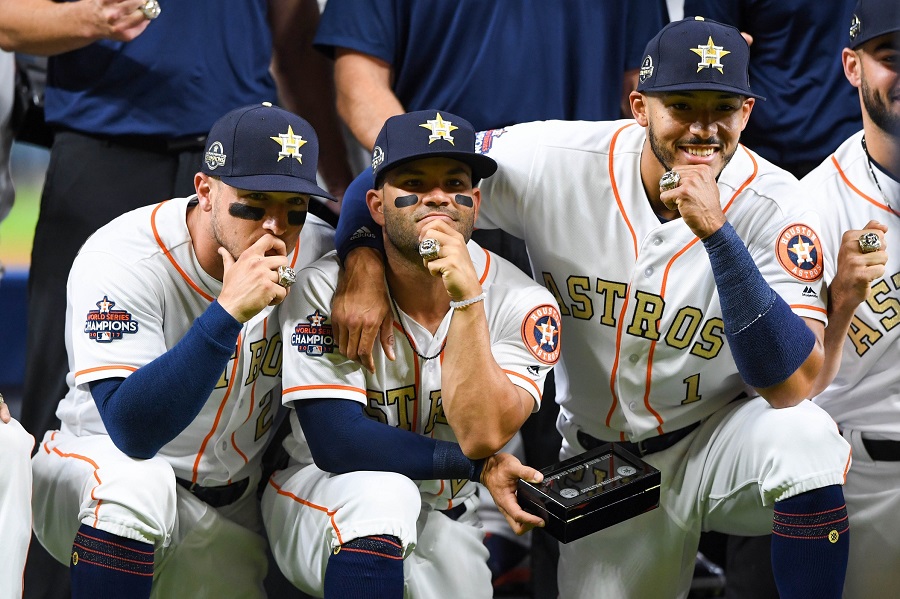 Houston Astros The Astros won the World Series two years ago and are coming off a franchise record 103 wins. Houston’s lineup and top starting pitchers are among the league’s best. This is just one of the many reasons the club will be at the top of the AL for the third consecutive year. It’s crazy to think how deep this lineup is with the likes of Carlos Correa, George Springer, Alex Bregman, and Jose Altuve. Gone from the rotation are Charlie Morton (free agent) and Lance McCullers Jr. (Tommy John surgery). Justin Verlander and Gerrit Cole are a strong one-two punch and the team added Wade Miley to be the club’s number three pitcher. While the club might not get to 100 wins, it’s Houston’s division to lose. Oakland Athletics The As won 97 games last season and no, that’s not a typo. Oakland rode a strong offense built around a lot of power to a surprising playoff berth. Matt Chapman, Khris Davis, Matt Olson and Stephen Piscotty are all capable of hitting 25+ home runs. Former top prospect Jurickson Profar is going to try and find himself by the Bay. Former Twin Robbie Grossman could also play a role in the outfield. Last season, Oakland’s biggest weakness was their rotation. The club is scheduled to start the year with Mike Fiers, Marco Estrada, Brett Anderson, and Frankie Montas. That’s not exactly a murder’s row of a rotation. Can the bullpen bail them out for the second consecutive year? Oakland will take a step back this season but could contend for the second Wild Card spot. Los Angeles Angels Mike Trout just got paid and he is well worth the price of admission. Unfortunately for Angels fans, there isn’t much else to get excited about in LA. Shohei Ohtani certainly brought some excitement last season but he had Tommy John surgery so his two-way playing will be limited to DH duties. Albert Pujols isn’t getting any younger, so Justin Bour was brought in for first base. A few new acquisitions could help the club. Jonathan Lucroy could add something behind the plate, but he’s been trending in the wrong direction offensively. Cody Allen add some stability to the late-innings. Matt Harvey and Trevor Cahill could surprise at the back-end of the rotation. New manager Brad Ausmus could guide LA to a wild card but don’t count on it. Seattle Mariners The list of players departed from Seattle’s roster could form the core of a strong roster. Robinson Cano, James Paxton, Nelson Cruz, Edwin Diaz, Jean Segura, and Mike Zunino are all gone. Seattle is in rebuild mode and the team’s above them on this preview should be able to beat up on what’s left of the Mariners. Edwin Encarnacion joins the club, but it was only to help trade away players like Carlos Santana and Jean Segura. Jay Bruce, Mitch Haniger, and Dee Gordon are still in the in the lineup. Kyle Seager will start the year on the DL. Felix Hernandez is only 32, but he has a lot of miles on his arm and has struggled recently. Seattle won’t be focused on winning this year. Eyes are on the future. Texas Rangers There’s not much in Texas except a whole lot of rebuilding. Joey Gallo can clobber the ball. Elvis Andrus and Rougned Odor form a decent middle infield. Their top prospects don’t figure to get much time in Arlington in 2019. This leaves players like Shin-Soo Choo, Asdrubal Cabrera, and Hunter Pence to fill-in until other younger players are ready to take over. Former Twin Lance Lynn is scheduled to be the number two starter. Let that sink in for a minute. The good news is there should be plenty of long balls for fans to catch if they sit through the Texas heat. Also, the club should end up with a top draft pick next summer. What do you think about the AL West? Can anyone catch Houston? Leave a COMMENT and start the discussion.
 -
 A big thank you to everyone that sent in mailbag questions throughout the off-season. It has been fun to write on a variety of baseball related topics. This concept has generated some great discussion here at Twins Daily. With the season starting, I will be shifting away from the mailbag and diving into some regular season stories. Thanks again to everyone that submitted questions. Enjoy the off-season’s final mailbag article. Baseball’s new rules are certainly going to take some adjustment time. The three-batter minimum for pitchers is going to be one of the toughest adjustments but there are some ways to avoid the problem. An end of an inning can also signal the end of a player’s time on the mound. This could be helpful for the LOOGY (left-handed one out guy). If there are two outs in the inning, come in and get the out you need, and your day will be done. “I think without question it is the most significant strategic on-field change relative to the changes that were announced,” Falvey said. “That one’s going to be interesting for a subset of players. We’ve all long thought that there might be a player that’s a left-on-left situational guy and you worry a little less about his exposure against right-handed hitters. Well, that will change.” There are going to be situational players that are hurt by this rule. Front offices are going to have to change roster construction and managers are going to have to change what they do on the field. I don’t like that it takes away a strategy from teams. I also don’t think it will save that much time, since the ultimate goal is to speed up the pace of play. Minnesota is slowly whittling down the roster. Over the weekend, Tyler Duffey was optioned to Triple-A and Chase De Jong was reassigned to minor league camp. Monday saw Tomas Telis, Brian Navarreto, and Randy Cesar sent to the backfields. This left 41 players in camp including 21 pitchers. There are also 10 non-roster invitees among the 41 remaining players. If I was creating the roster today… Rotation (5): Jose Berrios, Kyle Gibson, Jake Odorizzi, Michael Pineda, Martin Perez Bullpen (7): Trevor May, Blake Parker, Taylor Rogers, Trevor Hildenberger, Adalberto Mejia, Matt Magill, Addison Reed Catchers (3): Jason Castro, Mitch Garver, Willians Astudillo Infielders (5): CJ Cron, Jonathan Schoop, Jorge Polanco, Ehire Adrianza, Marwin Gonzalez Outfielders (4): Eddie Rosario, Byron Buxton, Max Kepler, Jake Cave DH (1): Nelson Cruz This will leave some players like Michael Reed open to waivers. Reed has the possibility of latching on with another team as a fourth outfielder, but it wouldn’t surprise me if he made it through waivers. On the offensive side of things, Adam Rosales has been having a great spring. Tom wrote about him as a possible winner of the Sire of Fort Myers. He’s 35-years old and the Twins seem to have some younger options ahead of him on the depth chart. Lucas Duda could have a shot too, but CJ Cron and Tyler Austin are ahead of him. The most likely non-roster choice might be on the mound. Ryne Harper has been outstanding this spring and Minnesota’s bullpen could offer him an opportunity. A player like Trevor Hildenberger has options left. Addison Reed has seen some rough spots this spring. Harper has certainly looked like he has earned a big-league job. Things are definitely going to be different in the Twins clubhouse this season. Spring training already saw some of those changes with workouts and schedules changing. Baldelli is not that far removed from his own career. This should help him relate to his players. He’s also coming from a Tampa organization that was very forward-thinking. As far as leaders in the clubhouse, Nelson Cruz was signed to fill some of that veteran leadership role. He’s been one of the best home run hitters of the last decade and he brings instant credibility. Kyle Gibson is a strong leader in the rotation, and I think he could serve in that capacity for the entire pitching staff. Minnesota is entering the Byron Buxton and Miguel Sano era, so it would be nice to see them take on leadership roles as well. What are your thoughts on this week’s questions? Leave a COMMENT and start the discussion. Click here to view the article
 -
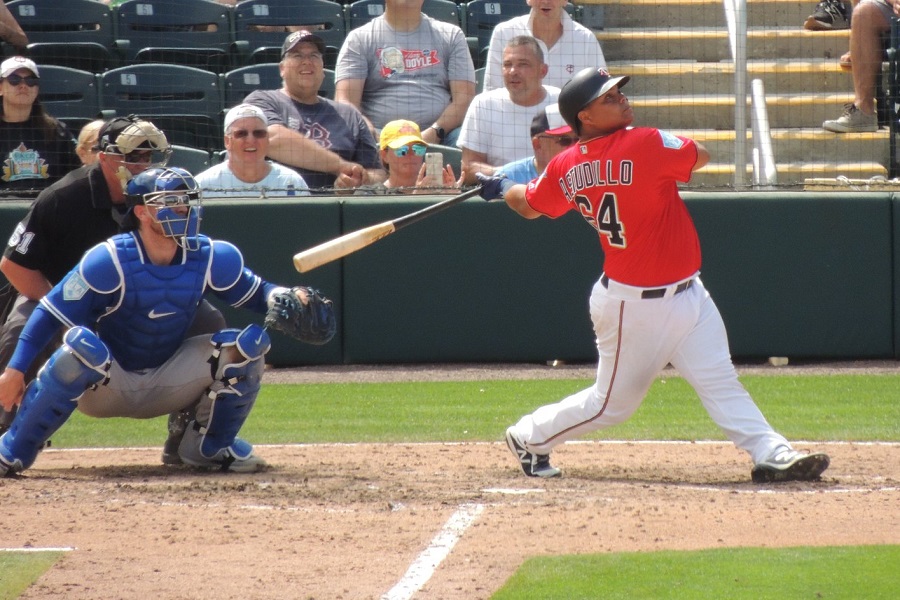 https://twitter.com/Hey_Yo_Its_GMan/status/1106268868765462536 Baseball’s new rules are certainly going to take some adjustment time. The three-batter minimum for pitchers is going to be one of the toughest adjustments but there are some ways to avoid the problem. An end of an inning can also signal the end of a player’s time on the mound. This could be helpful for the LOOGY (left-handed one out guy). If there are two outs in the inning, come in and get the out you need, and your day will be done. “I think without question it is the most significant strategic on-field change relative to the changes that were announced,” Falvey said. “That one’s going to be interesting for a subset of players. We’ve all long thought that there might be a player that’s a left-on-left situational guy and you worry a little less about his exposure against right-handed hitters. Well, that will change.” There are going to be situational players that are hurt by this rule. Front offices are going to have to change roster construction and managers are going to have to change what they do on the field. I don’t like that it takes away a strategy from teams. I also don’t think it will save that much time, since the ultimate goal is to speed up the pace of play. https://twitter.com/StevoFromSD/status/1106391527973113858 Minnesota is slowly whittling down the roster. Over the weekend, Tyler Duffey was optioned to Triple-A and Chase De Jong was reassigned to minor league camp. Monday saw Tomas Telis, Brian Navarreto, and Randy Cesar sent to the backfields. This left 41 players in camp including 21 pitchers. There are also 10 non-roster invitees among the 41 remaining players. If I was creating the roster today… Rotation (5): Jose Berrios, Kyle Gibson, Jake Odorizzi, Michael Pineda, Martin Perez Bullpen (7): Trevor May, Blake Parker, Taylor Rogers, Trevor Hildenberger, Adalberto Mejia, Matt Magill, Addison Reed Catchers (3): Jason Castro, Mitch Garver, Willians Astudillo Infielders (5): CJ Cron, Jonathan Schoop, Jorge Polanco, Ehire Adrianza, Marwin Gonzalez Outfielders (4): Eddie Rosario, Byron Buxton, Max Kepler, Jake Cave DH (1): Nelson Cruz This will leave some players like Michael Reed open to waivers. Reed has the possibility of latching on with another team as a fourth outfielder, but it wouldn’t surprise me if he made it through waivers. https://twitter.com/nater79a/status/1106990948133883904 On the offensive side of things, Adam Rosales has been having a great spring. Tom wrote about him as a possible winner of the Sire of Fort Myers. He’s 35-years old and the Twins seem to have some younger options ahead of him on the depth chart. Lucas Duda could have a shot too, but CJ Cron and Tyler Austin are ahead of him. The most likely non-roster choice might be on the mound. Ryne Harper has been outstanding this spring and Minnesota’s bullpen could offer him an opportunity. A player like Trevor Hildenberger has options left. Addison Reed has seen some rough spots this spring. Harper has certainly looked like he has earned a big-league job. https://twitter.com/dwj1965/status/1106987052887928834 Things are definitely going to be different in the Twins clubhouse this season. Spring training already saw some of those changes with workouts and schedules changing. Baldelli is not that far removed from his own career. This should help him relate to his players. He’s also coming from a Tampa organization that was very forward-thinking. As far as leaders in the clubhouse, Nelson Cruz was signed to fill some of that veteran leadership role. He’s been one of the best home run hitters of the last decade and he brings instant credibility. Kyle Gibson is a strong leader in the rotation, and I think he could serve in that capacity for the entire pitching staff. Minnesota is entering the Byron Buxton and Miguel Sano era, so it would be nice to see them take on leadership roles as well. What are your thoughts on this week’s questions? Leave a COMMENT and start the discussion.
 -
Opening Day is a little over two weeks away. Even with the mounds of snow that continue to grow, they believe there will be baseball played at Target Field on March 28. I’ve been to every home opener at Target Field and I have been at something like 15 of the last 16 home openers for the Twins. It’s not happening this year. No number of puffy vests could change my mind. That being said, there are still some things that need to be decided about the club. Let’s open the mailbox and see what the people have sent in. Dallas Keuchel would be a strong addition to the Twins rotation, but I don’t think it is going to happen. I truly don’t understand why he is still a free agent. Houston’s front office knows him the best, but they haven’t bitten the bullet on adding him back to staff. There must be more to the Keuchel situation. There are some health and durability concerns about Keuchel, especially if he wants a long-term deal. He’s only 31 and he has a Cy Young, four Gold Gloves, and two All-Star appearances. He’s not going to pitch the same way he did in 2015, his Cy Young year, but he could be a nice number two or three pitcher on a contending team. At this point, it seems like his agent might be waiting for a key injury to a starting pitcher to drive up the Keuchel cost. When it comes to the final rotation order, some of the pieces are already decided. Jose Berrios has been named the team’s Opening Day starter. It seems likely that weather will impact some of the team’s early season games and the club wouldn’t need a fifth starter for the first couple of weeks. Behind Berrios, Kyle Gibson seems like a logical number two pitcher. From there, things get murky. Michael Pineda, Jake Odorizzi, and Martin Perez are the next three in line for starting spots. Odorizzi got crushed in his last Grapefruit League start but he might have been working on some specific pitches. Perez has some experience in relief so he could start the year in the bullpen. A couple more rough starts and Odorizzi could switch places with Perez. Twins Opening Day Rotation Jose BerriosKyle GibsonMichael PinedaJake OdorizziMartin Perez (begins in the bullpen)Minnesota has focused on power this offseason, but I don’t think it is enough to reach the 350-home run mark. Last year, the Yankees hit 267 home runs and that was the most in big league history. Minnesota ranked 23rd with 166 home runs. Only five teams in MLB history have hit over 250 home runs and that might have been what you meant. With Minnesota’s revamped line-up, I believe the club can crack the 200-home run mark. This would put them near the top-10 in the league. Most of the Opening Day line-up should have the potential to hit 20 home runs or more. Also, Nelson Cruz certainly helps any club’s home run total. In the last week, the Twins announced some family friendly pricing on items at concession stands in Target Field. Unfortunately, there are only two stands with these family friendly prices. Target Field still lets fans bring in any outside food that they want as long as it is in an appropriate container. I took advantage of this policy multiple times when I lived in the Twin Cities. Unfortunately, I think Twitter allows fans to be negative when it isn’t necessary. People can hide behind their computer screens or their phones and complain about things that don’t have that much of an impact on them. The Twins made an effort to lower prices at Target Field. They didn’t have to do it. If you don’t want to wait in the lines, bring in your own food or go to a more expensive stand. I love the food options at Target Field. I only make it to a couple games per year so I’m going to buy the food I want and pay full price. What do you think about this week’s questions? Leave a COMMENT and start the discussion. Click here to view the article
-
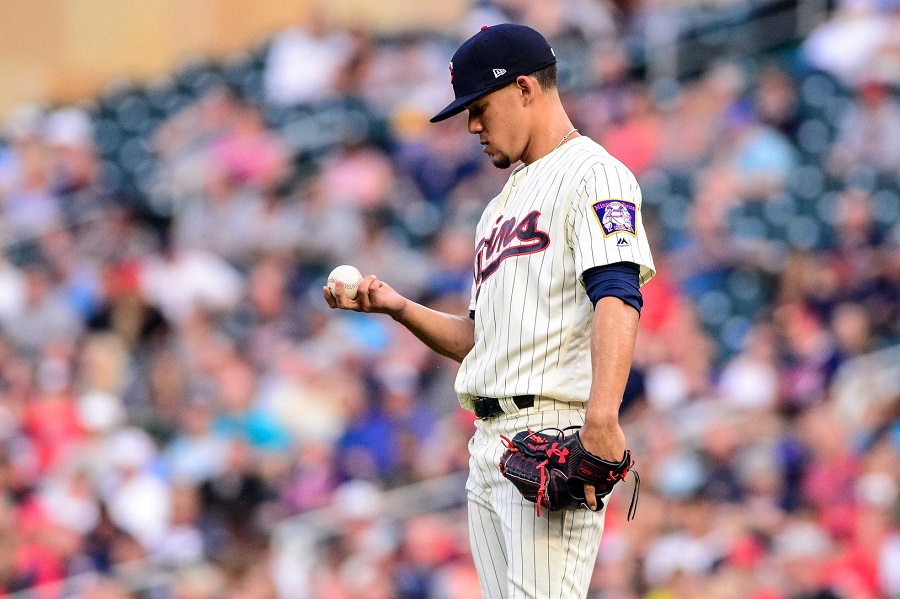 https://twitter.com/PaulLovesTacos/status/1103744332392161280 Dallas Keuchel would be a strong addition to the Twins rotation, but I don’t think it is going to happen. I truly don’t understand why he is still a free agent. Houston’s front office knows him the best, but they haven’t bitten the bullet on adding him back to staff. There must be more to the Keuchel situation. There are some health and durability concerns about Keuchel, especially if he wants a long-term deal. He’s only 31 and he has a Cy Young, four Gold Gloves, and two All-Star appearances. He’s not going to pitch the same way he did in 2015, his Cy Young year, but he could be a nice number two or three pitcher on a contending team. At this point, it seems like his agent might be waiting for a key injury to a starting pitcher to drive up the Keuchel cost. https://twitter.com/C__Lee/status/1103724903637884929 When it comes to the final rotation order, some of the pieces are already decided. Jose Berrios has been named the team’s Opening Day starter. It seems likely that weather will impact some of the team’s early season games and the club wouldn’t need a fifth starter for the first couple of weeks. Behind Berrios, Kyle Gibson seems like a logical number two pitcher. From there, things get murky. Michael Pineda, Jake Odorizzi, and Martin Perez are the next three in line for starting spots. Odorizzi got crushed in his last Grapefruit League start but he might have been working on some specific pitches. Perez has some experience in relief so he could start the year in the bullpen. A couple more rough starts and Odorizzi could switch places with Perez. Twins Opening Day Rotation Jose Berrios Kyle Gibson Michael Pineda Jake Odorizzi Martin Perez (begins in the bullpen) https://twitter.com/Daviddix69/status/1103720780200853506 Minnesota has focused on power this offseason, but I don’t think it is enough to reach the 350-home run mark. Last year, the Yankees hit 267 home runs and that was the most in big league history. Minnesota ranked 23rd with 166 home runs. Only five teams in MLB history have hit over 250 home runs and that might have been what you meant. With Minnesota’s revamped line-up, I believe the club can crack the 200-home run mark. This would put them near the top-10 in the league. Most of the Opening Day line-up should have the potential to hit 20 home runs or more. Also, Nelson Cruz certainly helps any club’s home run total. https://twitter.com/PandaPete21/status/1103714067552894976 In the last week, the Twins announced some family friendly pricing on items at concession stands in Target Field. Unfortunately, there are only two stands with these family friendly prices. Target Field still lets fans bring in any outside food that they want as long as it is in an appropriate container. I took advantage of this policy multiple times when I lived in the Twin Cities. Unfortunately, I think Twitter allows fans to be negative when it isn’t necessary. People can hide behind their computer screens or their phones and complain about things that don’t have that much of an impact on them. The Twins made an effort to lower prices at Target Field. They didn’t have to do it. If you don’t want to wait in the lines, bring in your own food or go to a more expensive stand. I love the food options at Target Field. I only make it to a couple games per year so I’m going to buy the food I want and pay full price. What do you think about this week’s questions? Leave a COMMENT and start the discussion.
 -
Snow continues to pile up. My snow blower was brand new this year and it’s already asking for an early retirement. Reports from Fort Myers say there is less snow near the Gulf of Mexico. Maybe all of Twins Territory can relocated to Florida for a couple weeks. While we have all been stuck inside, there were some great questions sent my way. Follow me on Twitter so you can be part of the next Twins Daily mailbag. Last year, the Twins signed players late into the spring as free agents were still available. Last week the club added Marwin Gonzalez, which might have seemed like a stretch at the beginning of the off-season. Instead, he was available and fell into the Twins laps. This is a phrase that has been thrown out multiple times by the front office. So… could a pitcher fall into the team’s lap? Dallas Keuchel was the top free agent starter on the market, and he has yet to sign. As a 31-year old, he is coming off a year where he posted a 3.74 ERA and a 1.31 WHIP in 204.2 innings. It seems logical that plenty of teams would be interested in his services. My guess is he ends up back in Houston to solidify their rotation. That being said, it sounds like he was good friends with Gonzales during their time in Houston. Maybe a reunion could be in the works. The Minneapolis Star Tribune doesn’t believe Keuchel will be coming to Minnesota. It seems most likely for the team to start the season with the current pitchers on the roster. Gio Gonzalez does little to excite me as a free agent. Last year as a 32-year old, he posted a 4.21 ERA and a 1.44 WHIP in 171.0 innings. He could be a nice veteran presence at the back of the rotation, but I’d rather give those innings to a younger arm. Minnesota will start the year with Jose Berrios, Kyle Gibson, Michael Pineda, and Jake Odorizzi occupying the top four spots in the rotation. Innings that could be allotted to Gonzalez should go to the likes of Martin Perez, Adalberto Mejia, Kohl Stewart, and Stephen Gonsalves. Even with the strong reports about Stephen Gonsalves, I doubt there is any way he makes the team out of spring training. The early weeks of the season are full of extra off-days and Minnesota will likely have some weather delays, sine the Home Opener is scheduled before the calendar turns to April. With that in mind, the club won’t need a fifth starter near the beginning of the year. This allows the team to carry an extra bullpen arm or an extra bat for the bench. Without an injury to one of the top starters, there is almost no chance Gonsalves breaks camp with the club. He will start the year in Rochester and be only a phone call away. I would love to buy into all of the Byron Buxton spring training hype. Unfortunately, spring training numbers mean little for the regular season. It’s great for his confidence to be finding consistent success, but fans haven’t seen him put it all together at the big-league level. Until he can do it consistently with the Twins, there will be a lot of fans that wonder if the Twins made the right choice with Buxton. However, many fans were disappointed with Joe Mauer for the majority of his career and he could end up being a Hall of Fame player. Earlier this off-season, I identified Buxton’s emergence as one of the keys to 2019. I still believe that to be true. He could end up being an All-Star. He could end up struggling. It seems more likely that he falls somewhere in the middle of those two extremes. This question took me the longest because of all of the options. Some of the options that popped into my head were Kirby Puckett’s eye injury, Justin Morneau’s concussions, and Joe Mauer’s concussions. All three of these injuries deprived Twins Territory of some tremendous years of Hall of Fame caliber baseball. My answer might be a little off the beaten path, but I am going to say Francisco Liriano’s Tommy John surgery in 2006. I fully believe the Twins could have won the World Series that season had Liriano stayed healthy. No team was going to beat Liriano and Johan Santana multiple times in the same series. It might have been one of the most dominant one-two punches in playoff history. I think Liriano’s arm injury deprived the Twins organization of their third World Series title. I think the Twins have made it clear this off-season. They don’t want to be known as the club that battles their tails off. They want to hit home runs and they want to hit a lot of home runs. Minnesota’s 2019 roster is going to hit the ball over the fence and the club is going to strike out a lot. This might be good and it might be bad, but it’s a far cry from the Nick Punto days back in the Metrodome. Thanks to all of those that submitted questions this week. Leave a COMMENT with your own answers to all of these questions. Click here to view the article
-
Mailbag: Available Pitchers, Buxton Hype, Baseball Time Machine
Cody Christie posted an article in Twins
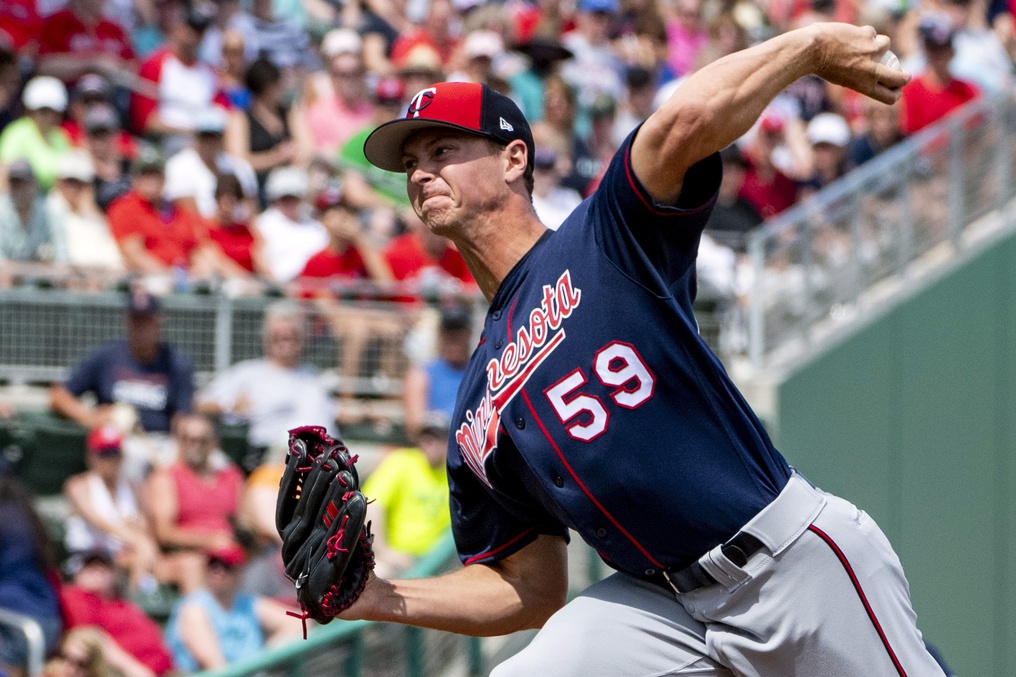 https://twitter.com/DSBerner2288/status/1101214854323601409 Last year, the Twins signed players late into the spring as free agents were still available. Last week the club added Marwin Gonzalez, which might have seemed like a stretch at the beginning of the off-season. Instead, he was available and fell into the Twins laps. This is a phrase that has been thrown out multiple times by the front office. So… could a pitcher fall into the team’s lap? Dallas Keuchel was the top free agent starter on the market, and he has yet to sign. As a 31-year old, he is coming off a year where he posted a 3.74 ERA and a 1.31 WHIP in 204.2 innings. It seems logical that plenty of teams would be interested in his services. My guess is he ends up back in Houston to solidify their rotation. That being said, it sounds like he was good friends with Gonzales during their time in Houston. Maybe a reunion could be in the works. The Minneapolis Star Tribune doesn’t believe Keuchel will be coming to Minnesota. It seems most likely for the team to start the season with the current pitchers on the roster. https://twitter.com/MNTwinpinions/status/1101204265769582592 Gio Gonzalez does little to excite me as a free agent. Last year as a 32-year old, he posted a 4.21 ERA and a 1.44 WHIP in 171.0 innings. He could be a nice veteran presence at the back of the rotation, but I’d rather give those innings to a younger arm. Minnesota will start the year with Jose Berrios, Kyle Gibson, Michael Pineda, and Jake Odorizzi occupying the top four spots in the rotation. Innings that could be allotted to Gonzalez should go to the likes of Martin Perez, Adalberto Mejia, Kohl Stewart, and Stephen Gonsalves. https://twitter.com/matthew_btwins/status/1101203489651224576 Even with the strong reports about Stephen Gonsalves, I doubt there is any way he makes the team out of spring training. The early weeks of the season are full of extra off-days and Minnesota will likely have some weather delays, sine the Home Opener is scheduled before the calendar turns to April. With that in mind, the club won’t need a fifth starter near the beginning of the year. This allows the team to carry an extra bullpen arm or an extra bat for the bench. Without an injury to one of the top starters, there is almost no chance Gonsalves breaks camp with the club. He will start the year in Rochester and be only a phone call away. https://twitter.com/ERolfPleiss/status/1101202433135513601 I would love to buy into all of the Byron Buxton spring training hype. Unfortunately, spring training numbers mean little for the regular season. It’s great for his confidence to be finding consistent success, but fans haven’t seen him put it all together at the big-league level. Until he can do it consistently with the Twins, there will be a lot of fans that wonder if the Twins made the right choice with Buxton. However, many fans were disappointed with Joe Mauer for the majority of his career and he could end up being a Hall of Fame player. Earlier this off-season, I identified Buxton’s emergence as one of the keys to 2019. I still believe that to be true. He could end up being an All-Star. He could end up struggling. It seems more likely that he falls somewhere in the middle of those two extremes. https://twitter.com/PandaPete21/status/1101143745968381952 This question took me the longest because of all of the options. Some of the options that popped into my head were Kirby Puckett’s eye injury, Justin Morneau’s concussions, and Joe Mauer’s concussions. All three of these injuries deprived Twins Territory of some tremendous years of Hall of Fame caliber baseball. My answer might be a little off the beaten path, but I am going to say Francisco Liriano’s Tommy John surgery in 2006. I fully believe the Twins could have won the World Series that season had Liriano stayed healthy. No team was going to beat Liriano and Johan Santana multiple times in the same series. It might have been one of the most dominant one-two punches in playoff history. I think Liriano’s arm injury deprived the Twins organization of their third World Series title. https://twitter.com/BrianHohlen/status/1101211556828856321 I think the Twins have made it clear this off-season. They don’t want to be known as the club that battles their tails off. They want to hit home runs and they want to hit a lot of home runs. Minnesota’s 2019 roster is going to hit the ball over the fence and the club is going to strike out a lot. This might be good and it might be bad, but it’s a far cry from the Nick Punto days back in the Metrodome. Thanks to all of those that submitted questions this week. Leave a COMMENT with your own answers to all of these questions.
 -
In the last week, the Twins have gotten things up and running in Fort Myers. The club played their first few games on their Grapefruit League schedule. Minnesota also made a splash by signing super utility player Marwin Gonzalez to a two-year contract. It’s tough to know where he will fit in the line-up, but he can play almost anywhere so he should still get regular at-bats. There were certainly some interesting questions in this week’s mailbag. Let’s head to the mailbox and open some mail. Baseball players certainly have some concerns with how the system is currently being run. Over the last two winters, teams have not been willing to give veteran players long-term contracts. Even the highest rated free agents have been on the market all the way until spring training began. According to USA Today, “The conditions players feel are suppressing their earning power – a luxury tax that serves as a de facto salary cap, a heavy reliance on analytics that leads to wage suppression, a segment of ownership disincentivized and perhaps ambivalent about winning – aren’t going away until then, if at all.” Teams have also manipulated service time of their top prospects to delay them reaching free agency. Players would like to reach free agency after five years, arbitration after two years, and for the minimum salary to be raised. To make this kind of change, the players are going to have to give something up. Players are getting frustrated and some are even preparing for a looming strike. It took baseball a long time to come back from the last strike. Hopefully, it won’t happen again. Free agency sure has taken on a different feel over the last two off-seasons. Bryce Harper and Manny Machado had to feel good about reaching free agency at such a young age. Still, it took until February for either of them to sign. With the way organizations approach spending money, I didn’t think anything will change with how clubs spend money next off-season. Names like Paul Goldschmidt, Xander Bogaerts, Nolan Arenado and Justin Verlander could all be on the free agent market. Goldschmidt and Verlander are already in their 30’s. Arenado might be the most prized free agent but there is talk of him signing a long-term deal with the Rockies. Bogaerts is good but he isn’t in the same realm as some of the other names on this list. Until the player’s union can force some changes, free agency is looking less appealing for veteran players. When it comes to the pitch clock, I think it is what it is. Players and teams need to get used to the idea because Major League Baseball is going to have a pitch clock. Younger players are getting used to the clock in the minor leagues so that will help the transition. I truly believe it will become something that fans and players don’t even notice. It will just become a transparent element of the game. Commissioner Rob Manfred’s focus on pace of play will certainly continue to be part of the game moving forward. I think a pitch clock will impact the length of games, but I don’t think it will be a significant impact. Baseball will continue to need to address at things like pitching changes and mound visits. Players can also take some of this on themselves. Pitchers can get the ball back on the mound and pitch right away. Batters can stay in the box and wait for the next pitch to come. Pitch clocks are just part of the steps MLB is going to take to speed up the game. Cleveland is vulnerable for the first time in years. I think the Twins can be in contention all the way into September. That being said, some of the young core needs to take the next step. I think Byron Buxton is going to have a breakout season and he will be the team’s lead-off hitter for a post-season run. So, let’s see what the line-up could look like: Potential September 2019 Line-Up 1. Byron Buxton, CF 2. Jorge Polanco, SS 3. Nelson Cruz, DH 4. Miguel Sano, 3B 5. Eddie Rosario, LF 6. Marwin Gonzalez, 1B 7. Jonathan Schoop, 2B 8. Max Kepler, RF 9. Mitch Garver, C The newly signed Gonzalez could fit into a few different spots in the line-up. I thought about putting him at first or second. Former first-round pick and top prospect Alex Kirilloff could hit his way into the line-up by September as well. I’d hope the team is giving more at-bats to Garver than Jason Castro in September since Castro will be a free agent. However, the team will likely be using both catchers and riding the hot bat. What do you think about this week’s questions? Leave a COMMENT and start the discussion. Click here to view the article
-
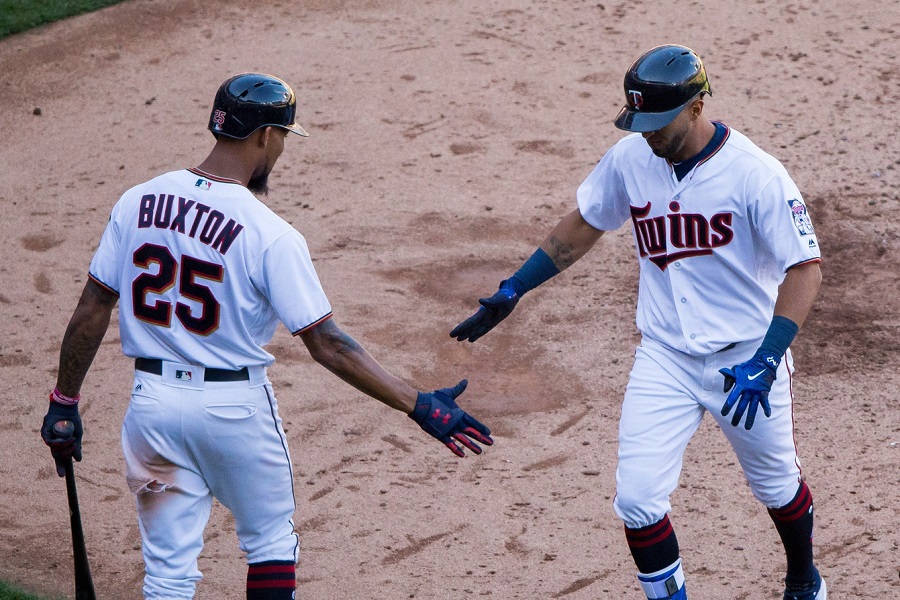 https://twitter.com/Hey_Yo_Its_GMan/status/1099177714790137856 Baseball players certainly have some concerns with how the system is currently being run. Over the last two winters, teams have not been willing to give veteran players long-term contracts. Even the highest rated free agents have been on the market all the way until spring training began. According to USA Today, “The conditions players feel are suppressing their earning power – a luxury tax that serves as a de facto salary cap, a heavy reliance on analytics that leads to wage suppression, a segment of ownership disincentivized and perhaps ambivalent about winning – aren’t going away until then, if at all.” Teams have also manipulated service time of their top prospects to delay them reaching free agency. Players would like to reach free agency after five years, arbitration after two years, and for the minimum salary to be raised. To make this kind of change, the players are going to have to give something up. Players are getting frustrated and some are even preparing for a looming strike. It took baseball a long time to come back from the last strike. Hopefully, it won’t happen again. https://twitter.com/PandaPete21/status/1098735489744539648 Free agency sure has taken on a different feel over the last two off-seasons. Bryce Harper and Manny Machado had to feel good about reaching free agency at such a young age. Still, it took until February for either of them to sign. With the way organizations approach spending money, I didn’t think anything will change with how clubs spend money next off-season. Names like Paul Goldschmidt, Xander Bogaerts, Nolan Arenado and Justin Verlander could all be on the free agent market. Goldschmidt and Verlander are already in their 30’s. Arenado might be the most prized free agent but there is talk of him signing a long-term deal with the Rockies. Bogaerts is good but he isn’t in the same realm as some of the other names on this list. Until the player’s union can force some changes, free agency is looking less appealing for veteran players. https://twitter.com/TFTwins/status/1098732744002154496 When it comes to the pitch clock, I think it is what it is. Players and teams need to get used to the idea because Major League Baseball is going to have a pitch clock. Younger players are getting used to the clock in the minor leagues so that will help the transition. I truly believe it will become something that fans and players don’t even notice. It will just become a transparent element of the game. Commissioner Rob Manfred’s focus on pace of play will certainly continue to be part of the game moving forward. I think a pitch clock will impact the length of games, but I don’t think it will be a significant impact. Baseball will continue to need to address at things like pitching changes and mound visits. Players can also take some of this on themselves. Pitchers can get the ball back on the mound and pitch right away. Batters can stay in the box and wait for the next pitch to come. Pitch clocks are just part of the steps MLB is going to take to speed up the game. https://twitter.com/alexmilne87/status/1098704366977105921 Cleveland is vulnerable for the first time in years. I think the Twins can be in contention all the way into September. That being said, some of the young core needs to take the next step. I think Byron Buxton is going to have a breakout season and he will be the team’s lead-off hitter for a post-season run. So, let’s see what the line-up could look like: Potential September 2019 Line-Up 1. Byron Buxton, CF 2. Jorge Polanco, SS 3. Nelson Cruz, DH 4. Miguel Sano, 3B 5. Eddie Rosario, LF 6. Marwin Gonzalez, 1B 7. Jonathan Schoop, 2B 8. Max Kepler, RF 9. Mitch Garver, C The newly signed Gonzalez could fit into a few different spots in the line-up. I thought about putting him at first or second. Former first-round pick and top prospect Alex Kirilloff could hit his way into the line-up by September as well. I’d hope the team is giving more at-bats to Garver than Jason Castro in September since Castro will be a free agent. However, the team will likely be using both catchers and riding the hot bat. What do you think about this week’s questions? Leave a COMMENT and start the discussion.
 -
Spring training has started, but there are certainly plenty of questions to be answered about the club. Over the next few weeks, the roster will be finalized and some of the club’s best prospects will find out where they will be playing this season. So what kind of questions were in the mail this week? Let’s find out. After locking up Jorge Polanco and Max Kelper last week, the Twins could still lock up another piece of their young core before the season begins. I believe the Twins lock up one more piece before the season begins and I think it will be a pitcher. That leaves Jose Berrios and Kyle Gibson in the discussion. Berrios is coming off an All-Star season and some recent MLB contract extensions could provide the outline for getting a deal done. Seth prognosticated on those possibilities over the weekend. Gibson can be a free agent at season’s end, but I believe the Twins want him to stay with the organization beyond this season. If I was betting on the next extension, it would be on Berrios. Even with the extension for Jorge Polanco, I believe Royce Lewis won’t be impacted. Nick Gordon will be slated to make his debut this season, but his stock has significantly dropped over the past year. Jonathan Schoop is only under contract for this season so Gordon could take over second base next year. Granted, Gordon is going to need to show some offensive improvements during the 2019 campaign. Lewis will spend the first half of this season in Fort Myers with the possibility to make it to Pensacola in the second half. Depending on how he does in 2019, he could split time next season between Double- and Triple-A during the 2020 campaign. That puts him in line for a debut at the end of that season or early in 2021. Middle infield depth is never a bad thing. It’s also something Minnesota hasn’t had in quite a long time. At this point in their careers, I think Max Kepler and Eddie Rosario are both trade worthy. Neither of them has shown me they are irreplaceable and there will certainly be some pressure from the minor leagues. Alex Kirilloff could make his debut in 2019 (see below) and this could put added pressure on some of the other young outfielders on the roster. Overall, I think John was right when he wrote about the Kepler deal at the end of last week. The club and the player might have found a balanced deal. However, it doesn’t mean Kepler is going to be in a Twins uniform for the remainder of his professional career. Yes, I do believe the Indians win the division, but baseball is a crazy game. If I was a betting man, I would say Cleveland wins the division but only manages less than 90 wins. Their roster has flaws for the first time in multiple years and this is when other AL Central teams can begin to try to take advantage. For Minnesota, it will be about their start to the season and how well their key players perform. The Twins could easily win as many games as Cleveland, but a lot of things are going to have to go right. Minnesota’s front office will also have to be willing to deal young players at the deadline to add impact pieces. Is that something that is in the best interest of the club? We will have to wait and find out. For me, the easy answer is Willians Astudillo. He might be a fan favorite, but I don’t see a scenario where the Twins will need three catchers on the roster. Jason Castro and Mitch Garver are ahead of him on the depth chart. He provides some defensive flexibility, but I don’t think it is enough to warrant a utility spot on the 25-man roster. Will he play for the Twins this season? Yes, but I don’t think he makes the 25-man roster out of spring training. Hot or cold starts are a tough thing to predict. In recent seasons, the Twins haven’t exactly come bursting out of the gate with an 8-14 record last April and a 12-11 record the year before. With a new manager and plenty of young pieces, I would guess on a slower start for the core to gel. I think the team will have around a .500 record at the end of April. From there, the club will have to make strides in the right direction to make the playoffs. I believe the Twins are going to use an opener most of the season. I don’t think it will matter if the starter is Jose Berrios or someone at the back end of the rotation. Minnesota is teaching their young players about the benefits of the opener and I think the veteran pitchers will follow the lead of Rocco Baldelli. He’s coming from the Rays organization that created the opener concept. Openers won’t be used every day, but I would guess the Twins use an opener four out of six games in a week. As I wrote about in his profile last week, Alex Kirilloff is clearly on a path to Target Field. Eddie Rosario, Byron Buxton, and Max Kepler all sit on the 25-man roster ahead of Kirilloff. He hasn’t played a game above High-A so the team will have to be aggressive with him this season for him to make his debut. That being said, I certainly think it is a possibility. He should be given the opportunity to start the year at Double-A. In the past, top prospects have shown the ability to skip Triple-A and head straight to the big leagues. Minnesota did this with Joe Mauer when he was making his debut. Even if Kirilloff moves quickly this year, there is no reason for him to debut before the second half of the year. Last season was outstanding, but he needs to show he can produce in the upper levels of the minor leagues. With a new coaching staff, there is plenty that is left to be seen with how it impacts the club. The Twins have put a new spring training format into focus so far with the club. This has been meant to minimize time standing around and to keep the club moving through drills. “I think the best way to describe it is to get the most out of our guys in a good, concise, short period of time,” Baldelli said. “We wanted to get out guys on the field, do good work, get them off the field to try to treat them good.” Less down time during drills could leave plenty of opportunities for off-field bonding. The first position player workouts are just underway so it will be interesting to see how the player react to the new format. I think Craig Kimbrel could be a very valuable piece for a bullpen, but I don’t think it will be in Minnesota. Maybe the asking price will become low enough. However, I think the organization is content starting the season with the bullpen arms already on staff. Especially with the news, about Fernando Romero joining the bullpen. I don’t know if the Twins will have a traditional closer. I wouldn’t be surprised if multiple players collect 10+ saves this season. I think Baldelli will go with the best match-up and not have a designated closer. What do you think about the questions asked this week? Leave a COMMENT and start the discussion. Click here to view the article
-
Mailbag: Extension-Palooza, Infield Log Jam, New Spring Format
Cody Christie posted an article in Twins
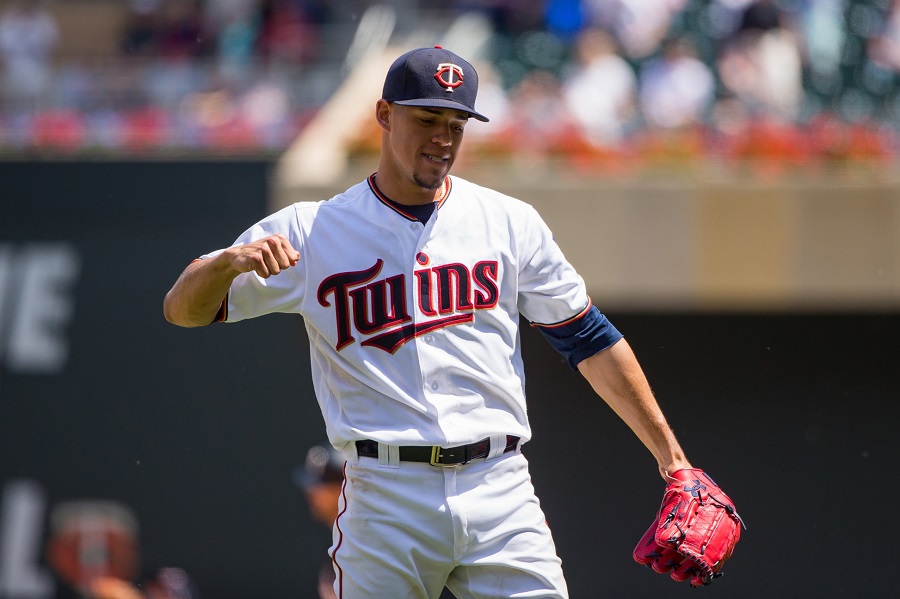 https://twitter.com/FinsTwinsLakers/status/1096825629440385034 After locking up Jorge Polanco and Max Kelper last week, the Twins could still lock up another piece of their young core before the season begins. I believe the Twins lock up one more piece before the season begins and I think it will be a pitcher. That leaves Jose Berrios and Kyle Gibson in the discussion. Berrios is coming off an All-Star season and some recent MLB contract extensions could provide the outline for getting a deal done. Seth prognosticated on those possibilities over the weekend. Gibson can be a free agent at season’s end, but I believe the Twins want him to stay with the organization beyond this season. If I was betting on the next extension, it would be on Berrios. https://twitter.com/gary_pecinovsky/status/1096380337574346752 Even with the extension for Jorge Polanco, I believe Royce Lewis won’t be impacted. Nick Gordon will be slated to make his debut this season, but his stock has significantly dropped over the past year. Jonathan Schoop is only under contract for this season so Gordon could take over second base next year. Granted, Gordon is going to need to show some offensive improvements during the 2019 campaign. Lewis will spend the first half of this season in Fort Myers with the possibility to make it to Pensacola in the second half. Depending on how he does in 2019, he could split time next season between Double- and Triple-A during the 2020 campaign. That puts him in line for a debut at the end of that season or early in 2021. Middle infield depth is never a bad thing. It’s also something Minnesota hasn’t had in quite a long time. https://twitter.com/jrodsup/status/1097293374250455042 At this point in their careers, I think Max Kepler and Eddie Rosario are both trade worthy. Neither of them has shown me they are irreplaceable and there will certainly be some pressure from the minor leagues. Alex Kirilloff could make his debut in 2019 (see below) and this could put added pressure on some of the other young outfielders on the roster. Overall, I think John was right when he wrote about the Kepler deal at the end of last week. The club and the player might have found a balanced deal. However, it doesn’t mean Kepler is going to be in a Twins uniform for the remainder of his professional career. https://twitter.com/Baumy19/status/1097237610622271489 Yes, I do believe the Indians win the division, but baseball is a crazy game. If I was a betting man, I would say Cleveland wins the division but only manages less than 90 wins. Their roster has flaws for the first time in multiple years and this is when other AL Central teams can begin to try to take advantage. For Minnesota, it will be about their start to the season and how well their key players perform. The Twins could easily win as many games as Cleveland, but a lot of things are going to have to go right. Minnesota’s front office will also have to be willing to deal young players at the deadline to add impact pieces. Is that something that is in the best interest of the club? We will have to wait and find out. https://twitter.com/Mike_AnthonyFL/status/1097230407161073664 For me, the easy answer is Willians Astudillo. He might be a fan favorite, but I don’t see a scenario where the Twins will need three catchers on the roster. Jason Castro and Mitch Garver are ahead of him on the depth chart. He provides some defensive flexibility, but I don’t think it is enough to warrant a utility spot on the 25-man roster. Will he play for the Twins this season? Yes, but I don’t think he makes the 25-man roster out of spring training. https://twitter.com/MikeAmundsen12/status/1097229446887673856 Hot or cold starts are a tough thing to predict. In recent seasons, the Twins haven’t exactly come bursting out of the gate with an 8-14 record last April and a 12-11 record the year before. With a new manager and plenty of young pieces, I would guess on a slower start for the core to gel. I think the team will have around a .500 record at the end of April. From there, the club will have to make strides in the right direction to make the playoffs. https://twitter.com/nater79a/status/1097228755980959746 I believe the Twins are going to use an opener most of the season. I don’t think it will matter if the starter is Jose Berrios or someone at the back end of the rotation. Minnesota is teaching their young players about the benefits of the opener and I think the veteran pitchers will follow the lead of Rocco Baldelli. He’s coming from the Rays organization that created the opener concept. Openers won’t be used every day, but I would guess the Twins use an opener four out of six games in a week. https://twitter.com/twolvesfan/status/1097227151592644610 As I wrote about in his profile last week, Alex Kirilloff is clearly on a path to Target Field. Eddie Rosario, Byron Buxton, and Max Kepler all sit on the 25-man roster ahead of Kirilloff. He hasn’t played a game above High-A so the team will have to be aggressive with him this season for him to make his debut. That being said, I certainly think it is a possibility. He should be given the opportunity to start the year at Double-A. In the past, top prospects have shown the ability to skip Triple-A and head straight to the big leagues. Minnesota did this with Joe Mauer when he was making his debut. Even if Kirilloff moves quickly this year, there is no reason for him to debut before the second half of the year. Last season was outstanding, but he needs to show he can produce in the upper levels of the minor leagues. https://twitter.com/DoubleDDe/status/1097249486181748736 With a new coaching staff, there is plenty that is left to be seen with how it impacts the club. The Twins have put a new spring training format into focus so far with the club. This has been meant to minimize time standing around and to keep the club moving through drills. “I think the best way to describe it is to get the most out of our guys in a good, concise, short period of time,” Baldelli said. “We wanted to get out guys on the field, do good work, get them off the field to try to treat them good.” Less down time during drills could leave plenty of opportunities for off-field bonding. The first position player workouts are just underway so it will be interesting to see how the player react to the new format. https://twitter.com/BTukua/status/1097298945146007552 I think Craig Kimbrel could be a very valuable piece for a bullpen, but I don’t think it will be in Minnesota. Maybe the asking price will become low enough. However, I think the organization is content starting the season with the bullpen arms already on staff. Especially with the news, about Fernando Romero joining the bullpen. I don’t know if the Twins will have a traditional closer. I wouldn’t be surprised if multiple players collect 10+ saves this season. I think Baldelli will go with the best match-up and not have a designated closer. What do you think about the questions asked this week? Leave a COMMENT and start the discussion.
 -
Roughly a year ago, Alex Kirilloff had to be feeling a little trepidation. Spring training was starting, and the former first round pick had missed all of 2017. Few knew the kind of season Kirilloff was about to embark on. During last off-season, none of baseball’s national prospect rankings had him in their top 100 lists. Now he is a consensus top-40 prospect. MLB and ESPN’s Keith Law have Kirilloff in their top-12 prospects. This is quite the jump for the former first round pick. What could that mean for the 2019 campaign?Age: 21 (DOB: 11/9/1997) 2018 Stats (Low-A/High-A): .348/.392/.578, 44 2B, 20 HR, 7 3B, 4-for-7 in stolen base attempts ETA: 2020 2018 Ranking: 5 National Top 100 Rankings BA: 31 |MLB: 9 | ESPN: 11 |BP: 39 What’s To Like Kirilloff can hit. That might be the understatement of the century. He might be the best hitting prospect in the minor leagues not named Vladimir Guerrero Jr. He’s been hitting for his entire life, as his dad runs baseball camps and clinics. He could have shown some rust last season, but he quickly made it known that he would be a force to be reckoned with. He started the season in Cedar Rapids and hit .333/.391/.607 with 38 extra-base hits in 65 games. Among Midwest League hitters with at least 280 at-bats, his .999 OPS was the highest. Once he was promoted Fort Myers, he continued to hit. In 65 games in the Florida State League, he hit .362/.393/.550 with 33 extra-base hits. He led the Twins system in hits, doubles, and RBI. His 71 total extra-base hits and 296 total bases each led the minor leagues. At season’s end, the accolades came rolling in. The Twins named him the Twins Minor League Player of the Year and Twins Daily named him the Minor League Hitter of the Year. MiLB.com named him as the Breakout Prospect of the Year. He represented the Twins in MLB’s Futures Game during All-Star Weekend. He was also a midseason and post-season All-Star in the Midwest League. Kirilloff can spray the ball all over the field. His spray chart from last season is a thing of beauty (see below). Even with a left-handed swing, he has power to the opposite field. In fact, he had more doubles and more home runs to the opposite field than from pulling the ball. What’s Left To Work On Kirilloff destroyed the ball last season so there was really no reason for him to try to draw a ton of walks. He is very aggressive at the plate and so his OBP was only slightly higher than his batting average. As he gets closer to the big leagues, hitting against more advanced pitchers could mean that he will need to be more patient. He knows the strike zone well and he will need to continue to prove that at Double- and Triple-A. His year off following Tommy John surgery might have been a blessing in disguise. For months, he wasn’t able to work on his swing, so he was able to develop his core and the lower half of his body. “It was total body strength,” he told MiLB.com. “I wanted to get all-around stronger. When they make you come in and work out every day, you don’t really have much choice. You’re going to get stronger. Everything happens for a reason, and maybe that was what I needed.” On the defensive side of the ball, he played some center field in high school, so he has plenty of athletic ability. As he has bulked up in the minors, he has moved to a corner outfield spot. At some point, he might need to move to first base, but he has a good arm and should be able to stick in right field. What’s Next Target Field… OK, that might be a stretch, but his bat could carry him to Minnesota by season’s end. Minnesota could decide to keep him at Fort Myers to start the year, but it wouldn’t be much of a surprise if he started the year in Pensacola. Prospects of his caliber don’t necessarily need time at Triple-A so he could be called up directly from Double-A. Minnesota’s outfield is full at the moment with Byron Buxton, Max Kepler, and Eddie Rosario. However, an injury or poor play by one of these players could expedite Kirilloff’s timeline. Right now, I think his bat could hold its own at the big league level. Twins Daily 2019 Top 20 Prospects Honorable Mentions 20. Jose Miranda, 2B/3B 19. Jorge Alcala, RHP 18. LaMonte Wade, OF 17. Zack Littell, RHP 16. Gilberto Celestino, OF 15. Yunior Severino, 2B 14. Ben Rortvedt, C 13. Ryan Jeffers, C 12. Stephen Gonsalves, LHP 11. Nick Gordon, SS 10. Akil Baddoo, OF 9. Blayne Enlow, RHP 8. Lewis Thorpe, LHP 7. Jhoan Duran, RHP 6. Brent Rooker, 1B/LF 5. Wander Javier, SS 4. Trevor Larnach, OF 3. Brusdar Graterol, RHP 2. Alex Kirilloff, OF TD Top Prospects: #1- COMING TOMORROW Get to know more about Larnach and many more minor league players in the 2019 Minnesota Twins Prospect Handbook. ORDER NOW: 2019 Minnesota Twins Prospect Handbook (paperback, $17.99) ORDER NOW: 2019 Minnesota Twins Prospect Handbook (eBook, $12.99) The 2019 Minnesota Twins Prospect Handbook goes in-depth and provides player bios, scouting reports, statistics and much more on almost 160 Twins minor leaguers. Click here to view the article
- 41 replies
-
- 1
-

-
- alex kirilloff
- vladimir guerrero jr
- (and 3 more)
-
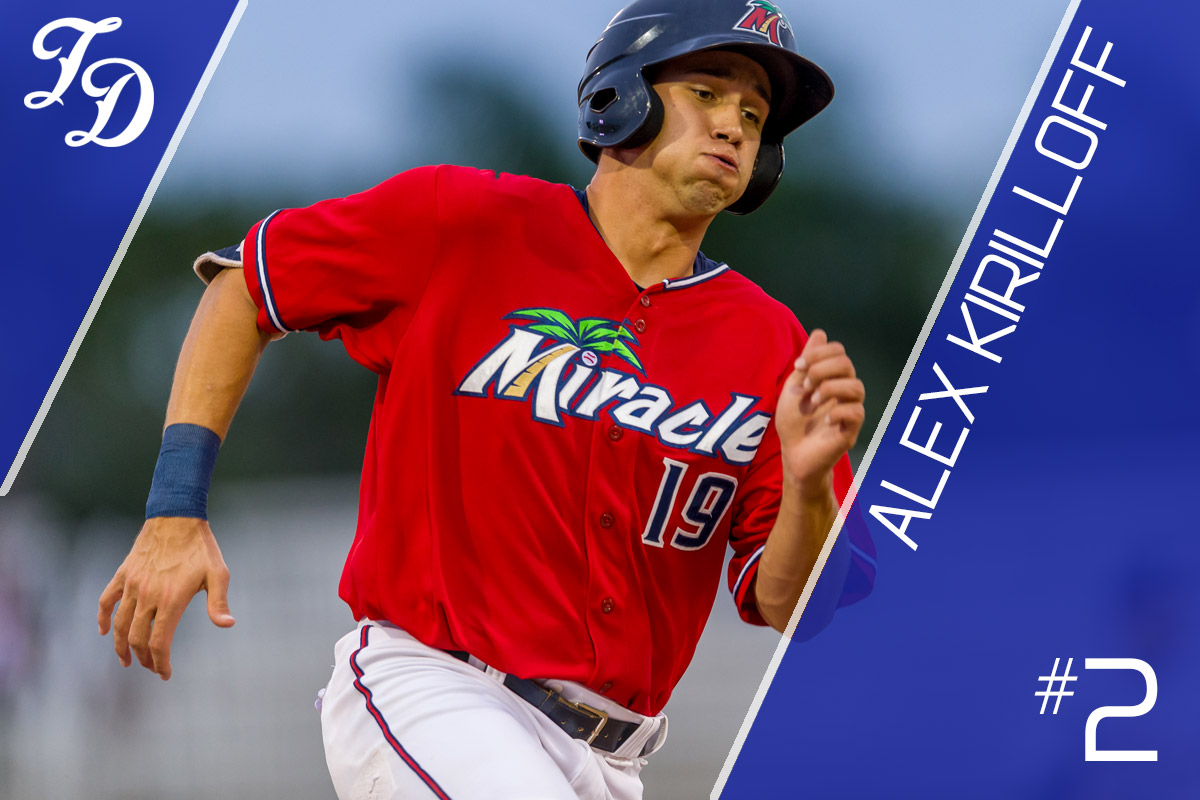 Age: 21 (DOB: 11/9/1997) 2018 Stats (Low-A/High-A): .348/.392/.578, 44 2B, 20 HR, 7 3B, 4-for-7 in stolen base attempts ETA: 2020 2018 Ranking: 5 National Top 100 Rankings BA: 31 |MLB: 9 | ESPN: 11 |BP: 39 What’s To Like Kirilloff can hit. That might be the understatement of the century. He might be the best hitting prospect in the minor leagues not named Vladimir Guerrero Jr. He’s been hitting for his entire life, as his dad runs baseball camps and clinics. He could have shown some rust last season, but he quickly made it known that he would be a force to be reckoned with. He started the season in Cedar Rapids and hit .333/.391/.607 with 38 extra-base hits in 65 games. Among Midwest League hitters with at least 280 at-bats, his .999 OPS was the highest. Once he was promoted Fort Myers, he continued to hit. In 65 games in the Florida State League, he hit .362/.393/.550 with 33 extra-base hits. He led the Twins system in hits, doubles, and RBI. His 71 total extra-base hits and 296 total bases each led the minor leagues. At season’s end, the accolades came rolling in. The Twins named him the Twins Minor League Player of the Year and Twins Daily named him the Minor League Hitter of the Year. MiLB.com named him as the Breakout Prospect of the Year. He represented the Twins in MLB’s Futures Game during All-Star Weekend. He was also a midseason and post-season All-Star in the Midwest League. Kirilloff can spray the ball all over the field. His spray chart from last season is a thing of beauty (see below). Even with a left-handed swing, he has power to the opposite field. In fact, he had more doubles and more home runs to the opposite field than from pulling the ball. https://twitter.com/MLBPipeline/status/1092798484443480070 What’s Left To Work On Kirilloff destroyed the ball last season so there was really no reason for him to try to draw a ton of walks. He is very aggressive at the plate and so his OBP was only slightly higher than his batting average. As he gets closer to the big leagues, hitting against more advanced pitchers could mean that he will need to be more patient. He knows the strike zone well and he will need to continue to prove that at Double- and Triple-A. His year off following Tommy John surgery might have been a blessing in disguise. For months, he wasn’t able to work on his swing, so he was able to develop his core and the lower half of his body. “It was total body strength,” he told MiLB.com. “I wanted to get all-around stronger. When they make you come in and work out every day, you don’t really have much choice. You’re going to get stronger. Everything happens for a reason, and maybe that was what I needed.” On the defensive side of the ball, he played some center field in high school, so he has plenty of athletic ability. As he has bulked up in the minors, he has moved to a corner outfield spot. At some point, he might need to move to first base, but he has a good arm and should be able to stick in right field. What’s Next Target Field… OK, that might be a stretch, but his bat could carry him to Minnesota by season’s end. Minnesota could decide to keep him at Fort Myers to start the year, but it wouldn’t be much of a surprise if he started the year in Pensacola. Prospects of his caliber don’t necessarily need time at Triple-A so he could be called up directly from Double-A. Minnesota’s outfield is full at the moment with Byron Buxton, Max Kepler, and Eddie Rosario. However, an injury or poor play by one of these players could expedite Kirilloff’s timeline. Right now, I think his bat could hold its own at the big league level. Twins Daily 2019 Top 20 Prospects Honorable Mentions 20. Jose Miranda, 2B/3B 19. Jorge Alcala, RHP 18. LaMonte Wade, OF 17. Zack Littell, RHP 16. Gilberto Celestino, OF 15. Yunior Severino, 2B 14. Ben Rortvedt, C 13. Ryan Jeffers, C 12. Stephen Gonsalves, LHP 11. Nick Gordon, SS 10. Akil Baddoo, OF 9. Blayne Enlow, RHP 8. Lewis Thorpe, LHP 7. Jhoan Duran, RHP 6. Brent Rooker, 1B/LF 5. Wander Javier, SS 4. Trevor Larnach, OF 3. Brusdar Graterol, RHP 2. Alex Kirilloff, OF TD Top Prospects: #1- COMING TOMORROW Get to know more about Larnach and many more minor league players in the 2019 Minnesota Twins Prospect Handbook. ORDER NOW: 2019 Minnesota Twins Prospect Handbook (paperback, $17.99) ORDER NOW: 2019 Minnesota Twins Prospect Handbook (eBook, $12.99) The 2019 Minnesota Twins Prospect Handbook goes in-depth and provides player bios, scouting reports, statistics and much more on almost 160 Twins minor leaguers.
 -
At one point, Oregon State was down to their final strike in the College World Series, but they wouldn’t go that quietly. Trevor Larnach stepped into the box with the score tied and a lot of pressure on his shoulders. He would launch a two-run home run into the outfield bullpen to give the Beavers a 5-3 lead. Oregon State won that night to force a decisive Game 3 and they would go on to be CWS Champions. Obviously, one hit doesn’t make a player a first-round pick. Larnach broke out during his junior season and helped the Beavers to win college baseball’s highest honor. What’s next for the College World Series star? Let’s find out.Age: 21 (DOB: 2/26/1997) 2018 Stats (Rookie/Low-A): .303/.390/.500, 13 2B, 5 HR, 3-for-3 in stolen base attempts ETA: 2021 2018 Ranking: NR National Top 100 Rankings BA: NR |MLB: NR | ESPN: NR |BP: NR What’s To Like During his junior season, Larnach went from a contributing player on a good team to a breakout star on a national title contender. He hit .348/.463/.652 with 19 home runs and 19 doubles. To put those numbers in perspective, he was a career .296/.417/.494 hitter at Oregon State. He only had three home runs during his sophomore season. Lucky for him, his hard work paid off. After taking a short break following the CWS, Larnach continued to hit when he joined the Twins organization. His professional career started in the Appy League so he could get accustom to hitting with a wood bat on a regular basis. The transition was smooth as he hit .311/.413/.492 with seven extra-base hits in 18 games for the E-Twins. Because of his college experience, Minnesota could be aggressive with Larnach. He would finish the year with over 100 plate appearances with the Cedar Rapids Kernels. After the promotion, he batted .297/.373/.505 with eight doubles and three home runs in 24 games. His excellent exit velocity was one of the reasons the Twins keyed in on Larnach. He also has a strong makeup and he is very coachable. He is a student of the game and spends countless hours studying video and working on improving his game. What’s Left To Work On At 6-foot-4 and 216 pounds, Larnach profiles as a corner outfielder and he has a strong arm to fit those positions. He will continue to add some weight to his frame. When he was drafted, he was listed at 205 but he weighed in at 216 during this past fall’s instructional league action. Even with his breakout season, he continues to refine his swing. “I’ve done everything from changing my batting stance to my mechanics like working on the load and working on the gather,” Larnach said. “I’m not done yet. There are still things I need to do.” Besides his swing, Larnach believes there are other parts of his game that can still be improved. “I’ve been working my tail off since high school,” Larnach said. “I’ve been getting results, but I feel like I can go high and develop mentally and physically.” He will never be an elite base runner, but he has the opportunity to continue to improve his base running abilities. While he continues to add weight, he needs to make sure he can continue to be an adequate base runner. He also needs to have enough speed to play a corner outfield position and he certainly has that ability at his point in his career. What’s Next Larnach could head back the MWL, where he finished last season. It seems more likely for him to spend the bulk of 2019 playing for the Fort Myers Miracle. If he hits well there to start the season, he could spend part of the season’s second half in the Blue Wahoo’s AA line-up. His work ethic and makeup should allow him to move quickly through the Twins system. It seems unlikely for him to get to Target Field before the 2021 season. Current corner outfielders Eddie Rosario and Max Kepler are under team control through the 2021 season and Alex Kirilloff is already ahead of him in the Twins system. That being said, Larnach’s bat might be strong enough to push any player out of his way. Twins Daily 2019 Top 20 Prospects Honorable Mentions 20. Jose Miranda, 2B/3B 19. Jorge Alcala, RHP 18. LaMonte Wade, OF 17. Zack Littell, RHP 16. Gilberto Celestino, OF 15. Yunior Severino, 2B 14. Ben Rortvedt, C 13. Ryan Jeffers, C 12. Stephen Gonsalves, LHP 11. Nick Gordon, SS 10. Akil Baddoo, OF 9. Blayne Enlow, RHP 8. Lewis Thorpe, LHP 7. Jhoan Duran, RHP 6. Brent Rooker, 1B/LF 5. Wander Javier, SS 4. Trevor Larnach, OF TD Top Prospects: #3- Coming Tomorrow Get to know more about Larnach and many more minor league players in the 2019 Minnesota Twins Prospect Handbook. ORDER NOW: 2019 Minnesota Twins Prospect Handbook (paperback, $17.99) ORDER NOW: 2019 Minnesota Twins Prospect Handbook (eBook, $12.99) The 2019 Minnesota Twins Prospect Handbook goes in-depth and provides player bios, scouting reports, statistics and much more on almost 160 Twins minor leaguers. Click here to view the article
-
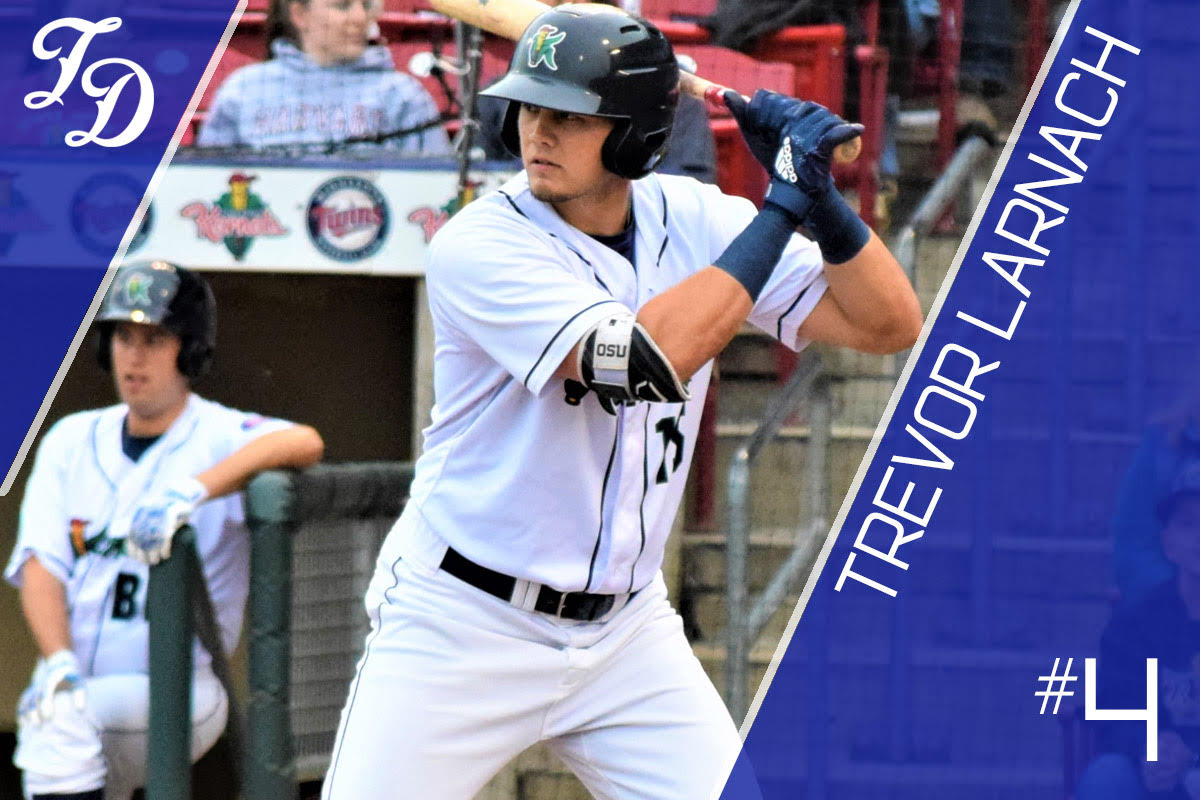 Age: 21 (DOB: 2/26/1997) 2018 Stats (Rookie/Low-A): .303/.390/.500, 13 2B, 5 HR, 3-for-3 in stolen base attempts ETA: 2021 2018 Ranking: NR National Top 100 Rankings BA: NR |MLB: NR | ESPN: NR |BP: NR What’s To Like During his junior season, Larnach went from a contributing player on a good team to a breakout star on a national title contender. He hit .348/.463/.652 with 19 home runs and 19 doubles. To put those numbers in perspective, he was a career .296/.417/.494 hitter at Oregon State. He only had three home runs during his sophomore season. Lucky for him, his hard work paid off. After taking a short break following the CWS, Larnach continued to hit when he joined the Twins organization. His professional career started in the Appy League so he could get accustom to hitting with a wood bat on a regular basis. The transition was smooth as he hit .311/.413/.492 with seven extra-base hits in 18 games for the E-Twins. Because of his college experience, Minnesota could be aggressive with Larnach. He would finish the year with over 100 plate appearances with the Cedar Rapids Kernels. After the promotion, he batted .297/.373/.505 with eight doubles and three home runs in 24 games. His excellent exit velocity was one of the reasons the Twins keyed in on Larnach. He also has a strong makeup and he is very coachable. He is a student of the game and spends countless hours studying video and working on improving his game. What’s Left To Work On At 6-foot-4 and 216 pounds, Larnach profiles as a corner outfielder and he has a strong arm to fit those positions. He will continue to add some weight to his frame. When he was drafted, he was listed at 205 but he weighed in at 216 during this past fall’s instructional league action. Even with his breakout season, he continues to refine his swing. “I’ve done everything from changing my batting stance to my mechanics like working on the load and working on the gather,” Larnach said. “I’m not done yet. There are still things I need to do.” Besides his swing, Larnach believes there are other parts of his game that can still be improved. “I’ve been working my tail off since high school,” Larnach said. “I’ve been getting results, but I feel like I can go high and develop mentally and physically.” He will never be an elite base runner, but he has the opportunity to continue to improve his base running abilities. While he continues to add weight, he needs to make sure he can continue to be an adequate base runner. He also needs to have enough speed to play a corner outfield position and he certainly has that ability at his point in his career. What’s Next Larnach could head back the MWL, where he finished last season. It seems more likely for him to spend the bulk of 2019 playing for the Fort Myers Miracle. If he hits well there to start the season, he could spend part of the season’s second half in the Blue Wahoo’s AA line-up. His work ethic and makeup should allow him to move quickly through the Twins system. It seems unlikely for him to get to Target Field before the 2021 season. Current corner outfielders Eddie Rosario and Max Kepler are under team control through the 2021 season and Alex Kirilloff is already ahead of him in the Twins system. That being said, Larnach’s bat might be strong enough to push any player out of his way. Twins Daily 2019 Top 20 Prospects Honorable Mentions 20. Jose Miranda, 2B/3B 19. Jorge Alcala, RHP 18. LaMonte Wade, OF 17. Zack Littell, RHP 16. Gilberto Celestino, OF 15. Yunior Severino, 2B 14. Ben Rortvedt, C 13. Ryan Jeffers, C 12. Stephen Gonsalves, LHP 11. Nick Gordon, SS 10. Akil Baddoo, OF 9. Blayne Enlow, RHP 8. Lewis Thorpe, LHP 7. Jhoan Duran, RHP 6. Brent Rooker, 1B/LF 5. Wander Javier, SS 4. Trevor Larnach, OF TD Top Prospects: #3- Coming Tomorrow Get to know more about Larnach and many more minor league players in the 2019 Minnesota Twins Prospect Handbook. ORDER NOW: 2019 Minnesota Twins Prospect Handbook (paperback, $17.99) ORDER NOW: 2019 Minnesota Twins Prospect Handbook (eBook, $12.99) The 2019 Minnesota Twins Prospect Handbook goes in-depth and provides player bios, scouting reports, statistics and much more on almost 160 Twins minor leaguers.
 -
It’s finally here. Our long national nightmare is over with pitchers and catchers reporting at the end of the week. Spring training can finally begin and that means regular season baseball is a little over a month away. It’s crazy to think the Twins are going to host a regular season home game at the end of March but that’s something that needed to happen with the Final Four being held in Minneapolis at the beginning of April. Thanks to everyone for this week’s mailbag questions. Let’s see what’s in the mailbox. My first thought to this question was I hope so. That being said, the Twins don’t necessarily need him to be what Logan Morrison was supposed to be last year. Morrison was brought in to be the team’s regular designated hitter. Lucas Duda is certainly not going to be give that responsibility with Nelson Cruz on the roster. Plus, Duda isn’t guaranteed any money under his deal with the Twins. He must be on the roster and contributing to get paid. Duda is left-handed so that could help him to find a place on a very right-handed heavy Twins line-up. Last season, he hit .241/.313/.418 with 29 extra-base hits in 107 games between Kansas City and Atlanta. He has a pair of 30 home run seasons under his belt including one as recent as 2017. CJ Cron, Tyler Austin, and Duda will all be battling for time at first base. A platoon with Cron or Austin versus lefties and Duda versus righties could add some power to the Twins line-up. I certainly believe the Twins think they can contend this season especially in a very open AL Central. One of the biggest keys for 2019 is making sure the young core is ready to take the next step. Byron Buxton and Miguel Sano have plenty to prove after last season. Eddie Rosario and Jose Berrios were two of the team’s best players last year but they each could be more consistent this season. Max Kepler destroyed every level of the minor leagues and he hasn’t shown that ability at baseball’s highest level. Prospects don’t always pan out, so the club needs to continue to add depth throughout the minor league system. They were able to do that in last year’s draft and by trading away assets at last year’s deadline. Last year’s club was a good example of why one-year deals don’t typically work. There were a bunch of players with no connection to the club and very little team chemistry. Minnesota is never going to outspend other teams and I doubt many big-name free agents are identifying the Twins as an ideal destination for their talents. As much as fans don’t want to hear it, the Twins need to see what their young core can do this season. Everything could come together and be great or things could crash and burn. We will have to see what players are up to the challenge. There has been some talk of teams offering Manny Machado and Bryce Harper shorter-term deal with more annual money associated with each contract. I believe both players and their agents are looking for more long-term stability. They are each reaching free agency at a young age so the next contract they sign could take them through the bulk of their formative (and defining) years in the big leagues. They need to make sure the city and team are the right fit and that the contract works for their future. I think there are a few reasons as to why the Twins wouldn’t be interested at four-years and $40 million per season. Adding another $80 million to the payroll seems like quite the jump. Minnesota needs to get into a situation where they can make more money on their television contract and that could help open the coffers for more payroll funding. I also don’t know if these two players want to be on the same team. They both have big egos and each wants to be the face of a franchise. Nick Gordon is coming off his worst season as a professional. Most of last year, Gordon was playing at Triple-A where he was four and a half years younger than the competition. He struggled mightily with Rochester by hitting .212/.262/.283. His power hasn’t developed, and he doesn’t show much patience in the batter’s box. He’s spent the off-season adding some weight to his frame, which could help him in the power department. He was a consensus top-100 MLB prospect in each of the last four off-seasons, but he didn’t make any top-100 lists this off-season. Here at Twins Daily, he dropped from the organization’s third best prospect to the club’s 12th best prospect. He was added to the 40-man roster this off-season, so I think he will make his big league debut this season. Gordon needs to find his swing at Triple-A and then he will be just a phone call away. There are certainly some trickle down effects from the big-league level all the way down to Double-A. Players throughout the system are impacted by those already ahead of them on the organizational depth chart. With that in mind, there are a lot of things that will impact who is starting at which level. I believe pitching continues to evolve and organizations are going to start taking a unique approach to the roles of starters. Chattanooga likely starts the year with a six-man rotation, but the organization most assuredly will be using more openers during the season. The Blue Wahoos’ bullpen will be equally important. If I am picking the rotation today, I think it will include Jorge Alcala, Tyler Wells, Sean Poppen, Daniel Camarena, Charlie Barnes, and Clark Beeker. Alcala was acquired from the Astros last season as part of the Ryan Pressly trade. Wells made five starts at Double-A last season and should start the year there again. Poppen spent the majority of 2018 in Chattanooga but there is depth ahead of him that will likely keep him at Double-A. Camarena was signed as a minor league free agent and hasn’t pitched yet in the Twins organization. Barnes pitched all last year at Fort Myers so he should move up a level. Beeker will be 26-years old this season, so he likely starts in Pensacola. What do you think? Leave a COMMENT and answer any of the questions above. Click here to view the article
- 45 replies
-
- 1
-
-
- lucas duda
- nick gordon
- (and 3 more)
-
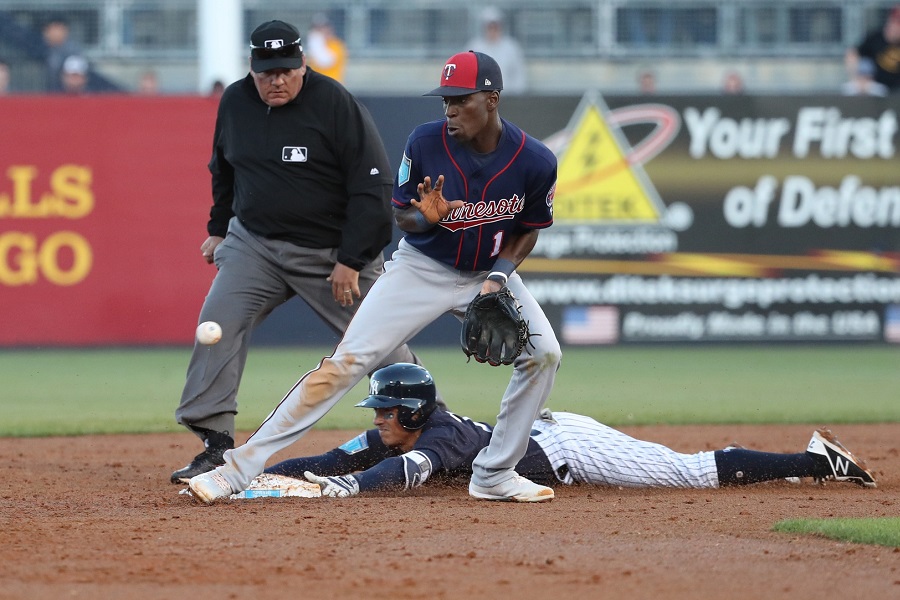 https://twitter.com/hotts58/status/1094647634290245634 My first thought to this question was I hope so. That being said, the Twins don’t necessarily need him to be what Logan Morrison was supposed to be last year. Morrison was brought in to be the team’s regular designated hitter. Lucas Duda is certainly not going to be give that responsibility with Nelson Cruz on the roster. Plus, Duda isn’t guaranteed any money under his deal with the Twins. He must be on the roster and contributing to get paid. Duda is left-handed so that could help him to find a place on a very right-handed heavy Twins line-up. Last season, he hit .241/.313/.418 with 29 extra-base hits in 107 games between Kansas City and Atlanta. He has a pair of 30 home run seasons under his belt including one as recent as 2017. CJ Cron, Tyler Austin, and Duda will all be battling for time at first base. A platoon with Cron or Austin versus lefties and Duda versus righties could add some power to the Twins line-up. https://twitter.com/MinnFan4Life/status/1094112001775886336 I certainly believe the Twins think they can contend this season especially in a very open AL Central. One of the biggest keys for 2019 is making sure the young core is ready to take the next step. Byron Buxton and Miguel Sano have plenty to prove after last season. Eddie Rosario and Jose Berrios were two of the team’s best players last year but they each could be more consistent this season. Max Kepler destroyed every level of the minor leagues and he hasn’t shown that ability at baseball’s highest level. Prospects don’t always pan out, so the club needs to continue to add depth throughout the minor league system. They were able to do that in last year’s draft and by trading away assets at last year’s deadline. Last year’s club was a good example of why one-year deals don’t typically work. There were a bunch of players with no connection to the club and very little team chemistry. Minnesota is never going to outspend other teams and I doubt many big-name free agents are identifying the Twins as an ideal destination for their talents. As much as fans don’t want to hear it, the Twins need to see what their young core can do this season. Everything could come together and be great or things could crash and burn. We will have to see what players are up to the challenge. https://twitter.com/PaulLovesTacos/status/1094016967755755520 There has been some talk of teams offering Manny Machado and Bryce Harper shorter-term deal with more annual money associated with each contract. I believe both players and their agents are looking for more long-term stability. They are each reaching free agency at a young age so the next contract they sign could take them through the bulk of their formative (and defining) years in the big leagues. They need to make sure the city and team are the right fit and that the contract works for their future. I think there are a few reasons as to why the Twins wouldn’t be interested at four-years and $40 million per season. Adding another $80 million to the payroll seems like quite the jump. Minnesota needs to get into a situation where they can make more money on their television contract and that could help open the coffers for more payroll funding. I also don’t know if these two players want to be on the same team. They both have big egos and each wants to be the face of a franchise. https://twitter.com/gary_pecinovsky/status/1094009443145170944 Nick Gordon is coming off his worst season as a professional. Most of last year, Gordon was playing at Triple-A where he was four and a half years younger than the competition. He struggled mightily with Rochester by hitting .212/.262/.283. His power hasn’t developed, and he doesn’t show much patience in the batter’s box. He’s spent the off-season adding some weight to his frame, which could help him in the power department. He was a consensus top-100 MLB prospect in each of the last four off-seasons, but he didn’t make any top-100 lists this off-season. Here at Twins Daily, he dropped from the organization’s third best prospect to the club’s 12th best prospect. He was added to the 40-man roster this off-season, so I think he will make his big league debut this season. Gordon needs to find his swing at Triple-A and then he will be just a phone call away. https://twitter.com/BlueWahoosBBall/status/1093921281458745346 There are certainly some trickle down effects from the big-league level all the way down to Double-A. Players throughout the system are impacted by those already ahead of them on the organizational depth chart. With that in mind, there are a lot of things that will impact who is starting at which level. I believe pitching continues to evolve and organizations are going to start taking a unique approach to the roles of starters. Chattanooga likely starts the year with a six-man rotation, but the organization most assuredly will be using more openers during the season. The Blue Wahoos’ bullpen will be equally important. If I am picking the rotation today, I think it will include Jorge Alcala, Tyler Wells, Sean Poppen, Daniel Camarena, Charlie Barnes, and Clark Beeker. Alcala was acquired from the Astros last season as part of the Ryan Pressly trade. Wells made five starts at Double-A last season and should start the year there again. Poppen spent the majority of 2018 in Chattanooga but there is depth ahead of him that will likely keep him at Double-A. Camarena was signed as a minor league free agent and hasn’t pitched yet in the Twins organization. Barnes pitched all last year at Fort Myers so he should move up a level. Beeker will be 26-years old this season, so he likely starts in Pensacola. What do you think? Leave a COMMENT and answer any of the questions above.
 -
Major League Baseball and the MLB Players Union are always searching for ways to improve the game. Under MLB Commissioner Rob Manfred, one of the biggest focuses has been pace of play. How can baseball speed up their games and keep younger fans interested in the action on the field? Some of the latest proposals by MLB and the MLBPA could help to alleviate some of the issues.Three-batter minimum This rule would result in a pitcher being required to pitch to a minimum of three batters upon entering a game. For teams, this could significantly reduce the number of pitching changes made by managers. It could also speed up games for team’s that like to change pitchers in the middle of an inning. During last year’s playoffs, the Brewers used left-handed pitcher Wade Miley for one batter before replacing him with right-handed pitcher Brandon Woodruff. This type of move wouldn’t be possible under this possible rule change. Universal designated hitter The MLBPA continues to push for a universal DH and they would like to have it in place for the 2019 season. That seems highly unlikely at this point. Offensive has been down across baseball so adding a DH in the National League could add some more offensive to the game. However, none of these teams have been preparing to add a DH to their roster. I believe this rule will happen at some point, but I don’t think it will be in place for the 2019 season. 20-second pitch clock One of the rules proposed by MLB last year was the implementation of a 20-second pitch clock. Manfred could put this rule in to affect for the 2019 campaign. Pitch clocks have been used in the minor leagues, so some players have already started to be accustomed to having them as part of the game. I think the pitch clock is coming and it might be happening for the current season. Mound visits Another rule that MLB can implement this year is reducing the number of mound visits from six to five. In their most recent proposal, MLB would like to reduce mound visits from six to four in 2019. Then in 2020, they would like the number of mound visits to be reduced to three. This seems like a large jump over a two-year span and I think the MLBPA will try to slow this process down. Roster size MLB would also like to expand rosters to 26 players starting in 2020. Along with that, they would like to reduce September rosters from 40 to 28. Expanding rosters from 25 to 26 would create 30 more big-league jobs and allow teams to be strategic as to what type of player they would like to have on the roster. Do they want another arm in the bullpen? Do they want a power bat for the bench? I don’t like the idea of reducing September roster sizes. We already see teams manipulate service time without using September call-ups and this seems like another way for teams to do that. Anti-tanking One of the ideas the player’s union would like addressed is the idea of teams tanking over multiple years to get a higher draft pick. In recent memory, the Astros did this to acquire high picks over multiple years. From this, they have built a very strong roster. The union would like a team’s draft position to be lowered if the club fails to reach a certain number of wins across multiple seasons. What rule changes would you like to see? Leave a COMMENT and start the discussion. Click here to view the article
-
Possible MLB Rule Changes: Universal DH? Roster size? Anti-tanking?
Cody Christie posted an article in Twins
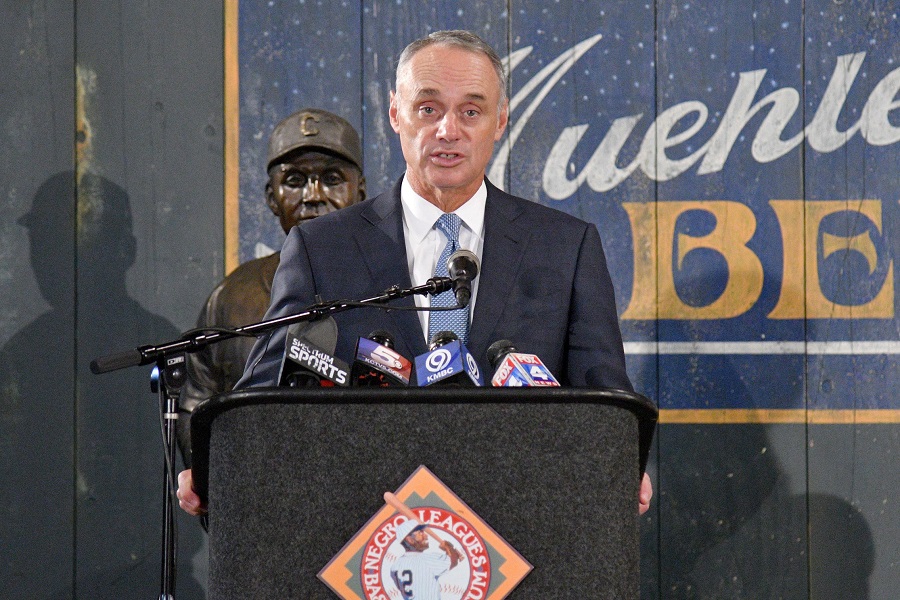 Three-batter minimum This rule would result in a pitcher being required to pitch to a minimum of three batters upon entering a game. For teams, this could significantly reduce the number of pitching changes made by managers. It could also speed up games for team’s that like to change pitchers in the middle of an inning. During last year’s playoffs, the Brewers used left-handed pitcher Wade Miley for one batter before replacing him with right-handed pitcher Brandon Woodruff. This type of move wouldn’t be possible under this possible rule change. Universal designated hitter The MLBPA continues to push for a universal DH and they would like to have it in place for the 2019 season. That seems highly unlikely at this point. Offensive has been down across baseball so adding a DH in the National League could add some more offensive to the game. However, none of these teams have been preparing to add a DH to their roster. I believe this rule will happen at some point, but I don’t think it will be in place for the 2019 season. 20-second pitch clock One of the rules proposed by MLB last year was the implementation of a 20-second pitch clock. Manfred could put this rule in to affect for the 2019 campaign. Pitch clocks have been used in the minor leagues, so some players have already started to be accustomed to having them as part of the game. I think the pitch clock is coming and it might be happening for the current season. Mound visits Another rule that MLB can implement this year is reducing the number of mound visits from six to five. In their most recent proposal, MLB would like to reduce mound visits from six to four in 2019. Then in 2020, they would like the number of mound visits to be reduced to three. This seems like a large jump over a two-year span and I think the MLBPA will try to slow this process down. Roster size MLB would also like to expand rosters to 26 players starting in 2020. Along with that, they would like to reduce September rosters from 40 to 28. Expanding rosters from 25 to 26 would create 30 more big-league jobs and allow teams to be strategic as to what type of player they would like to have on the roster. Do they want another arm in the bullpen? Do they want a power bat for the bench? I don’t like the idea of reducing September roster sizes. We already see teams manipulate service time without using September call-ups and this seems like another way for teams to do that. Anti-tanking One of the ideas the player’s union would like addressed is the idea of teams tanking over multiple years to get a higher draft pick. In recent memory, the Astros did this to acquire high picks over multiple years. From this, they have built a very strong roster. The union would like a team’s draft position to be lowered if the club fails to reach a certain number of wins across multiple seasons. What rule changes would you like to see? Leave a COMMENT and start the discussion.
 -
Pitching is changing and organizations are trying to find the best way to take advantage of the arms in their system. Clubs have started to utilize an opener so that the starting pitcher can avoid pitching to the top of the line-up during the first inning. It also seems like teams are turning to their bullpens much more frequently. With pitching evolving, it’s hard to predict what young pitchers might be asked to do at the big-league level. Will pitchers be asked to throw 200 innings on a regular basis? Or can teams be more effective by using more pitchers and limiting their innings? No matter what happens moving forward, Blayne Enlow looks like an arm that will provide plenty of value for the Twins.Age: 19 (DOB: 3-21-1999) 2018 Stats (Low-A): 94.0 IP, 3.26 ERA, 71/35 K/BB, 1.37 WHIP ETA: 2022 2018 Ranking: 8 National Top 100 Rankings BA: NR |MLB: NR | ESPN: NR |BP: NR What’s To Like Enlow could be entering his sophomore season at LSU but Minnesota was able to steal him in the third round of the 2017 Draft. They had to go over slot to get him, but the team wanted him badly enough to make the move. It also helped that the club had saved some money on signing Royce Lewis with the number one overall pick. In his professional debut, Enlow burst onto the scene with the GCL Twins. He posted a 1.33 ERA and a 0.69 WHIP in 20.1 innings. He only allowed three earned runs and he posted 19 to 4 strikeout to walk ratio. It certainly seemed like the Twins aggressive draft strategy was paying off. Minnesota continue to be aggressive with Enlow in 2018. Instead of pitching for the E-Twins, he was bumped up to Cedar Rapids. In his last 10 appearances (53.1 IP), he had a 2.36 ERA and a 40 to 17 strikeout to walk ratio. His inning total increased over the season’s final months and he ended August with an 8.9 K/9 mark. His fastball can reach the mid-90s and his curveball continues to be a strong pitch. When he was drafted, MLB.com’s Jim Callis called it the best curveball in the draft. That placed him ahead of multiple college arms. His delivery allows him to put a lot of movement on his pitches. What’s Left To Work On He has a good one-two punch with his fastball and curveball, but he needs time to continue to develop other secondary pitches. He worked on a changeup this season and hopes are that he will be able to continue to work on his secondary pitches as he continues to pitch more professional innings. He continues to have the opportunity to grow into a better pitcher, which should come as he works his way through the system. During the 2018 campaign, Enlow was placed on the DL multiple times with muscle strains. His highest pitch total was 87 last year and he reached that total on three separate occasions. Other than that, there were only three other times he crossed the 80-pitch mark. Enlow averaged just under 67 pitches per game. He should get stretched out even more during the coming season. By pitching deeper into games, Enlow will get the opportunity to work more regularly on his secondary pitches. This will make him a stronger pitching prospect as he pitches his way towards Target Field. What’s Next After spending last season in Cedar Rapids, Enlow should spend all of 2019 pitching for Fort Myers. Minnesota will continue to take their time with Enlow since he is young and continuing to work with his secondary pitches. At this point, it is about him adding strength to his frame and building up his innings totals. Starting pitching continues to evolve, especially with addition of openers and more frequent use of bullpen options. By the time Enlow makes it to the big leagues, starting pitchers might only be asked to make it through the line-up a couple of times. With his top two pitches, he might be a dangerous arm no matter what role he is given. TD Top Prospects: Honorable Mention TD Top Prospects: 16-20 TD Top Prospects: 11-15 TD Top Prospects: #10 Akil Baddoo TD Top Prospects: #9 Blayne Enlow TD Top Prospects: #8- Coming Tomorrow! Get to know more about Enlow and many more minor league players in the 2019 Minnesota Twins Prospect Handbook. ORDER NOW: 2019 Minnesota Twins Prospect Handbook (paperback, $17.99) ORDER NOW: 2019 Minnesota Twins Prospect Handbook (eBook, $12.99) The 2019 Minnesota Twins Prospect Handbook goes in-depth and provides player bios, scouting reports, statistics and much more on almost 160 Twins minor leaguers. Click here to view the article
-
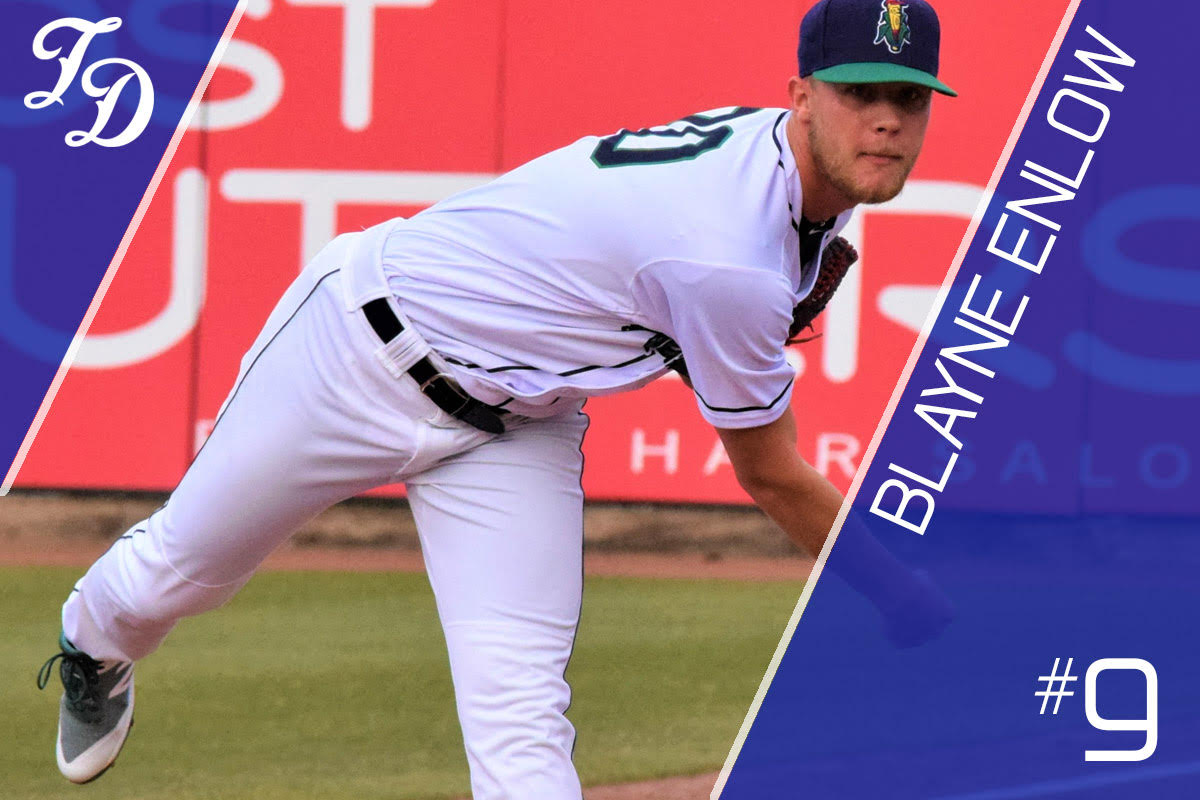 Age: 19 (DOB: 3-21-1999) 2018 Stats (Low-A): 94.0 IP, 3.26 ERA, 71/35 K/BB, 1.37 WHIP ETA: 2022 2018 Ranking: 8 National Top 100 Rankings BA: NR |MLB: NR | ESPN: NR |BP: NR What’s To Like Enlow could be entering his sophomore season at LSU but Minnesota was able to steal him in the third round of the 2017 Draft. They had to go over slot to get him, but the team wanted him badly enough to make the move. It also helped that the club had saved some money on signing Royce Lewis with the number one overall pick. In his professional debut, Enlow burst onto the scene with the GCL Twins. He posted a 1.33 ERA and a 0.69 WHIP in 20.1 innings. He only allowed three earned runs and he posted 19 to 4 strikeout to walk ratio. It certainly seemed like the Twins aggressive draft strategy was paying off. Minnesota continue to be aggressive with Enlow in 2018. Instead of pitching for the E-Twins, he was bumped up to Cedar Rapids. In his last 10 appearances (53.1 IP), he had a 2.36 ERA and a 40 to 17 strikeout to walk ratio. His inning total increased over the season’s final months and he ended August with an 8.9 K/9 mark. His fastball can reach the mid-90s and his curveball continues to be a strong pitch. When he was drafted, MLB.com’s Jim Callis called it the best curveball in the draft. That placed him ahead of multiple college arms. His delivery allows him to put a lot of movement on his pitches. What’s Left To Work On He has a good one-two punch with his fastball and curveball, but he needs time to continue to develop other secondary pitches. He worked on a changeup this season and hopes are that he will be able to continue to work on his secondary pitches as he continues to pitch more professional innings. He continues to have the opportunity to grow into a better pitcher, which should come as he works his way through the system. During the 2018 campaign, Enlow was placed on the DL multiple times with muscle strains. His highest pitch total was 87 last year and he reached that total on three separate occasions. Other than that, there were only three other times he crossed the 80-pitch mark. Enlow averaged just under 67 pitches per game. He should get stretched out even more during the coming season. By pitching deeper into games, Enlow will get the opportunity to work more regularly on his secondary pitches. This will make him a stronger pitching prospect as he pitches his way towards Target Field. What’s Next After spending last season in Cedar Rapids, Enlow should spend all of 2019 pitching for Fort Myers. Minnesota will continue to take their time with Enlow since he is young and continuing to work with his secondary pitches. At this point, it is about him adding strength to his frame and building up his innings totals. Starting pitching continues to evolve, especially with addition of openers and more frequent use of bullpen options. By the time Enlow makes it to the big leagues, starting pitchers might only be asked to make it through the line-up a couple of times. With his top two pitches, he might be a dangerous arm no matter what role he is given. TD Top Prospects: Honorable Mention TD Top Prospects: 16-20 TD Top Prospects: 11-15 TD Top Prospects: #10 Akil Baddoo TD Top Prospects: #9 Blayne Enlow TD Top Prospects: #8- Coming Tomorrow! Get to know more about Enlow and many more minor league players in the 2019 Minnesota Twins Prospect Handbook. ORDER NOW: 2019 Minnesota Twins Prospect Handbook (paperback, $17.99) ORDER NOW: 2019 Minnesota Twins Prospect Handbook (eBook, $12.99) The 2019 Minnesota Twins Prospect Handbook goes in-depth and provides player bios, scouting reports, statistics and much more on almost 160 Twins minor leaguers.
 -
After the Polar Vortex gripped most of Twins Territory, it seems strange that pitchers and catchers will be reporting to Fort Myers in the days ahead. The Twins still have plenty of questions to answer about their roster before the team heads to Target Field for Opening Day. Who catches the most innings? Could the Twins sign a big-name closer? Why did the team ditch their cream-colored alternate jerseys? All of those questions and more will be answered in this week’s Twins Daily Mailbag. When it comes to the man behind the plate, it seems likely for Jason Castro and Mitch Garver to split time. Castro is coming off a major injury, but he should be able to go full-steam ahead with spring training starting. Mitch Garver caught almost 670 innings last season and hit .268/.335/.414. Those are very respectable numbers for a back-stop. Garver might seem like a young player but he will already be 28 next season. I think the Twins will rotate through both these players and allow them to work with specific pitchers to build a rapport. Willians Astudillo has become someone of a cult hero over the last year but I can’t see him filling more than a third catcher role with this team. Obviously, an injury to Castro or Garver could change the plan. Astudillo showed some defensive flexibility last year but it hardly seems likely for the team to give him a utility job. My guess is they carry two catchers and Astudillo isn’t one of them. Another catching option for the Twins is newly signed Wilin Rosario. He hasn’t played in the big leagues since 2015 when he was with the Rockies organization. In his five big league seasons, he has combined to hit .273/.306/.473 including two seasons with 20+ home runs. He spent the 2016-17 seasons playing overseas in the KBO, as he hit .330/.390/.625 while averaging 35 home runs per season. Last year, Rosario played in Japan and hit .242/.285/.374 with eight home runs. While some of those numbers sound good, the Twins are not giving him an invite to big league camp. This seems strange since almost every catcher in the system gets a chance to help at big league camp at some point. He will provide some organization depth to start the year. Depending on how he hits in the minors, he could be added to the team later in the year. As many people know, the Twins have gotten rid of their cream alternate home jerseys in favor of a new blue jersey. These new threads incorporate the Kasota gold colors the team has embraced since the 2014 All-Star Game. I was disappointed to see the cream-colored jerseys go because they reminded me of the early Target Field years with Jim Thome cranking home runs to all parts of the field. They had a throwback feel to them, but the team decided to go in a different direction. From the team’s perspective, rotating alternate jerseys is a good way to keep fans interested in buying new gear. Most likely, everyone that wanted a cream color jersey already bought one. At the beginning of the 2016 season, the club had added in the red home alternate jerseys. Adding in a new color, allows the team to bring in a little extra. However, I believe the team only gets the revenue if the jerseys are purchased at an official team store. Either way, this was an opportunity for the team to rebrand and for fans to pick up another jersey of their favorite player. Manny Machado and Bryce Harper are still free agents and spring training is days away from starting. Back in January, Buster Olney thought the Twins could be a mystery team for Machado or Harper because of their payroll flexibility. Minnesota has almost no guaranteed money on the books beyond this season so adding a franchise altering player could help push this team to the next level. At TwinsFest, it sounded like the Twins have very little interest in going after either of the mega-free agents. “My view … for doing it is the best time to acquire players of that magnitude is when your window to win is wide open,” Levine said to the crowd. “Not when you’re got your fingers underneath the window and you’re trying to jam the window open. I want to do it when we’re projected to win the Central and we’re ready to put our foot on someone’s throat.” Craig Kimbrel is the number one relief pitcher on the market. He’s a seven-time All-Star and he has topped the 30 save mark in eight consecutive seasons. He will be 31-years old next season and he hasn’t shown many signs of slowing down in recent years. He’s only pitched more than 70 innings in one season so it’s not like he has a ton of wear and tear on his arm. If you follow the trail of this tweet, the Twins seem to be one of the teams in the running for Kimbrel. Jon Heyman, a well-respected national baseball writer, named the Twins as a possible landing spot for Kimbrel. Paul Crane is based out of Atlanta so he might have connections to Kimbrel and his camp from during his Braves tenure. This might be one of the reasons none of the Minneapolis beat writers are reporting on it at this point. Does Kimbrel make sense for the Twins? I’m never a big fan of offering multi-year deals to aging relief pitchers. That being said, three-years and $45 million certainly wouldn’t hinder the team during the life of the contract. Also, he could be an intriguing trade piece if the Twins aren’t in contention. Do you think the Twins should sign Kimbrel? Who catches the most innings for the Twins next year? Leave a COMMENT and start the discussion. Click here to view the article
-
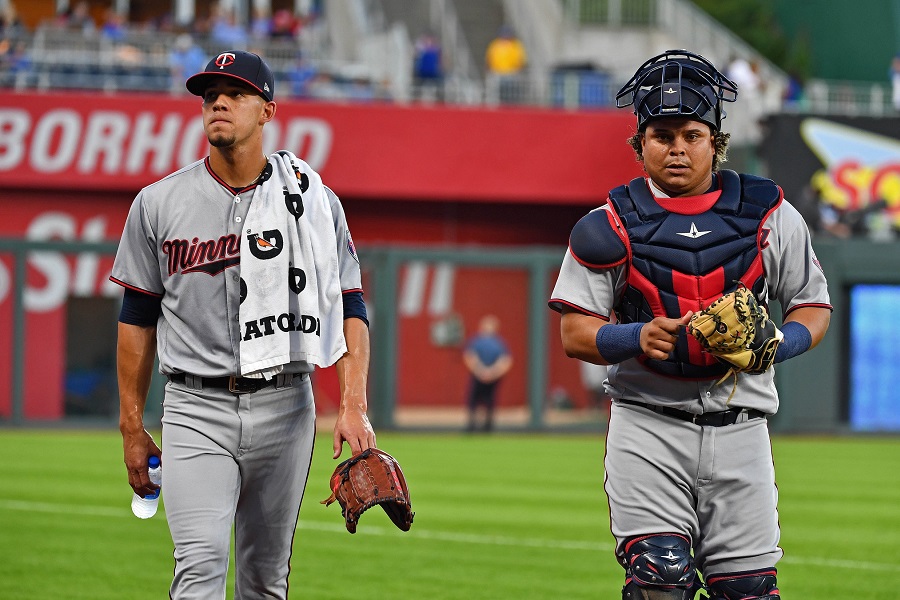 https://twitter.com/hotts58/status/1091534395670962177 When it comes to the man behind the plate, it seems likely for Jason Castro and Mitch Garver to split time. Castro is coming off a major injury, but he should be able to go full-steam ahead with spring training starting. Mitch Garver caught almost 670 innings last season and hit .268/.335/.414. Those are very respectable numbers for a back-stop. Garver might seem like a young player but he will already be 28 next season. I think the Twins will rotate through both these players and allow them to work with specific pitchers to build a rapport. Willians Astudillo has become someone of a cult hero over the last year but I can’t see him filling more than a third catcher role with this team. Obviously, an injury to Castro or Garver could change the plan. Astudillo showed some defensive flexibility last year but it hardly seems likely for the team to give him a utility job. My guess is they carry two catchers and Astudillo isn’t one of them. https://twitter.com/hotts58/status/1092114226045423617 Another catching option for the Twins is newly signed Wilin Rosario. He hasn’t played in the big leagues since 2015 when he was with the Rockies organization. In his five big league seasons, he has combined to hit .273/.306/.473 including two seasons with 20+ home runs. He spent the 2016-17 seasons playing overseas in the KBO, as he hit .330/.390/.625 while averaging 35 home runs per season. Last year, Rosario played in Japan and hit .242/.285/.374 with eight home runs. While some of those numbers sound good, the Twins are not giving him an invite to big league camp. This seems strange since almost every catcher in the system gets a chance to help at big league camp at some point. He will provide some organization depth to start the year. Depending on how he hits in the minors, he could be added to the team later in the year. https://twitter.com/Hey_Yo_Its_GMan/status/1091530143514984448 As many people know, the Twins have gotten rid of their cream alternate home jerseys in favor of a new blue jersey. These new threads incorporate the Kasota gold colors the team has embraced since the 2014 All-Star Game. I was disappointed to see the cream-colored jerseys go because they reminded me of the early Target Field years with Jim Thome cranking home runs to all parts of the field. They had a throwback feel to them, but the team decided to go in a different direction. From the team’s perspective, rotating alternate jerseys is a good way to keep fans interested in buying new gear. Most likely, everyone that wanted a cream color jersey already bought one. At the beginning of the 2016 season, the club had added in the red home alternate jerseys. Adding in a new color, allows the team to bring in a little extra. However, I believe the team only gets the revenue if the jerseys are purchased at an official team store. Either way, this was an opportunity for the team to rebrand and for fans to pick up another jersey of their favorite player. https://twitter.com/gary_pecinovsky/status/1091046086477791232 Manny Machado and Bryce Harper are still free agents and spring training is days away from starting. Back in January, Buster Olney thought the Twins could be a mystery team for Machado or Harper because of their payroll flexibility. Minnesota has almost no guaranteed money on the books beyond this season so adding a franchise altering player could help push this team to the next level. At TwinsFest, it sounded like the Twins have very little interest in going after either of the mega-free agents. “My view … for doing it is the best time to acquire players of that magnitude is when your window to win is wide open,” Levine said to the crowd. “Not when you’re got your fingers underneath the window and you’re trying to jam the window open. I want to do it when we’re projected to win the Central and we’re ready to put our foot on someone’s throat.” https://twitter.com/filmreviewbyme/status/1091413247134068736 Craig Kimbrel is the number one relief pitcher on the market. He’s a seven-time All-Star and he has topped the 30 save mark in eight consecutive seasons. He will be 31-years old next season and he hasn’t shown many signs of slowing down in recent years. He’s only pitched more than 70 innings in one season so it’s not like he has a ton of wear and tear on his arm. If you follow the trail of this tweet, the Twins seem to be one of the teams in the running for Kimbrel. Jon Heyman, a well-respected national baseball writer, named the Twins as a possible landing spot for Kimbrel. Paul Crane is based out of Atlanta so he might have connections to Kimbrel and his camp from during his Braves tenure. This might be one of the reasons none of the Minneapolis beat writers are reporting on it at this point. Does Kimbrel make sense for the Twins? I’m never a big fan of offering multi-year deals to aging relief pitchers. That being said, three-years and $45 million certainly wouldn’t hinder the team during the life of the contract. Also, he could be an intriguing trade piece if the Twins aren’t in contention. Do you think the Twins should sign Kimbrel? Who catches the most innings for the Twins next year? Leave a COMMENT and start the discussion.
 -
On the field, Byron Buxton’s emergence might be the most important key to the Twins winning next season. While Buxton is key on the field, new manager Rocco Baldelli has a lot to prove to the front office and to Twins Territory. Right now, he is saying all of the right things but winning and losing go a long way to prove, or not, a manager’s worth. Can Rocco bring the Twins into the modern managerial world? It could be crucial if the Twins want to win back the AL Central.Twins owner Jim Pohlad said Paul Molitor would continue to manage the club when Derek Falvey and Thad Levine took over the Twins front office. Molitor would win the AL Manager of the Year Award in 2017 as the Twins surprisingly qualified for the final Wild Card spot. It was hard to dump him at that point so Falvey and Levine stuck with him for one more season. Even with the Twins finishing second in the AL Central, the writing on the wall was clear: The new front office wanted a more forward-thinking manager to steer the Twins back into contention. Molitor was removed from his managerial duties and the Twins went on the hunt for a modern manager. Enter Rocco Baldelli. Baldelli’s once promising playing career was cut short by illness and injuries. He joined the Tampa Bay Rays as an assistant and then was a coach in the years since he was forced to retire. Last season, he was given the title of major league field coordinator. This allowed him to work with the manager on in-game strategy while continuing to work to develop the team’s younger players. Now the 37-year old is tasked with turning around a core of young Twins players that need their own development. Players like Byron Buxton and Miguel Sano underachieved throughout 2018. So far this off-season, Baldelli has visited both of these players at their homes. Just one of the first signs of his abilities to connect with players. Baldelli should also bring some new ideas to the Twins managerial position. Tampa Bay has long been considered a hotbed for forward-thinking coaches. Baldelli played almost his entire career in the Tampa Bay organization and even played under Joe Maddon, who is considered one of the game’s best managers. One of the new things Baldelli could bring to the Twins is a comfort with a concept like the opener. This was originated with the Rays last season and Minnesota has some in-house options that could slide nicely into an opener role. Minnesota started using openers throughout their system last season but Baldelli might make this a regular occurrence for big league pitchers. He’s also mentioned that he wants players to be more mentally prepared for the game. Baldelli even mentioned that the players might not always be ready physically, but he needs them to have their heads in the right place for this team to find success. As a player, he fought through plenty of injuries, so this seems a likely focal point for the new manager. Baldelli will need to establish his culture in spring training and the early months of the season. He’s been saying all the right things but winning isn’t going to happen overnight. Minnesota’s window of opportunity is just starting to open and the club needs Baldelli to take them to the next level. What can Baldelli do for the club in 2019? Leave a COMMENT and start the discussion. Click here to view the article
- 19 replies
-
- 1
-
-
- rocco baldelli
- paul molitor
- (and 3 more)
-
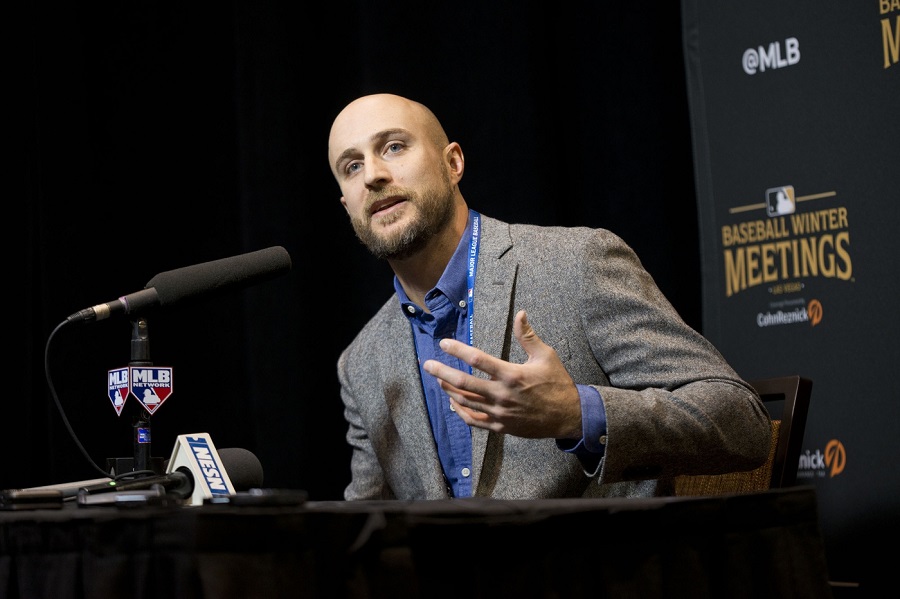 Twins owner Jim Pohlad said Paul Molitor would continue to manage the club when Derek Falvey and Thad Levine took over the Twins front office. Molitor would win the AL Manager of the Year Award in 2017 as the Twins surprisingly qualified for the final Wild Card spot. It was hard to dump him at that point so Falvey and Levine stuck with him for one more season. Even with the Twins finishing second in the AL Central, the writing on the wall was clear: The new front office wanted a more forward-thinking manager to steer the Twins back into contention. Molitor was removed from his managerial duties and the Twins went on the hunt for a modern manager. Enter Rocco Baldelli. Baldelli’s once promising playing career was cut short by illness and injuries. He joined the Tampa Bay Rays as an assistant and then was a coach in the years since he was forced to retire. Last season, he was given the title of major league field coordinator. This allowed him to work with the manager on in-game strategy while continuing to work to develop the team’s younger players. Now the 37-year old is tasked with turning around a core of young Twins players that need their own development. Players like Byron Buxton and Miguel Sano underachieved throughout 2018. So far this off-season, Baldelli has visited both of these players at their homes. Just one of the first signs of his abilities to connect with players. Baldelli should also bring some new ideas to the Twins managerial position. Tampa Bay has long been considered a hotbed for forward-thinking coaches. Baldelli played almost his entire career in the Tampa Bay organization and even played under Joe Maddon, who is considered one of the game’s best managers. One of the new things Baldelli could bring to the Twins is a comfort with a concept like the opener. This was originated with the Rays last season and Minnesota has some in-house options that could slide nicely into an opener role. Minnesota started using openers throughout their system last season but Baldelli might make this a regular occurrence for big league pitchers. He’s also mentioned that he wants players to be more mentally prepared for the game. Baldelli even mentioned that the players might not always be ready physically, but he needs them to have their heads in the right place for this team to find success. As a player, he fought through plenty of injuries, so this seems a likely focal point for the new manager. Baldelli will need to establish his culture in spring training and the early months of the season. He’s been saying all the right things but winning isn’t going to happen overnight. Minnesota’s window of opportunity is just starting to open and the club needs Baldelli to take them to the next level. What can Baldelli do for the club in 2019? Leave a COMMENT and start the discussion.
