-
Posts
25,652 -
Joined
-
Last visited
-
Days Won
109
Content Type
Profiles
News
Minnesota Twins Videos
2026 Minnesota Twins Top Prospects Ranking
2022 Minnesota Twins Draft Picks
Minnesota Twins Free Agent & Trade Rumors, Notes, & Tidbits
Guides & Resources
2023 Minnesota Twins Draft Picks
The Minnesota Twins Players Project
2024 Minnesota Twins Draft Picks
2025 Minnesota Twins Draft Pick Tracker
Forums
Blogs
Events
Store
Downloads
Gallery
Everything posted by Seth Stohs
-

2013 was a big year for Brian Dozier. He had been hyped (maybe over-hyped) in spring training in 2012, and when he finally made his big league debut as a 24-year-old in early May, it proved to be a major struggle for him. Dozier learned a lot from 2012, and came into 2013 ready to take the next step. By season’s end, he was an easy choice for the Twins' most improved player. Some even made an argument that he could have been named the team’s MVP.[PRBREAK][/PRBREAK] To understand where Dozier entered 2013, we really need to go back and look at his 2012. He was named the 2011 Twins' Minor League Hitter of the Year. When he came up in 2012, he hit just .234/.271/.332 (.603) in 84 games. He was sent down to Rochester in mid-August and did not get called up when rosters expanded in September. However, when he came to Fort Myers for spring training 2013, he was handed a new job, starting second baseman. His defense at the position solidified his roster spot. But after going 1-5 with on May 27 he was hitting just .197/.238/.270 (.508). To their credit, the Twins stood by him, and he made that decision look great. In his final 110 games of the season, he hit .259/.335/.461 (.796) with 30 doubles, two triples and 17 home runs. It was a topic that Parker Hageman addressed in spring training when he said Dozier’s swing was something that Twins fans needed to watch. In August, Parker went back and reviewed Dozier’s swing and showed some of the reasons behind his improved production. Dozier gave a lot of credit to hitting coach Tom Brunansky for working with him through a couple technical glitches. A quick look at how his numbers after May 27 compare to other top second basemen shows that he can play with the best. His .796 ranked behind only Robinson Cano, Matt Carpenter, Jason Kipnis, and Chase Utley. His 49 extra base hits was behind only Carpenter’s 54 (39 doubles, 7 triples, 8 home runs) and three ahead of Cano (30 doubles, 14 home runs). No one else had more than 38 (Kipnis). Dozier’s defense was a constant throughout the 2013 season, as well. He made enough great plays to fill up a couple highlight reels. At season’s end, he was named the Twins recipient of the Wilson’s Twins Top Defender. Now, Dozier will be the first to tell you he’s still got plenty of room for improvement. He would like to increase his batting average, something that would be helped by cutting down his strikeout count. Overall, he hit .244/.312/.414. His OPS of .726 was exactly league average. However, his WAR (by Baseball-Reference) was 3.8, and his Fan Graphs WAR was 2.8. Photo by Betsy Bissen The Twins will be counting on Dozier to continue that improvement track in 2014. In 2013, his emergence was certainly one of the bigger Twins stories. A look at other Twins stories from 2013 includes: #13 – Twins in the WBC #12 – Drew Butera Traded to Dodgers #11 – Twins Sign Kubel, Trade Doumit
-
As happens every three years, Major League Baseball's Spring Training gets interrupted by the World Baseball Classic. Some teams had to qualify in the fall of 2012 but by March, 2013 teams comprised of players from 16 countries participated. In 2013, the Minnesota Twins were very well represented in the WBC. Several players contributed with very impressive performances, and several helped unexpected teams advance in the tournament. [PRBREAK][/PRBREAK] Let's start with the teams that advanced to the final, championship round of the WBC. The Dominican Republic beat Netherlands in one semi-final game while Puerto Rico beat two-time WBC defending champion, Japan. In the championship game, the Dominican Republic was victorious. One of the heroes of that Dominican Republic team was none other than the Twins' Sam Deduno. He went 2-0 in his three starts in the tournament. He was the winning pitcher in the championship game. In 13 WBC innings, he gave up 11 hits, walked five and struck out 17, working his curveball as his strikeout pitch and showing exuberance that was fun to watch. Two young Twins' prospects competed for the Puerto Rico team. In an outfield that had Angel Pagan in center and Alex Rios in right, Eddie Rosario split time in left field with veteran Jesus Feliciano. Rosario played very well last winter in the Puerto Rican Winter League, then went 3-14 in the tournament with a double. Also on the roster was youngster JO Berrios, working out of the bullpen. He did strike out Robinson Cano, but he did give up four runs in his two innings over two games. Netherlands was the surprise WBC team in the 2009 Classic. This time around, they didn't surprise teams, but they still got to the finals. Tom Stuifbergen had been a hero for the team in '09, but he struggled in 2013: in three games, he gave up eight earned runs in 6.1 innings. Shairon Martis gave up four earned runs in seven innings over two games. Team USA created a lot of discussion and controversy. While the top players from many other countries were playing for their homeland, many of the top players from the US said "No". However, two Twins' All-Stars represented the Twins and the Stars and Stripes. Joe Mauer, the teams cleanup hitter, caught a couple games and was the team's DH in the other games. He came through by going 9-21, hitting .429/.538/.619 (1.158) with two doubles and a triple. Glen Perkins was named to the bullpen by manager Joe Torre. He pitched in just two games and two innings. He gave up two earned runs on two walks and three hits while striking out two. The surprise team of the 2013 WBC was the from Italy. Most of the players on the roster were qualified due to distant, generational relations. The Twins' Chris Colabello and his parents had lived in Italy for several years. Colabello had played for Team Italy in youth tournaments. In this Classic, he went 6-18 with two homers and seven RBI, hitting .333/.368/.667 (1.035). Drew Butera went just 3-16, but each of his hits was big, including an RBI double and a big home run. Former Twins player Nick Punto hit .421 and posted a 1.003 OPS in the tournament. Australia didn't get out of the first round. Shortstop James Beresford went 2-11 in the round. Finally, the team from Canada also had a first-round exit though Justin Morneau did all he could, though. Morneau went 7-11. He hit .636/.692/.909 (1.601) with three doubles. The only hitter in the tournament who put up more impressive numbers was his teammate, outfielder Michael Saunders. Andrew Albers pitched three innings in one game for the Canadian team and gave up two runs on six hits. He walked none and struck out five. Albers and former Twins outfielder Rene Tosoni were involved in an event that may be the most memorable play of the 2013 WBC. Tosoni was the batter hit by a Jose Leon pitch after third baseman Luis Cruz essentially told him to (following a Chris Robinson bunt). A brawl ensued and there were several ejections, including Tosoni and Albers. http://www.youtube.com/watch?v=eAtGT-fFvr0 The WBC is an interesting topic of discussion for baseball fans. Is there a good time for it? Should the best players play? If you were an owner, would you want your top players playing for their country and risking injury (see the Mark Teixeira situation). It is a good opportunity for some players and teams to get extra recognition. It is fun. It is what it is in terms of importance. And it was a part of 2013 for many players in the Twins' system.
-
No one would ban you for expressing a well thought-out opinion. It's completely fair to make the comments that you are about GATG. It would be completely fair for people to not like or enjoy the Twins Hangouts that Jeremy and I have been doing. The goals of the two shows are very different. The Talk to Contact podcast does some great work too. The nice thing is that Twins fans have options. And, part of the beauty of Twins Daily is that it is OK for not everyone to agree about Twins topics or format of a podcast. All we ask if that people do it in a well thought-out manner. (and if you do get banned, let me know )
-
2013 was another difficult season for the Minnesota Twins and their fans. However, that does not meant that are not some terrific stories that came out of the season. As we look to the hope these holidays bring, I think there are stories from the Twins that can inspire hope in anyone. Poor performances and injuries created opportunities that might not have been available in a typical, or at least a more successful, season. The stories of Andrew Albers, Doug Bernier, Chris Colabello and Caleb Thielbar are great reminders of believing in yourself and following your dreams.[PRBREAK][/PRBREAK] As we look back at 2013 and build hope for 2014, these stories are worth highlighting. Caleb Thielbar had a tremendous rookie campaign with the Twins in 2013. He was my choice (and the Twins Baseball Writers’ choice) for 2013 Twins Rookie of the year. Thielbar was an 18th round pick of the Milwaukee Brewers in 2009 after four years at South Dakota State. By 2011, he was pitching out of the bullpen for the independent St. Paul Saints. He pitched well and ended the season making three appearances with the Ft. Myers Miracle. In 2012, he began with seven games with the Miracle followed by 16 games with New Britain. He ended the season with 25 games in Rochester. That’s where he began the 2013 season. He struck out 34 batters in 26.1 innings over 17 appearances with the Red Wings. On May 20, he made his major league debut in Atlanta. Facing the Braves, he struck out three in two innings. On the final day of May, he made his first Target Field appearance for the Twins and struck out two in a perfect inning against the Seattle Mariners. Making the story even better, Thielbar is a Randolph, MN, native, a small town not far from the Twin Cities. He grew up watching the Twins and in 2013 his unconventional baseball journey had him putting on a Twins uniform and playing at home. ---------- In 2011, Chris Colabello was named the Independent Leagues Player of the Year by Baseball America after a remarkable season for Worcester of the Canadian-American Association. He had played in the league since the 2005 season after graduating from Division II Assumption. Before the 2012 season, the Twins gave Colabello an opportunity and he has made the most of it. He had one previous opportunity, having gone to minor league camp with the Detroit Tigers. However, after that camp, he returned to Worcester. With the Twins, he put up solid numbers in 2012 with New Britain. He had a remarkable winter season in Mexico and earned an invitation to big league spring training. He was also a key member of the improbably-successful Team Italy in the World Baseball Classic. He impressed at camp and was sent to Rochester. In 89 games with the Red Wings, he hit .352/.427/.639 (1.066) and was named the International League’s MVP and Rookie of the Year. Late on May 21, Colabello got the call. He hopped a late flight to Atlanta and was in the lineup on the afternoon of the 22nd against the Braves. He made the trip between Rochester and the Twins several times throughout the season. In all, he spent 81 days on the Twins 25 man roster. Colabello speaks of trusting a process and knowing that a person can’t control some things. It is a philosophy that has been great for him. He told me in September that he wants to prove that he can stick in the big leagues for a while. Recently, it was reported by Mike Berardino of the Pioneer Press that Colabello had an opportunity to earn about $1 million for playing in South Korea in 2014. He has declined that opportunity, choosing instead to continue to bet on himself and his dreams. ---------- Andrew Albers is from North Battleford, Saskatchewan, Canada. He found his way to the University of Kentucky where he spent four years, splitting time between the rotation and the bullpen. He was a 10th round pick of the San Diego Padres in 2008. He missed all of 2009 with Tommy John surgery and while recovering in spring training of 2010 he was released. He signed with Quebec of the Can-Am Association and recorded 17 saves in 40 appearances. His story of trying to get an affiliated team to sign him for spring training in 2011 is the stuff of made-for-TV movies (or bigger). While in Arizona, working to get tryouts, he worked with his college coach and tried to get a tryout with the Twins. While the Twins were deciding if they should fly him to Ft. Myers for a tryout, Albers called the Twins back and said he would drive to Ft. Myers. If the Twins signed him, they could reimburse his travel expense. If they didn’t, he would drive back home to Saskatchewan. The Twins liked what they saw enough to invite him to minor league spring training. He earned a spot with the Miracle, though obtaining a work visa meant his season would be delayed a bit. He posted a 1.55 ERA in 22 games with the Miracle and moved up to New Britain where he posted a 2.91 ERA in 13 games. Of his 35 appearances, he made seven starts and was my choice for Twins Minor League Relief Pitcher of the Year. In 2012 he fought injury, but in 17 starts (and two relief appearances), he was 4-3 with a 3.75 ERA. In 2013, in the WBC, Albers pitched well for Canada. He began the 2013 season as the fifth starter for the Rochester Red Wings. He was clearly the team’s most consistent starting pitcher. He made 22 starts and went 11-5 with a 2.86 ERA. In 132.1 innings, he struck out 116, which led the International League when he was promoted. Albers was the Twins choice for minor league pitcher of the year. Despite pitching well, Albers has never fit the “prospect” criteria. He doesn’t have the “stuff” to look like a big league starter. However, as options became limited, the Twins finally gave Albers an opportunity. On August 6th, Albers made his major league debut in Kansas City. Against the Royals, Albers went into the ninth inning without allowing a run. He got one out in the ninth, but was removed. Casey Fien completed the shutout and Albers had his first big league win. Six days later, Albers took the mound in Cleveland and this time, he didn’t need any help. He threw a complete game, two hit, no walk shutout. Overall, he was 2-5 with a 4.05 ERA in ten starts with the Twins. Albers has overcome his origin from a remote location, injury and lack of stuff to make it to the big leagues. He is as tough as it gets mentally and believes in himself. He combines that with pinpoint control, which he acknowledges is necessary for his success. He earned the opportunity and he took advantage of it. ---------- The first three that we talked about today are all Independent League survivors and success stories. Doug Bernier never spent any time in independent baseball, but he has spent a lot of time in the minor leagues. He was signed by the Colorado Rockies in 2002 as a non-drafted free agent out of Oral Roberts University. He slowly worked his way up the Rockies system, and in June of 2008, at the age of 27, he made his big league debut with the Rockies. He went 0-4 in two games before being sent back to the minors. He spent all 2007 and 2008 in Colorado Springs, the AAA Affiliate of the Rockies. In 2009, he played for Scranton/Wilkes-Barre, the AAA team of the Yankees. In 2010, he spent the season in Indianapolis, the Pirates AAA affiliate. He spent 2011 and 2012 back with Scranton/Wilkes-Barre. The Twins signed him before 2013 and gave him a spring training invite. The plan, most likely, was to have him play the entire season in Rochester. However, Eduardo Escobar’s first-half struggles, coupled with a solid .295/.370/.407 (.778) line by Bernier, led the Twins to call him up at the All-Star break and he spent the rest of the season with the Twins. He was able to record his first big league hit and showed a great glove. He hit just .226, but he got on base at a .339 clip. Think about it. Bernier became a big leaguer in 2008. At any point from 2009 through 2012, when he was sent back to AAA and often struggled with the bat, he could have hung up the spikes able to tell his grandchildren he had played in the big leagues. Teams kept offering him contracts because of his great defense. Clearly Bernier has great belief in himself and a “tear the uniform off me” mentality. ---------- Following the season, Bernier was removed from the 40-man roster, but he quickly signed a minor league contract to return to the organization. Thielbar appears to be a lock for the Twins opening day bullpen and the organization hopes he can fill the role for years to come. Colabello and Albers remain on the team’s 40 man roster, but with every transaction their names are mentioned as possible DFA candidates. Both could fill a role at the big league level if given another opportunity. Whatever happens going forward, the 2013 seasons of Andrew Albers, Caleb Thielbar, Chris Colabello and Doug Bernier serve as reminders that people should not give up on their dreams and should continue to work to make them happen, because every once in a while those dreams really can come true.
-
Yesterday, the Minnesota Twins acquired lefty Sean Gilmartin from the Atlanta Braves in exchange for catcher Ryan Doumit. Of course, just a couple days after we released the Minnesota Twins Prospect Handbook, the Twins make a trade to acquire a 23-year-old prospect. Gilmartin is not included in the paperback or electronic books, but Jeremy, Cody and I thought it would be good to post a profile on him that you can print out and consider an addendum to your handbook. [PRBREAK][/PRBREAK] As with all of the Prospect Profiles in the Handbook, Jeremy wrote up the Amateur Days section. Cody Christie wrote the Stat Pack information. I wrote the Scouting Report and we worked on the Forecast for '14 together. Sean Gilmartin – LHP – (5/8/90) 2013 Team(s): Gwinnett Braves (also Rome & GCL Braves for rehab) 2013 Stats: 4-8, 5.06 ERA, 1.43 WHIP, 105.0 IP, 33 BB, 81 K Amateur Days: Gilmartin graduated from Crespi Carmelite High School in Encino, the same high school as Trevor Plouffe, before heading east to Florida State. Gilmartin became the Seminoles Friday-night starter just three weeks into his freshman season, a position he held for the rest of his college career. As a Seminole, Gilmartin went 33-13 (which looks even more impressive when you consider he was 9-8 his sophomore year) with a 3.57 ERA. He struck out 321 batters in 330 innings (8.75 K/9) and had a career WHIP of 1.21. Gilmartin helped lead the Seminoles to the College World Series in 2010, where he struggled in his match-up with then-freshman sensation Matt Purke. Gilmartin was drafted by Atlanta in the 2011 draft 28th overall, just two picks before the Twins selected Levi Michael and only five picks after the Nationals selected Alex Meyer. Gilmartin, who signed for $1,134,000, was lauded for his clean arm action and plus change up. Stat Pack: 2011-2012: Gilmartin moved up rapidly in his first full season in the Braves organization, his college experience likely helping push him from Double-A to Triple-A. Over 157.0 innings, he posted a 3.84 ERA and a 1.22 WHIP. Lefties struggled to make consistent contact against Gilmartin, hitting .185/.217/.289 with 48 strikeouts. Between the 2011 and 2012 seasons, Gilmartin had a strong AFL performance (29.0 IP with 26 SO and a 1.21 WHIP). 2013: After a couple rough outings at the beginning of June, something wasn’t right with Gilmartin. He went on the disabled list with shoulder tendinitis. By the end of the season, he had worked his way back to the Triple-A level. Left-handed hitters improved their numbers versus Gilmartin (.219/.252/.383), but some of this can be attributed to velocity lost due to his shoulder injury. Scouting Report: At 6-2 and 200 pounds, Gilmartin has four pitches that are at least average. His fastball sits between 89 and 92 and touches 93 at times. He has a very good change up that he throws in the low 80s. He has a terrific slider that is thrown in the low 80s as well. It is sharp and very difficult for left-handers. He also throws a slow curve ball in the low 70s which he tends to use against right-handers and it is more of a 12-6 pitch. Gilmartin has very good control and command of his pitches, at least when he is healthy. When he’s not healthy, like in 2013, he sat at 86 and 87 mph and was very hittable. Forecast for ‘14: After a frustrating 2013 season in AAA Gwinnett, next year the Twins could keep him in the International League with the Rochester Red Wings. Or, due to the starting pitching depth, they could take a step back and send him to New Britain in AA to start the season. He could be a leading candidate to be added to the 40 man roster following the season. As I've stated on Twitter, I think Gilmartin would rank somewhere between 19 and 23 in my Top Twins Prospect rankings. Hopefully he uses the offseason to get healthy and strong and get back to what he showed in 2012. If that's the case, this is another solid arm for the future.
-
On Sunday night, the paperback version of the Minnesota Twins Prospect Handbook 2014 became available. On Tuesday night, the electronic pdf version became available for immediate download. As we have mentioned, Cody Christie, Jeremy Nygaard and I put a ton of work into it over the last couple of months. As has been mentioned, there are over 150 player profiles in the book, but I thought today I would share a few nuggets from some of the stories that were written.[PRBREAK][/PRBREAK] As you know, I wrote articles on all four of my postseason minor league award winners. I selected Miguel Sano as the Hitter of the Year. Taylor Rogers was the Starting Pitcher of the Year while Tyler Jones was the Relief Pitcher of the Year. Finally, Jake Mauer was the Manager of the Year. Here are some blurbs of those articles: Minor League Hitter of the Year 3B Miguel Sano Jon Paley was the Director of Pelotero (and is working on the sequel, The Miguel Sano Story which you can read more about at http://miguelsanostory.com/). He talked about the movie and how Sano was selected. “When we started filming we were following 5 characters. We narrowed that down to (Jean Carlos) Batista and Sano who ended up in the movie. The first week we were there, we went to a very high profile showcase with most of the top prospects in the country. We met both Sano and Batista's trainer there.” He continued, “We were welcomed into Miguel's life by him and his whole family. We would spend most days filming at the field and the Sano house for hours. Whether it was working on the field or on the film Miguel had a dedication and a work ethic that is incredible to watch. Talent is one thing, but he's got the determination to take on any challenge.” Asked about Sano’s personality, Paley expressed that it did change some through the scandal. “Miguel has always been the kid with a sweet swing and a big smile. He is a goofy kid with a great sense of humor. When the age scandal began to effect his signing options you could start to see that demeanor change and Miguel take things more seriously. It was really the first stage of his transformation from being a kid to a grown up.” ---------------------- Minor League Starting Pitcher of the Year LHP Taylor Rogers He caught the attention of Twins scouts. He was the team’s 11th round pick in 2012. “During the draft, it was a possibility that the Twins were interested, but I just wanted to be taken at some point. After it all settled in, I was very thankful that it was the Twins because of their reputation with developing minor league players and drafting well-rounded individuals.” Tim O’Neil is a Twins scouts and a national cross-checker. He saw Rogers pitch several times. Regarding Rogers, O’Neil said, “He was a three year starter, and we saw him pitch a lot. His stuff was light, but he knew how to pitch and compete. His hits per nine were high, but he had pitches, and he threw it over. He threw 87 to 88 with lighter spin at the SEC tourney which may be a reason for the slide. His stuff is all a grade higher now as he’s maturing physically. He’s now proving he’s a legit starter prospect.” However, O’Neil continued, showing that sometimes scouts can find other intangibles that come into play. “During the winter prior to Taylor’s junior season, I was working out a former UK pitcher and quarterback, Shane Boyd. That day, our usual catcher couldn’t make it, so Taylor volunteered to catch Boyd – in shorts, no cup, with his pitching glove. Boyd threw hard, with a heavy ball and erratic command. Taylor gutted out numerous balls in the dirt and never flinched. It was pretty impressive.” ---------------- Minor League Reliever of the Year RHP Tyler Jones “My first year, I was in really bad shape. From college, you play fall ball, winter workouts, then spring ball. Then you go play summer ball, so it’s baseball year-round for three years. When I got home, I relished the time off. I did nothing. It hurt me. It cost me a spot on the Beloit roster. I had to start in Extended Spring. I went in there at like 260, and by the time I got to Beloit a month and a half later, I was at 245. I didn’t want to make that mistake again.” Jones worked hard throughout the offseason and came to spring training in 2013 in much better condition. “I think it helped immensely. It helped in spring training. I felt fresher. I felt better throughout the season. Instead of getting to spring training and having to get in shape, I got to spring training in a lot better shape and continued to get in better shape throughout the year. I think that I’ll improve on that this year, and I plan on it.” --------------- Minor League Manager of the Year: Jake Mauer Unfortunately, 2005 was his final season as a professional baseball player. So, what was his transition from player to coach? For him, it came quite abruptly. “In 2006, I was in (minor league) camp. I had just had surgery the summer before on my elbow and tried to come back and play and really couldn’t throw. Even to this day, I don’t throw very well. Rob Antony talked to me a little bit about possibly making the switch, and Jim Rantz talked to me as well about what I thought. I wanted to try to play, but as we got to the end of camp, it didn’t look like I was going to be able to play. Literally, I signed my release papers, and then I signed my contract to be the hitting coach within about five seconds of each other. I went back into the clubhouse, grabbed my stuff out of my locker and walked into the coach’s locker room. So, it was kind of a quick transition. That was actually at the end of camp, so GCL and Extended had two days off. Nelson Prada was the manager, talked to him for a while, and then we had two days off and I was back hitting fungoes. So, it was a really quick turnaround.” -------------- Of course, these segments are just the tip of the iceberg. Each of these articles is six to eight pages worth of quotes and stories. I just thought these were really good ones to share. Again, I hate shameless self-promotion, but the Minnesota Twins Prospect Handbook is now available online in paperback and e-book at Lulu.com. You can order them or previous versions by clicking here.
-
This afternoon, the Twins made a trade with the Atlanta Braves. The Twins sent catcher/DH/outfielder Ryan Doumit to Atlanta in exchange for LHP Sean Gilmartin. The Braves will take on the entire $3.5 million of Doumit's 2014 contract which helps the Twins as they look to continue adding players. It also opens up a 40 man roster spot because Gilmartin is not yet on the that roster. [PRBREAK][/PRBREAK] Doumit came to the Twins before the 2012 season. In his first season, he hit .275/.320/.461 with 34 doubles, 18 homers and 75 RBI. In 2013, he dropped to .247/.314/.396 with 28 doubles, 14 homers and 55 RBI. He spent time as the team's backup catcher, but also was a primary designated hitter and spent some time in the corner outfield positions. He did miss time with concussion symptoms in the 2013 season and has talked about wanted to not catch (or at least catch less often) which makes the move to the National League interesting. The Twins had great interest in Sean Gilmartin before the 2011 draft. He was taken with the 28th overall pick in the draft, two picks before the Twins selected Levi Michael. Gilmartin, a 23 year old who went to Florida State, moved up the Braves system quickly. Last year, he made 17 starts for AAA Gwinnett. He went 3-8 with a 5.75 ERA, though he missed time with injury. He will not need to be added to the 40 man roster until after the 2014 season. Here is a huge scouting report on Gilmartin. Gilmartin graduated from Crespi Carmelite HS in Encino, California. That is the same high school that Twins third baseman Trevor Plouffe is from. When the Twins signed Jason Kubel last week to a minor league contract, the writing was on the wall that Doumit would likely be traded. The two are really DHs who can play in the corner outfield spots. With the $3.5 million saved, the Twins could continue their search for more starting pitching or they could turn their attention to the offense. The Twins busy, exciting offseason continues to be eventful! What's next?
-
Minnesota Twins Prospect Handbook 2014 (AVAILABLE NOW)
Seth Stohs posted an article in Minor Leagues
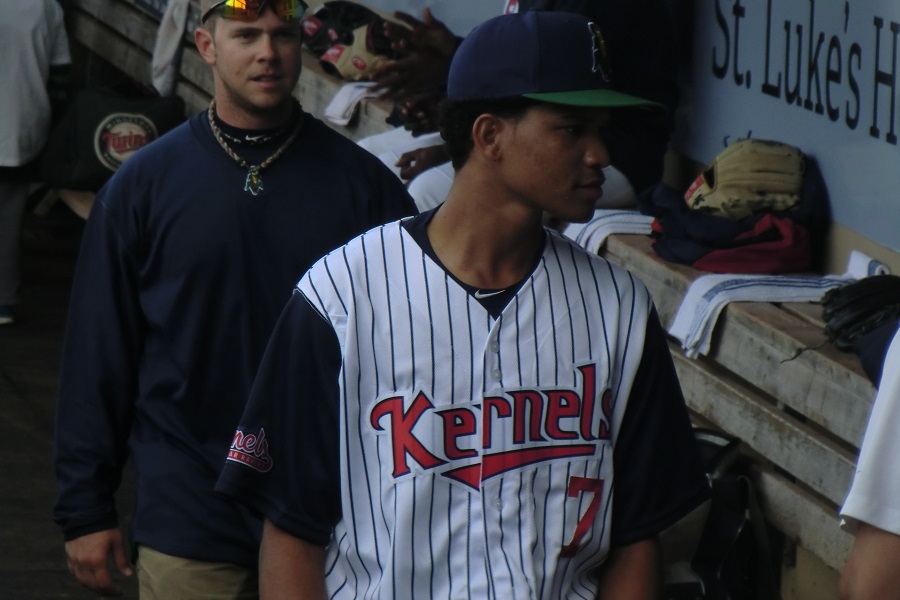
I am happy to announce that the Minnesota Twins Prospect Handbook 2014 is now available to be purchased. The self-published book was co-authored by Jeremy Nygaard, Cody Christie and myself. Several others contributed to the book, as shown below. Order Your Own Copy of the Minnesota Twins Prospect Handbook 2014 Right Here for $14.95. NOW AVAILABLE AS AN E-BOOK! Click here to order with an immediate download. [PRBREAK][/PRBREAK] For much more on the book and what is included in the book, click down below. Also, Jeremy, Cody and I conducted a Google Hangout last night to introduce the book. That was a lot of fun to discuss the stories, the 150+ prospect profiles and much more. --- Though we tried to be more concise and efficient in our profiles, we ended up with about 188 pages of Twins minor league content. Included are: Stories on my minor league award winners: Miguel Sano (hitter), Taylor Rogers (starting pitcher), Tyler Jones (relief pitcher) and Jake Mauer (manager). A Foreword by Twins Daily's John Bonnes. Cody wrote an article on The Anatomy of a 5-Tool Player. Jeremy wrote articles reviewing the 2013 Twins draft, and another looking forward to the 2014 draft. Jeremy also conducted an interview with Twins scout Freddie Thon. Season Reviews from each of the four Twins minor league affiliates. Twins Daily contributors Chris Fee (Rochester), Andrew Walter (New Britain) and Steve Buhr (Cedar Rapids) along with Miracle play-by-play guy Adam MacDonald penned these articles. The Top prospect lists for myself, Cody and Jeremy. And most important, there are the prospect profiles. There will be about 150 profiles on Twins minor leaguers. Yes, there are profiles on Byron Buxton, Miguel Sano and Alex Meyer. There are also profiles on Adonis Pacheco and Leonel Zazueta, as well as Jim Fuller and Kevin Thomas, the Twins minor league Rule 5 picks from Thursday. If you're looking for Christmas gifts for yourself or your Twins fan friends or family, this just might be it. The plan is for it to be available as both an e-book and a paperback book. The e-book is for those who don't like hard copies of anything. The paperback book is great as a coffee table book. When Dick Bremer or Cory Provus talk about a Twins minor leaguer, or a player recently promoted, you can go through the pages and learn a little about the player. It's also great for autographs. The cover is something that will look great autographed and many get the players' profiles autographed. It's been a ton of work for myself, Jeremy and Cody, but it's exciting that it's close. Other versions, such as an e-book or versions for Readers will hopefully be available shortly. If you have any questions, please let me know. Thanks also to Josh Johnson for designing the cover for the third straight year!Special thanks also to Justin Rinaldi (of Rinaldi Photos) for many pictures used on players of the Kernels and Rock Cats. Also, Linwood Ferguson, a Miracle photographer, and Scott Blanchette, a photographer for the Rock Cats. -
According to Jon Heyman, The Minnesota Twins have reached an agreement with RHP Mike Pelfrey. He says that it is a two year deal at $11 million. It also includes incentives up to another $3.5 million. There have been reports for a month that the two sides were very close, and that the Twins had made an offer. On Saturday night, there was finally an agreement. Pelfrey went 5-13 with a 5.19 ERA and a 1.55 WHIP with the Twins in 2013. He had undergone Tommy John surgery in April of 2012 and returned quickly. He struggled early with the Twins, but he did show good velocity on his fastball. Last month, Parker wrote about why the Twins might have interest in bringing back the right-hander. The Twins have been busy in the free agent pitching market. Last month, they inked Ricky Nolasco to a four year, $49 million contract with an option for a fifth year. Days later, they agreed with Phil Hughes on a three year, $24 million deal. The Twins have Kevin Correia under contract for 2014 at $5.5 million. If the Twins do not sign any other starting pitchers or make any trades, Sam Deduno, Kyle Gibson, Andrew Albers, Kris Johnson, Scott Diamond, Vance Worley and Alex Meyer will be competing for the fifth starter job. (Deduno, Diamond and Worley will be out of options) There is no word yet on whether the Twins would still consider adding another starting pitcher as rumors surrounding Bronson Arroyo and Matt Garza have not subsided.
-
What you are about to read, should you choose to continue, is in a bit of a stream of consciousness style of writing. However, that is arguably the most accurate style in describing what the Winter Meetings are all about. A little chaos. A lot of rumors. Some with basis in truth, some just for fun. If nothing else, it's fun speculation and hopefully it gives you some topics to discuss while we wait for another big Twins news story... Wednesday was a seemingly very quiet day in terms of Minnesota Twins news from baseball's Winter Meetings in Orlando. There were a few notes that certainly garner the term "interesting" but little really happened. I mean, the Twins signing of C.J. Ziegler, Baseball America's Independent League 2013 Player of the Year, was the biggest move of the day for our home team. Despite that fact, it still feels like the Twins will make another flurry of moves. I don't know why. I mean, the Winter Meetings are generally a time when front offices meet with agents and other teams to understand parameters for potential deals, free agent signings or trades. But just one year ago, on the eve of the Rule 5 draft and the final day of the Winter Meetings, news came very late that the Twins and Phillies were discussing Ben Revere. It seemed to come out of nowhere, and with Denard Span having been traded a week earlier, we made little of it. By about noon, an hour or two after the Rule 5 draft, Ben Revere had been traded to the Phillies for Vance Worley and Trevor May. My point is that it is clear Terry Ryan has had many discussions this week. So has assistant GM Rob Antony and the rest of the Twins front office. Maybe it is because of the early signings of right-handed pitchers Ricky Nolasco and Phil Hughes. It just feels like the Twins have a lot of things going on. That's probably good since the Twins will not be making a Rule 5 selection in the Major League portion of the draft. It will still be interesting to see if the they lose anyone though! The Twins should be active in the minor league portion. Because of the Nolasco and Hughes signings, the Matt Garza rumors don't see quite so outlandish. There were rumors on Wednesday that he could sign by the end of the week. Could the Twins be a leading candidate for bringing him back? The Mike Pelfrey rumors simply are not going away. It is clear that there is an offer on the table to Pelfrey. A two year, $10 million deal was said to be on the table a week or more ago, but it sounds like the Twins may have gone up to $12 or $13 million. If that's the case, could the Twins really bring back Pelfrey? And even with that, the Bronson Arroyo rumors continue to swirl. Ken Rosenthal even tweeted on Wednesday that signing one may not mean they won't sign the other. Wow!! After being inactive in the free agent pitching market most of the last decade (or last 50 years?), can you imagine a Twins' Opening Day rotation of Matt Garza, Ricky Nolasco, Bronson Arroyo, Phil Hughes and Mike Pelfrey? Considering Kyle Gibson, Alex Meyer and Trevor May could all be ready to contribute by early-to-mid summer, the Twins would have incredible depth. Now, like everyone reading this, I don't expect the Twins to sign all three. In fact, I don't think they sign two of them. However, I fully expect them to sign one of them, and probably soon. Likewise, the Stephen Drew/Twins rumors haven't gone completely away. As a Boras client (like Pelfrey), he may not sign real quickly. He certainly is an intriguing name. He is better than Pedro Florimon. No question. But if you look at WAR or other stats, is Drew really worth $12+ million per year more than Florimon? Of course, as much as we like to guess who the Twins may or may not be interested in as free agents, it's often the names that you would never guess in a million years that wind up with the team. In fact, Matt Guerrier's name came up as someone in whom the Twins had shown interest and had discussions with. Why do I mention that? Well, consider this. The Twins have a strong bullpen and have several needs, mostly starting pitching and offense. The Twins also have several players who are either out of position or find themselves with a questionable role with the organization. For instance, Liam Hendriks remains in DFA (Designated for Assignment) Limbo. The Twins have until Sunday to trade him or place him on waivers. Could he be traded? Could he be packaged with someone like Chris Parmelee who is also young and has shown flashes of potential? However, he is out of options, and with Joe Mauer now at first base, he suddenly has to try to fit into the right field situation. He is certainly a trade candidate. Finally, bullpen guys such as Jared Burton, Casey Fien and Brian Duensing could also be available. Now, the Twins are not going to get David Price for a package of Liam Hendriks, Chris Parmelee and Jared Burton, but could that get Jeremy Hellickson or another similar pitcher? Consider the Rays have gone with Casey Kotchman and James Loney as their first basemen the last two seasons. Parmelee could come in for league minimum and put up solid numbers for them. Burton is a cost-effective late inning bullpen arm and Hendriks is still young. It just feels like a trade could happen at any time. The Braves were interested in Brian Duensing in July. They are said to be looking for a left-handed reliever. It has been reported that Duensing is not currently on the Braves radar. How many times this winter have we already heard that a player is not on a radar, or that talks have broken down, etc.? Remember last week when it came out that talks between Robinson Cano and the Mariners were off? Was it two hours later they announced a deal? Wednesday was relatively quiet in terms of Twins news. But I just can't get past the feeling that there are a couple other moves in the works. That's not to say they will happen Thursday or Friday, but I tend to think that Nolasco and Hughes are not the final "big" names the Twins will acquire. Maybe I'm wrong, but the more I type in this stream of consciousness style, the more I tend to believe the Twins will continue to be aggressive and make moves. Where there is smoke, there is generally fire. In the past with the Twins, when there was smoke, it didn't mean a whole lot. This year, there is reason for optimism. Frankly, the Twins have already made two really good, big, aggressive, somewhat risky moves. That has set the tone, and if that is all they did, it would be an improvement. But the talk is there is still a lot to do and it will get done. Maybe I'm drinking, and now delivering the Kool-Aid, but if nothing else, it is going to be an entertaining offseason!
-
Late on Monday night, rumors began circulating (originating from friend of Twins Daily, Darren Wolfson) that the Minnesota Twins are interested in outfielder Rajai Davis, maybe even willing to go to two years with him. Immediately I had some thoughts on the idea of Davis with the Twins and what he might be able to do for the organization. My first thought is always: What does it mean for the Twins' outfield depth? (Note - Ben Nicholson-Smith says "industry sources" indicate the Detroit Tigers may be the favorite for Davis at this time.) [PRBREAK][/PRBREAK] So, I thought I'd take a look at the Twins outfield situation. First though, let's take a look at Rajai Davis. He is a player I have always liked because of his speed. His yearly stolen base totals in the big leagues going back to 2008 are: 29, 41, 50, 34, 46, 45. He has spent the last three seasons with the Blue Jays and has hit .252/.299/.369 with 61 doubles, 11 triples and 15 home runs. He was their regular centerfielder in 2011, but the last two years, since Colby Rasmus came over to the Jays, he has played the two corner outfield spots. With the Twins, he could potentially start in center or left field. Before Toronto, Davis played for Oakland, Pittsburgh and San Francisco. He will be 33 years old through the 2014 season, and his game is about speed. I like him as a fourth outfielder and as a guy who can compete with Alex Presley and Aaron Hicks for the starting centerfield job. Ideally, he is a fourth outfielder on a good team, but he can also be a placeholder for Byron Buxton. With that said, here is a brief look at the Twins outfield situation: Josh Willingham - He is likely to begin the season as the team's left fielder. Though his best defensive position is designated hitter, he has more trade value if he proves healthy and can play defense; it would make him a possible trade target for National League teams. He had a down year last season, likely largely due to injuries, but we know he's got the ability to hit the ball out of the park. Alex Presley - Acquired last August in the Justin Morneau deal, Presley played adequately over the final month. He will compete for the starting centerfield job in spring training and if he isn't starting he is a solid fourth or fifth outfield option. Aaron Hicks - Handed the starting centerfield job out of spring training a year ago, he had a very difficult transition in his jump from AA to the big leagues. But the potential is still there, and he likely learned a ton from 2013. Hopefully he can make some adjustments and at some point in 2014, he could come up for good. Oswaldo Arcia - Having played center field and right field in the minors, the Twins called up Arcia and had him play a lot of left field. His defense was in Willingham's category out there. My belief is he can be an adequate, maybe average, defensive right fielder. The man can flat-out hit and has a ton of power. I wouldn't trade him, but in a trade he could bring back something big! Chris Parmelee - Started a lot of games in right field a year ago and impressed with his glove and a generally accurate arm. The bat didn't come around with any consistency in 2013, but he does still have potential. He is also out of options. With Joe Mauer moving to first base, left or right field will become important to Parmelee's playing time. Chris Colabello - See Chris Parmelee. Colabello dominated AAA a year ago, but he struggled with the Twins. He had played very little outfield in his career before playing some right field with the Twins. Darin Mastroianni - He was hurt throughout the 2013 season. Even when he came back, he struggled and clearly was not at 100%, Speed is his game. He can play all three outfield spots. He is a candidate to be DFA'ed if the Twins sign Davis. Byron Buxton - Baseball's #1 prospect will likely be invited to big league spring training. It is possible he surfaces with the Twins in the season's second half and never looks back. Eddie Rosario - He has played second base most of the last two years, but with the emergence of Brian Dozier at second base, it appears the Twins are looking to move Rosario back to the outfield. Honestly, that's where he should be. He is a natural, gifted outfielder with a very strong arm. His bat may not have huge home run power, but he can hit, uses the whole field and hits a lot of doubles. That potential/rumored 50 game suspension certainly hurts his chances of debuting in 2014. I would not be against the signing of Rajai Davis by the Twins. Of course, that depends on the years and the money. A one year, $2-3 million deal makes sense. A two year, $4-5 million deal makes sense. Anything beyond that doesn't make sense. It's all part of the picture. The beauty of the week of Winter Meetings is that rumors are abundant. How many are true? Some. With each rumor it's nice to be able to go through an exercise like this, looking at those currently on the roster and those in the near-future plans, to see what makes sense. To me, a 2015 outfield of Eddie Rosario, Byron Buxton and Aaron Hicks, with Oswaldo Arcia as the DH and Rajai Davis or Alex Presley as the fourth outfielder looks and sounds pretty good. So, what are your thoughts? Should the Twins be interested in or sign Rajai Davis? What does it mean for the future?
-
If you had to quickly guess, just off the top of your head, which college has the most player in the Twins system, who would you pick? Most would say the University of Minnesota, and that wouldn’t be inaccurate, but it’s actually tied, at five, with the University of Kentucky. The Gophers are Glen Perkins, Nate Hanson, AJ Pettersen, Kyle Knudson, and Mike Kvasnicka. The players from Kentucky include Andrew Albers, Logan Darnell, Lance Ray, Alex Meyer and Taylor Rogers. Since each has a good basketball program, maybe we should set up a 5-on-5 hoops contest between these players for organization supremacy? Recently, I had the great opportunity to talk with the head coach of the Wildcats, Gary Henderson. [PRBREAK][/PRBREAK]He was instrumental in the development of each of the players that came through his program. He was kind enough to share his thoughts on the players he met as 16 or 17 year old recruits and the development he saw in these young men over their time in college. There certainly appears to be a trend or two that developed as he talked about these five players, these five people. Gary Henderson has had a tremendous college coaching career. He began as a JV coach at San Diego State in 1988. He was an assistant coach at Cal State Fullerton, Riverside Community College, Chapman, Pepperdine, Florida and Oregon State from 1989 through the 2002 season. (While at Oregon State, Henderson recruited Jacoby Ellsbury who played three years for the Beavers.) In 2003, he took over as the pitching coach at Kentucky, a position he held until 2008. Since 2009, he has been the head coach of the Wildcats. In 2012, he was the SEC’s coach of the year when his team went 45-18 (including 18-12 in the conference). In the soon-to-be-released Minnesota Twins Prospect Handbook 2014, I wrote a story on my choice for Twins Minor League Starting Pitcher of the Year, Taylor Rogers. In it, he talked a little about Coach Henderson. “From the first day I met Coach Henderson, I knew I wanted to go there (to Kentucky).” He continued, “He talked pitching in an accelerated fashion and yet it was easy to comprehend. There are not enough good words to describe the influence Coach Henderson had on me as a person and a baseball player.” Henderson told me a little about his philosophy. “The thing that we try to do is get them convinced that they’re going to get better, not just with hard work in the weight room, or on the field, or in the bullpen, or with long toss or running, but get them to commit themselves to the process of playing baseball. The very basic ‘One Pitch at a Time’ and what that really means. Not only just hearing the cliché, but really committing yourself to that process. Boy, is it easier said than done! You and I can sit and watch a Major League Baseball game, and it becomes obvious to see when some guy has gotten away from that process, either on the mound or in the batter’s box. We talk a lot about that. The ability to understand and the willingness to give yourself to the process of playing One Pitch at a Time. Not playing against the scoreboard. Not playing against the other dugout. It’s just making good pitches. It sounds so simple, but it’s a challenge. It’s what allowed David Eckstein to be in the big leagues. It’s what allowed Andrew Albers to have the summer he did. It’s just completely getting immersed into playing the game at a high level.” And, the four Twins minor league pitchers that threw for Coach Henderson at Kentucky each too strides in 2013. Taylor Rogers was my choice for Starting Pitcher of the Year. Andrew Albers was his runner-up in my opinion while the Twins chose him as their Minor League Pitcher of the Year. Logan Darnell was recently added to the 40 man roster after a strong showing in AA and AAA this year. Despite missing two months with a shoulder issue, Alex Meyer solidified himself as the Twins top pitching prospect. He really took an impressive step in the Arizona Fall League. Outfielder Lance Ray was hobbled with injury most of the 2013 season, but he was the top home run hitter in Ft. Myers in 2012. Henderson was kind enough to tell us a little more about the players that he coached and influenced. TAYLOR ROGERS Rogers was the Twins 11th round pick in 2012 from Kentucky. He split 2013 between Cedar Rapids (where he was the Opening Day starter) and the Ft. Myers Miracle. Rogers grew up in Colorado, but Henderson was able to get him to Kentucky. “He had really good arm action. He threw strikes. He looked like he would fill out and get better. He had a really good frame. Most impressive about him were his work ethic, drive and honesty. The character issues with him were outstanding.” His early collegiate numbers certainly don’t jump out on the screen, but it was clear that he was improving with each season. “He was a starting pitcher in our league as a freshman. He never shied away from that, never backed down. He was always interested in doing whatever it took to get better. His development was fairly standard. He worked very hard. As a freshman, he had a freshman curveball. By the time he was a junior, it was solid. It was good. The velocity got better each year. His ability to throw the changeup was better.” ANDREW ALBERS Albers has been a great story since signing with the Twins before the 2011 season out of the independent Can-Am League. He is a Tommy John survivor (and now ‘Thriver!’) who was my choice for Twins Minor League Relief Pitcher of the Year that first season. He spent more time starting in 2012, and was a full-time starter in 2013 with the Rochester Red Wings before finally getting the call in August to make his major league debut. He exceeded all expectations and show great grit and intensity despite not having overpowering stuff. “His story was a little different. He’s the same type of person (as Rogers). Work ethic is off the chart. Extremely good feel for pitching, which I thought was very unusual for a kid coming from a town of 5,000 people in Saskatchewan. Extremely good feel for the game, way above average. He was slender, obviously not as tall as Rogers, but he was 6-0, 165 pounds. I actually saw him when I was working at Oregon State. I saw him a year earlier, and I made up my mind that wherever I was coaching, he was going to school. At least, I was going to do everything I could to get him. He was a little advanced in terms of understanding and feel for competition. His stuff wasn’t. It was fine. In fact, it compared fairly well to Taylor, although he doesn’t have the velocity that Taylor has. His command was very good. His secondary stuff was below average as a freshman. Because of that feel for competition, and feel for the game, he understood really quickly that he was going to have to improve that secondary stuff. As he has in the minor leagues, Albers pitched in different roles at Kentucky too. “He started as a freshman and a junior. He relieved as a sophomore and a senior. We rotated him every year, not by design, but that’s just the way it happened.” Henderson continued, “(Albers is a) tremendous leader, not just of the pitching staff, but a leader on the club as well. Another kid whose makeup is A+, beyond A+, if there’s such a thing. Personal characteristics? Personal qualities? Outstanding. He was the type of guy that, when you’d introduce new contacts or new techniques, like Taylor, they embraced them fully. It was never about ‘It’s too hard’, or ‘Why are we doing this?’ They were in from the start, both those kids.” Albers also had great support from his family. “That’s what the kid was when he was 16. His parents, they’re just impressive people. He’s an impressive kid. As you watched all summer, his stuff is not dominant. He’s going to get by because he has a lot of poise and a lot of confidence, and he can really concentrate. His stuff is fine. And he’s the first guy to tell you that.” LOGAN DARNELL Darnell was the Twins 6th round pick in 2010. He quickly moved up the system in 2011, from Beloit to Ft. Myers and to New Britain. He pitched in New Britain throughout the 2012 season and began there again in 2013. Shortly after midseason, he was promoted to Rochester. Following the season, the southpaw was added to the 40 man roster. Regarding Darnell, Henderson said, “He is (a character guy). He was real aggressive early on. His secondary stuff was short, early on. When you’re looking at these guys, there’s a part of you that says that’s why you got them. If you’re left-handed, and you show any arm strength, and you have above average secondary stuff, then professional baseball can happen early. Logan was a very hard worker, very aggressive on the mound, willing to make adjustments, willing to learn. Made huge strides. He got better each year. He comes from a top-notch family. Really good people. At this point, I began to notice a trend. Each has a very high character and a strong family foundation of support. It’s a theme that we hear often in the Minnesota Twins organization. I asked if character was something he focuses on with recruits. “I think a couple of things. I think that the ones that don’t have it, you and I don’t talk about for obvious reasons. I think there’s also that saying about who you attract in the recruiting process. You tend to attract similar types of people. It’s certainly not an absolute by any stretch and there’s a lot of stuff that goes into it. The fact that these guys are having success is not surprising. You’re happy for it. We all understand the odds of making it in the big leagues and doing well, and they’re (the odds) are never good no matter how talented you are. But the fact that these people are having success, I’m not surprised. They’re really good people and they really work hard. ALEX MEYER The character trend continues when talking about Alex Meyer. The former first round draft pick of the Washington Nationals came to the Twins organization one year ago in a trade that send centerfielder Denard Span to the National League. At 6-9 and 250 pounds, and blessed with an arm that has the ability to throw a baseball 100 mph while showing good command and control of four pitches, makes Meyer the top pitching prospect of the Twins, but also one of the top pitching prospects in baseball. Henderson recalls Meyer’s younger years. “He was a guy that made a lot of jumps in high school. He was a stereotypical guy who hadn’t yet grown into his body as a 16 or 17 year old. The older he got, he made really rapid jumps in terms of being able to control his body. That’s how it goes with those guys who are 6-6, 6-7, 6-8. They’re long and lean and haven’t yet developed the musculature to control their body on the mound and repeat their delivery. That’s kind of where Alex was.” He continues, “He is a really hard worker. His arm action was outstanding. The thing that was different about Alex, besides the arm strength, was that when he came in, he had a feel for a breaking ball. He did not have a changeup, but he had the feel for a breaking ball. That kind of put him into a different group. It was arm strength. It was feel. It wasn’t always a strike early on. He made the typical jumps. He wasn’t way ahead. He wasn’t way behind. His improvement was pretty standard in terms of being able to slow the game down which he did as a sophomore. He attacked the running game. That part of the game was much better as a sophomore. He’s a really hard worker. (He) comes from a top-notch family, very supportive people. I think the whole family understood and desired for him to have a college experience. I think they knew that was best for him and his development. I think that’s also what they wanted.” So, does Henderson think that Alex Meyer has the stuff to be top of the line starter? “Yep, and I think that’s going to happen. Nobody’s got a crystal ball, but I think that’s going to happen. I think he’s going to be a frontline guy. Just like everybody else, he will need to stay healthy, make normal progression, and I think he’s going to have a really nice career. No question.” He spoke more of what makes Meyer special. “(He) really accepts responsibility, accountable for everything, works really hard. There’s nothing there that’s going to get in the way. Obviously, the talent is pretty good.” LANCE RAY The Twins used their ninth round pick in 2010 on the powerful left-handed outfielder/first baseman. Ray struggled in Beloit in 2011 to start the season, but was remarkable through the middle of the season. He was the Ft. Myers home run leader in 2012. Unfortunately, he was slowed by injuries throughout the 2013 season and hopes to get back to a healthy, productive 2014. Henderson said, “He is a good guy. He has kind of traditionally been a slow starter, every place he’s been. If you look back at high school, or junior college, or Us, or professional ball, he’s gotten off to a slow start. I don’t know why that is, or what that is. He started slow for us at the plate as a junior. He played for a guy that I played for and a guy that I coached, a father and son in Vegas. That’s how we got on Lance. He started at a junior college in western Nevada. Early in March, about four weeks into our season, he was hitting below .200. Then he got on fire, and he was as good of a college hitter as you’ll see for the last six or seven weeks.” So, what makes Ray a solid professional player? “(He has a) very good feel to hit, a good plan, good plate discipline. He was very good. Similar type kid. Good to have around, good teammate, very likable kid, a very good feel to hit. He just needs to get healthy.” ------ I really appreciate Coach Gary Henderson and the media relations group at the University of Kentucky for helping set this up. Coach Henderson was very gracious with his time, but it was clear that he really cares about his players during their time at Kentucky and as they move forward in life and in professional baseball. He did tell me that he has a couple of players on his upcoming team who could be taken in the early rounds of the 2014 MLB Draft. And, one name to get to know in the Upper Midwest of that of Chippewa Falls (Wisconsin) native Kyle Cody. He was the 33rd round draft choice of the Phillies in 2012 but went to Kentucky. He’s a big, 6-7, 230 pound kid who can throw in the mid-90s. Might be worth watching again in the 2014 MLB draft. Please feel free to leave any questions or comments below.
-
On Monday night, the Pioneer Press's Mike Berardino tweeted that an MLB Official told him that the Twins were no longer "in the mix" on AJ Pierzynski. In recent days, it had been reported that the Twins and Pierzynski's representatives were making progress in contract discussions. UPDATE - Monday morning, it was announced the Pierzynski has reached terms with the Boston Red Sox. What does that mean for the Twins pursuit of a catcher? Discuss in the Forum! I just can't help but thinking whether the Twins really should be considering a reunion with AJ Pierzynski. So, I thought I'd write it out to see what I thought. He really has had a very good MLB career. He was an All-Star in 2002. He had the best numbers of his career as a Minnesota Twins catcher. He hit .301/.341/.447 (.788) in his time with the Twins and played in the 2002 All-Star game. In 2003, he hit .312/.360/.464 (.824) the season before he was traded. He was a very good player. In my mind, it makes absolutely no sense for the Twins to bring back the 37 year old catcher. Some may think it is his personality that makes me think this. Not the case at all. As Ozzie Guillen famously once said of Pierzynski, "If you play against him, you hate him. If you play with him, you hate him a little less." That is not the reason for not bringing him in, however. Twins fans have been booing Pierzynski ever since he left. First, I am not a person who believes in booing people, so I have never partaken in that ridiculousness. I've never understood it. He was huge in the Twins' last playoff series win. He was a big part of the organization's turnaround in the early years of this century. He did not ask to leave. He was traded. And in that trade the Twins acquired Boof Bonser, Francisco Liriano and Joe Nathan. That turned out pretty well for the Twins, particularly when you consider it also opened the door for Joe Mauer to play. Sure, there were the times he would try to clip Justin Morneau's feet as he ran by first base on ground balls. Sure, he is an irritant. But again, those are not reasons for the Twins to not bring back Pierzynski. Joe Mauer has moved to first base full time, and the Twins could use a veteran catcher. They have Josmil Pinto, but he could use some mentorship, or even some additional time in AAA in 2014. So, it does make sense to bring in a player like Pierzynski. Pierzynski has been a winner throughout his career. That is a phrase the Twins have used a lot this offseason. Some may believe his personality has helped his teams to the playoffs. Others say that he's been just one piece on the teams he has been on. He has been remarkably durable through his career. Annually, he has played in no fewer than 128 games since the 2002 season. That said, he went on the disabled list for the first time in his career in 2013. Not that that means anything necessarily, but it's certainly not unusual for a catcher at 37 to start getting hurt more often. So, I have acknowledged that it is not his personality that makes me say the Twins should not go after AJ Pierzynski. It's not his success or performance earlier in his career. He has been on very good, winning teams. He is going to want a multi-year contract, and I don't think that makes a lot of sense for a 37 year old catcher when you've got a 25 year old catcher who is nearly ready. It's also simply about performance. Frankly, Pierzynski was not very good in 2013 with the Texas Rangers. He hit .272, but he got on base just 29.7% of the time! Yes, he had 17 home runs for the Rangers, but do we actually expect him to hit for any power as a left-hander at Target Field? I mean, I would anticipate him hitting about .265/.290/.350 (.640) as a Twin. Defensively, Parker tweeted earlier today that he was worth -11.4 RAA (or Runs Above Average) due to framing in 2013. That's pretty bad. He also threw out just 26% of would-be base stealers in 2013. He hasn't topped 30% in any season since the 32% he threw out for the Twins in 2002. So to summarize... AJ Pierzynski is going to be a 37 year old catcher, is looking for a multi-year contract at a starter's wage, likely $7 to $9 million per year, who no longer has much ability to hit and is apparently allergic to walking and doesn't do a very effective job defensively. Don't get me wrong. If he is willing to come here for one year and $5-6 million, I'm fine with that. I won't write a scathing article or anything. There are other options. If the Twins choose to go big, they could sign Jarrod Saltalamacchia for three or four years. He's nine years younger than Pierzynski and still has some upside. JP Arencibia was terrible with the Blue Jays, but now that Toronto decided to sign Dionner Navarro for the next two years, Arencibia will likely be non-tendered. Ryan Hanigan is said to be available. And, there are any number of veteran, backup catchers available. So yes, it was a relief to hear that the Twins are likely out of the AJ Pierzynski sweepstakes, but until he signs elsewhere, I will remain a little nervous. So what do you think? Should AJ Pierzynski be a priority for the Minnesota Twins this offseason?
-
The Twins (and all of the teams in baseball) have until 11 p.m. central time tonight (Monday) to decide whether or not to offer arbitration to their arbitration-eligible players. For the Twins, those players are Trevor Plouffe, Brian Duensing and Anthony Swarzak. My first prediction is the Twins will offer arbitration to all three. First, the dollars they will potentially receive for 2014 will not be huge, so the Twins could take them on. Secondly, each would have at least some measure of trade value at the dollars he will receive. Plouffe has shown flashes of power, is young and has the ability to play a lot of positions. Swarzak can eat a lot of innings out of the bullpen or there may be some teams that think he could be a back-of-the-rotation starter. Duensing is a left-handed reliever who, aside from 2013, has dominated left-handed hitters. Again, there is value in that. Below, I will put out predictions for each of these players as it relates to tonight and his arbitration process. Last year at this time Duensing and the Twins settled on a $1.3 million contract for 2013 . He went 6-2 with a 3.98 ERA and 1.48 WHIP in 61 innings. He walked just 22 and struck out 56. He is in line for a raise with projections being anywhere from $1.8 million to $2.3 million. Duensing will be 31 years old through the 2014 season. Prediction: The two sides will reach an agreement today and won't need to exchange numbers. My guess is $2.1 million. If they don't, I would think the Twins will come in at $1.8 and Duensing's side will come in at $2.5. Offseason Handbook Prediction: $2.5 million MLB Trade Rumors Prediction: $1.9 million This year, Anthony Swarzak is eligible for arbitration for the first time. He led all relievers in 2013 with 96 innings pitched. He walked 22 and struck out 69. He posted a 3-2 record with a 2.91 ERA and 1.16 WHIP. He will be 28 years old through the 2014 season. Projections have been that he would make $0.8 million, but I could see him getting as much as the $1.3 million that Duensing made a year ago. Prediction: I think the two sides will come together on a deal at or just over $1 million dollars. If not, I think the Twins will offer $800,000 while the Swarzak camp will likely ask for closer to $1.4 million. Offseason Handbook Prediction: $1.3 million. MLB Trade Rumors Prediction: $800,000. Photo by Betsy Bissen. Trevor Plouffe is an interesting case, in his first year as an arbitration-eligible player. Last year, he hit .254/.309/.392 (.701) with 22 doubles, one triple, 14 home runs, and 52 RBI in a career-high 129 games. He won't turn 28 until mid-June. Prediction: My sense is that this one won't settle today and the two sides will exchange numbers. I think the Twins will offer about $1.4 million and Plouffe's side could ask for as much as $2.2 million. At the end of the day, they'll likely agree on a deal somewhere around $1.75 million. Offseason Handbook Prediction: $2.0 million MLB Trade Rumors Prediction: $2.1 million So there are my predictions with the predictions of the Twins Daily Offseason Handbook and MLB Trade Rumors. What are your thoughts? What will they offer to these three players and what kind of money would you offer or find acceptable? Get your thoughts in before tonight's 11 p.m. CT deadline.
-
Late in the year, the Twins traded Justin Morneau who had been in the organization since he was the team’s 3rd round draft choice in 1999. After the season, Nick Blackburn, who had been with the organization since signing after the 2001 draft, was allowed to become a free agent. As the Twins have added players to their 40 man roster and made free agent decisions on others, I got to wondering which players in the Twins organization have been around the longest. To make the top 15 on this list, a player had to be signed before 2009. There are some interesting names that you may not have realized have been with the Twins for so long. In fact, there may be a couple that you have never heard of and I’ll add a few more names to take us to 2008. So, here you have it, a look at the Top 15 most tenured players in the Minnesota Twins organization: Honorable Mention: Hein Robb – Signed from South Africa as a 16 year old in July 2008. The June 2008 Twins draft class and round taken – Aaron Hicks (1), Danny Ortiz (4), BJ Hermsen (6), Michael Gonzales (9), Evan Bigley (10), Nate Hanson (28), Michael Tonkin (30). Deolis Guerra came to the Twins in the January 2008 trade from the Mets for a certain left-handed pitcher. In December 2007, the Twins signed Danny Santana and Adrian Salcedo as 16 year old free agents. The Top 15 #14/#15 – On July 4, 2007, the Twins signed a left-handed reliever named Jose Gonzalez and a left-handed hitting outfielder named Oswaldo Arcia. Arcia debuted as a 21-year-old in April and showed signs of the type of hitter that he has become. Gonzalez has been a very good reliever in the lower levels of the system, but he has struggled in his transition to AA the last two years. #13 – Dan Rohlfing was the Twins 14th round pick of the Twins in 2007 out of his high school in St. Louis. After splitting the 2013 season between New Britain and Rochester, he signed quickly with the Twins following the season to avoid becoming a free agent. He has primarily caught in the Twins system, though he’s a good athlete and can play a solid corner outfield, too. #12 – Jairo Rodriguez signed with the Twins in May of 2007. Like Rohlfing, he signed quickly to return to the Twins as a backup minor league catcher. In 2013, he played for Cedar Rapids, New Britain and even played in a game with Rochester. #11 – Liam Hendriks signed out of Australia in February of 2007. After missing the 2008 season with a spinal injury, Hendriks flew through the minor leagues in 2010 and 2011, pitching at five levels those seasons. Since then, he has gone back and forth between the Twins and the Red Wings, hoping to stick with the big league club. #10 – Chris Parmelee is the only member of the Twins 2006 draft who is still in the organization. He is out of options so he will need to remain with the Twins or they risk losing him to another team. With Joe Mauer’s move to first base, Parmelee will need to make it as a corner outfielder and pinch hitter. #9 – Josmil Pinto signed with the Twins in February of 2006. He could have become a minor league free agent following the World Series in 2012, but he decided to avoid that and return to the Twins. They added him to the 40 man roster a year ago and he had another strong season in 2013, including a tremendous showing with the Twins in September. #8 – Edgar Ibarra signed with the Twins in January of 2006. Like Pinto, Ibarra avoided free agency after the 2012 season and put together a solid 2013 campaign. That, along with a good repertoire, including a fastball the regularly hits 94, earned him a spot on the Twins 40 man roster following the 2013 season. 2014 will mark his first big league camp with the Twins. #7 – James Beresford, from Australia, signed with the Twins in August of 2005 as a skinny kid. His missed a season and has just gradually worked his way up the system. Again, he became a minor league free agent last offseason and came back to the Twins. He re-signed much more quickly with the Twins this offseason. #6 – Brian Duensing was one of two third round picks by the Twins in 2005, out of the University of Nebraska. He moved quickly through the Twins minor league system as a starter. He was given a couple opportunities as a starter in the big leagues, but his inability to get right-handers out while dominating lefties meant he would be given an opportunity out of the bullpen. In 2013, he struggled against lefties too, but he should bounce back strong in 2014. #5 – Deibinson Romero signed out of the Dominican Republic in July of 2004 and has been with the organization since. He was actually a member of the Twins 40 man roster in his first year of eligibility, but injuries affected him earlier in this career. He was invited to the big league camp last year, but he had visa issues and could not come to America until the regular season was about to start. He’s got good power and provides organizational depth at third base. #4, #3, #2 – The Twins had a lot of draft picks in 2004 and three of them remain with the Twins. Second round pick Anthony Swarzak has been very good as a long reliever the last couple seasons. Glen Perkins became an All-Star for the first time in 2013. Trevor Plouffe remains a question mark at the hot corner, though that six week stretch in 2012 still gives us hope. #1 – Joe Mauer is now the longest tenured Twins player, having signed in 2001 after being the #1 overall pick in the draft. I won’t get into all of the accolades, the AL MVP, the three batting titles, the Gold Glove Awards, the Silver Sluggers, etc. He’s moving to first base this year after his Hall of Fame first decade in a Twins uniform at catcher. So there you have it, the players in the Twins farm system who have been in the system the longest, consecutively. Some of the names may not surprise you, but I’m certain you wouldn’t have guessed everyone on this list. Feel free to leave your thoughts, or let me know if I forgot anyone. I didn’t count Ron Gardenhire who has been in the organization since 1987, or Terry Ryan who has been around since 1986, though maybe not consecutively.
-
On Wednesday afternoon, the Minnesota Twins announced they have added four players to their 40 man roster. Jorge Polanco is probably the headliner, or certainly the most obvious choice, but they also added Max Kepler, LHP Logan Darnell, and DH Kennys Vargas. Also, RHP BJ Hermsen was outrighted off the 40 man roster. This leaves the Twins 40 man roster at 39. Polanco, 20, struggled for two seasons in the Gulf Coast League, but in 2012 in Elizabethton, he came through with a .903 OPS. He hit .318/.388/.514 with 15 doubles, two triples and five home runs. He moved up to Cedar Rapids in 2013 and proved that his Appy League stats were not a fluke. In 115 games, he hit .308/.362/.452 (.813) with 32 doubles, ten triples and five home runs. He also drove in 78 runs hitting primarily out of the #3 spot in the lineup. Max Kepler, 20, was also signed in 2009, at the same time as Polanco. The German outfielder was moved slowly through the early levels because he was so raw, but at 6-4, 220 pounds he has very good power potential. In 61 games in the 2nd half in Cedar Rapids, the left-hander hit .237/.312/.424 (.736) with 11 doubles, three triples and nine home runs. He played a lot in left field, center field and first base. He missed the first half of the season with an elbow injury. Left-hander Logan Darnell quickly rose to New Britain a year after being drafted. He remained there until the second half of 2013. The left-hander has a mixed bag of pitches including a fastball that tops out around 90 and a very good slider. Kennys Vargas is a DH who can play some first base. He put up big numbers in Ft. Myers in 2013, hitting .267/.344/.468 (.813) with 33 doubles, 19 home runs and 93 RBI. He plays first base as well. He’s a large, physically imposing man who reminds many of David Ortiz. He is often referred to as “Little Papi” though he may be bigger than the Red Sox star. This leaves several Twins players at risk of being selected in MLB’s Rule 5 draft on Thursday, December 5, the final day of the Winter Meetings. 2010 top pick Alex Wimmers will be eligible to be taken in the Rule 5 draft. Relief pitchers such as AJ Achter, Adrian Salcedo, Lester Oliveros and Dakota Watts could be picked. Others, such as James Beresford and Pat Dean, could also be taken. Any thoughts?
-
By Wednesday afternoon, the Minnesota Twins, and all other major league teams) will need to submit their 40 man rosters. The Twins current 40 man consists of 36 players, 19 pitchers and 17 position players. Since season’s end we have seen several removed from the 40 man roster, such as Clete Thomas (Phillies) and Pedro Hernandez (Rockies) who have signed with other teams and Doug Bernier who remained with the Twins. [PRBREAK][/PRBREAK] The Twins have also added RHP Duke Welker and LHP Edgar Ibarra before he could become a minor league free agent. There are several players on the current 40 man roster who you or I may believe could come off, but they are there for a reason. You see, the players who get added to the 40 man on Wednesday can’t be removed until at least spring training. If the Twins were to sign a couple free agents, they need to be able to make room for them on the roster. So there are players on the 40 man roster who may not feel real comfortable until they get to spring training. Of course, as they have in the last three seasons, the Twins may also choose to make a Rule 5 selection. Last year they added Ryan Pressly and three years ago it was Scott Diamond. Both have already exceeded the results of most Rule 5 picks. If the Twins want to make a Rule 5 pick this year they must have fewer than 39 on the roster. Photo by Tim Gale So, who is eligible for the Rule 5 draft? Players who signed at age 18 or younger during the 2009 season or players who signed at age 19 or older in 2010. Jorge Polanco signed with the Twins as a 16-year-old in July of 2009, so he is eligible. Miguel Sano signed as a 16-year-old, after the season, in October of 2009, so he is not eligible--the Twins could add him, but it would make no sense. Here are some others who could be added to the 40 man on Wednesday. Most likely no more than two or three will be added. Jorge Polanco – Played in Cedar Rapids in 2013, primarily playing second base, but getting time at shortstop when Niko Goodrum was injured. He’s very talented and continues to improve. He appears to be the biggest lock to be added. Max Kepler – After an elbow injury the first half, he played for Cedar Rapids in the second half, spending time in left field, center field and at first base. He’s got good power and at 6-4 and 220 pounds is very athletic and has immense potential. He is probably the second most likely to be added. Alex Wimmers – The Twins first round pick in 2010 out of Ohio State where he was back-to-back Big 10 Pitcher of the Year. Unfortunately, he has not pitched much or well since signing and he rehabbed from Tommy John surgery in 2013. That said, his first round pedigree makes him a possible add. Logan Darnell – 6th round pick in 2010 out of Kentucky. The lefty has worked his way up the system with a solid three-pitch mix. He is a very aggressive starter, looking to get outs quickly. Kennys Vargas – The first baseman from Puerto Rico looks like former Twin David Ortiz. He is long and not real swift, but he can hit and he has tremendous power. He spent 2013 in Ft. Myers. AJ Achter – The right-hander was the Twins 46th round pick in 2010 out of Michigan State. Since moving to the bullpen in 2012, he has performed better than any other reliever in the Twins farm system. He pitched in New Britain and Rochester during the season and ended the year with a stint in the Arizona Fall League. There are others who are interesting and also eligible for the Rule 5 draft if not protected. Here is a list of all eligible players, courtesy of the Twins Daily Rosters & Payroll page. LHP - Pat Dean, Aaron Thompson, Ryan O’Rourke, Jose Gonzalez, Chad Rodgers, Hein Robb, RHP - Lester Oliveros, Adrian Salcedo, Dakota Watts, Deolis Guerra, Virgil Vazquez, Tim Atherton, Mark Hamburger, Matt Hauser, Dallas Gallant, OF - Mike Kvasnicka, Daniel Ortiz, Wilkin Ramirez, Jermaine Mitchell, Evan Bigley, Lance Ray, Nate Roberts, Romy Jimenez, Adonis Pacheco, IF – Doug Bernier, James Beresford, Deibinson Romero, Jason Bartlett, Reynaldo Rodriguez, Nate Hanson, Brad Boyer, Andy Leer, Michael Gonzales, Rory Rhodes, Jonatan Hinojosa, C – Dan Rohlfing, Jairo Rodriguez, Kyle Knudson, Michael Quesada. So, there you have a look at the players the Twins will need to protect on their 40 man roster by Wednesday afternoon or risk losing in the Rule 5 draft. Who do you think will be added? Who do you think could be lost if not protected? Tonight at 8:30, Hangout with Jeremy Nygaard and myself on YouTube for our weekend Twins Talk. You can interact by asking questions. Tonight, we’ll be discussing the 40 man roster as well as any Twins rumors of the day and week. Join us here. We'll also take your questions.
-
On Friday afternoon, I welcomed Twins and Twins minor league related questions on my Twitter account. A few people asked questions, but one really stood out as really interesting. So, I will answer that one first before answering the others more quickly. The first question was asked by Seth Postma. Great name, Great Questions. Right? In two tweets, he asked: [PRBREAK][/PRBREAK]Think about that just for a minute. Kershaw won the National League Cy Young Award this year, his second Cy Young Award in the last three seasons (finished 2nd in 2012!). Jose Fernandez finished third place in this year's NL Cy Young voting and was the easy choice for National League Rookie of the Year. Though Fernandez is right-handed and Kershaw is a southpaw, they both made their big league debut less than two years after they were drafted out of high school. They were both first round picks, Kershaw seventh overall in 2006, and Fernandez taken with the 14th overall pick in 2011. Kershaw debuted in 2006 in the GCL with five walks and 54 strikeouts in 37 innings. He began the 2007 season in the Midwest League (Low-A) where he went 7-5 with a 2.77 ERA and a 1.25 WHIP in 97.1 innings. He gave up 72 hits, walked 50 and struck out 134. He was promoted directly to AA and made five starts to end that 19-year-old season. He was 1-2 with a 3.65 ERA and a 1.38 WHIP in 24.2 innings. He struck out 29, but he also walked 18. He began the 2008 season (his age-20 season) back in AA, but he went 2-3 wit ha 1.91 ERA and a 0.95 WHIP in 11 starts. He struck out 59 and walked just 18 in 61.1 innings. On June 20, 2008, he made his big league debut. Now, his debut wasn't earthshaking. He was 5-5 with a 4.26 ERA and a 1.50 WHIP. In 107.2 innings, he gave up 109 hits, walked 52 and struck out 100. Of course, in five seasons since then, he has gone 72-41 with a 2.43 ERA. After walking 4.8 per nine in 2009 and 3.6 per nine in 2010, he has walked 2.5 per nine or less each of the last three years while striking out more than a batter per inning in all but 2013 (8.8/9). If you thought that Kershaw's ascent was quick and impressive, wait until you read about Jose Fernandez. The Cuban-born righty was drafted in 2011 out of his Tampa high school. He pitched in just two games after signing that season. As a 19 year old in 2012, he began in Low-A and went 7-0 with a 1.59 ERA and a 0.87 WHIP. In 79.1 innings, he gave up just 51 hits, walked just 18 and struck out 99. He was promoted to High-A where he went 7-1 with a 1.96 ERA and a 1.00 WHIP. In 55 innings, he gave up 38 hits, walked 17 and struck out 59. That's it for his minor league career. Mike Redmond decided that he would skip AA and AAA and make the Marlins' Opening Day roster. He went 12-6 with a 2.19 ERA and a 0.98 WHIP. He was shut down in September at 172.2 innings and had given up just 111 hits, walked 58 and struck out 187. As a 20 year old! Would the Twins have done that? I think we can safely answer "No" to that one! They wouldn't have a 20 year old skip AA and AAA. I think that's fairly definitive, and I don't think many (if any) Twins fans would disagree with the decision to let him start the season in AA. That's probably enough about two immensely talented pitchers who do not pitch for the Minnesota Twins. Let's talk Twins. Back to Seth's questions. I do believe that if a young pitcher put up the types of numbers that Jose Fernandez did, the Twins would move him quickly. However, I can't imagine a scenario where the Twins would be willing to have a player skip both AA and AAA, especially a player that youthful, coming out of high school. The Twins have proven time and again that they will move pitchers, particularly college pitchers who dominate, up the ladder quickly. We saw it with Matt Garza, Kevin Slowey, Brian Duensing, Logan Darnell, Scott Baker and several others. It's harder to know what they would do with that kind of performing high school pitcher, in part, because the Twins have not drafted very many high school pitchers in the early rounds in the last decade. We'll get to those that Seth mentioned, but Hudson Boyd was a supplemental first round pick in 2011. He was the first high school pitcher that the Twins drafted in the first round since 2004 when the drafted high school hurler Kyle Waldrop in the first round. Waldrop got hurt early in his career, and Boyd has really struggled adjusting to the pro game. Brad Radke was the Twins 8th round pick in 1991 out of Tampa. He moved fairly quickly and skipped AAA when he debuted in 1995 with the Twins. However, he was 22 years old already (old, right?). He also doesn't fit the mold of Kershaw and Fernandez. Willie Banks was the 3rd overall pick in the 1987 draft. He moved up one level each season and debuted in July of 1991 at the age of 22. Johnny Ard was the 20th overall pick in the 1988 draft. He put up those Fernandez-like numbers in rookie ball and Low A that same year and was very good the next two seasons before being traded. Pat Mahomes put up some very impressive numbers after he was the Twins 8th round pick in 1988, but he moved up one level early and pitched at AA and AAA in 1991 and debuted in April of 1992 at age 21. Honestly, if a high school drafted pitcher moves up one level each season and debuts in the big leagues at 22 years old, that is a pretty fast track. But it's nowhere near the Fernandez/Kershaw path. So, let's consider the pitchers Seth referenced. Jose (JO) Berrios - As a 19 year old, Berrios went 7-7 with a 3.99 ERA and a 1.40 WHIP. In 103.2 innings, he walked 40 and struck out 100. I like those strikeout numbers, but his odds of making it to the big leagues at 20 is pretty unlikely. He will turn 20 in May, so 2014 is his 20 year old season. That said, if he were to be with the Twins very early in 2015, he could debut at 20. I would think that the Twins would start Berrios in Ft. Myers in 2014, but there is a chance that he could make a few more starts in Cedar Rapids. There is an outside chance that he could finish 2014 with a couple of starts in AA. I think more likely he ends 2014 in Ft. Myers and spends all of 2015 in New Britain. I think if all goes well, he could debut in 2016, his age-22 season. Stephen Gonsalves - The Twins fourth round pick in 2013 was very impressive in his professional debut in the GCL and Elizabethton. He has the size and stuff to move up more quickly than many. However, he turns 20 years old early next July. So, simply put, he won't be the next age-20 superstar, but I believe he could move up quickly. I think he could be one that will spend all of 2014 in Cedar Rapids. I think he could get up to New Britain in 2015 and debut in 2016, at the age of 22. However, that is also very aggressive. Kohl Stewart - For what it's worth (and based on Willie Banks, it's not worth a whole lot), Stewart was drafted earlier in his draft than Fernandez and Kershaw were in theirs. He is the type of athlete and has the pitches to be a guy who will move pretty quickly, if he remains healthy. Unfortunately, his professional debut was ended by a sore shoulder. However, assuming he is healthy going into next season, he should start the season in Cedar Rapids (or at least get there when it warms up!). For him to meet the Fernandez path, he would have to dominate in Cedar Rapids and Ft. Myers in 2014 and debut with the Twins in 2015. Likely? Not really. Possible? I guess. That said, again if healthy, Stewart will likely move quickly, though I would expect him to spend all of 2014 in Cedar Rapids (just like I expected Byron Buxton to do in 2013!). He could pitch at two levels in 2015, and like the others, if things go well, he could debut in mid-2016, at the age of 21. Lewis Thorpe - Of course, Thorpe is the one with the highest probability of debuting with a strong 20-year-old season, but he has the furthest to go having just pitched in the GCL this year. He will turn 18 this coming week. If he pitches in Cedar Rapids in 2014, he will actually be ahead of the pace (so to speak) of of Fernandez and Kershaw. He's got tremendous, raw stuff, but the key word there is raw. He's very young, and his innings count may be the biggest deterrent to rushing him. His age-20 season will be 2016, so it's still very difficult to imagine a scenario where he would be up that quickly. It would involve him finishing 2014 in Cedar Rapids, and ending 2015 in New Britain. In that scenario, he could realistically debut as a 20-year-old in 2016. Again, that would be incredibly aggressive. To summarize, things have to play out pretty much perfectly for pitchers to follow the Clayton Kershaw/Jose Fernandez path to the big leagues by 20. It also takes tremendous risk on the part of the team. It assumes that the pitcher not only has the stuff to succeed, but also the heart and the makeup to overcome presumed struggles (though the award winners sure haven't found many struggles to this point). One thing to remember... I would consider a pitcher making it to the big leagues by 23 very good. Getting to the big leagues at 22 is very aggressive. Anything earlier than that is just incredible and very unusual. Joe Mauer debuted days before his 21st birthday. Miguel Sano should debut in 2014. If he debuts before May 11, he will still be 21 years old. If Byron Buxton debuts in 2014, he will be just 20 (and he has moved up at a pace faster than the Mauer path). I have no doubt that the Twins would be willing to move deserving pitchers quickly up the fast track, but I don't believe they would have them skip full-season levels with the exception of AAA. The four pitching examples referenced will most likely not debut by the age of 20, but there is a chance that they will all be big leaguers well before they turn 23. Consider that when Alex Meyer debuts with the Twins sometime in 2014, he will be 24 years old. And, he will likely debut about three years after being drafted. Great question, and there was the Seth-lengthed response to the Twitter question from Seth. ---------------------------------------------------------------- Here are the other questions: From Keprios: What we know so far: Rochester: Manager - Gene Glynn, Hitting Coach - Tim Doherty, Pitching Coach - Marty Mason --- No change from last year. Ft. Myers: Manager - Doug Mientkeiwicz, Hitting Coach - Jim Dwyer, Pitching Coach - Gary Lucas Cedar Rapids: Manager - Jake Mauer, Hitting Coach - Tommy Watkins, Pitching Coach - Ivan Arteaga. New Britain's coaching staff should be announced in the next week, and the Elizabethton and GCL coaches will be named at a later date. So the only change we know of at this time is that Gary Lucas and Ivan Arteaga flip-flopped pitching coach roles. Gary Lucas is a terrific pitching coach and moves up a level. Arteaga has been in the organization a long time too and did some really good things with some of the Miracle pitchers in 2013. However, in 2014, there is a good chance that big pitching prospects Yorman Landa, Felix Jorge and Randy Rosario will pitch in Cedar Rapids, so having Arteaga there makes a lot of sense. It will be interesting to see if any changes are made in New Britain and the rookie leagues. From jimaaa: The additional $25 million each team receives is because of the new TV deals with ESPN, Fox and the MLB Network. Those deals for for multiple years, so they will get that $25 million each of those years. And then a heads up, it's most likely those contracts will be even larger, and teams will likely get even more money to spend. Any thoughts or questions? Seth On Radio If you're up and about on Saturday morning, I will be a guest on Steve's Sports Saturday on am1100 in Fargo. Former NFL (Buffalo Bills) star and NDSU star and Detroit Lakes resident Phil Hansen will also be on the show. It is on from 9-11 (central time) and you can listen online here.
-
As has been mentioned, the Twins are likely to be linked to many names over the next couple of months. One name I think we will hear a lot about is lefty Scott Kazmir. In 2013 with Cleveland he went 10-9 with a 4.04 ERA and a 1.32 WHIP. There is certainly a lot of risk, but he will be 30 through the 2014 season. He made strides in the 2013 season that might make some believe that he could take yet another step forward in 2014. Considering where he was the last couple of seasons, the fact that Kazmir is expected to get a multi-year deal at around $8-9 million per year is really quite remarkable. Victor Zambrano for Scott Kazmir? If you ever wanted to know what kind of crazy used to happen at that July trade deadline, and possibly why it doesn’t happen as often any more, look no further than this July, 2003 trade between the Mets and the Rays. Zambrano was a back-of-the-rotation guy that apparently the Mets thought could take them to the playoffs, and Kazmir was a Top 10 prospect in all baseball, blessed with an upper-90s fastball. To no one’s surprise, Kazmir became a star with the Devil Rays. He went 10-9 with a 3.77 ERA as a rookie in 2005, though he was raw and led the league with 100 walks in 186 innings. By 2006, he led the league with 239 strikeouts in 206.2 innings. He never had pinpoint control, but he was young and continuing to improve. From that 2005 rookie season through his age-24 season in 2008, he never posted an ERA over that season’s 3.77. However, in 2009, at age 25, he had a 5.92 ERA when he was dealt to the Angels in August. He ended the season fine, but in 2010, he went 9-15 with a 5.94 ERA in 28 starts. In 2011, he made one appearance for the Angels before being sent down to AAA Salt Lake. There, he made five starts and in 15.1 combined innings, he was 0-5 with a 17.02 ERA before being released. In 2012, he got an opportunity in his home state of Texas, playing for the Sugar Land Skeeters of the independent Atlantic League. In 14 starts for former Twins third baseman Gary Gaetti, he went 3-6 with a 5.34 ERA. Certainly not the kind of showing you would hope for from a guy with his history. I mean, he was the Game 1 starter for the Rays in the 2008 World Series. But, as you know, things have changed. The lefty went to Puerto Rico and, although he wasn’t throwing in the upper-90s any more, the reports were that he looked good, and was throwing strikes. So, Cleveland gave him a minor league contract with the opportunity to make their roster. He pitched well in spring training and earned a spot on Cleveland’s roster. He got hurt late in spring and made one start for Columbus before coming up to the big leagues again. Kazmir was good in 2013. He went 10-9 and posted the 4.04 ERA. His WHIP was a little high, at 1.32, but he had a solid return. Certainly a nice season considering where he had been. His 2.7 BB/9 rate was the lowest of his career. He also pitched well against the Twins. Regarding Kazmir, Twins manager Ron Gardenhire said, “When he was in Tampa, he was young and his body flew everywhere. He’s definitely in more control and command of the strike zone. You don’t see him flying all over. I remember him back there, glove flailing all over the place and the ball coming out at 98, consistently, but missing the strike zone. On his good days, you had no chance. He’s definitely in more command of his body and control of his plate. Now more than ever. The ball has a certain little jump at the end that really jumps on you. Nice little cutter. Decent little change up. His fastball looks like you should get to it, but it jumps. Good for him. He’s worked really hard to get back and I’d say he’s a really good pitcher.” Earlier in the week, I wrote about having appropriate expectations during rumor season and particularly when looking at the top pitchers from this year’s free agent class. Each one of them have risks and/or injuries in their recent history. Scott Kazmir will sign with someone and be a big risk. As much as Ubaldo Jimenez had been bad for several years before 2013, Kazmir had been bad enough to get released by a team that owed him $12 million and he ended up pitching poorly in the Atlantic League. However, like Jimenez, Kazmir has the ability to miss bats and that makes him very intriguing. His 4.04 ERA is alright, but his 3.16 xFIP is very impressive. In 158 innings, he struck out 162 batters. Kazmir is very intriguing. The Twins Daily Offseason Handbook projected two years and $18 million for Kazmir. I think I would jump all over that. What do you think? How hard should the Twins go after Kazmir?
-
The baseball offseason can be a lot of fun for rumor mongers. It is always interesting to hear what rumors are going around, particularly about the Minnesota Twins. Maybe it’s the cynic in me, but I have to take everything I read in the offseason with a little grain of salt, at least until things have gone a little further. For instance, we heard last week that the Twins have already talked to agents about several pitchers including Bronson Arroyo and Phil Hughes. I read that and immediately think, “Yeah, no surprise on either of those.” But what does it mean? [PRBREAK][/PRBREAK] Terry Ryan likely has talked to most agents (or at least agencies) already this offseason. In doing so, he probably is getting a feel for what they're thinking about all their clients. This is likely something that every GM in baseball has already done. Then we read that the Twins have asked to review the medical reports of Johan Santana. Guess what? It’s likely most teams in baseball have requested that paperwork. It doesn’t necessarily indicate that the Twins and Santana are close to any deals. My assumption is no fewer than 28 teams will at least have a conversation about the former Twins Cy Young recipient. The day the Twins and Joe Mauer announce he is going to move to first base, they are linked to Jarrod Saltalamacchia. I love reading stuff like that. I mean, it’s fun to read the hometown nine linked to such a big (and long) name. “Salty” has been very good. But, when the Twins have a guy like Josmil Pinto very nearly ready to post a .750 OPS in Target Field, does it make sense to give a catcher a four year deal worth 8 figures each year? I can see them adding a veteran to a one year deal to split time with Pinto, or even give Pinto another half-season in Rochester. I’d be perfectly fine with giving a one year deal to someone like AJ Pierzynski or John Buck, or any of several veteran catchers. I find all of it fascinating, and I enjoy dissecting each rumor, putting it to a test in my mind to see if there is anything worthy of excitement. With the General Manager’s meetings going on this week, a lot of those rumors will start up. Little, if anything of note, will happen during the week, but it may set the table for the annual Winter Meetings in early December. My favorite rumors may be those where we hear what a player is expecting or asking for as a free agent. In the last week, it came out that Ervin Santana was looking for five years and at least $100 million. Ricky Nolasco was looking for five years and $80 million. Sure, those are the numbers the agents and players want, but will they get them? I guess it’s like when you were younger and walking through the toy section at the store with your parents. It doesn’t hurt to ask for the really cool, spendy toys, but generally speaking, the parents will say no. Except this offseason, will 30 GMs all balk at this crazy types of numbers? Well, I guess we will find out. We know that each team is expected to get $25 million in additional revenue from the television deals. 52% of that is about $13 million. So, there are extra funds, but will teams just give that money to one player or will it be spread over a few players, or will it just be used to pay arbitration-eligible players? I guess we will find out. I do think a little sanity check is needed when it comes to a few of these top starting pitching free agents. ERVIN SANTANA After a horrible 2012 with the Angels, Santana was traded (given away) to the Royals. He put together a very solid season in 2013. He will be 31 years old in December. Stats since 2006: ERA – 4.28, 5.76, 3.49, 5.03, 3.92, 3.38, 5.16, 3.24 ERA+ - 106, 79, 127, 87, 102, 111, 74, 127 IP – 204, 150, 219, 139.2, 222.2, 228.2, 178, 211 WHIP – 1.23, 1.55, 1.12, 1.48, 1.32, 1.22, 1.27, 1.14 K/9 – 6.2, 7.6, 8.8, 6.9, 6.8, 7.0, 6.7, 6.9 Santana certainly put himself in a good position for a new contract, but if we’re being honest, he’s no Anibal Sanchez. A year ago, Sanchez signed with the Tigers for 5 years and $85 million. Sanchez was also about three years younger when he signed his deal. Santana has been healthy for the most part. He has value. I know a lot of Twins fans want to see a guy who can miss bats. Though Santana’s strikeout rate would be higher than most Twins pitchers, he is far from a strikeout pitcher. He has eaten a lot of innings for most of his career and has really been good in two of his last three years. I think that the Twins (and any other team) would be crazy to give him more than four years, but he will likely get a fifth year. There’s no way he should make more than $16 million per season, but I would expect he will get at least $18 million. He will probably get five years and $90 million. The team that signs him will likely be looking to get rid of the contract by year three. UBALDO JIMENEZ I have not yet read any rumors on what Jimenez’s side is requesting. I’m certain he’ll be looking for at least $16 million a year for four years. Hey, it’s understandable for him to ask for those kind of dollars. He was very good in 2013, in his contract year. He even struck out more than a batter an inning. Jimenez will turn 30 in January. Stats since 2008: ERA – 3.99, 3.47, 2.88, 4.68, 5.40, 3.30 ERA+ - 118, 136, 161, 93, 72, 114 IP – 198.2, 218, 221.2, 188.1, 176.2, 182.2 WHIP – 1.44, 1.23, 1.16, 1.40, 1.61, 1.33 K/9 – 7.8, 8.2, 8.7, 8.6, 7.3, 9.6 FB Velocity – 94.9, 96.1, 96.1, 93.5, 91.7 Again, Jimenez was pretty good in 2013, but even then, he gave up a bunch of base runners thanks to walking 3.9 batters per nine innings (4.0 BB/9 career rate). The drop in fastball velocity has to lead to concern for injury going forward. Frankly, he has not been a great pitcher since the All-Star game in 2010. I can see him getting a four year contract at $16 million per year. That would scare me as a Twins fan to no end. Three years, maybe up to $36 million is where I would feel comfortable with the risk-reward and even then I would be immensely nervous. RICKY NOLASCO Nolasco spent a lot of time in relative anonymity with the Marlins. He has been a guy that people have thought would take the next step for several years. He really just hasn’t, and yet, some of his peripherals look very good. He will turn 31 in December. Stats since 2008: ERA – 3.52, 5.06, 4.51, 4.67, 4.48, 3.70 ERA+ - 124, 85, 92, 84, 91, 101 xFIP – 3.69, 3.23, 3.37, 3.55, 4.17, 3.58 IP – 212.1, 185, 157.2, 206, 191, 199.1 WHIP – 1.10, 1.25, 1.28, 1.40, 1.37, 1.21 K/9 – 7.9, 9.5, 8.4, 6.5, 5.9, 7.4 FB – 91.2, 91.5, 91.2, 90.5, 90.0, 90.3 Although his ERAs haven’t looked great, his xFIP has consistently been around a full run less than his ERA. He walks just 2.1 per nine inning. His fastball velocity has dropped, but minimally. Again, if you look at his strikeout rate and his velocity, he is not the kind of guy many visualize when they think of a $15 million pitcher. I think Nolasco is a guy I would feel comfortable going to four years with, but maybe at $13 or $14 million year, not the $16 million he is looking for. I’d feel OK about a four year deal between $52 and $56 million. At that price, he would likely have a few suitors, which means he may get that fifth year and the average annual rate may move up a bit. MASAHIRO TANAKA Some may have various opinions based on what MLB and Japan work out in a new posting system, but rumors earlier indicated his posting fee would be upwards of $75 million, maybe more. Let me remind you, under the current system, that means a team would pay $75 million just to negotiate a contract with Tanaka. That’s in addition to the 6 years and $75 million he might get in a contract. Yes, he was 24-0 with a 1.27 ERA and a 0.94 WHIP this season. Yes, he just turned 25. Yes, in his last three seasons he has BB/9 rates of 1.1, 1.0 and 1.4. Yes, he’s got talent and he most likely will be good. Yes, there’s no guarantee at all. I’m certainly comfortable with the 6 years and $75 million or so. But, those numbers guarantee nothing. Yu Darvish was certainly good in his second season in the States after coming from Japan. In 2013, he went 13-9 with a 2.83 ERA. Through two seasons, he has a 3.34 ERA and a 1.17 WHIP. For comparison’s sake, in Daisuke Matsuzaka’s second season in the States, he went 18-3 with a 2.90 ERA. Like any pitcher, there is no certainty Darvish won’t follow the Dice-K path. Tanaka could be great, but the change to starting every fifth day instead of every sixth day is always an adjustment. Tanaka may be very good, but would he be worth 6 years and a total of $150 million? Maybe. I guess I would rather take my chances and sign Ricky Nolasco and Phil Hughes (or another starter who could get $20-30 million packages), and you could still sign a Saltalamacchia or another hitter as well. ------------------------------------------- I have no problem with the concept of the Twins spending. I just think fans need to understand these guys that are likely to get 4-5 year contracts worth $60 to $100 million are not the sure-fire aces their contracts will imply. If the Twins sign one of them to crazy money, I’ll hope like crazy he stays healthy and pitches consistently well. I just don’t see an arm in this free agent class that is worth breaking the bank for. Thankfully we have this comment section so in the years to come we can all go back and remember what we said, what we would have offered and stand by those comments over the life of these contracts.
-
Over the past three weeks, I have been posting my choices for the top 50 Minnesota Twins Prospects. As the lists have been posted, there has been some tremendous discussion in the Comments about the lists. So below, I will post my top 50 as presented. I encourage you to let me know who is too high, or to low? Then, I've been encouraging you to prepare your own person Top 10 or Top 20 or Top 50 Twins prospect list. It would be interesting to see who others rank where because we all have our own personal favorite prospects that we may rank a little higher than others. It's all part of the fun.[PRBREAK][/PRBREAK] Here is a quick breakdown of my Top 50 Twins prospects by position: RH Starting Pitchers: 14 LH Starting Pitchers: 11 RH Relief Pitchers: 5 LH Relief Pitchers: 0 Catchers: 3 Corner Infielders: 6 Middle Infielders: 5 Oufielders: 6 With that, here are my choices for Top 50 Twins Prospects. Discuss. #50 – Adrian Salcedo – Ft. Myers – RH RP (22) #49 – Josue Montanez – Cedar Rapids – LH SP (21) #48 – Aaron Slegers – Indiana/Elizabethton – RH SP (21) #47 – Stuart Turner – Mississippi/Elizabethton/New Britain – C (21) #46 – AJ Achter – New Britain/Rochester – RH RP (25) #45 – Mike Kvasnicka – Ft. Myers – OF (24) #44 – Levi Michael – Ft. Myers – 2B (22) #43 – Pat Dean – LH SP (24) #42 – Zach Larson – OF (20) #41 – Danny Ortiz – OF (23) #40 – Alex Wimmers – RH SP (24) #39 - Tim Atherton – RH SP (23) #38 – Tyler Duffey – RH SP (22) #37 – Mason Melotakis – LH SP (22) #36 – Brian Navarreto – C (18) #35 – Matt Summers – RH SP (24) #34 – Tyler Jones – RH RP (24) #33 – JD Williams – OF (23) #32 – Luke Bard – RH SP (22) #31 – Logan Darnell – LH SP (24) #30 – Dalton Hicks – 1B (23) #29 – DJ Baxendale – RH SP (22) #28 – Randy Rosario – LH SP (19) #27 – Brett Lee – LH SP (23) #26 – Yorman Landa – RH SP (19) #25 – Michael Tonkin – RH RP (23) #24 – Miguel Sulburan – LH SP (19) #23 – Amaurys Minier – 3B (17) #22 – Zack Jones – RH RP (22) #21 – Felix Jorge – RH SP (19) #20 – Niko Goodrum – SS (21) #19 – Taylor Rogers – LH SP (22) #18 – Fernando Romero – RH SP (18) #17 – Ryan Eades – RH SP (21) #16 – Kennys Vargas – 1B (23) #15 – Danny Santana – SS (22) #14 – Stephen Gonsalves – LH SP (19) #13 – Trevor May – RH SP (24) #12 – Travis Harrison – 3B (21) #11 – Josmil Pinto – C (24) #10 – Adam Walker – OF (22) #9 – Lewis Thorpe – LH SP (17) #8 – Max Kepler – OF/1B (20) #7 – Jose (JO) Berrios – RH SP (19) #6 – Jorge Polanco – 2B (20) #5 – Eddie Rosario – 2B (22) #4 – Kohl Stewart – RH SP (19) #3 – Alex Meyer – RH SP (23) #2 – Miguel Sano – 3B (20) #1 – Byron Buxton – OF (19) There it is. Discuss. And if you missed any of the ten pieces, check them out here: Part 1: 46-50 Part 2: 41-45 Part 3: 36-40 Part 4: 31-35 Part 5: 26-30 Part 6: 21-25 Part 7: 16-20 Part 8: 11-15 Part 9: 6-10 Part 10: 1-5
-
It took nearly three weeks, but today our ten-part series on my choices for the Top 50 Minnesota Twins prospects culminates with my picks for the Twins top five prospects. The list has been building, but I don't think anyone will be surprised by the five players. All five of these players could be Top 50 prospects when lists start coming out next spring. Prospect lists are about tools and potential. But I do go back and continue to think about something Kyle Gibson told me a couple of years ago. "It's nice to be considered a top prospect, but all that really means is that you haven't done anything yet." [PRBREAK][/PRBREAK] That's the beauty of these rankings and lists like it. It's great for discussion, but if you look back at rankings from previous years, you find that to be very true. There are occasionally prospects who get the hype and become everything fans could ever hope. There are prospects who no one would consider a prospect who have come up and been major contributors. And most prospects are somewhere in between. It will be fun to see how this group progressed and develops, and how much of an impact they have on the future of the Minnesota Twins. Part 10: Prospects 1-5 Today, we are looking at some pretty impressive prospects. There are two pitchers who are able to work in the mid-to-upper 90s. One may be ready next year while the other could be redshirting behind Johnny Football right now. There are two infielders who have been teammates since their days in the GCL. One is a top prospect who has the potential to hit 40 home runs. The other could hit .300 for years to come. And then there is the guy who has been determined, by experts from respected media, to be the top prospect in all baseball. All five of these guys have a chance to be impact players in the big leagues. Photo by Rinaldi Photos #5 – Eddie Rosario – 2B (22) Rosario was the Twins 4th round pick in 2010 out of high school in Puerto Rico. Since then he has hit every step of the way. He made a name for himself in 2011 with Elizabethton. He was the Appy League Player of the Year when he hit .337/.397/.670 (1.068) with nine doubles, nine triples and a league-leading 21 home runs. He also stole 17 bases and played a terrific centerfield. He went to Instructs where he was moved to second base. At Beloit, he hit .296/.345/.490 (.835) with 32 doubles and 12 homers despite missing about a month after being struck in the mouth by a batting practice line drive. After a strong season in the Puerto Rican Winter League, he played for his country in the WBC. He split the 2013 season between Ft. Myers and New Britain and hit .302/.350/.460 (.810) with 32 doubles, eight triples, and ten home runs. Clearly he is not a big fan of walking, but he has the quickest hands I’ve seen. He is able to watch pitches longer because he can still get the bat through the zone. He also uses the whole field well. He has a lot of pop, particularly for a middle infielder. Of course therein lies the question about Rosario. Can he play second base in the big leagues? There are certainly opinions on both sides. In general, I believe that he could be an adequate big league second baseman because he is such a good athlete. However, he will likely never be a good defensive second baseman. That said, he is already a very good defensive outfielder with a very strong arm. He is getting some good experience in the Arizona Fall League, and will then play in the Puerto Rican Winter League again. He is likely to receive a non-roster invite to spring training with the Twins. #4 – Kohl Stewart – RH SP (19) The fourth overall pick in the 2013 draft, the Twins were thrilled Stewart fell into their lap. The 6-3 right-hander from Houston was best known for having signed to play quarterback at Texas A&M behind Johnny Football. Instead, he signed with the Twins and started his professional baseball career. He is an exceptional athlete with a very strong arm. He has a fastball that sits between 92 and 95, but he has hit 97 mph at times as well. He also has a very good slider in the upper-80s. He has four pitches, but the other two will likely be little better than average. He posted a 1.69 ERA in his 16 innings in the GCL. He then made just one start for the Elizabethton Twins and gave up one hit and one walk while striking out eight in four scoreless innings. In his 20 pro innings in 2013, he walked four and struck out 24. Unfortunately, he was shut down with some shoulder soreness and did not pitch in the Instructional Leagues. It is not believed to be serious and he should be ready by spring training. #3 – Alex Meyer – RH SP (23) Meyer was the first round pick (23rd overall) of the Washington Nationals in 2011 out of the University of Kentucky. Just about a year ago, he came to the Twins in a one-for-one swap for Denard Span. At 6-9 and 220 pounds, he certainly comes with a mound presence. More important, he has four above average pitches and the ability to be completely dominant. After missing two months this season with a shoulder injury, he returned and after three rehab starts hit 100 mph with a pitch in his first start coming back to New Britain. His fastball sits between 94 and 98 and does hit 100 with some regularity. He also has a terrific slider that could become better as he gains more and more control. He also has a slow curve and a good changeup. With New Britain, he was 4-3 with a 3.21 ERA. In 70 innings, he walked 29 and struck out 84. He is now pitching in the Arizona Fall League to make up some lost innings. He has a chance to be a true ace. He is another guy who should receive an invite to big league spring training. (and, I can't tell you how close I was to moving him up to #2, but I just couldn't pull the trigger.) #2 – Miguel Sano – 3B (20) The Twins surprised a lot of people in October of 2009 when they were the team that signed the top foreign player, Sano, to a bonus of $3.15 million. He appeared in the pre-2010 Baseball America’s Top 100 at #94. In the years since, he has ranked #60, #18 and was the ninth overall prospect before the 2013 season. When the list comes out next spring, he will certainly be in the top five, if not the top three. His career has been directly tied to that of Eddie Rosario. They played together in the GCL in 2010. In 2011, Rosario was the Appy League Player of the Year, but Sano hit .292/.352/.637 (.988) with 18 doubles, seven triples, and 20 home runs. At Beloit in 2012, he hit .258/.373/.521 (.893) with 28 doubles, four triples, 28 home runs and 100 RBI. Combined, between Ft. Myers and New Britain in 2013, Sano hit .280/.382/.610 (.992) with 30 doubles, five triples, 35 homers and 103 RBI. Those are just the numbers. Sano is more than just the numbers. He is 6-4 and about 225 pounds. He’s as powerful as anyone in baseball. My sense is that he won’t hit for real high average, but he will take walks, he will hit home runs and he will strike out. A lot. He could hit .270, get on base 40% of the time and hit 40 or more home runs. Defense is the other part of the equation. After posting an .884 fielding percentage at Beloit in 2012. In 2013, his fielding percentage jumped to .932. His errors dropped from 42 to 23. His hands have become much softer. He now plays a very deep third base because he has one of the strongest arms in baseball. Will Sano be the Twins third baseman in 2014? Absolutely, yes! When? If you were to put the over/under at the All-Star break, I would be the over (meaning, before), unless the Twins want to keep him eligible for the Futures Game at Target Field. (Hopefully his elbow injury will not affect his timeline in 2014!) #1 – Byron Buxton – OF (19) Go back and review the profiles of Miguel Sano, or Alex Meyer and possibly Kohl Stewart. In many organizations, each of them could be the number one prospect. However, if you’re in an organization with Byron Buxton, then #2 is the best you can hope for. I went down to Cedar Rapids for their Opening Weekend. I assumed Buxton would be talented and look the part, but in my mind, he wasn’t going to surpass Sano atop my prospect list. About two days later, my mind was changed. Byron Buxton was the best prospect I had ever seen (and I saw Mike Trout in Beloit, playing for Cedar Rapids, three years earlier). Speed may be his most obvious tool. In that initial series, I saw him beat out regular ground balls to shortstop, third base and even second base. He also stole 55 bases (in 74 attempts). Not bad considering it is an area that he can improve. I saw him show remarkable range in centerfield. We also saw his range in the game that appeared on Fox Sports North, and not just on The Play. Despite currently being 6' 2" and a lean 190, he is very strong, very powerful. I saw one of the several home runs that he hit in Cedar Rapids that went out of the stadium and across the street. Most of his home runs were line drives. His approach at the plate is remarkable. He is very patient at the plate. Like Joe Mauer, he often takes the first pitch and isn’t afraid to hit with two strikes. He uses the entire field. I could go on and on, but the things that people with the Twins organization stress are Buxton’s makeup and work ethic, pointing out that he wants to be great. Between Cedar Rapids and Ft. Myers, he hit .334/.424/.520 (.944) with 19 doubles, 18 triples, 12 homers and 78 RBI. Buxton will likely start 2013 in New Britain. I will be completely shocked if he is not in the big leagues by mid-July. ------------------------------------------------------------------ Thank you for reading part Part 10 of my ten-part series highlighting my Top 50 Twins Prospects. Hopefully you have learned something about a few of these guys and have enjoyed reading them. In case you missed any of the previous installments, here are those links: Part 1: 46-50 Part 2: 41-45 Part 3: 36-40 Part 4: 31-35 Part 5: 26-30 Part 6: 21-25 Part 7: 16-20 Part 8: 11-15 Part 9: 6-10
-
On Wednesday night, Twins catcher Joe Mauer was presented the American League Silver Slugger Award for catcher. He had previously won the award in 2006, 2008, 2009 and 2010. Joe Mauer played in 113 games for the Twins in 2013. He hit .324/.404/.476 (.880). That represents an OPS+ of 144. He hit 35 doubles, 11 homers, drove in 47 RBI. He also walked 61 times. Carlos Santana was the next highest OPS for an AL catcher, at .832. Even with missing the final five or six weeks, Mauer's WAR of 5.4 was a point higher than Santana's 4.4. Salvador Perez was at 4.1 WAR. With his fifth Silver Slugger, only Mike Piazza (10), Ivan Rodriguez (7) and Lance Parrish (6) have more... Brian McCann, Gary Carter and Jorge Posada each have won five as well. Former Twins that have won the 2013 Silver Slugger Award include: David Ortiz, Torii Hunter, JJ Hardy and Michael Cuddyer. Photo by Betsy Bissen
-
Twins prospect Miguel Sano has been shut down from winter ball, and Byron Buxton may be shut down from the Arizona Fall League. According to the Star Tribune's La Velle E. Neal, Miguel Sano has been shut down from the Dominican Winter League. He was in the Twin Cities this last week and diagnosed with a strained right Ulnar Collateral Ligament (yes, the Tommy John ligament). He visited the infamous Dr. James Andrews on Tuesday, and he agreed with the diagnosis. According to Baseball America's John Manuel, Byron Buxton may be shut down because he has reaggravated his shoulder injury from last month. It is not believed to be serious. In fact, the Arizona Fall League is complete next week. It was reported last month that Kohl Stewart did not pitch in the Instructional League due to his sore shoulder. Of course, Alex Meyer also missed over two months with his shoulder issue. Hopefully everything with these guys is OK by spring training!! Obviously with guys of this caliber, the Twins need to proceed with utmost caution.