



Seth Stohs
-
Posts
25,911 -
Joined
-
Last visited
-
Days Won
109
Content Type
Profiles
News
Minnesota Twins Videos
2026 Minnesota Twins Top Prospects Ranking
2022 Minnesota Twins Draft Picks
Minnesota Twins Free Agent & Trade Rumors, Notes, & Tidbits
Guides & Resources
2023 Minnesota Twins Draft Picks
The Minnesota Twins Players Project
2024 Minnesota Twins Draft Picks
2025 Minnesota Twins Draft Pick Tracker
2026 Minnesota Twins Draft Tracker: Picks & Bonuses
Forums
Blogs
Events
Store
Downloads
Gallery
Everything posted by Seth Stohs
-
 Regarding Wander, somewhat mixed reports. Might be awhile before he gets to Cedar Rapids. Lewis will move up sometime. And late 2019 is possible. Early 2020 more possible, if not almost probable.
 -
Yesterday, Nick Anderson was named our Twins Minor League Relief Pitcher of the Month. Today, we’ll find out which starters had solid performances in April. There have been some months where it’s been difficult to decide the winner. There have been months with strong performances but an easy choice at the top. This month, there were several solid performers, but the choice wasn’t easy. Image courtesy of Seth Stohs, Twins Daily Yesterday, Nick Anderson was named our Twins Minor League Relief Pitcher of the Month. Today, we’ll find out which starters had solid performances in April. There have been some months where it’s been difficult to decide the winner. There have been months with strong performances but an easy choice at the top. This month, there were several solid performers, but the choice wasn’t easy. Before we get to our Top 4 starting pitchers for the month of April, here is a list of a couple others who deserve to be recognized for a solid final month of the season. HONORABLE MENTION Randy LeBlanc - Chattanooga Lookouts - 5 GS, 28.1 IP, 3-1, 2.22 ERA, 1.34 WHIP, 30 H, 8 BB, 22 K Fernando Romero - Rochester Red Wings - 4 G, 3 GS, 21.0 IP, 0-1, 2.57 ERA, 1.29 WHIP, 17 H, 10 BB, 20 K. THE TOP FOUR STARTING PITCHERS #4 - LHP Anthony Marzi - Ft. Myers Miracle - 4 G, 3 GS, 1-0, 1.93 ERA, 1.18 WHIP, 18.2 IP, 18 H, 4 BB, 20 K Anthony Marzi got the Opening Night start for the Miracle, and he’s been good since. He did pitch once out of the bullpen, but that was just piggybacking a Phil Hughes rehab start. Marzi was a graduate of the University of Connecticut in 2014. He went undrafted, but that winter he signed with the New York Yankees. In 2015, he pitched in six games for the GCL Yankees before being released in March of 2016. He tried out for the independent New Britain Bees of the independent Atlantic League and did well in 2016 and 2017. In late June 2017, he was signed by the Twins because they needed starters in Cedar Rapids. He made nine starts for the Kernels and pitched well enough that his final regular season start came for the Ft. Myers Miracle. While the left-hander does not throw hard or miss a lot of bats, he can be effective by hitting his spots. He has been able to do that since signing. #3 - Tyler Wells - Ft. Myers Miracle - 4 GS, 2-1, 3.63 ERA, 0.87 WHIP, 17.1 IP, 11 H, 4 BB, 18 K Wells had a terrific month. He’d done a terrific job of limiting base runners. He doesn’t give up a lot of hits, and he doesn’t hurt himself with walks. Wells was the Twins 15th-round pick in 2016 draft out of Division II Cal State - San Bernadino. He ended that season strong in Elizabethton, and last year he went 5-3 with a 3.11 ERA in Cedar Rapids, though he was limited to 75 innings due to a couple of injuries. Wells went to work this offseason and lost 25 pounds and came to spring training in great shape. #2- Stephen Gonsalves - Chattanooga Lookouts - 4 G, 3-0, 1.77 ERA, 1.03 WHIP, 20.1 IP, 11 H, 10 BB, 25 K Gonsalves is not a new name to these monthly starting pitcher awards. He’s won several of the monthly awards, and he was the Twins Daily Minor League Starting Pitcher of the Year in both 2016 and 2017. After his 2017 season, the Twins added him to the 40-man roster. He went to his second straight big league spring training. It was a bit of a surprise that he was sent to AA Chattanooga to start the season. It was much less surprising to see him put up really impressive numbers through his first four starts. It’s also not surprising that his first start of May was with the Rochester Red Wings (or that he threw 7 2/3 scoreless innings). The former fourth-round pick from San Diego is on track to make his major league debut sometime in 2018.And the Twins Minor League Starting Pitcher of the Month is: Rochester Red Wings - RHP Aaron Slegers - 4 GS, 2-0, 1.50 ERA, 0.92 WHIP, 24.0 IP, 19 H, 3 BB, 14 K Speaking of guys who have been mentioned in these reports a lot, Aaron Slegers was twice a Twins Minor League Starting Pitcher of the Month in 2017. He even made three big league starts. He was the runner-up for Starting Pitcher of the Year. And he has started out 2018 very well as well. Slegers threw six innings in all four of his starts. He had four quality starts and twice he didn’t give up a run. He even got to spend one day in the Twins bullpen in New York, called up in case a long reliever was needed. Slegers was the Twins fifth-round draft pick in 2013 out of Indiana University where he had been been the Big 10’s Pitcher of the Year. He has moved up one level each year and has developed well at that pace. After debuting in 2017, Slegers returns to Rochester where he will continue to pitch in hopes of more of those call-ups.Congratulations to our Twins Daily Minor League Starting Pitcher of the Month of April, Rochester starter Aaron Slegers. Feel free to discuss and ask questions. View full article
- 7 replies
-
- 1
-

-
- aaron slegers
- stephen gonsalves
- (and 3 more)
-
Twins Minor League Starting Pitcher Of The Month - April 2018
Seth Stohs posted an article in Minor Leagues
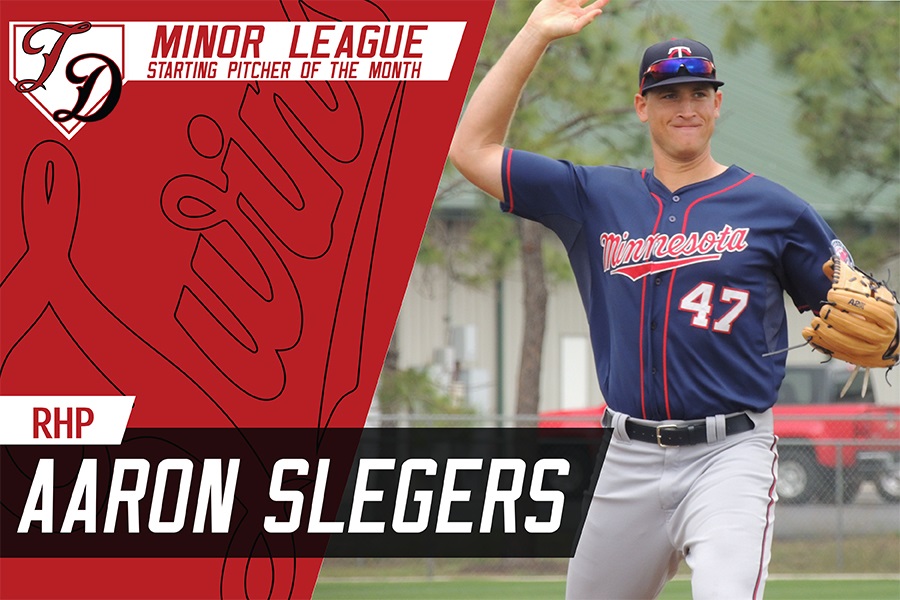 Before we get to our Top 4 starting pitchers for the month of April, here is a list of a couple others who deserve to be recognized for a solid final month of the season. HONORABLE MENTION Randy LeBlanc - Chattanooga Lookouts - 5 GS, 28.1 IP, 3-1, 2.22 ERA, 1.34 WHIP, 30 H, 8 BB, 22 K Fernando Romero - Rochester Red Wings - 4 G, 3 GS, 21.0 IP, 0-1, 2.57 ERA, 1.29 WHIP, 17 H, 10 BB, 20 K. THE TOP FOUR STARTING PITCHERS #4 - LHP Anthony Marzi - Ft. Myers Miracle - 4 G, 3 GS, 1-0, 1.93 ERA, 1.18 WHIP, 18.2 IP, 18 H, 4 BB, 20 K Anthony Marzi got the Opening Night start for the Miracle, and he’s been good since. He did pitch once out of the bullpen, but that was just piggybacking a Phil Hughes rehab start. Marzi was a graduate of the University of Connecticut in 2014. He went undrafted, but that winter he signed with the New York Yankees. In 2015, he pitched in six games for the GCL Yankees before being released in March of 2016. He tried out for the independent New Britain Bees of the independent Atlantic League and did well in 2016 and 2017. In late June 2017, he was signed by the Twins because they needed starters in Cedar Rapids. He made nine starts for the Kernels and pitched well enough that his final regular season start came for the Ft. Myers Miracle. While the left-hander does not throw hard or miss a lot of bats, he can be effective by hitting his spots. He has been able to do that since signing. #3 - Tyler Wells - Ft. Myers Miracle - 4 GS, 2-1, 3.63 ERA, 0.87 WHIP, 17.1 IP, 11 H, 4 BB, 18 K Wells had a terrific month. He’d done a terrific job of limiting base runners. He doesn’t give up a lot of hits, and he doesn’t hurt himself with walks. Wells was the Twins 15th-round pick in 2016 draft out of Division II Cal State - San Bernadino. He ended that season strong in Elizabethton, and last year he went 5-3 with a 3.11 ERA in Cedar Rapids, though he was limited to 75 innings due to a couple of injuries. Wells went to work this offseason and lost 25 pounds and came to spring training in great shape. #2- Stephen Gonsalves - Chattanooga Lookouts - 4 G, 3-0, 1.77 ERA, 1.03 WHIP, 20.1 IP, 11 H, 10 BB, 25 K Gonsalves is not a new name to these monthly starting pitcher awards. He’s won several of the monthly awards, and he was the Twins Daily Minor League Starting Pitcher of the Year in both 2016 and 2017. After his 2017 season, the Twins added him to the 40-man roster. He went to his second straight big league spring training. It was a bit of a surprise that he was sent to AA Chattanooga to start the season. It was much less surprising to see him put up really impressive numbers through his first four starts. It’s also not surprising that his first start of May was with the Rochester Red Wings (or that he threw 7 2/3 scoreless innings). The former fourth-round pick from San Diego is on track to make his major league debut sometime in 2018. And the Twins Minor League Starting Pitcher of the Month is: Rochester Red Wings - RHP Aaron Slegers - 4 GS, 2-0, 1.50 ERA, 0.92 WHIP, 24.0 IP, 19 H, 3 BB, 14 K Speaking of guys who have been mentioned in these reports a lot, Aaron Slegers was twice a Twins Minor League Starting Pitcher of the Month in 2017. He even made three big league starts. He was the runner-up for Starting Pitcher of the Year. And he has started out 2018 very well as well. Slegers threw six innings in all four of his starts. He had four quality starts and twice he didn’t give up a run. He even got to spend one day in the Twins bullpen in New York, called up in case a long reliever was needed. Slegers was the Twins fifth-round draft pick in 2013 out of Indiana University where he had been been the Big 10’s Pitcher of the Year. He has moved up one level each year and has developed well at that pace. After debuting in 2017, Slegers returns to Rochester where he will continue to pitch in hopes of more of those call-ups. Congratulations to our Twins Daily Minor League Starting Pitcher of the Month of April, Rochester starter Aaron Slegers. Feel free to discuss and ask questions.
 -
I mean, a week or so ago, the Twins promoted RHP Brady Anderson from Ft. Myers to Rochester for one day to work out of their bullpen.' That's probably about what this is.
-
Twins Minor League Report (5/2): Starters Toss Zeroes
Seth Stohs replied to Seth Stohs's topic in Twins Daily Front Page News
Gonsalves, Jaye. Baxendale is making another spot start. I'm sure Adalberto Mejia will be back soon. If Enns clears waivers, he could be back in time to make his next start. -
Twins Minor League Report (5/2): Starters Toss Zeroes
Seth Stohs replied to Seth Stohs's topic in Twins Daily Front Page News
Probably the same thing as yesterday the non-Gordon promotion. I assume this is a very short-term thing until a couple of players are eligible to come off of the DL. -
I don''t know... It shouldn't have.
-
Maybe there is something in a name. Or maybe they were inspired by the Major League debut of top pitching prospect Fernando Romero. Tyler Wells and Tyler Watson combined for 11 1/3 scoreless innings in their starts tonight. Add in four scoreless innings for Lewis Thorpe is his Wednesday start and that’s a lot of levels getting the message that it all starts with starting pitching. Find out how the four Twins affiliates did and who were the top performers. Image courtesy of Seth Stohs, Twins Daily (photo of Tyler Wells) Maybe there is something in a name. Or maybe they were inspired by the Major League debut of top pitching prospect Fernando Romero. Tyler Wells and Tyler Watson combined for 11 1/3 scoreless innings in their starts tonight. Add in four scoreless innings for Lewis Thorpe is his Wednesday start and that’s a lot of levels getting the message that it all starts with starting pitching. Find out how the four Twins affiliates did and who were the top performers. Keep reading to find out more on the night in the Twins minor league system on Wednesday. And as always, please feel free to discuss and ask questions. TRANSACTIONS On Wednesday, the Twins officially announced that John Curtiss was optioned to Rochester and RHP Fernando Romero was promoted to the Twins. Romero had a pretty strong MLB debut! OF Jimmy Kerrigan was promoted from Ft. Myers to Rochester. 1B Robbie Rinn was promoted from extended spring training to Ft. Myers. He was acquired in a minor league trade during spring training. RED WINGS REPORT Rochester 6, Pawtucket 7 Box Score Down 1-0 in the top of the fifth inning, Jermaine Curtis stepped up with a couple of runners on and hit his first home run of the season to give the Red Wings a 3-1 lead. Miles Jaye started for the Wings and gave up just one run through the first four innings. However, given the lead, Jaye gave up a four-spot in the bottom of the fifth frame. In total, he gave up five runs on eight hits and a walk in 4 2/3 innings. He struck out three. Ryne Harper came on and gave up two runs on three hits over 1 2/3 innings. Ryne Harper came on and gave up two runs on three hits over 1 2/3 innings. He got five outs, all of them on strikeouts. Casey Crosby got the final five outs for the Red Wings without any further damage. Curtiss added another RBI later in the game. He was 2-for-5 with four RBI. James Ramsey was 2-for-2 with a walk and was hit by a pitch. Willians Astudillo added his second home run of the year. CHATTANOOGA CHATTER Chattanooga 7, Mobile 6 (10 innings) Box Score Lewis Thorpe made the start for the Lookouts. The southpaw from Australia threw four scoreless innings. He gave up just two hits, but he walked five and struck out six. That led to a high pitch count. He was done after four innings having already thrown 89 pitches. Ryan Eades went the next two innings and gave up three runs on two hits and three walks. He struck out two. Cody Stashak worked the next two innings. He gave up two runs on three hits and a walk. He struck out three. Fellow Australian, Todd Van Steensel, came on to protect a one-run lead in the ninth. He gave up one run and the game went to overtime, or extra innings, if you prefer. In the top of the tenth, LaMonte Wade started the inning on second. He advanced to third on a wild pitch and scored on a Brent Rooker sacrifice fly. Van Steensel was back on the mound for the bottom of the 10th. The first batter reached on an error, putting runners at first and third. But Van Steensel got a strikeout and then coaxed a double play to end the game. Edgar Corcino led the offense by going 2-4 with his third and fourth doubles. He drove in two runs. Zander Wiel went 2-5. Alex Perez was 1-2 with three walks. Nick Gordon drove in a run with his fifth double. MIRACLE MATTERS Ft. Myers 5, Tampa 0 Box Score If you’re looking for a Twins minor league starting pitcher who could move up prospect rankings throughout this season, look no further than Tyler Wells. The 6-8 right-hander got himself in very good shape in the offseason and has taken his performance to a new level. On this night, Wells threw six shutout innings. He gave up just two hits, walked one and struck out four. He improved to 3-1 with a 2.70 ERA. After Wells left, the Westmont Duo took over and combined for the final three innings. Andrew Vasquez worked two innings and was charged with an unearned run. Hector Lujan threw a perfect ninth inning. Joe Cronin continued his hot stretch to start the season. The infielder went 2-for-4 with a walk and his first triple. He drove in three runs and stole a base. Robbie Rinn made his Twins and Florida State League debuts on Wednesday night. He went 1-2 with a walk and a double. Nelson Molina went 1-3 with a walk and his first stolen base of the year. KERNELS NUGGETS Cedar Rapids 5, South Bend 0 (6 innings, rain) Box Score There was a threat of some serious weather, but the game was able to get through the necessary five innings to be complete. Tyler Watson did his part to keep the game rolling. The left-hander threw all 5 1/3 innings without allowing a run. He gave up just three hits and walked none. He struck out six. Jean Carlos Arias led the offense. He went 3-for-3 with two RBI. Alex Kirilloff scored twice and drove in one with his seventh double. Andrew Bechtold added his third double. For South Bend, their second pitcher of the game was Rollie Lacy. He was a Cubs draft pick last year out of Creighton. He played his high school baseball at Holy Family High School in Victoria, Minnesota. In 18.1 innings this season, he has a 1.93 ERA. STARS OF THE DAY Twins Daily Hitter of the Day: Jermaine Curtis, Rochester Wings (2-5, HR(1), 4 RBI) Twins Daily Pitcher of the Day: Tyler Wells, Ft. Myers Miracle (6 IP, 2 H, 0 ER, 1 BB, 4 K) TOP PROSPECT SUMMARY Here’s a look at how the Twins Daily Top 20 Twins Prospects performed: #2 - Fernando Romero (Minnesota) - 5.2 IP, 4 H, 0 R, 3 BB, 5 K (MLB Debut) #3 - Nick Gordon (Chattanooga) - 1-5, 2B(5), R, RBI, BB, K #5 - Alex Kirilloff (Cedar Rapids) - 1-3, 2B(7), 2 R, 1 RBI #7 - Brent Rooker (Chattanooga) - 0-4, BB, SF, RBI, 4 K #10 - Akil Baddoo (Cedar Rapids) - 0-2, R, 1 BB, 1 K #12 - Lewis Thorpe (Chattanooga) - 4 IP, 2 H, 0 R, 5 BB, 6 K #14 - LaMonte Wade (Chattanooga) - 0-5, 2 R, BB, 2 K #16 - Ben Rortvedt (Cedar Rapids) - 0-2, K #17 - Travis Blankenhorn (Ft. Myers) - 0-4, 2K THURSDAY’S PROBABLE STARTERS Lehigh Valley @ Rochester (6:05 CST) - RHP Aaron Slegers (2-0, 1.50 ERA) Chattanooga @ Mobile (6:35 CST) - RHP Kohl Stewart (2-1, 5.82 ERA) Ft. Myers @ Tampa (5:30 CST) - LHP Charlie Barnes (0-2, 4.24 ERA) South Bend @ Cedar Rapids (6:35 CST) - RHP Bailey Ober (0-1, 81.00 ERA) Please feel free to ask any questions about Wednesday’s full schedule of games, or ask any questions you may have. View full article
-
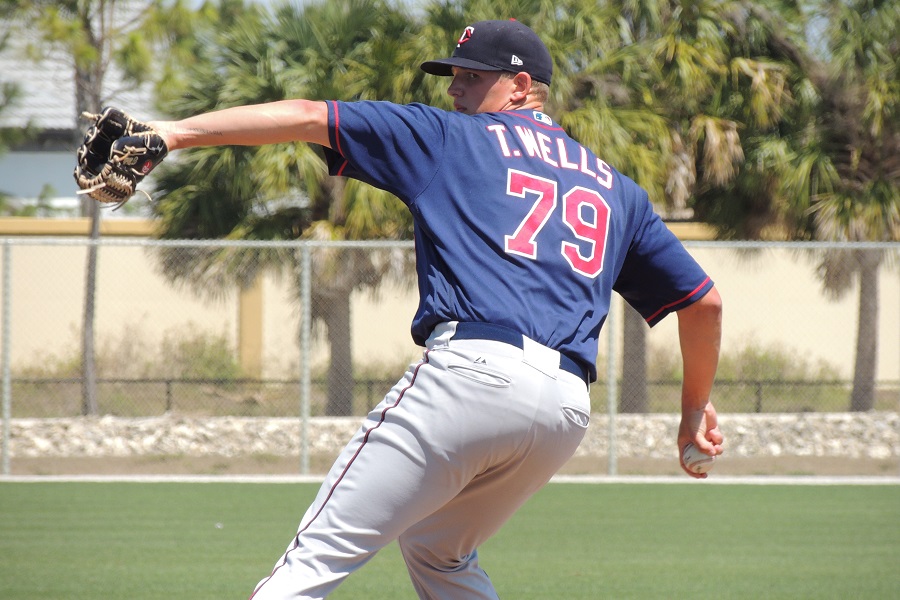 Keep reading to find out more on the night in the Twins minor league system on Wednesday. And as always, please feel free to discuss and ask questions. TRANSACTIONS On Wednesday, the Twins officially announced that John Curtiss was optioned to Rochester and RHP Fernando Romero was promoted to the Twins. Romero had a pretty strong MLB debut! OF Jimmy Kerrigan was promoted from Ft. Myers to Rochester. 1B Robbie Rinn was promoted from extended spring training to Ft. Myers. He was acquired in a minor league trade during spring training. RED WINGS REPORT Rochester 6, Pawtucket 7 Box Score Down 1-0 in the top of the fifth inning, Jermaine Curtis stepped up with a couple of runners on and hit his first home run of the season to give the Red Wings a 3-1 lead. Miles Jaye started for the Wings and gave up just one run through the first four innings. However, given the lead, Jaye gave up a four-spot in the bottom of the fifth frame. In total, he gave up five runs on eight hits and a walk in 4 2/3 innings. He struck out three. Ryne Harper came on and gave up two runs on three hits over 1 2/3 innings. Ryne Harper came on and gave up two runs on three hits over 1 2/3 innings. He got five outs, all of them on strikeouts. Casey Crosby got the final five outs for the Red Wings without any further damage. Curtiss added another RBI later in the game. He was 2-for-5 with four RBI. James Ramsey was 2-for-2 with a walk and was hit by a pitch. Willians Astudillo added his second home run of the year. CHATTANOOGA CHATTER Chattanooga 7, Mobile 6 (10 innings) Box Score Lewis Thorpe made the start for the Lookouts. The southpaw from Australia threw four scoreless innings. He gave up just two hits, but he walked five and struck out six. That led to a high pitch count. He was done after four innings having already thrown 89 pitches. Ryan Eades went the next two innings and gave up three runs on two hits and three walks. He struck out two. Cody Stashak worked the next two innings. He gave up two runs on three hits and a walk. He struck out three. Fellow Australian, Todd Van Steensel, came on to protect a one-run lead in the ninth. He gave up one run and the game went to overtime, or extra innings, if you prefer. In the top of the tenth, LaMonte Wade started the inning on second. He advanced to third on a wild pitch and scored on a Brent Rooker sacrifice fly. Van Steensel was back on the mound for the bottom of the 10th. The first batter reached on an error, putting runners at first and third. But Van Steensel got a strikeout and then coaxed a double play to end the game. Edgar Corcino led the offense by going 2-4 with his third and fourth doubles. He drove in two runs. Zander Wiel went 2-5. Alex Perez was 1-2 with three walks. Nick Gordon drove in a run with his fifth double. MIRACLE MATTERS Ft. Myers 5, Tampa 0 Box Score If you’re looking for a Twins minor league starting pitcher who could move up prospect rankings throughout this season, look no further than Tyler Wells. The 6-8 right-hander got himself in very good shape in the offseason and has taken his performance to a new level. On this night, Wells threw six shutout innings. He gave up just two hits, walked one and struck out four. He improved to 3-1 with a 2.70 ERA. After Wells left, the Westmont Duo took over and combined for the final three innings. Andrew Vasquez worked two innings and was charged with an unearned run. Hector Lujan threw a perfect ninth inning. Joe Cronin continued his hot stretch to start the season. The infielder went 2-for-4 with a walk and his first triple. He drove in three runs and stole a base. Robbie Rinn made his Twins and Florida State League debuts on Wednesday night. He went 1-2 with a walk and a double. Nelson Molina went 1-3 with a walk and his first stolen base of the year. KERNELS NUGGETS Cedar Rapids 5, South Bend 0 (6 innings, rain) Box Score There was a threat of some serious weather, but the game was able to get through the necessary five innings to be complete. Tyler Watson did his part to keep the game rolling. The left-hander threw all 5 1/3 innings without allowing a run. He gave up just three hits and walked none. He struck out six. Jean Carlos Arias led the offense. He went 3-for-3 with two RBI. Alex Kirilloff scored twice and drove in one with his seventh double. Andrew Bechtold added his third double. For South Bend, their second pitcher of the game was Rollie Lacy. He was a Cubs draft pick last year out of Creighton. He played his high school baseball at Holy Family High School in Victoria, Minnesota. In 18.1 innings this season, he has a 1.93 ERA. STARS OF THE DAY Twins Daily Hitter of the Day: Jermaine Curtis, Rochester Wings (2-5, HR(1), 4 RBI) Twins Daily Pitcher of the Day: Tyler Wells, Ft. Myers Miracle (6 IP, 2 H, 0 ER, 1 BB, 4 K) TOP PROSPECT SUMMARY Here’s a look at how the Twins Daily Top 20 Twins Prospects performed: #2 - Fernando Romero (Minnesota) - 5.2 IP, 4 H, 0 R, 3 BB, 5 K (MLB Debut) #3 - Nick Gordon (Chattanooga) - 1-5, 2B(5), R, RBI, BB, K #5 - Alex Kirilloff (Cedar Rapids) - 1-3, 2B(7), 2 R, 1 RBI #7 - Brent Rooker (Chattanooga) - 0-4, BB, SF, RBI, 4 K #10 - Akil Baddoo (Cedar Rapids) - 0-2, R, 1 BB, 1 K #12 - Lewis Thorpe (Chattanooga) - 4 IP, 2 H, 0 R, 5 BB, 6 K #14 - LaMonte Wade (Chattanooga) - 0-5, 2 R, BB, 2 K #16 - Ben Rortvedt (Cedar Rapids) - 0-2, K #17 - Travis Blankenhorn (Ft. Myers) - 0-4, 2K THURSDAY’S PROBABLE STARTERS Lehigh Valley @ Rochester (6:05 CST) - RHP Aaron Slegers (2-0, 1.50 ERA) Chattanooga @ Mobile (6:35 CST) - RHP Kohl Stewart (2-1, 5.82 ERA) Ft. Myers @ Tampa (5:30 CST) - LHP Charlie Barnes (0-2, 4.24 ERA) South Bend @ Cedar Rapids (6:35 CST) - RHP Bailey Ober (0-1, 81.00 ERA) Please feel free to ask any questions about Wednesday’s full schedule of games, or ask any questions you may have.
 -
It's against the CBA to do that... It should never happen.
-
April was an interesting month for baseball, in the big leagues and in the minor leagues. Weather effected many teams including the Rochester Red Wings and the Cedar Rapids Kernels. But we have a month worth of games, so it’s time to post our first monthly minor league award. Today, we start with the Twins minor league relief pitchers of the month. We’ll count down the Top 5 Twins minor league relievers, and there are enough good bullpen performances that we’ll include some honorable mentions. Image courtesy of Seth Stohs, Twins Daily April was an interesting month for baseball, in the big leagues and in the minor leagues. Weather effected many teams including the Rochester Red Wings and the Cedar Rapids Kernels. But we have a month worth of games, so it’s time to post our first monthly minor league award. Today, we start with the Twins minor league relief pitchers of the month. We’ll count down the Top 5 Twins minor league relievers, and there are enough good bullpen performances that we’ll include some honorable mentions. Before we share our choices for the Twins Minor League Top Five Relievers for April, here are some terrific bullpen performances that just missed the cut. HONORABLE MENTION Tyler Duffey - Rochester Red Wings - 5 G, 11.0 IP, 3 H, 1 BB, 14 K, 0.00 ERA, 0.36 WHIP. Matt Magill - Elizabethton Twins - 5 G, 8.2 IP, 5 H, 2 BB, 13 K, 0.00 ERA, 0.81 WHIP. Andrew Vasquez - Ft. Myers Miracle/Chattanooga Lookouts - 8 G, 14.0 IP, 8 H, 6 BB, 14 K, 1.29 ERA, 1.00 WHIP Todd Van Steensel - Chattanooga Lookouts - 7 G, 13.2 IP, 10 H, 6 BB, 17 K, 2.63 ERA, 1.17 WHIP THE TOP FIVE RELIEF PITCHERS #5 - Kevin Marnon - Cedar Rapids Kernels - 5 G, 1.46 ERA, 0.81 WHIP, 12.1 IP, 7 H, 3 BB, 14 K Kevin Marnon went undrafted last year after his college career, a career that took him to East Tennessee State, Akron and Ball State. He went to the USPBL, but soon after, the Twins called him and he signed. The 6-8 left-hander began the 2018 season in Cedar Rapids. As you can see, he did a nice job out of the Kernels bullpen. He worked two innings most times and once worked in five innings in an extra-innings game. As the calendar changed from April to May, Marnon learned that he had been promoted to the Ft. Myers Miracle. #4 - John Curtiss - Rochester Red Wings - 5 G, 2.89 ERA, 0.96 WHIP, 9.1 IP, 7 H, 2 BB, 17 K Curtiss was the Twins sixth-round pick in 2014 out of the University of Texas. In college, he had both thoracic outlet surgery and Tommy John surgery. He missed time his first full season in the minor leagues. However, the last two seasons, he has been as good as any other pitcher in the system and moved up very quickly. He was the Twins Daily Minor League Relief Pitcher of the Year in 2017 and ended the year with nine games with the Twins. He had a really good April with the Red Wings and earned his promotion to the Twins at the end of the month. He was returned to Rochester last night where he’ll jump back into late-inning relief work. #3 - DJ Baxendale - Rochester Red Wings - 6 G (2 GS), 0.00 ERA, 0.91 WHIP, 14.1 IP, 11 H, 2 BB, 9 K Baxendale was the Twins 10th-round pick in 2012 out of the University of Arkansas. He began his career as a starter, but he has worked primarily out of the bullpen in recent years. He’s worked in many roles including short-relief, long-relief and spot starting, a role he has continued to have in 2018. Baxendale was very good in April. While he isn’t a strikeout pitcher, he works fast and has a real good slider and good control. #2 - Ryan Mason - Cedar Rapids Kernels/Ft. Myers Miracle - 8 G, 2.20 ERA, 0.61 WHIP, 16.1 IP, 9 H, 1 BB, 19 K Mason led all Twins minor league relievers in innings pitched in April. It’s impressive, in part, because he received a promotion to Ft. Myers mid-month. He moved up and didn’t miss a beat. He’s mostly been working two to three innings late in games. He went 2-1 with three saves in his eight outings. At 6-6, he was drafted in the 13th round out of Cal-Berkeley in 2016. He’s got a good fastball, and he can throw as many as four pitches thanks to his college years as a starter.And the Twins Minor League Relief Pitcher of the Month is: Rochester Red Wings – RHP Nick Anderson - 6 G, 0.82 ERA, 0.91 WHIP, 11.0 IP, 6 H, 4 BB, 17 K Anderson won this month award a couple of times in 2017 and was a finalist for Twins Daily’s Minor League Relief Pitcher of the Year. He spent most of 2017 in Chattanooga, but he jumped right to Rochester to start the 2018 season. He continues to do what he has done since signing with the Twins. He throws a lot of strikes. He throws hard, mid-90s, touching 97. He’s got a wipeout slider. He’s able to miss bats. Opponents hit just .162 off of him for the month. While he is not on the 40-man roster, it will be interesting to see if he is given an opportunity with the big league club in 2018. For those still unaware, Anderson’s is a great story. He is a graduate of Brainerd High School. He went to St. Cloud State for three years before heading to Mayville State for a season. The Brewers drafted him, but they didn’t even offer him a contract. After working in the indy leagues for a few seasons, the Twins signed him late in 2015, and he’s been a dominant late inning reliever wherever he’s played. He is in his first season with the Rochester Red Wings.There were several very strong relief pitcher performances in April throughout the Twins minor league system. It was a good month for each of these pitchers mentioned today, but again, Congratulations to the Twins Daily Minor League Relief Pitcher of the Month for April 2018, Nick Anderson. View full article
-
Twins Minor League Relief Pitcher of the Month - April 2018
Seth Stohs posted an article in Minor Leagues
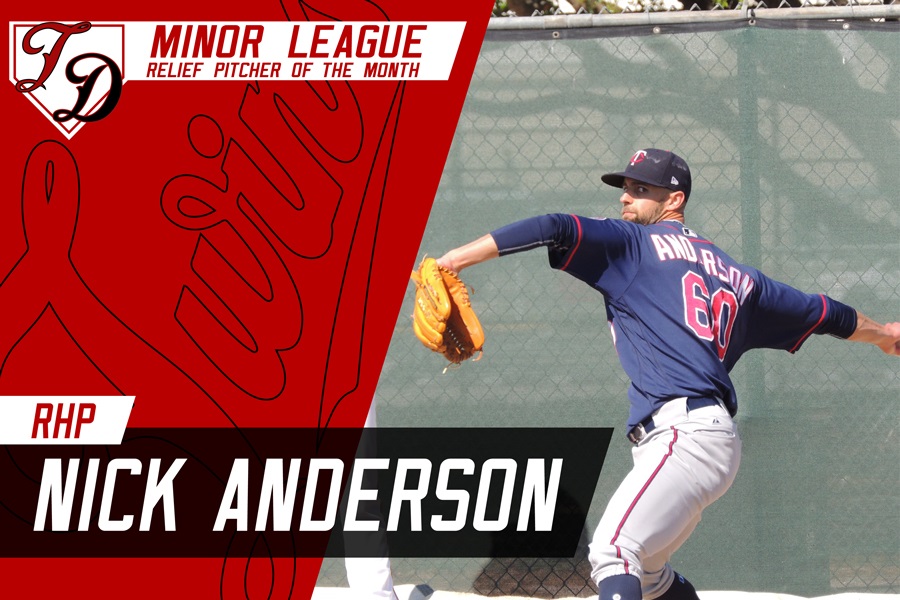 Before we share our choices for the Twins Minor League Top Five Relievers for April, here are some terrific bullpen performances that just missed the cut. HONORABLE MENTION Tyler Duffey - Rochester Red Wings - 5 G, 11.0 IP, 3 H, 1 BB, 14 K, 0.00 ERA, 0.36 WHIP. Matt Magill - Elizabethton Twins - 5 G, 8.2 IP, 5 H, 2 BB, 13 K, 0.00 ERA, 0.81 WHIP. Andrew Vasquez - Ft. Myers Miracle/Chattanooga Lookouts - 8 G, 14.0 IP, 8 H, 6 BB, 14 K, 1.29 ERA, 1.00 WHIP Todd Van Steensel - Chattanooga Lookouts - 7 G, 13.2 IP, 10 H, 6 BB, 17 K, 2.63 ERA, 1.17 WHIP THE TOP FIVE RELIEF PITCHERS #5 - Kevin Marnon - Cedar Rapids Kernels - 5 G, 1.46 ERA, 0.81 WHIP, 12.1 IP, 7 H, 3 BB, 14 K Kevin Marnon went undrafted last year after his college career, a career that took him to East Tennessee State, Akron and Ball State. He went to the USPBL, but soon after, the Twins called him and he signed. The 6-8 left-hander began the 2018 season in Cedar Rapids. As you can see, he did a nice job out of the Kernels bullpen. He worked two innings most times and once worked in five innings in an extra-innings game. As the calendar changed from April to May, Marnon learned that he had been promoted to the Ft. Myers Miracle. #4 - John Curtiss - Rochester Red Wings - 5 G, 2.89 ERA, 0.96 WHIP, 9.1 IP, 7 H, 2 BB, 17 K Curtiss was the Twins sixth-round pick in 2014 out of the University of Texas. In college, he had both thoracic outlet surgery and Tommy John surgery. He missed time his first full season in the minor leagues. However, the last two seasons, he has been as good as any other pitcher in the system and moved up very quickly. He was the Twins Daily Minor League Relief Pitcher of the Year in 2017 and ended the year with nine games with the Twins. He had a really good April with the Red Wings and earned his promotion to the Twins at the end of the month. He was returned to Rochester last night where he’ll jump back into late-inning relief work. #3 - DJ Baxendale - Rochester Red Wings - 6 G (2 GS), 0.00 ERA, 0.91 WHIP, 14.1 IP, 11 H, 2 BB, 9 K Baxendale was the Twins 10th-round pick in 2012 out of the University of Arkansas. He began his career as a starter, but he has worked primarily out of the bullpen in recent years. He’s worked in many roles including short-relief, long-relief and spot starting, a role he has continued to have in 2018. Baxendale was very good in April. While he isn’t a strikeout pitcher, he works fast and has a real good slider and good control. #2 - Ryan Mason - Cedar Rapids Kernels/Ft. Myers Miracle - 8 G, 2.20 ERA, 0.61 WHIP, 16.1 IP, 9 H, 1 BB, 19 K Mason led all Twins minor league relievers in innings pitched in April. It’s impressive, in part, because he received a promotion to Ft. Myers mid-month. He moved up and didn’t miss a beat. He’s mostly been working two to three innings late in games. He went 2-1 with three saves in his eight outings. At 6-6, he was drafted in the 13th round out of Cal-Berkeley in 2016. He’s got a good fastball, and he can throw as many as four pitches thanks to his college years as a starter. And the Twins Minor League Relief Pitcher of the Month is: Rochester Red Wings – RHP Nick Anderson - 6 G, 0.82 ERA, 0.91 WHIP, 11.0 IP, 6 H, 4 BB, 17 K Anderson won this month award a couple of times in 2017 and was a finalist for Twins Daily’s Minor League Relief Pitcher of the Year. He spent most of 2017 in Chattanooga, but he jumped right to Rochester to start the 2018 season. He continues to do what he has done since signing with the Twins. He throws a lot of strikes. He throws hard, mid-90s, touching 97. He’s got a wipeout slider. He’s able to miss bats. Opponents hit just .162 off of him for the month. While he is not on the 40-man roster, it will be interesting to see if he is given an opportunity with the big league club in 2018. For those still unaware, Anderson’s is a great story. He is a graduate of Brainerd High School. He went to St. Cloud State for three years before heading to Mayville State for a season. The Brewers drafted him, but they didn’t even offer him a contract. After working in the indy leagues for a few seasons, the Twins signed him late in 2015, and he’s been a dominant late inning reliever wherever he’s played. He is in his first season with the Rochester Red Wings. There were several very strong relief pitcher performances in April throughout the Twins minor league system. It was a good month for each of these pitchers mentioned today, but again, Congratulations to the Twins Daily Minor League Relief Pitcher of the Month for April 2018, Nick Anderson.
 -
Royce Lewis is Finding His Stroke
Seth Stohs replied to Cody Christie's topic in Twins Daily Front Page News
Yeah, I think that the Twins will be appropriately aggressive with Lewis. He's much more advanced offensively than Buxton was at the same stage, and Buxton was promoted to Ft. Myers in early July or late June. Lewis could be promoted in that timeline... I'm mainly hoping they wait until after Memorial Day as I'm hoping to go down there that weekend. I think he finishes this year in Ft. Myers. He could start next year in Chattanooga... Then honestly, it may depend some on Gordon and Polanco (and obviously the Dozier and Escobar free agency possibilities), but he could be up as early as late 2019. I think early 2020 is very realistic. -
I don't know if he'd been dominant in his AA starts. Yeah, the numbers looked good, but he had high pitch counts and struggled with command of pitches. Last night was by far his best performance of the year. Obviously that shows in the stats. But having watched a lot of it, he was absolutely on. He had a good fastball with good command of it. He had the slow curve working both as a get-ahead pitch and as a swing and miss pitch. And he threw a couple of great changeups. To me, this start is the building block for him. The AA starts were almost like extended spring training for him...
- 15 replies
-
- 1
-
-
- stephen gonsalves
- edwar colina
- (and 3 more)
-
It's not a prospect thing... We assume Petit is only going to be up for a week, and likewise Miller will likely only be up with Rochester for a week, so why have Gordon go through hoops? That said, if they would have called up Gordon, it likely would have been for good. Tells me that they're not quite ready to say that Gordon has accomplished the things (whatever they may be) at AA that they want to see before moving him up. Or, they feel they could just call Gordon up directly.
- 15 replies
-
- 1
-
-
- stephen gonsalves
- edwar colina
- (and 3 more)
-
It’s safe to say that the Minnesota Twins have struggled mightily in every facet of the game the last two weeks. They haven’t hit well. They haven’t played good defense. The bullpen has struggled, and the starting pitchers have rarely been able to provide relief to the bullpen with extended starts. There is, however, reason for Twins fans to be excited about the team’s starting pitcher on Wednesday afternoon against the Blue Jays. Twins top pitching prospect Fernando Romero will make his major league debut. Image courtesy of Bare Antolos/Rochester Red Wings It’s safe to say that the Minnesota Twins have struggled mightily in every facet of the game the last two weeks. They haven’t hit well. They haven’t played good defense. The bullpen has struggled, and the starting pitchers have rarely been able to provide relief to the bullpen with extended starts. There is, however, reason for Twins fans to be excited about the team’s starting pitcher on Wednesday afternoon against the Blue Jays. Twins top pitching prospect Fernando Romero will make his major league debut. BACKGROUND Fernando Romero burst onto prospect rankings way back in 2013 when he went 2-0 with a 1.60 ERA and 47 strikeouts as an 18-year-old in the Gulf Coast League. Much more important than the numbers were the scouting reports which showed he was sitting in the mid-to-upper 90s with his fastball and that he had a good breaking ball too. In 2014, he moved up to Cedar Rapids in mid-May, but after just three starts, he experienced pain in his elbow. Soon after, he needed Tommy John surgery. He missed the entire 2015 season, and as he was rehabbing, he needed knee surgery. When he returned at Instructional League that year, reports showed him hitting triple-digits with his fastball. He was not able to return to the field until May of 2016. Once he returned, it was as if he didn’t miss a beat. He made five starts in Cedar Rapids where he went 4-1 with a 1.93 ERA. He moved up to Ft. Myers where he went 5-2 with a 1.88 ERA in 11 starts. Combined, he threw 90.1 innings and struck out 90 batters while walking just 15 batters. Following the season, he was added to the Twins 40-man roster. He spent the entire 2017 season in Double-A Chattanooga where he went 11-9 with a 3.53 ERA. In 125 innings, he gave up 45 walks and struck out 120 batters. And that brings us to 2018. Following a strong showing in big league spring training (eight no-hit innings). That pushed him up to Rochester to start the season. Romero has made three starts for the Red Wings. He also came out of the bullpen once, piggybacking after Adalberto Mejia went two innings. He is 0-1 with a 2.57 ERA and a 1.29 WHIP. In 21 innings, he has given up 17 hits (just one home run), ten walks and struck out 20. SCOUTING REPORT From the Minnesota Twins Prospect Handbook 2018: Scouting Report: Romero has absolutely electric stuff, probably the best pure “stuff” of anyone in the organization right now. He is built very strong. He’s just over 6-0 and about 220 pounds. He’s got a very strong lower half, very strong legs. He is quite aggressive with his fastball. His fastball usually sits in the mid-to-upper 90s and he has touched triple digits. His slider can be in the upper-80s and can be a strikeout pitch. He’s still inconsistent with it, but it has potential to be a plus-plus pitch. He also throws a cutter. He has really worked to improve his changeup as well. If he can have three plus-plus pitches, he could be a great starter. Without a third pitch, he could be an elite reliever. He’s shown a commitment to the process of becoming great. He has been willing to work on pitches, such as his changeup, in game situations. Romero is light-hearted and known to be a good teammate. TWINS MLB DEBUTS The Twins will be the underdog in this afternoon’s series finale against the Toronto Blue Jays at Target Field. However, with Fernando Romero making his Major League Debut, the excitement and energy in the stadium could certainly affect him and the rest of the Twins team. How comfortable are you with Romero and his stuff in his debut? Be sure to do your research before joining an online betting site and double check the lines. There is incentive for the bookies to have equal bets on both sides. Here is a quick review of how many of the Minnesota Twins pitching prospects over the last dozen years performed in their first major league start. Jose Berrios (4/27/16) – 4 IP, 6 H, 5 ER, 2 BB, 5 K, 93 pitches, 56 strikes. Alex Meyer (5/2/16) – 2.2 IP, 3 H, 3 ER, 3 BB, 4 K, HR, 64 pitches, 34 strikes. Trevor May (8/9/14) – 2 IP, 3 H, 4 ER, 7 BB, 0 K, 63 pitches, 28 strikes. Tyler Duffey (8/5/15) – 2 IP, 5 H, 6 ER, 2 BB, 1 K, 2 HR, 60 pitches, 32 strikes. Kyle Gibson (6/29/13) – 6 IP, 8 H, 2 ER, 0 BB, 5 K, 91 pitches, 64 strikes. Andrew Albers (8/6/13) – 8.1 IP, 4 H, 0 R, 1 BB, 2 K, 109 pitches, 67 strikes. Liam Hendriks (9/6/11) – 7 IP, 4 H, 3 ER, 3 BB, 4 K, 99 pitches, 65 strikes. Cole De Vries (5/24/12) – 5 IP, 6 H, 3 ER, 1 BB, 4 K, 3 HR, 96 pitches, 60 strikes. Scott Baker (7/5/05) – 5 IP, 5 H, 2 ER, 2 BB, 5 K, HR, 88 pitches, 54 strikes. Francisco Liriano (9/14/05) – 5 IP, 2 H, 2 ER, 1 BB, 6 K, HR, 69 pitches, 44 strikes. Kevin Slowey (6/14/07) – 6 IP, 5 H, 1 ER, 2 BB, 3 K, HR, 99 pitches, 66 strikes. Nick Blackburn (4/2/08) – 7 IP, 5 H, 1 ER, 1 BB, 6 K, 86 pitches, 63 strikes. Anthony Swarzak (5/23/09) – 7 IP, 5 H, 0 R, 2 BB, 3 K, 98 pitches, 64 strikes. Jeff Manship (9/1/09) – 5 IP, 4 H, 1 ER, 2 BB, 2 K, HR, 80 pitches, 48 strikes. Matt Garza (8/11/06) – 2.2 IP, 8 H, 7 ER, 2 BB, 2 K, 2 HR, 67 pitches, 42 strikes. I would say that the takeaway from a quick review of first major-league starts is that we need to not make too much of it as a predictor of the future in any way, good or bad. So, I’m just going to try to enjoy and realize that he is a big part of the Twins future. View full article
-
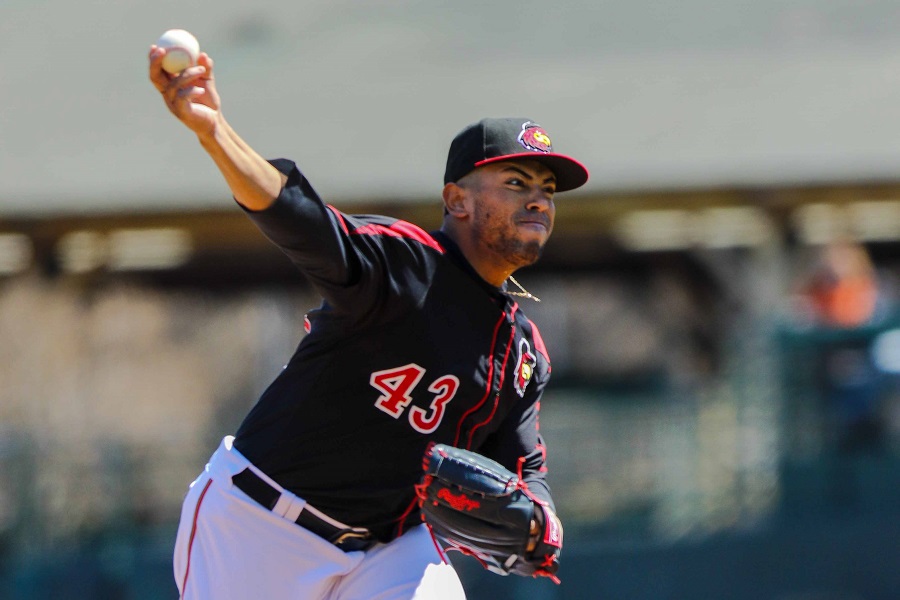 BACKGROUND Fernando Romero burst onto prospect rankings way back in 2013 when he went 2-0 with a 1.60 ERA and 47 strikeouts as an 18-year-old in the Gulf Coast League. Much more important than the numbers were the scouting reports which showed he was sitting in the mid-to-upper 90s with his fastball and that he had a good breaking ball too. In 2014, he moved up to Cedar Rapids in mid-May, but after just three starts, he experienced pain in his elbow. Soon after, he needed Tommy John surgery. He missed the entire 2015 season, and as he was rehabbing, he needed knee surgery. When he returned at Instructional League that year, reports showed him hitting triple-digits with his fastball. He was not able to return to the field until May of 2016. Once he returned, it was as if he didn’t miss a beat. He made five starts in Cedar Rapids where he went 4-1 with a 1.93 ERA. He moved up to Ft. Myers where he went 5-2 with a 1.88 ERA in 11 starts. Combined, he threw 90.1 innings and struck out 90 batters while walking just 15 batters. Following the season, he was added to the Twins 40-man roster. He spent the entire 2017 season in Double-A Chattanooga where he went 11-9 with a 3.53 ERA. In 125 innings, he gave up 45 walks and struck out 120 batters. And that brings us to 2018. Following a strong showing in big league spring training (eight no-hit innings). That pushed him up to Rochester to start the season. Romero has made three starts for the Red Wings. He also came out of the bullpen once, piggybacking after Adalberto Mejia went two innings. He is 0-1 with a 2.57 ERA and a 1.29 WHIP. In 21 innings, he has given up 17 hits (just one home run), ten walks and struck out 20. SCOUTING REPORT From the Minnesota Twins Prospect Handbook 2018: Scouting Report: Romero has absolutely electric stuff, probably the best pure “stuff” of anyone in the organization right now. He is built very strong. He’s just over 6-0 and about 220 pounds. He’s got a very strong lower half, very strong legs. He is quite aggressive with his fastball. His fastball usually sits in the mid-to-upper 90s and he has touched triple digits. His slider can be in the upper-80s and can be a strikeout pitch. He’s still inconsistent with it, but it has potential to be a plus-plus pitch. He also throws a cutter. He has really worked to improve his changeup as well. If he can have three plus-plus pitches, he could be a great starter. Without a third pitch, he could be an elite reliever. He’s shown a commitment to the process of becoming great. He has been willing to work on pitches, such as his changeup, in game situations. Romero is light-hearted and known to be a good teammate. TWINS MLB DEBUTS The Twins will be the underdog in this afternoon’s series finale against the Toronto Blue Jays at Target Field. However, with Fernando Romero making his Major League Debut, the excitement and energy in the stadium could certainly affect him and the rest of the Twins team. How comfortable are you with Romero and his stuff in his debut? Be sure to do your research before joining an online betting site and double check the lines. There is incentive for the bookies to have equal bets on both sides. Here is a quick review of how many of the Minnesota Twins pitching prospects over the last dozen years performed in their first major league start. Jose Berrios (4/27/16) – 4 IP, 6 H, 5 ER, 2 BB, 5 K, 93 pitches, 56 strikes. Alex Meyer (5/2/16) – 2.2 IP, 3 H, 3 ER, 3 BB, 4 K, HR, 64 pitches, 34 strikes. Trevor May (8/9/14) – 2 IP, 3 H, 4 ER, 7 BB, 0 K, 63 pitches, 28 strikes. Tyler Duffey (8/5/15) – 2 IP, 5 H, 6 ER, 2 BB, 1 K, 2 HR, 60 pitches, 32 strikes. Kyle Gibson (6/29/13) – 6 IP, 8 H, 2 ER, 0 BB, 5 K, 91 pitches, 64 strikes. Andrew Albers (8/6/13) – 8.1 IP, 4 H, 0 R, 1 BB, 2 K, 109 pitches, 67 strikes. Liam Hendriks (9/6/11) – 7 IP, 4 H, 3 ER, 3 BB, 4 K, 99 pitches, 65 strikes. Cole De Vries (5/24/12) – 5 IP, 6 H, 3 ER, 1 BB, 4 K, 3 HR, 96 pitches, 60 strikes. Scott Baker (7/5/05) – 5 IP, 5 H, 2 ER, 2 BB, 5 K, HR, 88 pitches, 54 strikes. Francisco Liriano (9/14/05) – 5 IP, 2 H, 2 ER, 1 BB, 6 K, HR, 69 pitches, 44 strikes. Kevin Slowey (6/14/07) – 6 IP, 5 H, 1 ER, 2 BB, 3 K, HR, 99 pitches, 66 strikes. Nick Blackburn (4/2/08) – 7 IP, 5 H, 1 ER, 1 BB, 6 K, 86 pitches, 63 strikes. Anthony Swarzak (5/23/09) – 7 IP, 5 H, 0 R, 2 BB, 3 K, 98 pitches, 64 strikes. Jeff Manship (9/1/09) – 5 IP, 4 H, 1 ER, 2 BB, 2 K, HR, 80 pitches, 48 strikes. Matt Garza (8/11/06) – 2.2 IP, 8 H, 7 ER, 2 BB, 2 K, 2 HR, 67 pitches, 42 strikes. I would say that the takeaway from a quick review of first major-league starts is that we need to not make too much of it as a predictor of the future in any way, good or bad. So, I’m just going to try to enjoy and realize that he is a big part of the Twins future.
 -
The biggest story line heading into the minor league games on Monday, was the 2018 Triple-A debut of top pitching prospect Stephen Gonsalves. He was beyond fantastic for the Rochester Red Wings as he got them to .500 on the season as you’ll read. It was quite possibly the best pitching performance I’ve ever NOT rewarded the pitcher of the day award to since I’ve been helping write these reports for Twins Daily. To find out why, you’ll have to make it to the Kernels recap to see what a couple of pitchers combined to do there (hint: what’s better than a one-hitter? Image courtesy of Steve Buhr (Photo of Edwar Colina, Mr. Shucks and Jovani Moran) The biggest story line heading into the minor league games on Monday, was the 2018 Triple-A debut of top pitching prospect Stephen Gonsalves. He was beyond fantastic for the Rochester Red Wings as he got them to .500 on the season as you’ll read. It was quite possibly the best pitching performance I’ve ever NOT rewarded the pitcher of the day award to since I’ve been helping write these reports for Twins Daily. To find out why, you’ll have to make it to the Kernels recap to see what a couple of pitchers combined to do there (hint: what’s better than a one-hitter? To find out what exactly happened in those games and how all the rest of your favorite Twins prospects fared on Tuesday night, keep reading! TRANSACTIONS There were several moves in the Minnesota Twins system on Tuesday: The Twins selected the contract of IF Gregorio Petit from Rochester. In the corresponding move IF Sean Miller was promoted to AA from Chattanooga. To get the Red Wings roster filled they also added catcher Winston Sawyer from the Lookouts while placing first baseman Brock Stassi on the temporary inactive list. To take one of the roster spots in Chattanooga IF Alex Perez was promoted from Fort Myers. To take his place on the Miracle roster IF Carson Crites was moved up from Cedar Rapids and they also received reliever Kevin Marnon who would debut for the Miracle on Tuesday night. RED WINGS REPORT Rochester 2, Pawtucket 0 Box Score The Rochester offense scored two runs in the top of the fifth thanks to the bat of Kennys Vargas, who clubbed his third home run of the season to give them the lead. That was all the lineup would need to produce as a top pitching prospect making his 2018 Triple-A debut turned in the second longest start of his MiLB career. Left-hander Stephen Gonsalves was that starter, and he was lights out against the Red Sox. In 7 2/3 innings he allowed just one walk and one hit while adding five strikeouts. Going into the eighth inning, Gonsalves had faced the minimum thanks to a double-play ball in the second inning, and had retired sixteen in a row. In that eighth inning, he walked the leadoff man but would get two outs, including a K to his final hitter, before being replaced by Alan Busenitz. Gonsalves threw 92 pitches on the game, with 55 of them going for strikes (including eight swinging strikes). Now with five starts in AAA on his resume, he has gone six plus innings in four of those while allowing only four runs. He did have a couple of outings last year that blew up his small-sample AAA stat line, but there’s a lot to like in all his other outings at the final rung on the ladder to the bigs. Busenitz finished the final 1 1/3 innings to pick up his first save of the season with Rochester. He allowed two hits and got all three outs via K's in the ninth. The Red Wings got multiple hit efforts from Jake Cave (2-4, 2 2B, RBI) and Jermaine Curtis (2-4) to give Gonsalves his fourth win of the season. CHATTANOOGA CHATTER Scheduled day off. The Lookouts had the day off on Tuesday as they traveled from Tennessee to Alabama. They begin a five-game series with the Mobile BayBears on Wednesday with lefty Lewis Thorpe on the mound looking for his first win of the 2018 season. MIRACLE MATTERS Fort Myers 1, Tampa 2 Box Score Fort Myers also got a strong effort from their starting pitcher, but the hitters weren’t able to get much going to back it. Anthony Marzi was that starter in this one, and he delivered a quality start. In his six innings, he scattered four hits and a walk while striking out five. He allowed two runs (one earned) on 92 pitches (64 for strikes). He left the game down 2-0 and in line for the loss. The Miracle got on the scoreboard in the top of the seventh inning when Travis Blankenhorn bombed his fifth home run of the season, a solo shot to left field. The rest of the lineup added just three singles and one walk while going 0-3 with runners in scoring position and leaving six men on base. Ryan Mason pitched a scoreless seventh inning thanks in part to a Jimmy Kerrigan assist to cut down a runner at home. Mason gave up two hits in the inning. Fresh off his promotion to Fort Myers, Kevin Marnon added a scoreless eighth inning to finish the game. He allowed two singles and struck out one in his Florida State League debut. KERNELS NUGGETS South Bend 0, Cedar Rapids 10 Box Score Unlike their higher-level cohorts, the Kernels had no problem with offense on Tuesday. As a team they racked up sixteen hits and used a big inning to take complete control against the Cubs. They really didn’t need that output either however, as two pitchers combined to toss the Kernels first no-hitter since the 2013 season. Their lineup scored single runs in the second and third innings thanks to solo home runs from Jean Carlos Arias and Akil Baddoo. It was the first one the year for Arias, and second for Badoo Cedar Rapids then put the game out of reach in the fourth as they sent eleven men to the plate and scored seven of them to go ahead 9-0. That big inning got going after one-out singles from David Banuelos and Trey Cabbage who trotted home on Ben Rodriguez’s second home run of the year. Singles from top prospects Baddoo, Royce Lewis, and Alex Kirilloff followed that blast, and Arias added an RBI single before Andrew Bechtold’s second double of the season cleared the bases to account for the crooked number. They tacked on another run in the eighth as a Kirilloff double brought in Baddoo who had reached with another single. Baddoo, Lewis and Cabbage all notched three hits on the game. Kirilloff and Arias added two hits apiece while Bechtold and Rodriguez each drove in three runs. As a team they were 5-for-12 with runners in scoring position while leaving only six men on base. Starter Edwar Colina was again effectively wild in this one as, despite allowing five walks in his six innings, he obviously didn’t allow a hit or run and struck out two. In picking up his second win of the year he lowered his ERA to 0.60 in 21 innings with the Kernels. He was replaced in the seventh inning with left-hander Jovani Moran who finished off the no-hitter by picking up a three-inning save, his first of the year. He walked one and struck out one. https://www.youtube.com/watch?v=kGWhzPURcpw&feature=youtu.be Colina and Moran combined to throw 131 pitches on the game, with 79 of them going for strikes. The no-hitter was quite an accomplishment for the defense as 24 of the 27 outs on the game were made in the field. The game started with an error on shortstop Royce Lewis and another error on second baseman Jose Miranda in the third inning put a runner on third base, but they caught him at home on a double-steal play for the innings second out before Colina would later escape that jam with the bases loaded. South Bend wouldn’t threaten again as they went 0-4 with runners in scoring position and left five men on base. Congratulations to Colina, Moran, and the Kernels on the fantastic effort! STARS OF THE DAY Twins Daily Pitcher of the Day – Edwar Colina/Jovani Moran, Cedar Rapids Kernels (Combined no-hitter, 9.0 IP, 6 BB, 3 K’s) Too good to not give honorable mention: Stephen Gonsalves, Rochester Red Wings (W, 7.2 IP, H, BB, 5 K’s) Twins Daily Hitter of the Day – Akil Baddoo, Cedar Rapids Kernels (3-5, 3 R, HR, RBI) TOP PROSPECT SUMMARY 1. Royce Lewis (Cedar Rapids) – 3-5, R 4. Stephen Gonsalves (Rochester) – W (1-0), 7.2 IP, H, BB, 5 K’s 5. Alex Kirilloff (Cedar Rapids) – 2-5, R, 2B (6), RBI 10. Akil Baddoo (Cedar Rapids) – 3-5, 3 R, HR (2), RBI 13. Lewin Diaz (Fort Myers) – 1-4, K 15. Mitch Garver (Minnesota) – 0-4, 2 K’s 17. Travis Blankenhorn (Fort Myers) – 1-4, R, HR (5), RBI WEDNESDAY’S PROBABLE STARTERS Rochester @ Pawtucket (11:05PM CST) – RHP Myles Jaye (0-1, 6.59 ERA) Chattanooga @ Mobile (6:35PM CST) – LHP Lewis Thorpe (0-3, 5.30 ERA) Fort Myers @ Tampa (5:30PM CST) – RHP Tyler Wells (2-1, 3.63 ERA) South Bend @ Cedar Rapids (6:35PM CST) – LHP Tyler Watson (1-1, 3.00 ERA) Please feel free to ask questions and discuss Tuesday’s games! View full article
- 15 replies
-
- 1
-
-
- stephen gonsalves
- edwar colina
- (and 3 more)
-
Royce Lewis is Finding His Stroke
Seth Stohs replied to Cody Christie's topic in Twins Daily Front Page News
Without saying it, the Twins are trying to help Lewis transition to full-season ball from a high school season. He hasn't played the last two Sundays and got last Wednesday off. The idea is to try to keep him fresh all year. I want to see him play all the time, but I actually think it's a wise strategy. -
Per Robert Murray, the Twins have signed lefty Paco Rodriguez. He was drafted by the Dodgers in 2012 and debuted with them that September. He spent parts of the next three seasons with the Dodgers as well.
-
Important to note... May not mean anything, but a little perspective.
-
Were We Possibly This Wrong?
Seth Stohs replied to Seth Stohs's topic in Twins Daily Front Page News
I'd' say each was a varying level of mistake. I don't' think Rosario lollygagged on the dropped fly ball. He got there in plenty of time, he just looked to find the wall and took his eye off the ball. I wont call it effort. I couldn't' tell you if it is about focus. I don't' know how to measure preparedness. You can prepare for everything as much as you want but the players have to do it. I definitely dont' question interest. I'm not going to question motivation. They're' losing right now. Its not fun for us to watch. I feel pretty strongly that it''s harder on the players, coaches, manager and front office.- 78 replies
-
- 1
-
-
- joe mauer
- max kepler
- (and 2 more)
-
Another Big Move Coming for Minnesota?
Seth Stohs commented on Ted Schwerzler 's blog entry in Off The Baggy
For Gordon, the "service time" isn't an issue, at least not in my opinion. If he's up for 5 days, that's just five days of service time. The bigger issue to me is the usage of the option for five days. If it's going to be just 5-8 days, then they should go with Gregorio Petit. When Sano comes back, you DFA Petit (or Adrianza). If we knew Sano would be out for 20-25 games and Gordon would play, then there is value in bringing him up. Then again, if the Twins call up Nick Gordon, I will be incredibly excited for him! -
Yes, I assume that $2.5 million can be removed from the $6.025 million.
- 8 replies
-
- 1
-
-
- misael urbina
- shoehi ohtani
- (and 2 more)
-
Were We Possibly This Wrong?
Seth Stohs replied to Seth Stohs's topic in Twins Daily Front Page News
You'll never hear me questioning effort. I won't do that because there is no way to know. Rosario had the error last night. That wasn't lack of effort, it was taking his eye off the ball, thinking he was closer to the fence than he was. Dozier didn't have his error after the due to lack of effort. He just didn't field the ball right. Lance Lynn isn't walking hitters because of lack of effort. I don't if it's mechanical or what, but it isn't like he's trying to walk guys. And yeah, I know the manager will take blame for the slow start. I get that. But he can't hit with runners in scoring position, and Molitor was never a pitcher, so he can't go out there and pitch for them. He can't field. And the team is prepared. We heard last year how they have so much more to digest in terms of stats and analysis. They aren't' suddenly using less of it now. Lineup construction is often overrated, but I don't really have an issue with that at this point. The guys at the top of the order are getting on, but they're not getting knocked in. Bullpen management is something he continues to get questioned on. I personally don't have much issue with it. I wonder about his usage of Duke against strings of righties, but outside of Reed and Pressly, its not like he's had anyone else be reliable. He's given Hildenberger a lot of chances, and hopefully last night's performance will spring him toward his 2017 success. He's used the short-term guys appropriately. As for motivation, that's always a tough one for me. One form of motivation isn't going to work for everyone. And again, I won't question the players' motivation or effort. If they can't get motivated to play an MLB game, that's on them. And also... there is a lot of baseball left. If they go 13-7 in their next 20, they're back to .500 before the end of May. If they go 23-17 in their next 40, they're at .500 in mid-June, and they're well within reach. So, I think we can ask the question (which I did in the article), but it's definitely too early to think we already know the answer.- 78 replies
-
- 3
-
-
- joe mauer
- max kepler
- (and 2 more)
