



Sherry Cerny
-
Posts
570 -
Joined
-
Last visited
Content Type
Profiles
News
Minnesota Twins Videos
2026 Minnesota Twins Top Prospects Ranking
2022 Minnesota Twins Draft Picks
Minnesota Twins Free Agent & Trade Rumors, Notes, & Tidbits
Guides & Resources
2023 Minnesota Twins Draft Picks
The Minnesota Twins Players Project
2024 Minnesota Twins Draft Picks
2025 Minnesota Twins Draft Pick Tracker
2026 Minnesota Twins Draft Tracker: Picks & Bonuses
Forums
Blogs
Events
Store
Downloads
Gallery
Everything posted by Sherry Cerny
-
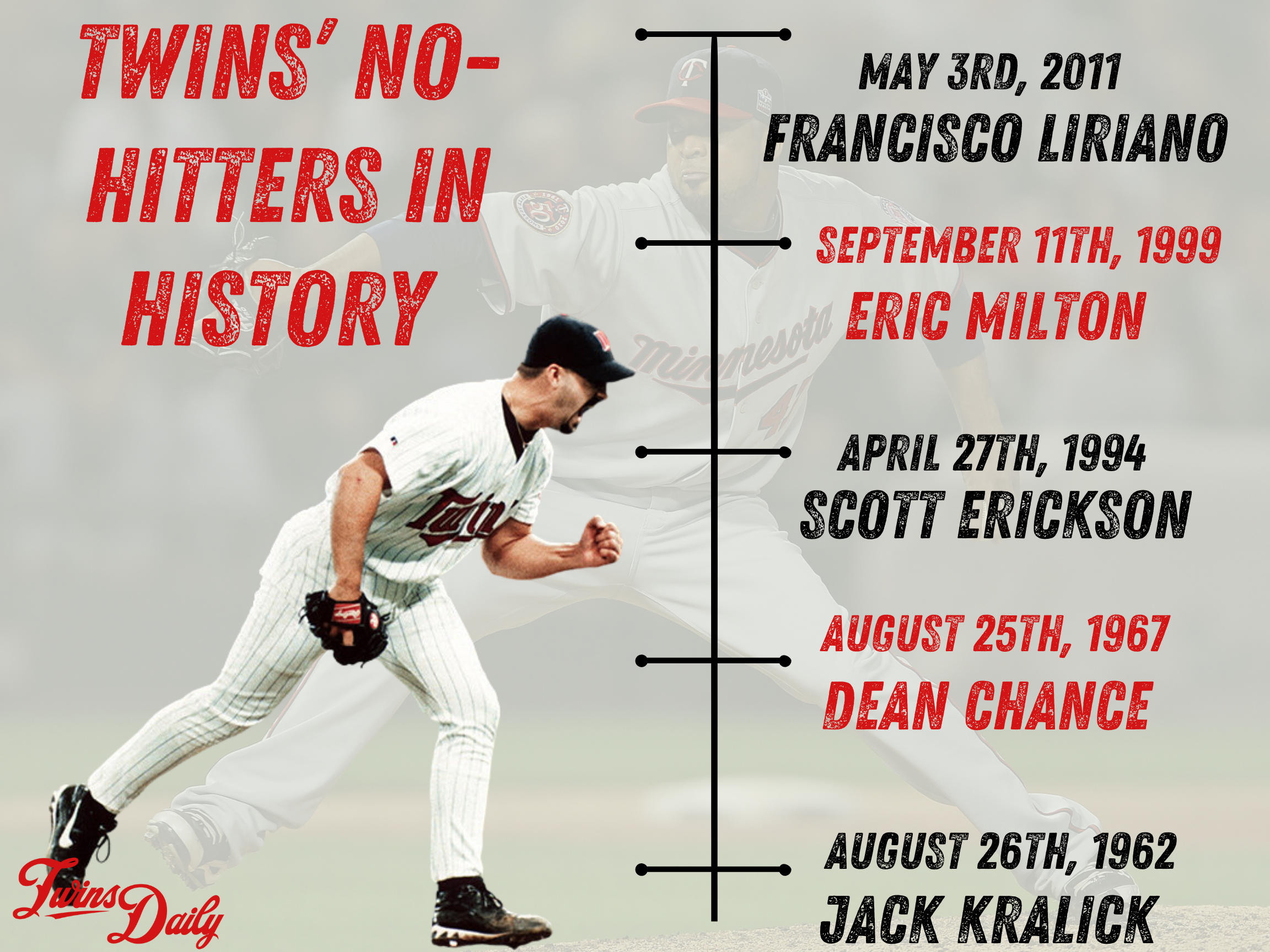 Welcome back, fans! I hope that you had a fantastic holiday and New Year! I know this lockout has created some of the longest, darkest days we have seen in baseball since 1994! I am still feeling frustrated knowing that baseball talks are still not happening. The best way to combat the baseball blues is to continue reaching into those archives and remembering why this is America's favorite pastime and why we continue to show up and watch these big kids play "the game." I had a rough time ranks games four and five for my no-hitter countdown. Both games were on the road. I noticed that road games made it harder for the Twins to pull off wins, which was likely due partly to schedule, stadium, weather, and fan base. The Twins played a doubleheader against Cleveland at the end of a strenuous road trip on this particular day. The team was tired. Chance was trying to come back after a break in his winning streak, making factors for this win admirable and slide into number four in our countdown. No-No Number 4 The Pitcher: Dean Chance The Date: August 25, 1967 The Opponent: Cleveland The Stadium: Cleveland Stadium The Pitcher's Background and Story Like the other Twins pitcher with a no-hitter in the 1960's Jack Kralick, Dean Chance was born and raised in Ohio. Both were also born on the same day, June 1 (no, not in the same year). The pitchers grew up an hour and forty-six minutes apart. Dean Chance attended West Salem Northwestern High School in West Salem, Ohio. He was best known as an all-Ohio Basketball player averaging 25 points a game, and then later, for his baseball prowess. He was a large youth, 6'3 by age 14, and loved playing basketball. Chance helped lead his high school to the 1958 Class A state final four. He had scholarship offers from colleges all over the country to play basketball, but Chance decided baseball was his best opportunity. Dean Chance's talent in baseball was just as astonishing as his basketball talent. As a junior and senior year, he was setting state records that still stand today: 52–1 career record 20 wins in a season 32 straight wins Eight no-hitters in a season (in both his junior and senior years) 18 no-hitters total His talent didn't go unnoticed. The Orioles, who were in the process of rebuilding their farm system, were the first team to come calling. Chance signed with the Orioles in 1959 as an amateur free agent. They signed him right out of high school, giving him a $30,000 bonus. He spent the next two seasons pitching for the Orioles until MLB expansion came around. He was drafted by the Washington Senators in the 1960 expansion draft. The American League expanded by two teams to catch up with the National League. Chance was picked by the Senators but immediately traded to the Angels for outfielder Joe Hicks. Chance returned to the Senators, now the Twins, until December of 1966, when the Angels dealt him to the Twins for outfielder Jimmie Hall, first baseman Don Mincher, and relief pitcher Pete Cimino. When Chance came back to the Twins in 1967, he had experienced quite a bit of success in Los Angeles. He finished third in Rookie of the Year voting in 1962. In 1964. he went 20-9 with a 1.95 ERA and even four saves to win the Cy Young Award (and finished fifth in MVP voting). Not only did he make the All-Star team that year, but he led the AL in games started (39), completed games (18), and innings pitched (283 2/3). He threw 11 shutouts. The Game Cleveland was over halfway through a stretch of 15 straight games when they played the Twins on August 25, 1967. It was the third of four doubleheaders for them that month. Doubleheaders were not uncommon for this period in baseball. It was a way to ramp up competition and make fans happy with "more baseball." Doubleheaders soon faded as owners realized they were losing money (go figure). Dean Chance struggled with his control throughout the game, and that started right away. He gave up an unearned run in the first inning due to two walks, an error, and a wild pitch. Lee Maye had got on base, but with number five hitter Max Alvis stepped to the plate and struck out. However, the third strike sailed past Twins catcher Jerry Zimmerman for a wild pitch, allowing Maye to score. In the game, Chance walked five batters and hit another. Sonny Siebert (who threw a no-hitter in 1966) was the Cleveland starting pitcher that day. He and Chance kept the game tied 1-1 through the top of the sixth inning. Harmon Killebrew came to the plate with Cesar Tovar on third base. Siebert balked, sending Tovar home and giving the Twins a 2-1 advantage. That score held up through nine innings. Over the final eight innings, Chance struck out eight hitters, earning the Twins their second no-hitter. At the time, it was their "third no-hitter." You see, earlier that month, Chance had throw five perfect innings in a game against the Red Sox before the game was rained out. Since then, MLB altered its rules to require nine innings pitched for an official no-hitter. Opponent Cleveland's roster that evening was nothing to write home about. In fact, throughout the entirety of the 1960s they were a weak team. The team had problems with attendance, due to their poor play... and legends of a curse. "The Curse of Rocky Colavito" stemmed from the team's owner making a trade with the Tigers in 1960, sending Rocky Colavito to Detroit for Harvey Kuenn. Whether is is related or not, Cleveland suffered for more than 30 years, with a losing record in 27 of the next 34 seasons. The Twins had a lineup of all-stars in comparison. Even with a strong lineup, there will be games where the offense struggles. This was one of those games. The pitching being better than the other team is a relief because the Twins had just as much trouble getting runs, and the game was close. How many pitchers pitched The pitching matchup in the second game was Dean Chance (16-9, 2.52 ERA) versus the Indians' Sonny Siebert. Dean Chance was the 1964 AL Cy Young Award winner who had won five straight games from July 28 to August 16 before lasting only 2 1/3 innings in a loss to Detroit on August 22. Siebert had identical 16-8 records for Cleveland in 1965 and 1966. It wasn't that he was pitching poorly this season, Cleveland's offense was scoring a meager three runs a game when he was the starting pitcher. Scoring an unearned run in this game was solely based on walks and an error. Home or Away The Twins were coming to the end of a long road trip that took them out to the West Coast to play against Los Angeles, and then back east to New York, Detroit, and to Cleveland, playing 16 road games in 13 days. This game was the first Twins road no-hitter. Did the pitcher hit All pitchers were still hitting during this time in the league. Dean Chance was not particularly strong at the plate. He had very few plate appearances during his time, a whopping .066 batting average when he retired. In this game, Chance had four plate appearances and went 0-for-3 and was hit by a pitch. At game's end, he was hitting .027 on the season. Wrap it up! Dean Chance had all the makings of a notable pitcher from a young age. He still holds high school pitching records in Ohio. When Chance won the 1964 Cy Young award, he was the first Angels pitcher to do so. Hitters struggled to hit off of him, "Every time I see his name on a lineup card," Mickey Mantle once told sportswriter Maury Allen about Chance, "I feel like throwing up." Dean Chance should be discussed more in Twins history and he was a player that I truly enjoyed learning about. What do you think? Was he too far down on the list? Would you have him put higher on the list? Do you believe that the 1960s were peak pitching for the Twins, or would you pick a different era? I look forward to discussions! PREVIOUS NO-HITTER ARTICLES Jack Kralick Eric Milton Scott Erickson MORE FROM TWINS DAILY — Latest Twins coverage from our writers — Recent Twins discussion in our forums — Follow Twins Daily via Twitter, Facebook, or email
 -
The Twins had beaten Cleveland 6-4 in 10 innings earlier in the day, in the first game of a double header. It was a beautiful August night. The weather was perfect all day in Cleveland, sitting at 76 degrees with clear skies. If there was a day for a doubleheader, this was it. Dean Chance had been pitching very well over the the previous weeks, and the Twins were finishing up a long road series. Welcome back, fans! I hope that you had a fantastic holiday and New Year! I know this lockout has created some of the longest, darkest days we have seen in baseball since 1994! I am still feeling frustrated knowing that baseball talks are still not happening. The best way to combat the baseball blues is to continue reaching into those archives and remembering why this is America's favorite pastime and why we continue to show up and watch these big kids play "the game." I had a rough time ranks games four and five for my no-hitter countdown. Both games were on the road. I noticed that road games made it harder for the Twins to pull off wins, which was likely due partly to schedule, stadium, weather, and fan base. The Twins played a doubleheader against Cleveland at the end of a strenuous road trip on this particular day. The team was tired. Chance was trying to come back after a break in his winning streak, making factors for this win admirable and slide into number four in our countdown. No-No Number 4 The Pitcher: Dean Chance The Date: August 25, 1967 The Opponent: Cleveland The Stadium: Cleveland Stadium The Pitcher's Background and Story Like the other Twins pitcher with a no-hitter in the 1960's Jack Kralick, Dean Chance was born and raised in Ohio. Both were also born on the same day, June 1 (no, not in the same year). The pitchers grew up an hour and forty-six minutes apart. Dean Chance attended West Salem Northwestern High School in West Salem, Ohio. He was best known as an all-Ohio Basketball player averaging 25 points a game, and then later, for his baseball prowess. He was a large youth, 6'3 by age 14, and loved playing basketball. Chance helped lead his high school to the 1958 Class A state final four. He had scholarship offers from colleges all over the country to play basketball, but Chance decided baseball was his best opportunity. Dean Chance's talent in baseball was just as astonishing as his basketball talent. As a junior and senior year, he was setting state records that still stand today: 52–1 career record 20 wins in a season 32 straight wins Eight no-hitters in a season (in both his junior and senior years) 18 no-hitters total His talent didn't go unnoticed. The Orioles, who were in the process of rebuilding their farm system, were the first team to come calling. Chance signed with the Orioles in 1959 as an amateur free agent. They signed him right out of high school, giving him a $30,000 bonus. He spent the next two seasons pitching for the Orioles until MLB expansion came around. He was drafted by the Washington Senators in the 1960 expansion draft. The American League expanded by two teams to catch up with the National League. Chance was picked by the Senators but immediately traded to the Angels for outfielder Joe Hicks. Chance returned to the Senators, now the Twins, until December of 1966, when the Angels dealt him to the Twins for outfielder Jimmie Hall, first baseman Don Mincher, and relief pitcher Pete Cimino. When Chance came back to the Twins in 1967, he had experienced quite a bit of success in Los Angeles. He finished third in Rookie of the Year voting in 1962. In 1964. he went 20-9 with a 1.95 ERA and even four saves to win the Cy Young Award (and finished fifth in MVP voting). Not only did he make the All-Star team that year, but he led the AL in games started (39), completed games (18), and innings pitched (283 2/3). He threw 11 shutouts. The Game Cleveland was over halfway through a stretch of 15 straight games when they played the Twins on August 25, 1967. It was the third of four doubleheaders for them that month. Doubleheaders were not uncommon for this period in baseball. It was a way to ramp up competition and make fans happy with "more baseball." Doubleheaders soon faded as owners realized they were losing money (go figure). Dean Chance struggled with his control throughout the game, and that started right away. He gave up an unearned run in the first inning due to two walks, an error, and a wild pitch. Lee Maye had got on base, but with number five hitter Max Alvis stepped to the plate and struck out. However, the third strike sailed past Twins catcher Jerry Zimmerman for a wild pitch, allowing Maye to score. In the game, Chance walked five batters and hit another. Sonny Siebert (who threw a no-hitter in 1966) was the Cleveland starting pitcher that day. He and Chance kept the game tied 1-1 through the top of the sixth inning. Harmon Killebrew came to the plate with Cesar Tovar on third base. Siebert balked, sending Tovar home and giving the Twins a 2-1 advantage. That score held up through nine innings. Over the final eight innings, Chance struck out eight hitters, earning the Twins their second no-hitter. At the time, it was their "third no-hitter." You see, earlier that month, Chance had throw five perfect innings in a game against the Red Sox before the game was rained out. Since then, MLB altered its rules to require nine innings pitched for an official no-hitter. Opponent Cleveland's roster that evening was nothing to write home about. In fact, throughout the entirety of the 1960s they were a weak team. The team had problems with attendance, due to their poor play... and legends of a curse. "The Curse of Rocky Colavito" stemmed from the team's owner making a trade with the Tigers in 1960, sending Rocky Colavito to Detroit for Harvey Kuenn. Whether is is related or not, Cleveland suffered for more than 30 years, with a losing record in 27 of the next 34 seasons. The Twins had a lineup of all-stars in comparison. Even with a strong lineup, there will be games where the offense struggles. This was one of those games. The pitching being better than the other team is a relief because the Twins had just as much trouble getting runs, and the game was close. How many pitchers pitched The pitching matchup in the second game was Dean Chance (16-9, 2.52 ERA) versus the Indians' Sonny Siebert. Dean Chance was the 1964 AL Cy Young Award winner who had won five straight games from July 28 to August 16 before lasting only 2 1/3 innings in a loss to Detroit on August 22. Siebert had identical 16-8 records for Cleveland in 1965 and 1966. It wasn't that he was pitching poorly this season, Cleveland's offense was scoring a meager three runs a game when he was the starting pitcher. Scoring an unearned run in this game was solely based on walks and an error. Home or Away The Twins were coming to the end of a long road trip that took them out to the West Coast to play against Los Angeles, and then back east to New York, Detroit, and to Cleveland, playing 16 road games in 13 days. This game was the first Twins road no-hitter. Did the pitcher hit All pitchers were still hitting during this time in the league. Dean Chance was not particularly strong at the plate. He had very few plate appearances during his time, a whopping .066 batting average when he retired. In this game, Chance had four plate appearances and went 0-for-3 and was hit by a pitch. At game's end, he was hitting .027 on the season. Wrap it up! Dean Chance had all the makings of a notable pitcher from a young age. He still holds high school pitching records in Ohio. When Chance won the 1964 Cy Young award, he was the first Angels pitcher to do so. Hitters struggled to hit off of him, "Every time I see his name on a lineup card," Mickey Mantle once told sportswriter Maury Allen about Chance, "I feel like throwing up." Dean Chance should be discussed more in Twins history and he was a player that I truly enjoyed learning about. What do you think? Was he too far down on the list? Would you have him put higher on the list? Do you believe that the 1960s were peak pitching for the Twins, or would you pick a different era? I look forward to discussions! PREVIOUS NO-HITTER ARTICLES Jack Kralick Eric Milton Scott Erickson MORE FROM TWINS DAILY — Latest Twins coverage from our writers — Recent Twins discussion in our forums — Follow Twins Daily via Twitter, Facebook, or email View full article
-
The Twins had some of the best pitching in the early 1970’s and Bert Blyleven was a part of that crew. He was a bright spot in the rotation, as well as a part of the 1987 World Series Twins. We forever love him for his “Circle Me Bert” trend, all trying to garner a spot on TV with the beloved circle from the charismatic announcer. A New Generation Bert Blyleven had a busy childhood before his family settled in for good in California when he was five. He was born in the Netherlands, moved to California, then Canada, and then back to California, where he became a baseball fan. He and his father watched Sandy Koufax and listened to legends Vin Scully and Jerry Doggett announce Dodgers games. He loved baseball so much that his dad built him a mound in the backyard where he would throw and throw until he developed his curveball. Blyleven attended Santiago High School, where he played baseball and ran track. He also played on local American Legion teams in the summers. He had a natural arm and worked hard to improve where needed. His arm and attitude were drawing the attention of professional scouts by the end of his junior year of high school. In his senior year, he knew playing in the majors was just a matter of which team would take him in the draft. The Big Move The Twins didn't waste time picking up Blyleven right out of high school. He was drafted 55th overall in round three of the 1969 draft. As a non-roster invite to spring training in 1970, team skipper Bill Rigney immediately saw something special in the teenager, and it didn't take long before Blyleven came to the majors. Early that season, Twins right-hander Luis Tiant was sidelined with a hand fracture. Management decided it was time for Bert Blyleven, at the age of 19 and with a mere 21 starts in the minors, to come up the majors. He never left On June 5, 1970, Blyleven debuted against the Washington Senators at RFK Stadium. In his MLB debut, he had a stellar game. He started out a little rocky when his first batter faced, Lee Maye, drilled a homer into the right-field seats. That run was all Blyleven allowed. He held the Senators to one run and five hits and earned his first win. In his rookie season, Blyleven broke many records. He was the first player in major-league history to be born in The Netherlands. Blyleven was the youngest player in the majors (19) to finish with a 10-9 record. Blyleven was the 25th pitcher to reach double digits in victories as a teenager and posted a 3.18 ERA in 164 innings. Young Ace Bert Blyleven had an excellent start to his 1972 season before hitting a slight slump. The rest of the team did as well. He started working with the team's new pitching coach, Al Worthington, to improve his mechanics, helping him find his stride for the last few weeks of the season. In 1973, Blyleven struggled again early with his mechanics. However, he won the subsequent ten decisions after making a minor adjustment to his timing. He had arguably one of the best seasons of any Twins pitcher, tossing nine shutouts, the most of any pitcher in the AL. Blyleven had an even more outstanding season in 1974. He continued to get better and better. In 36 games, he went 17-17, but had an ERA of 2.66 and over 281 innings. He had 249 strikeouts. Blyleven knew his value, and late in the season, he demanded a salary showing his worth. He continued to negotiate his contract terms with the management, but between his demands and insistence upon being paid more, he was completely frustrated by the end of the season. The tension between the ownership and the pitcher was at an all-time high. Blyleven got a raise, but he felt it wasn't enough. The relationship with the front office withered, and with the health with his back and shoulder issues, his 1975 season was derailed early. Blyleven came back strong. He went 15-10 with a 3.00 ERA. He had 20 complete games, and struck out 233 batters. 1975 was his last season (for then). It ended with the Twins trading him to the Rangers. Coming Home Blyleven spent the next nine seasons bouncing around the league with the Rangers, Pirates, and Indians before coming back to the Minnesota Twins halfway through the 1985 season. Coming home to the Twins proved to be a smooth transition. Blyleven posted an 8-5 record and completed nine of his 14 starts with the Twins. Blyleven had a 17-16 record and 3.16 ERA overall. He led the AL in starts (37), shutouts (5), and strikeouts (206) while pacing the majors in complete games (24) and innings (293 2/3). 1987 was another excellent season for Bert Blyleven and the Twins. Along with a core of sluggers (Kirby Puckett, Kent Hrbek, Gary Gaetti, Dan Gladden), he helped the Twins to an ALCS win and the World Series. Along with previous Twinsmas pitcher Frank Viola, they carried each other and the team to the title. The 1987 World Series was one of the best times Bert Blyleven had as a pitcher. "When you put fifty-five thousand screaming people in here (Metrodome), it's something," said Blyleven, soaking in the moment. Beloved Announcer Bert Blyleven ended his career as a pitcher in California with the Angels. He 'officially' retired from baseball as the Twins announcer in 2020. He was affectionately known for the "Circle Me Bert" trend in which fans would bring a sign to the Twins game with a fun saying on it to catch the attention of the former All-Star. They would "hereby be circled" from the booth. In 2002, Bert Blyleven was inducted into the Twins Hall of Fame. Then in 2011, he was inducted into the Baseball Hall of Fame, receiving 79.7% of the vote. Thank you for reading, and Go, Twins! Read Previous "12 Days of TwinsMas" articles here: #12 - Torii Hunter #11 - Chuck Knoblauch #10 - Jim Kaat #9 - Frank Viola #8 - Kent Hrbek #7 - Tony Oliva #6 - Johan Santana #5 - Bert Blyleven #4 - Coming Soon! View full article
-
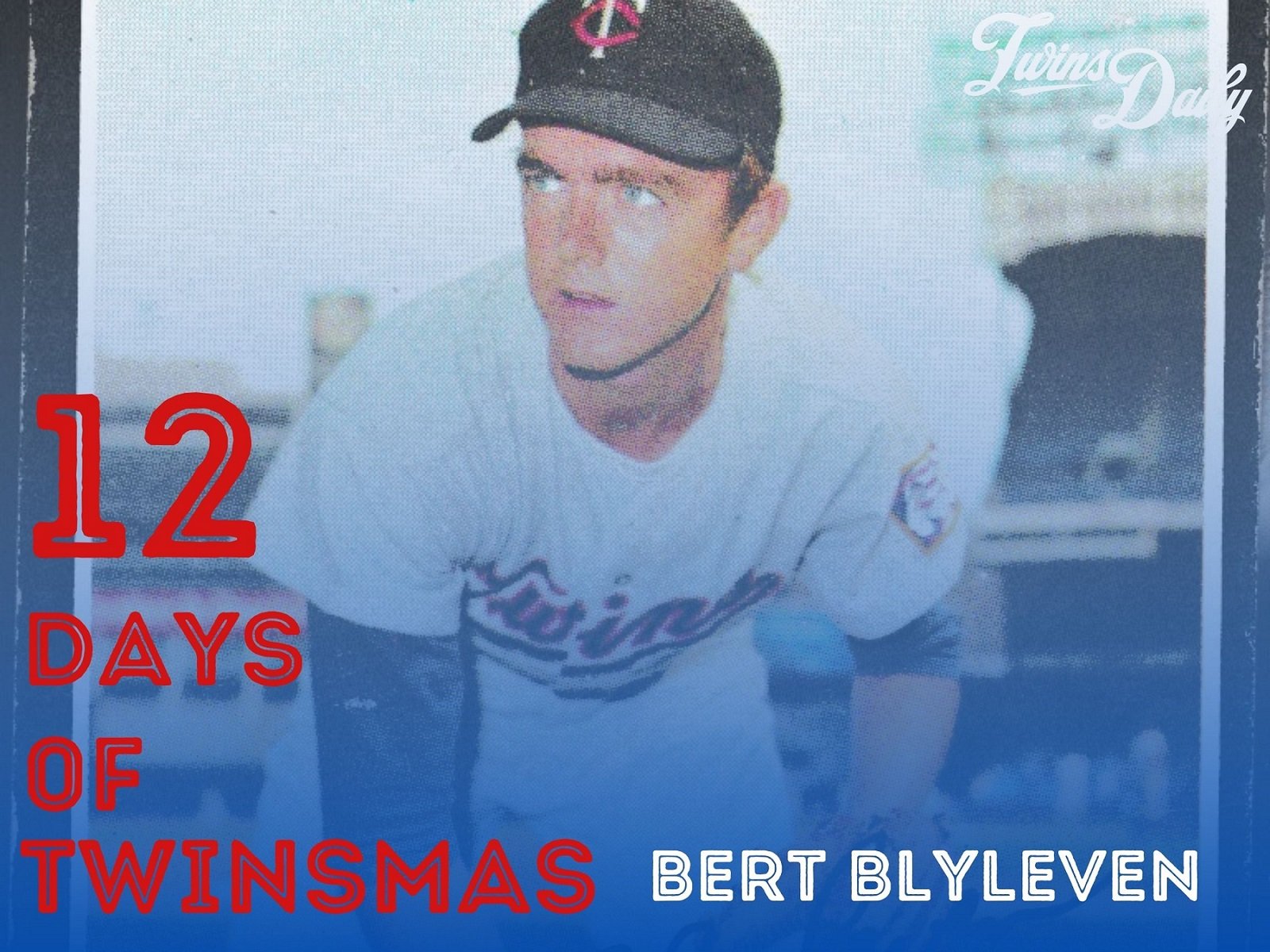 A New Generation Bert Blyleven had a busy childhood before his family settled in for good in California when he was five. He was born in the Netherlands, moved to California, then Canada, and then back to California, where he became a baseball fan. He and his father watched Sandy Koufax and listened to legends Vin Scully and Jerry Doggett announce Dodgers games. He loved baseball so much that his dad built him a mound in the backyard where he would throw and throw until he developed his curveball. Blyleven attended Santiago High School, where he played baseball and ran track. He also played on local American Legion teams in the summers. He had a natural arm and worked hard to improve where needed. His arm and attitude were drawing the attention of professional scouts by the end of his junior year of high school. In his senior year, he knew playing in the majors was just a matter of which team would take him in the draft. The Big Move The Twins didn't waste time picking up Blyleven right out of high school. He was drafted 55th overall in round three of the 1969 draft. As a non-roster invite to spring training in 1970, team skipper Bill Rigney immediately saw something special in the teenager, and it didn't take long before Blyleven came to the majors. Early that season, Twins right-hander Luis Tiant was sidelined with a hand fracture. Management decided it was time for Bert Blyleven, at the age of 19 and with a mere 21 starts in the minors, to come up the majors. He never left On June 5, 1970, Blyleven debuted against the Washington Senators at RFK Stadium. In his MLB debut, he had a stellar game. He started out a little rocky when his first batter faced, Lee Maye, drilled a homer into the right-field seats. That run was all Blyleven allowed. He held the Senators to one run and five hits and earned his first win. In his rookie season, Blyleven broke many records. He was the first player in major-league history to be born in The Netherlands. Blyleven was the youngest player in the majors (19) to finish with a 10-9 record. Blyleven was the 25th pitcher to reach double digits in victories as a teenager and posted a 3.18 ERA in 164 innings. Young Ace Bert Blyleven had an excellent start to his 1972 season before hitting a slight slump. The rest of the team did as well. He started working with the team's new pitching coach, Al Worthington, to improve his mechanics, helping him find his stride for the last few weeks of the season. In 1973, Blyleven struggled again early with his mechanics. However, he won the subsequent ten decisions after making a minor adjustment to his timing. He had arguably one of the best seasons of any Twins pitcher, tossing nine shutouts, the most of any pitcher in the AL. Blyleven had an even more outstanding season in 1974. He continued to get better and better. In 36 games, he went 17-17, but had an ERA of 2.66 and over 281 innings. He had 249 strikeouts. Blyleven knew his value, and late in the season, he demanded a salary showing his worth. He continued to negotiate his contract terms with the management, but between his demands and insistence upon being paid more, he was completely frustrated by the end of the season. The tension between the ownership and the pitcher was at an all-time high. Blyleven got a raise, but he felt it wasn't enough. The relationship with the front office withered, and with the health with his back and shoulder issues, his 1975 season was derailed early. Blyleven came back strong. He went 15-10 with a 3.00 ERA. He had 20 complete games, and struck out 233 batters. 1975 was his last season (for then). It ended with the Twins trading him to the Rangers. Coming Home Blyleven spent the next nine seasons bouncing around the league with the Rangers, Pirates, and Indians before coming back to the Minnesota Twins halfway through the 1985 season. Coming home to the Twins proved to be a smooth transition. Blyleven posted an 8-5 record and completed nine of his 14 starts with the Twins. Blyleven had a 17-16 record and 3.16 ERA overall. He led the AL in starts (37), shutouts (5), and strikeouts (206) while pacing the majors in complete games (24) and innings (293 2/3). 1987 was another excellent season for Bert Blyleven and the Twins. Along with a core of sluggers (Kirby Puckett, Kent Hrbek, Gary Gaetti, Dan Gladden), he helped the Twins to an ALCS win and the World Series. Along with previous Twinsmas pitcher Frank Viola, they carried each other and the team to the title. The 1987 World Series was one of the best times Bert Blyleven had as a pitcher. "When you put fifty-five thousand screaming people in here (Metrodome), it's something," said Blyleven, soaking in the moment. Beloved Announcer Bert Blyleven ended his career as a pitcher in California with the Angels. He 'officially' retired from baseball as the Twins announcer in 2020. He was affectionately known for the "Circle Me Bert" trend in which fans would bring a sign to the Twins game with a fun saying on it to catch the attention of the former All-Star. They would "hereby be circled" from the booth. In 2002, Bert Blyleven was inducted into the Twins Hall of Fame. Then in 2011, he was inducted into the Baseball Hall of Fame, receiving 79.7% of the vote. Thank you for reading, and Go, Twins! Read Previous "12 Days of TwinsMas" articles here: #12 - Torii Hunter #11 - Chuck Knoblauch #10 - Jim Kaat #9 - Frank Viola #8 - Kent Hrbek #7 - Tony Oliva #6 - Johan Santana #5 - Bert Blyleven #4 - Coming Soon!
 -
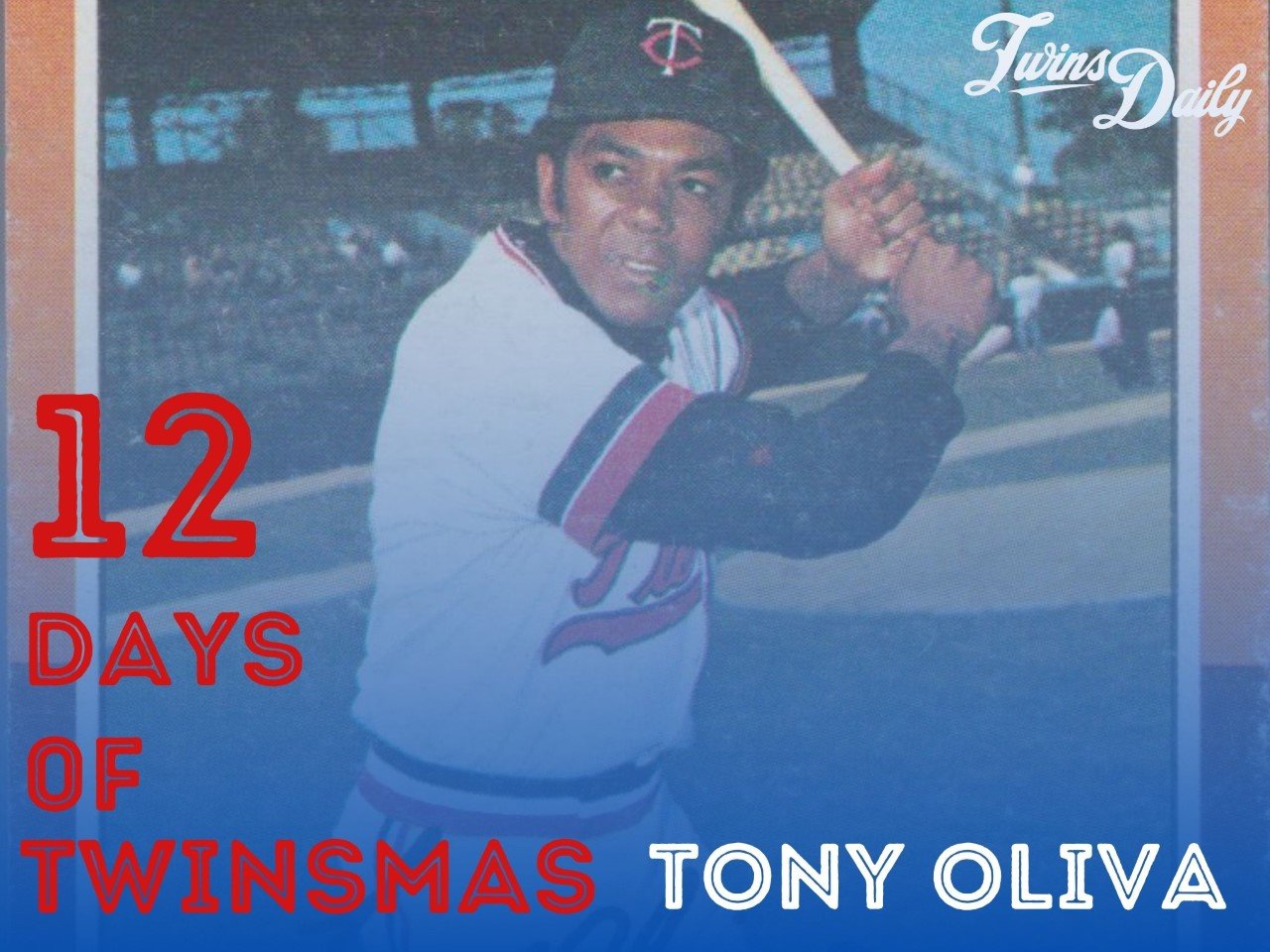 There have been plenty of great players in the history of the Minnesota Twins. From Killebrew to Buxton and many in-between, it is tough to narrow it down to the top twelve players in the history of the Twins. Tony O, as he is affectionately called, is a fan favorite that spans generations of Twins fans everywhere. People from the 1960's through the present not only know Tony Oliva, but celebrate him as being one of the best Twins of all time. It's in the Blood Oliva grew up as Pedro Oliva II and lived in Pinar del Rio with his family. His father worked harvesting tobacco, oranges, potatoes, and mangos. He also was known for the way he rolled Cuban cigars. Pedro Lopez, his father, was a former semi-pro baseball player and carved a make-shift baseball diamond for his family in their land and introduced his boys to the nation's favorite sport. Later they would form a squad and play on Sundays against other competitors from their area. Oliva grew up playing ball with whittled branches of majau trees as bats with his nine siblings and father. They only got real bats and balls when their father brought them back from Havana. They played so often; they wrapped them with tape to last longer. Even with make-shift bats and balls, it didn't take long for Oliva's talent to show. He was a fast runner, strong hitter and played on a local team at a young age because of his talent. He credits his father with helping make him the "best hitter in Pinar del Rio." The Big Move Oliva had no desire to play professional baseball in America. His goal was to play for his home country's professional team, the Cienfuegos Camaroneros. There was no doubt that Oliva loved baseball and had a natural talent. He dedicated hours to improving his swing, working on getting better. His teammate, Roberto Fernandez, played with Oliva on the Los Palacios village ball club during the winter. Fernandez played in the United States as a journeyman on the Washington Senators, soon the Minnesota Twins. Fernandez contacted Joe Cambria, a scout credited with signing 400 Cuban players for the Senators/Twins. After signing a contract for $250.00 a month, Oliva grabbed his brother Tony’s passport, which had a different name and date of birth, but it was available, convenient and with the time crunch, a quick fix. Oliva headed to America to meet up with the rest of the Twins at training camp and Pedro Oliva would be known as Antonio "Tony" Oliva from now on. Oliva and several other players got held up in Mexico and made it to camp late. Oliva finally arrived at Twins training camp in April 1961, but by the time he got there, training camp was almost over and the rosters were already set. Joe Cambria knew Tony was an asset, and that he could not go home to Cuba, so he stepped in to advocate for Oliva and was able to get him on a team in Wytheville, Virginia. The Rookie Tony Oliva went to Wytheville and played Class-D baseball for the Twins. He played in 64 of the 68 games and posted an outstanding .410 batting average. The Twins offered him a chance to play in Minneapolis with the main club because he improved his fielding. After he left Minneapolis in the fall, the Twins assigned Oliva to St. Petersburg, Florida in 1962. In Florida, Oliva got more practice and a chance to polish up on skills which earned him a spot to play a handful of games for the Twins in the majors before landing a position on the 40-man roster in 1964. Oliva had one of the best rookie seasons MLB has ever seen. It’s very well known that he had weak knees. The rookie stood in a knock-kneed, awkward stance when he was at the plate, but it didn't slow him down. That season Oliva was almost unanimously voted as the 1964 Rookie of the Year with a league-leading .323 batting average with 32 home runs and 94 RBI, along with American League highs in runs (109), hits ( 217), and doubles (43). 15-Year Career He won another batting title in 1965 when he hit .321, becoming the first player ever to win batting crowns in his first two full seasons. Oliva finished second in the AL Most Valuable Player voting that year (to teammate Zoilo Versalles), leading the Twins to the AL pennant with 16 homers, 98 RBI, and a league-best 185 hits. In 1966, Oliva led the AL in hits for the third straight year (191) while winning a Gold Glove Award for his play in right field. There was a slight dip in his career for two seasons in 1967 and 1968; his batting average dropped to .289. In 1969 Oliva rebounded with a .309 average and a league-best 197 hits in 1969, while leading the Twins to their first AL West title. He was even better in 1970, hitting .325 with 23 home runs and a career-high 107 RBI along with his fifth AL hits crown (204) en route to another second-place finish in the MVP vote. The Twins again won the AL West crown. Hall of Famer Tony Oliva finished his career with 1,907 hits, 220 home runs, 947 RBI's, and a batting average of .304. Oliva had one of the best Twins careers and one of the best MLB careers of all time. Charlotte Baseball and the Twins inducted Oliva into their Halls of Fame, but Cooperstown had not yet come calling. A glimmer of hope, in 2014, Tony Oliva was on a "second-chance" ballot for the Hall of Fame, falling one vote short. His disappointment and frustration turned to joy on December 4th, 2021, when he got the phone call to be inducted to the Baseball Hall of Fame, along with former Twin Jim Kaat, this coming summer. His raw emotion and reaction allowed him and Minnesota Twins fans alike to share a moment that was beyond due and well deserved. Tony Oliva is one of the best Twins players of all time. Not only is he one of the best, but the most humble, kind, and caring humans on this planet. He and his family's contributions to baseball and their communities are inspiring. He came from a small town in Cuba with nothing but sticks for bats and landed in Cooperstown as one of the best players. Stay tuned for the sixth day of Twinsmas! Thank you for reading, and Go, Twins! Read Previous "12 Days of TwinsMas" articles here: #12 - Torii Hunter #11 - Chuck Knoblauch #10 - Jim Kaat #9 - Frank Viola #8 - Kent Hrbek #7 - Tony Oliva #6 - Coming Soon!
 -
Baseball may be America's pastime, but for Cuba, the Dominican Republic, or any central and southern American countries, baseball is a lifestyle that runs through the blood of many players who come to America to play. Tony-O was born with that blood and because of a good teammate and a chance meeting, Tony became one of the best Twins players to play the game. There have been plenty of great players in the history of the Minnesota Twins. From Killebrew to Buxton and many in-between, it is tough to narrow it down to the top twelve players in the history of the Twins. Tony O, as he is affectionately called, is a fan favorite that spans generations of Twins fans everywhere. People from the 1960's through the present not only know Tony Oliva, but celebrate him as being one of the best Twins of all time. It's in the Blood Oliva grew up as Pedro Oliva II and lived in Pinar del Rio with his family. His father worked harvesting tobacco, oranges, potatoes, and mangos. He also was known for the way he rolled Cuban cigars. Pedro Lopez, his father, was a former semi-pro baseball player and carved a make-shift baseball diamond for his family in their land and introduced his boys to the nation's favorite sport. Later they would form a squad and play on Sundays against other competitors from their area. Oliva grew up playing ball with whittled branches of majau trees as bats with his nine siblings and father. They only got real bats and balls when their father brought them back from Havana. They played so often; they wrapped them with tape to last longer. Even with make-shift bats and balls, it didn't take long for Oliva's talent to show. He was a fast runner, strong hitter and played on a local team at a young age because of his talent. He credits his father with helping make him the "best hitter in Pinar del Rio." The Big Move Oliva had no desire to play professional baseball in America. His goal was to play for his home country's professional team, the Cienfuegos Camaroneros. There was no doubt that Oliva loved baseball and had a natural talent. He dedicated hours to improving his swing, working on getting better. His teammate, Roberto Fernandez, played with Oliva on the Los Palacios village ball club during the winter. Fernandez played in the United States as a journeyman on the Washington Senators, soon the Minnesota Twins. Fernandez contacted Joe Cambria, a scout credited with signing 400 Cuban players for the Senators/Twins. After signing a contract for $250.00 a month, Oliva grabbed his brother Tony’s passport, which had a different name and date of birth, but it was available, convenient and with the time crunch, a quick fix. Oliva headed to America to meet up with the rest of the Twins at training camp and Pedro Oliva would be known as Antonio "Tony" Oliva from now on. Oliva and several other players got held up in Mexico and made it to camp late. Oliva finally arrived at Twins training camp in April 1961, but by the time he got there, training camp was almost over and the rosters were already set. Joe Cambria knew Tony was an asset, and that he could not go home to Cuba, so he stepped in to advocate for Oliva and was able to get him on a team in Wytheville, Virginia. The Rookie Tony Oliva went to Wytheville and played Class-D baseball for the Twins. He played in 64 of the 68 games and posted an outstanding .410 batting average. The Twins offered him a chance to play in Minneapolis with the main club because he improved his fielding. After he left Minneapolis in the fall, the Twins assigned Oliva to St. Petersburg, Florida in 1962. In Florida, Oliva got more practice and a chance to polish up on skills which earned him a spot to play a handful of games for the Twins in the majors before landing a position on the 40-man roster in 1964. Oliva had one of the best rookie seasons MLB has ever seen. It’s very well known that he had weak knees. The rookie stood in a knock-kneed, awkward stance when he was at the plate, but it didn't slow him down. That season Oliva was almost unanimously voted as the 1964 Rookie of the Year with a league-leading .323 batting average with 32 home runs and 94 RBI, along with American League highs in runs (109), hits ( 217), and doubles (43). 15-Year Career He won another batting title in 1965 when he hit .321, becoming the first player ever to win batting crowns in his first two full seasons. Oliva finished second in the AL Most Valuable Player voting that year (to teammate Zoilo Versalles), leading the Twins to the AL pennant with 16 homers, 98 RBI, and a league-best 185 hits. In 1966, Oliva led the AL in hits for the third straight year (191) while winning a Gold Glove Award for his play in right field. There was a slight dip in his career for two seasons in 1967 and 1968; his batting average dropped to .289. In 1969 Oliva rebounded with a .309 average and a league-best 197 hits in 1969, while leading the Twins to their first AL West title. He was even better in 1970, hitting .325 with 23 home runs and a career-high 107 RBI along with his fifth AL hits crown (204) en route to another second-place finish in the MVP vote. The Twins again won the AL West crown. Hall of Famer Tony Oliva finished his career with 1,907 hits, 220 home runs, 947 RBI's, and a batting average of .304. Oliva had one of the best Twins careers and one of the best MLB careers of all time. Charlotte Baseball and the Twins inducted Oliva into their Halls of Fame, but Cooperstown had not yet come calling. A glimmer of hope, in 2014, Tony Oliva was on a "second-chance" ballot for the Hall of Fame, falling one vote short. His disappointment and frustration turned to joy on December 4th, 2021, when he got the phone call to be inducted to the Baseball Hall of Fame, along with former Twin Jim Kaat, this coming summer. His raw emotion and reaction allowed him and Minnesota Twins fans alike to share a moment that was beyond due and well deserved. Tony Oliva is one of the best Twins players of all time. Not only is he one of the best, but the most humble, kind, and caring humans on this planet. He and his family's contributions to baseball and their communities are inspiring. He came from a small town in Cuba with nothing but sticks for bats and landed in Cooperstown as one of the best players. Stay tuned for the sixth day of Twinsmas! Thank you for reading, and Go, Twins! Read Previous "12 Days of TwinsMas" articles here: #12 - Torii Hunter #11 - Chuck Knoblauch #10 - Jim Kaat #9 - Frank Viola #8 - Kent Hrbek #7 - Tony Oliva #6 - Coming Soon! View full article
-
Frank "Sweet Music" Viola was an integral part of the Twins 1987 World Series. He was a true master at the art of pitching. Viola was a strong, confident pitcher and a true fan favorite, making him number nine for Twinsmas! There have been plenty of great players in the history of the Minnesota Twins. From Killebrew to Buxton and many in-between, it is tough to narrow it down to the top twelve players in the history of the Twins. For Twinsmas, one of the players who will live in infamy is Twins player number nine, Frank Viola (and his mustache). Average Joe Not every baseball player comes bursting onto the scene like some other players I have covered recently. Frank Viola is one of those players. He didn't have a distinguished history, family legacy, and he wasn’t a baseball prodigy. But, Frank Viola was good. Frank Viola was first drafted out of high school, by the Royals in 1978. However, he didn't sign and went to St. Johns. In 1981. Frank attended and played for St. John's University, a Division 1 college located in Queens, New York. If you were a New Yorker and a baseball player, there was one school to attend if you wanted to play baseball and St. John’s was it. The team had been to the College World Series five times since 1949, and Viola, along with a closely-bonded team, worked hard to see the World Series again in 1980. St. John’s has not been back to the World Series since. In his final season (junior year) with the Red Storm, the young southpaw caught the Twins' attention. During that season, he pitched a gem against future Mets teammate Ron Darling. Both pitchers threw 11 scoreless innings before Darling made a mistake in the 12th inning to give St. John’s the win. Viola made a significant impact in 1980 and 1981 with the Red Storm with a 10-1 record, and a 0.87 earned run average over 83 innings. His record is still second-all time at St. Johns. Viola was the Twins 2nd round pick in 1981. Sweet Music Viola progressed quickly through the minors, only staying in Triple-A for eight starts and then was moved to the majors. The future Cy Young winner did not start out great for the Twins, garnering a 5.21 ERA in 1982 and 5.46 ERA in 1983. Both the team and Viola struggled those two seasons, but by 1984, Viola’s pitching and the team did a 180-degree turn. He found himself an anchor in the Twins pitching rotation from 1984 until his trade late in the 1989 season. Frank Viola had a nickname that followed him everywhere after the Twins. Of course, since his last name was a musical instrument (his favorite instrument), it made sense. He was called “Sweet Music”. More appropriately, though, Viola's true nickname came from a sportswriter who described the fans at the Metrodome erupting into "sweet music" whenever Frank Viola pitched. Later, a fan hung a banner out in the right upper-field deck that read “Frankie Sweet Music Viola”. The banner became a source of "good luck" to those who subscribed to superstition in the sports world. One and Done Frank Viola only saw one postseason run in all his years in MLB. Viola's postseason was in 1987, the first year the Twins took home the pennant. Viola appeared in three of the seven World Series games. He held the Cardinals to one earned run in his first start (Game 1), and the Twins offense put up ten runs on the board. He took the loss in Game 4 but returned after the Cardinals forced Game 7. Viola allowed two runs in the second inning but that was it. Although by a small margin that game, the Twins beat the Cardinals. Viola was named MVP of the 1987 World Series. He never played a postseason game again. In 1988, he was named American League Cy Young Award winner in his final full season with the Twins. That season, he went 24-7 and had a 2.64 ERA. The following season, he was traded to the New York Mets for four pitchers (Rick Aguilera, Kevin Tapani, Dave West and Tim Drummond) and a pitcher to be named later (Jack Savage) Aguilera and Tapani were key to the team’s 1991 World Series title. Conclusion Frank Viola stayed around the leagues for another six seasons after his trade. He continued to shine with ERA's under 4.00 until 1994 when he underwent Tommy John surgery while with the Boston Red Sox. He left baseball behind as a player in 1996 and has been a minor league pitching coach the past couple of decades. He is currently the pitching coach for the High Point Rockers, a team in the Atlantic Professional Baseball League located in North Carolina. Viola now leads a staff that in 2019 posted a 3.72 ERA, placing third in strikeouts (1043) and second in walks (409). Four pitchers from Viola's staff were named Atlantic League All-Stars in 2019. He continues to impact the pitching world and shows he is truly a master of his art. And, he still has his mustache. Thank you for reading, and Go, Twins! Read Previous "12 Days of TwinsMas" articles here: #12 - Torii Hunter #11 - Chuck Knoblauch #10 - Jim Kaat #9 - Frank Viola #8 - Coming Soon! View full article
-
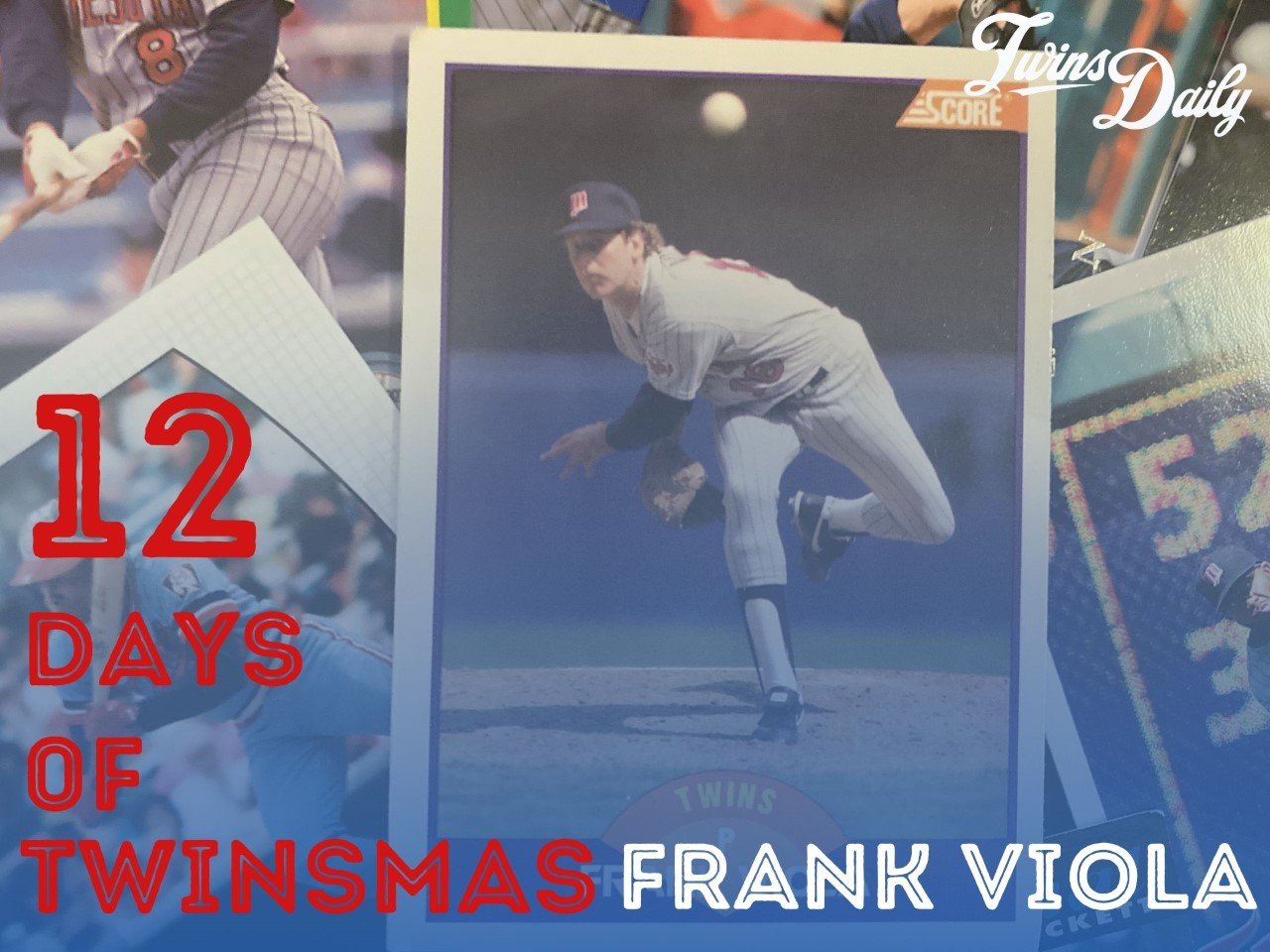 There have been plenty of great players in the history of the Minnesota Twins. From Killebrew to Buxton and many in-between, it is tough to narrow it down to the top twelve players in the history of the Twins. For Twinsmas, one of the players who will live in infamy is Twins player number nine, Frank Viola (and his mustache). Average Joe Not every baseball player comes bursting onto the scene like some other players I have covered recently. Frank Viola is one of those players. He didn't have a distinguished history, family legacy, and he wasn’t a baseball prodigy. But, Frank Viola was good. Frank Viola was first drafted out of high school, by the Royals in 1978. However, he didn't sign and went to St. Johns. In 1981. Frank attended and played for St. John's University, a Division 1 college located in Queens, New York. If you were a New Yorker and a baseball player, there was one school to attend if you wanted to play baseball and St. John’s was it. The team had been to the College World Series five times since 1949, and Viola, along with a closely-bonded team, worked hard to see the World Series again in 1980. St. John’s has not been back to the World Series since. In his final season (junior year) with the Red Storm, the young southpaw caught the Twins' attention. During that season, he pitched a gem against future Mets teammate Ron Darling. Both pitchers threw 11 scoreless innings before Darling made a mistake in the 12th inning to give St. John’s the win. Viola made a significant impact in 1980 and 1981 with the Red Storm with a 10-1 record, and a 0.87 earned run average over 83 innings. His record is still second-all time at St. Johns. Viola was the Twins 2nd round pick in 1981. Sweet Music Viola progressed quickly through the minors, only staying in Triple-A for eight starts and then was moved to the majors. The future Cy Young winner did not start out great for the Twins, garnering a 5.21 ERA in 1982 and 5.46 ERA in 1983. Both the team and Viola struggled those two seasons, but by 1984, Viola’s pitching and the team did a 180-degree turn. He found himself an anchor in the Twins pitching rotation from 1984 until his trade late in the 1989 season. Frank Viola had a nickname that followed him everywhere after the Twins. Of course, since his last name was a musical instrument (his favorite instrument), it made sense. He was called “Sweet Music”. More appropriately, though, Viola's true nickname came from a sportswriter who described the fans at the Metrodome erupting into "sweet music" whenever Frank Viola pitched. Later, a fan hung a banner out in the right upper-field deck that read “Frankie Sweet Music Viola”. The banner became a source of "good luck" to those who subscribed to superstition in the sports world. One and Done Frank Viola only saw one postseason run in all his years in MLB. Viola's postseason was in 1987, the first year the Twins took home the pennant. Viola appeared in three of the seven World Series games. He held the Cardinals to one earned run in his first start (Game 1), and the Twins offense put up ten runs on the board. He took the loss in Game 4 but returned after the Cardinals forced Game 7. Viola allowed two runs in the second inning but that was it. Although by a small margin that game, the Twins beat the Cardinals. Viola was named MVP of the 1987 World Series. He never played a postseason game again. In 1988, he was named American League Cy Young Award winner in his final full season with the Twins. That season, he went 24-7 and had a 2.64 ERA. The following season, he was traded to the New York Mets for four pitchers (Rick Aguilera, Kevin Tapani, Dave West and Tim Drummond) and a pitcher to be named later (Jack Savage) Aguilera and Tapani were key to the team’s 1991 World Series title. Conclusion Frank Viola stayed around the leagues for another six seasons after his trade. He continued to shine with ERA's under 4.00 until 1994 when he underwent Tommy John surgery while with the Boston Red Sox. He left baseball behind as a player in 1996 and has been a minor league pitching coach the past couple of decades. He is currently the pitching coach for the High Point Rockers, a team in the Atlantic Professional Baseball League located in North Carolina. Viola now leads a staff that in 2019 posted a 3.72 ERA, placing third in strikeouts (1043) and second in walks (409). Four pitchers from Viola's staff were named Atlantic League All-Stars in 2019. He continues to impact the pitching world and shows he is truly a master of his art. And, he still has his mustache. Thank you for reading, and Go, Twins! Read Previous "12 Days of TwinsMas" articles here: #12 - Torii Hunter #11 - Chuck Knoblauch #10 - Jim Kaat #9 - Frank Viola #8 - Coming Soon!
 -
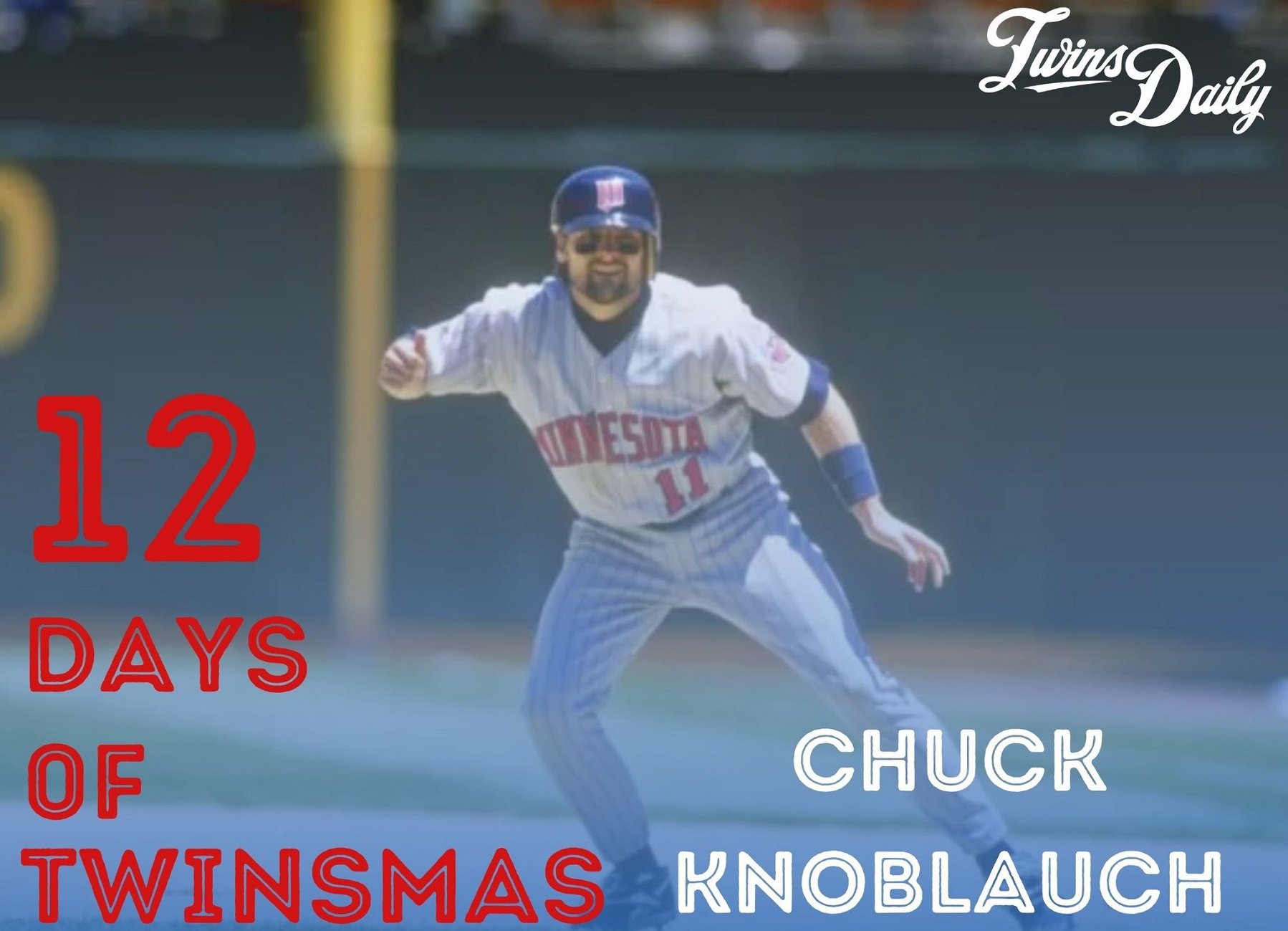 Young Legacy Chuck Knoblauch was born with a baseball silver spoon in his mouth. Both his father and uncle played and coached in the minor leagues from the 1930s to-1950s. Knoblauch attended Bellaire High School in Houston, Texas, where RHP Chris Young (GM for Texas Rangers) and outfielder Jose Cruz, Jr attended. His father was the head coach while he was there, and Knoblauch attributes a lot of his discipline and success to his father. Knoblauch was a very talented young man. He was drafted in 1986 by the Phillies, but forewent signing to attend Texas A&M and play baseball. He played at Texas A&M for three seasons He became a second-team All-American shortstop He was part of the team that had 58 wins in 1989, the most in Texas A&M baseball history. Knoblauch had a knack for being on teams that made history happen from high school through his astounding career in which he collected four World Series rings. The Climb Knoblauch was drafted 25th overall in the 1st round in 1989 by the Twins. His talent was noticed by many. Minnesota Twins scout Marty Esposito wrote about Knoblauch that he was “an exceptional competitor, aggressive baserunner, intelligent fielder, and line-drive hitter, who would be an ideal leadoff hitter.” Knoblauch spent a short amount of time in the minors, starting in Kenosha, Wisconsin, in 1989, and quickly moving to the Double-A Orlando Sun Rays in 1990. Knoblauch was an all-star in the minor leagues. He was the hardest-hitting player and most difficult batter to strike out. In 118 games for the Sun Rays, Knoblauch hit .289, had an on-base percentage of .389, and led the team in doubles (23). Knoblauch knew early on that he was "being primed" for the majors, and it didn't take long for him to see his hard work pay off. Knoblauch was a non-roster invitee to Twins spring training in 1991 and batted .388. He was so impressive that he became Minnesota's Opening Day starter at second base, batting second in manager Tom Kelly's lineup against the Athletics on April 9th at the Oakland-Alameda County Coliseum. The Rookie Knoblauch's first season with the Twins is quite literally one for the books. Knoblauch was part of the team that won the World Series with fellow greats; Jack Morris, Gene Larkin, Dan Gladden, and Kirby Puckett. The 1991 Twins team was the most robust team Twins fans have seen play, and Knoblauch made his mark to help carry the Twins to the pennant. In 151 games, he only had one home run, but he pushed other players home with 50 RBI's and also stole 25 bases. He won the American League Rookie of the Year to accompany his World Series ring. During the 1991 World Series, one of the most fun memories is the "Invisible Ball Trick," or the Greatest Double Play Never Made. On this play, Braves outfielder Lonnie Smith, in the 8th inning, didn’t see where the ball was hit. Standing just inches past second base, he flips his head back and forth between Knoblauch and Greg Gagne, wondering where in the world the ball went as they turned a “double play,: a double play that, well, wasn't. Instead, Terry Pendleton crushed the ball into the left-center gap with no Twins defensive player in sight. The ball bounced off the wall just as Smith realized the rouse, but it was too late. The fake was just enough of a distraction for Smith to lose the ball and have to stop at third or risk getting out at home. It mattered though. The genius of Knoblauch and Gagne kept the game scoreless and allowed the Twins to win in 10 innings. That play helped the Twins win the 1991 World Series; whether you want to believe it or not. I do. The Cold Hard Truth Chuck Knoblauch was the fans' second favorite player, behind Kirby Puckett. Knoblauch was good, and he knew it. The fans knew it, and the staff was fully aware. The front office either was not in agreement of Knoblauch's worth in talent, or they didn't feel that the all-star second baseman was worth the money he was requesting. When the team continued to slip further and further in the standings in 1997, Knoblauch requested a trade. The media caught wind, and so did the fans, leading to a frustrated player and fan base. After Knoblauch was traded in 1998 to the Yankees in exchange for four players (including two future All-Stars, Eric Milton and Cristian Guzmán) and $3 million, he was no longer the Minnesota hero. His career ended with an alarming series of "Yips," In 2001, fans threw objects at him when the Yankees visited the Metrodome in 2001. Conclusion Chuck Knoblauch was the best second-baseman for the Minnesota Twins, no argument. He carried the second-highest WAR (33.6) behind Rod Carew (37.5). His drive for greatness packed into a 5'8” frame and natural tenacity gave the Twins some great seasons. His galvanizing style of play made it easy for fans to get behind him and hard to let him go. His stats make no argument for his Hall of Fame status. His years with the Twins, he was an on-base machine, posting OBP well above league average. While he slumped in 1993, Knoblauch fought back and had his best season with the Twins in 1996. He led the league with 14 triples in 153 games. Chuck Knoblauch was one of my favorite players to watch during his years with the Twins, and I hope that I brought you some recollective joy for Twinsmas! Stay tuned for the third day of Twinsmas! Thank you for reading, and Go, Twins!
 -
There have been plenty of great players in the history of the Minnesota Twins. From Killebrew to Buxton and many in-between, it is tough to narrow it down to the top twelve players in the history of the Twins. One of the players that I will never forget is Chuck Knoblauch. When I was a kid Chuck Knoblauch had the most significant impact on me as a player and is a core memory I will have forever. He was powerful, charismatic, and dynamic at second base. Chuck Knoblauch is the 11th most outstanding player in Twins history. Young Legacy Chuck Knoblauch was born with a baseball silver spoon in his mouth. Both his father and uncle played and coached in the minor leagues from the 1930s to-1950s. Knoblauch attended Bellaire High School in Houston, Texas, where RHP Chris Young (GM for Texas Rangers) and outfielder Jose Cruz, Jr attended. His father was the head coach while he was there, and Knoblauch attributes a lot of his discipline and success to his father. Knoblauch was a very talented young man. He was drafted in 1986 by the Phillies, but forewent signing to attend Texas A&M and play baseball. He played at Texas A&M for three seasons He became a second-team All-American shortstop He was part of the team that had 58 wins in 1989, the most in Texas A&M baseball history. Knoblauch had a knack for being on teams that made history happen from high school through his astounding career in which he collected four World Series rings. The Climb Knoblauch was drafted 25th overall in the 1st round in 1989 by the Twins. His talent was noticed by many. Minnesota Twins scout Marty Esposito wrote about Knoblauch that he was “an exceptional competitor, aggressive baserunner, intelligent fielder, and line-drive hitter, who would be an ideal leadoff hitter.” Knoblauch spent a short amount of time in the minors, starting in Kenosha, Wisconsin, in 1989, and quickly moving to the Double-A Orlando Sun Rays in 1990. Knoblauch was an all-star in the minor leagues. He was the hardest-hitting player and most difficult batter to strike out. In 118 games for the Sun Rays, Knoblauch hit .289, had an on-base percentage of .389, and led the team in doubles (23). Knoblauch knew early on that he was "being primed" for the majors, and it didn't take long for him to see his hard work pay off. Knoblauch was a non-roster invitee to Twins spring training in 1991 and batted .388. He was so impressive that he became Minnesota's Opening Day starter at second base, batting second in manager Tom Kelly's lineup against the Athletics on April 9th at the Oakland-Alameda County Coliseum. The Rookie Knoblauch's first season with the Twins is quite literally one for the books. Knoblauch was part of the team that won the World Series with fellow greats; Jack Morris, Gene Larkin, Dan Gladden, and Kirby Puckett. The 1991 Twins team was the most robust team Twins fans have seen play, and Knoblauch made his mark to help carry the Twins to the pennant. In 151 games, he only had one home run, but he pushed other players home with 50 RBI's and also stole 25 bases. He won the American League Rookie of the Year to accompany his World Series ring. During the 1991 World Series, one of the most fun memories is the "Invisible Ball Trick," or the Greatest Double Play Never Made. On this play, Braves outfielder Lonnie Smith, in the 8th inning, didn’t see where the ball was hit. Standing just inches past second base, he flips his head back and forth between Knoblauch and Greg Gagne, wondering where in the world the ball went as they turned a “double play,: a double play that, well, wasn't. Instead, Terry Pendleton crushed the ball into the left-center gap with no Twins defensive player in sight. The ball bounced off the wall just as Smith realized the rouse, but it was too late. The fake was just enough of a distraction for Smith to lose the ball and have to stop at third or risk getting out at home. It mattered though. The genius of Knoblauch and Gagne kept the game scoreless and allowed the Twins to win in 10 innings. That play helped the Twins win the 1991 World Series; whether you want to believe it or not. I do. The Cold Hard Truth Chuck Knoblauch was the fans' second favorite player, behind Kirby Puckett. Knoblauch was good, and he knew it. The fans knew it, and the staff was fully aware. The front office either was not in agreement of Knoblauch's worth in talent, or they didn't feel that the all-star second baseman was worth the money he was requesting. When the team continued to slip further and further in the standings in 1997, Knoblauch requested a trade. The media caught wind, and so did the fans, leading to a frustrated player and fan base. After Knoblauch was traded in 1998 to the Yankees in exchange for four players (including two future All-Stars, Eric Milton and Cristian Guzmán) and $3 million, he was no longer the Minnesota hero. His career ended with an alarming series of "Yips," In 2001, fans threw objects at him when the Yankees visited the Metrodome in 2001. Conclusion Chuck Knoblauch was the best second-baseman for the Minnesota Twins, no argument. He carried the second-highest WAR (33.6) behind Rod Carew (37.5). His drive for greatness packed into a 5'8” frame and natural tenacity gave the Twins some great seasons. His galvanizing style of play made it easy for fans to get behind him and hard to let him go. His stats make no argument for his Hall of Fame status. His years with the Twins, he was an on-base machine, posting OBP well above league average. While he slumped in 1993, Knoblauch fought back and had his best season with the Twins in 1996. He led the league with 14 triples in 153 games. Chuck Knoblauch was one of my favorite players to watch during his years with the Twins, and I hope that I brought you some recollective joy for Twinsmas! Stay tuned for the third day of Twinsmas! Thank you for reading, and Go, Twins! View full article
-
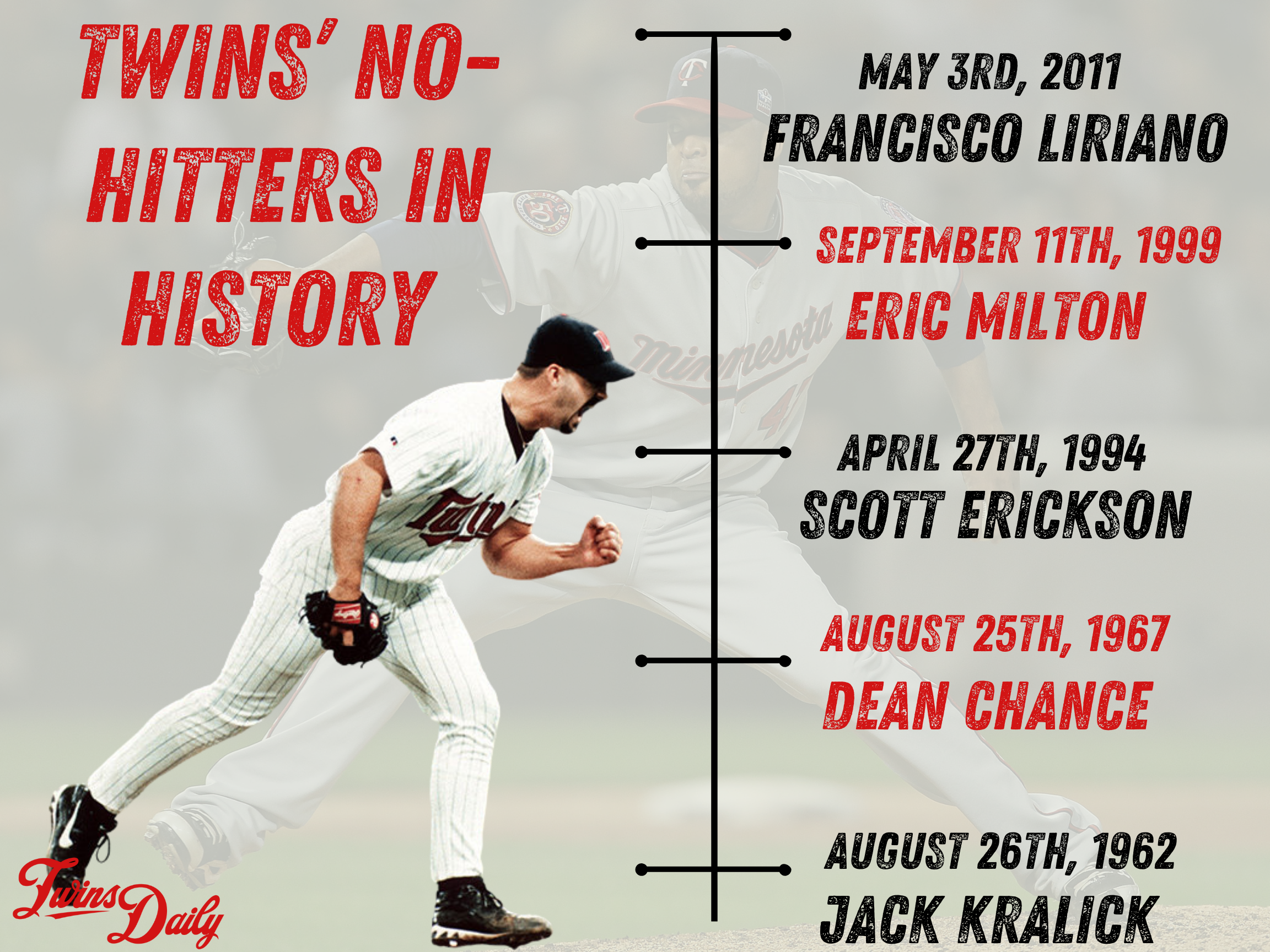 Hello, Twins Fans! When I was younger, my maternal grandparents used to say, "Hello Sportsfan!" and I loved that. It would not apply to me until I was much older since I grew up in theater and music. Baseball was never far from me though. I went to countless games in the summer with KidStop (If you know - you know), and I remember watching Kirby Puckett, Kent Hrbek, and Chuck Knoblauch and loving the feeling of the crowd roaring inside the Metrodome. A lot of you have shared similar experiences with me after reading the previous no-hitter articles. Jamie Johnson, who is a follower of TwinsDaily, had the experience of attending both of the no-hitters at the Dome and told me how it felt to him: These moments are what baseball is all about and for Jamie, getting to experience BOTH no-hitters at the Metrodome is an extraordinary memory (and incredibly unlikely!). Minnesota sports made more memories last week. The Vikings beat the Packers, and the Gophers beat the Badgers. So it's a perfect time to talk about the second no-hitter in Metrodome history where the Twins stuck it to the Brewers. No-No Number 4: Scott Erickson - 1994 The Pitcher: Scott Erickson The Date: April 27, 1994 The Opponent: Milwaukee Brewers The Stadium: Metrodome (First No-Hitter in the Metrodome) The Pitcher's Background and Story Scott Erickson grew up on the west coast in sunny Long Beach, California. where he returned to retire after his 15-year stint as a pitcher in Major League Baseball. While attending both San Jose Junior College and the University of Arizona, not only did he graduate with degrees, he played ball. While attending Arizona, Erickson set a school record for wins with an 18-3 record, had the most wins in the country (18), most innings pitched (175), and complete games (14). He was only there for a year, but his impressive numbers and hard work earned him a unanimous First Team All-American honor, and he was inducted into the Arizona Wildcat Hall of Fame. Erickson was drafted four times before he signed with the Twins in 1989. Whether it was to get selected higher in the draft or a desire to pitch in college, the 21-year-old was ready to prove to the other scouts and organizations that even though his fastball was only hitting in the 80's, he was right where he needed to be for the Twins. Erickson worked hard to develop his slider and honed his two fastballs and a changeup that made him sometimes unhittable. The outcome of the game and his ability to focus and work hard to get where he wanted to be shocked not only him but also others." The thing that impresses me is his ability to concentrate through the pressure of a nine-inning game," said [Jack] Morris (in a June 1991 New York Times interview). "That's a great trait for a young pitcher, and it has a lot to do with his success. He gets into his little world." 1994 was a challenging year for baseball and left a bad taste in a lot of people's mouths. The American and National League decided to realign the teams and add a central division. The Twins struggled to an 8-14 record by the time the game against the Royals took place. They finished the season at 53-60 and in fourth place in the AL. Later the strike took away the post season and the World Series. The drama of the strike overshadowed the accomplishments of many teams and players, including Scott Erickson's no-hitter. This particular game was a gem, but overall it was a mediocre-at-best season for the Twins and Erickson, who led baseball with 19 losses. The Game The Metrodome was sparsely filled. A mere 17,988 fans filled the stadium. It was still early in the season. There was nothing special or crazy about this game, the stadium or the teams. Before the game, he wasn't feeling that great. Nothing said this would be a no-hitter; there was no precursor to routine or even a belief that the Twins could manage a win. In an interview after the game Erickson shared, "I haven't changed anything since my last three starts," he said. "I had a better slider today, reminiscent of years past." He did say at one-point once he realized after the sixth or seventh inning he treated each inning as if it was the first inning. His catcher Matt Walbeck recalled the game as his favorite memory with the Twins in a Twins Daily story, “My biggest memory, my happiest moment playing for the Twins, was catching Scott Erickson’s no-hitter. By far. That was my career highlight.” Opponent The Milwaukee Brewers were not faring any better than the Twins. The Brewers had an awful 1993 season, and the decision to re-brand was a year into the making, but it was just putting lipstick on a pig. The new colors were supposed to bring a vibe, and the new logo was "so cool" one team official was "concerned it would fall victim to gang usage." The Brewers fans, though? They disagreed. In a poll taken by the local newspaper, only 20% of 300 fans polled liked the new colors and logo. There was just nothing Milwaukee could do right from their logo to their gameplay. They finished their season 53-62, 5th in the American League Central Division but fairing better than the Twins sitting at 11-9 when they came to the Dome. When they made it to the Metrodome, they had a slew of problems. However, they also had some positives like injured players from 1993 that were starting to bounce back and make improvements that helped carry the team after the all-star break. The Twins had a line-up that still lingered from the 1991 World Series, players like: Chuck Knoblach, Kirby Puckett, and Kent Hrbek. It’s not that Milwaukee didn’t have a great line up, they had two stand out players who seemed to carry the team throughout the season, Greg Vaughn paced Milwaukee with 19 home runs Dave Nilsson drove in 69 runs and topped batters with significant playing time by hitting .275. Even with two all star hitters, they weren't a team that was feared coming into the Dome that day in April. How many pitchers pitched Scott Erickson was the only Twins pitcher that game. Erickson exploded into the Twins pitching scene in 1991, helping the Twins get to their 1991 World Series. Since then, he struggled; in fact, he was the most hittable pitcher in 1993. Erickson walked four batters and struck out five while throwing 128 pitches. 128 pitches! That blew my mind. His catcher, Matt Walbeck, noticed he continued to get stronger throughout the game. He was confident, and his fastball was moving faster than ever. Not a single hit, run, or error. Scott Erickson was on fire. Home or Away The game was at the Dome, and the crowd was small, but by the time they were loud, they realized what was going on. In the ninth inning - all 17,988 people were on their feet cheering for Erickson. He shut down the Brewers for nine innings, completing the first no-hitter in the Metrodome and breaking the Twins 27-year no-hitter drought Did the pitcher hit Scott Erickson did not hit in this game. He left that to the all-star lineup. The offense was able to capitalize on Brewers pitching , scoring six runs. Kent Hrbek homered. Kirby Puckett hit a ground-rule double, and Chuck Knoblauch singled in a run. By the fourth inning, the Twins were up 5-0, but that did not slow down the pace of Erickson, or the Twins bats, which scored one more run to seal the deal. The Twins wore down the pitching of the Brewers, forcing them to bring four pitchers to the mound throughout the game after starting pitcher Jaime Navarro gave up the five runs to the Twins. Wrap it up! Scott Erickson had one of the best no-hitter performances that I have researched. I know I ranked his no-hitter at #3 out of five Twins no-hitters, but I have to be fair to my criteria, and allowing for four walks is not a massive deal in the grand scheme. The fact that it was the first no-hitter in the Metrodome is also exciting. A no-hitter on artificial turf was impressive in itself, but the Dome was also the place to hit "home runs," so to see that much control and focus on pulling off the no-hitter was indeed against the odds and statistics. The fans that were there for that game experienced the rush of emotions. They erupted in noise when Greg Vaughn’s fly ball landed in left fielder Alex Cole’s glove for the last out. Those fans will never forget the pitcher that beat the odds in a season when the chips were down. I look forward to discussions! MORE FROM TWINS DAILY — Latest Twins coverage from our writers — Recent Twins discussion in our forums — Follow Twins Daily via Twitter, Facebook, or email
 -
Today we continue the Twins No-Hitter series with Part 4. Scott Erickson had gone through many ups and downs in his first four years in the big leagues, and certainly has in his life since then. However, on one late-April night in 1994, Erickson stole the show. Hello, Twins Fans! When I was younger, my maternal grandparents used to say, "Hello Sportsfan!" and I loved that. It would not apply to me until I was much older since I grew up in theater and music. Baseball was never far from me though. I went to countless games in the summer with KidStop (If you know - you know), and I remember watching Kirby Puckett, Kent Hrbek, and Chuck Knoblauch and loving the feeling of the crowd roaring inside the Metrodome. A lot of you have shared similar experiences with me after reading the previous no-hitter articles. Jamie Johnson, who is a follower of TwinsDaily, had the experience of attending both of the no-hitters at the Dome and told me how it felt to him: These moments are what baseball is all about and for Jamie, getting to experience BOTH no-hitters at the Metrodome is an extraordinary memory (and incredibly unlikely!). Minnesota sports made more memories last week. The Vikings beat the Packers, and the Gophers beat the Badgers. So it's a perfect time to talk about the second no-hitter in Metrodome history where the Twins stuck it to the Brewers. No-No Number 4: Scott Erickson - 1994 The Pitcher: Scott Erickson The Date: April 27, 1994 The Opponent: Milwaukee Brewers The Stadium: Metrodome (First No-Hitter in the Metrodome) The Pitcher's Background and Story Scott Erickson grew up on the west coast in sunny Long Beach, California. where he returned to retire after his 15-year stint as a pitcher in Major League Baseball. While attending both San Jose Junior College and the University of Arizona, not only did he graduate with degrees, he played ball. While attending Arizona, Erickson set a school record for wins with an 18-3 record, had the most wins in the country (18), most innings pitched (175), and complete games (14). He was only there for a year, but his impressive numbers and hard work earned him a unanimous First Team All-American honor, and he was inducted into the Arizona Wildcat Hall of Fame. Erickson was drafted four times before he signed with the Twins in 1989. Whether it was to get selected higher in the draft or a desire to pitch in college, the 21-year-old was ready to prove to the other scouts and organizations that even though his fastball was only hitting in the 80's, he was right where he needed to be for the Twins. Erickson worked hard to develop his slider and honed his two fastballs and a changeup that made him sometimes unhittable. The outcome of the game and his ability to focus and work hard to get where he wanted to be shocked not only him but also others." The thing that impresses me is his ability to concentrate through the pressure of a nine-inning game," said [Jack] Morris (in a June 1991 New York Times interview). "That's a great trait for a young pitcher, and it has a lot to do with his success. He gets into his little world." 1994 was a challenging year for baseball and left a bad taste in a lot of people's mouths. The American and National League decided to realign the teams and add a central division. The Twins struggled to an 8-14 record by the time the game against the Royals took place. They finished the season at 53-60 and in fourth place in the AL. Later the strike took away the post season and the World Series. The drama of the strike overshadowed the accomplishments of many teams and players, including Scott Erickson's no-hitter. This particular game was a gem, but overall it was a mediocre-at-best season for the Twins and Erickson, who led baseball with 19 losses. The Game The Metrodome was sparsely filled. A mere 17,988 fans filled the stadium. It was still early in the season. There was nothing special or crazy about this game, the stadium or the teams. Before the game, he wasn't feeling that great. Nothing said this would be a no-hitter; there was no precursor to routine or even a belief that the Twins could manage a win. In an interview after the game Erickson shared, "I haven't changed anything since my last three starts," he said. "I had a better slider today, reminiscent of years past." He did say at one-point once he realized after the sixth or seventh inning he treated each inning as if it was the first inning. His catcher Matt Walbeck recalled the game as his favorite memory with the Twins in a Twins Daily story, “My biggest memory, my happiest moment playing for the Twins, was catching Scott Erickson’s no-hitter. By far. That was my career highlight.” Opponent The Milwaukee Brewers were not faring any better than the Twins. The Brewers had an awful 1993 season, and the decision to re-brand was a year into the making, but it was just putting lipstick on a pig. The new colors were supposed to bring a vibe, and the new logo was "so cool" one team official was "concerned it would fall victim to gang usage." The Brewers fans, though? They disagreed. In a poll taken by the local newspaper, only 20% of 300 fans polled liked the new colors and logo. There was just nothing Milwaukee could do right from their logo to their gameplay. They finished their season 53-62, 5th in the American League Central Division but fairing better than the Twins sitting at 11-9 when they came to the Dome. When they made it to the Metrodome, they had a slew of problems. However, they also had some positives like injured players from 1993 that were starting to bounce back and make improvements that helped carry the team after the all-star break. The Twins had a line-up that still lingered from the 1991 World Series, players like: Chuck Knoblach, Kirby Puckett, and Kent Hrbek. It’s not that Milwaukee didn’t have a great line up, they had two stand out players who seemed to carry the team throughout the season, Greg Vaughn paced Milwaukee with 19 home runs Dave Nilsson drove in 69 runs and topped batters with significant playing time by hitting .275. Even with two all star hitters, they weren't a team that was feared coming into the Dome that day in April. How many pitchers pitched Scott Erickson was the only Twins pitcher that game. Erickson exploded into the Twins pitching scene in 1991, helping the Twins get to their 1991 World Series. Since then, he struggled; in fact, he was the most hittable pitcher in 1993. Erickson walked four batters and struck out five while throwing 128 pitches. 128 pitches! That blew my mind. His catcher, Matt Walbeck, noticed he continued to get stronger throughout the game. He was confident, and his fastball was moving faster than ever. Not a single hit, run, or error. Scott Erickson was on fire. Home or Away The game was at the Dome, and the crowd was small, but by the time they were loud, they realized what was going on. In the ninth inning - all 17,988 people were on their feet cheering for Erickson. He shut down the Brewers for nine innings, completing the first no-hitter in the Metrodome and breaking the Twins 27-year no-hitter drought Did the pitcher hit Scott Erickson did not hit in this game. He left that to the all-star lineup. The offense was able to capitalize on Brewers pitching , scoring six runs. Kent Hrbek homered. Kirby Puckett hit a ground-rule double, and Chuck Knoblauch singled in a run. By the fourth inning, the Twins were up 5-0, but that did not slow down the pace of Erickson, or the Twins bats, which scored one more run to seal the deal. The Twins wore down the pitching of the Brewers, forcing them to bring four pitchers to the mound throughout the game after starting pitcher Jaime Navarro gave up the five runs to the Twins. Wrap it up! Scott Erickson had one of the best no-hitter performances that I have researched. I know I ranked his no-hitter at #3 out of five Twins no-hitters, but I have to be fair to my criteria, and allowing for four walks is not a massive deal in the grand scheme. The fact that it was the first no-hitter in the Metrodome is also exciting. A no-hitter on artificial turf was impressive in itself, but the Dome was also the place to hit "home runs," so to see that much control and focus on pulling off the no-hitter was indeed against the odds and statistics. The fans that were there for that game experienced the rush of emotions. They erupted in noise when Greg Vaughn’s fly ball landed in left fielder Alex Cole’s glove for the last out. Those fans will never forget the pitcher that beat the odds in a season when the chips were down. I look forward to discussions! MORE FROM TWINS DAILY — Latest Twins coverage from our writers — Recent Twins discussion in our forums — Follow Twins Daily via Twitter, Facebook, or email View full article
-
Well, I am ready to go big and hope it works!!!
-
I agree and which is why I am hoping this works!
-
you are absolutely right - I didn't miss it - I had a few in there but had to tailor down the article. There are also others like Bobby Bonilla. Many contracts have busted, but my hope is that with incentives to hit 500K per each game appearance reached - he is staying true to his word on staying healthy and doing what it takes, then I think this will be a good deal.
-
Yep! He will be paid through 2035!
-
One Fan’s Opinion: Byron Buxton Contract: Bust or Boom
Sherry Cerny posted an article in Twins Daily
 It finally happened. The Twins have signed Byron Buxton to a huge deal, $100 million deal over seven years and a bunch more incentives per Ken Rosenthal. Twins fans are very excited right now, but not every big contract pays off. While this is an excellent deal for the Twins and exciting for the fan base, it is more than fair to be concerned about the health of Buxton and how much time he can stay on the field. Buxton has only appeared in over 100 games once in his career. That was in 2017, when he appeared in 140 games. $15 million per year with incentives is not an insufficient salary for a player who has trouble staying on the field. While this investment could work out for the Twins, it could also go wrong if Buxton doesn't stay healthy. When Buxton is healthy, he is easily the best player on the field and in the lineup. He’s made clutch catches and his batting average in 61 games this year was .306 . He made those 61 games count. The incentive for him to stay healthy? $500K each for reaching 502, 533, 567, 600, and 625 plate appearances. It is an incentive to stay healthy. The gamble is Buxton is like other players who have had outstanding years and been an asset to their team. This article is not meant to say that Buxton is not an asset, or will not fulfill the contract. When he is on the field, he is a solid asset to the team. He is a hard-nosed player who rehabs hard and does go all out. The concern of this writer, and some other fans, is that larger deals with players who are prone to injury can be exciting while still being concerning. Some players got long-term, big contracts and then busted after the ink had dried. Here are three such examples: Gary Matthews Jr had an outstanding year with the Rangers in 2005. He hit .313 and drove in 79 runs with 19 home runs. The Angels liked what they saw and offered him five years and $65 million. He was barely productive with the Angels posting a .248 hitting average, ten home runs, and totaled just 55 RBI in three seasons. The contract amount is comparable to what we are looking at in terms of length and desired production for Buxton. Jeffrey Hammonds signed a three-year, $21 million deal with the Brewers. In 2001 that was a fairly large deal but it wasn’t the largest or craziest. Milwaukee saw Hammonds hit.335 and drive in over 100 runs while posting an OPS over .900 the year before. Hammonds only played 49 games due to injuries in 2001 and never lived up to his contract or potential. Looking for an example with the Twins? Well, the largest contract the Twins have signed was with Joe Mauer. He was coming off of an MVP season and a year away from free agency. At the time, the Yankees and Red Sox likely would have been competing for his services, so the Twins didn’t let him get to free agency. They locked him up for eight years and $184 million. The Twins were about to move into Target Field and the local boy turned future Hall of Famer had to be retained. Was he worth the $184 million during that contract? No. He fought some knee injuries and a concussion that altered the trajectory of his career. He struggled some and had to switch positions. Like Mauer a dozen years ago, the Twins could not afford to lose Byron Buxton this offseason. Of course, the ultimate hope would be to see Buxton have an inverse career to that of Mauer. Buxton has fought injuries before signing his nine-figure deal. Hopefully he will be able to remain healthy after signing the deal. The Twins are signing Buxton based on his previous field production and his immense talent and ceiling, but also considering his on-field time missed. There have been notable times when players have been signed and gone downhill. The contract shows that the Twins have the means to make big contracts happen. Not all large contracts are bad. The Twins certainly are showing us that they are willing and able to make commitments to players and I believe this is a good sign for the organization and fans alike. I know there is still plenty of time left and about $50 million left, so now with Buck locked in and a good outfield roster, we can focus on putting that money into pitching - both starters and relief. While I am cautious about what this will mean for the Twins in the long run and the team if they have to continually cover for Buxton if his injurious state does not improve, it is proof that the organization is willing to do what it takes to retain players. The fans who were putting all their hopes into the organization, I just hope it’s enough. Now we can take a quick sigh of relief and hope the Twins make some pitching moves that will help the team in 2022 and beyond. But will they sign anyone before the CBA comes to an end and signings will be on a freeze.
 -
The day has arrived! The Twins have brought Christmas early to Twins Territory signing a deal with Byron Buxton! Some fans are elated, others are cautious but hopeful. Many contracts have had success, but others have not worked out for the team writing the checks. Join me while we take a look at a few contracts that have gone bust in the past. It finally happened. The Twins have signed Byron Buxton to a huge deal, $100 million deal over seven years and a bunch more incentives per Ken Rosenthal. Twins fans are very excited right now, but not every big contract pays off. While this is an excellent deal for the Twins and exciting for the fan base, it is more than fair to be concerned about the health of Buxton and how much time he can stay on the field. Buxton has only appeared in over 100 games once in his career. That was in 2017, when he appeared in 140 games. $15 million per year with incentives is not an insufficient salary for a player who has trouble staying on the field. While this investment could work out for the Twins, it could also go wrong if Buxton doesn't stay healthy. When Buxton is healthy, he is easily the best player on the field and in the lineup. He’s made clutch catches and his batting average in 61 games this year was .306 . He made those 61 games count. The incentive for him to stay healthy? $500K each for reaching 502, 533, 567, 600, and 625 plate appearances. It is an incentive to stay healthy. The gamble is Buxton is like other players who have had outstanding years and been an asset to their team. This article is not meant to say that Buxton is not an asset, or will not fulfill the contract. When he is on the field, he is a solid asset to the team. He is a hard-nosed player who rehabs hard and does go all out. The concern of this writer, and some other fans, is that larger deals with players who are prone to injury can be exciting while still being concerning. Some players got long-term, big contracts and then busted after the ink had dried. Here are three such examples: Gary Matthews Jr had an outstanding year with the Rangers in 2005. He hit .313 and drove in 79 runs with 19 home runs. The Angels liked what they saw and offered him five years and $65 million. He was barely productive with the Angels posting a .248 hitting average, ten home runs, and totaled just 55 RBI in three seasons. The contract amount is comparable to what we are looking at in terms of length and desired production for Buxton. Jeffrey Hammonds signed a three-year, $21 million deal with the Brewers. In 2001 that was a fairly large deal but it wasn’t the largest or craziest. Milwaukee saw Hammonds hit.335 and drive in over 100 runs while posting an OPS over .900 the year before. Hammonds only played 49 games due to injuries in 2001 and never lived up to his contract or potential. Looking for an example with the Twins? Well, the largest contract the Twins have signed was with Joe Mauer. He was coming off of an MVP season and a year away from free agency. At the time, the Yankees and Red Sox likely would have been competing for his services, so the Twins didn’t let him get to free agency. They locked him up for eight years and $184 million. The Twins were about to move into Target Field and the local boy turned future Hall of Famer had to be retained. Was he worth the $184 million during that contract? No. He fought some knee injuries and a concussion that altered the trajectory of his career. He struggled some and had to switch positions. Like Mauer a dozen years ago, the Twins could not afford to lose Byron Buxton this offseason. Of course, the ultimate hope would be to see Buxton have an inverse career to that of Mauer. Buxton has fought injuries before signing his nine-figure deal. Hopefully he will be able to remain healthy after signing the deal. The Twins are signing Buxton based on his previous field production and his immense talent and ceiling, but also considering his on-field time missed. There have been notable times when players have been signed and gone downhill. The contract shows that the Twins have the means to make big contracts happen. Not all large contracts are bad. The Twins certainly are showing us that they are willing and able to make commitments to players and I believe this is a good sign for the organization and fans alike. I know there is still plenty of time left and about $50 million left, so now with Buck locked in and a good outfield roster, we can focus on putting that money into pitching - both starters and relief. While I am cautious about what this will mean for the Twins in the long run and the team if they have to continually cover for Buxton if his injurious state does not improve, it is proof that the organization is willing to do what it takes to retain players. The fans who were putting all their hopes into the organization, I just hope it’s enough. Now we can take a quick sigh of relief and hope the Twins make some pitching moves that will help the team in 2022 and beyond. But will they sign anyone before the CBA comes to an end and signings will be on a freeze. View full article
-
Twins No-Hitters: Eric Milton
Sherry Cerny replied to Sherry Cerny's topic in Twins Daily Front Page News
I was actually thinking of rounding this out with an article like that. It really makes me realize how good our pitching was back then. I do think we had a crappy offense though - for quite a few years off and on - but now we have the opposite problem. Thank you so much for your input! I love hearing from subscribers. -
Twins No-Hitters: Eric Milton
Sherry Cerny replied to Sherry Cerny's topic in Twins Daily Front Page News
That is ABSOLUTELY fantastic! I love hearing stuff like this and it really makes me enjoy my writing more. I am learning a lot and I love knowing that people enjoy recalling those memories. -
Twins No-Hitters: Eric Milton
Sherry Cerny replied to Sherry Cerny's topic in Twins Daily Front Page News
absolutely enjoying this part of my writing!! I am glad that you are enjoying it. -
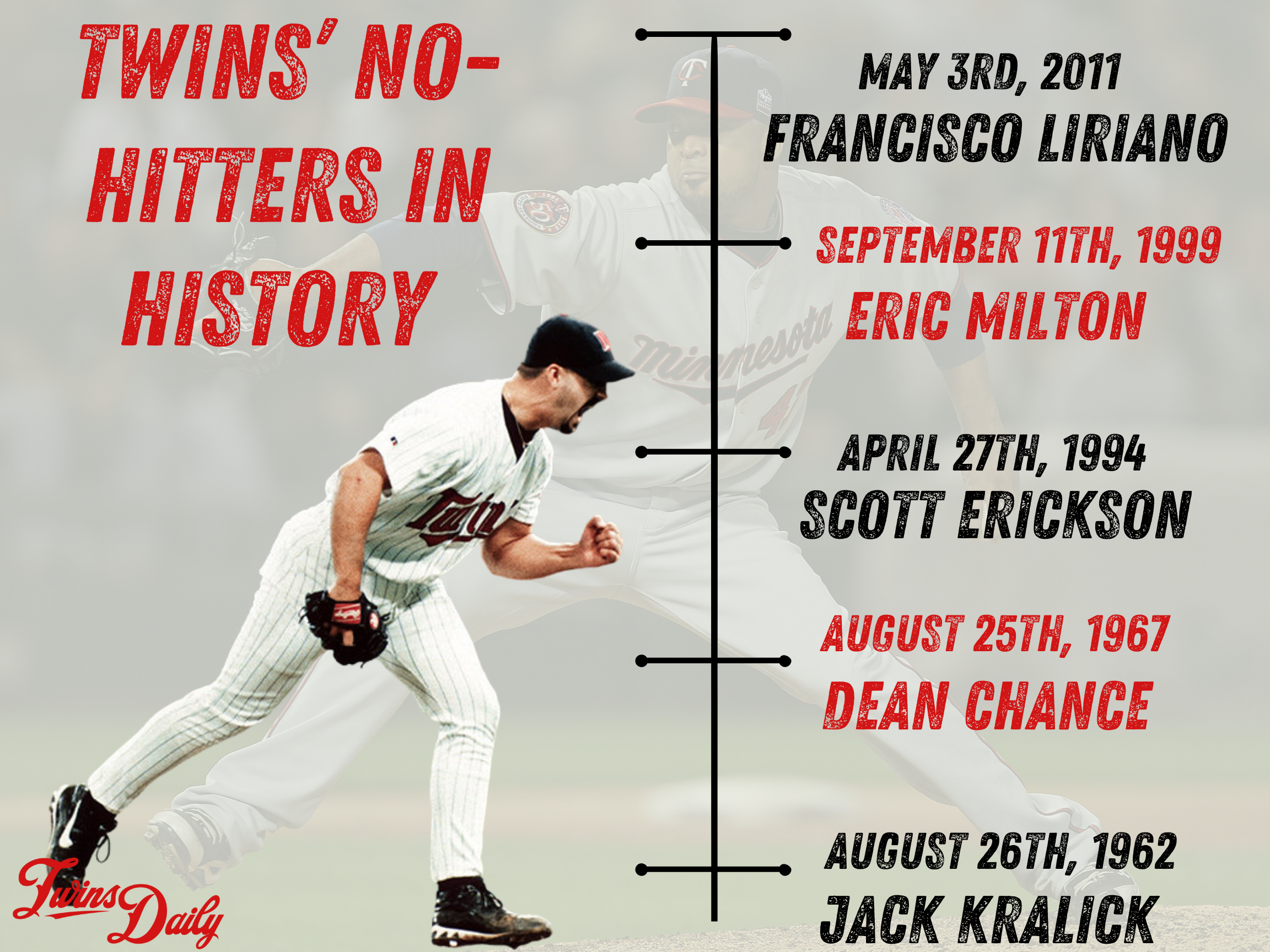 Welcome back, fans! I hope that you had a good Thanksgiving. I know that going over Twins History isn’t as juicy as all the news we have had lately from a Cave extension, Astudillo saying good-bye and potential trades. History is important to our future and while we are looking ahead at potential arms for our line up, looking back over pitchers that made an impact on our team. I am learning a lot about where we came from and what has changed and hasn’t in this organization. Onto our next no-hitter! Were you right? Did you guess Eric Milton? It may come as a shock to some, but Milty had a great no hitter which included an on fire offense. Some of the choices are more of an internal battle than others - but laying out stats and guidelines help me narrow down my choices. No-No Number 2: Eric "Milty" Milton - 1999 The Pitcher: Eric Milton The Date: September 11, 1999 The Opponent: Anaheim Angels The Stadium: Metrodome The Pitcher's Background and Story Eric Milton was born in Pennsylvania in 1975 in a small town called Bellfone, where he attended the local high school. Milton left home to play ball and attend the University of Maryland. He had three strong seasons for the Terrapins, and in the summers he played collegiate summer ball in the Cape Cod Baseball League. In 2004, he was inducted into the Cape Cod’s Hall of Fame. In 1996, Milton was selected with the 20th overall pick by the New York Yankees.; He left college to chase his MLB dream. Milton only played one season with the Yankees minors before being traded to the Twins. Milton was part of a trade that sent Chuck Knoblach to the Yankees for Brian Buchanan, Cristian Guzman, Danny Mota, and cash. His MLB debut was on April 5, 1998, as a Minnesota Twin. He pitched against the Kansas City Royals, and had six scoreless innings to record his first major-league win. The Twins were having another lackluster season in 1999. They were on a losing streak and carrying a 59-82 record. Even with guys like David Ortiz, Brad Radke, Corey Koskie, Doug Mientkiewicz, and Jaque Jones, they were clearly a young, inexperienced team taking their lumps.. That day was something different. The Game: It was not a typical day in Twins territory on September 11, 1999. The Twins were starting at 11:00am instead of a typical Saturday night game. Dating back to the Twins' inaugural season in 1961, there was an agreement that they would change the schedule so fans could leave their game and make it to the Gophers football home opener. This schedule began at The Met and continued when the Metrodome opened. When the Gophers and Twins were home on the same day, the Twins would move their games up to noon central time. It sounds like a huge inconvenience, as the Dome had to be converted from a baseball field to a football field in a matter of hours, but the teams made it work. Terry Steinbach was behind the plate. Steinbach helped Milton navigate the game. Immediately the chemistry was on point. Milton started the game by getting Jeff Davanon out on four pitches. The 24-year-old lefty remained in control for the remainder of the game. He walked a few hitters but was able to maintain control of the game with his fastball. Milton was putting on a show and had no clue that he was working on a no-hitter. Superstition was running rampant through the Twins dugout. Milton said at one point a kid brought him Gatorade and sat next to him. When the kid got up to walk away, Milton said, "Hey, what are you doing? You have to come back." Opponent The Anaheim Angels and the Twins were not having great seasons, respectively. Both teams were well below .500. There was nothing happening for either team that would have predicted this being a no-hitter. The Angels were struggling to get along with their manager Terry Collins. Collins had a reputation for a volatile temper that collided with his players leading them to undermine his authority. This issue had a significant impact on the field, and players admit it was hard to play and have cohesion with the conflict looming. That was not the only thing that was against the Angels at that time. Due to the early start time and the September rosters - Joe Maddon, the new Angels manager that replaced Terry Collins, had four call-up players that had their MLB debut that day and only two starters in the line-up that day: Troy Glaus and Orlando Palmeiro. Needless to say, there was a lot going against the Angels, but that does not cheapen the no-no for Eric Milton. How many pitchers pitched Milton was the only Twins pitcher that pitched that day. He threw all nine innings, striking out 13 batters, with his fastball reportedly touching 94 mph. As Milton stared down the batter's box with his first no-no in progress, Steinbach behind the plate had already seen a no-hitter in his career. Even with control and a mean fast ball, Milton only allowed two walks and nothing else to the Angels. Home or Away The Twins hosted the game versus the Angels at the Metrodome when they were splitting the building with the Golden Gophers football team. Sharing a field meant more pressure to get through the game promptly to turn the area into a gridiron. The Dome held 60,000 people, but only 11,222 showed up to cheer on the Twins. Given their record, I am not surprised. Thanks to the acoustics of the Dome, we know that it could get loud. However, once Milton realized what was going on and his spidey sense kicked in that this may be a no-hitter around the sixth or seventh inning, he said, "It sounded like 20,000" people were in there, and that's part of what kept me going”. Did the pitcher hit In Major League Baseball, the Designated Hitter rule had been in place for more than 20 years. Even though Milty did not have to hit, the offense was on fire. Terry Steinbach set the tone in the bottom of the first inning. He hit a triple to right field which scored Matt Lawton and gave the Twins a lead. The Twins offense scored seven runs by the end of the game, the highest number of runs of any Twins no-hitters. Even though he didn’t have many at-bats with the Twins, Milton when he was traded to the Phillies in exchange for Carlos Silva, Nick Punto and Bobby Korecky in 2004. He wasn't a great hitter, but with 209 plate appearances, he posted a .166 batting average, above average of pitchers. This no-hitter was fun to research and write about. From Milton’s superstition to other fun facts I learned, such as the ill-timed "Wheel of Fortune" promotion. A fan had to fill in the letters of a puzzle on the scoreboard to unveil the answer to the question of "Who pitched the first no-hitter for the Twins?" (Jack Kralick) The question had been developed before the game and went unchanged despite the no-hit bid. ANA@MIN: Milton completes no-hitter against Angels Eric Milton says that this no-hitter isn't on the top of his list of achievements. That Moment was his 2002 American League Divisional Series win against the Oakland A's, where he held them to only two earned runs after pitching seven innings. Milton threw second no-hitter in 2004 with the Phillies. Would this have been your second choice? Would it have even been in your top three? Does the DH make a difference to you in how you view pitching? Let me know your thoughts. I look forward to discussions! MORE FROM TWINS DAILY — Latest Twins coverage from our writers — Recent Twins discussion in our forums — Follow Twins Daily via Twitter, Facebook, or email
 -
Welcome back to article two of the Twins no-hitter series. This week, we take a look back at Eric Milton's no-hitter. Welcome back, fans! I hope that you had a good Thanksgiving. I know that going over Twins History isn’t as juicy as all the news we have had lately from a Cave extension, Astudillo saying good-bye and potential trades. History is important to our future and while we are looking ahead at potential arms for our line up, looking back over pitchers that made an impact on our team. I am learning a lot about where we came from and what has changed and hasn’t in this organization. Onto our next no-hitter! Were you right? Did you guess Eric Milton? It may come as a shock to some, but Milty had a great no hitter which included an on fire offense. Some of the choices are more of an internal battle than others - but laying out stats and guidelines help me narrow down my choices. No-No Number 2: Eric "Milty" Milton - 1999 The Pitcher: Eric Milton The Date: September 11, 1999 The Opponent: Anaheim Angels The Stadium: Metrodome The Pitcher's Background and Story Eric Milton was born in Pennsylvania in 1975 in a small town called Bellfone, where he attended the local high school. Milton left home to play ball and attend the University of Maryland. He had three strong seasons for the Terrapins, and in the summers he played collegiate summer ball in the Cape Cod Baseball League. In 2004, he was inducted into the Cape Cod’s Hall of Fame. In 1996, Milton was selected with the 20th overall pick by the New York Yankees.; He left college to chase his MLB dream. Milton only played one season with the Yankees minors before being traded to the Twins. Milton was part of a trade that sent Chuck Knoblach to the Yankees for Brian Buchanan, Cristian Guzman, Danny Mota, and cash. His MLB debut was on April 5, 1998, as a Minnesota Twin. He pitched against the Kansas City Royals, and had six scoreless innings to record his first major-league win. The Twins were having another lackluster season in 1999. They were on a losing streak and carrying a 59-82 record. Even with guys like David Ortiz, Brad Radke, Corey Koskie, Doug Mientkiewicz, and Jaque Jones, they were clearly a young, inexperienced team taking their lumps.. That day was something different. The Game: It was not a typical day in Twins territory on September 11, 1999. The Twins were starting at 11:00am instead of a typical Saturday night game. Dating back to the Twins' inaugural season in 1961, there was an agreement that they would change the schedule so fans could leave their game and make it to the Gophers football home opener. This schedule began at The Met and continued when the Metrodome opened. When the Gophers and Twins were home on the same day, the Twins would move their games up to noon central time. It sounds like a huge inconvenience, as the Dome had to be converted from a baseball field to a football field in a matter of hours, but the teams made it work. Terry Steinbach was behind the plate. Steinbach helped Milton navigate the game. Immediately the chemistry was on point. Milton started the game by getting Jeff Davanon out on four pitches. The 24-year-old lefty remained in control for the remainder of the game. He walked a few hitters but was able to maintain control of the game with his fastball. Milton was putting on a show and had no clue that he was working on a no-hitter. Superstition was running rampant through the Twins dugout. Milton said at one point a kid brought him Gatorade and sat next to him. When the kid got up to walk away, Milton said, "Hey, what are you doing? You have to come back." Opponent The Anaheim Angels and the Twins were not having great seasons, respectively. Both teams were well below .500. There was nothing happening for either team that would have predicted this being a no-hitter. The Angels were struggling to get along with their manager Terry Collins. Collins had a reputation for a volatile temper that collided with his players leading them to undermine his authority. This issue had a significant impact on the field, and players admit it was hard to play and have cohesion with the conflict looming. That was not the only thing that was against the Angels at that time. Due to the early start time and the September rosters - Joe Maddon, the new Angels manager that replaced Terry Collins, had four call-up players that had their MLB debut that day and only two starters in the line-up that day: Troy Glaus and Orlando Palmeiro. Needless to say, there was a lot going against the Angels, but that does not cheapen the no-no for Eric Milton. How many pitchers pitched Milton was the only Twins pitcher that pitched that day. He threw all nine innings, striking out 13 batters, with his fastball reportedly touching 94 mph. As Milton stared down the batter's box with his first no-no in progress, Steinbach behind the plate had already seen a no-hitter in his career. Even with control and a mean fast ball, Milton only allowed two walks and nothing else to the Angels. Home or Away The Twins hosted the game versus the Angels at the Metrodome when they were splitting the building with the Golden Gophers football team. Sharing a field meant more pressure to get through the game promptly to turn the area into a gridiron. The Dome held 60,000 people, but only 11,222 showed up to cheer on the Twins. Given their record, I am not surprised. Thanks to the acoustics of the Dome, we know that it could get loud. However, once Milton realized what was going on and his spidey sense kicked in that this may be a no-hitter around the sixth or seventh inning, he said, "It sounded like 20,000" people were in there, and that's part of what kept me going”. Did the pitcher hit In Major League Baseball, the Designated Hitter rule had been in place for more than 20 years. Even though Milty did not have to hit, the offense was on fire. Terry Steinbach set the tone in the bottom of the first inning. He hit a triple to right field which scored Matt Lawton and gave the Twins a lead. The Twins offense scored seven runs by the end of the game, the highest number of runs of any Twins no-hitters. Even though he didn’t have many at-bats with the Twins, Milton when he was traded to the Phillies in exchange for Carlos Silva, Nick Punto and Bobby Korecky in 2004. He wasn't a great hitter, but with 209 plate appearances, he posted a .166 batting average, above average of pitchers. This no-hitter was fun to research and write about. From Milton’s superstition to other fun facts I learned, such as the ill-timed "Wheel of Fortune" promotion. A fan had to fill in the letters of a puzzle on the scoreboard to unveil the answer to the question of "Who pitched the first no-hitter for the Twins?" (Jack Kralick) The question had been developed before the game and went unchanged despite the no-hit bid. ANA@MIN: Milton completes no-hitter against Angels Eric Milton says that this no-hitter isn't on the top of his list of achievements. That Moment was his 2002 American League Divisional Series win against the Oakland A's, where he held them to only two earned runs after pitching seven innings. Milton threw second no-hitter in 2004 with the Phillies. Would this have been your second choice? Would it have even been in your top three? Does the DH make a difference to you in how you view pitching? Let me know your thoughts. I look forward to discussions! MORE FROM TWINS DAILY — Latest Twins coverage from our writers — Recent Twins discussion in our forums — Follow Twins Daily via Twitter, Facebook, or email View full article
-
Awwww thank you Melissa!!!! That means a lot!!
-
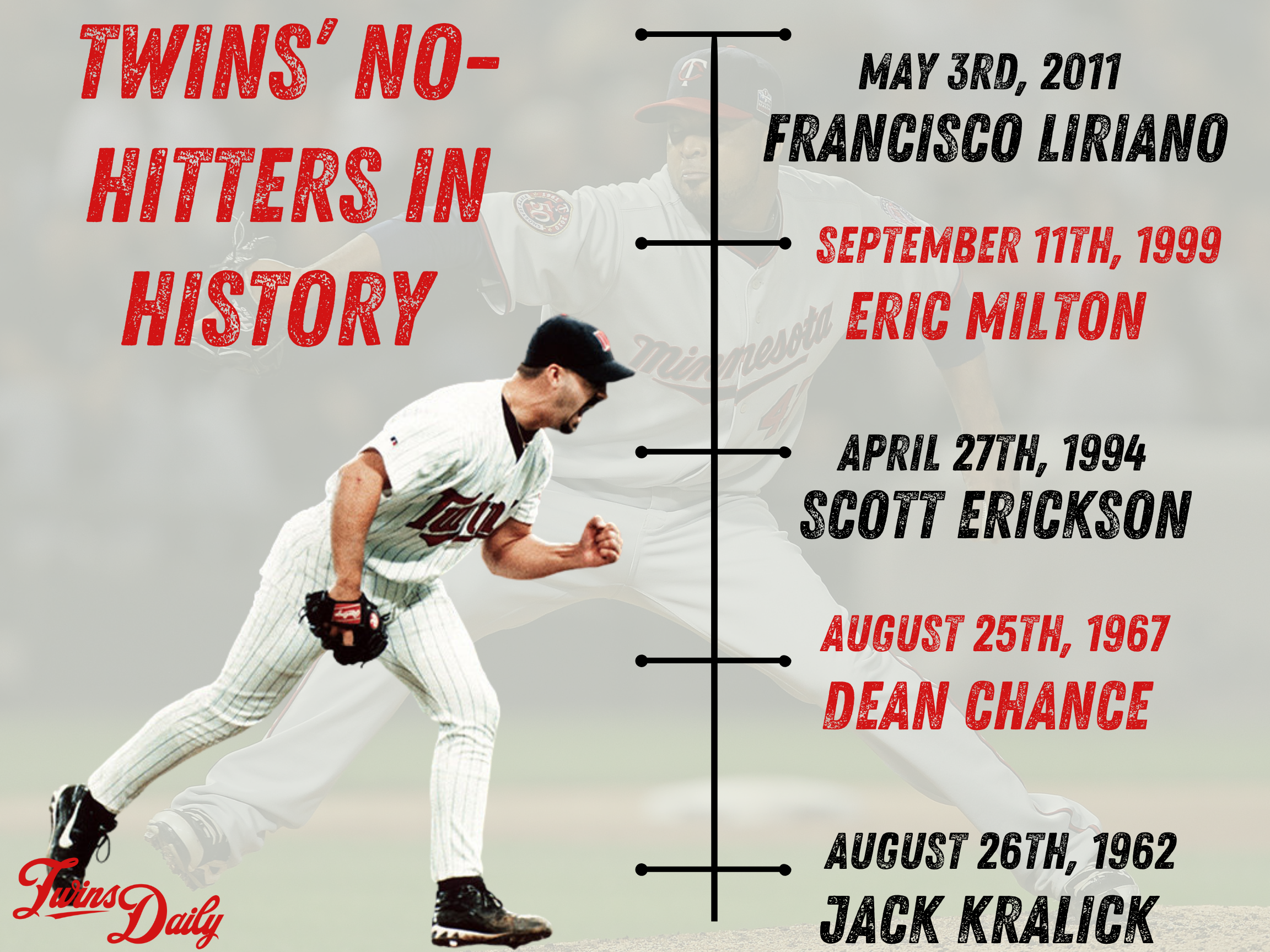 It's the held breath before the last pitch, the arms wide open as the catcher runs towards the pitcher, and the roar of the crowd as they witness one of the most magical moments in baseball: the no-hitter. The no-hitter is one of the beauties of baseball and games that you never forget as a fan. The no-hitter is as much luck as talent, and there have been some great pitching talents to pass through the Twins pitching staff. There have been 314 No-Hitters since 1876. They are rare, about 1.2 per year (statistically). However, in 2021, we saw the most no-no’s in any season in MLB history, nine to be exact. With all the excitement of the no-hitters this season, it’s a perfect time to look into the Twins no-no’s. Just one year after moving from DC as the Senators to Minnesota as the Twins in 1961, the Twins recorded their first no-hitter. The Twins organization has gone on to experience four more no-hitters since, the last one ten years ago. I intended to write about the no-hitters in one article and rank them. However, the more I read about each game, I thought it would be fun to make a series out of the rankings. There is a lot that goes into a game to take into consideration as I considered ranking their quality, even more so when the game ends as a no-hitter or a perfect game. It’s not all luck. With many variables that go into a game's success. So let’s take a brief look at what factors I considered to decide how to rank the games. Opponent The opponent is essential. A stronger opponent will give a pitcher more trouble than a team that is hitting poorly, has a lesser coaching staff, and any luck at the plate. It doesn't make it easier - nothing about baseball is easy - it's just a different scenario with more challenges. Baserunners Allowed Since having errors, walks or a hit batter is likely in a no-hitter (unless it is a Perfect Game, something no Twins pitcher has done, yet), looking at these numbers could make one no-hitter score higher than another. A good defense will come to the pitcher's aid and how well they can get an out, a ground ball, and round out double plays is a large factor. How many pitchers pitched Fewer pitches to accomplish a no-hitter is undoubtedly preferred. The number of pitchers involved in a game makes a difference. In a game for the Yankees this past May, Corey Kluber pitched a no-hitter. The Cubs also tossed a no-hitter this season. Zach Davies started but three other pitchers followed to finish the game. A combined no-hitter is not the norm (though certainly more likely as today’s pitchers rarely go beyond six innings), but certainly, I wanted to take that into account. Home or Away The strength of the schedule is important. So sleeping in your bed and playing in your home stadium with your fans can be better than playing at the closest opponent's stadium. It is also better than traveling back two time zones after a double-header or late-night game. There are a lot of things that people don't think affect a team that genuinely does. I am sure that the east to west coast games are exhausting and play a part in the turn-out and how well the players play. Does home or away really make a no-hitter more or less likely? If so, I’m sure it’s nice to have the fans there. Did the pitcher hit? The DH came into the American League in 1973. Before then, Twins pitchers and their opposing pitchers had to hit. Since then, American League pitchers have had to deal with batters whose sole purpose is being a good hitter. In theory, that should make throwing a no-hitter much more difficult in the AL than NL. Unless a player like AL MVP Shohei Ohtani is on the team. He can dominate on the mound and at the plate. People who say baseball is boring may not have a clue how much goes into a game. The low-scoring games are some of the best games to watch. It is a battle of the pitchers and hitters, as well as t defense can affect the games we see. Based on the criteria above, I looked over the five no-hitters that the Twins had. All no-hitters are impressive, some more than others. As I reviewed box scores and numbers, the #1 ranked no-hitter to me was a no brainer. No-No Number 1: “Jittery” Jack Kralick - 1962 The Pitcher: Jack Kralick The Date: August 26, 1962 The Opponent: Kansas City Athletics The Stadium: Metropolitan Stadium The Pitcher’s Background and Story Jack Kralick was born in Youngstown, Ohio in 1935. His parents later moved to Michigan where he attended high school and eventually attended Michigan State University. He spent time bouncing between minor league teams and a semi-pro squad back home in Michigan. Later he was pursued by the Tigers, Yankees and Indians. Kralick however was more keen on the offer from the Washington Senators and made his debut in the Majors in 1959 with the Washington Senators, which would eventually become the Minnesota Twins. Jack Kralick went the distance in this game, a near-perfect game. It was the very first no-hitter for the “Minnesota Twins”. Kralick was described as a “loner,” a smoking machine, and was called “jittery” for his constant movement on the mound from twitching his feet to fidgeting with his belt. Even though he was seen as quiet and a recluse, teammate Rich Rollins said that he “got along well with everyone in the clubhouse and everyone got along with him while he was in Minnesota.” The Game It was a beautiful 78 degrees for this late August game, a day when one is almost disappointed that the game only lasted one hour and 57 minutes! That’s how quickly the pitchers turned and burned the line-ups. The Kansas City Athletics (now the Oakland Athletics) were a struggling team when they played against the Twins and eventually finished ninth in the AL with a record of 72-90. They certainly were not a strong team, but that’s not what makes this no-hitter my favorite no-no. Let’s review the rest of my criteria to see why it continued to impress me more and more. Only one Kansas City baserunner was allowed on base in this game. That is the lowest number of base runners among the five Twins no-hitters. The only runner came with one out in the ninth inning. “Jittery” Jack Kralick retired 25 batters and was two outs away from a perfect game before George Alusik walked. That just blew my mind. For a pitcher to get that far into the game with no other pitching maladies is just … awesome. The game ended with a foul-pop fly to first base. Because it was a decade before the Designated Hitter rule which came about in 1972 and was implemented in 1973 throughout the American League. All pitchers were also hitters. You pitched. You hit. Being able to hit was a requirement to play the game. In my opinion, it made teams stronger and more cohesive. Along with the no-hitter, Kralick also went 1-for-2 and had a sacrifice bunt.. Through the three seasons that he was with the Twins, the southpaw hit .173. During the 1962 season, his batting average was .202, definitely an asset to the Twins and the highest batting average of his career! 1962 was his last full season with the Twins. In early May of 1963, Kralick was traded to Cleveland in exchange for righty Jim Perry. Yes, the Jim Perry that is in the Twins Hall of Fame. I am excited to share more of the Twins no-hitters with everyone and see if you agree with where I ranked the games. Do you have ideas for this series? What do you think is important in a no-hitter? Is it talent, or just luck? Let me know below! With all of the no-hitters this year and speculation as to why they are happening, it’s fun to think about the potential for another Twins no-hitter sooner rather than later! I look forward to discussions! MORE FROM TWINS DAILY — Latest Twins coverage from our writers — Recent Twins discussion in our forums — Follow Twins Daily via Twitter, Facebook, or email

