



Jim Crikket
-
Posts
1,414 -
Joined
-
Last visited
Content Type
Profiles
Minnesota Twins News, Rumors & Analysis
Minnesota Twins Videos
2026 Minnesota Twins Top Prospect Rankings
2022 Minnesota Twins Draft Picks & Signing Bonuses
Minnesota Twins Trade & Free Agent Rumors
Minnesota Twins Fan Guides & Resources
2023 Minnesota Twins Draft Picks & Signing Bonuses
The Minnesota Twins Players Project
2024 Minnesota Twins Draft Picks & Signing Bonuses
2025 Minnesota Twins Draft Picks & Signing Bonuses
2026 Minnesota Twins Draft Picks & Signing Bonuses
Forums
Blogs
Events
Store
Downloads
Gallery
Everything posted by Jim Crikket
-
Mis-typed that... the Cats lost their last TWO games (the completion of a suspended game from Friday, as well as Saturday's game) by identical 4-3 scores.
-
Beresford had a bit of a Jeckyll and Hyde week, getting off to a great start Monday and Tuesday with two hits in each game, both Rock Cats wins. He struggled a bit the rest of the week, adding only one more hit in games through Saturday. The Cats themselves have finished the week with plenty of frustration, losing their past three games through Saturday all by identical 4-3 scores. James' current stat line through Saturday, May 26: In 39 games: 31 H, 119 AB, 2 2B, 0 3B, 0 HR, .261 BA, ..336 OBP, 277 SLG, .613 OPS, 8 RBI, 13 BB, 18 K. Beresford committed his first error of the year this week, a throwing error on Wednesday.
-
I don't recall ever seeing an organization as bankrupt in the pitching department. I hope Manship does well... I hope they ALL do well. It's just that I'm getting a bit tired of hoping without seeing much return for that hope.
-

Weird Ideas: The Designated Starter
Jim Crikket commented on Jim Crikket's blog entry in Knuckleballs - JC
I hadn't thought about it ending up looking like a preseason game... all the more reason for Gardy to try it. Pre-season is the last time the Twins were winning games with any regularity. -
Weird Ideas: The Designated Starter
Jim Crikket commented on Jim Crikket's blog entry in Knuckleballs - JC
This article was originally posted at Knuckleballsblog.com. With the dismissal of Jason Marquis and subsequent promotion of Cole DeVries, the Twins’ rotation is down to one member of the original group projected to come out of Spring Training. Only Carl Pavano remains (and his balky shoulder makes you wonder how much longer he’ll last). And we haven’t reached Memorial Day yet. So, with the rotation situation as it is, I’m going to put myself in Ron Gardenhire’s and Rick Anderson’s shoes for a moment, today. The season is off to an absolutely abysmal start, to the point where your team has pretty much been eliminated from any shot at contending with only about 25% of the schedule behind you. The pitching… in particular the starting pitching… has been a disaster. And our grips on our jobs… manager and pitching coach of the Minnesota Twins… is growing just a bit tenuous. So what do we do? If ever there was a situation that called for trying unconventional pitching strategies, this is it. After all, what is there to lose? If the weird approaches work, we’re geniuses. If they don’t work, well, at least we get credit for recognizing the status quo had failed and we were willing to try something… anything… to get things turned around. But what to do? What kind of changes could we make that would be so unheard of among our peers that we’d get credit for trying something totally new AND at least have some remote chance of not blowing up in our faces and costing us whatever little bit of credibility we might otherwise retain at the end of this season? Ron… Andy… please allow me to introduce you to Joe Posnanski. This week, Poz wrote one of his “Curiously Long Posts” about one of those off-the-cuff sort of truisms that broadcasters and other baseball “experts” tend to spout off without really checking to see if they’re the least bit true. There are a lot of those, of course, but in this instance it was the cliché that, “the last three outs are the toughest outs to get in baseball.” Of course, for a variety of reasons, that’s not the least bit true. Statistically, in fact, ninth inning outs turn out to be the easiest three outs to get in baseball. The actual toughest three outs are the first three outs. Yes, hitters have the best stat lines in the first inning and pitchers have their worst stat lines in the first inning. More runs are scored in the first inning than any other single inning. Posnanski hypothesizes that this may be because it’s the one inning when the opposing manager can actually set his batting order the way he wants it. I don’t know if that has anything to do with it, but it sounds as good as anything, I guess. He credits, “a couple of radical thinkers inside the game,” with proposing that teams might be better off to have official game “starters” rather than “closers”… guys who start games every other night or so and go just one or two innings, before turning the game over to another pitcher geared up to pitch several innings. The idea, of course, is to use a hard throwing pitcher with, perhaps, a limited arsenal of pitches to get through that dangerous first inning or so when, statistically, more runs are historically scored than any other single inning. Think about that in terms of the current Twins for a moment. http://knuckleballsblog.com/blog/wp-content/uploads/2011/03/LirianoST11-300x220.jpg Francisco Liriano, "designated starter"? What if Francisco Liriano and, say, Jared Burton, were designated the team’s two “starters”? One lefty and one righty, they would start every other game and pitch just the first inning… maybe two if the first inning turned out to be easy enough. How many starts this year did Liriano breeze through the first inning, only to cough up runs in the second? Wouldn’t it have been great to let him get through that first inning, then immediately turn the game over to Carl Pavano or another “starting pitcher,” who could then face the bottom of the opposing team’s order in his first inning of work? Wouldn’t it have been much more likely that the “starting pitcher” in that situation would be able to get through the 7th inning before hitting the magic 100-pitch mark, allowing Glen Perkins and Matt Capps to close things out? Why not give it a whirl, guys? What are you afraid of? Is it that the national baseball media would howl? Would it just be too weird to see the same two guys listed the starting pitcher for the Twins on the schedule every other day? Or are you afraid that the managers and players on the other teams will laugh at you? Let’s hope that isn’t what stops you, guys. If it is, I’ve got news for you… they’re already laughing at you, because doing things the way they’ve always been done sure isn’t working. You might as well try something really new. - JC -
This article was originally posted at Knuckleballsblog.com. With the dismissal of Jason Marquis and subsequent promotion of Cole DeVries, the Twins’ rotation is down to one member of the original group projected to come out of Spring Training. Only Carl Pavano remains (and his balky shoulder makes you wonder how much longer he’ll last). And we haven’t reached Memorial Day yet. So, with the rotation situation as it is, I’m going to put myself in Ron Gardenhire’s and Rick Anderson’s shoes for a moment, today. The season is off to an absolutely abysmal start, to the point where your team has pretty much been eliminated from any shot at contending with only about 25% of the schedule behind you. The pitching… in particular the starting pitching… has been a disaster. And our grips on our jobs… manager and pitching coach of the Minnesota Twins… is growing just a bit tenuous. So what do we do? If ever there was a situation that called for trying unconventional pitching strategies, this is it. After all, what is there to lose? If the weird approaches work, we’re geniuses. If they don’t work, well, at least we get credit for recognizing the status quo had failed and we were willing to try something… anything… to get things turned around. But what to do? What kind of changes could we make that would be so unheard of among our peers that we’d get credit for trying something totally new AND at least have some remote chance of not blowing up in our faces and costing us whatever little bit of credibility we might otherwise retain at the end of this season? Ron… Andy… please allow me to introduce you to Joe Posnanski. This week, Poz wrote one of his “Curiously Long Posts” about one of those off-the-cuff sort of truisms that broadcasters and other baseball “experts” tend to spout off without really checking to see if they’re the least bit true. There are a lot of those, of course, but in this instance it was the cliché that, “the last three outs are the toughest outs to get in baseball.” Of course, for a variety of reasons, that’s not the least bit true. Statistically, in fact, ninth inning outs turn out to be the easiest three outs to get in baseball. The actual toughest three outs are the first three outs. Yes, hitters have the best stat lines in the first inning and pitchers have their worst stat lines in the first inning. More runs are scored in the first inning than any other single inning. Posnanski hypothesizes that this may be because it’s the one inning when the opposing manager can actually set his batting order the way he wants it. I don’t know if that has anything to do with it, but it sounds as good as anything, I guess. He credits, “a couple of radical thinkers inside the game,” with proposing that teams might be better off to have official game “starters” rather than “closers”… guys who start games every other night or so and go just one or two innings, before turning the game over to another pitcher geared up to pitch several innings. The idea, of course, is to use a hard throwing pitcher with, perhaps, a limited arsenal of pitches to get through that dangerous first inning or so when, statistically, more runs are historically scored than any other single inning. Think about that in terms of the current Twins for a moment. http://knuckleballsblog.com/blog/wp-content/uploads/2011/03/LirianoST11-300x220.jpg Francisco Liriano, "designated starter"? What if Francisco Liriano and, say, Jared Burton, were designated the team’s two “starters”? One lefty and one righty, they would start every other game and pitch just the first inning… maybe two if the first inning turned out to be easy enough. How many starts this year did Liriano breeze through the first inning, only to cough up runs in the second? Wouldn’t it have been great to let him get through that first inning, then immediately turn the game over to Carl Pavano or another “starting pitcher,” who could then face the bottom of the opposing team’s order in his first inning of work? Wouldn’t it have been much more likely that the “starting pitcher” in that situation would be able to get through the 7th inning before hitting the magic 100-pitch mark, allowing Glen Perkins and Matt Capps to close things out? Why not give it a whirl, guys? What are you afraid of? Is it that the national baseball media would howl? Would it just be too weird to see the same two guys listed the starting pitcher for the Twins on the schedule every other day? Or are you afraid that the managers and players on the other teams will laugh at you? Let’s hope that isn’t what stops you, guys. If it is, I’ve got news for you… they’re already laughing at you, because doing things the way they’ve always been done sure isn’t working. You might as well try something really new. - JC
-
You can view the page at http://twinsdaily.com/content.php?573-Purpose-Pitches
-
Baseball is a great game. Almost every game has some sort of unique situation arise, allowing fans to try to get in to the minds of the players and managers. Is the starting pitcher beginning to lose his stuff or can he go another inning? Is the centerfielder cheating a bit by playing shallow to keep a runner from advancing or to cut off a short line drive and will the hitter be able to get something past him in to the gap? Yes, almost every game provides opportunities to wonder what’s going on in the minds of those on the field and in the dugouts. Even 16-4 games where the outcome was never in doubt past the second inning. [PRBREAK][/PRBREAK] I didn’t see that mess of a game the Twins lost to the Brewers on Sunday, but from what I’ve read, there was at least one such, “what were they thinking?” moment. It came in the top of the 9th inning when Brewer relief pitcher Tim Dillard threw one pitch low and inside at Jamey Carroll and, having failed to hit him, threw his next pitch behind the Twins infielder. Dillard was immediately ejected by umpire Hunter Wendelstead. Carroll indicated that he asked Brewer catcher Jonathan Lucroy what it was all about and Lucroy told him the purpose pitch was in retaliation for Jeff Gray plunking Nyjer Morgan. Let me just say that I admit I’m pretty much “old school” on the subject of Purpose Pitches. In this case, that means I believe there is a time and place for purpose pitches. Yes, while I know others disagree, I believe there are times and places when a pitcher should… maybe even MUST… intentionally throw a ball with the intent of hitting the batter… or at least knocking him down. I started hitting batters intentionally when I was 13 years old. The “recreational” league I played in had time limits. You couldn’t start a new inning after the game had gone 90 minutes or something along those lines. This meant that there were times when the home team was at bat with a lead and, with the time limit approaching, some hitters got pretty deliberate about getting in to the batters box. When I was pitching in such a situation, that batter got one fastball in the ribs and next hitter got a stare that dared him to screw around. I seldom had to throw a second purpose pitch. Of course, the more common “purpose” behind throwing at a hitter, especially in professional ball, is in retaliation for something deemed unsportsmanlike or for your own hitters getting hit intentionally. Of course, a guy like Bob Gibson didn’t need a “purpose”. A bad cup of coffee with breakfast might have been enough for Gibby to knock three opposing hitters on their butts. But here’s where pitchers today lose me. If the guy you’re throwing at has to ask the catcher what the purpose of that “purpose pitch” was, you have to question the decision. In the situation Sunday, frankly, I can understand the Brewers getting a bit irritated with the situation. Twins pitchers hit not one… not two… but THREE Brewers hitters in that game. Did any of those HBPs occur because the Twins thought the Brewers were “piling on”? I have no idea, but that’s one “purpose” I’ve never seen as being a legitimate reason to throw at a hitter. If you don’t want the opposition to keep scoring runs, you should do something about getting more outs and giving up fewer hits. Anyway, as I said, I didn’t see the game. I don’t know what the circumstances were behind the Twins hitting three Brewers batters. But I do know that the last of those three occurred in the bottom of the seventh inning. That means the Brewers had plenty of opportunities in the top of the eighth inning to send the message to the Twins that they didn’t appreciate what had been going on. But they didn’t do that. They waited until Carroll came up to lead off the ninth inning… knowing full well there would be no “bottom of the ninth” where a Brewers hitter might risk getting “purposed” himself. That’s chicken****. I hope the Twins will have memories long enough to make that point to the Brewers when Milwaukee visits Target Field next month, but I doubt it. That’s simply not the “Twins Way” (gag). Since this got me reminiscing about my days as a 13 year old pitcher, there was another event on Sunday that brought back a memory of those days. My dad used to catch me in the back yard as he was schooling me on the finer points of the art and science of pitching. As 13 year olds and their fathers tend to do at times, there were occasions when the schooling led to… shall we say… differences. Yes, I would, at times, get angry with my father during those sessions. When I got angry, I would wind up and try to throw every pitch right through him. Of course, I never succeeded in doing anything except motivating him to remind me that he could throw a ball much, much harder than I could. Invariably, I ended up with a very bruised glove hand to go along with my bruised ego. http://knuckleballsblog.com/blog/wp-content/uploads/2011/03/ButeraST11-251x300.jpg Drew Butera All of which is my long way of pondering this question. Now that we know catcher Drew Butera is capable of throwing a baseball accurately at a speed in excess of 94 mph, how tempting must it be for him, at times, to rifle a ball back to one of the Twins pitchers, as a way of saying, “is that weak-assed 87 mph crap all you got?” - JC
-
First Look at the 2012 Snappers
Jim Crikket commented on Jim Crikket's blog entry in Knuckleballs - JC
Thanks for the compliments, shs... sorry it took me so long to respond. I'm actually holding out some hope that the Twins might change their MWL affiliation to Cedar Rapids next season. I know it won't help you out where you're at, but I know where I'd be spending about 70 nights every summer! -
This article was originally posted at Knuckleballsblog.com. Baseball is a great game. Almost every game has some sort of unique situation arise, allowing fans to try to get in to the minds of the players and managers. Is the starting pitcher beginning to lose his stuff or can he go another inning? Is the centerfielder cheating a bit by playing shallow to keep a runner from advancing or to cut off a short line drive and will the hitter be able to get something past him in to the gap? Yes, almost every game provides opportunities to wonder what’s going on in the minds of those on the field and in the dugouts. Even 16-4 games where the outcome was never in doubt past the second inning. I didn’t see that mess of a game the Twins lost to the Brewers on Sunday, but from what I’ve read, there was at least one such, “what were they thinking?” moment. It came in the top of the 9th inning when Brewer relief pitcher Tim Dillard threw one pitch low and inside at Jamey Carroll and, having failed to hit him, threw his next pitch behind the Twins infielder. Dillard was immediately ejected by umpire Hunter Wendelstead. Carroll indicated that he asked Brewer catcher Jonathan Lucroy what it was all about and Lucroy told him the purpose pitch was in retaliation for Jeff Gray plunking Nyjer Morgan. Let me just say that I admit I’m pretty much “old school” on the subject of Purpose Pitches. In this case, that means I believe there is a time and place for purpose pitches. Yes, while I know others disagree, I believe there are times and places when a pitcher should… maybe even MUST… intentionally throw a ball with the intent of hitting the batter… or at least knocking him down. I started hitting batters intentionally when I was 13 years old. The “recreational” league I played in had time limits. You couldn’t start a new inning after the game had gone 90 minutes or something along those lines. This meant that there were times when the home team was at bat with a lead and, with the time limit approaching, some hitters got pretty deliberate about getting in to the batters box. When I was pitching in such a situation, that batter got one fastball in the ribs and next hitter got a stare that dared him to screw around. I seldom had to throw a second purpose pitch. Of course, the more common “purpose” behind throwing at a hitter, especially in professional ball, is in retaliation for something deemed unsportsmanlike or for your own hitters getting hit intentionally. Of course, a guy like Bob Gibson didn’t need a “purpose”. A bad cup of coffee with breakfast might have been enough for Gibby to knock three opposing hitters on their butts. But here’s where pitchers today lose me. If the guy you’re throwing at has to ask the catcher what the purpose of that “purpose pitch” was, you have to question the decision. In the situation Sunday, frankly, I can understand the Brewers getting a bit irritated with the situation. Twins pitchers hit not one… not two… but THREE Brewers hitters in that game. Did any of those HBPs occur because the Twins thought the Brewers were “piling on”? I have no idea, but that’s one “purpose” I’ve never seen as being a legitimate reason to throw at a hitter. If you don’t want the opposition to keep scoring runs, you should do something about getting more outs and giving up fewer hits. Anyway, as I said, I didn’t see the game. I don’t know what the circumstances were behind the Twins hitting three Brewers batters. But I do know that the last of those three occurred in the bottom of the seventh inning. That means the Brewers had plenty of opportunities in the top of the eighth inning to send the message to the Twins that they didn’t appreciate what had been going on. But they didn’t do that. They waited until Carroll came up to lead off the ninth inning… knowing full well there would be no “bottom of the ninth” where a Brewers hitter might risk getting “purposed” himself. That’s chicken****. I hope the Twins will have memories long enough to make that point to the Brewers when Milwaukee visits Target Field next month, but I doubt it. That’s simply not the “Twins Way” (gag). Since this got me reminiscing about my days as a 13 year old pitcher, there was another event on Sunday that brought back a memory of those days. My dad used to catch me in the back yard as he was schooling me on the finer points of the art and science of pitching. As 13 year olds and their fathers tend to do at times, there were occasions when the schooling led to… shall we say… differences. Yes, I would, at times, get angry with my father during those sessions. When I got angry, I would wind up and try to throw every pitch right through him. Of course, I never succeeded in doing anything except motivating him to remind me that he could throw a ball much, much harder than I could. Invariably, I ended up with a very bruised glove hand to go along with my bruised ego. http://knuckleballsblog.com/blog/wp-content/uploads/2011/03/ButeraST11-251x300.jpg Drew Butera All of which is my long way of pondering this question. Now that we know catcher Drew Butera is capable of throwing a baseball accurately at a speed in excess of 94 mph, how tempting must it be for him, at times, to rifle a ball back to one of the Twins pitchers, as a way of saying, “is that weak-assed 87 mph crap all you got?” - JC
-
Things have become a bit more interesting for James since the Rock Cats lost their leadoff hitter, Wilkin Ramirez, and their primary shortstop, Pedro Florimon, to the Rochester Red Wings. First, and most obviously, he's been getting more starts. Prior to Florimon's departure, the Cats were pretty much rotating Beresford, Florimon and Estarlin De Los Santos through the middle infield, meaning each player pretty much would play two games and then sit one out. Now, Beresford and De Los Santos are starting almost every game, with newcomer Shawn Roof being worked in to the rotation only one or two games a week. Beyond just getting more playing time, after being used pretty much exclusively at 2B while Florimon was with the Cats, Beresford has begun getting a lot more time at shortstop. In fact, he's been at shortstop four of the past six games he's been in the line up. I like seeing that. I still believe he's one of the best defensive shortstops I've watched come through the Midwest League and until he develops a bit more gap power with the bat, his defense is going to go a long way in determining his future in with the Twins and in the game, itself. Finally, in the absence of Ramirez, the Cats are looking for a new leadoff hitter and Beresford and De Los Santos are probably the two most likely options. Beresford's 70 point OBP advantage over De Los Santos might make him the better option. James did get an opportunity to lead off on Sunday, going 1/4 plus a walk. He also scored a run and drove one in. The Rock Cats have understandably missed the offense provided by the players that have been promoted recently. If they're going to continue contending in the Eastern League, other players are going to have to step up their games. Let's home James is one of those players. Here's Beresford's current stat line: 26 H, 101 AB, 1 2B, 0 3B, 0 HR, .257 BA, .345 BP, .267 SLG, .612 OPS, 6 RBI, 13 BB, 15 K, still errorless in the field.
-
Game 37 - Twins @ Detroit - 5/17/12
Jim Crikket replied to Seth Stohs's topic in Archived Game Threads
Sweeps sure feel better when your team is the sweeper than the sweepee. -
Game 37 - Twins @ Detroit - 5/17/12
Jim Crikket replied to Seth Stohs's topic in Archived Game Threads
Wow... well that was... fortunate. -
Game 37 - Twins @ Detroit - 5/17/12
Jim Crikket replied to Seth Stohs's topic in Archived Game Threads
I suppose it's encouraging that he gave up a hit and managed to keep it in the ballpark? -
Game 37 - Twins @ Detroit - 5/17/12
Jim Crikket replied to Seth Stohs's topic in Archived Game Threads
Hmmm... Maybe Walters should only pitch at Target Field. -
Game 37 - Twins @ Detroit - 5/17/12
Jim Crikket replied to Seth Stohs's topic in Archived Game Threads
nice double by that .294 hitting liability. -
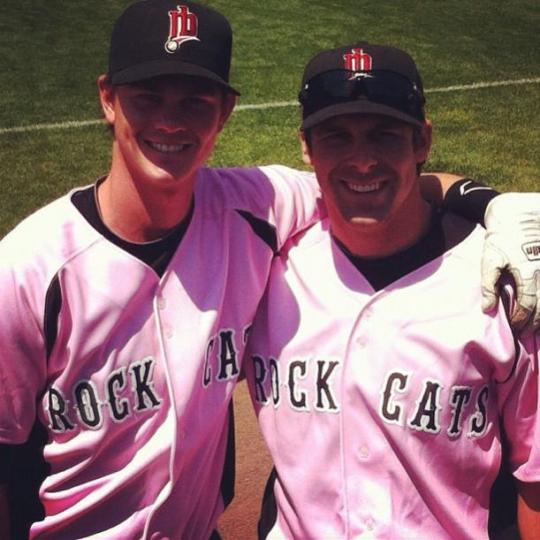
Just a quick Sunday night update... After a 1 for 3 day in Sunday's game, James' BA is .262 and his OBP is up to .361. He's still flashing the leather in the field... the next error he makes will be his first of the season! And tonight, James shared this little Mothers Day gift with his Twitter followers... a picture of he and team mate Nathan Hanson in their pink "cancer awareness" New Britain Rock Cat Mothers Day jerseys. (Hope you don't mind that I lifted your picture, James!)
-
The Wings beat writer for the Rochester newspaper is Jim Mandelaro and he's done a decent job of covering the rather unique situation with the Yankees affiliate playing a lot of games in Frontier Field. For example, Andy Pettitte is scheduled to pitch tomorrow and the Wings made some scheduling adjustments to accommodate this unique opportunity for Rochester's baseball fans to see it. Good move, too, because they sold out the stadium for the game in a very short amount of time once it was announced. You should check out Jim's blog at http://blogs.democratandchronicle.com/extrabases/
-
Article: Twins Live Chat Saturday at Noon
Jim Crikket replied to Seth Stohs's topic in Twins Daily Front Page News
YEp... working now -
Article: Twins Live Chat Saturday at Noon
Jim Crikket replied to Seth Stohs's topic in Twins Daily Front Page News
First one got me to where you posted you'd start answering questions momentarily, but I don't see a place to type questions and send them in. Second link just got the same error message the links in the post did. -
Article: Twins Live Chat Saturday at Noon
Jim Crikket replied to Seth Stohs's topic in Twins Daily Front Page News
Clicking the link, I get a brief "you are not logged in to Coveritlive" message and then brought back to this page. Maybe that will change when the chat starts? -
I agree. The other thing you have to keep in mind is that the incident started when the Kernel catcher made a comment to Sano as he crossed home plate. If you've listened to the mlb.com interview Seth imbedded in this thread at the beginning, it's pretty clear that the guy has very, very limited command of the English language. I doubt Sano even understood what Baker said to him, but I'm sure the tone of voice wasn't exactly congratulatory. So maybe Sano just reacts to an opposing player getting snippy with him. Anyway... minor league baseball is about teaching lessons and I'm sure if there was a lesson to be taught in this, the Snapper coaches will do so.
-
Snappers Series Finale Ends With a Bang
Jim Crikket commented on Jim Crikket's blog entry in Knuckleballs - JC
This article was originally posted at Knuckleballsblog.com. After a rather ugly game Wednesday night and Thursday’s suspended game, the Snappers and Kernels put on a good show on Friday in Cedar Rapids. In the completion of Thursday’s suspended game, the Snappers got a home run from newcomer Drew Leachman and Miguel Sano hit his 7th home run of the season immediately after an AJ Petterson double in the 8th inning, but it wasn’t enough for the win. The Kernels topped Beloit 9-6. http://knuckleballsblog.com/blog/wp-content/uploads/2012/05/SanoHR2012-801x1024.jpgMiguel Sano's home run stroke in the first of two dingers on the night (Photo: Jim Crikket) The nightcap was a different story, with the Snappers breaking a 3-3 tie in the top of the 9th inning when Sano followed a JD Williams walk with his 8th home run of the year. The Kernels thought Sano spent a bit too long admiring the blast and getting around the bases and their catcher, Abel Baker, let Sano know about it as he crossed home plate. The two exchanged words and that led to both benches emptying. The 5-3 lead held up and the Snappers left town having won two of three games from the Kernels. There were plenty of good performances among the Snappers in the series finale as starting pitcher Steven Gruver retired the first six hitters he faced and threw five decent innings. Michael Tonkin gave up a run in his 1 1/3 innings of work, but struck out four Kernels, and Clint Dempster finished up with 2 2/3 strong shutout innings, without giving up a hit, to notch the Win. On the offensive side, Sano, Eddie Rosario, Wang-Wei Lin and Matthew Koch all had two hits and JD Williams & Tyler Grimes added doubles. But the story of this series was Sano. In the three games in Cedar Rapids, he was 7 for 13 plus one walk. He had two doubles to go with his two home runs. He scored five runs and drove in seven RBI. He did strike out once on Friday, stranding runners at 2nd and 3rd base, so I guess he’s human. Still, in a post-game interview with the Cedar Rapids Gazette, Kernels manager Jamie Burke called Sano, “unbelievable” and, “the best player I’ve seen here – by far.” Personally, I still believe Mike Trout is the best player I’ve ever seen in the Midwest League, because he literally showed no weaknesses in his game during his time with the Kernels. But Sano’s performance this week was the most impressive offensive series I’ve witnessed. I know the Twins organization is reluctant to push their position players up the ladder quickly. Selfishly, I hope he’s still with Beloit in mid June when the Snappers return to Cedar Rapids again. But as a Twins fan, I can’t imagine what more he needs to demonstrate in the Midwest League that he can’t just as easily work on in Fort Myers. There’s absolutely no doubt that Sano has work to do with the glove before he’s ready for prime time, but does it really make that much difference whether he works on his defense in Beloit or Fort Myers? I’m convinced he’s more than ready to face better pitching. Kernels pitchers were feeding him almost nothing but breaking balls and other off-speed pitches. When they did throw a fastball, it wasn’t often anywhere near the strike zone. ************* I leave you with the following picture. As is the case at many ballparks, the Kernels give some lucky kids the opportunity to stand next to Kernels players on the field during the National Anthem and they give the kids t-shirts to wear. Very large t-shirts. I call this picture “Angels in the Infield.” http://knuckleballsblog.com/blog/wp-content/uploads/2012/05/AngelsInTheInfield-1024x758.jpgAngels In The Infield (Photo: Jim Crikket) -
This article was originally posted at Knuckleballsblog.com. After a rather ugly game Wednesday night and Thursday’s suspended game, the Snappers and Kernels put on a good show on Friday in Cedar Rapids. In the completion of Thursday’s suspended game, the Snappers got a home run from newcomer Drew Leachman and Miguel Sano hit his 7th home run of the season immediately after an AJ Petterson double in the 8th inning, but it wasn’t enough for the win. The Kernels topped Beloit 9-6. http://knuckleballsblog.com/blog/wp-content/uploads/2012/05/SanoHR2012-801x1024.jpgMiguel Sano's home run stroke in the first of two dingers on the night (Photo: Jim Crikket) The nightcap was a different story, with the Snappers breaking a 3-3 tie in the top of the 9th inning when Sano followed a JD Williams walk with his 8th home run of the year. The Kernels thought Sano spent a bit too long admiring the blast and getting around the bases and their catcher, Abel Baker, let Sano know about it as he crossed home plate. The two exchanged words and that led to both benches emptying. The 5-3 lead held up and the Snappers left town having won two of three games from the Kernels. There were plenty of good performances among the Snappers in the series finale as starting pitcher Steven Gruver retired the first six hitters he faced and threw five decent innings. Michael Tonkin gave up a run in his 1 1/3 innings of work, but struck out four Kernels, and Clint Dempster finished up with 2 2/3 strong shutout innings, without giving up a hit, to notch the Win. On the offensive side, Sano, Eddie Rosario, Wang-Wei Lin and Matthew Koch all had two hits and JD Williams & Tyler Grimes added doubles. But the story of this series was Sano. In the three games in Cedar Rapids, he was 7 for 13 plus one walk. He had two doubles to go with his two home runs. He scored five runs and drove in seven RBI. He did strike out once on Friday, stranding runners at 2nd and 3rd base, so I guess he’s human. Still, in a post-game interview with the Cedar Rapids Gazette, Kernels manager Jamie Burke called Sano, “unbelievable” and, “the best player I’ve seen here – by far.” Personally, I still believe Mike Trout is the best player I’ve ever seen in the Midwest League, because he literally showed no weaknesses in his game during his time with the Kernels. But Sano’s performance this week was the most impressive offensive series I’ve witnessed. I know the Twins organization is reluctant to push their position players up the ladder quickly. Selfishly, I hope he’s still with Beloit in mid June when the Snappers return to Cedar Rapids again. But as a Twins fan, I can’t imagine what more he needs to demonstrate in the Midwest League that he can’t just as easily work on in Fort Myers. There’s absolutely no doubt that Sano has work to do with the glove before he’s ready for prime time, but does it really make that much difference whether he works on his defense in Beloit or Fort Myers? I’m convinced he’s more than ready to face better pitching. Kernels pitchers were feeding him almost nothing but breaking balls and other off-speed pitches. When they did throw a fastball, it wasn’t often anywhere near the strike zone. ************* I leave you with the following picture. As is the case at many ballparks, the Kernels give some lucky kids the opportunity to stand next to Kernels players on the field during the National Anthem and they give the kids t-shirts to wear. Very large t-shirts. I call this picture “Angels in the Infield.” http://knuckleballsblog.com/blog/wp-content/uploads/2012/05/AngelsInTheInfield-1024x758.jpgAngels In The Infield (Photo: Jim Crikket)
