



H2H Debater B
-
Posts
6 -
Joined
-
Last visited
Content Type
Profiles
Minnesota Twins News, Rumors & Analysis
Minnesota Twins Videos
2026 Minnesota Twins Top Prospect Rankings
2022 Minnesota Twins Draft Picks & Signing Bonuses
Minnesota Twins Trade & Free Agent Rumors
Minnesota Twins Fan Guides & Resources
2023 Minnesota Twins Draft Picks & Signing Bonuses
The Minnesota Twins Players Project
2024 Minnesota Twins Draft Picks & Signing Bonuses
2025 Minnesota Twins Draft Picks & Signing Bonuses
2026 Minnesota Twins Draft Picks & Signing Bonuses
Forums
Blogs
Events
Store
Downloads
Gallery
Everything posted by H2H Debater B
-
CLOSING STATEMENT: After several tries as a starting pitcher, Jorge López went to the bullpen full time in late August of 2021. The results since that time have been promising, including an outstanding run as the Orioles' closer until the trading deadline in 2022. That he was given an opportunity to be a starter by three teams, a testament to his arm and stuff. Like many others, he has thrived as a full-time bullpen arm. He has adjusted to the routine of being a relief pitcher. He did struggle after being traded to the Twins, but finished his season with five scoreless outings. The underlying metrics for the season show why he broke through--weak contact, ground balls and keeping the ball in the park, while striking out his share. There is no reason, at age 30, why López can't continue to be an effective arm for the Twins in the coming year and 2024. He truly can be part of the solution for the 2023 bullpen, not part of the problem.
-
ROUND 2 REBUTTAL: I am in agreement that small sample sizes make it tough to project future performance. I would submit that the full season's results are a more accurate reflection than of the season than seven weeks with the Twins. López' full season numbers are very good, not otherworldly and I would think that would be the upside projection for him in 2023. Bullpen arms fluctuate from year to year. That is why counting on things other than ERA is the better way to go in order to project even so far as next year. As I noted in my first rebuttal, MLB and Twins' history is full of pitchers whose career changed positively when switched to the bullpen. It isn't automatic that pitchers succeed when sent to the 'pen. They have to be able to throw two days out of three, be able to warm quickly and adjust to working one inning at maximum effort. I think López very much fits the profile of the successes--Joe Nathan, Rick Aguilera, Glen Perkins--and he has stayed healthy since moving into a bullpen role. López hits the upper 90s with his fastball, and for the entire season in 2022 allowed only four homers. His ground ball percentage of 58% was elite and a repeat of those numbers should limit big innings and runs. I don't expect him to be handed a closer role, but he should be expected to work in high leverage innings in an improved revamped bullpen for 2023.
-
ROUND 1 REBUTTAL: Citing examples of people who haven't lived up to scouting reports or projections could take pages and pages. However, in the names you listed in your opening statement as successes are examples of what I see in López and also why he figures to have success beyond 2022. López was an unsuccessful starter, but so too were future Twins closers Eddie Guardado, Rick Aguilera, Glen Perkins, and Joe Nathan. López was given a bullpen role late in 2021 and experienced success and he continued his success with Baltimore until the trade deadline. All of these guys assumed key bullpen roles in their late 20s and had multiple successful seasons in the Twins' bullpen. Many, if not most, current MLB closers and elite setup men find their niche in the bullpen after struggling to one degree or another as a starter. We are dealing with really small sample sizes here. In fact, deleting one appearance from September from López' stats, would give him an ERA below 3 with the Twins, and improve all the other supporting stats. As is, López continued to limit home runs, line drives and fly balls better than league average and keep an elite ground ball percentage. Free passes and strikeouts were the areas where he struggled with the Twins after doing well as Baltimore's closer. It would figure that walks and strikeouts were interrelated and that he can limit the free passes and get more chases out of the zone if he's ahead of the count. I fully expect López will be a key and positive element of the 2023 Twins' bullpen.
-
OPENING STATEMENT: Jorge López had a career breakthrough in 2022. He was properly named an All Star after putting together an otherworldly first half of the season as the Orioles' closer. His numbers were excellent--.925 WHIP, 1.62 ERA, over 10 K per 9, with 17 saves. Post All-Star the numbers regressed to the mean with the final numbers coming in far above league average. His ERA was 2.54, WHIP 1.183, 9.1 K per 9 innings and 23 saves. López will turn 30 in the off season. I don't believe he will be able to put together another season like his half season with the Birds this year, but I think his overall results this year can be approximated in the coming two years that he is under team control. López has always been regarded as having a live arm and good stuff. Witnessing him as a Twin for 23 appearances, I'll vouch for that. He throws a mid- to upper-90s fastball and a sharp slider. He has always induced a high number of ground balls and this year, he was able to record a good number of strikeouts. So what happened after the Twins acquired him? I'm going with regression to the mean. Every relief pitcher gets hit around occasionally and the law of averages caught up with him in the second half of the season. Hard hit balls at someone in the first half of the year found their way for hits, close umpire calls didn't go his way as often and he put on more guys with free passes. Also, there were rumors that Jorge may have been distracted by family issues (sick child?) which could have adversely affected his performance. I think López comes back in 2023 with a good season because his arm is good and he throws good pitches. He'll be more comfortable with his new team and has an overall good season in 2022 to build off.
-
Having a strong pitching staff is a requirement to winning the World Series, as I have shown with how heavily allowing runs is correlated to making the playoffs. Teams with middling pitching simply do not make the playoffs, while teams with middling hitting have a better chance of making a run if their pitching allows. While scoring runs has correlated more to winning specifically the World Series, that is but a single series compared to the aggregate of an entire season. Hitters who had sub-optimal years like Jorge Soler and Eddie Rosario can get hot at the right time and carry a team to the promised land, but that opportunity wouldn’t have been there if Atlanta’s pitching were outside of the 60th percentile. Next, I would like to re-emphasize the importance of building a pitching staff through the minor leagues. Having a pipeline of cheap and capable pitchers allows for spending flexibility throughout the offseason and offers a buffer for the inevitable wave of injuries. Failing to build an abundant farm system and ignoring trades for pitchers will force teams to overpay for past-their-prime pitchers on the open market, who fail more often than not. So, while I would prefer to sign position players to free agent deals, I do not believe that conflicts with my position on the superiority of pitching. In the end, winning it all requires a lot of luck alongside good hitting and good pitching. I am not a big proponent of “just get to the playoffs and see what happens”, but recently we have seen a couple teams sneak in and win titles out of nowhere. Having a strong rotation and bullpen is key to surviving the regular season and putting your team is position to be in the big dance.
-
I would like to comply and present a case for pitching being the deciding factor in the World Series, I'll be honest - I had a hard time coming up with a compelling case. I did some more research, but I found the raw numbers do bear out that hitting is more important once you get to the World Series. I have to reiterate my earlier point - it is nearly assured that both teams in the Championship have very good pitching staffs, and the team that hits better usually acts as the tiebraker. I would prefer to continue my line of reasoning by returning to a different point of debate. Earlier you had discussed free agent strategy. To contrast that, I'd like to bring up prospect development. I believe that there is nothing in baseball more important than developing pitching prospects. Having a core of young and affordable pitchers can give a team a massive advantage over the competition. Having a cost effective pitching staff gives a front office the flexibility to spend their money to patch up holes. And yes, while I agree with you wanting to sign the hitter over the pitcher, it's dependent on the construction of the pitching staff. With the inability to develop pitching prospects/trade for arms/make prudent waiver claims, this roster can't afford to dump $25M into a guy like Corey Seager or Carlos Correa because we also need to pay for several starters. Sure, landing Seager might turn this lineup into one that could win a World Series, but how are you going to get there with a pitching staff that is going be below the 50th percentile? Meanwhile, a team like Milwaukee that's developed guys like Woodruff, Burnes, Peralta, Houser, and Lauer can have the flexibility to improve the lineup (of course their payroll was only $99M last year, you'd think they should have more to spend than that pathetic amount).
-
I have never been the biggest proponent of WAR, and I did consider basing my graph according to it. I would then have to choose a source (I usually refer to Baseball Reference's or Fangraphs'), but also deal with the shortcomings of the stat, like the way fielding is graded and adjustments based on positional differences. For comparison of hitters to hitters I would consider WAR, but when it comes to the collective of all hitters vs all pitchers, I do not see the results of the study to be as significant. While your point about a bad offense being worse than bad pitching is correct, I think I perhaps should have emphasized the difference better. My point was that if you could choose to have a stronger lineup or a stronger pitching staff without reducing the quality of the opposite side. So if you have the option between the 50th/60th percentile hitting/pitching compared to a 60/50th split, then the numbers say that putting effort towards pitching will be better. To better prove this statement, I'd like to go back to my data and confirm my hypothesis about "surviving the 162 game season". While the goal should never be just to make the playoffs, there is no merit in building a team designed to win a championship, but can't even make the playoffs. Going by what I said earlier with the 60th percentile, here is how teams did in 2017-2021: 53/56 (94.6%) teams that had pitching in the 60th percentile or better made the playoffs 40/56 (71.4%) teams that had hitting in the 60th percentile or better made the playoffs Note that the 3 teams that made the playoffs with sub 60th pitching were the 2017 Twins and 2020 Marlins and Blue Jays - none of whom were teams that had any real chance to do damage in the playoffs, partly due to 2020's expanded playoffs. I can't refute the point about risk factor, as I think it is plainly obvious that hitters' performance are more consistent over their careers than pitchers are on the whole. However, that is not the object of debate here, or at least for how I understood the topic. Just because it is more difficult to find good pitching should not mean teams are better off avoiding it entirely.
-
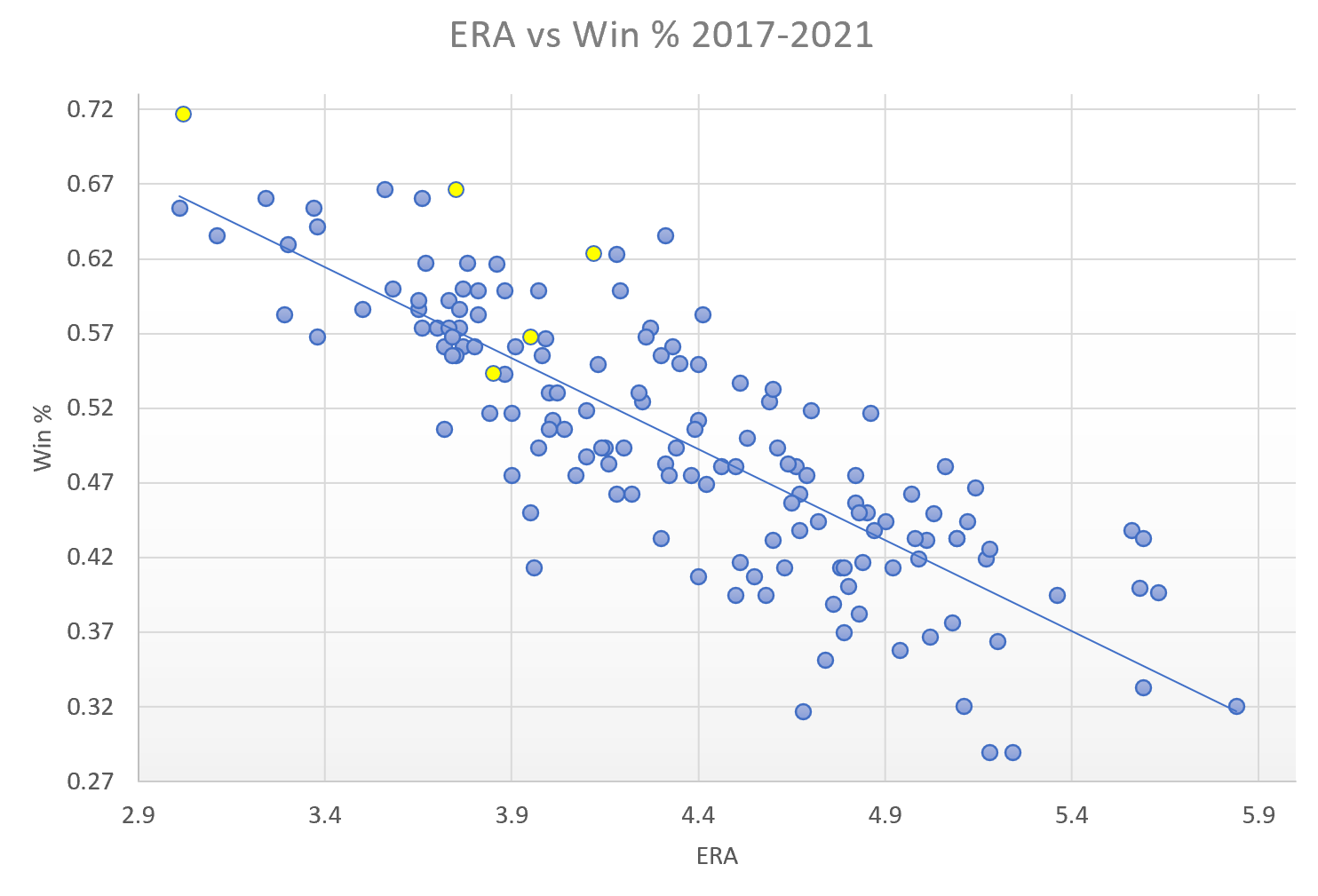
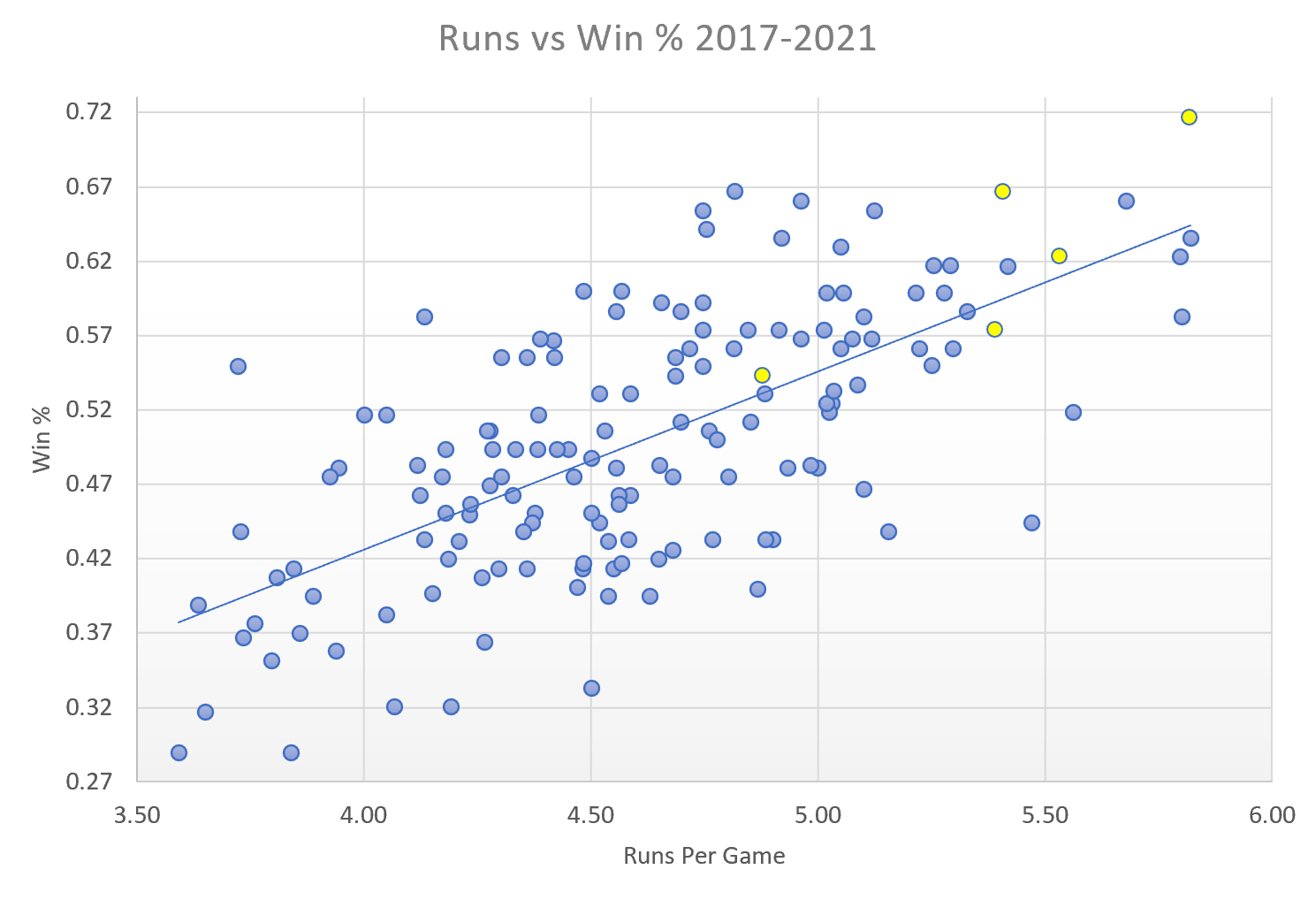
To begin my argument, I'd like to make it clear that I find building a lineup and building a pitching staff to be very close in importance. After doing some research, I believe that there is sufficient data to suggest that the pitching side is more important. I did an analysis on the impact of runs allowed and runs scored against win record for 2017 through 2021 and here is what I found: As you would expect, scoring runs and preventing runs both correlate to winning baseball games. However, a closer examination of the slopes of each trendline reveals the advantage: the ERA trendline has a slope of -.122 compared to the Runs trendline of .119. In layman’s terms: With the 20th percentile ERA of 4.86, expect to win 43.7% of your games With the 80th percentile ERA of 3.77, expect to win 56.95% of your games Conversely: With the 20th percentile runs per game of 3.77, expect to win 39.6% of your games With the 80th percentile runs per game of 4.86, expect to win 52.6% of your games It has been my belief that surviving a 162 game season is easier with a stronger pitching staff compared to a stronger hitting core, and the numbers over the past 5 years seem to indicate that. With pitchers usually facing more durability issues, teams with less depth in the rotation and bullpen cannot withstand a wave of injuries and thus become more susceptible to losing more games due to poor pitching. We also saw rising spin rates and allegations of illegal substances have pitchers dominating hitters for large stretches of 2021 – benefitting teams that were squeezing every individual RPM from their pitchers, like the Dodgers and Astros – while teams like the Twins suffered from a lack of it. I will note that I highlighted World Series winners in yellow on my graphs. Elite run production topped run prevention in that very small sample size. Based on the question posed to me I have focused on building the team to survive the regular season and get to the big dance – having a team ERA of under 3.90 nearly guarantees this. Conversely if you are only looking at playoff success, then the better hitting team is more likely to win, but let’s not forget that both of those teams likely had similarly good/great pitching staffs. So while the goal is to win a Championship, you simply can’t get there without good pitching.
-
The theme of my argument has been consistent throughout this debate: Joe Mauer, as a catcher, not only shined in comparison to other catchers of his era, he literally did things no other catcher has done in the 145 year history of Major League Baseball. He won three batting titles, which is over 40% of all batting titles won by catchers in the 145 year history of the sport. He won an MVP award, a recognition only three catchers have achieved in the past half-century of baseball. Those three catchers are Johnny Bench, Joe Mauer, and Buster Posey. That’s quite a pair of bookend names around Joe Mauer. By comparison, Kirby Puckett never performed at a historic level at his position. He didn’t even compare favorably to other centerfielders over the two decades spanning his career. While only three catchers have won MVPs in the past half-century, Mike Trout alone has won three MVPs as a centerfielder. While Mauer appeared in the top 100 catcher seasons six times - including the best catcher season overall - in the two decades he played, Ken Griffey, Jr appeared three times before Puckett appeared even once on the centerfielder list. Once we start exploring the performances of Mauer and Puckett relative to their positions, the more extraordinary the career of Joe Mauer becomes as he consistently rises to the cream of the crop of not only catchers of his era, but also the all-time list of catching greats. Using the JAWS ranking system that evaluates player performance over their peak seven seasons, Joe Mauer is considered the eighth greatest catcher of all time. Which brings me back to this statement: Mauer could be placed into any era and be not only a good, but elite player. He had all the tools to be great and was extraordinary, historic in a few of those traits. I pointed out to my opponent that Puckett not only doesn’t rank favorably when put into the context of his own position, Kirby Puckett wasn’t even that good of a player outside the Metrodome (again, a +.148 OPS home/road gap). My opponent chose not to respond, which tells me they had no rebuttal to Puckett’s pedestrian performance outside his home stadium over a dozen year career and the 20+ stadiums in which he played. That sample size is large enough to show his road performance was not a fluke. In conclusion, if you’re going to compare and evaluate two players, choosing the best, do you select: The player that ranks as high as eighth on the all-time list of players at his position, a player who did things no other player at his position has done in 145 years, a player who has won awards that only all-time greats at his position have won in the past 50 years? Or do you choose the player who wasn’t even that good of a player outside the stadium he was lucky enough to be drafted into, much less be included on lists of all-time feats accomplished by the greats at his position? The choice seems rather obvious to me.
-
My opponent continues to refuse to acknowledge the difference between baseball positions - primarily catcher - so it’s time to pull out the spreadsheets and point out how comparing seasons and raw numbers between a catcher and centerfielder always leaves the catcher at a disadvantage. For those who subscribe to TL;DR, I’ll pre-summarize the following paragraphs: Playing catcher is extremely difficult and catchers require days off to heal and recuperate. Who knew that squatting for three hours a day and taking foul tips off the face (which ultimately led to literal brain trauma for Mauer) makes baseball a really, really hard game to play well? So let’s look at the numbers. From 2004-2013 (before the concussion and forced move to first base), Joe Mauer played the fourth most games at catcher in all of Major League Baseball. From 1984-1993 (before being so wildly out of shape that he had to move to right field), Kirby Puckett played the second most games at center field in all of Major League Baseball. Wow, what a massive difference. Contextualization is key here and it’s the driving point of almost everything I’ve written. Without attempting to adjust to competition level and their own peers, how can one compare two players as wildly different as Puckett and Mauer? Because my opponent continues to tout seasonal efficiency as the basis of their argument, let’s do just that, except we’ll compare the players not to each other but to the peers of their respective eras. Joe Mauer played in two decades, the 2000s and 2010s. Kirby Puckett played in two decades, the 1980s and 1990s. Let’s take a look at how they compare to their own peers: From 2001-2020, here are the top 10 seasons at catcher in either league: Rk Player WAR/pos Year Age Tm Lg G PA AB R H 2B 3B HR RBI BB IBB SO HBP SH SF GDP SB CS BA OBP SLG OPS Pos 1 Joe Mauer 7.8 2009 26 MIN AL 138 606 523 94 191 30 1 28 96 76 14 63 2 0 5 13 4 1 .365 .444 .587 1.031 *2D/H 2 Buster Posey 7.6 2012 25 SFG NL 148 610 530 78 178 39 1 24 103 69 7 96 2 0 9 19 1 1 .336 .408 .549 .957 *23/HD 3 Yadier Molina 7.2 2012 29 STL NL 138 563 505 65 159 28 0 22 76 45 4 55 5 3 5 10 12 3 .315 .373 .501 .874 *2/H3 4 Javy Lopez 6.8 2003 32 ATL NL 129 495 457 89 150 29 3 43 109 33 5 90 4 0 1 10 0 1 .328 .378 .687 1.065 *2H/D 5 Jonathan Lucroy 6.4 2014 28 MIL NL 153 655 585 73 176 53 2 13 69 66 3 71 2 0 2 13 4 4 .301 .373 .465 .837 *23/HD 6 Yadier Molina 6.2 2013 30 STL NL 136 541 505 68 161 44 0 12 80 30 4 55 3 0 3 14 3 2 .319 .359 .477 .836 *2/3H 7 Buster Posey 5.9 2015 28 SFG NL 150 623 557 74 177 28 0 19 95 56 10 52 3 0 7 17 2 0 .318 .379 .470 .849 *23/HD 8 Joe Mauer 5.9 2010 27 MIN AL 137 584 510 88 167 43 1 9 75 65 14 53 3 0 6 19 1 4 .327 .402 .469 .871 *2D/H 9 Jorge Posada 5.9 2003 32 NYY AL 142 588 481 83 135 24 0 30 101 93 6 110 10 0 4 13 2 4 .281 .405 .518 .922 *2/HD 10 Joe Mauer 5.8 2006 23 MIN AL 140 608 521 86 181 36 4 13 84 79 21 54 1 0 7 24 8 3 .347 .429 .507 .936 *2D/H From 1981-2000, here are the top 10 seasons at centerfield in either league: Rk Player WAR/pos Year Age Tm Lg G PA AB R H 2B 3B HR RBI BB IBB SO HBP SH SF GDP SB CS BA OBP SLG OPS Pos 1 Rickey Henderson 9.9 1985 26 NYY AL 143 654 547 146 172 28 5 24 72 99 1 65 3 0 5 8 80 10 .314 .419 .516 .934 *8/7HD 2 Ken Griffey Jr. 9.7 1996 26 SEA AL 140 638 545 125 165 26 2 49 140 78 13 104 7 1 7 7 16 1 .303 .392 .628 1.020 *8/D 3 Ken Griffey Jr. 9.1 1997 27 SEA AL 157 704 608 125 185 34 3 56 147 76 23 121 8 0 12 12 15 4 .304 .382 .646 1.028 *8/D7 4 Lenny Dykstra 8.9 1990 27 PHI NL 149 691 590 106 192 35 3 9 60 89 14 48 7 2 3 5 33 5 .325 .418 .441 .859 *8/H 5 Ken Griffey Jr. 8.8 1993 23 SEA AL 156 691 582 113 180 38 3 45 109 96 25 91 6 0 7 14 17 9 .309 .408 .617 1.025 *8D/3 6 Andruw Jones 8.2 2000 23 ATL NL 161 729 656 122 199 36 6 36 104 59 0 100 9 0 5 12 21 6 .303 .366 .541 .907 *8 7 Willie McGee 8.2 1985 26 STL NL 152 652 612 114 216 26 18 10 82 34 2 86 0 1 5 3 56 16 .353 .384 .503 .887 *8/H7 8 Eric Davis 7.9 1987 25 CIN NL 129 562 474 120 139 23 4 37 100 84 8 134 1 0 3 6 50 6 .293 .399 .593 .991 *8/7H 9 Andre Dawson 7.9 1982 27 MON NL 148 660 608 107 183 37 7 23 83 34 4 96 8 4 6 8 39 10 .301 .343 .498 .841 *8/H 10 Kirby Puckett 7.8 1988 28 MIN AL 158 691 657 109 234 42 5 24 121 23 4 83 2 0 9 17 6 7 .356 .375 .545 .920 *8/H Compared to his peers at catcher, Joe Mauer had the 1st, 8th, 10th, 12th, 15th, 40th, and 67th best seasons in the top 100 seasons during that span. Compared to his peers in centerfield, Kirby Puckett had the 10th, 18th, 55th, and 93rd best seasons compared to his peers. That’s it. Joe Mauer had three top ten seasons compared to catchers of his era. By the time Puckett appears on his list a second time, Mauer has made five appearances. If we want to tout efficiency per season and how effective each player was on a seasonal basis, I think that clearly sums up who the better player was during their career. On the subject of “durability”, there’s no denying that Puckett was something of an iron man. Good for him. But as I’ve shown above, Joe Mauer was no slouch, either, despite Twins fans somehow tricking themselves into believing he had the injury history of Byron Buxton. He played the fourth most games in baseball at his position before a concussion flipped his career on its head. The difference between Mauer and Puckett is that Puckett’s career-ending injury/condition was obvious and Mauer’s was not. Baseball was only beginning to learn about the long-term significance of CTE, which is literally brain trauma and should be viewed as such. Joe Mauer stopped being a catcher at age 30 (he was so young!) not because of some failure of willpower or toughness but because his brain was literally damaged from playing the hardest position in baseball. And if someone wants to hold a brain injury against a guy as a claim that he wasn’t “durable”, well… *shrugs* It’s not a good look.
-
I’m glad my opponent agrees that Mauer was more valuable in his career but they forgot to mention the most important aspect of performance and it’s not total seasons played. Joe Mauer ended his career with 7,960 plate appearances while Puckett ended his career with 7,831 plate appearances. The two players are less than 150 plate appearances apart in the number of opportunities to affect a game positively or negatively, yet Joe Mauer was worth 7.6 wins more than Puckett. Is 7.6 wins a lot? Well, to Kirby it was, as it’s more wins than he produced in a single season. Mauer, on the other hand, easily cleared that number in his 2009 MVP season (there’s another feat Mauer accomplished that Puckett did not). Mauer performed at a higher level on a per-inning basis and he was worth more overall to his team than Puckett, and it’s not particularly close. By the very definition of the word, doesn’t that mean Joe was the better baseball player? They receive a bad rap because they’re a terrible stat to evaluate individual performance, and that’s what we’re talking about here. But if we want to go that route, I’ll play. Runs and RBI are team contextual numbers. If we look at just the raw performance numbers over their careers: Runners in Scoring Position Mauer: .937 OPS in 2,107 opportunities Puckett: .879 OPS in 2,146 opportunities Men on Base Mauer: .888 OPS in 3,548 opportunities Puckett: .874 OPS in 3,567 opportunities One aspect few ever mention is how “clutch” Joe was in two out situations. Look at this: Runners in Scoring Position, Two Outs Mauer: .943 OPS in 849 opportunities Puckett: .854 OPS in 814 opportunities Again, we see Mauer was better than Puckett across the board in run-scoring opportunities on a per-plate appearance basis. This is becoming a theme. There’s no doubt that Puckett’s 1991 postseason helped the Twins win a championship but to quote The Great One, “You miss 100% of the shots you don’t take.” Well, what happens if you aren’t given an opportunity to take your shots? Mauer played in only 10 postseason games, accumulating 44 plate appearances, or basically one long road trip during the baseball season. He posted a disappointing stat line of: .275 batting average, .641 OPS (.666 OPS once adjusted for Phil Cuzzi’s badly-needed corrective surgery) Whereas Kirby Puckett was a postseason beast, right? Well, hold on for a minute and let’s look at this more closely. Through his first ten postseason games, Puckett posted the following stats: 44 plate appearances (same as Mauer so there’s nice symmetry here), .205 batting average, .580 OPS Kirby kept receiving plate appearances, something Joe didn’t, because he had a team that picked him up and put him on their backs in that 1987 ALCS against the Tigers. Brunansky posted a 1.524 OPS, Gagne posted a 1.187 OPS (what?!?!), and Gladden posted a .908 OPS. What would Mauer have done in plate appearance 45+? We’ll never know because Joe, despite being surrounded by good players, never had a teammate pick him up for a few games as he stumbled, as all players do at times. Puckett had the benefit of support that Mauer never received. Kirby was a good - not great - player who benefited from his era, team, and the Metrodome. This one is going to chafe a few readers and I’m sorry, but it’s true, so I’ll just tear the Band-Aid off. Without benefiting from playing 50% of his career games using a tennis ball in a concrete cave, Kirby Puckett would be a rather forgettable player to baseball fans at-large. He’d be fondly remembered by Twins fans as a pretty good player in the vein of Gary Gaetti but he would not be Kirby Puckett, Hall of Fame player. Puckett’s home/road splits weren’t just noticeable, they were Coors-esque in their size. Kirby Puckett had an OPS of .909 in the Metrodome and .761 on the road. That’s a +.148 OPS gap. Without the Metrodome and its very specific atmosphere (particularly the turf) inflating Puckett’s batting average and slugging, we’d view him very differently today. He wouldn’t be in Cooperstown, that’s almost certain. As a comparison point, teammate Gary Gaetti had a .744 OPS in a Twins uniform. Gaetti was also an outstanding defender, just like Puckett, so Kirby’s defense wouldn’t have propelled him far above Gaetti in overall value. No one builds statues of Gary Gaetti. Mauer, on the other hand, performed pretty much the same no matter where he went. By the time Joe donned a Twins uniform, the Superball silliness of the turf in the Metrodome had been replaced by softer, slower turf that played more like a grass field. Later, Mauer transitioned to Target Field, which was not a stadium built to put Mauer’s game on full display, yet he still performed well above league average (also note that Mauer, due to concussion symptoms, had already begun a premature decline for most of his Target Field career, which we’ll talk about later). Metrodome: .882 OPS Target Field, .786 OPS Road: .832 OPS The point I’m making here is that you can drop Joe Mauer into literally any era of baseball and his hit tool and defense at catcher make him an elite player. But if you remove Kirby Puckett from the very specific era and stadium in which he played, no one asks the question “who’s the better player, Mauer or Puckett?” because the answer is obvious to everyone. The answer is Joe Mauer.
-
Joe Mauer is perhaps the most unappreciated athlete whose career I witnessed from opening to close. Once he passed through the honeymoon phase of Minnesota fandom, I saw increasing hostility toward a man who is one of the top five greatest athletes to spend his entire career in a Minnesota uniform. Baseball, the oldest American sport, is full of historic feats and Joe Mauer did things no other catcher in the history of the sport has accomplished. Let’s talk about one of those things… If your name ain’t Joe Mauer and you played catcher in the American League of Major League Baseball, the number of batting titles you have won in the 121 year history of the league is… zero. If your name ain’t Joe Mauer and you played catcher in any league of Major League Baseball, the number of batting titles you have won in the 145 year history of the sport is… four. According to Baseball Reference, a total of 2,734 people have squatted behind the dish for a Major League Baseball team in the 145 year history of baseball. By my math, that brings the tally to: The other 2,730 catchers to play in an MLB game: four batting titles Joe Mauer: three batting titles But it’s not as if Mauer was just Mike Piazza, a designated hitter masquerading as catcher. Because Joe was such a natural athlete that defensively, he just randomly pulled off stuff like this: Before the tragic concussion that altered his career, Mauer had the following triple slash line: .323/.405/.468 The man had an on-base percentage that rivaled the most aggravating walk machine I’ve seen in my life (Frank Thomas at .419) and slugged squarely between fellow Minnesotans Kent Hrbek (.481) and Paul Molitor (.448). Everyone I mentioned in that sentence either played first base or designated hitter for most of their career. Joe Mauer was a catcher. He was a complete player in every way; he batted for high average, had the discipline to walk and reached base in nearly 40% of his plate appearances, and played the most difficult position in baseball and did it very well, winning three Gold Gloves. Oh, and he also did this. Say hello to Joe Mauer, the best baseball player you’ve seen in a Minnesota jersey in the past 40 years and perhaps ever.
-
The overriding consideration is how can we best compensate minor league players fairly. There is already a vehicle with which this can be done, the MLBPA union. What they would lose in leverage, they would gain in membership. To offset both cost and influence of minor leaguers, the union could adopt lesser shares for minor leaguers (...A ball 1/8th share/vote/dues; AA 1/4th; AAA; 1/8th). Those already on the 40 man may as well be considered major league players; with a new scheme that invites minor league players, that of course, would change. We cannot ignore the below minor wage conditions MiLB players live within; something must be done, and will be done. If MLBPA does not adopt the minor league players into their own union; those players will unionize on their own, adverse to the MLBPA. Control of the entire feeder leagues to the MLB is serious, if unrealized leverage. The MLBPA should get creative and seek to negotiate some settlement that brings the minor league players in. Otherwise, the MLBPA will have two fronts with which to battle.
-
I think the issue is that minor league players aren’t being fairly compensated. There already exists a union in baseball to barter for such, why not negotiate to expand the ranks? Surely, there’s some accommodation that the parties could reach? As I’ve suggested, minor leaguers need not have full voting shares/membership. The union implosion you predict, suddenly followed by a non-guaranteed contracts, doesn’t seem realistic to me. The signing bonuses wouldn’t come into play at all. Those are negotiated before the players sign, as such the players at that point wouldn’t be part of any union. Again, signing bonuses are consideration for signing the contract, not for future work. (Respond to Debater A's most recent post will be in the closing.)
-
The premise of my opponent’s post is that this issue should be decided by what’s best for those who already benefit from a leveraged system, a pragmatic consideration no doubt, though I argue part of the systemic problem. The beneficiaries are the owners and those major league players with the highest earning potential. Practically, any admission into the MLPA union, would take a majority vote, or some formal mechanic. I don’t know, exactly. But what such players decide, most of whom do not make top dollar, and not so far from the minor leagues, can be influenced by the court of opinion, the fans. Perhaps the minor leaguers would be part of the CBA, perhaps not. The MLBPA union could simply negotiate a separate contract for the minor leaguers; so as not to compromise their negotiation in the CBA; in fact, that's probably likely. Though as you suggest below, even still the MLBPA's leverage could conceivably be compromised. Leverage is what you make of it. Certainly adding more members, affecting the MiLB ownership's capacity to make dollars, and affecting more regional entertainment options all provide leverage. As I said above, the minor league players do provide leverage with their own ability to strike and cut off the ability to feed the major league team further. Points 2 and 3 are related so I address both issues just below. Not all minor league players need to join in order for the union to represent their interests. The dues could be renegotiated at a different rates for minor leaguers, perhaps in exchange for a lesser share/vote (majors=full share; minors at A ball 1/8th a share). There are bold solutions, but we must be willing to venture there. Again, minor league baseball need only be represented by small caucus of minor leaguers who comply with union rules, in order for the union to represent their interest. I’m pretty sure MLB pays the salary, but minor league owners own the “team,” the uniforms, logo, location, coaching staff, etc. But the players I believe to do actually work for their parent club. It’d be interesting to see a paystub. According to https://www.advocatesforminorleaguers.com/ : MLB pays the salary: “MLB and its teams decide the minimum amount to pay the players, and the paycheck then comes from the MLB team — not the Minor League team. I think the argument here is that players work for MiLB clubs; I don’t think they do. But MiLB owners do benefit from minor leaguers. To the extent MiLB clubs have been unjustly enriched, MLB will certainly will negotiate or sue for such. I just disagree. I think drafted players are under a severe negotiation disadvantage. The only leverage drafted players really have is to not play for an entire year, and that’s an incredible risk to take on, even for the most talented. The overriding problem is that the minor leaguers will not reach a “free-gent-ish” environment for up to seven years. Seven years is an incredibly long time for someone to wait to negotiate a new contract, especially for someone living in near poverty condition. Well, what do you mean by “baseball”? Again, I think you mean the owners and some elite players. Baseball to me is just more expansive than that, it’s the broadcast crew, the grounds keepers, the vendors, the coaches, the mlb players, the fans, the sports writers, and yeah the minor leagues, because we see and root for those players too. And, the idea that there’s not enough money to pay minor league players more is just baloney. Maybe the minor league needs to contract, and it already has, and if that’s what needs to happen so that those who are enlisted to play can actually have a living wage. So be it. I think baseball will benefit by giving a quality of life for those who play at all levels. And Brian Dozier isn’t worth condemning the whole minor league to serfdom, as good as the hair was.
-
Minor League players deserve membership in the MLBPA and a seat at the negotiating table Hollywood extras. They can actually unionize. That’s right, those people populating streets and grocery stores in favorite shows and films can be unionized. The fodder for horror movies, that don’t make a sound before their gruesome death, union. Yup those guys jogging with Forest Gump across the country, union-eligible. And what is that union? It’s the Screen Actors Guild. Oh, there is the caveat that the extra works for three days on set, and if they had a line, well just one day. Three days. (Source.) So how can minor leaguers be excluded from the MLBPA union, when actors are practically including mannequin in theirs? Indeed, the current scheme that excludes minor league players from the MLBPA Union is akin to a teacher’s union that excludes elementary teachers. Kids never get to high school unless they move up through the primary school ranks. Major League Baseball Player Association Union. The Union of Supervisors, Mangers, and Highly Compensated. The Millionaires who work for Billionaires Union. Union of Space Hotel Workers (Front of House only). Only one of these is a real thing. Well it’s just capitalism at work! Let’s dispense with the notion that the current system is a natural order of things. As if market forces are actually at work in minor league baseball’s employment scheme. Drafted players have already put years into crafting their skill for nearly free-of-charge, save a scholarship if they go to college, by the time they are drafted. Drafted. It’s literally conscripting employees, just taking turns with your competitors. I don’t pass moral judgment on this process, but this system is not a bastion of capitalism. The individual players have no say in where they go, beyond negotiating their signing (the only real choice is the team that drafts them or no team at all). After being drafted, the player does not so much negotiate a contract for payment for time spent playing the game, but rather to sign with the team that drafted them at, near, above, or below the given slot. The signing bonus is paid in consideration/exchange for the player signing with the team. The signing bonus guarantees that you will work for the particular team that drafted you; the signing bonus is not designed to compensate for your future work. (Though your future value to the team is always good leverage for a larger signing bonus). Well it’s the journey they signed up for, right? I mean how long do teams even have control of minor leaguers? Seven years. SEVEN YEARS. See Major League Rule 3b (and here). So what’s the actual pay for the work they do? In 2016, Congress addressed the situation and made MLB raise there pay from $1,100 to $1,160 per month Saving America’s Pastime Act. Sixty bucks, problem solved. (It should be noted, that just this month, MLB, all on their own (not due to the threat of litigation or unionization), is giving them even more, though details are a bit sketch as of yet.) What’s worse, they only get pay checks for the months they actual play (5), and they work for Spring Training for free. (See here and here.) ESPN claims that adds up to anywhere between $8000 and $14000 over those months, hovering right around the poverty line ($12K). Some woke scientists at MIT think it takes 26K to make basic needs. But they haven’t tried sleeping in a chest of drawers to save costs. Because minor leaguers cannot bargain on their own behalf, they need outside forces like Congress, or the 9th circuit ruling, allowing minor leaguers to sue as a class action law suit. What’s the significance of a class action lawsuit? Well, that the harm being caused is not limited to the suing plaintiffs. Put another way, the harm suffered is not anecdotal. or by a few and remote individuals. The 9th circuit ruled that all players in Arizona, California, and Florida were similarly situated to have suffered the same harm and that any of those players could take part of the suit. What was the underlying claim? Minor thing, like being paid below minimum wage for hours actually worked. This isn’t a living argument; baseball isn’t even meeting the federal minimum wage for its minor league players. Or perhaps with looming litigation we can depend on the goodwill of Major League Baseball to do right upon the minor leaguers. Look, they just made teams provide housing, too! No need to bargain here. So cancel the chest of drawers, IKEA! Where there is an actual market for free agent minor leaguers who were not drafted, the Royals scored 6 of the top 50 such free agents, because of the amenities they offered, more than twice any other team. Indeed, teams were inconsistent on what kind of housing and benefits they offered minor leaguers, but because they are conscripted to service, it’s not like the minor leaguers have any meaningful choice outside of retirement or demanding a trade if they don’t like how their owners treat them. (See ESPN). And as far as other benefits, like off-season health insurance, Minor League Baseball doesn’t seem to know, as their FAQ directs you to call some one at their administrative office. (See here). Oh I almost forgot about the $25 whole dollars per diem to fill 3 meals on the road; that’s 8 bucks a meal, that’s like 48 bags of ramen. 9th circuit may not care to address each anecdotal harm visited upon individual minor leaguers, but those people are real, their times are tough, and their story deserves to be heard and are already being told. These are men who have had to work second jobs (something not afforded to visa holders), sleep in their car, or with numerous roommates, hold off having families, having no means of pursuing any entertainment (what he has netflix accout and an xbox??). Sure if we ran an austerity state, the minor leaguers could probably survive some semblance of a life somewhat better than standing in a breadline, but why is that standard? (We have not begun to discuss the opulence of their bosses, the owners, and their more senior peers, the major leaguers). Coming full-circle, we hear similar stories about actors early in their career making due with their depravity of pay, yet even the dudes and ladies in the background can be unionized, and get the benefit of that bargaining power. If SAG can include extras, it is long past time to bring minor leaguers to the bargaining table. If you consider yourself a believer in the market at all, the essence of any exchange of goods or services is a fair deal. Given the non-market structure of the initial acquisition of professional baseball players, only a union can assure that minor leaguers get a fair shake.

